
J.D. and I already have our favorite fresh salsa down to a science, but we only get to enjoy it for a few short months when real tomatoes are in season. In order to see us through the rest of the year, I went searching for a canned salsa recipe that we’d like just as much.
Starting with a high-rated post on RecipeZaar, I’ve adapted this to our taste and the crops we grow (Anaheim and jalapeno peppers as well as the tomatoes), but you can play around with the heat by varying the types of peppers.
In the interest of full disclosure, the original recipe site has a few comments saying that the posted recipe doesn’t have enough acid to be safely canned in a boiling water bath. They suggest increasing the vinegar to a full cup or processing the jars in a pressure canner at 10 pounds pressure for 30 minutes.
On the other hand, there are plenty (200+) readers who say they have used this recipe for years and never had a problem. It’s only my second year with it; last year’s jars showed no problems. It’s up to you, but to be on the safe side, be sure not to decrease the vinegar, salt, or lime juice or alter the ratio of tomatoes to other ingredients. More lime juice or vinegar can be added if you like your salsa a bit more on the sour side. I hope you enjoy it!
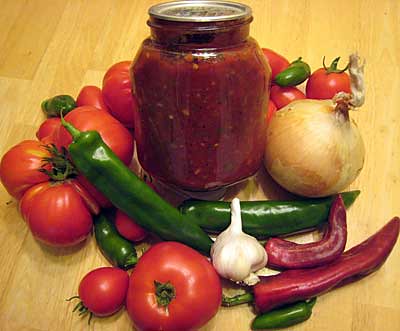
Canned Salsa (Medium-hot)
- 8 cups very ripe tomatoes, cored & chopped (no need to peel or seed)
- 2 1/2 cups yellow onions, chopped
- 1 1/2 cups mild green Anaheim-type peppers, chopped
- 1 cup jalapeno peppers, minced
- 1 canned chipotle chili (optional– or you can add more for super hot salsa)
- 6 cloves garlic
- 2 1/2 teaspoons cumin
- 2 teaspoons black pepper
- 2 Tablespoon canning salt (also called pickling salt — it has no iodine)
- 1/3 cup white vinegar
- 15 ounces tomato sauce (homemade or from the store)
- 12 ounces tomato paste (homemade or from the store)
- juice of 1 lime
- 1/4 cup fresh cilantro, chopped
Chop tomatoes, onions, peppers, garlic and chipotle chilis by hand or in a food processor. Make it as chunky or fine as you like. In a large non-aluminum pot, mix everything together except the lime juice and cilantro.
Bring the mixture to a boil. Continue boiling 10 minutes, stirring occasionally. Remove from heat and stir in lime juice and cilantro.
Fill six pint jars (or your choice of jars) with hot mixture. Wipe rims and add lids and screw-bands. Process in a boiling water bath for 15 minutes. Make sure the boiling water is deep enough to cover the jars by at least one inch, and start timing when the water returns to a boil after adding the jars.
Makes about 3.5 quarts (7 pints). Check the jar seals. If any haven’t sealed, you get to eat that right away! Keeps in the fridge for several weeks once opened.
If you want a very mild salsa, start by omitting the chipotle, cutting the cumin to 1 teaspoon, and removing the seeds from the jalapenos. Once the mixture has cooked for about 5 minutes, give it a taste, and season to desired “hotness” by adding the cumin, jalapeno seeds and chipotles (with or without the adobo sauce in the can). The recipe as listed makes a medium-hot version.
This sounds delicious! We are hoping for a better tomato crop this year, and will keep this handy.
The canned salsa looks so good. I really envy you guys especially when you all are able grow your own veg in the garden and carry out all these cool canning stuff. Wish I could buy a home with a nice garden to grow some of my own veg and fruits too =)
While I’m too lazy to ever can, I did want to give a big thumbs up to RecipeZaar, and recommend that everyone give it a click.
The Vegetarian With 5 Ingredients or Less category, along with the pretty pretty pictures is perfect for a lazy bachelor such as myself.
Thank-you for this. My tomato plants are going crazy and I haven’t been able to keep up.
Kris,
JD sent me this recipe last weekend. I finally got to make it last night. Wow, this was great. I ended up with 7 pints of salsa, plus a little bit to eat on the spot. I had forgotten that I had canned all of my jalapenos so I had to hit the supermarket for some. I used 6 of them and it seemed just right. Same with the anaheims. I just used what I had on the plants outside. I’ll be sharing some with my mom who incidentally did the canning of the jalapenos for me.
Well,you guys are lucky that I live too far. Otherwise, instead of going through all these hassle to follow recipe and make salsa, I would just appear at your door and try some.
A Dawn
http://www.adawnjournal.com
Toronto, Canada.
Another easy fix for anyone worried about acidity would be to add about 1/4 teaspoon of powdered citric acid to each jar before putting the lids on. It might make the salsa just a little more tart, but it would definitely be acidic enough. Personally, though, I’d just can it using the recipe as is.
OMG!!! Tomato Paste and Tomato Sauce? OMG!!!
For authentic salsa (not pico de Gallo)use:
5 lbs Roma Tomatoes
1 Large White Onions
1 or 2 Tbls garlic (you can leave this out if you don’t like garlic.)
The peppers of your choice, I like jalapeno’s or Serrano
1 bunch Cilantro
The qualities are suggested and is what I start with.
Roast the tomatoes over an open fire until the skin is black. You can roast the onions and peppers too, but if you roast the peppers too long, they lose their bite.
Put in all into a blender or food processor and grind it until you get the consistency you want. You can leave out the cilantro and add it later chopped up instead of pureed. Add salt to taste.
You shouldn’t need to add tomato paste or sauce, that’s blasphemous. 😉
This is a pretty cool idea. You can pretty much make your own anything. Canned salsa being one of them. I love canned salsa on nachos but I don’t think I could be bothered making it
Thanks for an easy recipe.
Salsa and its ingredients is also a good way to start a garden, if you have never planted one. The vegetables in salsa are easy to grow and maintain. It is a great headstart for those wanting to start growing more of their own foods.
Great job on the post! Thanks!
If you can’t find canning/pickling salt, you can use Kosher salt instead.
I am looking forward to making this, but I have a question. Are the 8 cups of tomatoes measured after they are chopped? I would assume so, but as a new canner, I want to make sure it’s right.
Also, I looked it up, and you can use kosher salt, but make sure to use double the amount (since it is less dense, you get less salt per scoop). Thanks!
Thanks. I saw this at momliving.com. I’m going to give these away for Christmas presents.
Here’s a simple, TESTED recipe that has NO tomato paste or any pre-canned ingredients. There are several here, but my favorites are the “HOT PEPPER SALSA I and II” recipes on page 13. I made over 100 jars (many 1/2 pints) this year…about half will be Christmas presents.
Here’s the link:
http://learningstore.uwex.edu/pdf/B3570.PDF
LOVE this recipe. Making it for the second time this year – and so looking forward to having salsa stocked on the shelves again! Last year I made two batches – one with the chipotle chile and one with out – they were both great. I cannot decide on a favorite…
Thanks so much for sharing this recipe
OMG this is the best made two batches last month and almost out already planning to make 3-4 batches tomorrow can’t wait its so good thank you for the post!!!