Will canning your food save you money?
When I was a child, we lived on a farm that had a grape arbor loaded with Concord grapes. Each September, my mom would can jars upon jars of grape juice, and I have fond memories of evenings around the kitchen table as our family ate popcorn and drank that delicious stuff (which doesn't taste like anything I've ever purchased from a store).

Well, apparently, nostalgia set in this year, and I ordered 1.5 bushels of Concord grapes. (And if you're wondering how much that is, it felt like a whole vineyard.) The grapes came earlier than I expected, so I texted my husband that morning: “The grapes are here and they're RIPE. We need to can the juice tonight.”
He texted back: “Sounds grape.” Yes, he really did.
So that's how we found ourselves — on our anniversary, no less! — late at night, plucking grape after grape after grape off stems, stuffing jars, wiping up grape juice, and feeling very, very tired.
My thoughts went something like this: This is a stupid way to save money. And then to an even scarier thought, Am I even saving money?
Does Preserving Your Own Food Save You Money?
Besides the grape juice, our family canned and froze lots of other produce, too. Back then, it was a way to save some serious money. But my mother also used to sew a lot of our clothes for the same reason: It was cheaper. However, it is not cheaper to sew my own clothes today, so I wondered if food preservation should fit more into the “hobby” category in my budget. And what a labor-intensive hobby it would be!
Here are my grape numbers:
- 1.5 bushels of grapes – $37
- 56 quart jars – free
- 56 rings/lids – rings were free, lids $10
- Sugar – around $4
- Electricity – I have no idea, although according to this article, it costs between 2.3 and 3.4 cents per quart (or $1.90 for 56 quarts, using 3.4 cents per quart)
- Canner – free
- Jar lifter and canning funnel – free
Using the above numbers, my costs were 94 cents per quart.
First, drinking water would be way cheaper than this. And, the crazy thing is, we usually do drink water, milk, or the occasional iced tea. This grape juice will be used judiciously. But let's say we did buy grape juice regularly. At my grocery store, a quart of grape juice is close to $1, just about the same amount.
Finding Canning Components
As you can see in my equipment list, my favorite word is mentioned a few times: free! I have had no problem finding free canning supplies. In fact, I have turned down offers for canning jars.
Anyway, look in the usual places (Freecycle, Craigslist, etc.), but also ask empty nesters or people who are downsizing. When my mom downsized earlier this year, she had boxes of jars and rings to give away. She also gave me the jar lifter, but didn't have a spare canning funnel. However, I asked my best garage-saling pal if she could keep her eyes open for one — and surprise! — she had two extras. And then there was my (free) pressure canner and (free) water bath canner that were given to me by someone who was getting older and didn't want to mess with canning anymore. So it has been really simple for me to amass the equipment needed for canning.
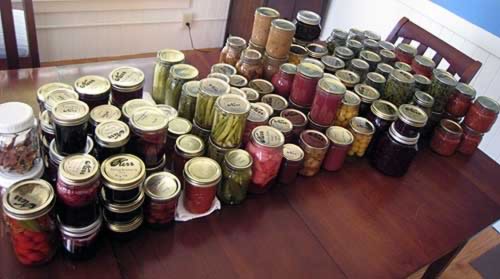
I bought my jar lids in bulk, but they were not reusable. However, there are reusable jar lids that I found for $8.50 a dozen. Based on these costs, I would have to use them over four times to equal the disposable lids. I haven't used them, but maybe they are cheaper somewhere else. I always like the idea of reusing something.
Freezing, the Cold Alternative
With canning, the energy use is on the front end. With freezing food, there may not be any consumption on the front end, but storing frozen food isn't free. Obviously.
I have more experience with freezing produce. This year, I bought 80 pounds of blueberries for $2.29 per pound (not cheap, but so delicious). Most of them made it into our freezer. Getting them ready for the freezer required little more than a quick rinse. Easy. And then there was our bumper apple crop that netted us 100 pints of applesauce for the freezer. That was a little more time-consuming: cook the apples, puree them into sauce, and freeze.
I also got some free plastic freezer containers from someone who prefers to use plastic freezer bags. I actually prefer the freezer bags, too, but I occasionally still use the plastic containers.
There are other pieces of equipment you may need. For instance, my applesauce was pureed with a part that pops onto my big mixer. These extra pieces could be borrowed, or I am sure you could find them by using the strategies above.
Finding Inexpensive Produce
1. Grow your own. If you grow your own produce, freezing and canning make sense, especially if you're trying to prevent wasting a surplus. But there are other avenues to find good produce — for less than you think.
2. Fruit trees and gardens are a lot of work. Perhaps you can barter your pruning skills in exchange for some peaches. I have been given free pears and apples by people who had picked all they needed, but didn't want more to go to waste. My Grandmother's neighbor couldn't pick her grapes, so she was relieved when my Grandmother picked them and used them. The grape jelly didn't hurt, either.
3. U-pick farms and produce stands aren't necessarily inexpensive, but sometimes they have “seconds,” produce that doesn't look as good, even though the taste is just fine. This produce is less expensive than the pretty stuff.
Getting Started With Home Canning
High-acid foods like jams, jellies, pickles, and some salsas are an easy way to start preserving your own food without stressing about botulism; recipes and instructions abound on the internet. My favorite canning blog (yes, they exist) is Food in Jars by Marisa McClellan. Her enthusiasm is infectious, and she's a pro at creating small batches in an evening hour or two. If you've tucked fruit into the freezer this summer for later use, check around for a canning recipe for a mid-winter day's work.
I especially like that glass canning jars are reusable year after year and don't need giftwrap when given away. They are welcome homemade gifts that won't turn into clutter (unless you're my Dad, who has an entire cupboard packed with food I've made for him over the last five years — long story). And I was excited to find a source for BPA-free reusable canning lids through the magic of the internet. I split an order with two friends and used them for the first time (easy!) on a batch of dill pickles the other night. One more step toward self-sufficiency; now if I could just grow and refine my own sugarcane…
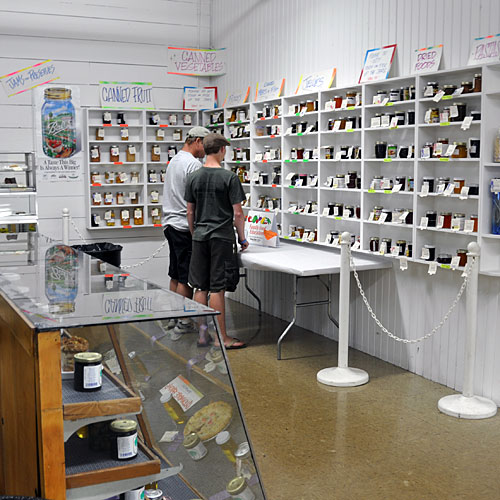
A word of caution: You'll still find recipes that tell you to seal canning jars by turning the jars upside down or by simply packing them with very hot food and closing them immediately. USDA recommendations call for a boiling water bath — usually between 5 and 25 minutes — for safe canning. Without the boiling water bath, your jars may seal, but they won't be sterile and could develop mold. It's worth the effort to do the boiling water bath step.
Apricot Essence Preserves
(Makes 2-3 pints)
- 3 pounds apricots, pitted and chopped (about 24)
- 1/2 cup canned apricot nectar
- 1/2 teaspoon unsalted butter
- 3 cups sugar
- 2 tablespoons fresh or bottled lemon juice
Puree the pitted fruit in a food processor. In a non-aluminum 8-quart pot, combine fruit, nectar, and butter. Bring to a boil over medium heat.
Reduce heat and stir until apricots are softened, about 10 minutes, stirring frequently. Stir in the sugar and lemon juice. Bring to a simmer and stir until the sugar is dissolved.
Reduce to a slow simmer and cook until it is thick enough to mound on a spoon, about 30-40 minutes.Stir frequently. (Remember, it will firm more as it cools—you can put some on a chilled plate to gauge how thick it is.
Ladle into clean pint or half-pint jars, leaving 1/4-inch headspace. Wipe the rims clean with a damp paper towel and add lids and screwbands. Process in a boiling water canner for 10 minutes. When cool, check the seals. If sealed, remove the bands and store in a cool, dark place. If it didn't seal, you can either re-process it or store it in the fridge for up to a month.
While I didn't experience the joy of canning while I was in the middle of it (it's a lot of work!), I do admire my colorful jars lined up on the shelves in my food cellar. Each sip of grape juice takes me back to my childhood, and that tastes pretty sweet.
For more information on canning, check out:
- National Center for Home Food Preservation
- PickYourOwn.org: All about home canning
- U.S. Department of Agriculture: Complete guide to home canning
- BALL Complete Book of Home Preserving
- Blue Ribbon Preserves: Secrets to Award-Winning Jams, Jellies, Marmalades, and More
Is food preservation worth it to you? Has anyone used the reusable canning lids?

Become A Money Boss And Join 15,000 Others
Subscribe to the GRS Insider (FREE) and we’ll give you a copy of the Money Boss Manifesto (also FREE)
