My First Budget: Drafting a Plan for Discretionary Spending
Published on - June 8th, 2009 (by J.D. Roth) I’ve decided to develop a budget.
This probably sounds strange coming from a guy who has been anti-budget all his life. Besides, haven’t I paid off all my debt? Don’t I have a positive cash-flow of over $1,000 per month? Yes, these things are true. But I’ve noticed something troubling: I’ve begun to experience that lifestyle inflation I’m always warning others about.
Lifestyle inflation is the natural tendency to increase our spending as our incomes increase. When we get a raise at work, we’re likely to spend more at home. A little lifestyle inflation is fine. But there’s a real danger of becoming too comfortable with increased spending. Once we become accustomed to a certain lifestyle, it’s difficult to cut back.
Cracks in the foundation
On our flight home from Orlando, Kris and I talked about my spending. It has increased in recent months. Some of this is deliberate. I’ve made a conscious decision to allow myself to spend more money on Wants. I can afford it. The trouble is that I’ve begun to spend indiscriminately again, and I’m afraid that’s a slippery slope. I’ll buy random magazines at the grocery store, or pick up a game for the Wii that I’m only half interested in.
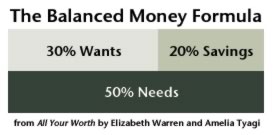
I’m certainly not spending beyond my means, but I’ve begun to make more impulse purchases. I want to correct this now — before it becomes a problem. In the past, I’ve used a spending plan to help me meet my goals, and more recently I’ve been following the broad outlines of Elizabeth Warren’s balanced money formula:

But sometimes broad outlines aren’t enough. In this case, Kris suggested that a budget might help curb my impulsiveness, and I think she’s right. With a budget, I can set specific goals. I can focus on the things I really want instead of just spending on random things that appeal to me in the moment.
So, I’ve decided to create a budget. Not a comprehensive budget — my Income, Needs, and Saving are all fine — but a budget for my Wants. I want to exercise discipline in this area so that I’m spending on things that are actually important to me instead of random stuff, stuff that ultimately turns into clutter.
Blueprint for success
To start, I reviewed my discretionary spending from last year and compared it to the totals from the first four months of 2009. This is where tracking every penny you spend can prove valuable. By comparing my past spending to my present spending, I’m able to detect trends. It’s very clear, for example, that I am again spending too much on dining out. Time to cut back.
Next, I thought about my goals. What is it that I really want to do? Lately, travel appeals to me. Kris and I both would like to take a vacation to Europe in 2010. To make that happen, I need to save. This gives me a medium-term goal to save toward.
Finally, I allocated a specific amount of money toward my monthly Wants. Remember, because I’m self-employed, I have an irregular income that passes through my business account first. If I pull out $2500 per month (after taxes) to act as personal income, that gives me $750 to spend on my passions. That should be plenty.
Building the budget
After collecting the data and setting my goals, I made a first pass at a budget. This is what I’ll use for June and July:
- Books: $50/month
- Comic Books: $50/month
- Entertainment: $50/month
- Clothing: $50/month
- Charity: $50/month
- Dining Out: $200/month
- Vacation 2010: $200/month (plus small windfalls)
- Miscellaneous: $100/month
Obviously, you might make different choices. I know that many GRS readers are avid contributors to charity, for example, and I suspect few of you budget for comic books! These are the allocations that seem to make sense for me and my situation. I’m sure that I’ll make changes to this budget as I work with it in the real world.
Actually, I have a lot of questions about how a budget should work in the real world. Because I’m a budgeting novice, I could use some help. I’m hoping that you experienced budgeters can answer some of my questions:
- How often do you re-evaluate your budget? Do you make monthly adjustments? Quarterly? Yearly?
- If you go over budget for a month, what do you do? Do you make immediate adjustments? Or do you simply try to correct things the following month?
- What if I go under budget in a category? Does that mean I get to carry that money into the next month? Can I use it for a different Want category? (Perhaps sweep anything extra into the Vacation fund?) Or does does that money go to Saving instead? Or should I donate it to charity?
- How do you track your spending against the budget? If I used the envelope system, I’d allocate the actual cash to each account before-hand. But what if I don’t want to have that much cash around the house? Is there a good way to keep track of current spending in each category? Should I carry a notecard with my monthly spending on it? (That seems to be what Bargain Babe recommends.)
- Do you try to further reduce spending on these categories? For example, should I try to drop my budget for Dining Out even more?
This is a strange new world for me. Over the past year, I’ve been pursuing more and more advanced personal finance subjects and concepts. Yet here I am, in better financial shape than ever, about to implement a basic skill I’ve never mastered before. That’s okay. I believe it’s important to continue focusing on the fundamentals even as we tackle more advanced topics.
This article is about Budgeting
SEARCH FOR RECENT ARTICLES


I use Quicken to track our budget (I’m using it anyway for tracking investments, so I’d rather just use one piece of software).
We put together a budget yearly. Some categories have monthly targets (like eating out, groceries) and some have annual targets (like vacations, house maintenance). About halfway through the year we do a mid-year review and see how we’re doing so far (and move money between categories as needed). On a monthly basis, I only track the categories where we would tend to overspend (like entertainment, which includes eating out, and groceries). Anything left over at the end of the year is usually carried forward to the next year (although this year I’m considering putting it towards the mortgage).
In general, I’ve found it more useful to have fewer categories. In your case, I might combine “books” and “comic books” and maybe even “entertainment” into a single category. For categories that tend to be sporadic throughout the year, like “clothing”, I might track it annually instead of monthly. Anything extra can be carried forward or directed to another category for the month.
I’d agree with other commenters that putting more towards vacation is a good idea. Europe isn’t cheap, and once you’re there it’s better to have extra money (that you don’t spend and can apply towards a future vacation) than to have to skip seeing something you really want because you’re out of funds…
loading....
Budgeting is exactly the way to plan. I have use Quicken for years. But with the age of my computer it is now obsolete and I must replace it here shortly. Along with the replacement will be the upgrading of programs. I discovered Quicken now has a free version on line I plan on looking into this instead of replacing my old version. If I had an I-phone, I-pod or other way of accessing the internet outside of my home I could keep a closer look at my spend on the go.
They even have
Free iPhone App Available!
Money Management Tips
20 Small Ways to Save Big
Budgeting for Your Peace of Mind
Stop Living Paycheck to Paycheck
How to Save Money
Live Debt Free
More resorces to check out.
This retired person has plenty to learn about the newer technologies.
JD I think by allocating a certain amount for each category of spending you will find you will not spend it all each month. Right now you are celebrating the fact you have the ability to spend more. The celebration time has finished so you will settle down to a more normal awareness of what you can afford and what you really need to spend money on. My husbands comment when I spend money has always been “Do you need that?” I spend less with that statement in my mind.
loading....
That’s a pretty detailed budget and it might be hard to track it through the month. If I were you, I’d do the following:
* Have the charity contribution auto-withdrawn on the 1st so it’s done and out of the way.
* Automatically put the vacation and clothing money in their own sub-accounts. You probably don’t randomly grab clothes but specifically go shopping for them. So just check your balance before you go.
* Get the eating out, entertainment, and misc money in cash. There’s probably a lot of crossover here (a night out might be a movie with popcorn, dinner, parking, and so on) so I’d just keep it in cash and when you’re out, you’re out.
* Track the book and comic purchases (from the store or Amazon) as you make them and shoot for within $5 of so. This keeps you from stressing out about pennies when you’re supposed to be enjoying a fun hobby.
I’d roll any unused balances into the vacation fund except for clothing. Since quality items can be more than $50 and you probably don’t need to get new stuff every month you’ll want to build it up a bit. You might check this sub-account seasonally. For example, you just picked up summer clothing and a winter coat on sale — anything left over can go into the vacation fund and you’ll have some cash built up again by September for autumn stuff. With a kid, we go shopping quarterly (she just keeps growing) and my husband and I biannually.
Our current budget after the bills, savings, and debt payments has three categories: food, transportation, and “stuff.”
loading....
I dunno I think you’re doing pretty well. I always feel like I’m using too much discretionary spending until I get to deposit some extra savings every 2-3 months or take a nice little vacation without dipping into vacation savings.
The 20/30/50 plan doesn’t seem to take into account “house savings”, just retirement. Are house savings a need or a want?
My split looks mostly like:discretionary 26%, needs 26%, savings 48% (post-tax income, doing some neat math with the 401k since it is taken out pre-tax). About half of my savings is for one big-ticket item.
What about some budgeting posts for the advanced renters (no debt, saving for a house)? I can’t really garden in my apartment
I have guest-post-series suggestions if you’re interested, although as you work full time on this blog I’d imagine you’ve thought of them.
loading....
I don’t agree that you can never have too much for retirement. I think this mindset is what leads many people to delay enjoying life to it’s fullest during their prime years, only to realize that all the money that was saved is almost useless when you feel your better years have passed you by. 3.5 million in the bank can’t help you with that problem.
I’m not saying “blow it all while you’re young,” but for me there has to be some balance for now and later.
loading....
As you can see, there’s no one right set of answers for everyone. Here are my answers.
How often do you re-evaluate your budget?
I’ve been budgeting for a long time now, so I update mine every time I get a raise or my mortgage changes. And I’d say I make another big change about once every year or two such as when I decided I wanted to renovate my house or when I realized my current car was costing more to maintain than my previous car. Normally, I’d expect novice budgeters to adjust their budget monthly as they learned more about themselves, but since your budget is based on knowledge of your actual spending habits, you might not need to. Any time you notice that you wish you had more in one area or are not spending as much as you thought you would in another area, that’s a good time to update your budget.
If you go over budget for a month, what do you do?
I keep a running total of how much I have to spend in each category. If I go over, my total in that category is negative. So long as my overall total for all the categories is still positive, I’m good with that. I consider that to be borrowing from one category to fund another. I don’t charge myself interest, but that might be interesting! When my car-fixing category was negative for a full year, that’s when I realized I should have been budgeting more all along, so I updated my budget.
What if you go under budget in a category?
Going under in a category lets me save for things in that category that are too expensive to get with just one month’s worth of savings. For example, if there’s a big comic book sale and you can get four things you’ve been wanting in one week, but it still comes to over $50, then that’s okay if you’ve been going under for a while. If it gets swept clean at the end of the month, you may be tempted to go shopping before that happens! Some categories, such as my vacation fund and repair funds, I usually go under. (And meanwhile, that money is available to loan to another category.) If you find yourself wishing the money went to saving or charity, then after a while you might want to reduce the categories you usually go under budget and increase your savings or charity category.
How do you track your spending against the budget?
For my budget categories like yours, I created a thing that looks just like a checkbook register and I actually paperclip it to my checkbook register. I have a separate column for each category with the total amount I’m allowed at the top and subtract what I spend in each category. Then I have a total category at the side. (For the longer-term ones like car expenses, I just circle any relevant entries in my checkbook (which is where I keep track of both checks and credit card purchases) and subtract them monthly from my spreadsheet at the same time I add the next month’s amount).
Do you try to further reduce spending on these categories?
Sometimes. The category I’m working on now is groceries. I also keep a very close eye on eating out. Mostly I just try not to buy stuff unless I need or really want it and I try to keep an eye out for cheaper ways to do the things I need and want to do.
loading....
Instead of a financial budget (ie. making sure you are spending the right amount of money each month) why not have a enjoyment budget (ie. making sure that you maximize the enjoyment you get from your purchases)? This is the approach that my wife and I have taken to our finances. We keep track of all of our spending to the penny (just finished our first year of this last month!) and at the end of the month we evaluate what we spent and how much pleasure we got from it. This amounts to basically the approach espoused by “your money or you life” and it works well for us. We are able to save about 30% of our money every month AND we have a great time doing it. I hate to blatantly advertise for myself (but it seems pretty on topic), but I actually just finished reviewing the year of purchasing over at my blog, if people are interested.
Anyway, to answer your questions…
1) We evaluate our *spending* (since we have no budget) monthly. The most important question we ask is “Did we get the amount of enjoyment out of this that we anticipated?” Then we ask “would it be worth it to spend more or less on this in the future?” This approach works surprisingly well for us.
2) Well, since we don’t have a budget, we mostly just keep an eye out for increases (or decreases) in spending and make sure that we increased the spending for a good reason (like we enjoyed it).
3) We save a set amount for retirement every month. All the extra ‘leftover’ money goes into a sort of slush fund, which we can use for whatever we want — donating to charity, going on vacation, paying to bring friends along on our vacations, taking people out for dinner, etc. I think that it is *VERY* important to not insist you spend the money on a particular thing, as this just forces you to spend money, even if there is nothing that you actually want to buy. (this is why I don’t like budgets — they often imply a spending minimum in addition to the maximum)
4) By law, I think that businesses are required to give you a receipt (if you ask) when you buy something from them. So collecting your receipts works well for this. Basically, I go though my receipts every day, at the end of they day, and write them down. Also, I make sure that I have a small scrap of paper in my wallet to write down money that I spend by giving it to a friend (basically, i make my own receipts for this).
5) As stated above, I just try to make sure that I am getting my ‘money’s worth’ on my purchases. For each person, there is an amount of cash that is appropriate for spending on each type of thing. Just try to make sure you are where *you* want to be. The only person that can answer this for you, is you.
Good luck with the budget, man. I really mean that. If it works for you, then super!
loading....
JD, you’ve previously discussed the plan from the book Your Money or Your Life. Do you plan to evaluate the purchases that you make in your “wants” budget against the “three questions” from that plan each month? Have you abandoned the YMOYL plan for the 50/30/20 plan you mention in this post? Meshed them together?
loading....
JD, I had no idea you didn’t budget – I’m shocked! But I’m impressed you were able to manage your money so well without one. I suspect you were budgeting unofficially.
Anyway, thanks for checking out my budgeting system, which has cut down my spending by thousands of dollars each month. Good luck with yours! I trust you’ll share your experiences with budgeting on GRS.
Julia
aka Bargain Babe
loading....
@Brian (#58)
While I’ve mentioned YMoYL many times and it has had a huge influence on me, I never actually adopted any particular part of its plan. Maybe I should. I embraced the attitude and philosophy, but not the plan. In fact, the only plan that I’ve ever really followed is the Balanced Money Formula I bring up all of the time.
loading....
JD, I’ve read with interest your mentioning of charitable giving, as well as the comments above on that topic.
My wife and I have found it helpful to put our charitable giving in as a standard line item in our budget. In our case, we do a comprehensive budget accounting for all expenses (including charity, taxes, wants, needs, etc.).
As Christians, we’ve chosen to set aside a percentage of our pre-tax income for giving to our church, as well as another percentage for other charitable giving. This allows us to “automatically” keep our giving at the percentage level we believe God is calling us to no matter what happens to our actual income level (in dollar amounts), tax rates, etc.
I hope this suggestion is helpful to others trying to sort out a budget including a charitable giving component.
loading....
** How often do you re-evaluate your budget? Do you make monthly adjustments? Quarterly? Yearly?
I re-evaluate whenever something changes. I have a “basic budget” that is annual, based on income and tax withholding. But I do change allocations more frequently than once a year. For example, a couple of years ago, we we not withholding enough in taxes. I changed my federal tax deduction, and had to adjust my spending.
I also re-work it based on financial goals. This year, my goal was to max out my 403(b) – something I’d never done before. I was on disability for the first two months of the year, so that meant I had to set aside ~ $1600 per month from March-December. And that increase changed my tax bill, for both state and federal. So that got-reworked in March, and then again in April when the fed changed the withholding schedules!
Finally, this last month, I paid off my car. The new “discretionary money” is getting re-allocated to savings, since I want to pay a LARGE portion of the next car purchase in cash.
The budget was adjusted in all of these circumstances – so almost MONTHLY. I think it’s a mistake to think each month will be the same.
** If you go over budget for a month, what do you do? Do you make immediate adjustments? Or do you simply try to correct things the following month?
One way I limit this is to pay everything I plan on at the first of the month. I also take out ~ $250 in cash – and this is my “fun” money allowance. It’s amazing how quickly I start to say “no” when the cash starts dwindling.
I did have an unexpected expense in April, when I replaced the windshield on my car. I didn’t want to remove the money from savings, so I used the credit card, and reduced my savings contributions for that month. That way, there’s no new debt, but there’s a little less in added savings for the month.
I find that the mindset of NOT USING a credit card is helping a lot – I don’t have an unexpectedly high bill at the end of the month, when I adjust immediately. Over budget, for me, usually involves whipping out the credit card. So I avoid it.
** What if I go under budget in a category? Does that mean I get to carry that money into the next month? Can I use it for a different Want category? (Perhaps sweep anything extra into the Vacation fund?) Or does does that money go to Saving instead? Or should I donate it to charity?
For me, it depends. I’ve already done the charitable donation, so that’s good.
If it’s auto care, I carry it forward. If it’s books or entertainment, I sweep the unspent funds into savings. I’m averaging ~ $100-$200 a month in unspent money, and sweeping into savings at both the FIRST of the month (planned) and at the END of the month (unspent funds) has TURBO BOOSTED my savings.
** Do you track your spending against the budget? If I used the envelope system, I’d allocate the actual cash to each account before-hand. But what if I don’t want to have that much cash around the house? Is there a good way to keep track of current spending in each category? Should I carry a notecard with my monthly spending on it?
See, for my $250 in cash spending, I don’t track it. It’s entirely discretionary for me.
If I use the debit card, I can track it. If I use the credit card, I can track it. But cash? I don’t really care if I bought McDonald’s for lunch, or a used paperback. By paying for all the budgeted categories right at the beginning of the month, the artificial limit of cash keeps the rest of the spending in reasonable territory…
** Do you try to further reduce spending on these categories? For example, should I try to drop my budget for Dining Out even more?
If you’re uncomfortable with it, YES! This is where tracking is useful. We have a separate budget for Eating Out, Groceries, and Costco/Beverages & More. I shop with a calculator. But I find that we’re averaging ~ $450 per month on eating out this year. (And that doesn’t include dining out when we’re traveling!) That’s too much.
So I am working to get my husband’s agreement for us to use cash for Eating Out, rather than the credit card. I *know* that will make a difference.
I am glad you’re thinking of a spending plan – I find that I hit my goals when I’m aiming for them.
loading....
Set it up automatically with subaccounts so that X amount is deposited into each at the beginning of the month. I’ve done this and there’s no charge to having additional savings accounts at my online bank.
So one subaccount could be 1) Charitable contributions, another 2) Entertainment & Dining, another 3) Hobbies, and the last 4) Travel. How much do you guess a Europe trip would cost? You want to do that in one year? Divide by 12 and have that amount automatically deposited into your Travel Fund. Do it for 18 months or a year and a half if the 12 month payments are too much. Maybe you could afford a Europe trip every year!! (Run the numbers).
I do this w/my Hawaii trips & it works out well, and I know that spending on my hobbies won’t cut into that Travel fund either. A plan turns a dream into a goal. Don’t squander your money on things you don’t value or care about or that aren’t important to you. Use your money to make your life the way you want it to be. It’s supposed to be used to make life better. Set up your discretionary cash flow automatically. It’s fun seeing those subaccounts build, just as it’s fun to use money from one, knowing it won’t take away from other things you value.
loading....
Oh, that is funny. I just wrote a post on why budgets fail. Take a read as it covers some of your concerns.
http://blog.canadian-dream-free-at-45.com/2009/06/08/why-your-budget-fails/
In general the MISC section is the key. You need some float for those up and down months. Then if after a few months you end up with a bit of a surplus move it over the savings.
Best of luck,
Tim
loading....
WRT what to do with “leftover” money, for me it depends on the category. I sweep most of it into vacation savings, but there are some categories where my spending varies widely from month to month. Gifts are one good example. I spend most of that money in the month or so before Christmas and in late February or early March, because a big clump of family birthdays happen around then. So if I swept that money into savings every month I would hit November and have $40 total spend on my husband, parents, brother, and neices and nephews! So I let the money in that category grow from month to month, minus whatever I spend on the odd wedding or graduation present.
Ditto my running expenses. Every four or five months I replace my running shoes, which may run between $80-$125 depending on what I get, and because I live where it is very cold and icy in the winter, most of my race entry fees are for races in May-October. If I swept that money into savings every month, I’d never have enough to replace my shoes and would have to cut back a lot on races.
Most categories I sweep, but it really depends on what the category is and whether you are budgeting for truly monthly expenses or whether you are essentially prorating annual expenses.
loading....
I’m looking forward to updates on this. I suspect, JD, that you shop a bit more than you used to because a) you can “afford” it and b) working at home makes the outer world seem so shiny and appealing.. which often leads to spending money! My particular bugaboo is dropping into the grocery store and coming out with unhealthy and unplanned-for items.
Anyway, I suppose you already have some money set aside for your trip, but even if you’re saving for half your trip, 200/month seems low to me. Remember: too much money saved for travel = more trips!
For reference, I just spent 3 weeks in Ireland & Scotland, and spent $3440. That’s all plane tickets, shared rental cars & gas, rail pass, meals, two carefully selected souvenirs, and lodging. I kept my lodging expenses at $45/night by sharing my room (I swapped out travel companions a few times) and staying in relatively inexpensive places. That also covers a wedding gift and some paperback books at the end of the trip. I could’ve done it for less, I think, but could definitely have paid a LOT more.
edited to add: I just remembered you work in a little office now.. I wonder if that’ll change anything?
loading....
Since I’ve been tracking my spending since 1995 (or at least my spreadsheet goes back that far), I can set up a pretty stable budget that requires minor tweaking once a quarter.
I’m a bit of a finance freak, so I track my budget daily. It’s not as bad as it sounds since checking up on my budget and incurred expenses takes five minutes or less. Since I record every financial transaction I make by the end of the day, I can check my budget using two views: (1) a monthly view that tells me how much I’m spending for the month-to-date and compare it against the month-to-date budgeted amount for that category and (2) a year-to-date view that compares my spending with prior years back to 2002 (going back to 1995 would’ve been overkill).
(BTW, the above is all doable in Excel. No need to fork over money for Quicken or other finance software.)
If I’m over my budget for the month, 99% of the time, the budget doesn’t get adjusted. I just cut back the following month(s) until I’m back on track.
If I’m under my budget for the month, it gets carried over to the next month until Dec 31, at which point I write a big cheque to prepay my mortgage.
EDITED because I’m distracted by the Apple WWDC.
loading....
So glad you are having some fun with your money. Love the Warren formula. I wouldn’t aim to lower these numbers if I were you – the point of the formula is to enjoy your money if you can afford it. I would roll extra into charity or a “treat” like a nice bottle of wine.
One thing you might do is also contribute monthly to an account, NOT KNOWING WHAT ITS FOR! I have started doing this, and its quite fun. I think when I have anough it will be for a new PC (mine died), but when I opened it I set a monthly auto-contribution and figured something would come up! If my computer hadn’t died it could have gone for a trip…but I think of it like a “positive” emergency fund. If someone called and said – “We have an extra room in our vacation house – can you buy a plane ticket to get here?” that money would be there!
loading....
This is a great discussion. I use Mint.com like a previous poster as well, and it’s useful for me to see how I’m doing within the month, because it has a little green line that tells you where you should be within the month. I give myself approximations of what I should be spending. If I’m over in 1 area for a month, that’s okay.
Proof of the success: I got out of college almost exactly 1 year ago, so I’ve had a job for the past year. I learned this past weekend that throughout the year, I’ve managed to save about a 1/4 of my $25,000 income. Yay!
loading....
I second the earlier recommendation of pearbudget. I like it because:
*I can set up as many accounts as I want, and categorize them as I want (ie, 8 accounts under “transportation” for things like “oil changes” or “new car” or “bus passes” or “bike” so that I can have one account at ING for “transportation,” but I always know how much money I have available to spend on major service for the car or bike goodies… and if I have to overspend on an unexpected major service, I know I’m still golden because I have a bit of a cushion from the other sub-categories.)
*Once I’ve created a budget, the numbers transfer over from one month to the next and reflect your most current thinking on that budget category and they’re very easy to adjsut
*the irregular categories allow you to accumulate funds in that account from month to month; I can see that I’m progressing toward a particular goal ($1000 for a vacation) and if I don’t spend all of it, I can decide to either maintain the balance for a future expense (my next big vacation) or sweep it into a different category (new car).
*I input receipts every week or so, and it is super easy to review my spending, so I’m always able to keep tabs on how the budget is holding up with just a quick glance. If I’ve overspent on eating out, I can decide immediately whether I want to shift some of the book allocation to the dining out category, or plan to make it up next month. (That said, I think it’s usually best to make adjustments right away, because putting it off until “next month” is a bit too much like carrying a balance on your credit card… and you need to make sure that your overall $750 is all that’s getting spent, not closer to $800 or $850!)
*It includes a nifty feature where you can print out your current available budget–so even if you’re not “forcing” yourself to stick to the cash you have on-hand, you can still see quickly and easily while you’re out how much money you have available in a particular budget area.
*They’ve been nicely responsive on the customer service side of things, incorporating suggestions from users and available to answer questions. (When have you ever been able to say that about something like Quicken??)
All in all, I think that having a budget for your wants is probably pretty similar to your spending plan–just on a smaller, more targeted scale. And if you’re tracking it over time, you can see that maybe you aren’t actually spending $50/month on books after all–maybe it’s closer to $35 or $40. So either you can splurge on the gorgeous coffee-table comics collection that costs a ton of money, or you can sweep the extra into your travel plans and adjust the spending in that category down.
loading....
- How often do you re-evaluate your budget?
Monthly. Income, fixed costs and even variable fixed costs (gas, etc.) don’t change very often but what I’m focused on saving for or my “fun fund” change frequently.
- If you go over budget for a month, what do you do? Do you make immediate adjustments? Or do you simply try to correct things the following month?
Emergency funds are great but I’m a firm believer that once you have one of those the next best thing you can have is an “Ouch / Planned Expenses” fund. You can keep this at whatever level you think is necessary, for me, I like to keep it at $1000 dollars. This covers planned expenses for me like Village Stickers, XBOX Live Accounts (anything I have listed in my Yearly Planned Expenses tab) and also covers they “Those new brakes cost HOW much?” I don’t want to tediously budget for every sporadic event but I don’t want to feel like I’m pulling from retirement savings or my emergency funds to pay for an XBOX account so before saving for anything fun I make sure my “Ouch” fund is at $1000.
- What if I go under budget in a category? Does that mean I get to carry that money into the next month? Can I use it for a different Want category? (Perhaps sweep anything extra into the Vacation fund?) Or does does that money go to Saving instead? Or should I donate it to charity?
To be honest I find categories horribly limiting and very frustrating. My discretionary spending (after fixed / semi-fixed costs and necessary saving – retirement, school payments, emergency fund) is divided into only three categories.
“Necessary Purchases” for me $100
).
“Free Spending” for me $250
“Savings” for me $275 (this number is what was left after my being alive costs and the above two categories – when I get a raise it grows
If I have a pair of jeans that rips apart and I buy a new pair it comes out of the Necessary Purchases category. If I run out of paper towels, Necessary Purchases. If, however, I see a cool leather coat I want but don’t need; Free Spending. Starbucks or dining out, Free Spending. Every cent that I don’t use rolls into the discretionary Savings category. That savings money is used for whatever I want since I’ve already taken care of my expenses so for me right now it is split between “Computer Fund”, “New car Fund” and “California Trip!”.
- How do you track your spending against the budget?
I hate cash and I’m horrible with it. If I have 10 dollars in my pocket it’s as good as gone. I do much better with money in the bank and a credit card. That said I treat my credit card like a checkbook not like a cash advance. I never put something on my credit card I do not have the money to pay for today. And I also keep a “Credit Card Register” in Excel right next to my budget and savings for the month. Every other day or so I open up my online account and transfer the data to my excel spreadsheet that tracks the Date, Category, Details, Cost. I do the same with my checking account.
This may not work for a lot of people on this site as I know some people aren’t good with credit cards but to be honest until I started reading this website it *never* occurred to me I could charge something I couldn’t pay for at the end of the month. I guess I just got lucky on the brain wiring there
.
- Do you try to further reduce spending on these categories? For example, should I try to drop my budget for Dining Out even more?
Pick a number you are comfortable losing every month. Think of it this way JD, if you walked into a casino and up to a Craps table and put $750 down on a 6 and rolled the dice… other than the obvious distaste you probably have for throwing that amount of money away… can you live with the consequences? If not, then figure out why. Do you have another goal that is more important to you then spending money on arbitrary splurges? If you do, say that trip to Europe, then lower the amount you leave available for splurging and increase the amount that you are saving for something *meaningful* to you. Personally, to me, dining out can be very meaningful to me because my boyfriend and I enjoy it and we get to spend time together and we both hate to cook! As long as I have the money I have no regrets putting down $50 dollars on a dinner somewhere new to try or having a nice night at our favorite place.
Sorry for the TLDR!
Oh, and if anyone wants to see an example of my budget just let me know I’m sure my description of it wasn’t that great.
loading....
I find it difficult to get that granular. I just take out a set amount of cash from the ATM each week (you can do it bi-weekly, monthly, whatever works for you). That is my discretionary spending for the week and that way I don’t have to worry about what I’m spending it on. If I run out, then I just don’t spend any money for a couple of days. That is about as close to a workable budget that I can get to, but it works well for me.
loading....
I use Excel for my budget, with a setup similar to what a couple of others described above (one sheet per month, and one sheet with a year-to-date overview). I use a rewards credit card whenever possible — I hate using cash — and whenever I make a purchase, I simply bring the receipt home and enter the information on my spreadsheet.
I find it easiest to budget on a monthly basis, but since some expenses can vary wildly from month to month, I look at my progress based on the whole year — in other words, I do carry over unused money if I go under budget. Likewise, if I go over budget in a category one month, I can make up for it by going under budget the next month.
Any money I don’t spend just accumulates as savings. I budget based on my base salary, but I work a lot of overtime, so pretty much all of my overtime and bonus money goes into savings. I don’t have my savings earmarked for a specific purpose like a vacation or car (well, except retirement, but I actually budget for and track my retirement savings as money spent), but if I’m considering a big-ticket purchase like furniture or facing an unexpected but unavoidable expense that will put me over my year’s budget in one category, I have enough savings to cover it.
I do a pretty thorough evaluation of my budget at the beginning of each year by looking at the previous year’s spending. I can see from my spreadsheet if I consistently go over or under budget in any given category, and reallocate my funds accordingly. But I also look at my total spending at the end of each month, and I will make changes mid-year if I need to.
I’m sure this makes me a huge dork, but I actually kind of enjoy playing with numbers in Excel, and having a budget challenges and motivates me to keep my spending in check. I find it rewarding to see, in concrete numbers, how much I’m saving. It also gives me peace of mind to know exactly where my money is going and where I stand financially at any given time.
loading....
If your spouse is never on the same page as you comes to budgeting, how do you deal with it?
loading....
Though not really in the spirit of the post I was just curious which comic books you are interested in?
loading....
My husband and I have a joint account for regular household expenses, food, gas, etc. and then we each get an allowance into our personal checking accounts that we can use however we want. Even though we still consult each other about most purchases, it’s nice to have dedicated “fun” money — even though we often “donate” extra amounts back into the joint account to help pay down our debt quicker.
We don’t budget either our joint or personal accounts strictly, just try to trim regular expenses (which we keep a list of on a spreadsheet) and keep an eye on all our account balances (which we also track on a spreadsheet every two weeks now). And it’s working great for us! We’re going in the right direction every month, even despite some hardships, and we’re even picking up more steam.
loading....
I have a question about groceries. While one would think this would go in the category of ‘needs,’ I haven’t found it to be so. When I was unemployed the last three months I cut way back on everything… and found my grocery bill rose noticeably. It turns out I was buying a few extra things here and there at the store (nice cheese, bottle of wine, good type of olive oil), and justifying it to myself that it was because I was eating in instead of out. It was the one splurge I was ‘allowing myself’, but I’ve found this varying level of grocery spending to wreak havoc on my budget.
loading....
JD, you should really check out Mvelopes (www.mvelopes.com). It completely changed the way I think about money, budgeting, and saving. Unfortunately, it isn’t free, but it’s well worth the ~$8/month. Also, I think there’s a one month free trial.
* How often do you re-evaluate your budget? Do you make monthly adjustments? Quarterly? Yearly?
- Monthly, though I spend 5 minutes every 3 or 4 days filing my transactions on the web site. At the end of each month, I reevaluate and adjust my spending plan before the funding my envelopes for the following month (20 minutes).
* If you go over budget for a month, what do you do? Do you make immediate adjustments? Or do you simply try to correct things the following month?
- I try to spread money around from the current month so that I don’t have to borrow from my money for the next month or dip into savings. For example, If I go $20 over on my food envelope, I’ll move $20 from my discretionary Electronics envelope to make up for it. It just means I’ll have to wait that much longer to get that video game.
* What if I go under budget in a category? Does that mean I get to carry that money into the next month? Can I use it for a different Want category? (Perhaps sweep anything extra into the Vacation fund?) Or does does that money go to Saving instead? Or should I donate it to charity?
- Some categories carry over, like the car maintenance envelope or the previously mentioned Electronics envelope. Others, like food, gas, and entertainment I sweep into savings at the end of each month.
* How do you track your spending against the budget? If I used the envelope system, I’d allocate the actual cash to each account before-hand. But what if I don’t want to have that much cash around the house? Is there a good way to keep track of current spending in each category? Should I carry a notecard with my monthly spending on it? (That seems to be what Bargain Babe recommends.)
- As I mentioned earlier, I use Mvelopes. The convenience and automatic transaction downloading is totally worth the money. I tried Mint for a while. The graphs are pretty, but the budgeting sucks. Also, taking out cash each month seems pretty ridiculous to me. Be easy on yourself, use a tool that was built for the job. Mvelopes also handles credit card transactions pretty transparently, meaning you don’t have to budget for paying off your credit card if you don’t carry a balance. That never made sense to me.
* Do you try to further reduce spending on these categories? For example, should I try to drop my budget for Dining Out even more?
- It’s hard for me to comment on this since everyone has a different situation and different priorities. But it sounds like you and I have similar income levels, and I spend about $250 a month dining out. $350 total for food.
Other suggestions:
- Use zero-balance budgeting. Allocate ALL of your income, whether it be to savings, rent, etc. This puts the pinch on you. If the “extra” is allocated to savings, then you know it isn’t there as a safety net if you go over budget. This was a problem for me at first.
- Don’t have a “Miscellaneous” or a “Cash” category. That’s just lazy. And also a slippery slope.
loading....
I finally started using a budget last year and it made it possible for me to have an emergency fund (halfway there!) I tweak the budget a little monthly, mostly because it’s still new – just over a year. At about the same time I found a product that is used in place of the checkbook register. I <3 my checkbook. I’m old-school that way. Anyway, the register pages open out sideways and your budget categories are columns. It’s online at budgetmap.com although you could make one. Basically, it’s a spreadsheet. I tried Mint, but it never could connect to my ING account and one other. So that wasn’t useful to me (might work for you).
More importantly, I need something that I update every time I buy something. If I have to go back and make a computer input later that night, it’s too late – I could easily have gone over budget. It has to be in my pocket or in my purse – if it’s back home or if I have to update it after the fact, it won’t get done. I think you have to know yourself in that regard. I realize I could use a smartphone app, but I don’t want to start spending that kind of money on my cell phone and usage. Easier for me to just write it down and subtract it out.
edited to add:
I just this coming month changed my accounts to use the “fictional employer” you’ve mentioned another poster using. In this way, my direct deposit goes to ING and I get paid twice monthly by having money transferred to my old bank from ING (not every two weeks, as I am in real life by my real employer). The goal here is to have all extra monies automatically saved in my online emergency fund and keep me in budget with less hoo haw. This will automatically save the entire two extra checks I get a year too. I have high hopes for this.
loading....
Did the Mini open the floodgates for you?
I took a look at my first year of finances to compare to the 50%/30%/20% budget. Here were my stats:
Needs: 47.4%
Wants: 6%
Savings: 46.6%
I include cable in the needs category, so that would raise the wants by 1% if you classified it differently. The surprising thing for me is that it seems like I spend a lot on wants already!
* How often do you re-evaluate your budget?
I don’t have a quota, but if one of my expenses changes, I update the budget.
* If you go over budget for a month, what do you do?
I have budgeted now for 12 months. I went over 1 month. I made no adjustments because it was a month I went on vacation.
* What if I go under budget in a category?
I don’t worry about it. I usually end up saving it. I think if you start adding it on to the next month you stand on a slippery slope.
* How do you track your spending against the budget?
I just open up my spreadsheet every few days and enter any spending. Each cost has a category. I can then pivot the spreadsheet to get a quick breakdown of costs if I choose.
* Do you try to further reduce spending on these categories?
Only if you are spending more than you budgeted!
loading....
@Kevin
I hope this doesn’t sound anyway insulting, because it is meant as a sincere question, but why do so many people — even (and maybe especially) people who are not doing well financially — put cable/satellite in the “needs” category? I really don’t understand it!
My husband and I grew up without cable. He didn’t watch any t.v. in college, nor did either of us the first year or so of our marriage. We had cable for a few years, but finally got rid of it last December because we saw it as a very unnecessary expense, especially since we can get DVDs from the library for free and watch so many things online! We don’t even have televisions anymore — despite the fact that we could have picked up plenty of stations via antenna.
So, a want? Yes. A need? Not even close, imho.
loading....
* How often do you re-evaluate your budget? Do you make monthly adjustments? Quarterly? Yearly?
– Monthly
* If you go over budget for a month, what do you do? Do you make immediate adjustments? Or do you simply try to correct things the following month?
– I track it in Excel and update the budget for the next month if appropriate. I also track these budgets in Mint and I can easily see where I go over or am short for a budget.
* What if I go under budget in a category? Does that mean I get to carry that money into the next month? Can I use it for a different Want category? (Perhaps sweep anything extra into the Vacation fund?) Or does does that money go to Saving instead? Or should I donate it to charity?
– I’ve been sweeping some of these into ING savings accounts / some remain in checking to help off set future overages and save for larger purchases or expenses.
* How do you track your spending against the budget? If I used the envelope system, I’d allocate the actual cash to each account before-hand. But what if I don’t want to have that much cash around the house? Is there a good way to keep track of current spending in each category? Should I carry a notecard with my monthly spending on it? (That seems to be what Bargain Babe recommends.)
– I use Mint, when I use cash I take notes and enter it in Mint later.
* Do you try to further reduce spending on these categories? For example, should I try to drop my budget for Dining Out even more?
– I do, especially if the budget is short for several months or if it is something I feel we spend to much on. Since I have savings, save my overages, etc., if I go over budget in a category it never breaks me. This lets me direct lots of money to savings and investments over time. I review the overages, subtract the under runs and direct the remainder to my savings accounts. My spending categories have gotten a bit granular over time so some of the direction to savings is subjective at this point. I.E. under runs in “eating out” might go to “baby supplies” savings account, etc.
I made a spreadsheet to model the budget. I track the total income, divide by 50% needs, 30% wants, 20% saves. Each division then breaks down into spending category, monthly budget, and category mapping to Mint. I also include notes and some other calculations to track progress… Each month I copy the sheet, make adjustments, relabel it, and update Mint for that month’s budget tracking.
Hope this helps.
-R
loading....
Hi Meg,
Your comment was not insulting at all, so no worries.
I agree with you that cable is not a “need” in any sense. For whatever reason, I instantly related “need” to fixed expenses. I don’t need to pay for an apartment or utilities or any of that stuff really…I could go live outside.
There are a million different ways to classify things in your personal budget, and I think this example speaks to that.
loading....
@Kevin
I think we can put shelter under “need” — though I think it’s safe to say, as you point out, that there are many kinds of “shelter” and that one doesn’t need much.
And as you said, “needs” vary. I consider AC a need here in Florida, lol — but then I am very heat sensitive and things start growing indoors when the humidity stays high.
loading....
Ive been budgeting for about 5 years, and it has allowed me to pay off ~$19K in debt and buy a condo, 10% down, some renovation (paid for with cash). I use a version of the envelope method. I don’t actually have envelopes full of cash, but every month make out a large envelope with all bills to be paid, and all other monthly goals listed: condo savings, debt, other and so forth. I tick bills off as I pay them and keep the month’s paperwork in the envelope, where I can get hold of it if I need it. Since buying the condo I’ve set up a zero based budget and am now tracking things in more detail. This has helped me see where I overspend and I am now saving even more $$ than I was before! I am using it to set and implement long term savings goals. I get paid twice a month. I usually have money left over at the end of each pay period and move it into savings right away. My main goal at the moment is to beef up my Emergency Fund and to finance some more fixups at my condo. I evaluate my budget periodically and fine tune. the important thing in my view is to have concrete goals, otherwise nothing gets done.
Re discretionary spending, I take out $40 a paycheck for lunches and misc expenses , but my job is so busy and pressured that I dont have time for shopping, and anyway do not enjoy it. I get far more pleasure budgeting for goals than frittering away $ on junk. Books are about the only thing I buy a lot of at this point and I am a homebody. My other recreational expense is entertaining-I budget for it.
loading....
@ Questions
I run slightly differently to the comments above:
Calculate the yearly (Financial year) expenses for known’s each year, car rego, electricity, Gas, House rates, insurances etc.
For each of the above I work out the fortnightly amount that needs to be paid + 3% inflation, on payday those amounts are automatically sent to the required companies, whether or not I’ve received a bill. When I receive a bill it’s normal for the account to be in credit or a very small balance due. I save each bill for the year and re-adjust/review for the following year. Some companies will now do the above for you automatically and you simply pay them X per fortnight and you receive a statement if you go to far into credit/debt.
Car services/maintenance and House maintenance just accumulate in a separate savings account at any time I can calculate how much each has.
Investment savings filter into another account and are invested in 10k lots when the balance reaches 11k
Normally the above gets us very close to spot on if it’s little out ie very cold winter to many heaters running we’ll chip in from discretionary/fun spending as the make up amount is normally very small.
Fun money is anything left in our regular accounts as all the above happens first each pay week it’s impossible to accidentally spend bill money. My wife and I run separate accounts and budget our fun money as we like, we do coordinate on things like holidays etc. this normally results in a new ING account in the short term and the money is auto filtered off till the goal is met.
@TS
I think I’ve probably gone through what your going through
~ You need to find out what your wife’s and your life goals are do they align? or close to align? Important this is a discussion not a blame game. Try a mind map each with the word life goal in the middle (sounds stupid but it works) then compare and makeup a combined map.
~ From the above you can then set common goals to work towards your life plan should then fall out of that and then your budget etc down the line.
~ Other things to check is your wife using spending as an emotional crutch to get through some other more deeper seated/underlying problems? check out shopping/spending addiction.
Possibly doesn’t understand financial matters is bad with numbers etc.
Whatever you do keep your patience, remember money is not worth ruining your marriage over. If need be seek professional help/guidance to get to core problems.
loading....
I’ve also been looking for simple tools to manage this flow of money to budgets, goals and expenditure.
Not satisfied with the current state, we decided to build a system of our own in our startup – http://www.trackeverycoin.com
Every month, a user can make a Plan that splits the Incomes into Goals and Budget for expenses. Thus, the user can visually see where his/her money is going.
And the mobile application / hardware gadget will keep reminding them of their budget before entering any new expenses. This reinforces the user to stick to his/her budget.
(Being a long-time GRS reader, I hope a small plug for our product is okay
loading....
This is my first comment, but I’ve been reading your blog for a while and have found it useful and interesting (although I have actually never had money problems, I want to start properly managing my money and trying to pay back my student loans as efficiently and quickly as possible) so thank you!
I would reccommend putting any money that you don’t save into your vacation fund. Don’t roll it over.
If you know that any money that you don’t spend is going to go towards something that you really want, then you will definitely be much less likely to buy things that you don’t really need. I did that all the way through university and ended up only making a few purchases that I regretted.
I can’t imagine spending that much on wants, I don’t even spend that much on needs! Haha.
loading....
Thanks, SO1. I’ve mentioned earlier in the discussion that my husband is a ‘today’ and I’m a ‘future’! I figure if after 18 years of marriage he has not changed his spending habits he is not going to change at this point of his life! So, to be fuming over it is not worth it and not effective anyway.
So I budget for all the needs and wants and savings, and pray that he doesn’t spring something unpleasant every now and then in my face. He works out of state. I separate our spending in two portions: one for me and the kids, all the needs, wants, and savings. One for him. Usually there is something left at the end of the month, in extra to my budgeted savings.
We don’t have any debt, have retirement fund, have goal of paying off our mortgage in 2 years; have first year of kids’ college funds; are rebuilding the EF after putting a chunk in a 2008 cheap ‘new-old’ car. So I probably shouldn’t be too uptight. But as I’ve said before, I’m a ‘future’, and would always want to ‘store nuts for the potential harsh winter’. He thinks there is going to be perpetual bright sunshine, no need to worry too much! We are very different people!
Anyway, he’s coming home to work next month. I will have to re-evaluate our spending budget. He will get a quite big budget of ‘blow money’ just to make him feel he indeed lives! I gave myself $60, and $40 respectively for ‘blow money’ the last two months and found that there was nothing I wanted to blow on. My husband, on the other hand, spent $700–un-budgeted– for an ice-fishing experience–no fish! IMO, you don’t need to spend that kind of money to realize that you are no fisherman! Ugh, ugh, ugh!
So if there is a discussion on this different life views on money btw couples, it would be great. I’m sure I’m not the lone spouse here bearing this burden.
TS
loading....
I’m coming from a much different place then most readers / posters being young and debt-free. I don’t hink that the $750 is entirely out of line, but it is getting up there a bit. (Congrats on being able to spend it.)
As far as the budget is concerned, I run mine like I run projects at work. The budget and any adjustments are only valuable in aggregate, so I readjust them once a year (around tax time). With that being said, I do look at my spending versus my budget weekly to make sure I’m keeping things in line.
loading....
I’m a big believer in the “automatic millionaire” method. All of our needs and savings are automated, so the money left over is our “wants” money. We actually put more like 25% into savings, and I always up that amount when one of our fixed expenses goes down (like when we paid off a student loan), or when our income goes up (like when we started getting the stimulus money in our paychecks). Otherwise, the extra money just gets frittered away, and you get that “lifestyle inflation” effect.
I also automate our charity contributions, since we are committed to tithing to our church.
I use Quicken, and put everything on plastic (and pay it off every month, of course). Quicken automatically downloads all of our transactions and categorizes them, so it’s easy to see where our money is going.
I don’t worry about where the “wants” money goes, since we’ve already identified our priorities and automatically pay for / save for them. If it seems like our bank balance is getting a little high, I just put some more of it into savings so it’ll earn a higher interest and so we won’t spend it. If our balance seems a little low, I analyze where we’ve been doing extra spending, which is easy with Quicken’s graphical reports.
I agree with the PP, that it’s not about “staying cheap forever.”
loading....
As an avid budgeter, I thought I’d take a stab at answering your questions. First, it is debt (school loans) that has us budgeting. Both my husband and I have fluctuating incomes, making budgeting critical.
1. “How often do you re-evaluate your budget?” My husband and I sit down together once a month for a budget meeting. Here, we evaluate both the past month and the coming one.
2. “If you go over budget for a month, what do you do?” If we go over, we count the amount over as an “expense” in the next month. For example, if we are $100 over in May, June’s budget will have an expense category of $100. Then we must be creative to cut $100 elsewhere to make up for it (less “play” money, less dining out, etc.) This really helps us keep in line on the wants. One thing that is critical to make this work is that we have an emergency fund. So if we go over because the of the unexpected vet visit or broken lawn mower, we have a different fund for that.
3. “What if I go under budget in a category? Does that mean I get to carry that money into the next month?” For us, until those student loans are paid off, anything under budget goes right to debt.
4. “How do you track your spending against the budget?”
I use an Excel spreadsheet to track everything, except cash categories. We have groceries, dining, play money, personal, gifts & entertainment as cash categories. Once the cash is gone, it’s gone. If it’s leftover, we do carry these categories forward. If you don’t want that much cash, use a debit card, but TRACK it, and when it’s gone, don’t go over. There are times when we have to use a debit card for a cash category (like if my husband goes to the store after work but I have the grocery cash). In this case, we have an envelope called “The Bank.” If we use the debit card for a cash category, when we get home, I take the actual cash from that category and put it in “The Bank” envelope. Then we pretend the cash in that envelope is really in our bank account. Make sense?
4. “Do you try to further reduce spending on these categories?” Because our income varies (some months we really struggle), we have to adjust each month. Some months we can spend $250 on dining, others we cut to $150. Groceries, play, personal, entertainment, etc….these categories have “baseline” amounts each month, but are subject to being reduced if the income is not high enough. We are committed to not spending more than we bring in. Period.
Hope that helps!!
loading....
Here’s how we budget. We use a google doc spreadsheet that we both have access to. Each month has a column, and each item on the budget is a row. We’ve divided it into sections – income, taxes, tithes, retirement, and spending. Within the spending, we allocate money each month for blanket things like “Maintenance.” Whatever we spend that we deem maintenance, whether it be furniture purchases or an oil change, counts into the total for that category for that month.
If we go over budget on any one category, we immediately sit down and decide what other category to downgrade or, if we have enough money in that category’s savings account to cover the extra while leaving $25 in the account, we’ll move money out of the account into the joint checking to cover the cost. If we’re under budget on any category, we put the remainder into the savings account it belongs to – i.e. Maintenance goes into the maintenance account. Not everything, like food, has an account, but the system works well for us!
loading....
Hi JD-
Congrats on your first budget!
We started our budget in March, and we have done quite well, but still having a few out-of-budget expenditures. However, these out-of-budget expenditures have been getting smaller and smaller, and June might be the month where we spend nothing outside the budget!
I have a written budget posted on a bulletin board right above my computer, so I can constantly be reminded of the budget (just stopped myself from buying Sounders FC and FC Barcelona tickets that aren’t in my budget), AND I keep a tally for categories that are spent over the entire month, such as groceries and gas, so I can ration if necessary to stay within my budget.
I also highlight if I go over in a category by a certain amount in PINK (to indicate over budget) and if I stay under budget, I highlight in GREEN (to show money surplus). I keep my budgets and refer to them every month when I make a new one, so I can see where I may not be allowing myself enough money, or allowing myself too much.
Good luck! I think budgeting is a blast (but then again, I also LOVE working on my debt snowball). I am what Dave Ramsey calls “the nerd”.
loading....
Hi JD,
I think you will find that budgeting your discretionary expenses is not so painful. Since I have predictable salary income and my necessary expenses do not change very much from month to month, my discretionary spending budget helps me accurately predict the time schedules of my financial goals.
My system is basically a weekly allowance backed by an envelope system. Every Monday I withdraw 75 bucks from the ATM to cover my discretionary spending for the week (this started out at 50 but I found that felt too restrictive). At the end of the week, anything that is left over from that 75 dollars goes into an envelope. If I ever want to buy something that is more than 75 dollars, I need to save up enough money in the envelope to buy it. I seeded the envelope with 100 dollars or so to make sure the first few weeks were not too painful. I found that the system works very nicely for me; I am able to save enough money in the envelope over a few months to make some bigger purchases. Saving towards these purchases also makes me thoroughly consider how much I really want the item.
Here are the details of my envelope system:
* If I use credit cards for discretionary spending, I write the amount on the envelope as a negative value to indicate that the amount *should* have come from my discretionary spending budget.
* If I ever use cash for necessary spending, I write the amount on the envelope as a positive value.
* I allow myself to allocate all or part of any windfall to my discretionary spending budget. These amounts may be marked on the envelope as positive values.
* If the envelope has too much cash in it, I will deposit some of it into my bank account and mark the deposited amount on the envelope as a positive value.
* I keep a running total of all the numbers written on the envelope. This number plus the cash inside the envelope is the real total of the “discretionary spending account”.
* If the running total written on the envelope grows too big in the negative direction I would actually take the money out of the envelope and deposit it in my bank account where I would use it to pay the credit card bill or toward some other goal.
* If the running total grows too large in the positive direction, I see that as an opportunity to use the credit card to buy something expensive
An important component of my system is that I try to not use credit cards for small discretionary spending expenses like meals and movies. I still use my credit cards to pay bills and to buy groceries and gas. This makes my credit card bill, which I of course pay in full every month, very predictable. The biggest discretionary purchases that I make are usually with my credit card though which is why I like to see a big number written on the envelope
loading....
We have used a budget for over ten years. Actually, I use the budget and my husband pays the bills – for us, that’s a good division of labor. We’ve had to negotiate extensively because he’s a spender and I’m a saver.
But when I say “a budget” I mean one document. It’s an excel spreadsheet broken down into functional categories, then into individual expenses. Each worksheet is a month, and specific items are linked across the months.
I purged it about 5 years ago (I don’t remember why), so this particular document goes back to 2004, and I’ve projected it out to my hopeful retirement year (about 15 years from now).
My philosophy is that our monthly budget should have no more than $5 unallocated, and the only “discretionary” funds are the cash we keep in envelopes and our allowances. Originally, DH hated this, but now he’s pretty enthusiastic about it because it’s made his life so much easier.
DH and I have different philosophies about our allowances, though. I’ve tended not to have an official budget unless I’m saving for something. He has a variable budget every month based on what he wants to accomplish.
I think the difference might be based in the fact that he has specific and expensive hobbies, and I don’t.
loading....
I was just thinking that I really need to reevaluate my budget – i.e. I write down everything I spend but I don’t actually change my spending habits because of it. I don’t really know how I’m going to change that mindset.
I’m really impressed with your initial charitable contributions. When I first started giving to charity, I could only muster $10/month and worried that it would be very painful to give away.
I just got back from a European vacation and it really wasn’t that expensive. Even though we took a 5-day cruise, all-inclusive with flights, 4-star hotels, cruise, food, transportation, souvenirs and admission fees, it was about $1600/person for 2 weeks in Spain, Italy and France (ok, it was a bit rushed). So with $200/month + windfalls, I think you can definitely have a great vacation. You deserve it!
loading....
I think it is a great idea to develop a budget. It will take a few months of keeping track before you can set realistic numbers in each category. To answer one of your questions: If you go under budget, a vacation fund sounds like a perfect idea. Knowing you could be closer to a vacation or have extra money to spend on vacation may make it easier to cut back in other categories.
loading....