Drafting a plan for discretionary spending
I've decided to develop a budget.
This probably sounds strange coming from a guy who has been anti-budget all his life. Besides, haven't I paid off all my debt? Don't I have a positive cash-flow of over $1,000 per month? Yes, these things are true. But I've noticed something troubling: I've begun to experience that lifestyle inflation I'm always warning others about.
Lifestyle inflation is the natural tendency to increase our spending as our incomes increase. When we get a raise at work, we're likely to spend more at home. A little lifestyle inflation is fine. But there's a real danger of becoming too comfortable with increased spending. Once we become accustomed to a certain lifestyle, it's difficult to cut back.
Cracks in the Foundation
On our flight home from Orlando, Kris and I talked about my spending. It has increased in recent months. Some of this is deliberate. I've made a conscious decision to allow myself to spend more money on Wants. I can afford it. The trouble is that I've begun to spend indiscriminately again, and I'm afraid that's a slippery slope. I'll buy random magazines at the grocery store, or pick up a game for the Wii that I'm only half interested in.
I'm certainly not spending beyond my means, but I've begun to make more impulse purchases. I want to correct this now — before it becomes a problem. In the past, I've used a spending plan to help me meet my goals, and more recently I've been following the broad outlines of Elizabeth Warren's balanced money formula:
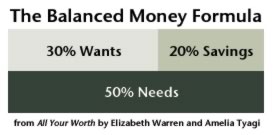
But sometimes broad outlines aren't enough. In this case, Kris suggested that a budget might help curb my impulsiveness, and I think she's right. With a budget, I can set specific goals. I can focus on the things I really want instead of just spending on random things that appeal to me in the moment.
So, I've decided to create a budget. Not a comprehensive budget — my Income, Needs, and Saving are all fine — but a budget for my Wants. I want to exercise discipline in this area so that I'm spending on things that are actually important to me instead of random stuff, stuff that ultimately turns into clutter.
Blueprint for Success
To start, I reviewed my discretionary spending from last year and compared it to the totals from the first four months of 2009. This is where tracking every penny you spend can prove valuable. By comparing my past spending to my present spending, I'm able to detect trends. It's very clear, for example, that I am again spending too much on dining out. Time to cut back.
Next, I thought about my goals. What is it that I really want to do? Lately, travel appeals to me. Kris and I both would like to take a vacation to Europe in 2010. To make that happen, I need to save. This gives me a medium-term goal to save toward.
Finally, I allocated a specific amount of money toward my monthly Wants. Remember, because I'm self-employed, I have an irregular income that passes through my business account first. If I pull out $2500 per month (after taxes) to act as personal income, that gives me $750 to spend on my passions. That should be plenty.
Building the Budget
After collecting the data and setting my goals, I made a first pass at a budget. This is what I'll use for June and July:
- Books: $50/month
- Comic Books: $50/month
- Entertainment: $50/month
- Clothing: $50/month
- Charity: $50/month
- Dining Out: $200/month
- Vacation 2010: $200/month (plus small windfalls)
- Miscellaneous: $100/month
Obviously, you might make different choices. I know that many GRS readers are avid contributors to charity, for example, and I suspect few of you budget for comic books! These are the allocations that seem to make sense for me and my situation. I'm sure that I'll make changes to this budget as I work with it in the real world.
Actually, I have a lot of questions about how a budget should work in the real world. Because I'm a budgeting novice, I could use some help. I'm hoping that you experienced budgeters can answer some of my questions:
- How often do you re-evaluate your budget? Do you make monthly adjustments? Quarterly? Yearly?
- If you go over budget for a month, what do you do? Do you make immediate adjustments? Or do you simply try to correct things the following month?
- What if I go under budget in a category? Does that mean I get to carry that money into the next month? Can I use it for a different Want category? (Perhaps sweep anything extra into the Vacation fund?) Or does does that money go to Saving instead? Or should I donate it to charity?
- How do you track your spending against the budget? If I used the envelope system, I'd allocate the actual cash to each account before-hand. But what if I don't want to have that much cash around the house? Is there a good way to keep track of current spending in each category? Should I carry a notecard with my monthly spending on it? (That seems to be what Bargain Babe recommends.)
- Do you try to further reduce spending on these categories? For example, should I try to drop my budget for Dining Out even more?
This is a strange new world for me. Over the past year, I've been pursuing more and more advanced personal finance subjects and concepts. Yet here I am, in better financial shape than ever, about to implement a basic skill I've never mastered before. That's okay. I believe it's important to continue focusing on the fundamentals even as we tackle more advanced topics.
My Discretionary Spending: Bits and Pieces
I want to talk about a couple of my spending habits. One is a worrisome trend, and one is a thing I'm doing right.
Food for Thought
Long-time readers know that Kris and I love to dine out. It's one of those things we're willing to spend on. We cut corners in other areas of our lives so that we can afford to make this happen. Still, I've been concerned about my restaurant spending for the past couple of years. It seems a tad excessive.
How'd I do last year? Well, my grocery spending dropped, but my restaurant spending went up again — a lot. Here's a look at five years of data:
- In 2005, we spent $1423.39 to dine out 100 times, for an average cost of $14.23 per meal.
- In 2006, we spent $1869.58 to dine out 108 times, for an average cost of $17.31 per meal.
- In 2007, we spent $2051.93 to dine out 84 times, for an average cost of $24.43 per meal.
- In 2008, we spent $2628.08 to dine out 77 times, for an average cost of $34.14 per meal.
- In 2009, we spent $3443.61 to dine out 69 times, for an average cost of $49.91 per meal.
Holy cats! Will you look at those numbers? We're only dining out about half two-thirds as often as we were in 2006, but we're spending nearly three times as much per meal. At the current rate of spending growth, we'll be spending $300 per meal in 2015! Since I can afford our current spending — I'm not living beyond my means — the real question is: Am I getting my money's worth? I'm not sure that I am.
If I'm honest, I have to admit that I don't like the idea that we're paying $50 per meal. I'd much rather return to our former habit: Dining out more often, but spending less each time. To that end, I've been brainstorming ways we can work to cut costs:
-
- We could do a better job of looking for discounts. We have an Entertainment book, and the local paper often features specials at local restaurants. We should take advantage of both of these. We used to do this, but have fallen out of the habit (primarily because we've become so used to eating at the same places again and again).
-
- We need to find more cheap places to eat. Half the fun of going out is just going out. Sure, we love the fancy restaurants, but we used to be happy with Dairy Queen. (This is lifestyle inflation in action!) The real problem is that the cheap places I know and love (Cha Cha Cha and Imperial Garden) aren't Kris' favorites. We need to find cheap places we both like.
-
- When we do eat in the same old haunts, we need to make an effort to reduce our spending. It's okay to have an appetizer, entree, dessert, and drink all in the same meal now and then, but we could save money by cutting one or two of these from the mix each time we dine out.
-
- Finally, we should invite friends to our home for dinner more often. As soon as the book is done (getting close!), I'm going to make a habit of inviting one family to dine with us every couple of weeks. We used to do this a lot, but have fallen out of the habit. It's fun and frugal to have folks over for dinner.
So, that's one part of my financial life that still needs work. Next, let's look at something I'm doing right.
A Waning of Want
Here's something that amazes me: We're twelve days into the year and I haven't spent anything yet on personal expenses. I haven't even felt the urge. I've bought gas for the Mini and groceries for home, and Kris and I went out to lunch last Friday, but I haven't spent a dime on gadgets or books or games or toys or magazines.
“Big deal,” you might say. “That's how it should be.” You're right. But for me, this is a big deal. All my life, I've had the uncontrollable urge to buy Stuff. It used to be that I couldn't go more than a day or two without buying something. Even while writing this blog, that's been the case. (I've just learned to channel my desires into smaller, cheaper things.) Now, as last, I seem to have licked it.
I still want things — no question! — but I've become very good at ignoring the wants and moving on. How?
- Sometimes, I just put down the thing I want, turn off my brain, and walk away. I force myself to stop thinking about it. (Usually by thinking about something else — like our upcoming trip to Europe, and how I need to save for that instead.)
- If I still want the thing when I get home, I put it on my Amazon wish-list. For whatever reason, that's often enough to satisfy the strange inner workings of my mind. I feel comforted knowing I've let myself put it on a list where I won't forget it.
- I'm very good about using the 30-day rule to control my impulse spending. My Amazon wish-list plays a role in that, but so does my mountain of index cards. (My life wouldn't be complete without index cards.) I have a handful of cards on my desk filled with notes about the things I want. It's amazing how many times I sort through this stack and end up throwing cards away because I no longer want the item I've written down.
These techniques help me deal with desire. They don't quell it completely — nor would I want them to — but they do keep it in check. That last rule is probably the most effective. By delaying purchases 30 days, I don't feel like I'm denying myself. I can still buy what I want if I want it 30 days later, but I'm not just giving in to impulse spending. (When 30 days rolls around and I do still want something, it actually feels pretty good to be able to buy it.)
My current spending moratorium isn't permanent, and I know that. In fact, the new Dick Tracy anthology comes out tomorrow, so if nothing else, I'll be shelling over $25 for that.
Remember: there's nothing inherently wrong with spending money on things that bring you joy. Problems arise when you finance these purchases with debt. If you're meeting your other financial goals and have money left over, it's good to indulge your interests and passions. Just make sure you're getting value for the dollars you spend.
A Look Back to Previous Years
I believe there are two components to building wealth:
- Reducing costs
- Boosting income
Doing one or the other can help you meet your goals, but to really succeed, you must do both. My goal has been to create a significant positive monthly cash flow. I've managed to do this. But as my income increases, so does the temptation to spend more. Have I been able to fight the urge? It's time for the annual review of my largest sources of discretionary spending:
- Comic Books (2005: $2810.52, 2006: $3202.91, 2007: $897.08, 2008: $550.51)
- Although I use comics as a prop for laughs at Get Rich Slowly, I've genuinely struggled with my spending on them in the past. Not this year. I made vast improvements in 2008, actually spending less on comics than I had planned. There are two reasons for this. First, I've narrowed my focus, collecting only those titles I most desire. I'm also making an effort to read all of the books I've bought but never finished. These two changes have helped me to spend less on this hobby.
- Books (2005: $1049.91, 2006: $657.96, 2007: $702.73, 2008: $404.49)
- At one time, I spent over $200 a month on books. Now I spend less than $40. I'm content with this number, especially since many of these are for our monthly book group. One reason my inclination to buy books has decreased is that I'm able to purchase personal finance books through Get Rich Slowly, the business. (Plus authors and publishers send them to me for free.) This gives me a never-ending source of reading material, and makes me less inclined to spend time in a bookstore. And again, I'm trying to read books I own but have never finished.
- Entertainment (2005: $478.81, 2006: $543.55, 2007: $1094.83, 2008: $897.91)
- This number isn't as bad as it seems. It includes two Decemberists concerts for me and Kris, and it also includes some of our television viewing. (Remember that Kris and I cut back to basic cable, and now we watch TV through Netflix and through the iTunes Music Store.) There's also a one-time $236 event here that ought to have been a business expense. I'm not unhappy with my spending on Entertainment.
- Pets (2005: $397.76, 2006: $471.03, 2007: $625.52, 2008: $378.75)
- Many personal finance writers view pets as an unnecessary expense. To me, $35 a month to keep four cats is a bargain. It only costs me about a quarter a day for each animal, and they bring much more joy to my life than that. If Kris would let me, I'd be the “crazy cat lady” on the block. (Are there “crazy cat gentlemen”?) Note that our actual pet expenses are greater. Kris pays for their food, and that's not reflected in these numbers
- Vice (2005: $1055.33, 2006: $768.95, 2007: $431.89, 2008: $924.79)
- This includes wine, liquor, pipe tobacco, poker nights, etc. I don't smoke regularly, but I do smoke a pipe maybe a dozen times a year. Most of this expense is for alcohol at dinner parties and social gatherings. My alcohol consumption did increase during 2008, which is a concern, but that's not the reason for the increased spending. For the first time ever, we bought a couple of cases of wine. This will actually reduce the “wages of sin” in the long run, but it bumped the number for 2008.
Although this report is interesting, there are problems with my methodology. For example, I've included my grocery spending above (although it's not really discretionary), but have not included spending on exercise equipment (which is discretionary). Also, Kris pays for much of our grocery shopping. Because we keep separate accounts, her share of that expense isn't reflected in these numbers.
In order to be consistent from year-to-year, however, I've elected to continue reporting the same expenses in the same ways. You'll have to take my word that the figures here are representative of my spending as a whole. This annual report is sort of like tracking a stock market index, I guess. It doesn't reveal nuances, but it's still a useful indicator of the Big Picture.
So despite cutting back on the areas that are really important to me — books and comics — my spending increased. And most of that increase came from dining out.
How did you do on your spending goals last year? Are there areas where you wish you spent less? If so, what strategies do you use to keep yourself in check?

Become A Money Boss And Join 15,000 Others
Subscribe to the GRS Insider (FREE) and we’ll give you a copy of the Money Boss Manifesto (also FREE)
