
After 36 hours of travel (followed by twelve hours of sleep), Kris and I are back from vacation. For the past three weeks, we’ve been exploring southern Africa. With a tour group, we visited South Africa, Zimbabwe, Botswana, Namibia, and Zambia. We had a great time, and we learned a lot. It was well worth the expense. In fact, I loved what I saw so much, that I’m eager to return. (On my next trip, I’ll probably aim for Ethiopia, Kenya, and Tanzania.)
Because it’s now ingrained in my being, I spent the entire trip looking at things through the lens of personal finance. This wasn’t tough. We saw a lot of wealth and poverty.
From the Rich to the Poor
On our first day in South Africa, as the tour bus set out from our hotel in Johannesburg to nearby Pretoria, our tour guide interrupted his narrative to say something strange.
“Before we go too far,” Brian said, “I want to thank you: Thank you for coming to Africa. Tourism is the biggest transfer of money from the rich to the poor in the world. For every seven people who come to South Africa, roughly one job is created. So, thank you.”
I thought this was odd at the time, so I pulled out my notebook and jotted down the quote verbatim. (When I travel, I always carry a small notebook to capture quotes and impressions.) During the course of our three weeks in southern Africa, I kept coming back to this notion, to the idea that tourism isn’t exploitive (as I’ve always believed), but actually beneficial to countries and communities.

Brian wasn’t the only one to mention this. Several of our local guides brought up the subject too. On our tour of Robben Island, where Nelson Mandela was held prisoner for nearly eighteen years, our guide echoed Brian’s statement. “For every six tour buses to visit Robben Island,” he told us, “one job is created. Thank you for visiting.” And on the final afternoon of our trip, we took a tour through the “informal settlement” in Langa Township. (“Informal settlement” is a polite term for a squatter camp or shantytown.) Our local guide — who lives in Langa Township — expressed heartfelt thanks.
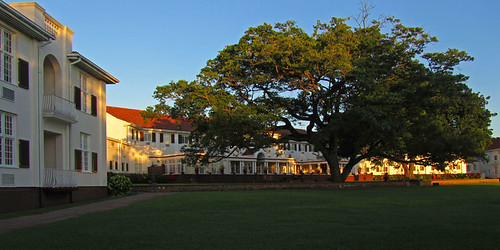
The Victoria Falls Hotel is gorgeous.
Despite assurances from Brian and the local guides, I felt guilty a lot of the time. I felt ashamed that I have so much and the people I met had so little. Yes, they were happy and friendly and giving, but consider this calculus:
- We spent three nights in the Victoria Falls Hotel, where the average room costs $618 per night. I’m not sure what our actual cost was — it was probably much less — because we booked the entire trip as a package through a tour company. If we’d paid full price, though, we might have expected to pay $1854 for our time in Victoria Falls.
- According to our local guide, minimum wage in Victoria Falls is currently $250 a month. And right now, nobody can afford to pay that, so workers are only being given a living allowance — enough to buy bare necessities.
So, three nights in this posh hotel cost the same as seven months of local wages. Worse, most Zimbabweans don’t even have a job. Unemployment in the country runs at nearly 80%. 80%!! One in five people has a regular job. Perhaps you can see why, despite our guides’ gratitude, I often felt ashamed to be there.

The Open Market
On Valentine’s Day, my favorite day of the trip, our group experienced three cultural outings.
In the morning, we visited the Victoria Falls open market, where local residents sell hand-made jewelry, rugs, statues, and knick-knacks. Before we entered the market, Brian gave us a piece of advice: “Think of this as a cultural experience, not a shopping opportunity,” he said. “And don’t just give these folks money. They don’t want your handouts. They want to earn a living.”
I heeded Brian’s advice, and did my best to learn more about the vendors I spoke with. At one stall, Joshua taught me about haggling. He explained how the process works, and where you might use it. (You don’t haggle at the grocery store, but you can at the fresh food market.)
I asked how much a carved hippo cost. “Thirty-five dollars,” Joshua said. He quickly added, “But that’s just my starting price. Now you make an offer.” I eventually bought the hippo for $12. I felt guilty for not paying $35.
A fellow called Moreblessing (no joke) talked to me about how his family produced and sold the items he had on display. (His brother had a stall right next to him.)
On Names
In Zimbabwe, names are the same as ours — Francis, Richard, Jacqueline, etc. — except when they’re not. Some people have African names, as you might expect, and others have names derived from English nouns and adjectives: Reason, Accurate, Blessed, Moreblessing, and Garlic (also no joke). We didn’t meet anyone named Precious, though.
Several of the fellows (I only spoke with men) told me that they needed to sell something because this was the only way they could get money to put food on the table. I asked Brian if this were true. “It is,” he said. “Some of these guys may only make one or two sales per week.”
I bought too many carved hippos, and I wish I could have bought more. No, I don’t need a dozen carved hippos — it’s just Stuff — but I wanted to help these people. (Some members of our group traded their clothes and shoes instead of using money. Brian says that in many ways, this is more useful to the vendors.)
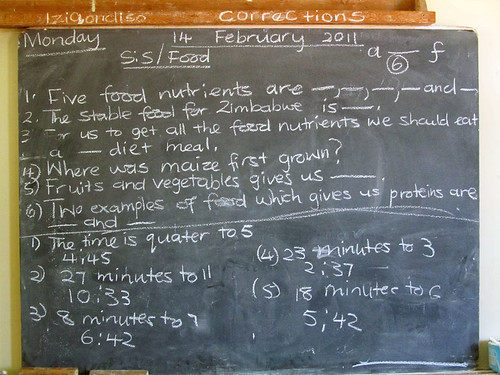
The Primary School
During the afternoon of our cultural day, we visited the Chinotimba Primary School, where about 25 children sang and danced for us. When they finished, we had a chance to chat with them. (English is the primary language in the countries we visited, another remnant of the colonial past.) One boy was fascinated by my camera, so I let him borrow it; he ran around the room, snapping photos of all his friends.
Before we left the school, we had a chance to donate school supplies. Kris had brought some pens, pencils, small notebooks, and inflatable globes. I was unprepared. I hadn’t expected to be so moved by the visit. I pulled aside Francis, our local guide (who had attended this school when he was a boy and now has a daughter who’s a student here), and showed him the books I was carrying in my bag. “Could the school use these at all?” I asked.
“Absolutely,” he said.
“Even these?” I asked, holding up four digest-sized comic books I’d brought to read on the plane.
Francis laughed. “Yes,” he said. “They’ll love them. The kids know who Superman is.” So, there’s a grade school in Zimbabwe that has some comic books from my collection now. The school principal, who collected the money and supplies our group donated, seemed touched and grateful.
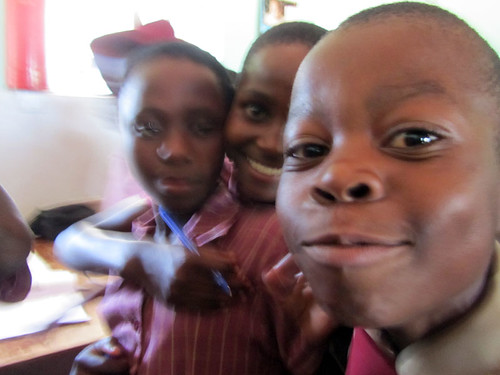
Photo taken by a boy at Chinotimba Primary School.
Back on the bus, many tour members talked about how sad it was that these kids had so little. Brian tried to squash this sentiment.
“Look at the children,” he said. “Are these kids unhappy? I’ll wager that you’ll see the children are happy. They’re happier than any of the children in South Africa. Why? Because everyone is equal. They all have the same Stuff. It’s not one kid has an iPod and another one doesn’t. They’ve got nothing, and we know that. But they’ve all got nothing. They’re all the same.”
Brian wasn’t arguing that it’s good for these people to live in poverty. He was trying to make it clear that it’s possible to be happy even without a lot of Stuff, and that if you give something to one person and not another, you sow the seeds of envy.
Dinner at Home
In the evening, we made a quick trip to a nearby food market, where we spent a few minutes wandering the stalls, looking at the items for sale. (I found two women who were selling used boxes! Because my family owns a small box factory here in Portland, I asked to snap their photo.)
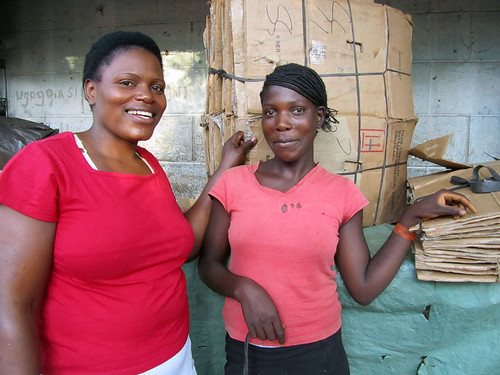
After this brief detour, we split into small groups. Each group went to the home of a local resident, where we were served a typical Zimbabwean meal. (Actually, it was a little atypical: We were given the equivalent of both lunch and dinner. Plus, our meal contained more meat than the families usually eat.)
Kris and I dined with Blessed and her family, which owns two homes on adjoining properties. “We are a family of sixteen,” Blessed told us, “and we are still expanding.” She says that “uncles, aunties, misses, cousins” live in these two houses.
Blessed served us hominy in peanut butter, pumpkin leaves in peanut sauce, and sadza with chicken stew. Sadza is a cornmeal pap; it’s Zimbabwe’s staple food. In fact, Blessed’s family eats so much sadza that they buy a 50kg (~110 pound) bag of cornmeal every month. (I think the “mielie pap” we saw in Botswana and South Africa is the same as sadza, but I can’t swear to it.) Fish is expensive, so it isn’t eaten often, and meat seems to be used as a flavoring agent, not a main ingredient.
As we ate, we talked with Blessed and her two helpers, which included a friend and a cousin. Blessed told us that her family is actually fairly well off compared to many in the area. Doreen, who is eighteen, is nearly finished with high school. She just got her exam results. Because she did well, she’ll soon be going to university, and then (she hopes) to medical school. So, in contrast to a lot of what we’d seen on this cultural day, this family seemed to be on a path toward relative prosperity.
This six-minute video mostly features footage from our cultural day.
The Bride Price
On the bus ride from Botswana to Zimbabwe, Francis, our local guide, talked about marriage customs in his tribe. Just two generations ago, it was common for men to have several wives. This still happens, but less often, especially in the city. Still, some of the old ways continue. When a man is ready for marriage, for example, he pays a bride price to the father of the woman he intends to marry. This is paid in cattle. (Francis actually called this a dowry, but that’s technically not correct.)
When Francis was married, he paid nine cows plus $700 for his wife. Our bus driver Ernest paid seven cows for his wife.
If a young man can’t pay the bride price, he pays in installments. If the man is unable to pay the full bride price by the time his own daughters get married, he has to use half of their bride wealth to repay the outstanding debt. And if the debt doesn’t get repaid in his lifetime, the responsibility falls to the man’s oldest son. In this way, it’s possible for complex chains of bride debt to exist.
Francis feels lucky — he has three daughters, which means he will eventually be a wealthy man. (In theory.) One day, he’ll have a lot of cattle.
“What do you do with the cattle?” one member of our group asked. “Are they for meat? Do you use them for milk?”
“In our African culture,” Francis said, “your cows are your bank. You can’t eat your bank. You have to save them.”
“What about people who live in the city?” another member of our group asked. “Where do they keep their cattle?”
Brian, the tour manager, explained that in places where it’s impossible to keep actual cattle (such as Johannesburg), the bride price has become abstracted. Some pay it in gold coins called Kruggerands. Others buy “bonds” (Brian’s word, not mine) that represent the cows. Brian says he’s been in homes where the certificates representing the cows are framed and displayed on the wall, like a stock certificate.
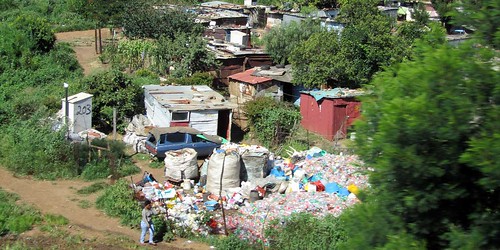
An informal settlement (or “shantytown”) in Soweto, Johannesburg.
Informal Settlements
e ended our African adventure in Cape Town, a vibrant city on the southwestern tip of the continent. We took the cable car to the top of Table Mountain, walked along the Victoria and Alfred Waterfront (which is packed with shops and restaurants), and wandered through the Company’s Garden and Greenmarket Square.
On our final afternoon, we went on a three-hour tour of the local townships. To quote Wikipedia:
During the Apartheid era, blacks were evicted from properties that were in areas designated as “white only” and forced to move into segregated townships. Separate townships were established for each of the three designated non-white race groups (blacks, coloreds, and Indians)…
Townships sometimes have large informal settlements nearby. Despite their origins in apartheid South Africa, today the terms township, location, and informal settlements are not used pejoratively.
Townships are permanent communities. As part of a township, there might be one or more “informal settlements”. You may know of informal settlements by less flattering terms, such as squatter camps or shantytowns.
We spent most of our time in Langa Township, where a young woman nicknamed Sugar (who lives in Langa) described how people work and live. As in any community, there are different levels of wealth in Langa. Some folks have relatively nice homes, with yards and garages and fences; we were told these belong to people who have university degrees: teachers, nurses, doctors and lawyers. These homes would seem small in the U.S., but are positively luxurious compared to the shacks in the informal settlements just a few hundred meters down the road.
Sugar led us on a short walking tour of some of the government-built housing in Langa. We were able to see two homes. I didn’t see much of the second because I stopped to talk with a girl in the first house (I couldn’t understand her African name, I’m afraid). I started by asking her about her life, but she was actually more curious about me. Where did I come from? Did I like Africa? And so on.
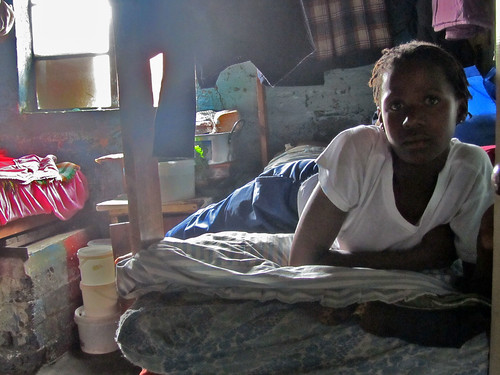
I wanted to know more about this girl; she wanted to know more about me.
I learned so much from this three-hour tour that I can’t possibly share it all here. Besides, you’re probably bored after reading this far. Instead, I’ve compiled this 9-minute video that features Sugar and Sophia (our guides) talking about the daily lives of township residents, especially from a financial perspective. I’ve done my best to annotate things to head off confusion.
This video is the cornerstone of this entire post.
I wish more of our trip could have been focused on meeting the people. While others appreciated the birds and the animals and the spectacular scenery, I got so much out of our brief interactions with actual South Africans and Zimbabweans.
Guilt is Not Productive
Because this trip was arranged through a tour company, there were a couple of obligatory shopping stops: one at a jewelry company and one at an ostrich farm. Kris and I bought nothing at either place (except pellets to feed the ostriches). Neither of us is interested in jewelry or ostrich leather goods.
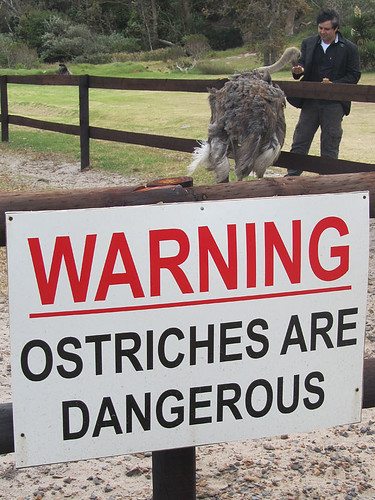
Ostriches are dangerous — unless you ply them with food pellets.
Others might have liked to buy something, but didn’t feel good doing so. “I’d feel guilty spending $320 on an ostrich-skin purse,” one woman said at dinner one night. “Especially after the poverty we witnessed in Zimbabwe. I’d rather give $300 to a family in Zimbabwe and then buy a $20 purse at Goodwill.”
As I’ve mentioned already, at times I felt guilty too. It’s hard not to feel guilty when you’re staying at a hotel where the average room runs $618 a night — and meanwhile, half a mile from this posh palace, men and women are scratching to make ends meet.
What is my moral obligation to these people? Do I have one? Should I feel guilty for spending money on tourism? Or, as our guides suggested, should I be comforted by the fact that I’m participating in a transfer of wealth from the rich to the poor? What productive ways can I help aside from just throwing money at the problem?
I don’t have answers to these questions.
Ultimately, however, I’ve realized that guilt is not productive. Guilt doesn’t accomplish anything. I can’t change who I am or the circumstances I’ve been born into. I’ve made the most of what I have: I’ve been lucky, and I’ve worked hard to build upon that luck. I can’t change this, and I can’t regret it.
Instead, I feel like it’s my responsibility to do something with this hand that I’ve been dealt. Do what? I don’t know — and I’m not sure I need to know right now. As I travel, I’m becoming more aware of the world around me, and I feel like maybe there’s something I can contribute to make it a better place. I’m not sure what that something is, but I’m willing to be patient until I discover it.
Wow! Thank you for sharing about your Africa trip. I can’t wait till I’m debt free and can take trips like this. 🙂
Thank you, J.D., for sharing such heartfelt impressions from your trip. I was very moved reading about your experience. I look forward to watching the second video when I have a little more time.
I’ve been fortunate to help a number of immigrant families buy homes in my town. One of my favorite families arrived in the U.S. after fleeing the civil war in Liberia. The wife only found out her husband was still alive after being here a year. She worked and raised her children while saving enough to bring him to the U.S.
Even as they improve their economic prospects, these families retain a sense of community, gratitude for their blessings, and a desire to help others worse off. I have so much to learn from them. I’m very thankful that when I can’t travel, travelers come and share their lives with me.
It sounds like you were transformed by your trip (which is what you really hope to happen when you travel).
JD,
Glad you had a safe trip overall, and that all sounds like fun! I agree with your conclusions–being born in America is in no way universally fair, but thankfully we have the ability to give back and really serve others with our time or money. And I’ve noticed with the whole haggling thing that it is in fact more respectful to barter with them, since they too are businessmen and women that don’t want to just get free money. Much like if you ran a fruit stall at a farmer’s market somewhere in the states, and some rich tourists came and offered to pay your list price plus 20%. It’d be kind of insulting.
I was only able to quickly skim through your post (will read more later), but it struck a chord with me. As much as being financially secure is important, it is easy to get stuck in the money “trap” and forget how much we really have. We all need a good reminder now and then about the things we should really value – family, friends, health, etc.
Thanks!
Correct, guilt is not productive.
There is even a logical inconsistency in your reasoning:
If what your guides at the top of the article said is true (‘creating jobs every…’) than your stay in that hotel *is* creating jobs.
You could argue about the efficiency (e.g. money being siphoned off to western companies), you might consider staying at another place next time, but that is also the local people/governments *own* decisions: if they are fine with that hotel being there, than who are you to argue? 😉
And thanks for the great article.
As a South African who regularly reads your great website, I’d like to thank you both for coming and for your fantastic attitude when you did so. I only wish that your thought provoking questions were asked just as frequently by those of us who live here every day and who have been blessed with relative wealth.
Fascinating article!
As for what you can do… well, there are a lot of NGOs out there in Africa doing all sorts of things. You want to help kids go to school, you can do that. You want to provide comics for schools, you can do that. You want to help kids born with cleft palates or mothers with incontinence get surgery, charities exist for those. Mosquito netting, deworming, anti-malarials… etc. all have NGOs that need money for supplies. Nicholas Kristof in the NYTimes will often profile one or another of these problems and the charities that help: http://topics.nytimes.com/top/opinion/editorialsandoped/oped/columnists/nicholasdkristof/index.html It is difficult to read some of his columns without making at least a small donation.
But don’t let yourself be overwhelmed so much that you hit the paradox of choice. Remember that helping just one person with just one aspect is better than doing nothing at all. It doesn’t really matter what you choose so long as you do something. (And no, you don’t have to do anything, but once you are aware of problems, it is easier to do something.)
p.s. I went to high school with someone named Precious Joy Lastname. She went by PJ. There was also a girl whose first name was Princess.
This was such a wonderful post, JD…thanks for sharing it xx
J.D. says:
“It’s hard not to feel guilty when you’re staying at a hotel where the average room runs $618 a night – and meanwhile, half a mile from this posh palace, men and women are scratching to make ends meet… What is my moral obligation to these people? Do I have one?”
And I just want to point out that this same situation exists right here as well, right in this country, in the cities and neighborhoods where we live. If we can’t (or don’t) get involved in Africa or other far-away places, we *can* get involved locally, and financially.
“Am I my brother’s keeper?” opens up a whole new level of looking at personal finance. Thanks for this thought-provoking post.
Regardless of your ethical worries (wealth transfer etc.), I am delighted to read about your travels.
It allows me a bit of fantasy escape from my life.
Thanks for posting it.
Glad you enjoyed your trip. It sounds like you got a very well-rounded view of southern Africa.
You gained an appreciation for just how much we have, and that’s a good thing. Your eyes were opened to what true poverty looks like. I livied in South Africa (Durban) for an extended work assignment, and it completely changed me.
>Ultimately, however, I’ve realized that guilt is not productive. Guilt doesn’t accomplish anything.
>Instead, I feel like it’s my responsibility to do something with this hand that I’ve been dealt.
Beautiful, beautiful, beautiful.
Thank you so much for sharing your trip. I will be coming back to this post again and again.
Thanks for your post, been reading this site for awhile now. I am a South African and yes I do live in a country with jarring extremes. Often with the work I do I find it v humbling to realise how caught up we can get in the rat race. I’d like to think that every little contribution that we make – whether it’s supporting a local trader or even employing someone to do menial labour has a positive impact.
Good to read that you had a good trip and Africa isn’t just about the game safari 😉
Always interesting to read a foreign insight into my country too.
The trouble with “wealth transfer”, by staying at jobs-creating hotels, is that a significant portion of the wealth gets transferred to a few wealthy families and siphoned into the hands of rapacious, brutal dictators, perhaps no more so than in Zimbabwe. Some of these monsters are far worse than the (admittedly horrible) colonial rulers that left so much of Africa in a mess. While I support the work of NGOS, especially ones like Partners in Health that seek to develop local capacity, continuous handouts from the rich West aren’t going to fix the lives of people when so much of that money ends up being siphoned right back to Paris designers, German and Italian automakers, and Swiss banks by strong-man murderers who run some of these countries.
The people you describe are hard working and enterprising. What’s really heartbreaking here is that their political structures never give them a real chance.
Welcome back! A few reactions to your post…
1) I agree that guilt isn’t useful unless it’s channeled into something that makes the work (or just your community) a better place. You’ve pondered the idea of becoming more generous and philanthropic, but this part of your financial self has been blocked. Hopefully you can work on unblocking it and becoming more of a giver with your wealth. There are thousands of great ways to give domestically and internationally. It’s a powerful (and scary, but in a good way) feeling to give until you feel/notice it, meaning going way beyond $50 or $100 checks. Try it!
2) I think there’s lots of good reason to feel guilt about hotels that cost massively more than the local standard of living (though I certainly understand that you can’t control what the tour does). I’ve traveled to dozens of hotels, and while I could afford to, I never stay in hotels that are that expensive. It just seems plain wrong to spend more in 1 night than people live on in a year. And the fancier the hotel, the more the money just goes to international corporations or to the most wealthy in the country. Fortunately, you can get very nice accommodation in developing countries for much cheaper prices. For example, there are backpacker-type places (hotels and hostels) for $10-20 per night in Vic Falls. While I used to stay at that level, these days I want something a little nicer. Fortunately, for $50-150 in Vic Falls and in any developing country (and the US and Europe in fact!) you can get very nice and safe hotels. Sometimes they are even fancy at that price, especially if purchased on a special promotion. And if the hotel is locally owned, all the more money going back to the local community.
2) Never ever feel guilty about bargaining. Though no one consciously intends this, it’s actually a sign that you are looking down on the other person. When you bargain in the US at a car lot or a garage sale or anywhere else, you assume that the other person isn’t going to make a gad deal for him or herself. Why wouldn’t you think the same in a developing country?! Local people are savvier with business than most tourists. They aren’t going to lose money on you. And no matter how low you think you got the price, I promise that as a foreigner (especially one from America), you are always over paying! Furthermore, when you’re buying stuff in established markets and from people who target tourists, you’re always dealing with people who are much better off financially than average. They have businesses and regular access to people who buy stuff for multiples of what locals pay. The real poverty and the people I like to try to help are those who are so poor that you’ll never see them — they don’t have businesses outside of their shanty towns, they can’t even leave home because they have 10 children, they are too sick to be in sight, etc. Anyone with a tourist-oriented business is doing just fine, relatively speaking, I promise. (And I worked with a nonprofit that helped locals start businesses in war-torn countries.)
First time poster and long time reader. This site has be been enormously helpful in helping us get our finances in order and I’ve recommended many times.
I used to live in South African and am now north of your border, though haven’t been back in 10 years felt some trepidation about reading your views on your ‘Africa trip’. Many see Africa as a big mass. The continent is huge and diverse with many vastly different countries. If an Italian says they’re going to visit family – people tend to refer to the country by name ie Italy and not say Europe, but when people come from Africa somehow the tendency is to say “oh you’re from Africa”. Well this is a a lovely article and you really ‘get it’. Thank-you. There are many ways to help, though research well.
The women selling used boxes reminds me of a story some friends at church told me. They were on a short mission trip in Tanzania and in a shop they saw someone selling Christmas wrapping paper. It was the used wrapping paper from Operation Christmas Child shoeboxes.
http://www.samaritanspurse.org/index.php/OCC/index/
Sounds like a wonderful trip. i plan to re-read this post later and watch the videos to really take it in. I like what you said about guilt and poverty vs wealth. Years ago, I visited Mexico and one of our day trips was to a small, brick making business. As we pulled into the driveway, our guide told us we’d be seeing a lot of poverty that day, but not to feel sorry for anyone. They are all happy and grateful for what they have and are happy to share their lives with you. That stayed with me. And yes, that evening I closed my eyes at a beautiful hotel that very likely cost a month’s worth of local wages. For me, the bottom line (so to speak) is that travel is too important in so many ways to NOT do. Not only does it transfer wealth, but it also transfers knowledge. That’s how we learn about one another, about different places and even ourselves.
Great read!
Is there a way to donate to these people without having to deal with charity corporations? I have zero faith that anything donated to a charity would actually get to the people.
This is what I learned while traveling around SE Asia with my wife last year.
1. Haggling is good, just don’t get caught up in it. I once caught myself haggling with a local over what was effectively a quarter. Once it clicked I just went with his slightly higher offer. Its easy to forget the exchange rate when haggling in a foreign currency.
2. Try to stay at locally run establishments, not western owned ones. Locally run places see a larger amount of your money stay in the community. Hostels with large staffs of locals are usually a good bet since many times the staff are encouraged to interact with guests to better their English skills. You get an interesting conversation and they get to practice their English.
3. Eat local. All the best meals I had in SE Asia were from little sidewalk restaurants where the locals ate.
4. Never give hand-outs. It goes a long way to destroying the local economy. Giving one person in a small village a couple dollars can warp the economics of the village, it can be like winning the lottery. If it is more profitable to beg than work, that is what people will do.
-Matt
“No, I don’t need a dozen carved hippos – it’s just Stuff – but I wanted to help these people.”
Perhaps it’s time for a blog giveaway? Something like: Tell me which charity you donated to, and I’ll enter you in the drawing for a reminder of why we give.
And welcome back.
Wow, what a trip. Living in the U.S., we sometimes forget how others live around the globe. It is hard to imagine an area where school costs $75 per year or having an 80% unemployment rate. Talk about a learning experience!
This post brings up great points.
Wealth transfer: What you did is great and falls under the term ‘eco-tourism’ which is a form of tourism that’s sensitive to the natural resources and cultural heritage of the host country. But a lot of tourism, ‘mass tourism,’ the kind where you get on a cruise ship, stay in a chain hotel and don’t visit any villages–this kind of tourism mostly benefits multinational corporations headquartered in rich countries and can be quite environmentally destructive. It’s up to travelers to make the choice.
“Why? Because everyone is equal. They all have the same Stuff.” There is a difference between relative poverty (between people in the same culture) and absolute poverty (on a scale of all the world’s people). The US, for instance, has very low absolute poverty because nearly everyone is far richer than most people in sub-Saharan Africa, but very high rates of relative poverty as compared to other countries similar to us since the difference between our poorest and richest people is vast. Neither is really good, but they have different effects.
Anyways, as a professional in a field related to development and tourism I want to thank you for your considerate travel choices and wonderful story.
Thank you for your rich story-telling!
I agree with you about the wonder of conversation. The longer I travel, the more I cherish conversations; for me, it is the heart of travel. The best way I’ve found to invite conversations is to stay in small family-run hotels whenever possible.
I understand the impulse to buy things in order to help people (e.g. the carved hippos), but I’m conflicted about buying something if I have no interest in it. It may help the person, but consuming something I’m not going to use or give someone else seems environmentally wasteful. I don’t have an answer to this.
My husband and I visited South Africa in 2007. We were there for two weeks, one of which was spent at an academic conference, so we did not get to see nearly as much as you did. It was such an amazing trip and the people we met were so warm and welcoming. I knew that you and your wife were going to love it. So glad that the trip turned out so great and that you were able to visit several other countries as well. You very eloquently echoed many of the feelings I was left with during and following my trip. I also became quite conflicted by the extremes of wealth & poverty I witnessed.
I especially enjoyed your sharing the part of the trip when the guide explained that the school children were not unhappy because they were all the same. There is a lot of truth in that. When I was living in Manhattan I had no money (absolutely no savings & tons of debt). I lived in an inexpensive (by NYC standards) tiny building that just happened to be on an incredibly expensive block on the Upper East Side. Every day for 7 years I was made so aware of everything that I did not have. I still miss NYC terribly but I do not miss that feeling. It’s amazing how much more content I am living among people in a generally similar financial situation. The interesting thing is that I am not a person who is into appearances or acquiring “stuff.” I’d rather have experiences (travel, theatre tickets, etc) and yet the disparity still got to me.
Wow – thanks for sharing your experience. Sounds like an amazing, if eye-opening trip.
I hope you’re able to channel that guilt into something helpful and productive. It doesn’t even necessarily need to be in Africa – there are probably plenty of people you could help within your own community.
But kudos to you about being open with the fact that it can be uncomfortable to spend so much time focusing on money and wealth when our standards in the US are so grossly different from those around the world.
“One way to do this is to use as many local services (shops, restaurants) as possible instead of sticking strictly to the tour itinerary. This efficiency question is also something to consider as I look at aid organizations.”
Not to take away from the needs of Africa, but this thought also makes so much sense when visiting/shopping closer to home. If you take a day trip to a spot two hours away from home, try the locally owned restaurants and shops.
Also, for those who are moved to give, this site can’t get enough love:
http://www.charitynavigator.org/
You mention that you wish that you had taken an up close and personal walking tour. Can you recommend one?
It sounds like you may have had a life-changing experience for the better.
When my family and I lived in Argentina while I was a teenager, I remember that feeling of guilt when we had so much and the families around us didn’t. But you are so right, guilt is useless. I made friends, we laughed, we ate a lot at my house, and no one ever seemed to hold wealth against us. By the time we moved back to Texas, 3 of my friends were pursuing college degrees and the others had their own life plans. Stuff isn’t necessary buy everyone valued our social lives as more important than gold.
I’m glad you enjoyed your trip!!!
I’ve had amazing opportunities to travel and live abroad, including in some very poor countries. I’ll never forget being in India in 2001, when a little boy, no more than 3 years old, followed me for several blocks, with his hand extended, not saying a word. My study abroad advisors had implored us not to give money to children. That it just encourages their parents and others (think Slumdog Millionaire these days) to continue to take advantage of children. His face, dirty and gaunt, haunts me to this day, and I always wonder if I should’ve just given him money. He’d be a teenager by now. I wonder how he’s doing. I’ve experienced things like that in many countries, but nothing has stayed with me like that one.
In another instance, in Vietnam, a cab driver told us that Vietnamese have a highly-regarded, but kind of secret, admiration and respect for Americans and Westerners. Their religious beliefs include reincarnation, and he explained to us that we, Americans and other wealthy westerners, must have done something amazing in their previous life to have earned to be reincarnated as an American. And that they are ashamed of what they had done in their previous life to have been born in such poor conditions.
Just two things that continue to make me think.
Great post – in particular I like the quote “…don’t just give these folks money. They don’t want your handouts. They want to earn a living.”
It’s hard to take pride in easy money no matter where you live. Whether you’re digging yourself out of debt or toiling to put food on the table, hard work and self-sufficiency are very rewarding and provide a sense of worth and dignity.
For those who read this article and would like to know what to do to help I would encourage you to check out and consider Kiva.org. If you’re unsure, start with just 1 loan, but let me warn you – helping people can be addicting!
Thanks again for sharing your experience. Learning about other cultures is very interesting and provides a welcome dose of perspective.
Thank you for this post! I loved watching the videos. I felt like I was on the tour bus. I really appreciate you sharing this.
Hi JD,
Great post. I am not a finance expert, but work for an international development company in DC area. We focus a lot of our efforts on improving health care in Africa. It’s a frustrating business, often 3 steps forward and 2 steps back. Remittances and tourism can sometimes provide a more direct impact than the country level work that we do. I recommend Jeffrey Sachs book “The End of Poverty” as food for thought on these topics.
JD, I often skip over “vacation” posts, but this one was really eloquent and well written. I’m not big into traveling myself, but your post almost made me want to go there. Thanks for writing and sharing this.
I lived in South Africa as a child. We had a gardener from Malawi. My parents gave him a bed with a wooden bed frame to use. He was so proud of that bed. When he first got it, we had a line of people coming to look at it. Many of my white South African friends slept on army like folding cots, so it was very unusual for the help to have a bed like that. Every year, my family was required by the work laws to send him home for a month to see his family in Malawi, and every year we had to reassure him that we would not give away his bed. When we went on trips, my mother had to hire a maid to cook for him because he did not do “womans work” and would not cook for himself. My private school partnered with a local African school and we would raise money to provide textbooks for them. The last time I was in South Africa was in 1985 when South African Airways had a special for $900 for the airfare, two weeks of hotels, two week unlimited car rental and two inter country flights. I would love to go back and see the changes. In 1973 there was no TV and it took several weeks to get approved for a phone. A calculator cost $100. In 1985 there was TV, ATMs on many street corners but it still took several weeks to be approved for a phone.
Thanks for sharing your trip – I would love a post about NGOs that explains some of them, what they do, and which ones are worth donating to. Either in Africa, or anywhere, including here in the US. Its something I always want to do but never have the time (ok never MAKE the time).
Another suggestion for a post would be about service travel. There are many organizations where you can travel somewhere and help out while you are there, live amongst the locals and use your skills to improve their community. I know of a few of these but don’t know which are more reputable than others. Based on what you say about wanting to know more of the people…might be a good idea for your next trip!
Wouldn’t beat yourself up to much over the “efficiency of wealth transfer”. More money often makes it into the hands of the locals at the higher end places. If I spend $100/night maybe $20 will go to the locals whereas if I paid $10/night at a local establishment it all might go to a local. At the end of the day a lot of the higher end places still provide more jobs for more people.
For instance, I’ve traveled to all the places you’ve been for quite a bit less money than the tour you took. However, you probably still contributed more to the local economy than I did.
Welcome back JD – I can’t believe you paid $12 for carved hippos – so expensive! (Peace Corps negotiating skills die hard)
Some thoughts on tourism:
My project in Peace Corps was in local tourism development – helping a small community build their tourism capabilities to attract more visitors, and to create methods to distribute the income equitably. I’m actually very torn as to whether or not this has been a net positive for the community. It did bring more development dollars, improved roads, and more services, but it created a lot of political infighting. After I left the chief overturned the community-wide committee I had formed, ostensibly taking any tourism money into his already well-lined pockets. I know the issue was really the chief and not tourism – but it will now be another source of income to bolster his sway over the community.
Despite this tricky situation – I think that community-based tourism is definitely worth seeking out. Yes, foreign tour providers and hotels will funnel funds out of the country – but this is not always bad – in some cases local communities cannot provide the same comforts – and having people learn more about different places who might not normally come without a flush toilet or a/c is definitely a plus for everyone, regardless of how many new jobs it creates or school fees it covers. The real issue is are those foreign companies displacing more efficient local ones that would attract a similar volume of visitors.
I also want to echo Margot’s comment – the people who need the most help are those whom you will likely never see – who aren’t lucky to have a nearby tourism destination. I think the most effective way to give money to people in African countries is through NGOs that target women and health.
One more P.C. plug – today is Peace Corps’ 50th anniversary!
Overall so happy that you went to Africa, and loved reading this post.
Wonderful! I especially love the perspective from the children, which reminds me of the idea of “experience stretching” as described by Daniel Gilbert’s “Stumbling on Happiness:”
“We often say of others who claim to be happy despite circumstances that we believe should preclude it that ‘they only think they’re happy because they don’t know what they’re missing.’ Okay, sure, but that’s the point. Not knowing what we’re missing can mean that we are truly happy under circumstances that would not allow us to be happy once we have experienced the missing thing. It does not mean that those who don’t know what they’re missing are less happy than those who have it…” ~ Daniel Gilbert
Happiness stretches with experience, which partially explains why ignorance is bliss…
Great article, and it really goes hand-in-hand with conversations I’ve been having with several of my friends lately about “How Much is Enough?”
Also, Pandora was kind enough to be playing Ben Harper’s “Satisfied Mind” while I was reading this. The lyrics perfectly capture the essence of your post:
“how many times have you heard someone say
if i had his money i’d do things my way
but little they know and it’s so hard to find
one rich man in ten with a satisfied mind
once i was waiting in fortune and fame
everything that i dreamed of to get a start in life’s game
suddenly it happened i lost every dime
but i’m richer by far with a satisfied mind
when my life is over and my time has run out
my friends and my loved ones i’ll leave there’s no doubt
but one thing is for certain when it comes my time
i’ll leave here for certain with a satisfied mind”
2 simple things that we can do to help lift the worlds poorest out of poverty:
-actively oppose subsidies to ‘rich world’ businesses.
-actively oppose anything our governments do to make ‘poor world’ products the expensive choice.
That was a great post, JD, and there are so many things in there I would like to hear you expand on. Future posts, perhaps?
The concept of relativity in terms of poverty and finance (the school children in this post) in particular is something I am interested in hearing more about.
A few years ago, I lived in an African capital city earning more in one month that most people there would in many, many years. I was uncomfortably aware of the differences but my savings account definately benefited.
Now, I currently live in a very expensive european capital city and I work for and with people earning vast sums of money whilst I am on what is probably a below average salary.
It is quite a role reversal and one that I am still adjusting to.
It seems to me be a major breach of good taste, for western tourists to trek through the ugly side of African slums toting cameras around their neck and treating the people like a tourist attraction, animals at a zoo. And a major ethical problem to PROFIT from it. I mean, I can maybe see putting something like this on a personal site, but on a commercial site where you are making money of it? Really? I’m very disappointed to see this posted here. I hope a major portion of the proceeds from the “Ally Bank” ads I see plastered all over are going directly back to Africa to support the people who were exploited in creating this piece, instead of some fat cats back in the states. Whenever you see such a piece on a serious journalistic medium it will say where the proceeds are going and never to profit, because it would be universally considered in poor taste.
In any case, the energy you burned just to get Africa so you could gawk at poor people probably would have have helped feed them for a few months probably. The food & energy demands you put while inevitably created a strain on local resources, reducing supply and increasing prices for the folks who need it. So much for helping them.
Creates jobs? Really?
I guess if you see Africans as being permanent spectacles on display, for rich people to gawk at, they will always have jobs. The starving Africans can always get a job just being a tourist attraction for rich people to gawk at. Or if you look at the as makers of knick knacks. Showing off the beautiful natural & man-made wonders of Africa – yes, very much productive. Building industry there, also. But holding them down to a menial existence is helping them? I’m very disappointed to hear this from you, really disappointed.
Thank you for sharing your experiences with us. While I certainly understand your sentiments re poverty vs. riches as exemplified in your travels, do keep in mind that money exchange, whether we GIVE it away or spend it on manufacturing something, is creating value for someone. This is why New Orleans after the hurricane and countries affected by the tsunami were begging people to come visit. It’s not exploitive, it’s helpful to have money spent in your own locality. Why do you think NYC prospers? Because not only do we have the financial world here, the city does everything to make sure that not only can the well-heeled who work here spend their money and expense accounts in restaurants, shops, hotels, etc., and that the tourism industry flourishes. That’s why they cleaned up Times Square, to get back the tourists who were being scared off by city crime rates. Does that all go back to the people who live here? No, but it’s not because tourism in and of itself is exploitive. In places where poverty is crushing, anything anyone can do to spread money around is a good thing.
Thanks for such a great post! It shows how people live in other countries. As we have always said and heard,”There’s always someone better off than you and someone who’s not.” That is the way of the world. There are people who are healthy but are poor. There are people that have medical problems but have money. People can be happy with and without alot of “stuff.” That was proven on this trip! There are billions of people in the world and just as many situations. Just help those that you can, when you can.
It sounds like your trip was amazing, and served as an opportunity to re-affirm your values and life choices. I, too, struggled with my relative wealth while on a trip to the Dominican Republic. We stayed at a fancy hotel that was securely gated in, and 2 miles down the street were shanty towns. It all felt so awful to me. We were drinking wine, laying on the beach, and eating great meals while children ran around in rags just miles away.
I’ve determined in the future that I will stay in local hotels, eat in local restaurants, and do my best to benefit the local economy (as long as it’s safe).
I’ve recently been struggling with my own reponsability to care for my fellow man. I just said to my fiancee the other night “we have so much, we are so lucky. we need to do more to help those who aren’t.” I think that there are numerous opportunities to do so every day.
Take time to explore NGOs. You may also be able to donate directly to organizations in South Africa. Little actions can make a difference also. There are many online and in-person stores that sell fair-trade goods from remote villages to boost the local economy. Just research and you will come up with a million ways to help!
Personally, I’m going to add to my grocery budget each week to shop for the local food pantry, and contribute a monthly lump sum also. It makes me so sad to think that people Here go hungry!!
I had the same experience when I went to Cuba last year. The disparity between their two currencies meant that a single tip from a tourist could equal a month’s salary. While I recognize that it makes tourism even more important there, it also made me really uncomfortable to be staying in such (relative) luxury while all around me people were far worse off.
I’ve read this blog for a long time now and by far this was my favorite post. There are those who accumulate money and wealth simply for the sake of having stuff, status. J.D. clearly is not one of those people and I’m glad to see he’s enjoying the fruits of his labors, sharing his experiences, and hopefully teaching others humility.
JD-
I loved this blog post. It was one of the more interesting things that I have read in a while and I read a lot.
I think the best thing about travel is it is a tonic for preconceptions.
My challenge is to eliminate preconceptions and to see things freshly even when I am at home!
My sister has been to Africa several times. She is a teacher. She went to both Nigeria and Liberia twice with the organization Litworld, http://www.litworld.org/about/ educating local teachers on literacy. In Nigeria, she worked in Kibera, the largest slum in the city of Nairobi.
Each time she went, when she returned to the United States, she went through a period of depression and culture shock.
We are so lucky here. We really should work more on truly appreciating everything we do have.
Thank you so much for your article.
J.D., This post was not boring at all. It was one of my favorites. You give a lot of food for thought. I probably will never travel to Africa, but through you, I just did. And that might be the answer to some of the critiques from Post #43. We cannot learn if we do not encounter — whether in person or through someone else.
I second a recommendation to make loans through Kiva. I also strongly encourage buying fair trade products when you are able (not just to buy Stuff, but if you are going to buy a shirt, for example, buy used, fair trade or locally made; if you are buying chocolate, buy fair trade or not at all). In terms of food, using meat as a flavoring, as you experienced during your “authentic” dinner, can improve you health and free up money that you might decide to give to causes that you believe in. I recommend Mennonite cookbooks like More-With-Less and Simply in Season.
I understand the burning desire to DO something. In my case, I have been increasingly moved by what I have read about human trafficking, and I want to make a real difference (and my goals are high — my heroes are people like William Wilberforce and Elizabeth Fry — people who really DID something during their lives), but I have not yet figured out what to do.
I appreciate your honesty in sharing your complex feelings about the trip. As you and your wife travel more, you might be interested in knowing about a group called Servas International (it used to be called Open Doors) that is an international home stay organization. A person can be a host or a traveler (or both).
Servas (an Esperanto word for service) is dedicated to increasing global understanding, peace, and goodwill, through people meeting people by staying in their homes. It’s a budget way to travel (members pay an annual fee, but no money is exchanged in the home stay, though guests often like to treat hosts to a meal out, while hosts generally make several meals for guests). But it’s more than just inexpensive — Servas members meet people from around the world and share their lives for a short time.
I’ve been a host and a traveler (right now, I’m just a host, but am saving up for a big multi-month tour to India in the next few years). I highly recommend it!
Another Kate (@51) – you may want to check out International Justice Mission (www.ijm.org) re stopping human trafficking.
JD, this the most interesting, thoughtful and thought-provoking article I’ve read here in a long time. Thank you.
(And if I double-post, I apologize. The first time I typed a comment, my web browser closed unexpectedly & I can’t see that the comment posted.)
Wow! What a great article. I am amazed at how in expensive it is to have an education there. It makes me want to put as many kids as possible through school that I can. My family and I sponsor 3 kids through World Vision and I never understood how they could do so much with what feels like so little money from us. I will be giving more and more to help as much as I can.
Fascinating, J.D.! I was not bored at all. I’m always intrigued by how others live and what their cultures are like.
I have a serious question, though it sounds silly. With the bride price, what happens if you die before you pay it all back but don’t have any sons? Does it get transferred to a daughter, or is it forgiven? Maybe you don’t know, but maybe one of your readers might.
Sounds like you had an eye opening experience on this trip. I haven’t been to Africa, but with your description, I will have to put it on my list of places to visit some day. The tour sounds like a good tour also. Usually we go our own way when we travel, but we probably will take a tour if we go to Africa.
I have been to Africa 3 times and had similar feelings. It was really strange to me that there was no middle class there. There are the rich and the dirt poor and really nothing in between.
Experiences like these are life changing and offer tons of perspective on how good we really have it in the western world.
This is one of my favorite things about travel — the cultural perspective it gives you. We’d have a lot less people in this country angry about Mexicans being lazy welfare recipients and drug dealers if more of us had been to Mexico and spent some time interacting with the people there. The same would be true of the African stereotype of a backwards AIDS-filled cesspit. Also, the whole notion that America is so great because it is “free”. I’ve never felt any less-free in any other country than I do here, and in fact the opposite is often true. The US is the *only* country that I’ve ever had to produce government-issued ID in so that I can drink a beer, for example. In Germany, one whole side of the lake was the “nude sunbathing” side. I know some of you are thinking “eww!” but, hey, what do you actually mean when you talk about “freedom”? In Greece, we could tie up our sailboat in any coastal town without worrying about whether we were allowed to use the dock or not. Imagine doing that in the U.S.
I have also traveled extensively and spend a lot of time learning from the local people.
While the poverty in Africa is extreme, as other have pointed out, it’s caused by the people in power. They retain the money and aide for themselves.
There is a lot of poverty in our own backyard. Government funded programs have and will continue to suffer from cutbacks, and it becomes increasingly necessary to help those in our OWN communities.
J.D., Great post. Thanks!
Katy
I was just telling my fiancee (who reads your blog every day) about how I want to get involved and visit Africa. And just today he tells me about your post. Thank you so much for sharing your experience. I cannot wait to visit and share mine.
Your post has stirred up quite a bit of response! I think (I hope!) its impossible to go to any impoverished area and not come back changed. I had the extreme good fortune to work on a project in a remote area of Tanzania for a week and then travel through some of the country. The difference between working with a NGO and spending time with women and children and then being a tourist was one of the most jarring experiences I have ever had. I will always cherish my experience. The questions that arose for me around my tourism dollars, my relative wealth, my responsibility to the world, are ones I still wrestle with. I’ve worked in non profit organizations my entire life, believe in philanthropy with all its problems, but believe even more in community– which can only come from actually talking with people and listening to people. Both of which are things you did on your trip– congrats! I hope you’ll also work philanthropy and giving into more of your posts here.
Great article. I learned a lot from it.
Thank you for posting this! It was absolutely fascinating to read! I’m glad you told us what the tour guides were saying – that tourism is HELPING those who have little. Sometimes we get so caught up in making the grand gesture (e.g., boycotting) that we fail to see what the actual effects are.
Thank you for the post, it touches on so many things. I think most anyone who has been abroad to a country where there a large disparity in wealth and sees how a regular person lives (and better yet talks to them as a fellow human being) is often forever changed. For me it was as a teenager on a Carribean cruise trip (believe it or not) where when we stayed at Caracas and got a behind the scenes tour from a local which was eye opening. For my husband visiting Haiti as a teen. The quote “travel broadens the mind” the value is not in the buildings, monuments or local scenery though that is nice, but to see how other people live on this world. You don’t look at your own life the same way ever again.
I went to Ethiopia a few years ago and came away with many of the same experiences and feelings you express. It really changed my whole outlook on life. Thanks for sharing.
I’m a fan of this blog and I’m from Cape Town, South Africa. Its a pity I missed your intention to visit Cape Town. I would have loved to have met you and showed you around.
JD, thanks for using your platform to write about this. Your best posts always challenge me to reestablish a realistic perspective, whether it is on saving, spending, investing, or giving. I appreciate your help in getting out of debt, and I appreciate your help turning my eyes back to the people who I can help. Your writing has been invaluable to me. All I can say is thanks for sharing!
I always appreciate when trips are taken and discussed. The experience is new, and it’s refreshing to hear about the person’s travels.
Two of my favorite blogs are from perpetual travelers–andy hobo traveler and wade vagabond journey.
My mentor, Dennis Prager, just returned from Vietnam/Cambodia and it was wonderful to hear his insights.
I’m so so so pleased you had such a wonderful and impactful time.
If you do find a way to try to give back to your African friends on an ongoing basis, perhaps you can take a page from the Yarn Harlot and encourage your readers to do some focused giving with you. She’s raised over a million dollars (from knitters!!!) since Dec 2004 for Doctors without Borders. [Of course, knitters take sticks and string and make art. We can do anything ;)] You can read about her campaign here http://www.yarnharlot.ca/blog/tsffaq.html
I can’t wait to read more about your trip. I think this will affect you in unexpected ways for years to come!
Very good post, instrospective and informative at the same time. This reminds me to some degree of the type of thoughts that permeated my mind when I returned from a trip to China 20 years ago…before it was the China of today. When people were making an annual income that equated to less than $1,000 USD at the time, it was eye opening to me.
Anyway, thanks for sharing this. It would be interesting to see a few more posts on your trip, both lessons learned as well as just your experiences traveling there as a Westerner.
I really appreciate the tone you wrote this article from, and your realization about the uselessness of guilt. I wanted to share my Aunt’s experiences with you. She felt similarly, so when she was in her mid-20’s she founded The Hunger Project with some friends. The Hunger Project was and is still unique – they do not give aid, they empower.
They give workshops, training. They go into villages and ask them what THEY need to thrive, and then support them in getting it. They never see people as victims or sad cases, and so the people never see themselves that way.
When you think about empowering the poor, participating in their economy is one of the best things you can do, even if that economy is lopsided (side note: you do need to learn some about the economy first so your money doesn’t go to a crime lord, but tour guides usually steer you well)
Honestly, many things The Hunger Project does is to encourage people to participate in the tourist industry, because it is empowering, and it gives them a way to earn their own living, rather than be given aid.
Yes, that hotel was rediculously expensive, but staying there also caused you to interact with the people, spend money, and add to the economy of the area. And that is a good thing.
This site has jumped the shark. Tis a shame..
J.D., What a WONDERFUL post-I’ve always wanted to go to Africa, but after reading your post, I realize that when I finally achieve this goal, I too want to focus more on meeting people and understanding the culture! I love how Brain and others show tourism in such a positive light.
I may be mistaken, but I thought you previously have not been a big supporter of personally giving to charity (or perhaps this was in reference to when one is still in debt?). Has your trip changed your mind on this subject at all?
At the end, you mention you’d like to do something, but I’m not sure if you’re referring to giving. If you haven’t heard of them, I wanted to mention two amazing organizations: KIVA and Heifer International–both which are not as much about charity as giving the tools for a person to support himself and his or her family, as well as the requirement to pay back the gift (so it is not really charity). Those who are truly needy don’t want a handout-they just need a hand to stand up on their own two feet.
http://www.heifer.org/site/c.edJRKQNiFiG/b.201592/
Thanks for the post, JD. I recently got back from a 5.5 week trip to SE Asia, and several of your themes held true.
One of my hobbies is traveling well for a reasonable price. So although I may be staying at international hotels for a large chunk of my trip, I’m usually not paying the asking price.
For instance, my wife and I stayed at a $450/night resort in Krabi Beach, Thailand, for 2800 points + $45 cash each night. In Chiang Mai, Thailand, we stayed at a wonderful 5* hotel for 1600 points + $35 cash. In Bangkok, we did pay cash for an excellent 5* hotel — executive lounge benefits, awesome breakfast, top floor room, for not much more than we would pay for a suburban airport hotel near Dulles Airport, where we live. When I travel in Asia with Starwood Hotel points, I’m able to enjoy a standard that I could never afford back home, and heck, couldn’t even afford if I paid the going rate absent some special offers. We flew business class, too, and only paid $2300/ticket.
But one thing that my wife and I constantly wrestled with is the wealth transfer thing. Yes, they have a lower standard of living than we do. But we’re not a charity; I work my butt off for my money — I’m not going to just turn around and hand it out for no reason. I haggle, and I don’t willingly let myself get ripped off because it might be a relatively small amount for me. I won’t pay 300 baht ($10) for something worth 150 baht ($5) just because I’m an American and can “afford” it. I haggle with kids with a clear conscience — I’m not exactly an expert haggler, and if they’re willing to sell products with no profit, they’ll quickly learn that that is bad business. After all, a fair price is one that *both* parties agree on — not one that parents set and use their kids to manipulate Americans out of more money.
One hard thing to deal with abroad is tipping. It’s something that Americans are so used to at home, but not abroad. In Thailand, you hardly leave much of a tip at all in a restaurant. This is doubly true when major establishments add a 10% “service charge” to every bill. But then it’s difficult watching folks work so hard, knowing that they’re working 6 or 7 day work weeks with family in other parts of the country.
J.D. – thanks for the post. Like many others I just got to travel to Zimbabwe and South Africa along with you.
Your observations about poverty and that Feeling – almost of shame, because you have so much more than the people you are amongst – you described it so well.
And you really nail it when you say that people can be happy because they don’t know what they don’t have.
I would argue that in the very poorest places, the sense of have/have not can be transcended once you realize that the people there do not even grasp the extent of what you have and they do not.
It gets much more uncomfortable when the differences are less stark, but just as (seemingly) insurmountable. In developing countries like Turkey, the people are well-educated but often have terribly limited prospects. I remember talking to a tour guide, a girl my own age, whose dream was to travel through Southeast Asia for a few weeks or months. That dream seemed so remote to her. While I was living it! (traveling through a foreign country for seven weeks.) Later I met a friend of hers who was stressing b/c she’d lent someone her credit card and they weren’t paying her back. It seemed odd…and a very small amount of money to stress over…until I realized that as a nurse, this friend was one of the few people in the village with a steady enough income stream to even qualify for a credit card! And that amount of money was huge for her.
So humbling. And I felt terribly uncomfortable.
About “guilt is not productive”, I think we can refine that notion. Some kinds of guilt can be productive, others can’t.
The word “guilt” in English is quite broad, semantically. On the one hand, guilt can be simply the awareness of having done something wrong. Without this awareness we would all be a bunch of sociopaths and we’d probably be extinct already.
Remorse on the other hand is more like what we call “guilt tripping”– an ongoing deep and painful regret that sinks one into paralysis and an emotional personal hell.
Nietzsche had this wonderful thing to say about remorse (this is not a complete quote but it makes the point):
“Never give way to remorse, but immediately say to yourself: that would merely mean adding a second stupidity to the first.–If you have done harm, see how you can do good. ”
Now, have you done something wrong? And if you have– how can you do good?
Part of our humanity is that we are able to identify with other people and share their pain. So yes, if we live in luxury while we allow others to live in suffering and deprivation, we are doing something wrong. This is even worse if our luxury comes at their expense. Of course this is not all of JD’s personal and individual fault, but we all share an individual burden in this system.
While tourism transfers wealth to poor countries, it is also predicated on the poverty of those countries. There is also wealth being transfered out, to rich countries. Think of blood diamonds, or coltan mining in the Congo (well, Congo is not a tourist paradise, but I digress). So tourism is a starter fund, an entry-level job of sorts, but not a permanent cure to underdevelopment.
So, what can you do to help solve global poverty and address those inequities?
Imperialist capitalism started this mess, but Communism is not a solution. Charity is not a solution either (it’s only another band-aid to a broken system and it keeps people dependent on other people’s wealth). I’m not aware of too many free-market based solutions, but I’m sure you can research them as a means to “do something good” about the (reasonable) guilt of being rich beyond most of humanity.
And now, Devi’ls Advocate: the people you visited have food, shelter and productive work that allows them to provide for their families. Are they really poor, are they only poor in relation to the comforts you’re accustomed to? I think Brian at the elementary school made a good point: the children are happy, healthy, and cared for. Just because they don’t have an ipod or 300 plastic toys and fruity loops and soda, it doesn’t make them “poor”. They might even be richer than rich kids in some ways, able to enjoy life without video games, 5000-channel cable, mouth-rotting candy, and their friends are real, not facebook friends. They get exercise playing outdoors and don’t get diabetes at age 11.
JD, I’m going to have to come back and keep reading later. I am getting emotional overload from reading the post (in a good way!). I spent a summer living and volunteering in a small village (maybe 2k people?) in Honduras through Amigos de las Americas when I was 16. It was one of the best things I’ve ever done . . . but I still feel guilty that I did not donate/leave more stuff there. We were told not to donate or leave anything other than a modest host family gift in our village so that the people there didn’t learn to expect things from Americans. I still am sad that I did not mail school supplies as soon as I got back, but I was worried about things being taken in customs.
I know you’ve written before about not being sure of where to put your charity money. Perhaps this will be a motivating experience — try to research places where your money can do good. I like the Afghan women’s institute for that area and the What If? Foundation in Haiti. Find some way to channel your money to help these folks that have moved you.
Thanks so much for the great post, and I hope you continue to share nuggets from this trip and many more.
What do you mean, what can you do to solve the problem of wealth inequality “besides through money at the problem”? We can only give time or money, so if you remove the latter, that leaves volunteering. Somehow I can’t see you joining the Peace Corps. It’s easier to donate to the likes of Heifer International or similiar charities.
I hope that you find the way you’d most like to help others, but considering your willingness to be “patient” on this-and that fact you didn’t buy school supplies in advance when you knew you would be going to an ill-equipped school-I doubt there will be anything coming to fruition.
But I think this is one of the first times where you’ve shown such support for charity or concern for the less-fortunate on the blog, so kudos for that.
@ Money Maker (#43)
I think you got up on the wrong side of the bed this morning.
J.D, one of your best posts ever. And I agree with #21, good idea for giving away some of your hippos! Thank you for sharing your experience. I’ve also enjoyed and learned from many of the comments.
I really enjoyed your perspective, J.D., and I thought it was extremely well written. I agree with your conclusion on guilt and have felt similar on some of the trips that I’ve been on. Perhaps the comments here will shed some light on what is the most helpful thing we can do and provide some creative ideas to cope with these problems (and maybe you’ll write a post about it in the future?)
I visited Langa township in October, and Sugar was my guide! I learned so much that morning, but it’s hard to write about it without sounding treacly.
JD, microfinance is a topic that might interest you. Limited access to credit and banking services can be an insurmountable obstacle. Think of a woman selling chickens in the township — how does she come up with enough money to buy her first installment of chickens? What if she has no collateral for a loan? How does she sign loan papers if she can’t read or write? Though not without recent controversy (especially in India), microfinance tries to bridge all of these obstacles, to lift up the poorest of the poor.
Check out Muhammud Yunus’s book, “Banker to the Poor”. Yunnus is the Bangladeshi Nobel laureate who is generally considered the pioneer of modern microfinance.
If you’re interested in learning even more about how microfinance works in the field, Global Partnerships is a Seattle-based non-profit that funds microfinance institutions in Latin America.
http://www.globalpartnerships.org/
I traveled with GP to El Salvador in 2009, and it radically changed my understanding of poverty. Every day of the trip, we spoke to women who’d received loans that helped them start businesses. We tagged along with loan officers as they trekked up mountains and into river valleys to meet with their clients. The last woman we visited had started with a loan of $25, which she used to buy reeds that she wove into baskets; now she nets $120/week from selling her baskets at market. After paying back her first loan, she’s used her profits to send her kids to school, and she converted their home from corrugated metal to cinderblock (though still with a dirt floor, no door).
I could go on and on (already have!), but will wrap this up by mentioning that GP offers the opportunity to travel with their group twice a year.
J.D.,
Thank you so much for sharing this story without editing/censoring your thoughts. All the thoughts you’ve highlighted really resonated with me.
I admit I had not looked at tourism as a transfer of wealth, but that could be because I have not yet visited a country that has a good portion of its citizenry living in abject poverty. Well, I am from one (India) but it’s home, and I have learnt to ignore the poverty as a survival mechanism.
Your experience at the Victoria Falls open market happened to me too, in India. I was vacationing in India a couple of years after moving to the United States and wanted to give away several old clothes. The system was that these old clothes would be given to the street vendor who would then give me stainless steel cookware in return (a negotiable exchange rate based on the weight, quality, newness of the clothes being given). I found the exchange rather uncomfortable, wanted to get rid of all the clothes as soon as possible and accept a token saucepan in return. My friend who was watching the exchange pulled me aside and said, ‘What are you doing? Stop raising prices for us. She expects a transaction, not a handout – haggle with her, and you give her self-respect and you make sure she values what she has earned.’
And this quote,
“In our African culture,” Francis said, “your cows are your bank. You can’t eat your bank. You have to save them.”
You couldn’t have explained better the reason why Hindus (and a majority of Indians) do not eat beef, and why we venerate the cow. Citing religious belief as the reason almost always seems to provoke some sort of pithy, thoughtless response from my counterparts here in the U.S. but perhaps this explanation will be better received.
I’m curious if they talked to you at all about land re-distribution in Zimbabwe, which is essentially the cause of the 80% unemployment rate. I highly suggest reading “When the Crocodile Eats the Sun” – an excellent account of what has happened there. I was also lucky enough to see “Mugabe and the White African” at SIFF last year, but have no idea where you might be able to see it now.
I’m sure you noticed that the currency used in Zimbabwe now is the US Dollar thanks to the astronomical inflation of the Zimbabwean dollar. While in South Africa over Christmas my brother bought a $200,000 note and a $500,000 note that a vendor at a street market had displayed – completely worthless, but fascinating to see and have. A very complicated and devastating situation, and from an economic stand point also extremely interesting.
@79 Ann…
I’m not sure that comment is productive. Putting on my armchair psychology hat (forgive me, JD), I think this is just one of those things that Kris (who did bring supplies) has been saying and demonstrating for decades and JD is just coming around to seeing.
Joining the Peace Corps is a really big change, one that requires spousal buy-in and a place for kitties to stay for a couple of years. There’s a reason people tend to do it after college or during retirement.
BUT there’s a lot a person can do between nothing and taking a couple of years in a foreign country. Why shouldn’t something come to fruition? Peace Corps isn’t even necessarily the big end goal and shouldn’t necessarily be held up as the “best” option. There are a LOT of ways to help.
I’m just thinking that saying, “I doubt you’ll do anything” and “The Peace Corps is the way to go” will result in nothing being done. It’s easy to go, “Oh, I will do the Peace Corps in the future” and then never get around to doing anything here and now.
It’s been a long afternoon so maybe that doesn’t make sense.
But maybe having a long discussion with Kris about ways to go forward is the way to, you know, go forward.
Hi JD…
This is one of the best and influencing article I have read in recent times. I am from a country that is developing and I could connect to most of the things you mentioned. We are very lucky to be living in a country that has all the riches from money to resources. But as you mentioned in your article..even without these, a person can live happily.
I too am “being patient until I discover it”. Lets hope that happens pretty soon
A great post, thank you for sharing.
I was stuck at how guilty you felt about spending so much when those around you had so little in Africa, when there are people and areas in your own country, like Native reservations for example, living in circumstances almost as dire… why is it that you are affected by those half a world away and not those in your own country?
If you wanted to do something positive, why not look into ways of starting a library fund for the school you visited or a scholarship program for those struggling to afford the $25 per term term fee?
Thank you for a great article that draws attention to the huge gap between our “western” concept of life and what much of the world experiences. My parents recently moved to Malawi, one of Zimbabwe’s neighbors, and their work there reminds me of our incredible wealth on a regular basis (they are directors of a home for 56 children in the capital city). Despite the material lack of most people, there is much joy in the simple things of life. I appreciate the insight you gained on your trip, JD – thanks for sharing!
Nice story JD. Thanks for sharing about your trip.
Great post, great video. I think your tour guide is touting the freshest chickens in the world, not the first!
Possible idea for Brian # 19 –
My daughter and grandson have gone with several medical missions to Africa. Their suggestion for making sure contributions actually help the people its intended for is to find a local – or semi-local – group going on a mission trip and donate directly to them. My family has since donated such things as money, eyeglasses,and books. We did the same thing recently for Haiti.
We use “Helping Hands” based in Portland, Or., but I think all parts of the country have these organizations.
Great post J.D.
JD
Thanks for this fascinating look at Africa and your thoughtful take on the lives of those you met.
What a wonderful post! I’m so glad you had this eye-opening experience in Africa, JD.
First time poster, long time reader. I am commenting specifically to let you know not to worry too much about #79’s comment. Look at how there are almost 100 comments on this article, a fascinating discussion about wealth and poverty, happiness, and how we can best help others. And I bet for every comment here there’s at least 10 other readers who read your article and mulled its themes over. At the very least, know that you inspired me to donate to charity today. 🙂
Didn’t have time to read post/comments very carefully, so forgive me if this has been dealt with. I’m wondering if the trip has changed your attitude concerning cash donations, a subject of some previous posts.
Travel is fatal to prejudice, bigotry, and narrow-mindedness, and many of our people need it sorely on these accounts. Broad, wholesome, charitable views of men and things cannot be acquired by vegetating in one little corner of the earth all one’s lifetime.
— Samuel Langhorne Clemens aka Mark Twain (Innocents Abroad)
What a wonderful article! I’ve never been interested in visiting Africa bafore; heat isn’t something I deal well with. But this is fascinating, and might persuade me to do some research – maybe I could travel in June and July, when it’s cooler?
I wanted to share an idea with you on poverty and wealth. Compare and contrast the richest people of a couple hundred years ago with the mid-level average folks in the US today: medical care, indoor plumbing, TV, instant communications, food selection at the grocer, central heat & AC, education, opportunities for social advancement, public transportation. The average joe today lives in technological and social wealth beyond the wildest dreams of the kings of yesteryear.
And yet we have folks today who, when reduced to living in fewer than three homes, feel as though they’ve come down in the world; and we have people who live with nothing more than they need, and feel wealthy beyond imagining.
It seems to me that beyond a basic subsistance level, the ideas of rich and poor are constructed in our minds and our attitude.
Really interesting post JD.
One thing that I’d like to add is that you don’t necessarily have to give money to help someone out.
I volunteer for 2 hours a week here in my hometown of Brisbane. My husband, a friend and I volunteer with a family of refugees (9 of them altogether – Mum and Dad and 7 children) from Burma. We help them with their english and any official correspondence they receive and they feed us yummy noodles.
They are a wonderful family and I so want to see them succeed. Donating my time to help them is a real and tangible way of giving back and it doesn’t cost anything.
Nice writeup, JD. You’re right, guilt isn’t productive… but neither are handouts. Many African economists have requested that Western countries stop giving economic aid to Africa because it breeds a culture of dependency. I’m sure it’d be politically infeasible in this country if a white economist said something like this, but we should take note if it’s the Africans themselves that are saying this.
Eritrea is the only African country to refuse any type of economic aid from the West and they are the best economic performers on the continent. It doesn’t help the hungry children off the street, but systemically, African nations in general need to get their shit together for everyone to benefit.
http://redsea1.websitetoolbox.com/post?id=5095235
Great post, J.D. I noticed that the students in your picture were boys, and I am commenting to emphasize the importance of girls’ eduction, too. While your trip did not include Malawi, there is an inspiring NGO run between DC and Malawi that focuses entirely on girls’ education. It’s called AGE (Advancing Girls’ Education) Africa, and it can be found at http://www.ageafrica.org. They give scholarships to girls who would not otherwise be allowed by their families to go to school, and they have had wonderful outcomes.
For more about what it’s like to live on $1 a day (like many of the residents of the region you visited), see this well-written, first-person account, which resulted in the donations that provided the first scholarships for AGE: http://www.csmonitor.com/2005/0706/p01s05-woaf.html
Thanks again for sharing!
Abby
@el Nerdo:
“While tourism transfers wealth to poor countries, it is also predicated on the poverty of those countries.”
This is untrue – most tourism is based on environmental, wildlife, historical and cultural destinations. Yes, in some (minority) cases cultural sites can mean things like visiting the Massai, but it also mean things like visiting Versailles – hardly predicated on poverty.
I think researching and patronizing well-run “community based tourism” sites in your destination and staying in homestays are good ways to at least make a go at responsible tourism.
JD, maybe you can consider the people from the settlements like to see visitors? It is quite human to be curious and want to see you, as well. I’m guessing the girl had a great time talking to you and getting a fresh take on things.
People have pride. Reaffirming a person’s worth as a person, allowing them the right to try to be a productive person, and telling them you value the time you spent with them is a great gift. It doesn’t feed stomachs but it does feed souls. Don’t let a soul wither.
Haven’t had time to read the other comments, but Peter Singer’s book “The Life You Can Save” addresses your ethical questions.
I’m in the camp that firmly believes we have a moral imperative to do what we can to help other people to our utmost, i.e., to our personal limits of happiness and comfort. It’s why I’m not sure I’ll have my own biological kid; I could adopt instead. It’s the main reason I want to get rich–so I can give it away.
I see some people mentioning NGOs. I worked in a developing country for a while, and I can say from firsthand experience that a lot of NGOs and international development projects (including those by UN organizations) aren’t that effective. Singer’s book discusses GiveWell, which is an organization that specifically attempts to measure the efficacy of different charities. I think it makes some odd assumptions and sometimes doesn’t go far enough, but it’s an excellent place to start.
Your trip sounds like an amazing experience. I am always in awe of any culture I am able to experience first hand. Even though you may not be able to contribute directly to those individuals you saw on your travels, it should open your eyes to those here in our own country who are struggling financially. Working in the public school system I see first hand how children, even as young as 7, are responsible for taking care of their families.
JD, the reason why travel like that feels exploitative is because it’s based on inequality. As Americans, we benefit from a blatantly unjust world economic system that allows us to live rich lives and travel halfway across the world for kicks, while many Africans die in abject poverty.
So YOU weren’t exploiting those people — you were just living your life. I’m sure the people you met appreciated your interest in their culture, your wonderful attitude, as well as your money. But the world we live in exploits those people, and you and I benefit.
That said, I totally agree that guilt is useless. It is negative, unjustified (you did nothing to create this situation, after all), and overwhelming. It’s better to care a bit less and do a bit more than to care so much that you feel paralyzed and hopeless.
PS, wonderful photos and trip report! Thank you for sharing your trip AND your thoughts.
And PPS, you may be interested in http://www.kiva.org, which allows you to lend money to small businesspeople like the ones you met.
This is such a touching post. It reminded me of my honeymoon, which happened to be right after September 11, 2001. And given the hit to the travel industry, the people who welcomed us were very happy we visited and shared their financial hardships.
While our trip took us to the Caribbean, we still witnessed two classes of people. We had the opportunity to go to the marketplace and instead of haggling I chose to pay the higher price. Although it was more than I should have paid, I felt it was the right thing to do.
what a beautiful trip, and your words are from the heart. I so enjoyed reading today’s post, I was almost in tears at some points. I have traveled to 30 countries, but have never been to Africa. Like you, I greatly enjoyed being invited into people’s homes – the visits offer a level of authenticity that the nice hotel or the comfortable transport cannot.
A note on a comment above: “While tourism transfers wealth to poor countries, it is also predicated on the poverty of those countries.”
I visited Iceland last summer, and spent over two weeks there (I also visited Greenland for the same amount of time). Whether the country is rich or poor – or emerging into a new economy (Greenland) or experiencing a set back (Iceland) tourism still creates the opportunities and the jobs. I felt this greatly while I was driving around Iceland, I was welcomed warmly and felt that I was contributing to the people’s emergence from what was a quick series of catastrophes.
Your post today awakened my desire to visit Africa someday. I still feel a little skittish about traveling there for safety reasons – were you with the tour guides / trusted activities at all times, or did you ever feel safe enough to wander about on your own?
I’ve had exactly the same thoughts about money and the relative costs of things such a a night at the Marriott esp. as compared to what people make here in Poland.
I do get frustrated when visitors visit only the Marriott in downtown Warsaw and then say “how lovely it is here”. They’ve not seen anything. They don’t know the REAL Poland…
Thanks for the write up. I’m SOO glad you decided to go. Sometimes after such a visit you begin to realize how petty so many of our own desires are.
I’ve not read the comments yet, but in my own experience as an American living in a country that has huge numbers of very poor people…
“The best thing you can give them is a job.” Unfortunately giving a one time gift is so much easier.
Oh yeah…before you know it, giving to charity actually might be something you won’t mind doing! 🙂
This post made me consider a few long held beliefs about tourism etc. that I was probably just wrong on (i.e. not wanting to visit countries with high levels of poverty through guilt)
J.D. – I have to say it’s of a far higher calibre than some of the usual staples that can be expected on a multi-author blog and is closer to journalism than the usual format. You seem to have reached a personal tipping point and hopefully this will manifest itself in your life in positive ways.
I’m not expecting you to make wholesale changes to the blog or your life (both are entirely up to you!), but it seems that you’ve come to the conclusion that there’s so much more that you could be working towards than articles about why it’s ok to own a nice car, or agonising over spending money on a holiday.
Why not start off with a blog posting on NGOs/not for profits that people might be interested in along the lines of your recent ‘international money sites’ roundup? I know that a lot of readers of this blog already view charity as an important part of their personal finances and who knows, it might even garner new readers?
Touching! And you said it correctly, Guilt serves no purpose.
Thanks.
All part of what happens when you start traveling the world and start seeing life with a different perspective. Often, in circumstances like this, ignorance is often bliss because then one would never have had to confront the harshness and inequalities that are present on this planet.
And, unfortunately, once you’ve experienced it the questions are many and the really good answers are few and far between. The world isn’t black and white and neither are the solutions. Be careful of the quick fixes [NGOs, I just support local (but oddly enough English speaking] people/businesses, etc]. Most of these are aimed at making us feel better about ourselves and may or may not address the major problems or help the people who really do need it. Keep in mind, it’s just as easy for us to be ashamed for our relative wealth as it is for us to excessively pat ourselves on the back for doing just enough to make ourselves feel better whether it made a real difference or not.
Ultimately, all most people want is just to get through life with some dignity and provide for their family. As such they are not looking for handouts but are just looking for equal opportunity and the ability to get paid a fair local wage for their services. Figuring out how to realistically implement that effectively with ones time/money is obviously the hard part.
JD, thanks so much for a wonderfully inspiring post. I read your blog frequently and this is the first time I have commented. I was recently in Mexico and while I have seen the poverty there before, there is an image from this trip that I can’t get out of my head. There was a small boy picking up aluminum cans from the trash cans on the beach. We were at a relatively upscale beach club so the contrast between this boy and the club goers was quite striking. I gave the boy a small amount of money and he gave me the BIGGEST smile. That was the best moment of the trip. I look forward to your future posts on NGOs etc.
This is why I love to travel especially internationally
You learn more about yourself than the country.
At least once a year I take my family on a international vacation. I love to hang with the locals. I may do one day of sightseeing and next I have to actually mingle with the locals. You get the full effect
Another comment/question. Where did you hear that travel was simply exploitation?
Many of these countries have economies that NEED tourism. I’ve never thought of me exploiting them when I travel. Rather, I’ve considered that my lack of haggling skills (or my desire to not insult someone by offering too low), meant that they exploited me.
I just went to Egypt. Try haggling there. 1/3 of the original asking price may still be way too much. Since I’m a native English speaker, I can talk to the people selling in the shops easily. I love it. It is my favorite part of traveling. I try to return home with several email addresses and/or facebook friends.
I give to Heifer International. It’s the best way I’ve found to give back to the world in a leg-up vs. hand-out way.
http://www.heifer.org/
Hi, I just wanted to correct my earlier comment. Nairobi is in Kenya, not Nigeria.
DUH!!
Sorry.
J.D.,
I’ve come back to this post several times over the past 24 hours because I need to digest bits of it one at a time.
Personally knowing both sides of the coin when it comes to poverty and the American middle class is my personal blessing and curse. It’s forever my struggle to better my position and deal with the guilt that ensues, the desire to help, and realizing I can never do enough.
But we can do something, we can all do *something*.
I just wanted to add that this post is a shining example of why it’s largely the readers/community that keep me coming back to GRS.
The observations are so insightful and for the most part, respectful. Wonderful, just wonderful.
I have so many different negative reactions to this post and the ensuing comments that honestly it is hard to know where to begin. But I’ll start with the big one: the generalization of all this as African. “Africa” is not a monolith. As a description it is as vague as someone from another continent saying hey I want to go to North America one day. Which North America? The United States? Haiti? El Salvador? And even beyond that, which parts of those countries are you interested in visiting? Rural or urban? West Coast/East Coast etc? Beach/mountains etc?. All are better descriptors and show you have an actual respect and appreciation for the diversity of the various people and cultures which comprise the 53 soon to be 54 different countries on the African continent and the 1000s of states and other regional bodies that these countries contain.
Two, and this comment is to JD specifically, there is something particular jarring about the photos you have chosen to share contrasted with photos you offered of previous travel experiences. Is it really your habit to photograph people in the various countries you live in? I personally would find it disconcerting if going about my day in Big City, USA someone thought I was enough of a spectacle to just photograph me. Whether you asked them or not, the fact that you felt the need to take them (and I might as as an observer and not a participant) seems like an interesting choice. Additionally, your soliloquy about their names seemed more than a little supercilious. Maybe rather than chuckling at the different sounds you might have asked what the name means and how it was chosen etc. I think you’d likely have gotten a better understanding of the people–if that’s what you were going for, rather than a few cheap shots.
While we’re talking about silly cultural rituals, my understanding is a certain group in North America, the Nacirema, also have interesting rituals around marriage. A man will often spend between 1/4th to ½ of their yearly salary to purchase a bauble to impress the girl and her friends. At times they get the money to purchase this from a cabal of local elders who set up a payment plan to allow them to make minimum payments for up to 30 years on this and ensuing wedding ceremony. If he dies before the debt is paid, she may be on the hook for the remaining funds! Other rituals of the Nacirema are described here https://www.msu.edu/~jdowell/miner.html.
While there is more I would quibble with (particularly the idea that you have to travel to “Africa” to see any of these issues), I think the reason you have to keep coming back to the idea that tourism isn’t exploitative is because that idea is fiction. There is nothing inherently great about tourism. Tourism can be both sustaining and crippling to the development of an economy. If you weren’t there to buy hippos, maybe the street vendors could be starting other businesses or farming etc. You want to talk about throwing money at a problem–our current subsidies to farmers leads them to export agricultural products where they flood the market of many African countries driving their own agricultural development underground. While there are certainly problems with the leadership of many African states, the truth is very few Western hands are clean when it comes to the state of African affairs and the idea that tourism is a salve to all of this is ridiculous. As an example, while sex tourists from Europe and Asia provide some financial benefit, they also help create and sustain an active black market and end up discouraging the education of many girls. While you may have limited effect on the macroeconomic effects of tourism as a whole, as a tourist, you have a great deal of influence in whether your trip provides a net benefit to the host nation or whether you ultimately are draining a nation of other capacities it should be building. One tip: if you actually want to invest as much of your dollars in the local economy as possible, taking a 12k luxury vacation sponsored by your alma mater, is clearly not the best way to do it. You aren’t going to make those connections with the local Zimbabweans and South Africans from the comfort of your $618 a night hotel and your air conditioned travel van where you get a brief snapshot of a few friendly “natives.”
Very moving, J.D.
In re “In this way, it’s possible for complex chains of bride debt to exist,” I find this absolutely fascinating, especially through the lens of American money matters that are spread culturally and through families/generations.
In re “I feel like it’s my responsibility to do something with this hand that I’ve been dealt,” you’re doing it. You’re doing it. Keep doing it.
Excellent work on this post, especially the videos.
@119 WM –
JD has already discussed his problems with calling it “Africa”, although it may have been in his personal blog. He used it to simplify speaking since he would be visiting multiple countries. He said he’d also say he were going to visit Europe if he were going to multiple countries there.
As to your point about his use of pictures. Street photography is very popular, even for people wandering around and taking photos in their home city. In fact, a very popular photography blog had a post about street photography. http://www.digital-photography-school.com/getting-close-and-personal-11-tips-for-close-up-candid-street-photography?utm_source=feedburner&utm_medium=feed&utm_campaign=Feed%3A+DigitalPhotographySchool+%28Digital+Photography+School%29
And I’m not even going into your blatant fanning of the flames with the sex trade comment. It seems like you’re grasping at straws to find ways to criticize JD here.
:57First Gen American says:
01 March 2011 at 9:56 am
“I have been to Africa 3 times and had similar feelings. It was really strange to me that there was no middle class there. There are the rich and the dirt poor and really nothing in between.”
Oh really? where did you go? http://www.washingtonpost.com/wp-dyn/content/article/2008/08/31/AR2008083102083.html
http://www.cp-africa.com/2011/03/01/growing-african-middle-class-potential-source-political-stability/
This is part of the problem with making blanket statements based on limited experience/information.
I think I would feel guilty visiting a place like Zimbabwe that has been ruled for so long by such a brutal dictator. Zimbabwe’s problems are so much the making of Mugabe. Much like with Burma, I feel as if some of the money you spend there gets back to the regime, while our own and other governments actually have sanctions against Zimbabwe. I’m curious if you did any research on the countries you went to before you did?
122:
I don’t think I’m grasping at straws at all. You wouldn’t be skevvied about some strange man taking pics of you randomly and your children while you were going about your business? Again, for me this is particularly jarring because when JD went to Paris etc we were not presented these “street views” of different Parisians and different neighborhoods. Why the inconsistency?
You cannot talk about tourism without mentioning that a large part of tourist dollars in many nations involves sex tourism and the associated trafficking. Sorry the world isn’t Disneyland and not all tourism is innocent fun. In fact the U.S. State Department has estimated that U.S. citizens account for an estimated 25% of child sex tourists. if anyone actually is interested in some of the ethical issues around tourism UNEP has a great guide targeted towards policymakers.
http://www.unep.fr/shared/publications/pdf/DTIx0592xPA-TourismPolicyEN.pdf
@WM (#119)
Thanks for expressing your concerns. Let me address some of them.
First of all, the complaint about calling Africa “Africa” bugs me. When I went to England and Ireland in 2007, I called that a European vacation and nobody complained. When I went to France and Italy last fall, I called that a European vacation and nobody complained. Why the double standard with Africa? The folks there call Africa “Africa” themselves. They use it as a general term all the time, even when talking to each other. And wherever we went, we saw signs for African restaurants and African art. There were sections for African books in the stores. Not Botswanan restaurants or Namibian art or Zimbabwean books. African. And if you have the complaint with a broad use of the word Africa, where do you draw the line. South Africa is very diverse. Very diverse. Is it fair to say that I visited South Africa when I only saw Johannesburg and Cape Town? Fair to say that I saw Botswana when I only saw the area around Chobe and Kasane? This complaint smacks of the absurd, and I don’t like it. If I were using the term Africa to draw broad generalizations about a vast number of people, I think your complaint would have merit. I’m not doing that, though. And, in fact, I try to use the more accurate “southern Africa” (as well as country names) most of the time. Can you tell this criticism bugs me? It does. I think it’s pretty lame. And making such a trivial complaints detracts from your more valid arguments.
Next, yes, it’s really my habit to take photos of the people who live in the countries I visit. I also take photos of people here in the U.S. When I can, I ask permission. (The girl on the bed, for example, granted me permission, and then asked to see the photo, which she liked.) Not everyone dislikes having their photo taken. And most people are accustomed to tourists taking pictures, both here and abroad. If it bugs you, don’t take photos. Or write letters to National Geographic to complain about their photos of people. (Also, note that most of my photos are of plants and animals. But this article wasn’t about plants and animals; it was about the people. That’s why I’m sharing photos of them.)
Your complaint about my name sidebar has some merit. I’m really only chuckling at the name Garlic; the others make sense. But Garlic cracks me up. I apologize.
Moving on, I’m not criticizing or otherwise judging marriage customs in Zimbabwe. Not a whit. I’m merely sharing them. They’re different than ours, and I find them interesting. Are you arguing that I shouldn’t bring them up? Is it better not to share this information? (Also, for the record, I think Zimbabwean marriage customs make much more sense than American customs. You’ll never see me arguing in favor of our current wedding system. I think it’s ludicrous.)
I agree with you that there’s something fishy about the notion that tourism is somehow virtuous and good. Perhaps it’s not exploitive (though I’m not arguing that), but it’s certainly a mixed bag. It’s not the wonderful thing that our guides (who, clearly, profit directly from tourism) make it out to be. There are heavy environmental and cultural costs. That said, I do think tourism has its benefits, both for the destination cultures and for the tourist herself. I haven’t digested things enough yet to know where I’m going to come down on this, though. What aspects of tourism are acceptable? Which are not?
Finally, there’s no question that an expensive trip through my college alumni association isn’t the best way to transfer wealth to the host culture. That wasn’t my goal when I scheduled the trip, though. (My goal was to actually see something of Africa with my wife, and this was the only way she’d do it.) It wasn’t something that had occurred to me until our time in Africa. It is, however, something I’ll consider in the future.
Follow-up to your comments in #125:
I probably took more photos of people in Europe than I did in Africa. Why? Because there weren’t as many plants and animals to shoot. Your complaint about photography is a personal pet peeve and nothing more.
Also, I think it’s crazy to assume that when people talk about tourism they have to talk about sex tourism. Really? That’s bizarre. Yes, sex tourism is a problem, but when most people talk about tourism, that’s not what they’re discussing.
I’m about to leave for my afternoon appointments. I suspect you’ll have responses, but I won’t be able to read them for four or five hours. I’m not avoiding you; I’m just taking care of business!
Thank you for sharing about your trip. Someone may have already asked and you may have already answered, but what tour company did you use for this trip?
And I completely agree with what you said about being able to help and not allowing guilt to step in and stop you from doing something. I felt sick to my stomach after spending the equivalent of $300 US for some scarves I bought in a market in Calcutta. I’m horrible at negotiating and my brother said AFTER we left the market that he read that whatever price they give you, you start haggling with half that. Well, wish you would have told me that ahead of time! After feeling horrible about my own spending, my sister-in-law said something to the effect that I probably provided for that man’s family for a month and I put food on his table. That made me feel much better, but still, its hard to know what to feel when you know you’re overpaying, but yet you also know you can afford to pay pretty much whatever they ask.
JD, re: the Africa comment, you may understand the distinction, but apparently a lot of your commentators don’t. I geared this comment primarily towards your readers who don’t see anything wrong with referring to Africa so broadly. Additionally, the reason you heard people use the term so frequently while there is often people have tried to give distinctions only to have it fall on deaf ears or to get blank stares so Africa becomes the common refrain. In many areas there are regional or cultural identities that superceed the nation-state that they realize you are unlikely to be familiar with and would be difficult to explain so they speak in terms of “our African culture.” Also realize in many of the areas you visited there are large refugee populations living there which is also likely to shade identification. The reason you don’t see a “Botswanan literature” department in the bookstores is there are limited publishing facilities by and large across most of Africa and thus African literature as a catch all is actually quite nascent in its development. Art is actually the opposite phenomenon, usually art springs from diverse ethnic groups so by the time you have gathered Fulani, Yoruba, Igbo, Xhosa, Zulu, Bakoena art, you would have a difficult time dividing all of it by nation-state. And again for the tourist-consumer, he/she just wants the art and aren’t concerned about the particularities of the culture it came from as long as it fits on their mantal.
Re: photos of random people. I actually dislike National Geographic for precisely that reason. It is exoticizing and invasive. And I’m hardly alone in that opinion. There are dissertations and articles galore on this topic. All I highlighted was that your pics on this blog re: your other vacations were not like this. Why weren’t you as interested by poverty in the First World as you were by it in the Third? NGOs are nothing more than nonprofits working abroad. You’ve previously been somewhat dismissive of some nonprofit work, but all of a sudden you’ve seen the light.
re: marriage customs in Zimbabwe, again my issue was with the way you conveyed it. If you put it within the context of a comparative analysis of how we treat marriage than that would be a different conversation, but the gawkerish snapshots are not helpful and read in context with your other remarks struck a chord.
Not to belabor the point, but sex tourism is just an example of the ways tourism can be incredibly destructive. There are many more. While it is not direct foreign aid, tourism can make an enconomy just as dependent on the transfer from “rich” to “poor.” And as I mentioned, it may create perverse incentives for individuals who might flourish more in another trade where they could produce tangible goods and/or agriculture to peddle wooden rhinos that ultimately are of little value to anyone.
“re: the Africa comment, you may understand the distinction, but apparently a lot of your commentators don’t. I geared this comment primarily towards your readers”
And we thank you profusely for your kind and thoughtful insight.
“Do people take pictures of you going about your day to day life?”
When I lived in tourist spots, they sure did. Nobody does now that I’m living out in the sticks, but in two of the destination cities I’ve lived it in was a fairly common occurrence. Videos too! Think of all the chest to knees pictures you see of folks at beaches, or of people walking on city streets in the US. Someone is taking that footage.
Thanks so much for sharing this experience! I fell in love with Sugar and Sophia. It was so nice to have their voices narrating. Some of the entrepreneurs in your piece reminded me of those one can support at the Kiva.org website, via microfinance loans. A nice book to give elementary age kids as a gift (which teaches them about microfinance in Africa) is called One Hen, by Katie Smith Milway.
We recently took a trip with our kids that made an impression on us similar to yours in Africa. Since we live in a not-so-diverse American city, it’s been a priority of mine to show my kids that not every place is like their home. Two summers in a row we traveled to Central America, lived with a local family for three weeks, and attended Spanish language school. We went to Costa Rica then Guatemala.
It made a huge impression on my kids to live with a local family. I wrote about our experience in Guatemala at: http://playfightrepeat.wordpress.com/2011/02/10/spanish-language-immersion-guatemala
The book Half the Sky by Nicholas Kristof and Sheryl WuDunn is very inspirational. Basically they describe how one can get the biggest bang for their buck (in terms of charitable giving). If you give to a group that supports women’s education, small businesses, and/or healthcare, your money will go the furthest because women almost always return their increased resources to their communities.
We visited a non-profit in Guatemala that perfectly fit this model. I wrote about it at: http://playfightrepeat.wordpress.com/2011/02/17/starfish-one-by-one-guatemala. GRS readers would appreciate that my kids met some older girls who were part of this non-profit’s program. The day we visited, the Mayan girls were being taught about creating small businesses and the importance of saving a certain percentage every time you get paid. My kids told the girls that they have a business and save a percentage of the money they earn each time. The Mayan girls had no idea American kids ever worked for money. (And since this was our second summer in Central Am., this conversation took place in Spanish.)
Trips like yours to Africa make a long-term impression and are so worth it.
I loved this post, thank you so much for sharing, JD. It’s also very timely for me as I am about to head to Kenya on a safari in a few weeks. I’ve given a lot of thought to the pros and cons of tourism as it affects economic justice, politics, and cultural exchange. Like so many other things there is not a single good answer. Right now I want to travel to developing countries more than Western ones because I want to see what these cultures are like before they are McGlobalized. (In 20 years the changes in France will be far less obvious than the changes in Vietnam.) Is this interest in seeing cultural differences “exoticising” as WM called it? And I realize the irony, that by visiting the place I wish to see before it is changed I am myself contributing to changing it.
But…is that bad or good? By seeing places and people that are outside of my daily experience, I know I am enriched. I am more open minded and more compassionate. I realize that people are more alike than they are different, that the sterotypes we hear about people – this group wants to kill us, that group is lazy, that culture wants to take over our way of life – do not hold up in everyday experience. Most people just go about living their lives without a sinister agenda. Might I be offering the same to those I meet on my travels, offering a different view of an American to what they might believe? Or am I reinforcing negative American sterotypes?
I don’t have answers but it’s a valuable conversation to have, and I appreciate when people ask these questions of themselves when they travel. It builds respect. I think the sterotype of the ugly American is the tourist who does not keep these kinds of things in mind.
As for WM’s comment about sex tourism. Well, yes obviously that has negative impacts on a culture. But to imply that all tourism is exploitive because some people use it for sex trade is like saying pharmacies are evil because some people abuse prescription drugs. And I live in a tourist town. I’m sure I’m in a ton of pictures. I think there is very little that is as beautiful as the human face. Pictures of people, especially when accompanied by stories, captures their individuality, humanizing them. So much dehumanizes others, but a good photo causes you to have empathy.
@bon #101
You’re right, I phrased that poorly . I should have said “this type of tourism”, which would instantly disqualify places like Paris, Salzburg or the Swiss Alps.
However, I wasn’t addressing tourism per se, I was addressing economic inequality (the source of JD’s sense of guilt), and my point was that tourism, while it can be a big source of revenue for poor countries, is not a cure for underdevelopment.
Even in developed countries, the hospitality industry does not create a lot of high-paying professional jobs– yes, yes, we all know it creates some of those, but it’s not software or aerospace or biotechnology, or even manufacturing. Most of the hospitality jobs are a lot of hard work for little pay, which is why in countries like the US hotels run on the backs of recent (let’s not discuss legal status) immigrants. Having your food carried to your table by another person requires a measure of inequality– if a waiter made as much as a lawyer, people probably would eat at home a lot more (bad for business!).
So yes, I can reframe now and say that the hospitality industry, including tourism, is predicated on economic inequities, whether they cut across nations or across social classes. Well, it’s the same with a lot of industries though, so I’m not saying tourism is some sort of criminal enterprise.
And I’m not saying “don’t eat out” or “don’t travel”. Inequalities will always exist (it’s human nature); and the hospitality industry can lift a lot of people out of poverty. Travel also promotes cross-cultural understanding, which is a great thing. I’m all for travel. Go and visit more countries. The thing is, we need more than that to create robust economies that allow poor countries to rise to the standard of living of developed countries. That is really the point I’ve been trying to make.
I live in downtown Baltimore and frequently rub shoulderes with people in the street. Overall wealth doesn’t necesarily translate to happiness. It’s surprising how men who live in homeless shelters can develop fulfilling relationships with others in thier same situation.
However once you see 1st had the poverty they experience here and around the world, you can begin to use your talents for good.
Thank you for this post. It helps to pop your bubble of blogging each day and see how other people in the world deal with thier relationship of life an money.
I’m coming late to the discussion but THANK YOU JD and Kris for this wonderful post!
I would second, third, fourth Kiva dot org. I’ve been using it for years now (my DS1 is a humanitarian aid worker).
When you loan somebody money, you decide who you want to to loan it to. The person’s sex, their location, their industry / project. It is indeed a loan, you can withdraw your money once it has been paid back. We consider it “the gift that keeps on giving”, but in a good way. Every month or two we get a notification that we have X to withdraw, leave alone, or relend. We are on our 14th or 15th loan now. You can also check the viability of the organization a given borrower is working with, and decide whether or not you want to loan to them based on that info.
The principle is that it is better to teach a person to fish rather than to give them fish (paraphrase).
Also, you could certainly lend money to the exact places in Africa that you have visited. That’s how we got started on Kiva, we “stalked” our DS1 during his travels and internships LOL.
PS One last thing … you can also get your money back via Kiva gift certificates (as your loan is repaid). Every year, our two older kids get a $25 Kiva gift certificate to lend to somebody themselves.
Even if they do nothing else (one does, one doesn’t) at some point those $25 will come back and they can then relend it to somebody else.
Our two younger kids also contribute to charity, but they choose an animal to “adopt” instead.
Coley,
Full quote: “I geared this comment primarily towards your readers who don’t see anything wrong with referring to Africa so broadly.”
For those who understand that depending on the context it might be problematic, it doesn’t apply. You’re welcome.
Michelle:
As I noted earlier, my point is that a blanket statement that tourism is positive doesn’t tell the whole story. Tourism can be positive, but it can also undermine local economies. It is all about context. I personally love travel, but I think we have to be deliberate about what and where we go and what impact we may be having on the places we visit.
JD, I am so glad you had a wonderful trip. I am not sure if this was mentioned earlier in the comments, but you might want to check out the book “A Hole in Our Gospel.” It is a book talking about what we should be doing in our lifetime for the poor in our world, framed in the gospel. It is a life-changing read, written by Richard Stearns, who currently leads World Vision but in a previous life was CEO of both Parker Brothers and Lennox.
Interesting post JD! Thank you for sharing your travels. I look forward to being able to take such globetrotting trips! I had to laugh at your video caption; translation can be rough – I think Sugar said that those were the “fresh chickens ever”…sounds like it from what she said about how those ladies set up their business! hahaha
Tourism is no more or less evil than the foreign labor that goes into the clothes or products we buy. In many ways it’s simply removing the middle man (well unless you are on a tour run by a foreign company). The simple reality is those of us in the developed world exploit the non-developed world based on the wage/price arbitrage we were handed to us solely based on the fortune of our birth.
The only true way to resolve these issues is to provide everyone the same birth rights. This means allowing people and products/services to freely move about the world. But the reality is we don’t really want this and you are not going to find many people/organizations out there campaigning for it either. And you certainly don’t have to go very far to see it. In America we don’t even want Mexicans to have any opportunities. At least not in America. Not in my backyard.
So, it’s the same story. Find a way to give without actually providing anyone the real opportunity to freely compete against you and lower your standard of living. Then pat yourself on the back, rationalize away your great fortune of birth, and move on with your life.
It’s ok. I’ve done it. Except, I’ve just skipped the rationalization part and am trying to be honest with myself.
Great post. I had many of your reactions when I visited Chile at age 18 and saw poverty that made me realize that in Canada, where I’m from, we really don’t know what true poverty is.
I had the same feelings of guilt too at first, but then I came to realize that it’s all relative. The people you met may think that you have more money than they can ever dream of and they may be right, but why should that make them unhappy? Movie stars and hockey players have more money than I could ever dream of, but I’m not seething with resentment over it. The world over, we’re all just trying to make our way and we’re all drawing our happiness from things that have nothing to do with money.
That said, poverty is no way to live and we all have basic human rights to food, clean water and adequate shelter. I donate to two separate agencies – the Red Cross for immediate disaster relief and Kiva for more long-term, sustainable development.
I’d like to address this feeling of (white) guilt that JD brings up in this article. As a young woman who grew up in the United States with such advantages as private education and a family who was working to own a home, I have also felt the sentiments that JD is feeling. However, I don’t think that taking 25 steps backwards and saying “there is nothing I can do, I was born into this” is the most productive path. After having lived in Africa for several months (and spending much time in the United States volunteering and working for homeless and low income populations) I can say that guilt can be used as a wonderful motivatior. I had a rule for my young life that whenever I bought anything over $100 dollars I made myself save that much and donate the money to a charity that would actually help feed someone who needed to be fed. There are some wonderful Unicef commercials that have been banned in many countries that cover the idea of “compassion is great, but we need your money.” I would encourage someone like JD who is so financially conscious, to take a less existential perspective on all of this, and start thinking about what he can really do to make a difference in these individuals’ lives.
At 22 years old making 32k a year in Manhattan, I raised enough money to send one of my host sisters from Cameroon to university in Europe. Right now and for the next year several Haitian children are supported by donations that I made in lieu of gifts to friends for Christmas. I can’t imagine what someone with JD’s influence and financial expertise could do, but the one thing that I might suggest is: please start.
I love the ostrich sign. It is likely that women and men show up and start feeding them. I have seen the same thing here in Ontario, where some tourists from Toronto will show up and approach a deet. And then the deer charges at the darling (ha!) tourists who turn tail and head for the car.
I don’t know if anyone else suggested this, but now that you’ve seen their country, perhaps you will sponsor some of them to come see yours. You could volunteer to host exchange students, for example.
JD, what a phenomenal post – I assure you it wasn’t boring. THANK YOU for sharing your experiences and for the amazing photos!!
I lived in the Philippines for 2.5 years in my early 20s and it rocked my world. The extreme poverty, families living in homes fashioned from card board boxes, no sanitation, wearing the same filthy clothes day in and day out. I did as much as I could for my `yardboy’ and his family of 6. I got all of my friends to hire him and at least for a few years he earned a decent living. I had a water pump installed behind their home, paid for his wife to have her tubes tied so they wouldn’t have another mouth to feed, bought them clothes and food – but always in exchange for something from them so their pride wouldn’t suffer. They gave me beautiful plants, wonderful home made ethnic food, crocheted table runners. I donated lots of $$ to other organizations but it truly felt like a mere drop in the bucket. I did struggle with guilt my first few months there.
The problem of such poverty feels too big to be fixed. I can’t solve it, you can’t solve it. We have to accept our limitations.
It’s important to realize how much we have here in this country of excess, and to be thankful for our good fortune to have been born here instead of in Zimbabwe or in a slum in Manila. Keep that experience in your heart, J.D. I know that you will!
If tourism is so bad, then why are so many countries spending so much money in order to get people to come and visit?
I’m not sure where you are getting (JD and WM) that tourism is bad for the country/economy and is exploitive.
As to the idea that hospitality jobs somehow create inequities–people aren’t equal. We’d like to believe that we have equal rights/equal value as people, but we aren’t equal. Some are smart and some aren’t. Some have the skills to work in hospitality and some have the skills to be computer programmers or brain surgeons.
Let’s not be so politically correct that we make the claim that we are “all equal” because it just isn’t true.
Maybe someone who actually knows could explain why tourism is so bad for an economy. I believe that knowledge of another culture (and first hand is the best) leads us to greater tolerance and understanding between people and people groups.
Thanks again, JD, for your very interesting article.
Becky,
If you reread my comments, I said tourism can be beneficial, but it also can undermine the development of local economies. I gave an example–the young man who sells souvenirs on the street might be better served working in manufacturing or working on a farm, perhaps he would have continued schooling etc etc.
Perhaps you believe people are not equal, but I believe many of the inequalities that exist are shaped by the absence of equality of opportunity. Where universal education remains largely aspirational, I find it difficult to make the claim that the people in these nations that work in hospitality do not have the skills to be computer programmers, doctors, etc. One doesn’t need to be PC to recognize that social mobility is not always tied to merit and/or hard work.
I also disagree fundamentally that “knowledge of another culture (and first hand is the best) leads us to greater tolerance and understanding between people and people groups.” Exposure doesn’t necessarily lead to better relationships. In some cases depending on the attitude of the individuals involved and the types of interactions, exposure can confirm negative stereotypes and further dehumanize. As an example, Rudyard Kipling had “first-hand” knowledge of many of the colonized and yet could pen the “White Man’s Burden.” Generally I think most tourists do not build their trips around getting a real appreciation for the particular cultures of an area. They go to see a few sights/experiences and squeeze in a side trip to a smaller village and 9 times out of 10 the fundamental attitudes and status of those involved doesn’t change.
Outstanding.
Thanks for sharing your experiences while traveling. I enjoy reading it as much as the personal finance advice!
WM – Have you traveled? Then you might understand how knowledge of another culture would lead to a better understanding of people and people groups. It sounds like you think we shouldn’t travel at all because we will exploit people. I’ve been to two countries in Africa and the first trip I visited my sister in the Peace Corps and met people first hand. My second trip was with a tour company, and I really didn’t like that tour as much. As I was able to see beautiful animals and scenery, but I didn’t feel like I was able get to know and see the real part of that country.
JD – it sounds like you were able to see both the tourist side and real side of the countries you have visited. Thank you so much for posting this article, I really enjoyed reading it.
JD,
Thanks so much for sharing this experience with us. It’s hard to hear any real stories of what life is like over there.
Oh, you have had such a wonderful time! I wish, I could do some kind of travel like this also.