
I just returned from my annual weekend trip to Oregon’s Opal Creek Wilderness area. Every year, I join five other friends to hike into the forest, pitch our tents on the banks of the creek, and sit around the fire talking about life. We drank a lot of whiskey this year, and spent a lot of time at the swimming hole.

Paul and Tim at rest above the Opal Creek swimming hole
This year, we also talked a lot about where we’re going in life. All six of us are about 40 years old, and we’re all dealing with career transitions of some sort. We chatted about “talkers and doers” (a topic I hope to write about soon), about building social capital, and about retirement. I mentioned that my wife hopes to retire when she’s 52, and that caused a lot of envy. It also prompted an interesting discussion on Sunday afternoon.
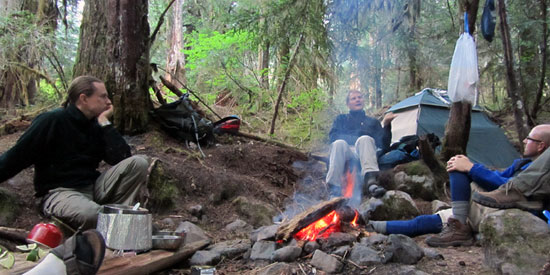
Paul, Tim, and Andrew chatting around the campfire
“How do you define retirement?” Paul asked as he and I climbed into his truck to start the long drive home. “And when do you plan to retire?”
I thought for a moment. “Are those rhetorical questions?” I asked. “Or are you really asking me when I plan to retire?”
“I’m asking you when you plan to retire,” Paul said. “Because in a lot of ways, you already seem retired. You do what you want when you want. You have time to travel and to pursue your hobbies and that sort of thing. Yet when I think of you, I don’t think of you as retired — I think of you as working.”
I had to think about this some more. “I don’t know,” I said at last. “I’m not sure I know what retirement is, and I don’t know when I plan to retire.”
“The thing is,” I said, “none of my family ever retired. Well, that’s not true — my mother’s father retired, but I didn’t know him well. On my dad’s side of the family, the side I really know, nobody retired. Part of that was because so many of them died young. They never got a chance to retire. But I remember that when my grandpa — who worked as a janitor at the high school — when he ‘retired’, he still worked. He didn’t work for money, but he ran a working farm until he was 75 or 80 years old.”
Then I realized I could be clever. If I couldn’t define retirement, if I couldn’t say when I wanted to retire, maybe Paul could. So I asked him. “What does retirement mean to you?” I said.
“Well, to me retirement is not having to do something for money,” Paul said. “If I was working at one thing and wanted to do something else, I could do it and not have to worry.”
“That sounds like Financial Independence,” I said (though I couldn’t capitalize the “F” and the “I” while speaking). “Actually, that’s a good way to look at retirement. In many ways, Financial Independence and retirement are the same thing. They both mean that you have enough money that you can afford to do what you want, right?”
Paul nodded. “Sometimes I think that retirement isn’t about the money,” he said. “The thing I wish I had is more time. I spend too much time doing things I don’t want to do for money. I guess I could have time to do the stuff I want, but to do so would require more sacrifices than I’m willing to make. I’m frugal, but I have limits. If I could make money doing something I enjoy, I wouldn’t have to retire. And that’s what it seems like you do.”
“Ahhh…” I said. Now I could see why Paul had asked the original question, why he wanted to know my definition of retirement and when I planned to retire. To him, I was already living the sort of life that he wants when he retires.
Paul continued: “I’ve been talking with Tiffany” — his girlfriend, and my wife’s sister — “and I’ve been wondering: What if I got to a point where yes, I had to work, but I could choose any job I wanted, even if it paid minimum wage? Maybe I could work in a music store.”
“Right,” I said. “I know what you mean. And actually, you’ve sort of hit on something that’s in one of my favorite books. It’s called Work Less, Live More by Bob Clyatt. It’s all about what he calls ‘semi-retirement’. Semi-retirement is like early retirement except that you’d continue to earn money from sort of work. I think it’s much more realistic for most people than a traditional retirement.”
“I’ll have to check it out,” Paul said.
“You know, I’m going to have to write about this conversation,” I said. “And when I do, I’ll add a bit of detail about semi-retirement from the book.”
A bit of detailIn Work Less, Live More, Bob Clyatt explains the advantages of semi-retirement:
“With a modest income from part-time work, early semi-retirees may not have to face the dramatic downshifting in spending and lifestyle that so often confronts those who live only on savings or pensions. And semi-retirees learn that a reasonable amount of work, even unpaid work, keeps them energized, contributing, and sharp.”
Though semi-retirement is more realistic than early retirement for most people, it’s still not for the faint of heart. You have to be dedicated and work hard to make it happen. Semi-retirement usually requires ample savings, frugal living, ongoing work, exploration, and a sense of purpose.
“I don’t know when I want to retire,” I said. “But I don’t think of myself as retired now, though I can see why it might look that way. To be honest, I don’t want to retire. I have purpose now, and I like it. For so long, my life had no purpose, and I think that’s why I struggled with depression. Having purpose has changed my life, has giving me a sense of meaning.”
Paul quickly noted my flawed logic. “Wait a minute,” he said. “That pre-supposes that retirement has no purpose.”
“Good point,” I said. “You’re right. And actually, I think it’s very important for everyone to find some sort of purpose, whether they’re retired or not.”
Just then, we reached the Gingerbread House, our pit stop for lunch. We went inside and ordered our burgers and malted milkshakes (Paul ordered double malt), and as the rest of the group arrived our conversation turned from retirement to more mundane things. Plus, we all hunched over our iPhones, catching up on 48 hours of e-mail and text messages.
Later in the day, I thought more about our conversation. The more I think about it, the more it seems that the traditional notion of retirement is something like a mirage. It’s not real. When I think about the people I know who have “retired”, I see that they’ve really just gently transitioned into some other phase of life, usually pursuing something they’re passionate about.
Ultimately, deciding when and how to leave the workforce isn’t about some number in a retirement account. It’s important for each of us to think about our goals and what makes us happy. So, when will I retire? Maybe if I’m lucky, I never will. I’ll just keep doing what I’m doing because it makes me happy and gives me a sense of purpose.
I’m in a similar place. According to some people’s definition of retirement, I’m retired right now. According to other people’s definition, I have absolutely no plan to retire at any point.
I’ve started to wonder whether retirement (at least, the traditional stop-working-completely version of it) is becoming obsolete.
It’s only existed for a very short portion of human history.
It’s becoming less and less necessary as fewer people do physical work that would require quitting in their 60s.
At the same time, it’s becoming less and less possible as we live longer and longer and require larger nest eggs in order to retire.
“…I see that they’ve really just gently transitioned into some other phase of life…”
As I’ve gotten older, I’ve realized that much in life isn’t about clear breaks, stops and then go’s like it used to be when you’re young. Back then you had school then a celebration and a summer break. Then another school year and eventually you celebrate because you graduate. Then you start working and “life” begins and there is no party, no celebration, just…life.
When I was young I waited for life to begin, like it was supposed to be this awesome, long party. Life isn’t like that but more exactly like you said; a gradual transition into a different phase.
My mother is semi-retired. She had been working all her life and finally her body started giving up. She experienced burnout and started having health issues so she had to cut back.
If you think about it, we don’t necessarily retire from working or earning. We actually retire from saving, whether or not we continue working in one form or another.
The point we transition from being from net savers to net spenders for the remainder of our lives, supplementing our living expenses from the nest eggs we’ve created, that’s when we are actually (technically) retired. It doesn’t really matter what we do or how active we are. We’re just not usually adding regularly to our nest egg any more in retirement.
To me, retirement is all about having the luxury of choice in how one spends the day. Doesn’t matter if it’s working for a paycheck, loafing, pursuing hobbies, etc. I want to do art. That takes long periods of sustained concentration, but by the time I get an idea going, it’s time to go back to work on Monday. The result is I never seem to reach the level of work I feel I could do, simply because of time constraints.
Whether you like it or not, J.D., you might just be ‘retired’ as most people see it. You gave up the job at the factory to pursue blogging full-time. And now that you have, you have a passion about it. You’re doing what you want to do. Question is: If the money stopped coming in tomorrow, would you still run this blog?
I have known people save and save for retirement, only to find themselves bored out of their minds when they didn’t have their day-to-day jobs.
I think the definition of retirement may have evolved somewhat. Where I grew up, people put in their time at the automotive plant or wherever, and then retired. It was very clearly defined. Now, with the internet and such, people have more options. There aren’t as many ’30 and out’ jobs, where people clearly retire. Now, people might consult part time to keep their minds busy or whatever.
To me, retirement is when you can afford to not work at all and you are just doing whatever the heck you want, regardless of if a paycheck is involved.
What beautiful pictures.
As to the question of what is retirement, you’d think economists would have this one down, eh?
Actually, every single talk I go to about retirement starts with a question from the audience, “How are you defining retirement?” It’s an important question because there are a million different definitions. The line between retirement and unemployment blurs a lot after you reach age 50.
The two most common definitions are:
1. Had been working, but now not working.
2. Self-defined retirement.
#1 is no good because a lot of people aren’t actually retired, but involuntarily unemployed. #2 is no good because people themselves have different definitions of retirement and these vary a lot by specific demographic group characteristics (age, gender, whether your kids are in college, etc.)
Some people come up with more complicated definitions:
not working for more than X amount of time
not working AND saying they’re retired
not working AND drawing pension income
moving from a career job (that has been worked at for more than Y years) to either not working OR a part-time (bridge) job
etc.
There’s also :
Taking pension or social security income. This one is never very good unless they’re specifically looking at the effects of getting pension or SS.
All these different definitions give different pictures. Retirement is impossible to define which makes it hard to measure, so instead we measure what we can measure.
I hope you keep working for a long long time!
p.s. #1 Mike Piper, there HAS been an increase in taking bridge jobs, at least since the 1990s. (experts: Charles Ruhm, Joe Quinn) Boomers report wanting to work to older ages and in part-time situations as they retire (Abraham and Houseman and countless AARP studies). There’s also been an increase in unretirement (expert: Nicole Maestas). So what you’re talking about is a real phenomenon documented in the Health and Retirement Study.
My husband rented this book from the library after reading a recent article of yours. We read it together as we camped and had a whole weekend of discussing our dreams about this around camp. Thanks for the wonderful recommendation!
I’ll accept that there are different definitions and stages of retirement, but I don’t see how changing careers qualifies.
To me, retirement would mean having the time and financial situation to wake up every morning and do what I wanted to do, and not be a slave to the routine of a job or even family obligations. I wouldn’t consider myself retired until after my kids have moved away and started their own lives, and I am not required to work to keep the financials in order.
My wife and I both love to travel and take pictures, and once we have our accounts in order where we don’t have to work, we want to buy a house near a beach and focus more on our hobbies and passions, because we will have the time for it.
I have a feeling that too much free-time given to the people with a set routine is what causes the semi-retirement phase. I might even pick up a job at a certain blue electronics store for a while to use the discount and get me out of the house for a few hours a day. But then again, if you love what you do, and don’t want to quit, then why do it if you don’t have to?
I know the trouble of semi-retirement since I could be there now. I am doing less of my day job and more ‘fun’ work like freelance writing.. The result is I am not sure when I will retire as I try to do less day job and more other work.
Money Smarts (#9) – I think changing a career is an important aspect of retirement. Maybe someone has the means to make volunteer work a career, or they can afford to take a low-paying job that interests them.
And I think Mike (#1) hit the nail on the head. There are a lot of people who thought they could retire at the age of 65, but now with the recession eating away at their savings, it’s becoming less and less likely they can do that.
JD (and other readers/commenters),
I have a question for you about this post and I hope you will be able to personally answer. I also hope I’m able to make myself clear, but I’m a little confused about this topic myself.
Let’s start with the assumption that I believe retirement=financial independence. Like Kris, I want to retire in mid-50’s. I am 24. It seems like money = freedom and liquid money is far better than locked-up assets (during “retirement). So, because of the penalties and requirements of having to be a certain age to withdrawal money from a 401(k) and/or Roth IRA, does it really make sense to invest in these vehicles? Don’t I also need to be investing in something quite similiar that doesn’t have the legal age requirements for withdrawal? If I do the “good girl” thing and max out my “retirement” contributions, won’t I be cash-poor from the ages of 52 to 65? Isn’t that the exact opposite of financial independence? I have money, but I am a slave to the legal requirements of withdrawal. That seems to be a close analogy to having money but being a slave to creditors. Is the true purpose of money to not only have some of it, but to be able to have total independence of how it is managed/spent?
Of course, I don’t want to miss out on the tax benefits of 401(k) and Roth and even traditional IRA. So I’m not sure where to go. I recently got a massive raise at work (about $20k more/year — I finished my Masters) and I want to be sure to use the majority of this money for my future financial independence. I’m just not sure what to do. The typical retirement model just doesn’t work for me (like in this post), so I’m not sure the typical retirement savings model will work either.
Your thoughts???
Elaine
If you plan to live a long, healthy, active life, then it’s important to enjoy each phase of work/retirement. My husband and I have chosen to work fewer hours (I stay home and he works 30 hrs/week) while our kids are young, so we can enjoy these years fully. Because he’s self-employed at home and takes all Fridays off, plus any vacation time he chooses, it looks to the world like he’s already semi-retired. However, he still is somewhat controlled by meetings and client needs.
For us to be truly retired, my husband would have to stop working as an engineer and gain total control over his work choices. We would probably renovate houses for extra cash, on our own time frame. (We do that now as a hobby.)
But retirement is not total control over life itself. There will always be challenges. The work you choose to do in retirement becomes an optional challenge, versus one that’s required or thrown at you. (Complete and total freedom from all responsibility is also called “death”.)
My grandfather has “retired” 5 times, although, if his doctor has his say, this last one will be the last. He started out in the NJ National Guard and working for the Guard – there is a difference. After he retired from the military in his early 50’s, he continued to work for the Guard as a civilian for another 10 years. After he retired, he promptly started working for the Guard again in another capacity until the project was completed. He then ran a gas station for a number of years and recently left the garage he worked for due to health concerns.
Somewhere along the line, retirement went from being the time that you could no longer work to the time when you no longer had to work. And that’s where the angst comes in with regard to questions like “when should I retire?” and “what should I do when I retire?”
I am the “homemaker” as my mother and grandmother were before me – the difference is that I took 25 years out of that to go into the work force. Loving being home- reading, vacuuming and making great meals- while my husband does his wood working. It is definitely comfortable and renewing. I will be substitute teaching- my husband pulls a pension.
To us retirement means that we can take off and do something at a moment’s notice. Otherwise we are caring for family or our small farm.
To us there is a small window between 60 and 70 that you need to squeeze in the things you haven’t done with your family yet. My husband is there- so we “retired” together.
I like the idea of a semi-retirement. I think I would drive myself crazy just sitting around all day. Work isn’t *that* bad when you’re doing work that’s meaningful and that you enjoy =)
Elaine,
I believe you can take penalty-free withdrawals from your retirement accounts beginning at age 59.5. You wouldn’t have to wait until 65. And you’re right that you absolutely can’t neglect the tax benefits of those accounts.
My amateur advice for now would be to first maximize your savings in those accounts. If all goes as planned, then when you’re in your early or mid-40’s you can start to re-evaluate your position and goals and still have plenty of time to fund your non-qualified accounts to get you through the early retirement years (52-59.5).
But so much can change between now and then. Personally, family and kids can change your plans entirely. Also, since we’re talking about something that is over three decades away for you, the laws will surely be different.
So, my recommendation is to maximize the efficiencies available to you now in the tax-advantaged plans. There will be plenty of time to fudge the margins down the road.
To Elaine (#12) – That is such a good question! Do you put tons of money into retirement vehicles at a young age, knowing you can’t have access to it for such a long time?
We struggled with this question for many years, and have come to some conclusions. First, if you get a 401k match at work, absolutely max it out. No stock market gains will out perform a guaranteed match.
Second, the Roth version of retirement savings does allow you to take out any contributions you’ve made without penalty. You just can’t take out the earnings. So contribute freely to a Roth.
However, the benefits of tax deferral on other retirement savings are questionable. For us, putting that money into regular, taxable accounts and having access to it has allowed us to make some very important financial choices – starting a business, paying off our mortgage, paying college bills, and now buying houses to renovate for profit. (Buying in cash allows us more time to fix them up without mortgage interest taking our profits.)
Putting savings into actual retirement funds is not the most important choice. The act of saving itself is the biggest contribution to your future.
Elaine, you’ve asked a rather complicated question. 🙂
As Trina says above, money that you contribute to a Roth can come out free of tax and penalty at any time. It’s only earnings that require you to wait.
Also, you may want to look into what’s known as 72(t) distributions. (The name comes from the section of the Internal Revenue Code that allows for them.) They’re a way to start pulling money out of an IRA prior to age 59.5 without penalties.
I love to be productive, so I can’t see myself ever being retired the way most people view it – golfing or fishing, traveling, sitting around, etc. I can’t imagine working one day, then dropping off the map the next day – the way traditional retirement.
I prefer a more gradual phasing down, similar to what my grandfather did. He owned a barber shop for his entire career. When he neared retirement age, he sold it but continued working there. I know they probably didn’t need the money, but he enjoyed it. He slowly transitioned to working less and less until he completely retired. This probably took 10 years.
If I found something I really liked to do and it would earn me a little spending money, that would be the best option. I’d like to semi-retire in a few years when our kids are in school and be able to set my schedule much like JD does now.
PS – JD you have some cool friends. I can’t imagine talking about stuff like that with my current group. Perhaps I need to branch out?
How about when you start collecting pensions?
There’s a guy at work who has 62 years of service. I think he’s collecting his work pension, social security and his regular paycheck.
At this point, could working be considered a hobby? He works his butt off even though he’s like 80 something. He gives away a lot of his money to family and buys lots of toys with it. I think he just likes not thinking about how much money he’s spending.
I think “retirement” for me will just be moving out of my current field, sort of how a professional athlete “retires” — they stop playing their sport, but that doesn’t imply they give up doing all productive or paid work. They may become a coach or otherwise involved in some other aspect surrounding their sport, or they may start a completely unrelated business.
I’ll probably “retire” from software someday, but that doesn’t mean I wont be earning any money. For now, software is lucrative and challenging in a way I enjoy, so I see no reason to move out of this field in the near future — I’ll probably do this for another 20 years or more. After that, who knows, maybe I’ll “retire” and take up some other profession.
My retirement philosophy has changed from save, save, save and take early retirement, to save responsibly and plan on working in some capacity beyond normal retirement (67 y.o.). I liked Dylan’s one liner about retirement being “the point we transition from being from net savers to net spenders for the remainder of our lives”.
I would rather enjoy life now while my wife and children are young, than to wait until I was 62 to start having fun. I also realize that my health might not allow me to work until/beyond 67, so I’d better plan accordingly.
I’ve been “retired” since the age of 37 but it had nothing to do with “financial independence.”
My definition of retirement is “to do what I want, when I want, within reason.”
When I started my own business, I considered myself retired because I started doing what I wanted.
I work more than 50 hours per week but I don’t consider it “work” because I enjoy what I do and I choose my own hours (within reason).
I also get to see my two young boys more than ever before.
Retirement and work can share the same meaning, as long as you are doing what you want…
Excellent post, by the way…
Kent
Wow J.D. this is some good stuff. I’ve read Work Less, Live More in the past but I think I need to revisit it.
For me, retirement is not being forced to work for money, as some of the other commenters have said. I honestly cannot see myself never doing some type of work until I’m not physically able to (hopefully never).
That is also a good point that some people see you as retired now since you have the freedom to do what you want when you want. I think that is one of the biggest arguments for owning your own business. Granted you still have obligations, but you can fulfill them on your time, not when your boss tells you.
Seems like a matter of semantics. Mr. BFS and I plan to “retire” at age 52. To us, that simply means having enough money saved and from his full pension to do whatever we want from age 52 on…so what you called financial independence is also my idea of retirement.
If I am doing something I love (like blogging), I won’t quit. But, I will leave the jobs I don’t enjoy in order to volunteer more (my dream job is volunteering full time…a great feeling of accomplishment and most people LOVE you, lol…). 🙂
My grandfather retired from his career job at 60 and they moved to their dream home in a resort area. They continued to work pretty darn hard at managing their real estate portfolio. They worked hard during the summer (real estate was located in the same summer resort area) and they traveled and relaxed during the other 9 mos. 10 years later, at about 70, they started downsizing their portfolio over the course of 5-10 years. By the time they were 80 they were fully retired. During this same time period, from 60-80, they both were involved in volunteer work as well.
They have remained generally active and generally in good health since they fully retired, 20 years after grandpa’s corporate retirement.
I think it will be much more difficult for our generation in that my grandfather had a defined pension and had health benefits for him and my grandmother until Medicare kicked in and they continue to have supplemental health benefits via corporate benefits to this day.
My husband’s father has semi-retired and then really retired recently and the cost of health insurance, he is not old enough for Medicare, is staggering.
And this is why I keep coming back to read your blog. Excellent post, thought provoking, and a great story all in one.
Thanks – this was a great way to start a Monday!
I like the fact that retirement is so hard to define, it’s different strokes for different folks.
My mother retired from the corporate world and now pet sits small dogs in her home. She’s always been an animal lover and loves her new business.
My husband’s father retired from the corporate world, and now at age 74 likes to work occasionally on ranches and farms doing fence mending and other odd jobs. He’s fit and active and very happy.
As for myself – I’ve been working full time since I was 17 (I joined the military for educational $$). I like having goals and I enjoy working. I’m least happy when I feel like I’m stagnating.
For me, retirement will mean shifting gears. I currently work 32-35 hours a week from home (telecommute for my employer), whatever hours I choose. So that is very liberating and allows me to pursue other passions.
I’m passionate about the surge in small, sustainable farms and the local food movement. I’m 48, and 2 years ago I purchased a home on 4 acres and am now studying permaculture gardening and small scale farming. This fall the deer fencing goes up and the project begins. I’ll probably shift more to that and downscale my work hours at my regular job (jobshare friendly) once I hit my 60s.
63% of retirees are dissatisfied in total retirement (not working at all). The majority of their time is spent in front of the t.v. That’s just not for me. I’d rather drop dead with a smile on my face, covered in chicken feathers and shoveling compost! When you love what you do, it’s not work.
My grandmother and father-in-law are both retired and it definitely seems more like a “next phase” than just sitting back doing nothing. My grandmother does quite a bit of volunteer work for soup kitchens and a local orphanage. And my father-in-law is helping his son get a house painting business off the ground.
I think the best part of retirement for each of them is that they get to choose just how much they want to do. If they start burning out or find something else to do, they have the luxury of just walking away. I think it’s this freedom that each of us crave; whether you call it retirement or financial independence, we all just want to be our own master.
If you look into the history, retirement is actually a relatively new concept. Unless a person was rich, retirement was not an option because wages were never high enough to allow the average person to save enough to stop working. The Social Security program changes that but that, again, is a relatively new concept. For the average working Joe or Jane, life was divided into three rather straight forward phases – childhood (birth until one was able to work – typically about 6 yrs old), work (something that continued until one was no longer able because of either sickness or death), and old age (like childhood, a rather short period which required someone else’s care). That was all there was. Retiring to ‘the good life’…not really an option until a little less than a century ago. If we are not careful, times might revert back…
We are 2 months into what I call semi-retirement. I think if you asked this question 30 years ago, it would have been an easy answer. Save, then spend it. Now, after watching patients life savings reduced 60% that’s not possible for many now. Plus, the advent of the internet has changed the game. The question we wrestle with for the first time is how does a society leave industrial revolution thinking. This is the first generation to challenge the norm we grew up with. I’m your age and are at the fringe of old and new thinking.
Normally I don’t comment but your post was most fitting. I’m taking a break from fly-fishing the Umpqua in Elkton, Oregon to “work”. We camp full time because we love everything about it. The creativity it generates is amazing. I can see why you take the trip to the woods.
I used to see patients 50 hours a week and the stress was starting to affect my life. We figured out how to salvage an internet business and start a new one. We decided to start living, you may call it retirement, but we do what we want and go where we want, when we want. I ran the numbers and a passive internet business or even a semi-passive blog that produces some money is like having $400,000 saved, except you don’t have to wait. I wish I could remember the blog I read this on, but they were making the analogy that it is much better to invest in “freedom”. Meaning to invest in a self sustaining business.
This is a true story. When we pulled into Elkton the guy next to me had been retired for 2 weeks. He was a pathologist from San Francisco. He was at least 20 years older than me. Sold his house and practice and bought a RV and was traveling Oregon fishing. He assumed I was on “vacation” and I still remember his comment. “In 40 years you can maybe do this”. He was a little stunned when I told him I’d been on the road for the past 60 days. He confirmed that we did the right thing and are living the life we want right now, not 40 years from now. Plus we have 3 kids along. How cool is that.
Thanks for a post that inspired me.
One more comment I think is worth making:
So many are talking about doing “what they want, when they want” as if this is some sort of attainable goal. We all have things we don’t really want to do, but we have to do: We wash dishes. We stand in line at the DMV to renew our car registrations. We attend boring family functions for the benefit of distant relatives. We mail checks to electric companies. We call our ISPs tech support line and get routed through India to someone who can’t fix our problem. We take off our shoes to go through the airport metal detector.
Retirement or not, we *always* have a certain set of things we do not out of desire but out of responsibility. This is what separates adults from children, not what separates the “retired” or “financially free” from the average working man or woman.
You can make an argument based on scale: 40 hours a week of obligations is too much for retirement, but maybe 5 hours a week isn’t? There’s a bit of validity in that, but wait until you end up spending a week in the hospital with an ill spouse. That’s not really a place you want to be, or a thing you want to be going through. It has no bearing on the state of your retirement, though. Or wait until you have an elderly parent fall ill, and you spend 4 hours a day helping them to get by. Does this affect your retirement state?
Retirement and lack of responsibility are two different things.
One thing I’m not seeing in this nor the comments is the incredible impact of health care costs. I’m 45 and very close to being able to live off of my savings and investments. Truly one the main reasons I’ll keep working is for the health care coverage. The cost of health care/major illness can wipe out retirement savings quickly. Given my family history and my current health, I’ll probably live till my 90s. Without an illness I’ll do fine with my current savings; but with an illness that (could) wipe out too much of the savings and leave me in a poorhouse for the last 10-15 years of my life. That health care scare situation makes it very unlikely I’ll retire early.
I used the word “retirement” for years before I realized it confused a lot of people (“you are too young to retire!”).
I now tell people my goal is financial independence with the additional goal of living to be 100 (a whole different subject – but it is about making good choices now so I can actively live that long – similar to saving now so one can “retire” later …).
I’m trying to imbue my kids with the notion that a good goal is to start working early on financial independence so they have the freedom to pursue what they want to do in life. Saying “save for retirement” had no meaning to a couple of pre-teens!
Interesting topic! I think the meaning it used to have is different today, that’s for sure.
I want to semi-retire by 55. For me that means I’m in a position to live off whatever money I’m bringing in, doing something I completely enjoy. My house will be paid off, no bills, so essentially I need enough coming in to cover my basics, like food and utilties. So, if I want to work 3 days a week at a little shop I enjoy, making minimum wage, as long it covers those expenses, and I don’t have to dip into any savings or retirement accounts to do so, then I will be semi-retired.
Full retirement, well, that would be not working at all. I see me being able to retire fully at 65, but not being able to travel and live the high life that I used to dream about. So, I kind of view full blown retirement as waiting for death. What am I going to do if I can’t travel and hang out ‘the club’? Sit in front of the TV all day? No thanks. So, I don’t plan to fully retire until my body will no longer allow me to work.
But I’m only 36 years old…I’m sure my plans and definition will change.
you should find some sort of happiness when you retire. whether you are looking to wind down, travel, or work part-time. either way the way i look at it whatever you want to do is up to you but one way to ensure some sort of happiness is having enough money saved up so you can do what you want and live stress free in doing so.
Don’t count on your health being there when you “retire”. I worked 60+ hours a week for 20 years, had to have spinal surgery, thought I would be back in 4 weeks and never went back. I take care of my 5 yr old and my wife works. Make time to enjoy your favorite activities,k particularly those requiring physical exertion. You never know what capacities you will still have at 65 that you take for granted at 30 or 40. Aging is life’s difficult secret we don’t think about till it happens to us
Why do so many people seem to assume that retirement is sitting around your house doing nothing?
The blanket assumption about retirement does seem to be, like leslie (39) mentioned, sitting around the house, doing nothing. My husband’s grandfather has been retired from his corporate job for over 20 years and is in his mid-80s. He volunteers 20-30 hours a week at a thrift store, does all the grocery shopping, volunteers for church events, works out 4-5 days a week at the gym, takes his wife to all her doctor’s appointments, helps care for his great-grandchildren… the list continues. He’s up at 7am or earlier most days and is active all day long. He and his wife travel several times a year, usually to visit family in other parts of the country. They’re surrounded by a large network of friends and family with whom they keep in close contact.
From his example, I think “retirement” and “financial independence” can mean the same things (they own their house outright, he has a pension, and they qualify for Medicare, so the essentials are covered). But it also means doing things that have a purpose beyond bringing in an income. He doesn’t get paid with money for anything he does, but his life has great purpose and he’s living each day to the fullest, which is a wonderful example to his kids (almost reaching retirement age, themselves) and grandkids.
@ Leslie #40, I can’t speak for anyone else, but I’ve got a few object lessons on “doing nothing” staring me in the face.
My parents-in-law. My paternal grandfather. My maternal grandmother. My paternal uncle and aunts.
A whole lot of old people whose lives revolve/d around TV, bridge, eating out, and the occasional game of golf. (Which to me is, at anything but the professional level, the sports equivalent of doing nothing.)
I imagine most of us have one set of family & friends who leave the working life for a life of active travel, volunteering, sports, whatever – and another set who think they’ve “done enough” and would rather just stay home with the TV, the crossword, and a weekly bridge date.
What we see represented in the media is more the second class of “retired” people, with the occasional cruise thrown in. It’s the image of retirement that was created in the 1970s with the Del Webb developments.
I oppose retirement.
The very word suggests the end of productivity, the end of usefulness and value. Who wants that? I derive joy from being useful to others (whether I get paid or not – tho’ I suppose paid is better).
Financial independence is one good alternative. But I think I particularly like the idea of freedom. Freedom to work (which may require cultural shifts in a country where older folks are supposed to be ‘retired’), freedom to play (which may require confidence in readily available healthcare), freedom to travel, to speak, to take risks – or to simply relax into a well-loved home. That’s not just about money – but it is my ultimate objective and drives my saving/investing activities.
#17 – that reminds me of the saying: Choose a job you love, and you will never have to work a day in your life – Confucius
Tyler,
I see the things you listed as choices as well:>) I choose to spend time with my husband in the hospital. I choose to spend time with my mother. I choose to pay the electric bill (rather than putting up solar panels). You may see them as responsibilities- but I see it all as a choice. I choose to retire and make my own choices on both time and money:>)
Retirement = working according to interest, values, and goals, not just for money
By that measurement, DH and I are semi-retired now — DH and I can afford to be choosy about our current work situations.
I agree with Barb about health insurance being an issue. I’m not sure I’d be looking at taking a full-time careerish job right now if we didn’t need the affordable medical coverage.
to retire and retirement are two completely different concepts and that is where the confusion/controversy lies.
To retire from someplace is to simply withdraw from a group and do something else or start drawing a pension. Either way, it’s an event.
Retirement is a state of being. I know plenty of folks who only spend a few months in this before they find more work to retire from.
Wow, I can’t wait to just be at home reading a book, watching TV, chatting with friends, out back gardening with absolutely no concern of when I have to get up and go in to the office.
I love my work, but I do it so I can get to that point where I don’t have to. I support myself, so it is up to me, I save and save so I can retire and stay at home.
Id issue a word of caution for the semi-retired. My father was semi-retired, having owned his own business that basically ran itself while he managed it part-time. When the economy crashed, his business crashed as well and suddenly he went from comfortably “semi-retired” to realizing he would have to go back to working full time for another ~15 years. So remember JD, your writing days could conceivably dissapear just as fast should something happen, and you could be staring at extreme early retirement or 15 years of full time box salesman again.
At work we sometimes talk about what we would do if we were financially independent.
I would like to pursue a path that you or Paul would follow. I don’t think being retired sitting on a porch swinging is for me!
It would be much better to be as mentally as sharp as you can, for as long as you can. And add value to society in the process!
Thanks for a great story, someday soon, I too would like to go on such a hiking trip! Sounds incredible!
It’s funny (or maybe sad) – it seems like most folks understand that retirement is about pursuing passions and have the freedom to choose whether you want to work full time or not; however, it also seems that the vast majority of Americans don’t make it to that point.
They work because they have to, or because they didn’t plan enough or save enough or whatever other reason there may be.
Is it because we talk more than we act? Maybe it’s because it takes hard work and discipline to get ourselves in position to “retire” when we want, how we want.
Or, perhaps we get so caught up in the American Dream and chasing our neighbors and coworkers lifestyles that we miss the point…
That True Wealth is not about commas or net worth -it’s about the quality of relationships, pursuing your passions and living life with purpose!
Great post J.D.!
My wife and I retired in May 2009 at age 56. People ask us, What do you do all day? Whatever we want, is the answer. We are both self-directed people with plenty of interests to keep us busy. We had lives outside of work while we were working. We now how more time for those lives, that’s all.
We’ve always lived well beneath our means, so there was no change in lifestyle when we retired. We just save a lot less money now.
My wife is a retired teacher, but she finds opportunities to “teach”. I’m a salesman. I’ve kept my hand in sales. We just don’t spend fifty hours a week at these endeavors anymore.
I think you’re bang-on when you talk about purpose; that really made me think of how Bill Gates retired. He didn’t leave Microsoft because he hated doing it or because he didn’t still enjoy managing people and making extremely important decisions. He left Microsoft so that he could devote his time to charities and making the world a better place.
I’m still a long, long way from retirement, but that’s definitely something I’d like to remember in 40 years or so.
I have to say my husband and I get looks like we have 3 heads when we say we are going to retire in 10 to 15 years (we are 29 and 30 now). LOL. Since we don’t have children (and definately don’t plan on having any in the future!), that obviously automatically negates having a retirement traveling around the country to see grandkids. LOL. Our version of retirement is actually opening a horse farm in a small town just outside a major state college in the midwest. If both of us teach there, even as part time adjucts, so we are still in our respective fields, we will run our horse farm because we want to. We also want to be a foster home to older teenagers who have been in the foster care system for several years. Give them a home, teach them about riding and responsibility, and maybe give them the idea they can go to college! So our retirement will have a purpose, and we will work because we want to, and granted this is the same as financial independence, which is ultimately our goal. We live a frugal life (but not by some other readers’ standards! My hats off to some of you guys!), and we save approximately 40% of our total net income. So our retirement is more a working retirement, but it is doing something that rejuvenates and fills the soul as oppose to the bank account!
Retirement to me means to do whatever I want whenever I want. If my wife and I want to take off for a few days in the car so be it. If we want to watch 2 movies in one day with lunch in-between, cool. Might even exercise and lose some weight. Semi retirement would work for me too. Work 2 or 3 days a week, to keep benefits and cover expenses so be it.
My roadmap to get there: be debt free specifically the mortgage, have enough dividend stocks that will pay the expenses and the part time job for extra spending money and to keep the benefits.
Nice photos. Do your friends ever tell you “Don’t write about this or me, on your blog?” lol 😀 You know I’m just kidding right? 🙂
Its funny that you published a post about retirement, because I just paid off all my debt so I’m thinking about my next financial goals in life. I want to finish my bachelor’s degree, I’m 27, but I also want to focus on retirement and traveling. I’ve become very frustrated at a lot of retirement advice out there.
There is so much advice out there, a lot of the experts don’t even agree with each other. Some say to save $1 million. Someone else comes in and says “that’s not enough, you need at least $4 million.” Some finance journalists say that Americans are saving too much and need to live it up a little.
Bob’s advice seems to be written for people who didn’t really think about retirement until their later years. There are some people who won’t be able to retire because of poor financial choices early in life and it seems that he is trying to reach those people with that book.
I’m not trying to be rude or anything, but I didn’t really care for Bob’s book while its very well written because I really don’t like the idea of working part-time as a senior. I really don’t.
And you know a lot of finance journalists are starting to realize that a lot of people won’t be able to retire completely so they’re telling them that full-retirement is out of the reach. But I really don’t want to work until old age.
It seems that if people want to retire well they have to live below their means throughout their lives even in their 20s and 30s, buy only as much house as they need even with a family and not any more, and to avoid debt. It also helps if you go against the norm and choose a state with low cost of living.
That way when they get older they don’t have to worry about downsizing and having a shock to their lifestyle. They can just carry on because they always lived below their means so retiring isn’t going to be such a shock to their pocketbook. I know because my parents are doing this and no they’re not miserable. They are happy.
Then there are the people who irritate me and blame Obama, Bush, Clinton, Mccain, their governor, some other politician, the social security administration, etc. for reducing their retirement savings, etc.
I really hate this because its not a politician’s job to coddle Americans. I mean really, unless someone is mentally disabled or have some disease like dementia, its really our job to take care of ourselves. To me retirement means having enough money for my needs, wants and some luxuries without working for a paycheck. Although to me a luxury is traveling and not shopping for leisure.
Also what is up with financial journalists that tell you to save $4 million for retirement. Seriously. Aside from the basic needs and wants and some luxuries, where else would I use that money on? I don’t intend on using it on mansions, yachts or shopping at Chanel.
Even if I were a multimillionaire, buying stuff gets old (I know I used to be in debt) and you need something more interesting to do in life besides own stuff. I think some people fear retirement because it means the end of an era, but people are not their jobs.
Sometimes I cringe when people say they love their job and don’t want to retire. I think its important to have skills so that you can go anywhere in the world and do whatever you did before even if you are retired.
It seems that people fear retirement because it means that they’re not valuable anymore, that what they did can’t be done somewhere else in the world and that’s not true. You can always use what you learned as a career somewhere else in life.
A write can always write, a nurse can always get licensed somewhere else, an accountant can help others with their money even after they retired from their accounting job at a corporation.
Some people choose to do nothing in retirement and others like being active. I think its different for everyone, anyway thanks for letting me vent. 🙂
Brenton-my mom has a business that she’s going to sell soon, if a person saves during the “fat” years of their business, then they don’t always have to work for another 15 years.
My mom is basically done with her business and wants to be retired already, my step-dad is already retired so she just wants to join him. JD has said that he saves, so I don’t think that he will have to go back to the box business should something happen to GRS, since he has savings then he should be just fine.
Also if a person saves more than they spend throughout good economic times, then they can do very well during lean economic times. I think its possible to save more than 10% of ones paycheck. Its all about controlling spending and avoiding all debt.
Besides writing is like any other profession, writers can find work writing about something else.
Tyler K- I disagree with you. I’m 27 and I learned you don’t have to do things you don’t want to do. I don’t have to work, I could be on welfare but I’m not, I CHOOSE to work. I don’t spend time with distant relatives. Why should I? It never made me happy to spend time with people that I wasn’t close to. I’m nice to everyone but I only spend time with my closest cousins and aunties and uncles.
I go to the DMV because I like driving my car and its not something that makes me miserable. In fact nothing in this world tells you that you need to drive, you could easily take the bus or a bike. That is a choice, not an obligation. When I got into debt that was a choice too. I got out of debt because I wanted it badly enough and have No debt anymore.
I’m saving for retirement because I want to make sure my basic needs and basic wants get covered. I don’t buy a lot of stuff anymore and that is a choice. I have chosen to be a minimalist after getting out of debt. I chose to move from the very active West Coast to a quiet mid-west state because there are jobs here and the cost of living is more affordable. Life is about choices. Life doesn’t have to be about despair.
A lot of obligations that you mention don’t have to be obligations if you don’t want them to be.
“The more I think about it, the more it seems that the traditional notion of retirement is something like a mirage. It’s not real.”
I was about to say that you’re right in the current economy, which makes retirement a very sketchy matter indeed. However, on reflection it strikes me that “mirage” has been the operative term for a lot longer than we think.
My father, a merchant mariner, retired in 1962, thinking he was set for life. He’d reached his lifelong savings goal at 53, after 36 years of very hard work, assiduous saving, and stringent frugality.
Within a year or two he went back to sea, not (I think) because he wanted to but because he felt he needed more money…and, I suspect, because life on land was less idyllic than he anticipated. When a health problem forced him to quit again, he did OK in retirement until double-digit inflation struck during the 1970s. That decade’s inflation effectively robbed him of his life savings, so that by the time it was over he had way too little to live on comfortably. Even though he remarried, after my mother died, and the new wife had a teacher’s pension as well as Social Security, together they didn’t have enough to live well.
I intend to keep on working part-time until I can’t dodder into the classroom anymore. Not because I want to, but because I don’t believe any amount of savings, short of eight or ten million dollars, is likely to retain its value long enough to support one through an extended period of old age.
i’ll never retire! ..just want to leave my tv job where i lie to the public for a living and get a job where eveyone lies to me for a change.
Good stuff–but it also begs the point that you need to define for yourself what you want your retirement to be before you can actually set you goal to achieve.
Kind of hard to work towards a goal if it is not clearly defined.
Being laid off at age 26 last December gave me good insight as to what it is to retire.
Basically collecting unemployment checks (aka “Social Security”) and having all the time I wanted mirrored what retirement might be like decades down the road.
To me, it was a self-reflecting time. I was not sure how to productively use all of my time, and to be honest, I was usually bored. My wife still had her full time job so it was just me and my dog every day. To give me something to do, I walked my neighbor’s dog every weekday and did some house projects.
I believe there are lots of people who can’t wait to retire and not work, but the question really becomes besides work, what is your real purpose? What will you do with your time?
Some people might have a difficult time answering theses questions, I know I did. Lots will say well I will start a garden, travel, visit family. This will certainly take up some time, but I am not sure these folks realize just how MUCH time you will have.
I was 26 when I had to think of these questions and I still do not know the answer.
I have a job now that takes 10 hours of my weekdays away. What would I be doing with this time if not working? Hmmmm
Elaine– I agree with the poster who said to max out retirement accounts NOW if you’re planning on leaving the workforce early. When you’re early retired you can’t add to them anymore. You can always see where you are when you hit your 40s or 50s and stop contributing then. (That’s close to what we’re doing… though I’m getting the spending bug for the house…want… new… drapes… We’ll see if it lasts.)
The French have a concept of “third life”, the time when your major obligations of raising a family and contributing to society are finished, but your health hasn’t fallen apart yet. This is viewed as an incredibly creative place to be, where you can develop skills, learn something new, travel, etc. I like it better than retirement, and am looking forward to my third life.
Easing into it, I am starting back to school in the fall, to prepare for a new career which I will be able to pursue part time while traveling. We are also considering getting a conversion van, so we can travel without going broke. Planning for the third life is becoming as exciting as planning for our wedding, all those years ago!
This is a very interesting and thought provoking post. I tried retirement once about 9 years ago after 25 years of management and entrepreneurship. It lasted about a year until I was so bored I went back into the workforce. I didn’t go back into a supervisory postion nor did I start another business, but instead took a much less stressful individual producer role. I have also added my blog to my “work”. I don’t consider myself retired, but it sure feels like it to me. Quality of life is so important.
My friend Joseph Carrozza got burned from bad investments when he tried to retire early.
I agree with many folks who define retirement as not “having” to work. But I qualify that to add either “not working” or “choosing to work.”
If you don’t “have” to work based purely on the “math,” and maintain your current lifestyle easily off of the interest but for some reason (paranoia, fear), you keep working at a job you hate, that is not “choosing to work,” in my opinion. Those people are definitely NOT retired. But if you love your job and don’t need the money, you’re retired to me whether you work or not. (i.e The people I’m talking about could live off of a very, very low interest or dividends using current assets (not a complicated, overly risky or complicated investment “plan” that only works if everything goes right – if then.))
On the other end, if you COULD work, but CHOOSE NOT TO, instead claiming you’re “retired,” but in reality you “have” to work to live your life (without getting into crazy debt), you’re not retired to me.
There’s my short answer…
One more thing – in the end I agree that it is personal. Some people see “retirement” as actually sitting on the beach with no worries. Others see it as starting a charity and giving back. Who am I to judge, I guess.
Retirement is having the ability to do whatever projects you want, regardless of the earn-ability of those projects.
My partner and I are working towards retirement. We’re both 40. I work for myself. He works for a company. We hope to have enough saved so that he can retire by the time he’s 50. I like to work, so I don’t intend on retiring until I’m in my 60’s somewhere. I also work by phone with many of my clients, so I can work anywhere.
So we’re learning how to sail, and we’re going to get a boat and sail all over the place, and I’m going to keep working “remotely”. He can do whatever he wants with his time, and I can do what I want with mine, which is my work.
Bridget
Thank you so much for this post. I’m 25 and my husband is 28, and we recently had a discussion about retirement after attending a financial planning dinner. I am seeking ordination to the Episcopal priesthood, and my husband is an anesthesiologist, currently doing his residency. We both feel that we are called to our professions, and subsequently, don’t ever really plan on going into full retirement. My great-uncle, also a clergy-person, worked in churches until he died, but backed off substantially when he “retired”. Of course, we want to travel and not feel pressure to make money just to survive, but full retirement just does not appeal to us. Like your final quote about not retiring because you’re happy doing what you’re doing, that is our plan as well. Thank you.
I’m not sure exactly what to call it,maybe living on your own terms.
At 42, everything is paid off(including mortgage 3 years ago) I am a self employed contractor, love my job and customers, and can make enough money two to three days a week to provide enough to support my family if I wish. I have a 2 years of e-funds available if needed.My wife works part time at a job that she enjoys. I love having the freedom to either work like a dog if needed, or take a couple extra days off and enjoy my kids while they’re still young and still enjoy being with me.
Having said that, I realize after 20 years in the stock market that I’m not going to retire with 2 mill. in my portfolio. I’ll probably still be working to some degree at 70, that’s why I work out 6 days a week and live a healthy lifestyle.
I’m not sure exactly what to call it,maybe living on your own terms.
At 42, everything is paid off(including mortgage 3 years ago) I am a self employed contractor, love my job and customers, and can make enough money two to three days a week to provide enough to support my family if I wish. I have a 2 years of e-funds available if needed.My wife works part time at a job that she enjoys. I love having the freedom to either work like a dog if needed, or take a couple extra days off and enjoy my kids while they’re still young and still enjoy being with me.
Having said that, I realize after 20 years in the stock market that I’m not going to retire with 2 mill. in my portfolio. I’ll probably still be working to some degree at 70, that’s why I work out 6 days a week and live a healthy lifestyle.
JD,
I have been a reader for about a year. I have never posted, but I am glad I found your wisdom. Thanks for stopping at the Gingerbread House. I am from Northern California and my Grandparents took me there many times and now I take my son and husband there, it’s the pleasant smell of my childhood. I think most falsly equate retired as financially independent. I know that we are laking in that department. Thanks for the info so that we can slowly change our outcome.
Retirement is simply Life After Work.
I worked (job, then business) then, at 49, I stopped.
Now, I ‘work’ on projects – because I want to.
Now, I travel a lot – because I want to.
Now, I write my blog – because I want to teach others what I have learned about money.
Tomorrow, if I decide that I no longer want to do any/all of the above, I simply STOP …
… because I am retired. The minute I HAVE to do any of these things, because I cannot (financially) afford NOT to, then I am NO LONGER RETIRED.
Simple 🙂
I’ve been retired for 2 1/2 years now (retired at 44). If there was one myth I could dispel it would be this, that retirement somehow strips you of your inherent personality and makes you sit on the couch and watch TV all day. I mean sure, if you love TV and want to watch, go ahead. But anyone that says “I would hate to be retired and do (fill-in-the-blank) all day.” I wonder why the heck you would do (fill-in-the-blank) all day. Why not do something you love to do all day? If that’s work, fine, but really, I think you’d be able to come up with something else you love if you just gave yourself the chance.
Really, zombies do not come remove your brain the day you retire and put in a new one requiring you to involve yourself in activities you hate all day. Really!
my husband & i retired in our 40s.
if you hang out for any amount of time on one of the early retirement sites, you’ll see that people have different ideas and *strong* opinions about what retirement is and isn’t. for example, some believe you aren’t retired if you still work. which i think is ridiculous.
retirement means to me the same thing it means to your sister-in-law’s boyfriend .. the financial freedom to do whatever i want. and that includes working if i feel like it, whether i’m paid or not.
My definition of retired is simple. When you no longer go to work for an employer that requires you to pay Social Security, and Medicare out of your paycheck. If you are a blogger, and receive your income, you are required to pay those (along with the other 6.5% your “employer” pays as you are self employed). When you are no longer going to work, but still draw a pension (and thus pay those taxes), you are still retired as you don’t go to work. If you are living off investment income, but you have to work at it (ie. look at the stock market, etc.) you are still working.
@13-Elaine: have you thought about getting an annuity? It is a very simple financial tool for you to save today and transfer your longevity risk to an insurance company. There are many different options so you will need good advice from a trusted financial advisor. Remember that his job is to sell you an insurance product. Be sure to include an inflation adjustement, in particular if your annuity will only start many years from now. I would probably not put all my eggs in the same basket (ie I would split my annuity between 2 or 3 carriers) and choose only those with excellent ratings. All the best!
PS: for me, retirement is to retire from ny current job functions and responsabilities and to pursue other interests because I reached financial independance, i.e. I am no more dependant on a steay pay cheque from a corporate work contract. It is not to retire from Life. In fact, I will be taking some classes to get a certification in accounting, so that I can help people or non-profit organizations with the finances. It will take a few years to make the shift, and it will be gradual until I retire from my current job.
By the way: Great post, great comments. Cheers!