The Value of a College Education Print
Thursday, 10th January 2008 (by J.D.)This article is about Career, Choices, Education
I’ve been thinking lately about the value of a college education. I earned a B.A. in Psychology from Willamette University in 1991 (with a minor in English Lit, and almost another minor in Speech Com). What have I done with this degree? Almost nothing. Yet I do not regret the money and years I spent working to earn it.
The financial value of a college degree
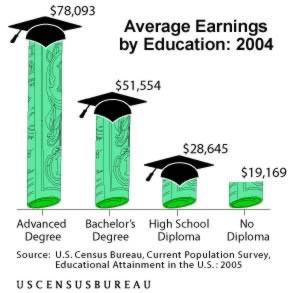
Does earning a college degree make a difference to your future? Absolutely. The facts are striking. On average, those who have a college degree earn almost twice as much as those who do not. According to the U.S. Census Bureau:
Adults with advanced degrees earn four times more than those with less than a high school diploma. Workers 18 and older with a master’s, professional or doctoral degree earned an average of $82,320 in 2006, while those with less than a high school diploma earned $20,873.
Workers with a bachelor’s degree earned an average of $56,788 in 2006; those with a high school diploma earned $31,071. This flurry of numbers makes more sense when viewed in a table:
| Education | Avg. Income | Increase |
| Drop-out | $20,873 | — |
| High school | $31,071 | 48.9% |
| College | $56,788 | 82.8% |
| Advanced | $82,320 | 45.0% |
Completing college is huge. Over a life-time, a college degree is generally worth almost a million dollars. That’s money that can be used for saving, for fun, for whatever. The financial benefits of a college education are significant, and they’re very real.
Other benefits of a college degree
Obtaining a college degree isn’t just about making more money. According to Katharine Hansen at Quintessential Careers, a college education is associated with other benefits, such as:
- Longer life-spans
- Greater economic stability and security
- More prestigious employment and greater job satisfaction
- Less dependency on government assistance
- Greater participation in leisure and artistic activities
- Greater community service and leadership
- More self-confidence
A college education also gives you a broad base of knowledge on which to build. It teaches you to solve more of life’s problems. It gives you future reference points for discussing art, entertainment, politics, and history.
College offers other learning opportunities, too. Much of what I gained in college came from learning outside the classroom, from participating in clubs and other campus organizations. Many degree programs allow students to “test-drive” careers through internships and practicums.
The label on your degree does NOT matter
I asked Michael Hampton, director of career development at Western Oregon University, what advice he would offer a student who is deciding whether or not to attend college. He replied:
Unless you are going to be an engineer, architect, teacher, lawyer, the label on your degree does not matter. The degree is a check-mark (as opposed to the focus) in most job requirements. Many job ads will state: “Business, Communications or other degree required.” Most folks have the “other”.
I have a BA in Speech, Telecommunications & Film. As a television news photographer, youth director, communications director, substitute school teacher,
sports marketing manager, career programs coordinator, no one ever said to me: “You know what? We would like to hire you, but we’re not sure what that label is on your degree.”
Honestly, at the University of Oregon, I was looking for an “easy” degree because I was not a book-smart student. I was able to take mostly film & television classes to earn my BA, so I signed up. The experiences I took advantage of (internships, volunteering, and part-time jobs) in college set me up to be marketable to employers. Again, the jobs I went after required degrees, but the label on the degree was not a barrier.
Here are some more prominent examples:
- What was Alan Greenspan’s major? Econ, but he studied music first
- What was Michael Jordan’s major? Math, then Geography (dropped out to play professional basketball, later returned to earn his degree)
- What was Lisa Kudrow’s major? Biology
- What was Cindy Crawford’s major? Chemical Engineering (dropped out for modeling career)
- What was Ted Turner’s major? Classics (expelled for hanky-panky)
- What was former HP CEO Carly Fiorina’s major? Philosophy
- What was George W. Bush’s major? History
- What was Jay Leno’s major? Philosophy
If a student is struggling to get good grades, I encourage them to look at the course catalog and choose a major based on the likability of most of the classes they would have to take, their positive experiences with the professors in the major, and the number of credits they have already taken that are compatible. They should set themselves up to be successful. Getting through the pre-reqs is a major barrier for some. Combine some “fun” classes with the challenging required courses to try and make the experience more enjoyable.
Be cool — stay in school
While a college education statistically provides a better shot at obtaining wealth, it does not guarantee success. There are English majors who end up with convenience store careers. There are high school drop-outs who go on to run multi-million dollar corporations. But obtaining a college education improves your odds.
For some young adults, college can seem like a waste of time. (Or worse, a waste of money.) Other things seem more important. I had friends who dropped out of school to pursue girlfriends across the country. I had friends who were convinced they could make more money by skipping college altogether. Student loans can be so enormous that they make a person lose sight of the fact that they’re an almost guaranteed investment in the future.
I personally had problems finding a career path — I simply had no idea what I wanted to do. When I went entered college, I wanted to be a religion major. Then I wanted to be a writer. Then I wanted to be a grade school teacher. Ultimately I earned a psychology degree, which has had little direct benefit to my life. But the education I obtained, my campus experience, and the contacts I made have been invaluable. A large part of who I am today was forged by my experiences in college. The value of a college isn’t just in the destination, but in the journey.

Resources
In preparing this article, I relied heavily on the following sources:
- U.S. Census Bureau: Educational attainment in the United States
- Free Money Finance: More education equals more pay and How I made millions off a $5,000 investment
- Quintessential Careers: What good is a college education anyway?
- Financial Calculators: What is the value of a college education?
How many of you attended college? Are you glad you did? If you didn’t get a degree, do you regret it? If you could talk to your 18-year-old self, what would you tell her? If I had a chance, I’d tell the young J.D.: “Set goals. Study more. Find a direction for life!”
Update: As usual, there are some great comments. Many have noted that education does not cause all these wonderful things — it’s simply correlated with them. (It may be that people who obtain an education would live longer even without one.) Also — and this is key — more important than education is doing what you love. Passion and drive can bring success, no matter what level of schooling you have.

RSS Feeds
Facebook
Twitter

sports marketing manager, career programs coordinator, no one ever said to me: “You know what? We would like to hire you, but we’re not sure what that label is on your degree.”
January 10th, 2008 at 11:10 am
This is a rare post that I conceived, wrote, edited, and published all on the same day. As a result, I actually know how long it took to create.
From start to finish, this article took four hours to write. The first hour was spent on a braindump: just pouring out the various ideas I had. (I also e-mailed a couple of friends, including Michael Hampton, asking for tips.)
The second hour was spent fleshing out details. The third hour was spent organizing the information, and incorporating some of what Michael sent me. The fourth hour was completely spent editing.
And this was a rush job. I wanted it done by eleven. Under normal circumstances, I’d spend another hour or two honing the piece.
Trivia time over.
January 10th, 2008 at 11:11 am
I received a Bachelor’s in Interactive Media Design, and hold an A.A in History and my peers make more money than I do without the college education.
Certain fields just don’t get paid as much as the statistics for a college degree, i wouldn’t recommend it.
Maybe it differs city to city, but here in Seattle my Degree has garnered me poor wages across the board due to over saturation in the field
January 10th, 2008 at 11:14 am
Interesting stuff. I found your blog about 2 weeks ago and bookmarked several posts to share with my husband on our annual “Financial Summit” getaway. (We “splurge” on an inexpensive hotel for a weekend to focus on our budget & financial goals.)
Anyway, my husband and I both have college degrees. He in Social Work, and I in Music Education. Both of us worked in career fields related to our degrees and earned appropriate salaries for the fields we were in. Now, however, neither of us is working in the field in which we received our degrees. We both benefitted from our college experiences, though. For me it was a growing up time. It helped me gain confidence and get over my shyness.
I would tell my 18-year-old self to take classes that interested me, without regard to degree plan. I would take more art, design, and religion classes.
My degree is not helping me to make more money, but it did contribute greatly to who I am today.
January 10th, 2008 at 11:21 am
Personally, I have a BS in Engineering Management and an MBA in Business Administration. I’m definitely glad I got the latter. My salary has doubled since I started the graduate degree. Sure, it would have gone up anyway, but it has really helped get my foot in the door and look more professional.
I totally agree that what matters is giving yourslef the chance to have the odds in your favor. Everyone has a story of someone they know who made it big without college and someone who flopped afterwards. There will always be extremes and you can’t count on being one of them.
As for talking to my 18 year old self, I would say, “Forget what you’re thinking, go ahead and get the Architecture degree you want!”
January 10th, 2008 at 11:26 am
This was the perfect timing for me to read this article. As much as I love my major and attending school, there are times I’m just so exhausted.
Thanks for putting things back in perspective!
January 10th, 2008 at 11:27 am
Ummmm…Cindy Crawford and Michael Jordan dropped out. Ted Turner was expelled. And the link you provided for Robin Williams doesn’t say anything about him being a philosophy major or having gone to college (unless Julliard counts).
January 10th, 2008 at 11:28 am
“Unless you are going to be an engineer, architect, teacher, lawyer, the label on your degree does not matter. The degree is a check-mark (as opposed to the focus) in most job requirements. Many job ads will state: “Business, Communications or other degree required.” Most folks have the “other”. ”
This is so true. I actually went to college to become an architect, but I’m doing the furthest thing from architecture as a career. Every job I received after college may have preferred a degree in a specific field, but generally they just wanted you to have some sort of college degree.
Like Michael Hampton said, unless you are in a specialized field that requires special certification or licensing requirements, more often than not employers are simply looking for a college graduate.
Of course, having a degree in the field you’re trying to get into will certainly improve your odds of getting a job, it isn’t a requirement, especially for entry-level stuff.
January 10th, 2008 at 11:28 am
Good post JD. I’ve got a BS in Math and have NEVER used any of my coursework in a professional capacity. I know for certain that just having a degree has opened doors for me.
January 10th, 2008 at 11:35 am
I have a degree and earn minimum wage. Can I give away my degree and take the earnings instead for a high school graduate?
January 10th, 2008 at 11:39 am
Actually, if you’re going to be a lawyer, your undergraduate major doesn’t matter one bit. Once I had a law degree from a top school, prospective employers didn’t care if my college degree was a B.A. in basketweaving from Party University. I think there are two lessons here: first, if you know you’re going to get a law degree, don’t go into debt for your bachelor’s–save that for law school. Second, study what you enjoy in college so you have something to fall back on when you get burned out practicing law.
January 10th, 2008 at 11:41 am
If I could go back I would tell my 18-year old self (actually 17 since I started college a year earlier) to just hurry up and finish the degree, any degree! I was set to graduate with a B.S. in Biology when I was 21 but during my senior year, I lost all focus, didn’t care, flunked a couple of courses, dropped out and went to work. I intended to go back in a year and finish but instead met THE ONE at the job I had taken, got married, and so on. I finally graduated this past summer, 11 years after starting college. For the past four years I’ve worked in accounting. I make decent money and learned most of my accounting skills on the job. I also handle environmental permits for my company and have found that my background in science and the technical writing I did in school have helped me immensely in that aspect. Also, I was generally an intense student (other than that one fateful year) and I believe I learn quickly on the job as a result of that training in school. I think one of the huge advantages to finishing an undergrad degree, whether you’ve found your true calling or not, is that later on you can pursue higher wages through an advanced degree without having to start from square one like those who chose not to finish (or start)college at all.
January 10th, 2008 at 11:43 am
I think that the important thing, as in so many areas of life, is not the process but starting it with a goal.
My advice to my 18-year-old self:
* Don’t believe the people who say that their degree program leads to starting salaries of $40k or $50k or whatever. Definitely don’t change majors because your original program isn’t saying that and the new one is. You’ll end up pulling $30k and miserable.
* Wait on school until you’re really ready to do it and do well at it. Don’t go at 18 just because it’s expected. Starting your career a few years late can make you really impatient, but it’s worth it in the long run when you have a career and your friends have brightly colored polo shirts.
January 10th, 2008 at 11:44 am
Hmmmm.
I agree, in principle.
For any given field, a higher degree will earn more money. Some fields will pay a PhD less than other fields will pay a high school graduate (e.g. post-doc researchers vs salespeople).
And in some fields you absolutely need a degree.
I think that a degree is more than a checkbox. Obviously, quality of school is important.
Second, science vs. liberal arts is undoubtedly important. Marketing, communications, philosophy, etc are all sorta/kinda interchangeable. But try getting a economics or statistics job (not even science) with a commuications degree. Also, the Alan Greenspan example is interesting, but using movie stars is just dishonest. Hey — you can be a pro football player regardless of what your degree is in! And maybe Bush isn’t the best example, either.
Also, I’ve been considering an MBA. And I actually came across an interesting article based on interviews with hiring managers that had a few quotes:
a) “ALL THINGS THE SAME, we’ll probably give the MBA a job… maybe give them about 5K more a year.”
b) “We actually look down on people with an MBA. What kind of choices are they making if they give up a 200K/year job in order to pay 50K/year and not work for two years? (that was for investment banking)
Also, the $1m extra is bit misleading. You need to think about the opportunity cost and time value of money. Easiest way to do the comparison would be:
“If, rather than going to university for four years and paying tuition, I worked in the best job I could get and saved as much money as I could (living an equivalent lifestyle as I would in college) for those years, how much would I have at the end of my life?”
At that point, a million doesn’t sound so great.
Lastly, there’s a bit of a selection bias. Sure, having a degree helps you earn more money. But I’d say a lot of the difference that Census found is that the types of people who go to college to get a degree are the types that would do well regardless and succeed in a lot of circumstances.
James
January 10th, 2008 at 11:49 am
There is a big difference between correlation and causation. The statistic shows that people with degrees get high paying jobs, but doesn’t indicate why. It could be they are smarter, more motivated, more interested in success, or have less factors holding them back.
Freakanomics has a great example of this. Children growing up in a house full of books do better in school. But adding books to a house doesn’t make a kid do better in school.
While I do agree getting a college degree increases your chances of success, I’d be curious to see if any studies were done on how much a college degree increases the salary of someone who is already in the work force with a high school degree.
January 10th, 2008 at 11:51 am
GREAT article!
Forcing my teenagers to read it. Thanks.
January 10th, 2008 at 11:57 am
Michael Jordan dropped out of college, but did finish his degree in 1986. Coincidentally the average salary for a geography major graduating in 1986 from Carolina was somewhere around $200k. Guess Michael skewed that a bit upwards?
The most important thing I got from my college degree was the appreciation for myself. I got out of my dinky hometown, I saw more of the world, met people from other places, learned more about myself and graduated with hope and self-esteem.
I do rail against the cost of education though. I’m just amazed at what people will pay for a degree. It’s one thing to go $200k in debt for a degree from Yale, but people go into great debt for small, less prestigious schools. Makes no sense to me to pay that for a no-name school, when you can get a fine education at a public institution.
January 10th, 2008 at 12:00 pm
Minimum wage made a good point, degrees do not automaticly mean more money. Along the same lines I have to question if spending tens of thousands of dollars (usally borrowed) is worth it. Almost every PF blog I read where they are tying to get out of debt school debts are a large portion of it. Most people would be better off getting a trade instead. Quite common is the low wage worker with tons of school debt.
January 10th, 2008 at 12:02 pm
I’m just amazed at what people will pay for a degree.
January 10th, 2008 at 12:03 pm
Far too many parents say to their children, ‘You have to go to college so you can get a good job.’ They don’t always say, ‘You have to go to college and go to classes and complete the problem sets and answer the professor’s questions and do the research and write the papers and sit the exams so you’ll have a better chance of being able to have the luxury to choose what you want to do with your life.’
January 10th, 2008 at 12:05 pm
Honestly, the biggest mistake I ever made was going to college. Twelve years after graduation I’m still paying for that mistake.
I’ve noticed that the biggest money makers in the world either didn’t go to college or dropped out, with very few exceptions. I also know many people who have gone up into graduate degrees who are very happy they did. Ultimately, I think the question is, “What’s the goal?”
For someone like me, an actor, college is a very bad idea unless you go to a school which is located in a major market.
For someone looking for a security-based income, regular paycheck, etc., college is a great idea.
It all depends on the goal.
January 10th, 2008 at 12:05 pm
When I sat down to write a post about my money decisions for my blog, I immediately knew that my educational choices were far and away my best. I got a BA in Computer Engineering and then took a job with an employer that paid for me to get a MS in Software Engineering. To get here is/was a lot of hard work, long nights, and Red Bull but it has paid off. This path is really only for those who enjoyed taking apart electronics when they were kids, begged for Legos and erector sets for Christmas, and would rather learn C++ than Spanish. My total bill for education was near $100k but 2.5 years out of school I’ve made back every penny.
January 10th, 2008 at 12:14 pm
Most of the “other benefits” listed are correlative, not causative. Getting a college degree will not make you live longer, nor will it give you more time for leisure (although once you finish your degree, you may feel like you have a lot more time). It may not even lead to a higher paying job, as Minimum Wage has noted.
Sure, on average people with a degree will earn more and live longer, but on average everyone has one testicle and one breast. I don’t think people should go to school to “get a degree.” They should go to school if a degree is a requirement for the career they want, or if they actually want to go to school.
I tried university, hated it and dropped out, then did a two-year diploma. Now I earn more than the average for people with an advanced degree. I know other people who love school and have multiple degrees (and a six-figure student loan). I think people should look at whether they really need or want a degree, because it’s a big commitment. I’ve never felt like not having a BA has held me back.
January 10th, 2008 at 12:18 pm
I agree 100%.
My wife and I were discussing this topic recently. The one thing I’d say though, is to try to come out of it with as little debt as possible.
We both went on 100% credit, and are paying for it now. We could have lived on less, and supplemented it to ease some of the stress we’re having now for sure.
But overall, it will always be worth it!!
ps. I have a Business Management degree, and I’ve done Graphic Design since I graduated.
January 10th, 2008 at 12:20 pm
for leno, crawford, michael jordan… I don’t think college did much for their careers!
Labels can matter, but they don’t have too. You could make a chart of the average pay for different majors, and there will be some clear winners. It’ll be hard to get into engineering with a music degree. But you can do a lot of stuff with having an “other” degree than having no degree.
January 10th, 2008 at 12:22 pm
When going to the Wikipeida article on Alan Greenspan, you find that he got a BS, MA and PHD in Economics. Although the article does state he was a very good musician.
January 10th, 2008 at 12:31 pm
Very interesting. I have an interdisciplinary degree in Humanities (aka General Studies). While on the surface it may appear useless - unlike a nursing degree or others mentioned in the post - I would have to agree that it was worth the time and money invested in getting it. My parents always told me you go to college to learn how to think. My degree was very much a “thinking” degree. Since college (about ten years) I’ve worked in biotech, insurance, and now design. My skills - mainly my ability to think logically and analytically - has taken me far each time I stepped into something new.
Our world is evolving so rapidly, things just aren’t as cut and dried as they used to be. It’s no longer a choice between being a nurse and a teacher or a doctor or a businessman. Stepping back and taking a broader perspective on the college degree (as this post did) is the way of the future, I think.
January 10th, 2008 at 12:31 pm
I remember hearing in one of my college classes that there was a very strong correlation between how successful a man was in his chosen profession and his mother’s education level. The more education the mother had, the more successful the son. This was 14 years ago and I know you can skew statistics, but still an interesting thought.
January 10th, 2008 at 12:39 pm
I graduated a month ago and (finally) got my B.S. in Business Management. I’m glad I attended, I just wish I started as a business major student. I would’ve been motivated enough to finish sooner. I changed degrees twice (both in first two years).
January 10th, 2008 at 12:39 pm
It bothers me that so many people look at the edge cases (extreme success/no degree, no success/advanced degree). These are few in number. The whole picture needs to be examined, namely, if you get a degree from an accredited institution, your chances for success are much higher than if you just graduated from high school.
Case in point: my dad and I are both software developers. Because he didn’t have a degree, it took him 20 years to reach the salary point it took me 4 years to reach. And my degree isn’t even technical!
So, in summary, get a degree, any degree, even a vocational degree, and you’ll have more options than if you have no degree.
January 10th, 2008 at 12:39 pm
I have 3 degrees, an AS, BS, and MBA. Certainly the “college degree required” bit is a checkmark. How many of those jobs really require anything you may have learned in college? A college degree today is the equivalent of a high school degree in the 50s. It’s the price of admission to corporate America.
I don’t dispute that college graduates earn much more. What I question is why. Are we worth more, or is it just really good marketing by the higher education industry?
January 10th, 2008 at 12:42 pm
Getting a degree from the right school is the key. An overpriced school that lands you $150,000 in debt from the start is a poor choice.
I am a proponent of online education with a bachelors from one school and an MBA from another. They were very demanding and I learned a great deal that I’m able to use in my corporate world job. You can read about my experience at my blog if you like.
Again, I would shy away from the mega expensive schools. The internal rate of return for those cash flows take a long time to work out to the positive, especially if you borrow the money to go.
January 10th, 2008 at 12:44 pm
Going to university was probably the best decision I’ve ever made. It gave me confidence, the ability to mix with other bright people with similar interests, and most importantly of all the opportunity to study the subject that I loved.
As it happens, I wouldn’t have got my job without a degree in a science/engineering type field, and it’s a job that I love. I also probably wouldn’t have moved cities, bought a house, discovered travel,…
Did I mention that it’s probably the best decision I ever made.
January 10th, 2008 at 12:46 pm
Thanks, folks, for the corrections. I’ve made the changes to the list of famous people, and used a strikethru to note better wording earlier in the piece. You’re all right: correlation does not imply causation. That’s an error on my part.
And remember that one of my major points is this: Education does not guarantee success, but it does improve the odds. Significantly.
January 10th, 2008 at 12:47 pm
I’m glad someone else pointed out the difference between cause and correlation.
As far as I’m concerned, the educational system is a travesty. It simply does not do what it claims it does.
People who can prosper without a diploma are infinitely more capable than those who depend on them for their success. Universities make people irresponsible, instill in them an abominable faith in the infallibility of self-styled experts, and perpetuate and promote political bias. Any omnipresent social institution that claims impartiality while, in effect, being dominated by a single political point of view — studies have shown that a super-majority of professors are leftists — poses a serious danger to democracy.
You don’t need to be branded by the establishment in order to succeed in life. I’d rather not be vetted by an incompetent and incapable educational system.
Centuries from now, people will look at our educational system the same way we look at astrologers today; with incredulity.
January 10th, 2008 at 12:47 pm
You can’t get a college degree for the money. It will almost always burn you. Take that statement with a grain of salt, I went to an all engineering school, and the people who just wanted the money (hated math) they struggled through classes, cheated a lot, and ended up with a job that would “take them” but they struggled with their job too. They might make more than average, but they are miserable, and that type of quality isn’t sustainable. I would venture a guess that anyone with a degree from my school could take their pick of jobs that don’t require an education. That’s hardly a consolation prize though.
Advanced degrees are the new college degrees. If you have a MS, you can usually take your pick at BS jobs. Another thing to look at is that an MS degree (typically two years, but some schools offer a non-thesis option that takes a year if you start getting credits your senior year of your BS) is the biggest bang/year. So if a BS is a good idea, then MS is a great idea. PHD’s don’t earn substantially more than MS, but they have to go to school for 5 more years+.
If I had a kid that was 18 right now, I would tell them to find a college/curriculum that challenges them, and keeps them interested.
If you are working at your potential, and you like what you do, the money will follow.
January 10th, 2008 at 12:52 pm
” If you could talk to your 18-year-old self, what would you tell her?”
How about buy Apple oh, and Google.
Interesting article. Have you thought about an article on the value of a graduate degree. Both my wife and I have PhDs in chemistry. I do pretty well, she’s somewhere between the average high school and college grad. My general recommendation, don’t get a PhD unless you want to do academics. The most bang for your buck is in a Master’s degree.
January 10th, 2008 at 12:53 pm
How many 18-21 year olds actually, truely, would work full time and actually live like a college student and save the “opportunity cost” into a IRA or other retirement fund? I think the budget category labeled “blow” pretty much consumed the majority of the income of those friends and acquantences I knew who weren’t going to college. That’s why blogs like this help, but not until most of us have already racked up the debt regardless of attending college or not.
I will say that my wife (HS diploma only) went to work for a company that paid two other employees the current equivalent of $5000 more in salary just because they had Associate degrees and she didn’t, even though her supervisor agreed she was more compentant at the same job (on the up side he was more than willing to pay for her schooling to get a degree and encouraged her to do so). Over the years the types of jobs she has been able to apply for have been limited since many asked for a college degree or equivalent experience, which is hard to get if you don’t have the degree.
You might also want to consider that most folks without a college degree who have become successful, often want their kids to attend college. In my opinion it’s because they feel via their experience, that you have a better chance (note, chance, not guarantee) of making more money and living a reasonably stable and secure life without encountering or taking on the risks they did to become successful. Not everyone is cut out to be a Cindy Crawford, Michael Jordon, or Bill Gates.
January 10th, 2008 at 12:56 pm
I have a BS & an MS in statistics. Without them (or very similar degrees) I couldn’t have been considered for my current job. A few prestigious internships didn’t hurt to set me above my peers.
That being said, I feel the greatest benefit I’ve received from my education was actually my education. Critical thinking, problem solving, learning how to work the system. And I got out of the whole thing less than $8K in the hole.
January 10th, 2008 at 12:59 pm
I’ve been to college twice: at “college age” to get my parents-sponsored BS in English (with some foreign languages and engineering classes thrown in) and about 10 years later to take some Math and Computer Science classes in preparation for graduate school (which I haven’t pursued, yet).
I was able to get a job out of college with relative ease (although I had to move to a coast), and my career has progressed with a few twists and turns since then. The latter set of classes helped my career a bit. I’m making a lot more money that I would likely have made with no degree. I’m not a schmoozy go-getter type of person — it helps me to look good on paper.
I would tell 17-yo me to take useful foreign languages and live abroad to learn how to use them properly. Do challenging internships and research projects in your major(s). Take a double major — one in something practical and one for love. Don’t be afraid to fail in the area you are doing for love — you’ll enjoy the learning, even if your grades aren’t the best, and you’ll use the education to pursue your interests as a hobby if not for profit. After 5 years of working, noone important will care where you went to school or what grades you got.
January 10th, 2008 at 1:04 pm
I don’t wholeheartedly agree with this post. While I love learning and I’m all for continued education, I don’t believe having a degree is an automatic ticket to a higher salary. I believe it depends on the career one wants to pursue.
My husband’s salary falls into that Bachelor’s Degree range you mentioned, although he never attended college. He is a construction worker, and did not need a degree for his chosen field.
As for me, I tried going to college right after high school because that’s what my teacher’s expected of me (since I took all the college-bound classes in high school). But my heart wasn’t in it and I dropped after one semester.
I returned to college for some course work when I was in my 30s. I loved the classes and made excellent grades, but I still didn’t have a career goal in mind. My life away from the classroom, i.e. work and family, were more important than pursuing a degree that didn’t mean anything to me.
I don’t see myself every pursuing a degree, although I can see myself taking a class now and then for pure enjoyment.
As for what I’d tell my 18-year-old self, I’d tell her to be true to herself and not do things just because someone else (namely teachers) expected it. I’d also tell her to look into vocational/technical training, something I might have been interested in but was never made aware of because my teachers and counselors tracked me into the college-bound classes.
January 10th, 2008 at 1:07 pm
I got a B.A. in writing in college but always intended to become an editor. Not a highly-paid career, true. But I love words and wanted to work with them; I didn’t care how much I would get paid. I figured going to college would help me achieve my goal. It did. I was able to get career experience by working in various Writing Centers and getting an editing internship.
Now I work for a small publishing house at a ministry. I make less than the high-school dropouts you list. But I live well enough (i.e., I have enough to eat and can put gas in my car) and I am extremely happy in my career. I think college was worth it for me.
I do wish I could’ve told my younger self to save more money by going to college earlier. I did only one year of PSEO; should’ve done two.
January 10th, 2008 at 1:09 pm
This is what I would tell my 18 year old self. My 18 year old self, I would say, there is almost nothing you can learn at an institution that you can not learn by yourself. If you are smart enough to get accepted at whatever prestigious university, you will be as successful as their students without spending 4-6 years learning things that are as testable as they are useless. Mostly success is about intelligence, persistence and drive. Getting a sheepskin from passing courses adds little value to that. It just shows what you already know - that you have those qualities. What an education does bring you is connections and an automatic foot in the door at the HR department. However, if you can learn to obtain these things without a degree, you will be better off than the herd who did the college thing.
Incidentally, I got a phd and I intend to be successful despite it, not because of it
January 10th, 2008 at 1:17 pm
Thanks for posting this JD. Over the past 2-3 days, my girlfriend and I have started the steps to go back to school. I am a 26 year-old with a BS in Management from Georgia Tech–she is 23 and never finished her degree. She is looking to get back into a Bachelor’s program to finish and I am pursuing my MBA. So this was post was quite timely for our situation!
I wish I could tell my 18 year old self: “Go to class you idiot!” It took me several extra semesters to graduate because I spent so much time early on slacking off. My GPA, and my grad school prospects, suffered because of it.
As to Annie J. above–in general a degree IS a ticket to a higher salary. While it’s true that some people do become quite successful without a college degree, many more do not. You don’t have to have a college degree to earn more money–but it (in the majority of cases) makes earning that much more money far easier.
January 10th, 2008 at 1:18 pm
I’m a supporter of college; it really does get your foot in the door, most cases, and emphasized it for my daughter who has a RN degree now. I think people tend to gain more maturity who go as well as an increased vocabulary. As for myself, I worked after high school in law firms, then at age 28 wondered, how would I do in college if I were to go? Would I get A’s, D’s - I was curious. So I went to a community college, part-time, for 2 years and got A’s in every class. (I had to work for them though). That 2 year time fulfilled my curiosity, and gave me some self-respect, and I really liked the knowledge I gained from all the required undergraduate classes too. But after that, I realized I preferred a self-taught approach, reading things that interested me, and I just didn’t want to sit in classrooms anymore. I retired at 48, following “millionaire next door principles”, so I did all right. My brother is one year older than myself and is a multi-millionaire! He and his wife own a computer-related business. And he never went to college period, but growing up with him, I remember him to be always brilliant, acing every high school class w/out hardly any effort whatsoever. I should ask him how he feels about not going - does he have any regrets, etc.
January 10th, 2008 at 1:26 pm
Adfecto, the cost for my BS in CompSci was $20K tuition+books at U + $3K tuition+books at community college. Despite getting into the relatively low-paying fields of tech support and testing I still paid off the $20K in student loans within 4 years.
This post dovetails well with my book club this month (Sayers’ Gaudy Night). As one Master of Arts points out, “If you learn how to tackle one subject - any subject - you’ve learnt how to tackle all subjects.”
January 10th, 2008 at 1:43 pm
I’m very glad I attended college. If I could talk to myself at 18, I’d tell her to go to a different school. My school was not a good fit for me, though I did manage to graduate.
One of the unspoken purposes of college is class laundering. Of course, we don’t have class in the U.S., but if we did, that would be part of the use of college.
January 10th, 2008 at 1:44 pm
” If you could talk to your 18-year-old self, what would you tell him?”
Get a degree in Finance and then work for a company that will pay for your masters. While there, work hard and smart and earn over $100K/yr.
I have BS-Biology and BA-Criminology. I am now in the computer field, where people just need certifications and not degrees. I make the same as people who never went to university.
All in all, it is what you do with what you have that makes the most difference. Degrees don’t make one person better than another, although some like to act so (see snooty license plate cover mentioning their school as they cut you off in the leased car).
January 10th, 2008 at 1:48 pm
Jeffeb3 says: “if you are working at your potential, and you like what you do, the money will follow.” Boy, I think that is the KEY! At least from my own personal experience. I always had jobs I loved — like I would have worked there on a volunteer basis, but of course would never tell my employers that. I looked forward to going into work on Mondays and if it were 3:00 p.m., I’d often wish it were 10:00 a.m. again, because the day was going by too fast — that’s self-actualization, when you are doing what you enjoy so much, and are being challenged and working right up to your potential. Consequently, saving 20% of my income was easy for me. Compare that to many, many friends I knew who had big salaries, but hated their jobs. Rather than saving, they would spend/waste money big-time to “justify” having this miserable job, like getting a McMansion and shiny new cars, etc. I was willing to live on much less because I enjoyed what I was doing, much like what “starving artists” will do. The key really is to follow your heart, and the money will follow.
January 10th, 2008 at 1:52 pm
@47.daedala
Ooh. Social climbing is a great reason to go to uni. And I mean that in absolutely the best way. If you aspire to live a middle-middle class lifestyle in the UK then your best bet is to go to Uni, and mix with people born into it. You’ll pick it up in no time.
January 10th, 2008 at 1:52 pm
It’s really difficult to believe this right now, but I sincerely hope that it’s true. I’m 22 and last summer I finished my Bachelor of Science in Psychology. The diploma’s hanging on a wall in my bedroom, of all places, and the two times I’ve tried looking for a job, I’ve been made to feel that my degree is completely useless. Most people are looking for specific degrees, and nobody is looking for a Psych major unless they’re in graduate school. This may just be how they advertise it, though, because frankly I don’t even try for the jobs that say “Marketing degree required” or “Business degree preferred.” It seems self-evident that it would be pointless. Maybe if I tried, I would surprise myself and succeed? Anyway, right now I’m taking computer programming and design classes at my local community college and I’m starting to feel disappointed with that, too. Maybe I’m just burnt out.
January 10th, 2008 at 1:54 pm
Interesting, Jeffeb3 and Sandy. I’ve always loved the notion do what you love and the money will follow, but I’ve never trusted. I’ve always been scared to. And so for most of my life, I’ve worked at jobs I didn’t like. (The only two jobs I ever loved were food service jobs, and I did well in them.) Most of my life, I’ve had money problems.
Now, for the first time, I’m doing what I love. I’m writing. I’m sharing stuff with you guys. I’m having a blast. And all of a sudden, I’m spending much much less, and I’m making enough to make ends meet. This is a real-life example of the money following me as I do what I love.
Another aspect, though, is that what I’m doing here is the culmination of everything else that has ever come in my life. I’m writing, using my psychology degree, learning what I’ve learned from jobs in sales and computer programming. It’s strange, but it’s as if my whole life led to this. And college was a key component.
January 10th, 2008 at 1:55 pm
I can say from my own experience that having a degree has kept me employed and fairly well paid.
I have to say the best plan I have seen work for people is to pick which college they want to get their major degree in, find out what liberal arts/non major classes will transfer credits from a cheaper community/public school and spend their first two years getting the requirements out of the way for less money. Then go for the more expensive school to finish the bachelor’s (hopefully paying as much as you can for it on the way) and if necessary to your goals, the master’s degree after working for a few years and saving up for it.
It really all depends on what you want to do - a year or two of business classes at a community college may be all someone needs to create success for themselves.
My own choices would have been different if I had supportive parents - I’ve been making a good living purely on the magic of having the degree I have from the school I have it from - but in the long run it hasn’t been worth it.
No matter what - pursue what you ENJOY and feel fulfilled at. I made good money and it hasn’t made one bit of difference in my happiness. Frankly I have been miserable and I despise my profession - all because I was pressured into a major because it was more lucrative than what I wanted to do. I would have been FAR happier making $20,000 a year less if I had been doing what I loved.
So my three life lessons: Lesson 1) Only go to school if 1) you can afford to for fun and education and 2) if it will help you reach your goal - Lesson 2) Stay out of debt as much as possible - Lesson 3)Do what YOU love to do, and second best, do something that pays the bills without breaking your heart.
January 10th, 2008 at 2:03 pm
Great post - I have been thinking about writing something similar for my site for a while now.
My basic story is this: went to college at 18 and studied something I did not like and dropped out. Worked for ten years and decided to go back and study something I find very interesting.
My motivation was not to make more money: it was to give myself more options and new ideas. While I am not yet finished with my undergraduate degree, I feel like I am already reaping benefits.
* I feel more confident in my knowledge and my abilities to think analytically as well as to think critically about my own beliefs and biases.
* I am better able to present arguments and information to coworkers and colleagues.
* I am able to have informed conversations and network with people who are involved in my areas of interest.
* I can see entrepreneurial and career opportunities which I did not see prior to this round of college.
* I have been pushed harder than I would have pushed myself.
* I feel like more career and post-graduate options are available to me. Like other commenters noted, sometimes those hiring just want to see a college degree.
I think that one thing that gets people into trouble when considering the value of college is thinking of it like a vocational school. It’s not. The trick - I have found - to being successful in college is not to ask yourself “What am I going to do with this?” but rather to keep yourself open to new ideas and experiences. By doing that, I have done things and gone places I would not have conceived of going into this. Same with jobs. Unless you have a deep knowledge of a field you can’t really see what job opportunities exist.
Finally, I want to touch briefly on the financial aspect as this is an important consideration for many. Myself included. By going to college for the past two years I have had to scale back my work hours by half. Over the course of the college career this means that I will lose over $100,000 in income. That sucks. Plus what I am paying for school(which is reasonable - I go to a public school).
However, I consider it an investment. Granted, there is no certainty that I will see a return on that investment(this holds true for all investments), but as a pure financial calculation I am literally banking on the fact that I will. As I mentioned before, I have already recouped some of that in non-material ways. And I am loving every moment of it.
January 10th, 2008 at 2:05 pm
I just finished a PhD in biology. I stand to make about $45-50k in postdoctoral research positions for a few years, after which point I will have to decide whether to go into industry or pursue a tenure-track job as a professor. I don’t anticipate ever making six figures in my life.
However, my job allows a huge degree of intellectual freedom - I can be sure that, every step of the way, I will be doing something that I’m interested in. By going into industry I may make more money but I will have to relinquish some of that freedom.
I don’t need to go back and tell my 18 year old self anything, because my parents gave me great advice when I was looking at colleges. They made it clear I should not go into debt for my education, and that I should do what I was interested in, and not worry so much about how much money there was to be made in that field. They recognized that it was the process of learning how to learn, rather than the piece of paper I got at the end, that would ultimately benefit me.
January 10th, 2008 at 2:11 pm
being that i am 42 and just now returning to school having raised my 4 children-i would tell my 18 year old self to quit partying and having fun. you never know when you will be 42 years old trying to help pay the college education of 4 kids. i refuse to go to work for $7.00 an hour, so i am working really hard for the next 2 years to become a special ed teacher. this is a field which is i will be accepted into regardless of age because of the vast need for these teachers.
January 10th, 2008 at 2:15 pm
I don’t have any experiences that agree that it doesn’t matter your discipline so long as you have the degree, but there’s another option at some schools: build your own degree. I’m doing this at my school and while stressful, it just might allow me to do what I love outside of college too.
January 10th, 2008 at 2:18 pm
@JD
I think it’s do what you love, and you won’t need to medicate your unhappiness by spending. In that sense the money will follow.
My biggest advice to me as an 18 year old thinking about college would be “You’re right not to care about job prospects in your degree - if you love it, you will do well at it and that helps more than anything else”.
Even if another subject is more lucrative, better to have enough and be happier than do something you don’t like at college.
January 10th, 2008 at 2:31 pm
One of the most fascinating degree/profession combos I’ve seen was the lead singer for the rock band, The Offspring. He has a masters degree in molecular biology and turned down PhD candidacy to focus on the band.
http://en.wikipedia.org/wiki/Dexter_Holland#Personal_life
January 10th, 2008 at 2:43 pm
Whoa this is creepy. I just wrote about the same thing a few days ago:
http://www.thewriterscoin.com/2008/01/07/why-a-library-card-is-more-valuable-than-a-college-degree-the-pros/
January 10th, 2008 at 2:55 pm
@plonkee, J.D.
If I did whatever I wanted, I would do something between talking with friends, and enjoying TV and movies. That isn’t profitable though, because it’s not challenging. The key that most people miss when they think about their dream job is that they need to feel pride.
January 10th, 2008 at 3:48 pm
The other day, Dave Ramsey made some snide comments about German Polka majors. I thought it was right on. Though there are obviously exceptions, but I agree that people, particularly people in positions to hire a bazillion competing college grads, are not impressed by fluffy degrees like that.
January 10th, 2008 at 3:50 pm
If only that wage scale was right! My husband has two degrees and doesn’t make even close to what it’s claiming! People with only a HS diploma make more than him…
Schooling is important, but it’s also important to pick the right field. I tell everyone who is just starting out not to go into multimedia and graphics unless they don’t want to make a lot of money. You really have to pick the right career based on the pay, and if you enjoy it.
January 10th, 2008 at 4:11 pm
I’ll gladly take the average dropout’s income, where do I sign up?
January 10th, 2008 at 4:26 pm
I have a B.A. and will have an M.A. in May and do not make the average salary for someone with a college degree. I work for a Fortune 500 company. Something is not right here…
January 10th, 2008 at 4:48 pm
If I had to do it all over again I would definitely get my college degree. I have only an Associates Degree. I pray every day that my son (who is six now) will go to college. I just don’t want him to be miserable like me. I hate my job and I’m stuck; nowhere to go. However, if my son does get a college degree I hope that he wont be like most of the college graduates that I work with — they look down on the people that don’t have a degree.
January 10th, 2008 at 4:54 pm
It’s hard to see how someone could actually regret going to college… although I never use what I learned in school, the contacts and experience were both invaluable.
My only regret? Student loans at a high interest rate. I should have done a lot more work when I was applying to colleges to try to minimize these. But I was lazy and ended up having to get a lot of private loans.
Luckily I was able to pay off most of them in 1-2 years, but I could have saved and invested a lot more if I didn’t have them to begin with.
I tell all my younger friends to go to college, but to make sure it’s cheap or scholarship-funded first.
And on the issue of pay and doing what you love, I think most are scared for the same reasons you were. However, I’m finding that as I move toward doing what I love, money is much easier to come by as well, plus I’m inclined to spend less.
January 10th, 2008 at 5:27 pm
Matter of point here from an economist:
The wages listed in the summary table are averages. Therefore, those of you who are saying its not right because you’re not that figure are either to the right or the left of the average.
The actual point, which is that education is highly correlated with a higher earning potential, is correct.
To argue that education doesn’t have significant impact on one’s earnings is to ignore the data. While other factors are important, education ranks among the most so.
January 10th, 2008 at 6:08 pm
To “Minimum Wage” if you’re still around: I’ve seen you on a variety of personal finance blogs, and even the WSJ blogs (same handle and attitude).
I am tempted to say that you maintain your minimum wage “fate” because you have a defeatist attitude and maintain a lot of ire (jealousy?) for those with more dollars than you. I wouldn’t be ad hominem here if I didn’t see a consistent pattern.
Anyone, perform a Google search for “minimum wage says” or “comment by minimum wage”. It’s fairly consistent.
Sorry for the threadjack!
January 10th, 2008 at 6:55 pm
My husband went all the way through high school only to be denied graduation. I live in Texas and each school district has it’s own set of requirements to graduate. He transferred districts his senior year and was missing two of his new schools requirements. This was in 1988 and this same stupididly still goes on.
He distrusts any school now and just got his GED two years ago. He is currently at a high level position in a major corporation earning well over six figures.
Me, I finished high school and took some college. I quit working out of the house to have kids. When I left, Sprint I was making around 55,000. I work from home now growing my own business.
It may be in our field knowledge and experience counts more than a degree. I’d like to get that check someday but I’m sure it will be when the kids get into school full time.
January 10th, 2008 at 8:28 pm
Jeffeb3 and Sandy–thank you for your posts. Story of my life: my parents were unsupportive of my decision to go to interior design school. They made me so miserable during my first year of college that I transferred to another university to find a more lucrative major in order to please them. After failing to get into business administration, I ended up with a degree in International Studies. Then I moved out and returned to pursue my degree in interior design. It took me many years since I was working full time and taking classes part time. But I finally graduated last year with honors. I was able to secure a good internship and look forward to more opportunities ahead. I have no doubt that the money will follow.
January 10th, 2008 at 8:29 pm
Well put! I returned to school after the birth of my daughter (after a 4 year layoff). It was tough going back to school at night and working during the day, but in the end it was worth it. The degree certainly wasn’t prestigious (Computer Info Systems, Troy University), but the knowledge I gained has allowed me to nearly double my income since I started school.
January 10th, 2008 at 8:35 pm
Education gives many a definite edge.
Though the degree itself doesn’t define you -it definitely helps you to develop into a stronger self:
* It aids in critical thinking,
* It helps you to look at life from a more global perspective,
* It gives you a greater breadth of choices.
* It also plays a significant role in allowing you to make strategic choices that will enable you to live out that dream of yours by making it real.
Nothing can replace the long-term benefits of an education.
And as for those who have acheived millionaire status without a degree…it’s highly likely that they were smart enough to recruit a few degreed persons to play on their team.
The bottom-line is what you said best: “The value of a college isn’t just in the destination, but in the journey.”
Thanks for the inspirational post!
January 10th, 2008 at 9:14 pm
College education is the most basic of our life. A college education also gives you a broad base of knowledge on which to build. It teaches you to solve more of life’s problems. It gives you future reference points for discussing art, entertainment, politics, and history. It must be given by the learning of opportunity.
January 10th, 2008 at 9:54 pm
It’s hard to see how someone could actually regret going to college…
Seems pretty easy to me. I started college with the equivalent (in today’s dollars) of $20K, and excellent prospects for a decent job.
I finished college with the equivalent (in today’s dollars) of $20K in debt, in a seriously depressed economy, with a dime-a-dozen degree and no real prospects for a good job.
January 10th, 2008 at 10:20 pm
I am tempted to say that you maintain your minimum wage “fate” because you have a defeatist attitude and maintain a lot of ire (jealousy?) for those with more dollars than you. I wouldn’t be ad hominem here if I didn’t see a consistent pattern.
When I send out resumes, employers don’t see a defeatist attitude. But my resume doesn’t get me interviews, so in jobseeking, we don’t even reach the issue of defeatist attitude.
I don’t have a lot of “ire” for those with more dollars than I, just for those who I think don’t particularly deserve it. I’m confident I’m more intelligent, more capable, and more deserving than a lot of these people, hence, there are a lot of people I consider less deserving than I.
January 11th, 2008 at 12:26 am
[...] Rich Slowly personal finance that makes cents « The Value of a College Education | [...]
January 11th, 2008 at 2:42 am
I dropped out of college before completing my AA to take my first IT job 20 years ago. I never went back. My skills been self taught or on the job experience. I have always stayed on top of whats going on in the industry, kept my skills sharpened and am always adding new tools and knowledge to my tool box.
I have never had an issue or a doubt that it was a bad decision. I have always earned well, currently I earn what would be at the low end of the advanced degree category.
Now I work at a college and there is tremendous pressure for me to complete my BA degree, this completely frustrates me. I pay 0 in tuition. I find the courses a waste of my time, over simplistic, void of value, and dry old material that was useful in the real world 4-5 years ago. I receive more pressure to complete my degree, than I receive to get my job done, and meet my deadlines, you know, the things they actually pay me for.
Along with the pressure to spend extra time taking classes I am also the one competent and talented person in the department. Instead of assigning my degreed coworkers the large, complicated, and critical projects, I am saddled with virtually all of them. I have a proven track record of delivery and quality, where they do not. Those that are my age and even the younger ones all seem to have stopped developing themselves, they seem to feel they don’t need to, this the kiss of death in the IT business. This leaves me with 50-60 hour work weeks. I am pressured to spend more time taking classes, while my degreed coworkers do less work, are less productive. On many occasions I have had to redo things they have done. I don’t mind this at all, I am always challenging myself to find new and better ways to get things done. I am always shifting gears and getting into new things up to my elbows.
I think it’s ridiculous to require a degree as Item #1 for any candidate. I find it laughable that a degree is required for the most mundane jobs and that most HR departments make it a requirement when, at the same time the media and masses, and even this blog point out and celebrate the successful “drop outs”. Its a bit hypocritical. I feel the reason a degree is required is it helps those doing the hiring to justify the time, expense, and student loans they racked up to get their degrees.
Don’t get me wrong, for some fields there is a need for a degree and usually an advanced one. For 90% of the jobs out there, no it shouldn’t be a concrete requirement. In fact I feel a company is doing themselves a disservice and could be over looking some highly skilled and talented people by putting too much stock in having a degree.
A degree does not guarantee competency, skill, productivity, longer life, higher salary, interest in the arts, etc.
A degree is not a substitute for passion, confidence, talent, drive, and skill.
January 11th, 2008 at 4:04 am
Minimum Wage,
Your experience is atypical. Did you get an unusual degree, or is there another reason why you did not increase your income potential? It may be that your resume doesn’t hit the right topics
To balance our your life experience, I went to undergraduate, came out and went from 20k to 35k. I went to graduate, and doubled my income. A few more years of experience and I’m moving again, probably 40% more.
EDIT: Oh, and this isn’t a seriously depressed economy, either now or 01. Seriously depressed was in the late 70s. What we’ve had since then have been the economic equivalent of a 24 hour flu.
January 11th, 2008 at 4:20 am
The most valuable class I ever took in college was People 101. You learn more about people and interacting with people in the four years that you are at college than anything you may learn in a classroom. This is especially true if you go away to school.
Building your people skills is by far the most important takeaway from any college.
January 11th, 2008 at 4:57 am
Think Rust Belt, 1980, Seriously depressed economy. Two-thirds of new graduates in my state were leaving to seek jobs elsewhere. Out of state newspapers were selling like hot cakes for the job ads.
I had a typical liberal arts degree, nothing particularly unusual about it. Took the first job I could get, after about five years in that dead-end position, my resume lost all appeal to employers. Hard to get a better job when you can’t even get interviews, and of course it just keeps getting harder and harder to get that job as time (and age) marches on.
January 11th, 2008 at 6:01 am
I’ve seen plenty of folks with much less turn their lives around.
I’m sorry you had the unfortunate circumstance to graduate during the last truely bad economic cycle. Scrap the resume and start from scratch. Around here, I’ve seen that even the Fast Food chains have a track to management that can be completed in 3-4 and one can go from minimum wage to making 45K a year.
January 11th, 2008 at 6:43 am
I frlipped hamburgers one summer and determinmed that I would nEVER work again in a fast food joint if I could help it.
January 11th, 2008 at 6:51 am
[...] J.D. has a really great article about The Value of a College Education. This is a must [...]
January 11th, 2008 at 7:08 am
I got a B.A. in Psychology. I’m currently working as a manager in a social work department but I’m growing dissapointed at the salaries that social service industry pays. Managers in other areas get more than I do. I’m thinking about getting an MBA but would like to do it online. I’m very worried, however, about online degrees not being equally valued or accepted in all companies. Any ideas?
January 11th, 2008 at 7:33 am
From a selfish perspective, I think it is great that everyone perpetuates the belief that it doesn’t matter what degree you get, just get one. It leaves my competition in the workforce grossly underqualified for the best careers.
The fact is, if you are going to spend 4+ years of your life and the subsequent money in college, you are far better off spending it on a challenging and elite degree.
Most people are much happier having career options and the ability to do something they enjoy. That is alot easier to do when you are over-qualified with an engineering or technical degree, as opposed to relying on luck and years of struggle with a liberal arts education.
In the long run, the easy way out is to take the hard road for 4 years and coast on your credentials for the next 40 years.
Personnaly, I spent 6 years getting an Electrical and Computer BS, while stacking up great experience co-oping. That got me out of school debt-free and with 2-years of marketable skills and a chance to pick almost any career. Now I do strictly business developement negotiations and let my employer pay for my part time pursuit of a ECE MS.
January 11th, 2008 at 7:56 am
One of my undergraduate majors was sociology, which influences me to always think about the larger social issues as well as individual situations. I’ve also been a University student advisor, working with students who haven’t declared a major, or are in a major that they aren’t suited for, and of course the occasional student who is loving everything about college.
Anyway, I think that as a society, college is useful as a place to “park” young people, since we’re really not generating enough jobs for everyone, and as many posters have pointed out, there’s a lot of maturing that takes place between 18 and 22.
But the connection between college and job is really nebulous; and while both parents and children assume that there is going to be a direct connection, I don’t see how there can be. Many jobs that used to be “pink or blue collar” and require only a high school education are now filled by people with college degrees. That’s not good or bad by itself. It’s the expectation that college = higher status job that’s the problem. And, ultimately, i think it is damaging to our culture that we often define ourselves and other people by jobs, instead of by more intrinsic evaluations that don’t depend on job title or income.
January 11th, 2008 at 8:53 am
I have to come to the defense of Minimum Wage here. I think some of you who are probably in your 30s and 40s who are making mid/upper 5 figure salaries can’t relate to younger people who are being shafted by the current economy. I know you mean well, but I don’t think that you understand what we’re dealing with here.
Not only do I have a BA, but also a MA. I started job hunting 8 months ago, and after a few months the best I could get was a temp job that was represented to me as “temp to hire”, only to find out that the firm never had any intention of hiring me, but rather just wanted to keep me in place until a regular employee came back from medical leave. Did I mention that I was actually grossly over qualified for the job, but took it just to pay bills? I ended up moving out of state recently hoping to find a more robust job market. My fingers are crossed that I’ll find something in the next few weeks.
So to you individuals who have worked your way to of regular employment with good salary and benefits, good for you! I;m sure you worked hard to get where you are in life, but realize that your are fortunate in that someone decided that you were worth taking a chance on. Some of us have not yet found someone who’s willing to give us a chance to show what we can do. Please offer us advice, encouragement, etc. But please do not make character judgments against us (”bad attitude”). I don’t see how that helps anyone.
January 11th, 2008 at 9:11 am
In my former life I worked for a bank in human resources. My job was to write job descriptions. Every single manager tried to argue with us that their position and the positions under them all required a college degree. It was bull, none of them did. As it turned out from a legal stand point only the top positions and advertising department were able to say that a college degree was required. Unfortunately many businesses claim it is anyway, when in actuality the position doesn’t really need it.
January 11th, 2008 at 9:12 am
I think the major reason a college degree is “required” now is because HR people need to make a big pile of resumes into a small pile of resumes before handing them over to a hiring manager. (No offense intended to HR people — In my experience, a lot of them simply aren’t familiar with the jobs they’re trying to fill — IT positions, for example.)
I’ll bet that most of the folks who don’t have college degrees have gotten their breaks via their contacts with other people who know them well and are familiar with the good work they do. After job #1 of college, that’s how I’ve gotten the rest of my career breaks. As I mentioned above, though, I’m shy and we’ve moved to a new region of the country, so my local “network” is pretty anemic right now. I’m sure that my education would help keep my resume in the small pile, should I need to make “cold call” job applications.
January 11th, 2008 at 9:14 am
FreshEngineer states:
“That is alot easier to do when you are over-qualified with an engineering or technical degree, as opposed to relying on luck and years of struggle with a liberal arts education.”
I would like to point out that it is not a given that a technical degree is an option for all people. Many simply do not have the strong mathematical skills required.
I went to a public school with a very highly rated engineering program. Since it was public, we had a lot of in-state students who were not the greatest at math/physics but still had good enough grades to get in and they were drawn to engineering for the money. They had to compete with students who were literally years ahead of them in math and many failed out of engineering. This was most pronounced in computer science where you had students with no programming and marginally math skills trying to compete with students who taught themselves C in junior high. Oftentimes there would be assignments that would take some 10-20 hours and others 1-2.
January 11th, 2008 at 9:26 am
While I agree in general education is a great thing, as a social worker (master’s level, which is not exactly anything but a minimum in order to be able to make enough money to eat), I look at the average salary for advanced degrees and continue to think that social workers and teachers (my lady friend is a M.Ed) with advanced degrees just don’t earn very much.
-
Ryan
http://uncommon-cents.net/
January 11th, 2008 at 10:52 am
wow I just found this site yesterday and it’s pretty awesome…a few points from a person currently working FT and going to school FT at night…
1. for a republic (like ours) to work we need an educated (read: competent) sector of people who will work in the best interests of all our society (technocrats, bureaucrats, etc.)
2. college’s most valuable resource: opening you to ideas and currents of thought that an overwhelming majority of mankind has never and most will never even examine - having a conversation like this alone is proof enough that college has been a wise investment (save those of you who walked out w/ manhattan-mortagage-size loans)
January 11th, 2008 at 11:03 am
In the ideal world, a college degree would be just another piece of paper. What really matters is a person’s knowledge and talents…both of these can be gained at college, but they can also be acquired in other ways.
January 11th, 2008 at 12:47 pm
[...] by Luke on January 11, 2008 JD, at Get Rich Slowly, has an excellent post outlining the correlated advantages of having a college degree: the levels of income and life [...]
January 11th, 2008 at 12:54 pm
I never got a degree. And it has really hurt my options over the years. I’m smart, well-read, enjoy learning, raised middle-class. None of these are prerequisites for higher eduction, but most people simply assume I have a degree and are surprised to discover I do not.
Why didn’t I get a degree? There are several reasons, but the biggest was that I just wasn’t paying attention! I didn’t realize that having a degree mattered; my parents didn’t drill it in or I didn’t care or know what I wanted to do, I wasn’t focused enough - or all of those. Also at the time (mid-late 70’s) it just didn’t seem as important generally as it does now.
Whatever the reason, I can tell it’s hurt me. Only a few months ago I got a full-time salaried job (it’s been years since I felt I was on a career track), but then only because I started as a temp and they liked me. I’m starting at an “OK” salary but small for the region. I have very little savings and not much equity. A simple piece of paper might have made a huge difference.
I’m making SURE that my daughter goes to college!
January 11th, 2008 at 2:06 pm
I agree with James- the statistics are oversimplified. Certainly you can compare the salary for a PhD and a high school dropout- but what about the extra 8-12 years that it took to get the Ph.D.? What about all of the extra costs to go to school and years of lost wages?
I got a PhD, but if I had it to do over again… I would have stopped with the BS, and started work 7 years earlier. It would have made a lot more financial sense.
If the dropout got a good paying job, and saved a modest amount they could be a LOT better off than a PhD just starting their first job with a lot of educational loans to repay. It’s really tough to keep up with compounding, especially if you consider the possibility of 43 vs. 30 years.
January 11th, 2008 at 3:18 pm
Those income statistics are averages over a lifetime of work. What is college worth if you are already middle aged? Not much economically, I would say. Know what you want to get out of it before you begin, I would say. Wasting time and money can be fun, but it is expensive.
January 11th, 2008 at 3:27 pm
Check this out: http://www.usnews.com/articles/business/best-careers/2007/12/19/the-most-overrated-careers.html
Dr J
January 12th, 2008 at 9:32 am
This is a great post and the comments are outstanding! Sure do wish your blog had been in business when I was teaching a short course titled “Jobs for Writers and Liberal Arts Majors.” (Yeah…well, it was part of a certificate program–we were trying to lure students into one of several programs in the liberal arts college.)
I actually managed to dig up most of the material you’ve presented here, but my presentation wasn’t anywhere near as interesting as yours. And the thoughtful comments readers have posted add a whole ‘nother dimension to discussion of the topic.
If you don’t mind, I’d like to post a link to this discussion on the BlackBoard sites for the two online courses I’m teaching in Writing for the Professions this semester. The sites are essentially intranet critters & so won’t be visible on the larger web, but it should send a bunch of bright young business, education, and communications majors your way.
January 12th, 2008 at 9:33 am
This is a great post and the comments are outstanding! Sure do wish your blog had been in business when I was teaching a short course titled “Jobs for Writers and Liberal Arts Majors.” (Yeah…well, it was part of a certificate program–we were trying to lure students into one of several programs in the liberal arts college.)
I actually managed to dig up most of the material you’ve presented here, but my presentation wasn’t anywhere near as interesting as yours. And the thoughtful comments readers have posted add a whole ‘nother dimension to discussion of the topic.
If you don’t mind, I’d like to post a link to this discussion on the BlackBoard sites for the two online courses I’m teaching in Writing for the Professions this semester. The sites are essentially intranet critters & so won’t be visible on the larger web, but it should send a bunch of bright young business, education, and communications majors your way.
(Uh oh! I accidentally double-clicked on “Submit comment”…my apologies if two of these things shows up!)