Earlier this week, April wrote with a personal finance predicament. She and her husband need to buy a car, but it’s not something they’d budgeted to do any time soon. Fate intervened:
My husband and I are trying to pay down our debt and to save money. This morning he called to tell me that he had been rear-ended in traffic. He’s fine, thankfully, but he thinks they’ll total his car, which was paid for. My best guess is that they’ll give us $4000. I don’t want another car payment, but I’m not sure what to do here.
The payments on my car are $240, and we have two years left. We pay $1013 for the lot we own [on which they plan to build a home --j.d.], and $200 for his motorcycle, which we’re trying to sell (keeping the bike isn’t an option). The rest goes toward the normal bills and paying off the credit card, which we have about $8000 left on. We don’t pay rent right now, don’t have cable, and we’re cutting back everywhere possible. Our two luxuries are Netflix and high-speed Internet.
What’s our best option?
- Should we buy something a little more than the expected $4000 settlement and finance the rest?
- Should we try to make it on one car and put the money toward the debt?
- Something in between?
My husband absolutely has to have a car because he makes sales calls all day long. I carpool to work and don’t drive, but on occasion I need to take my own vehicle. Maybe we could make other arrangements on those days, but it’s hard to account for any circumstance that could come up. I want to be really smart about the choice we make, because I don’t want to derail all of our hard work. We really want this to be the year that we get our finances in order.
April adds that because of where they live, biking to work isn’t an option, and neither is public transportation. Her choice seems to be: remain a two-car family for convenience, or make a go with one car while tackling the last of the debt.
Often I don’t have a strong opinion about reader questions, but this time I know exactly what I’d do if I were in April’s situation. I’d defer the decision. I would take the money, place it in savings, and try to get by with just one car for a few weeks. If this worked well, I’d pay down the debt. If there were problems, I’d buy a car.
I actually experienced something similar several years ago. In December 2000, a tractor-trailer rig sideswiped my beloved Geo Storm during the morning commute on the freeway. My car was totaled.
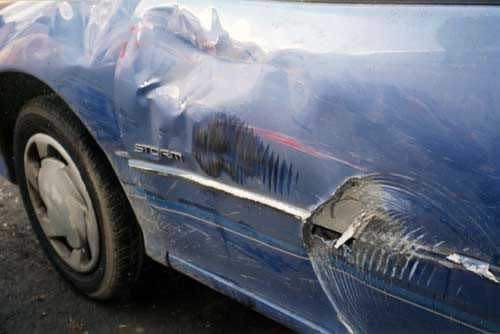
I didn’t have an emergency fund and was already deep in debt. But the car was paid off. The insurance company gave me $2000 for it. Rather than make the smart move — buy a used car — I borrowed $15,000 to purchase a brand new Ford Focus, the car I’m still driving today. That choice prolonged my life in debt.
April’s situation is slightly different, of course. I had to buy a car; she and her husband have the option of using the money to pay off debt instead. But is that the best choice?
Have you had to make the choice between buying a car or paying off debt? Which did you choose and why? (Or, to look at the question from a different angle, have you ever opted not to have a car in order to avoid debt?) What would you do if you were in April’s shoes?
GRS is committed to helping our readers save and achieve your financial goals.Savings interest rates may be low, but that’s all the more reason to shop for the best rate.Find the highest savings interest rate from Ally Bank, Capital One 360, Everbank, and more.
This article is about Ask the Readers, Cars, Choices, Real-Life
Disclaimer: This content is not provided or commissioned by American Express. Opinions expressed here are author's alone, not those of American Express, and have not been reviewed, approved or otherwise endorsed by American Express. This site may be compensated through American Express Affiliate Program.
Discover is a paid advertiser of this site. Reasonable efforts are made to maintain accurate information. See the Discover online credit card application for full terms and conditions on offers and rewards.
SEARCH FOR RECENT ARTICLES


One more thing…you don’t mention emergency fund. I think any money received from the totaled car needs to be your emergency fund, especially if you only have one car!
loading....
it’s tough to say what i would do.. since a nice car to drive is important to me.. i’m willing to make the sacrifice to pay a little extra for a nice automobile (even if it means paying extra for gas too =/)
in their case.. maybe this is a blessing in disguise.. i would cash that 4k (or whatever it is they will be getting) and use it to pay half of their credit card debt.. sacrifice for a few months and use only 1 car.. heck.. maybe he can take his motorcycle to work!
then once they knock out that CC debt.. the husband can go ahead and finance whatever car he needs.. if they are really serious about getting their finances in order.. this is what they should do
loading....
One word Scooter. This might not work if you have to take the hwy.
loading....
I’m currently going through this struggle myself. I’m a bit of a car freak, so these choices may not make a whole lot of sense to someone trying to save as best they can, but cars as a hobby isn’t something I’m willing to relinquish.
I have a Z06 Corvette, which I’m racking up way too many miles on. I currently owe ~$10,000 on it. I also own a motorcycle, and I did own a pickup which I just sold. With the money from the truck, plus some savings, and with the possible sale of the motorcycle, I’m thinking about paying off my vette. Problem is, I don’t like how many miles I’m putting on it, and even though it gets 30mpg on the highway I could get something more efficient (i.e. not 93 octane). I’ve created a spreadsheet that tells me in just 1.8 years I’ll break even by buying an $8000, 32mpg 87 octane car, and that in 3 years I’d break even with a $15,000, 35mpg 87 octane car. So currently I’m leaning towards purchasing a new car, selling my motorcycle, and using the money I get from the sale plus the savings to go towards the new car. I’ll have two payments but I think in the long run I’ll be better off.
loading....
Lots of great ideas here. I’ll second the notion of deferring and getting the 2000-4000 econo car if necessary. If you’re anywhere near a larger city, there are plenty on craigslist. I like to review the used car research on Edmunds, MSN Carpoint and Consumer Reports before buying. Edmunds has a great feature called true cost to own that estimates all expenses related to owning a given model over a 5 year period. It’s a great way to assess those questions about whether it’s better to buy a more expensive car that is more reliable and/or will get better fuel mileage versus sticking with what you have.
I’ll also agree with KC (#50)’s comment that you can’t go wrong with a Civic or Corolla. I would add that the Geo/Chevy Prizm is actually mechanically identical to a Corolla, and often costs less. Both the Prizm and the Corolla were manufactured in a GM-Toyota joint venture factory in California. I believe that plant also produces the Toyota Matrix and Pontiac Vibe. The mid-late 90s Nissan Sentra is also a decent bet.
In my case, based on my family situation and Edmund’s data, I opted to hold on to my wife’s 2002 Explorer with a V8 even though the fuel costs have gone up so much. We wouldn’t save enough on gas to cover the cost of transitioning to another more efficient vehicle that meets our family’s needs. I sold my F150 and borrowed my father’s 20 year old Toyota pickup to commute. It will get me by until debt is paid off. Also we’re moving to within 3 miles of work, so I’ll commute by bicycle and avoid buying a second car for the foreseeable future.
I suppose that it would also be worth mentioning that if you live next door to your father, you might be able to work out an arrangement with him to share a car for those occasional needs. As I mentioned when I discussed my situation, that’s working out for my father and I.
I have a very detailed spreadsheet that I worked up with Edmund’s data to support my decision if anybody is interested.
loading....
TOTALED? – What this means in insurance land is that the repair cost is more than the blue book value of the car. Often you will come out ahead if you can convince the adjuster to NOT total the car, but they often want to total it because they come out ahead by giving you a check and selling the car for scrap.
For example:
TOTALED – they give you a check for $4000
They sell the car for $1000
Their net cost is $3000
Vs. If the repair costs are $3800 then they have to give you a check for $3800 AND YOU GET TO KEEP THE CAR.
The secret with a used car that is paid for is to get a SET OF ESTIMATES from a small independent body shop. Tell the shop that you are going to pay cash, buy used parts, repaint the old parts, etc.
This DOES NOT WORK if you owe money on the car. The bank uses your car for collateral and they have a right to make sure the car is COMPLETELY fixed.
If you own the car free and clear you can take the money, fix only the things that need fixing in your opinion, and still have a driveable vehicle.
TIP – ask the adjustor if you can keep the car after it is “totalled.” Ask if you can buy it from them? This will let you know what they are doing with the old car. You are in a much better position if you already have some repair estimates BEFORE you show the car to the insurance adjuster.
loading....
@ Mike: I’d be interested in seeing such… do you have it publicly posted somewhere?
loading....
I like the try for one car for a few weeks before making a decision idea.
If they need a second car, there are lots of reliable cars for under $4,000 if you’re willing to drive something a little bit older. Honda Civics specifically are known for their longetivity. All they need is regular maintenance which is not any more expensive than the maintenance you would pay for any other car (probably cheaper since the cars and parts are soooo common).
Also, the season for motorcycle riding is soon approaching (or may already be here depending on the area of the country), so they could combine the 4k with the proceeds from the motorcycle sale to purchase something a little fancier.
OR, April could take the motorcycle to work on days she really needs to drive her and husband could take her car.
loading....
I know it’s the same advice as a lot of other people, but I would recommend attempting to be a one-car household for a while, and if that doesn’t work, buy an older Honda. Specifically an older Honda because they last for many, many miles. I know of a lot of ’88 Accords that lasted to *past* 300K miles (I just sold my ’88 Accord w/166k for $1500), and my ’90 Accord had 200k+ miles (sold for $2000 2yrs ago). Great cars
loading....
She said her husband says he “thinks they’ll total his car.” They need to find out first if the car is truly going to be considered totalled, and often when a car is considered totalled, that might not be the case at all.
If the car is in fact totalled, do a thorough search before you buy a new used one.
To JD,
You bought your new Focus and drove yourself deeper in debt. Yet you still have the Focus, you know everything about it maintenance-wise, and you’ll probably have it for a long time to come with luck and TLC. Sometimes you gotta take a step back before you go forward.
loading....
With gas prices being what they are and the trends pointing to $5.50 gallon in 4 years or less, I’d recommend moving somewhere where they could walk, bike, and use mass transit.
Owning a home builds equity. Cars lose value. Our society is undergoing a fundamental shift.
Visit http://www.walkscore.com and put your address into the box. If your score is under 50, I would seriously consider moving. We moved to a condo with a Walkscore of 83 in 2006. Our gas bill so far this year, for two people with two cars = $496. This is possible because we mostly walk and take the bus.
loading....
I’ve never paid more than $2000 for a car. They’ve always been quality vehicles that lasted for years. There’s your standard couple of hundred bucks for repairs a year but it’s minimal. For the $4000 I’d buy two cars…just kidding. Seriously though, but a good $3000 car and you’re set. You wont get all the bells and whistles but who cares? It’ll get you around and it’ll still look sharp for that price.
loading....
interesting- i had never seen walkscore before. however, they don’t take into account crossing dangerous roads! they say the cinema is half a mile away from us… yes, if you cross the major interstate on foot! the grocery store is about a mile away, but from our place you have to cross 6 lanes of traffic. i’d be afraid to do that on foot or on 2 wheels.
i concur with the wait argument, and if you do need another car, buy a late 80s/early 90s honda or toyota. go for the 4-cylinder instead of the v6.
loading....
Depending on which state you are in, you can request that the other guy’s insurance company not pay you for the totaled car, but to request that they replace the car. Same make, model, miles, and same condition that your was in.
loading....
walkscore.. pretty interesting.. i got an 18 =/
makes me seriously want to get a scooter
loading....
People: Starving Artist got it right. SELL THE LAND!!! Raw land is generally a poor investment. Sell the land (assuming it’s not “under water”) and pay off the credit card. Also, they should be able to buy an adequate used car for $4K. Or, try to go without. For two years, my wife had no car. She got by through a combination of car pooling, taxis, buses, friends, walking, the occasional car rental, etc.
loading....
I like the suggestion on waiting a few weeks and seeing if you can make it on one car. Give it maybe 2 weeks, then decide. If you need a car, you should definitely be able to get a decent used car for $4,000. If you do buy a car, don’t forget to have a professional mechanic give it a look, and try to save some of that $4k for repairs that undoubtedly will pop up in the next several months.
loading....
@ JMG: Why again would we sell the land we plan to live on for the rest of our lives just to pay credit card debt that will be gone in less than seven months, if not almost immediately if we use the money from the insurance company? And what is “under water”? Do you mean upside-down? Hardly. It’s skyrocketed in value since we bought it, and we bought it for well under market value at the time.
By the time the land would sell and the closing would go through, based on average days on market in this area, the credit card debt will be gone. When we build, we’ll have well over 20 percent in equity to put toward the construction loan.
I’m not getting what the issue is here.
loading....
Get rid of the cars, get jobs that don’t require you to have cars.
loading....
Joe Falconer is right. Deal with the problems as they occur. If you can repair your vehicle, you would be better off. If you do have to get a car, try to find something small that isn’t new and gets good gas mileage. If you use it for sales you should be able to claim a mileage discount on your taxes. check into it.
loading....
I, like you, would defer.
However, I would also caution her about going into more debt when she buys a car. You don’t have to get a new car to get a really nice car. My boyfriend just bought a 2002 Saturn in gorgeous condition for 5000. You can get good used cars in the $4000 range without spending it all on a new one.
loading....
Buy a $2000 car.
Pay off $2000 worth of debt.
-Ken
loading....
While I absolutely agree that you should consider the one-car path, I’ve actually gone the other route with success before.
About a year and a half ago, someone hit our ’04 Grand Prix and their insurance company give us a fair bid for the repairs, around $5,000.
We took it back to the dealership where we’d bought it used and asked them what they’d give it for us on trade as-is (they have a body shop on site). And they offered us about $6,500 for the trade.
We shopped around their lot and found a used ’06 Grand Prix that they’d had for almost 120 days (so they were motivated to discount it) and got them to settle on a price of $12,500 for the car (once taxes and everything came into it).
Well, we gave them the trade, and used the money from the insurance company to pay for most of the rest of it.
We rolled the rest of what we owed on the ’04 into a new note on the ’06 and ended up $1,000 deeper in debt for a car that was 2 years newer and had 26,000 fewer miles on it.
So, you might argue that we did the wrong thing, going further into debt, but it’s not every day that you can upgrade to a car that’s a year old with 2 years fewer miles on it for $1,000.
Essentially, we added 2 years to the life of our old car for $500 a year.
Another benefit is that my credit had improved over the time since we’d gotten the previous loan at 12.5% interest and the new loan was at 8.2%.
We considered it a good deal and paid off the entire loan 10 months later.
loading....
I would move. In fact I have, four times in the last two years. The first move was to a larger city with a lower cost of living, the second move was from an apartment within biking distance of my job to an apartment withing walking distance. The third move was to a much larger city with much better transit where many old friends lived. The fourth move was to a more central district in that city. Location was vital in all of these moves because I refuse the wage slavery that car ownership requires.
loading....
Gosh, some people say they want to get out of debt, but then they constantly find reasons to jump right back in. This really isn’t a difficult situation — either try to get by with one car or buy a second car that costs no more than $4000. At some point, you must decide to live on what you have and that nothing is worth justifying debt. In terms of how much her husband drives, very reliable Honda Civics and similar cars can be purchased for $3000 or $4000.
loading....
Kudos to April for carpooling. On the rare occasions when she needs wheels, some options may be: Flexcar, public transportation, a nice bike ride.
Assuming she’s in the US, the public transportation option might not be a good one. This country really needs to work on that. Our train and bus system really sucks compared to Europe. Though I will say that San Francisco has a pretty good system.
This is getting somewhat off topic, but within my lifetime (I’m 27) I believe I’ll see less people living in rural areas. Vehicle ownership will become far too costly, so folks will have to live closer to work out of necessity. That means people being less spread out across the land (less elbow room for individuals), and more concentration into urban cities. Small apartments will go for ridiculous rates (think Manhattan prices in Austin…or worse). It will probably start out with people using their cars more as a recreational appliance, like a ski jet, instead of a regular means of transportation. But I digress. I could spew my doomsday rubbish all day and never get tired of it
loading....
Also agree with the “wait a couple weeks” approach – in addition to the reasons that JD lists, every week that you don’t spend that money you earn some interest and have the opportunity to look for a good deal. Even if they eventually buy a car, the longer you can hold off on the purchase the longer they can look for a good deal, get interest on the $4000, and learn to make adjustments to their schedule so that when they do return to a 2 car household, they can learn to use that 2nd car less often, therefore saving on gas in the future.
loading....
Hey April, it wasn’t a personal knock, it was the “rent free” bit (you don’t mention that you carpool with your Dad in this post). Sorry, I assumed “rent free” was code for “living with parents.” It usually is. Also, you don’t mention that you’re (consistently) paying $1,200 a month to pay off the CC’s–knowing you have an extra $1,200/month makes it apparent that you’re a whole lot better off than the original post made it seem. In the original post, you were mysteriously living rent free (which sounded dire) and barely had a nickel to spare. Sounds like you’re fine one way or another.
loading....
loading....
I think trying the one car strategy initially is smart. You can always purchase a second vehicle if coordinating rides does not work out or is too stressful. I have been delaying buying a car for three years now and continue to put it off each month while I function fine with public transportation and the occassional taxi. Each month I put away a little in an account I know will one day be used for the car purchase I keep delaying.
loading....
Pay off debt for sure, a car will just depreciate.
Buy a car and you will be losing double your money (interest on debt, & depreciation on car).
loading....
I would buy a used car that was reliable (Buy Toyota, cough). If I didn’t have enough money to buy something reliable I would borrow just enough so I could. If I had money left over from buying a cheaper but reliable car, I would pay off as much debt as I could.
loading....
this is one case when a poll would’ve been so much more efficient…
i agree w/ defer decision
loading....
We’re having fun making suggestions — but don’t take them all personally. We’re just giving our opinions; you have to make the decision…
I would have suggested keeping the motorcycle and your husband using it for his work biz. (saddlebags could hold the car stock, I thought, but what do I know…) Another possibility that hasn’t been mentioned: how about purchasing a scooter, instead?
At the very least, you should be able to get reliable (used) transportation for a good bit less than that $7000-8000 settlement. The folks’ Cherokee sounds like a good idea to consider — we’ve driven used Cherokees now for two decades, and have generally been extremely pleased with their reliability. (Although they don’t get terrific mileage — in the 17-25 mpg range.)
We had two Cherokees (see, I told you — love ‘em!) and sold one to our daughter. That was a year ago. DH takes the car to work most days, and I do errands/groceries when he gets home. (Or I take him to work, do my stuff and pick him up at night — this happens perhaps once every two weeks.)
One unexpected benefit of living with just one car: you spend less! It must have something to do with fewer trips to the grocery store/Walmart/wherever. And the trips you do make are a better use of gas and time. Even trying it for a month or two will give you time to find the best bargain possible.
Obviously from the many replies, there have been a lot of us out there in your position at one time or another. Good luck to you!
loading....
Don’t worry sharing will work out fine. Pay your debt off since that looks like it is right there, it will feel AMAZING. Conveniences are sometimes something that you don’t see as conveniences but as necessities until you change your outlook and just jump in without the “necessity” there. Try the one car thing, remember you can always change it later, but I don’t think you will want to for awhile. We have gone down a car when I was working from home. We intended to get another car when I started commuting but I didn’t push the issue and shared a car with my live-in mother in law. We are glad that we didn’t purchase another one when originally intended as now we have to make a different purchase for a minivan as we are expecting baby #3. See it works out in the end. Plus you’ll never know how well you will do without it until you try.
loading....
Ok, I have not read through all the comments so I don’t know if this has been mentioned.
Most Insurance companies use the NADA to determine car prices. Be sure to look this number up b/c it is usually less than Kelly Blue book and Edmunds.
But don’t stop there! Check your local newspapers to see what your make and model is going for and discuss the price with the insurance company using the research you’ve done. They can usually give you more money than what they first offer.
loading....
PJ, love the http://www.walkscore.com mention. I just learned that I’m also an 83.
loading....
I need to know what year the car is, what kind of car it is, what the estimate is, and which insurance company hit you. What is your insurance company and do you have full coverage on the car? All these are factors.
Insurance companies are not going to total your car if they don’t have to BUT there are differences between insurance companies. Here in Illinois I know State Farm does not use Aftermarket parts but most other companies do. So in this case if State Farm hit you and no used parts were available they would have to write the car for new parts totalling the car that much faster. ALL insurance companies will try to save the car by using used parts. If the car is totaled but DRIVEABLE ask the insurance company if you can owner retain the vehicle. If the car is old enough you will get a check AND the car. The check would be lower than if you gave them the car but you still get some $. In Illinois I believe it is 8 years old for a vehicle to be possible for owner retainment. Sometimes it’s best just to get rid of the car though, if it was hit hard. Try to get an idea of what your car is going for in your area. Insurance companies are supposed to give you the value of the car IN YOUR GENERAL AREA. Try to negotiate if you think your not getting enough. Remember they can’t take the car until you RELEASE it to them. If the shop/yard is charging storage then they are charging the insurance company, meaning that the insurance company will want to total the car and get it out of there. You can use this as leverage against the insurance company if you feel they are not being fair. I hope this helps.
loading....
Oooh. I love the Walk Score, too. Our current score is 55 (and I’m surprised it’s that high). Our score before we moved four years ago was a 71. That seems about right. I’d love to have an 83!
If there were a Bike Score, we’d do all right on that…
loading....
What’s wrong with buying a $4,000 (or less) car? In reply to your question, yes, we’ve been making the decision to pay off debt rather than buy replacement vehicles for years. Both of our cars are 12 years old. But we just keep fixing and maintaining them, and we don’t have car payments. And, we’re out of debt. We’ve been able to purchase several spendy household items (water softener, water heater, heating repairs, etc.) and go on vacations without going into debt and it feels great!
loading....
Just as I figured, our Walkscore is only 14. Ugh. This is exactly why we are planning on moving within a year. I would LOVE to be able to go without a second car! I do hope it works out for April to forgo the replacement vehicle – just think of the money they’ll save.
loading....
Paying down debt is always a great option.The repayment is always in tax paid dollars. So it takes a lot more time.
What is a walkscore?
loading....
I agree with JMG and Starving artist…sell the land. You cannot afford the land, cannot afford to take out the 20% equity in the land to use towards house construction, and cannot afford to build a house on the land. You are paying $1013/mo, which sounds like you are spending well over 50% of your income on something you cannot use.
how much did you buy it for? how much is it worth now? how much equity will you have? how much will you still owe?
I’m going off of what you have written with the understanding i have no numbers here, but you will still have a $1013/mo payment on the land since you are expecting to have only 20% equity in the land. In order to tap the 20% equity, you are going to have to take out a loan, which means you now have two payments unless you are refinancing the land to consolidate and get the equity, in which case your one payment will increase. Presumably this 20% equity is not going to be sufficient to build your home, so you would be taking out a loan to pay for the difference, which means you will have another monthly payment. given these rough estimates, have you actually done the number crunching to determine if you can afford this? From what is given, I simply do not see how you can afford what will eventually be double the $1013/mo payment on the land in order to keep the land, tap the 20% equity, and take out a new loan to pay the difference for the house.
coupled by the fact, you have no savings or emergency fund. moreover, home ownership also includes increased property taxes, insurance, etc which means you should be adding an additional 30-40% of your now roughly $2000/mo for land+house payments. granted, i’m just throwing fictitious numbers out there, but i simply don’t get how you can afford the land. get rid of it, pay off your debt, get your second car, and then save towards your home ownership goal.
loading....
As someone who has worked in personal injury/property damage law, I would caution our hero toine be careful of counting her chickens before they hatch. Any number of things can pop up in the claim/lawsuit process that could reduce the settlement amount. We warned all of our clients not to rely on receiving any amount of money from their cases and yet so many ignored our warnings and were left in awful financial situations because they took our preliminary estimate as a final figure.
I know that this question is posed to us as more of a theoretical exercise than a real life advice situation, but I wouldn’t feel right without at least posting this warning.
loading....
I think April is close to making her own decision! See #44
Interesting to see different takes on the topic.
loading....
I guess the best idea is to buy a small car that doesn`t use a lot of petrol.
I`d take some used car from some trustworthy carmakers.
Everybody should start thinking of a smaller car now to cut expenses.
GL to all
loading....
@Tim: We’re using 50 percent of our income toward the land? I didn’t ever state what our income is, so that’s some interesting math you’ve done! I listed our biggest monthly bills, not total income. Our lot payment isn’t even 25 percent of our income, and it will be mostly paid off and rolled into the construction loan (accounting for 20 percent of the total loan). No need to worry…I have a real estate license, so I do know what I’m doing. It’s not at all the scenario you’ve come up with.
If my posts sound like I’m offended, I’m really not. It just surprised me when a few people took the limited information (I can’t post every detail–it’d be awfully long and boring) and went to so many extremes. Luckily most posts fell somewhere in the middle, and I got so much great advice. Thanks to everyone who weighed in.
loading....
To sum up what a financial expert told a group of us teachers…a car is one of the worst investments we make! Rather than spend $20K on a new car, spend $4000 on a properly researched used car every 5 years!
(amounts updated to today’s prices since this was 15 years ago!)
loading....
The one car strategy works great though it can cause a little bit of pain.
When my wife started her first job in 2004, we could have bought another car but we decided to just do with my 5 year old car (even though together we were making 8000 per month after tax and our other expenses were only 3500).
We had to align our work timings so I could pick her up and drop off etc. (On occasion she would request one of her colleagues to drop her off).
Thanks to little pains like this that we took, we saved and invested enough that once we had a baby this year, we had the luxury of my wife deciding to stay at home for a couple of years.
It was all a matter of planning ahead about what were the goals we *really* cared for, and dealing with small pains to make that happen.
loading....
April, as i said, i was going off of the limited info you posted, so why not post your stats because it takes very little to post your monthly income and expenditures? when asking a question of paying off debt vice buying a replacement car, the answer cannot come in a vacuum, because you have a larger financial picture that is at play here. by omitting key details of your overall financial picture, you simply cannot get a real answer to your question. it may not be all the scenario that i have posted, but there are key things in your budget that you lack like savings, retirement, and the biggie an emergency fund which you haven’t denied. given the further info you posted…
if your land payment of $1013/mo is roughly 25% of income, this means after taxes your take home is roughly $3500/mo. The three major debt amounts you’ve posted are land @ $1013/mo, car @ $240/mo, motorcycle @ $200/mo, cc debt @ $1200/mo (based off of you have $8k cc debt and you stating paying off in approx 7 months), which leaves roughly $700/mo for other living expenses. you didn’t list any savings, emergency fund, or retirement funds and are faced with needing a second car for work. if you are unable to reduce the $700/mo in other expenses, how are you going to afford a new car, paying down your cc debt, maintaining payments on your other debts, and continue to live?
let’s say that you can roll your equity into construction loan and you can afford approx $2000/mo for construction loan (also taking into mind that you haven’t paid off the land loan yet, but we’ll just wish that away) given that you pay off your cc loan in 7 months that would free that amount up, let’s further assume you can continue to reside where you are rent free (utilities free?) during your home construction, where are you going to get the additional resources to pay for extra home ownership costs, especially taking out a second car loan?
I still say get rid of the land, pay off your debts and then readjust your goals. sometimes you have life goals that you simply cannot afford to pursue, and from what you’ve written, you cannot afford to continue owning the land, when you have other debt and no savings. if your land has appreciated (which means increased property taxes coupled with property taxes on the house once you build it, etc), take the profits, get your finances in order before starting starting to think about a home loan, especially constructing your own home because construction always has additional costs. you are setting yourself up for failure pursuing home construction which invariably has those oops and i didn’t think of costs (presumably you are building your dream home on this dream plot of land), because you have no wiggle room in your finances either now or in the future. Asking the question of paying off debt or getting a car has nothing to do with your real estate expertise (otherwise, i’d say you wouldn’t be asking the question to JD). your real estate expertise should give you the advantage of insight into what it will actually cost you to construct a new home and owning the home, so you can use that information to determine if you really can afford to pursue this given your current income levels, debt, and savings or lack there of. to me and some others, you simply cannot afford to own the land at this time.
loading....