Hidden Price Increases at the Grocery Store Print
Tuesday, 29th July 2008 (by J.D.)This article is about Food, News, Shopping
“Look at this,” Kris said yesterday when she returned from grocery shopping. She held up two yogurt containers for me to see.
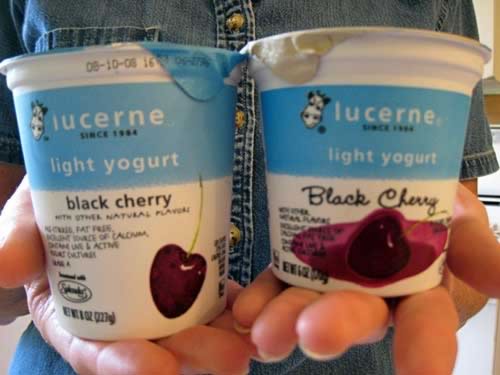
“So what?” I said. “Black cherry yogurt.”
“Look closer,” she said.


“That one’s smaller,” I said. “Did they change the container size?”
“Yes,” she said. “But they didn’t change the price.”
The incredible shrinking yogurt
I’ve received several e-mails lately from readers noting the same thing. They go to buy a product they’ve been using for years, only to discover that the container has shrunk. The price hasn’t changed — only the packaging. Reader David Cox, for example, wrote with the following anecdote that mirrors our own:
We went to the grocery last night and one of the items I wanted to get was yogurt. The store always seems to have their brand of yogurt on sale @ 10/$5.00. I was about to scoop up a bunch, when I noticed that they had redesigned the packaging with pretty new colors, but the package seemed a bit smaller. On closer examination, it was.
The new size was 6 oz. of yogurt, while the old style had been 8 oz. The price per package hadn’t changed, but the package now contained 25% less product. I thought it was very tricky of them to leave the big sales sticker on the shelf (10/$5.00!!!) just like we were used to seeing, without any thing to warn you of the repackaging. I guess they would claim it was obvious, but it still seems a bit tricky to me.
Is it tricky? I don’t know. I understand that manufacturers need to make a profit, but when they reduce the container size instead of raising the price, it does seem a little sneaky. It’s as if they’re unwilling to raise prices directly, so they take a circuitous route.
Standard operating procedure
I recently had a conversation with a friend who knows a great deal about this subject.
“You see marketing stories like this over and over,” Freeman told me. “Fabric softeners cut the sheets from 40 to 36 — same size box and same price. Ketchup switches from a glass bottle to a smaller plastic bottle and the price stays the same. Some companies mess with cap and lid sizes as a way to increase consumption. Want a bottle of laundry detergent to run out faster? Then increase the cap size slightly. (Many people use a capful per load.)”
Freeman then pointed out other ways companies subtly manipulate spending. “Think of the famous lather, rinse, repeat instructions on shampoo. Like you really need to do that. Same things happen with chips, cereal, and on and on. Just consider: maybe a box of cereal hasn’t gone up in price much in the past decade, but I guarantee you that the average box size has certainly decreased.”
Another friend, Jeffrey, chimed in: “I always wondered why, if the cost of packaging is so expensive, do cereal companies reduce the amount inside the box but the leave the size of the box alone?”
“They also do this with cereal bars,” Jeffrey said. “A while back, General Mills came out with Fiber One bars. The box is the same size as all the other boxes but there’s only five bars in the box, not the standard six bars that are in every other box. Nature Valley does the same thing with their family size box of granola bars. You open the box and only half of the box has product. It’s the same thing as lying but it’s disguised as ‘marketing’ so it’s okay.”
Savvy shoppers
Again, I’m not sure it’s lying, but it’s obvious that shoppers don’t like to be duped this way. But both David’s e-mail and Jeffrey’s comments reveal they don’t appreciate being tricked. They’d rather have the same package size but see the price increase. I would, too.
Food inflation is a hot topic in the United States right now. I think we’re all beginning to realize that the things we love cost more. But some of us would rather pay the increased price than have manufacturers try to hide the inflation with packaging.
For more on this subject, take a look at Nickel’s thoughts on product packaging. He observes that suggested portion sizes are increasing even as package sizes are decreasing. You may also be interested to read about unit pricing in the GRS archives.

RSS Feeds
Facebook
Twitter

July 29th, 2008 at 5:18 am
Sometimes they do even worse - the other day I went to buy some cereal that I usually get and it was in a bigger box but a smaller amount was in it. How’s that for marketing tricks.
I really dislike it when they do this while saying it’s “new and improved” or somehow “better”
July 29th, 2008 at 5:23 am
I’m also not sure if they’re lying, but it’s definitely something customers can’t feel comfortable with. I’m sure the company will have a feeling like, “It’s ok until someone will notice” and that’s not right.
July 29th, 2008 at 5:25 am
The great blog Consumerist calls that the “grocery shrink ray” and it’s happening all over now. They were on NPR the other day talking about it.
July 29th, 2008 at 5:34 am
This is something Consumer Reports has been grousing about for years. No doubt we’ll see more of it as the costs of food and transportation rise.
Interesting about the cap sizes! I hadn’t thought of that…but of course. I’ll get an inexpensive plastic measuring cup to use with the detergent after this.
Shampoo twice? Well, of course a guy doesn’t have to do that. But if you’re a woman with hair that’s much longer than a man’s and you use a lot of styling products (conditioner, mousse, gel, spray), it actually takes two shampooings to get all that gunk out. The stuff sets up like cat food.
July 29th, 2008 at 5:52 am
Wegmans, my favorite of favorite grocery chains recently posted an explination of the “grocery shrink ray”.
Consumerist also posts on this topic on occasion.
http://consumerist.com/5029914/wegmans-grocery-store-admits-that-the-dreaded-grocery-shrink-ray-exists
July 29th, 2008 at 5:55 am
That’s why you always look at the unit pricing, not the sale price (super markets update the unit price when items are on sale). You won’t get duped then.
July 29th, 2008 at 5:56 am
Everyone is complaining that companies are being evil profit suckers . . . What they don’t say is that consumers have ALL of the power in these situations. It’s completely simple, when a company pull this stunt, buy a different brand. All of a sudden this will stop happening. The dollar is the only vote that counts these days, stop being a sucker and show them what you want.
July 29th, 2008 at 5:57 am
We’ve noticed this as well in our shopping trips. I especially noticed it with the Fiber One bars, since I get them regularly. It is frustrating. Also, they are doing it with ice cream. They do 1.5 quarts instead of a half gallon now.
July 29th, 2008 at 5:59 am
A family member pointed out that her favorite cereal boxes were slimmer (but the same height) so they had less product inside each box. Looking at them faced in a row you couldn’t tell the difference…pretty sneaky. I’m all about shopping by unit price.
July 29th, 2008 at 6:08 am
Edy’s ice cream also did this. It’s very sneaky.
July 29th, 2008 at 6:08 am
This could really bite you if you have a recipe that calls for an amount that used to be one container’s full, and now will call for one and part of another. Not only do you have to buy two, paying twice as much, but depending on the contents, you might never use the leftovers. (Think ricotta cheese and lasagna)
July 29th, 2008 at 6:09 am
I agree - if you’re going to complain about the cost of packaging, I’d rather pay a higher price for the packaging as to pay the same price and get less. Of course, I’d RATHER that the serving sizes were smaller AND the price was smaller, but hey, we can dream, right? *smile*
As far as laundry cap sizes go, I’ll have to agree, I’d not thought of that, and getting a cup to measure a standard amount is a good idea - anyone have any idea how much one should use for a BIG load of laundry in a standard sized washer? (because I only do one big load a week usually)
As far as washing your hair twice is concerned, there’s only been a couple of times I’ve had to do this - and both were while I was in Army field training (once in Basic, and once in our AIT) - we were out for a week without really being able to wash our hair, and I just felt gross. (not to mention the fact that I was in the sandy area of South Carolina!) Even after using all that gunk for my proms (to get my hair to stay, I had to use a whole bottle of mousse, two bottles of hairspray, AND not wash my hair that morning…plus, sometimes, gel!), I still only had to use the shampoo once. And shampoo brands don’t matter - Suave cheapo works just as well as Paul Mitchel.
July 29th, 2008 at 6:13 am
I noticed that a couple years ago on Dannon plain yogurt. What amused (and annoyed) me one time was my local Giant Eagle had a sign on the yogurt shelf saying “new low price” and the price was in fact, higher than the previous price. Ridiculous.
July 29th, 2008 at 6:17 am
I despise it when I buy toothpaste to discover 30% air in the tube. Now THAT’S cheap!!
July 29th, 2008 at 6:21 am
I may be showing my age here, but I remember a standard can of coffee being one pound. The price went up and down, but the can price *was* the price per pound. More recently, I noticed a brand of ice cream dropping in container size from 1/2 gallon to 56 oz. Yet, this same brand is always on sale, buy one get one free. I attribute some of this recent activity to adjust single serving packages (like the yogurt) to try to get the calorie count to some target number. Maybe 100? I find it curious when a soup can label says “100 cal per serving” but then the back label says there are 2.5 servings per can. There’s so much of all this going on, I’m sure it could take a full web site to track it all.
Joe
July 29th, 2008 at 6:27 am
I second Lynn’s comment about the effect of changing packaging sizes on recipes. My husband often has friends over to help with projects on our property, and we make sure to feed them well while they’re here. When a box of my favorite pasta shrank from 16 ounces to 14, I needed to re-jigger my spaghetti and baked ziti recipes to ensure there’d still be enough volume of food to feed a bunch of big hungry guys.
Bet Campbell’s would hear a bunch of whoopin’ and hollerin’ if they shrank the can size on cream of mushroom soup.
July 29th, 2008 at 6:28 am
News Flash: The cost of EVERYTHING is going up. It’s getting impossible for the manufacturers to maintain margins with the rising cost of fuel, grain, etc. They have a choice, cut the pay of CEO’s, or bleed the consumer…and from this article, which do you think they are taking?
Want to fight back? Get off the packaged food ride and shop at food co-ops. Bulk bins are always what they are. The price may increase, but you know exactly what you are getting. Makes the price per pound calculation a moot point…it’s always by the pound. You’ll save money…and the health benefits are worth it on their own.
Many people bemoan the higher packaged food prices at co-ops/natural food stores…but you don’t have to buy fancy raw food bars…just stick to the bulk bins and produce.
Case in point:
Bulk Raw Goji Berry Energy Nuggets - $5.99/lb
Clif Bars on Sale - $1.00/ea or $8.00/lb
July 29th, 2008 at 6:28 am
It’s annoying that they think we’re really that ignorant. I’ve shopped the unit pricing stickers since they’ve been forced to use them. My complaint lately is with the grocery stores. The new marketing ploy is to group a variety of products & say any 10 for $10. or $20. Or two for $5.00, etc. It used to be that even if you only bought one of two or eight of ten, you got the sale price. Not anymore. If you don’t buy two, you pay full price on one. A gallon of milk in the brand I prefer is almost always listed indivdually at 0.75 - 1.00 higher per than if I buy two. If you’ve got a large family, it’s not a problem. If you’re single & it’s perishable, you usually end up with the product going bad before you can use it all.
By the way, Sam’s club sells the chocolate & oats flavor Fiber One bars in a large quantity box at a very affordable price compared to the regular grocery stores, even when they have them on sale.
Many rural communities don’t have access to coop bulk food. Years ago one of our groceries offered it & didn’t maintain them in a sanitary fashion (you can’t just dump more new product in the bulk barrel on top of existing product). Eventually food spoils & that store ended up having to take them out. I saw a group of filthy dirty kids rifling through them early on with their bare hands & knew I’d never shop out of them no matter how good the price was.
July 29th, 2008 at 6:28 am
Re: Laundry Detergent Caps
My mom has been harping on me for years that laundry detergent caps have been getting bigger and bigger.. Have you seen the size of the caps on laundry detergent you buy at Costco? My husband and I have been using an old cup my mom had that is probably 10 years old. There’s a huge difference!
July 29th, 2008 at 6:38 am
Re: Unit Pricing
Paying attention to the unit price of items prevents you from being “tricked.” The price per unit, which is standardized for each product (ounce, square foot, etc) is right in front of you each time you pick up a product. You may have to do some math in the aisle to figure out which item is actually less expensive, but it’s worth it.
Paper towels and toilet paper is sold in “mega-rolls” and such, but if you look at how much you pay for how many square feet of product your getting, it can be quite enlightening. More smaller rolls, often means more toilet paper and less cost.
Don’t blame companies for your own ignorance. The actual cost is right in front of you. Just take the time to figure it out instead of expecting someone to have already done all the work for you.
July 29th, 2008 at 6:44 am
Dangit, I was just at Winco and bought Lucerne yogurt. I was reading the unit price on the shelf tag, not the size, and I just did the math. Unit price on the shelf tag was still for the 8oz. Guess I need to go back to taking my calculator with me.
July 29th, 2008 at 6:50 am
Sorry, but I have a dissenting voice this time. I don’t feel sorry for myself — or for other Americans with good incomes — about higher food prices. Our record levels of obesity indicate that we haven’t handled inexpensive food very well. I do admit, though, that eating less is challenging.
For a fun and unconventional approach to losing weight, see my article http://www.diamondcutlife.org/the-very-best-diet/
July 29th, 2008 at 7:12 am
@Mary: Price per unit is NOT standardized by product. I have often found when shopping for paper towels (to use your example) that some packages will use square feet as the unit, some will use “towels” as a unit (where 1 towel /= 1 square foot), and some multipacks will use “rolls of towels” as a unit! The math is always doable, but it often takes several calculations to convert items to comparable units.
July 29th, 2008 at 7:13 am
“I especially noticed it with the Fiber One bars, since I get them regularly”
Regularly. Heh.
July 29th, 2008 at 7:18 am
Arm and Hammer now procaims “half the size, same number of loads” and the 100 oz bottle is now 50oz and the price is $2.00 more expensive. I noticed the trick to getting the 32 loads out of the same number of ozs is fill the little cup a quarter full.
July 29th, 2008 at 7:23 am
Since I’m trying to avoid weight gain (and ideally lose weight), I haven’t been totally unhappy to see smaller sized “single serving” items like yogurt, even at the same price…
Also, Lynn @11 says this could be a problem for recipes, but, in fact, there’s usually wiggle room. One can use an ounce less ricotta in lasagne and not miss it, and that’s true of a lot of recipes, don’t be afraid to experiment with cutting fat, sugar, and salt amounts in recipes, you may find you prefer healthier versions.
July 29th, 2008 at 7:27 am
I find myself having to calculate cost per unit in creative ways when it comes to Kleenex, paper towels and toilet paper. Those “giant” and “mega” sizes are quite misleading.
July 29th, 2008 at 7:28 am
Unit pricing is not standard across the shelves. Some sizes of an item at our kroger will be listed as price per ounce, while some will be listed as price per pound. Others will be listed as price per Gallon and price per ounce, depending on size of the container for the same product.
July 29th, 2008 at 7:30 am
I noticed a few years ago that yogurt started changing size. First Dannon was 6 oz, and then every other brand started. I have to search for a yogurt that’s 8oz, because 6 isn’t enough for me. I also think that it’s not just cost with the yogurt, it’s also calories, like those over-hyped 100 calories packs.
The real way to be frugal here is probably to buy the big cartons of yogurt and scoop out individual servings.
July 29th, 2008 at 7:33 am
Not that shrinking product sizes doesn’t hit my wallet where it hurts, but perhaps this isn’t a bad thing.
America is suffering an obesity epidemic. We also spend a significantly smaller portion of our incomes on food than people in the rest of the world - where obesity is less of a problem. If food is more expensive, people consume less and fewer people suffer from obesity.
Maybe smaller size containers and high prices will help people get a handle on what an actual portion size is. After all, money is one of the great motivators.
July 29th, 2008 at 7:38 am
I remember my engineer father a few years ago was involved in designing the shape of ice cubes. What is important about the shape of ice cubes you ask? Seems that fast food restaurants and bars wanted to displace the most beverage dispensed while maintaining the appearance of a full glass! Sneaky yes, but that’s what he was paid for. Those 100ths of an ounce displaced and multiplied by millions adds up to big bucks.
It’s all around us, just follow the money!
July 29th, 2008 at 7:41 am
@ artist:
“”Many rural communities don’t have access to coop bulk food. Years ago one of our groceries offered it & didn’t maintain them in a sanitary fashion (you can’t just dump more new product in the bulk barrel on top of existing product).”"
That is true, but if you dug a little deeper, you might be able to find something.
http://www.coopamerica.org/
And a link on starting your own:
http://www.cgin.coop/public/food-coop-info/start-a-food-coop
And one for buying in bulk on-line:
http://www.frontiercoop.com/
In the small town I grew up in, many of my friends in the rural areas got together and ordered in bulk, then split things up. Good way to work on establishing community AND save money…
July 29th, 2008 at 7:41 am
Here in Brazil, this started happening a few years ago. Everyone got pissed with that.
And this huge amount of complaints from everyone made the government create a certain rule.
If a product is going to have its size reduced, they are obliged to write in the box something like this:
“new amount: 200 ml, reduction of 10% (220 ml to 200 ml)”
And that sorta helped.
July 29th, 2008 at 7:42 am
My mother told me about this sneaky trick over 20 years ago. I think it seems shocking now because it is happening all at once. She also always told me to use less detergent than called for because “they just want you to buy more”.
I would prefer a price increase instead of the “incredible shrinking ray gun” because I’ll have to buy more often now; I’d prefer to have a good size amount available so I don’t have to increase my shopping trips.
July 29th, 2008 at 7:43 am
Perhaps there is a silver lining: The shrinking economy is also shrinking the size of our meal portions, the size of our cars, the size of our wardrobes, the size of our homes, and so on…
It may also be shrinking our net worth but perhaps it is simultaneously increasing our net HEALTH…
“The first wealth is health.” ~ Ralph Waldo Emerson
Kent (The Financial Philosopher)
July 29th, 2008 at 7:46 am
About laundry detergent - the biggest family size containers have started to shrink in favor of more “concentrated” liquid. That’s great for store space and transportation costs, but many people will still use the same amount they are used to for one load of laundry.
The new containers have a new measuring cap as well. It’s smaller for sure, but instead of being cylindrical, the markings are evenly spaced on a slope-sided cup. That means going from 1 to 2 is actually more than double the amount of soap.
July 29th, 2008 at 8:00 am
I noticed Breyer’s Ice Cream did this awhile back. Not only did they shrink the size, they raised the price at the same time. Sheesh
July 29th, 2008 at 8:01 am
I think the outrage is a little off the mark here. Companies (esp. packaged food companies) are having to deal with a large amount of cost increases (gas, commodities, etc.). They have 2 choices - raise prices or decrease sizes. The fact that they often choose to decrease sizes is because of the CONSUMER. I’ve done a lot of consumer research for companies and let me tell you that even a small price increase can result in a dramatic decrease in sales (esp. for items where consumers are really price sensitive - like detergent). Companies are only responding to consumer behavior (which is what they should do).
July 29th, 2008 at 8:02 am
My husband and I just had this exact conversation after my last trip to Costco. Putting my 6 pouch pack of chicken breasts into the freezer, I noticed that they were all 2 breast pouches. Previously three had been 2-breast and three 3-breast pouches. The price was ofcourse the same.
I’m fighting back by splitting the chicken breasts in half lengthwise when I cook them. Frankly you’ll never find chicken breasts that big in Europe anyway, so as expats we’re used to smaller portions. I also realise that without a political vote here, my most effective voice is my money. The consumer wields a lot of power here these days. Don’t underestimate the power of your pocketbook.
July 29th, 2008 at 8:04 am
I have read that companies do that because consumers would rather pay the same price for less product that more for the same amount.
I have noticed toilet paper rolls getting smaller (width wise) and shorter. I always buy in bulk when I find it on sale. I had a old package in the basemen that was for double rolls of Quilten Northern, it had 440 sheets in each roll and fit across the dispenser. Last package I bought of double rolls has 352 in each roll and didn’t fit all the way across the dispenser.
There’s not much we can do about it but try to buy the least processed foods in bulk. My batch of 12 muffins is the same size all each time I make them, and much cheaper and healthier than cereal! No shrinking there.
July 29th, 2008 at 8:11 am
This is really nothing new, Andy Rooney did a piece on changing coffee container sizes back in ‘88, then again in ‘93, then again in 2003, it’s easy to find by googling it.
Really, I’d imagine it’s been going on forever, Time magazine did a piece about the changing size of Hershey’s nickel candy bar back in 1962. In fact, Hershey kept the bar a nickel while changing the size until they discontinued it in 1968. People noticed it then too commenting “Hershey is packaging a nice razor blade now.”, according to the article.
July 29th, 2008 at 8:12 am
UNIT COST!!!! Always check this, as you have recommended in the past, and it will alert you to true changes in the price or the size.
July 29th, 2008 at 8:13 am
I’ve noticed that bars of soap like Zest have been shaved at the sides to make the bar more slim in the middle so it runs out faster.
July 29th, 2008 at 8:14 am
Let the buyer BEWARE! I don’t understand when people are constantly anthropomorphizing [no, I don't know if it's spelled right - such is life] corporations.
A corporation is a legal entity - a fictional being. It doesn’t have a heart. It doesn’t care about you. It cares about making money for it’s shareholders. If it doesn’t do that then it is failing in it’s reason for being. Think of it more as a machine and you’ll stop feeling tricked by ‘Good old Betty Crocker’ and realize you have only yourselves to blame if you’re duped.
If you were going to buy a car would you just walk in and assume the dealer was going to set you up with something perfect and fair. You go in KNOWING that their goal is to separate you from as much of your hard earned money as they can.
It’s not really any different at the grocery store.
I have noticed these sorts of thing MANY times over the years - not just lately. These companies do TONS of research to see what the consumer will put up with best - be the rebel - don’t put up with it! Compare unit pricing ALWAYS - if you’re buying something that’s more expensive because you like the ingredient list or taste better do so KNOWING that you’re making a CHOICE! In truth just like your costs have risen so have the production and delivery costs - they’re just trying to pass the increase along in the most palatable way [no, I don't work for a grocer/manufacturer or corporation even]
That’s what this is all about anyway - knowledgable choices in all things
And I agree with the above poster - my homemade muffin recipe hasn’t gone down in size either LOL!
July 29th, 2008 at 8:21 am
I’ve noticed that the size of the packaging has gotten a bit smaller and I’ve noticed the price going up on some products. But what really baffles me is one chain will carry a cereal for say 2.99 on sale and that same cereal is going for 4.29 in another. Buyers have to be conscious of what they buy.
As the saying goes ‘Buyer beware’.
July 29th, 2008 at 8:34 am
It’s nice that some stores display some sort of unit price, but it’s spotty at best. That’s why your best weapon against this is a calculator!
As far as cereal boxes looking about the same size… the cereal companies compete for “face time” on the shelf and arrange with grocery stores for placement. Walking down the cereal aisle is just walking through a commercial!
July 29th, 2008 at 8:35 am
“”Perhaps there is a silver lining: The shrinking economy is also shrinking the size of our meal portions, the size of our cars, the size of our wardrobes, the size of our homes, and so on…
It may also be shrinking our net worth but perhaps it is simultaneously increasing our net HEALTH…”"
Bingo. As the NYTimes said in the Book Review section re: “The End of Food”…
“Eating Beef is the new Driving a Hummer.”
Eat less, mostly plants.
It’s cheaper, better for the environment, and better for your waistline.
July 29th, 2008 at 8:40 am
I’m sure I’m repeating something, but I think part of the marketing game employed here is that noone wants to be the first to raise prices. It’s less obvious that you’ve jacked up your prices if the volume of product is smaller in a package that looks the same as the competitors.
I buy many items in bulk now, so unit pricing has become a habit — thank goodness. I have enough relearning to do with all the other things rising in price. I don’t like to think about how much money we lose every time we let produce go bad.
July 29th, 2008 at 8:43 am
Maybe the lack of moving to the metric system is being driven by the food companies. If everything was metric it would be even easier to calculate unit prices between different sizes. Considering the US is one of three countries that don’t use it, with the other two being Burma and Liberia. What great company to be in.
July 29th, 2008 at 8:48 am
When I told a friend of mine yesterday that I worked in marketing, he immediately called me a name under his breath. “Manipulator.” I asked what he meant, and he explained that, to him, “marketing” was synonymous with “molding people” and lying to sell product.
In the case of making subtle changes to packaging and not changing price, product managers are, in fact, “manipulating” their customers. We’re used to buying a specific box of cereal bars and getting 6 bars inside. Finding that they’ve only packaged 5 but kept the same price is frustrating. As is finding a smaller portion of yogurt, or any other product, in a familiar package.
July 29th, 2008 at 8:55 am
It’s happening here in Malaysia too ! Especially after the recent fuel price increase. As usual, you can see in the size of foodstuff.
July 29th, 2008 at 9:01 am
watch the corporation (http://www.thecorporation.com/) for its raison d’être, it’s here to make money, has all the ‘rights’ that you and I have, but no moral conscience to guide it..
July 29th, 2008 at 9:01 am
You know, they aren’t just reducing the size of the finished product, they are reducing the quality of the finished product as well.
I haven’t eaten a twinkie in about 5 years - they changed the whole thing. Granted it’s junk and I know it’s junk. But I still ate them occasionally. The quality has suffered on many things like that, and the price? Just keeps going up!
July 29th, 2008 at 9:02 am
To make the arguement that all this downsizing is for the best because of obesity or any other health issues is a moot point, in my opinion. I don’t need the government or some grocery store dictating the choices I make and then telling me they’re doing me a favor.
Being aware of what you purchase and not just blindly throwing anything in your basket is the best defense against these new “marketing” tactics. I find that its almost always better to buy in larger quantities when you can and separate as you like after you get home.
July 29th, 2008 at 9:05 am
It’s happening in other consumer industries too. For instance, airlines aren’t raising fares that much even though their costs are skyrocketing (obviously they use a lot of fossil fuel). Instead they’ve been hiding the cost increases by lowering service (no more meals) and adding fees (the “free” ticket with your frequent flier miles is no longer free. many major us airlines now charge even for the first checked bag.)
I wish all these places would just raise their prices instead of this trickery. I am not mad at being tricked, per se; I am more frustrated at how difficult they are trying to make it to comparison shop. (I’m sure they would prefer no comparison shopping at all!)
July 29th, 2008 at 9:17 am
I don’t know if anyone else noticed, but Kraft reported record profits yesterday - on a smaller number of units sold. How did they do it? You guessed it: raising prices and decreasing packaging volumes. Caveat emptor, indeed.
July 29th, 2008 at 9:19 am
Aren’t they so sneaky. It is sad because I have not really taken notice to the price increases at the grocery store. I have a set budget to meet for groceries and always seem to stay under it.
I think I need to pay more attention.
Austin Hike and Bike
July 29th, 2008 at 9:23 am
It’s funny that a marketer would consider these tactics as “genius” because the average consumer would not notice the changes that you pointed out. But a savvy consumer would call these practices “deceiving”. I wonder if marketers forget that they are consumers as well and this affects them too…
I never noticed this about laundry detergent. I guess I can start using less to save money. Unless they watered down the formula’s as well so that a smaller amount will not be as effective…
July 29th, 2008 at 9:30 am
I can’t say I agree with the tactic of creating smaller sizes, but something has to be done with the rising food prices.
The manufacturer can raise prices, but no one likes to pay more for products. Loyal customers might switch over prices, it’s really simple and very likely.
Changing the package size saves them money not only in product cost, but in shipping the product as well. And they realize most consumers won’t catch it.
I really don’t think they are trying to raise profits in situations like this, I think they are just trying to keep costs low for the consumer, even if at the end of it all it’s not a good deal for the consumer. Rising prices must be passed on to everyone in the supply/consumption chain.
Look at it this way … 6oz of yogurt vs. 8oz is less calories, and you probably won’t notice much of a difference in the amount when you sit down to enjoy it in the morning. Maybe they are just trying to help us with our diet’s and healthy eating lifestyles.
July 29th, 2008 at 9:35 am
I’m the Dave mentioned in the post, and as it happens, it was the Lucerne yogurt pictured that I was writing about. I don’t have any problems with the change of the packaging size. My objection was that it was done without any indication to the consumer at all. There was no sign on the shelf indicating any change, there was nothing on the package itself - even the sale sign was the same: 10 cups for $5.00. Unlike most of the readers here, I would say that your typical consumer would walk up, see the same 10/$5.00 sign, and throw a bunch of them into their cart, without ever realizing that they had just bought 25% less product for the same price. I understand that prices are increasing, but a company will make me much happier if it is open about that. Instead, many companies make pronouncements about “holding the line on prices” while deceiving us by giving us less for the same amount of money. It’s as annoying to me as a consumer as the various ads for cars that say things like “buy a new whomper 3000 for under $20,000″ when the fine print says “actual price: $19,999.99, tax, license and dealer markup not included”
July 29th, 2008 at 9:40 am
I find it interesting that there’s actually some economic pressure on companies to change their traditional “consume more” marketing strategies. As someone who’s concerned about health, I’ve always been annoyed by package up-sizing. I remember when the normal serving size for yogurt was six ounces, not eight ounces. I guess everything old is new again.
That said, it’s not personally relevant to me because we stopped buying packaged food years ago (except for graham crackers for our toddler). The price was always higher than bulk foods and the environmental impact of the plastic and cardboard depressed me. I’m glad I now live someplace where I can buy in bulk locally, instead of by mail order, but even mail order purchasing was worth the effort.
July 29th, 2008 at 9:42 am
@dorothy, would you mind expanding on what you mean by bulk? What exactly do you buy? Ingredients or made food?
Grains? Beans? Rice? etc?
July 29th, 2008 at 9:45 am
Banks, phone companies, and utility companies also raise rates and increase “hidden fees” — in most cases, you have to check your bill carefully to spot the changes. It’s your money, take responsibility for it and stop blaming the “evil” corporations. They are responding to higher gas prices and market fluctuations just like everyone else. Their business is making money. My business is making (and saving) money, too. So I take the time to check prices and make sure I know where my money is going. It surprises me that so many people blindly throw items in their cart, then complain that they are being “duped.”
July 29th, 2008 at 9:53 am
Yeah, and all the while, wallets keep shrinking as well.
July 29th, 2008 at 10:03 am
Maybe eating 25% less for the same price (without knowing it) would actually be a cost SAVINGS in the longer term. Let’s face it, America is fat, and it could really use the health costs savings and productivity increases of being in better shape.
July 29th, 2008 at 10:05 am
While I agree it’s not right to charge the same price for less product, portion sizes have doubled and tripled since the 1970’s.
for example, see here:
http://steinhardt.nyu.edu/nutrition.olde/PDFS/young-nestle.pdf
Cutting portion size will combat rising obesity problem among americans.
Just sayin…
July 29th, 2008 at 10:20 am
I had to add a small rant. A lot of companies are shortcutting ingredients.
The prime example I remember was a while back. I was at costco and wanted Vanilla ice cream for desert (for a party.) I picked up a Breyer’s 4l container. Everyone knows that Breyer’s is the ‘all natural’. It even said “All natural” on the front.
I was putting it in the freezer when I realised it didn’t say “All Natural Ice Cream” anymore, which I’m sure it used to… it said “All Natural Vanilla”. And sure enough, it was real vanilla. The ice cream? Not very all natural.
Everyone is feeling the squeeze. Granted, I feel very misled due to the packaging switch in this case, and have no tolerance for it… but it has become a bit harder to shop well in this environment. I’ve had to check cheese and cold cuts recently - I noted an increase in calories; more fat, less protein. Surprise!
July 29th, 2008 at 10:21 am
Just, most items sold in bulk are ingredients (spices, flours, nuts, etc.), but I’ve also seen some made foods (chocolate chips, cookies, granola bars, trail mix) sold in bulk.
I hated when pumpkin went from 16 ounces to 15 many years ago. The recipe for pumpkin pie still required one can of pumpkin and one can of evaporated milk (also shrunk), but the same amount of spices. It took me a while to figure out why I didn’t like pumpkin pie as much any more. Now I’ve cut down on the cloves a bit.
My favorite ice cream is fighting back. Their container says, “Still 1/2 gallon” on it.
July 29th, 2008 at 10:34 am
This is a great motivation to switch to bulk products and fresh foods - a trend we’ve already been undergoing for other reasons in our household.
We have a produce store less than a mile from our house with bulk rice and beans, and all the fruits and veggies we could desire - for cheaper than grocery stores. And grocery stores are starting to add bulk bins in this area, especially the higher-end stores.
July 29th, 2008 at 10:40 am
We’ve noticed this trend with ice cream, orange juice, yogurt, and cereal.
One thing to really watch out for is that grocery store tags can lag behind the size change. So the new smaller bottles are in place (with the same great pricing!) but the grocery tag has the old size and, more importantly, THE OLD PRICE PER UNIT (cents per ounce or dollars per quart or whatever). This is just plain misleading and false. I had to complain to my store twice after a couple of weeks where the old price per unit stayed in place, even though the quantity had changed.
I just wrote an article about rising grocery prices and our efforts to start using coupons to save money… seems like lots of us are seeing the same trends.
July 29th, 2008 at 10:52 am
We buy some ingredients (like grains, vegetables, and fruit) and some prepared foods (like dried pasta, cereal, and cheese) and some things that could be classified either way (like flours, olive oil, and dried fruit). Most of our produce comes from our CSA. We don’t ever buy ultra-processed foods like granola bars or frozen dinners (just not interested), although my husband buys a bag of corn chips once or twice a month. We do most of our cooking on weekends because we both work full-time.
Our usual grocery store is an anarcho-syndicalist cooperative that makes all of this pretty easy by selling things like oils and cheeses in bulk, which is unusual in my experience. I don’t follow their politics, but I appreciate that they let us buy even household products like soap, shampoo, conditioner, and laundry detergent in quantities of our choice using our own containers. And they’re pretty hostile to consumer culture in general (they put entertaining little signs under the white sugar bin and the bunny graham crackers our son loves saying, “We didn’t want to carry this but you all kept asking for it so now we do”–they’re responsive revolutionaries!) which makes it a very nice place to shop with a preschooler.
July 29th, 2008 at 11:12 am
Adrienne said: “They have 2 choices - raise prices or decrease sizes. The fact that they often choose to decrease sizes is because of the CONSUMER. I’ve done a lot of consumer research for companies and let me tell you that even a small price increase can result in a dramatic decrease in sales (esp. for items where consumers are really price sensitive - like detergent). Companies are only responding to consumer behavior (which is what they should do).”
I’m not doubting this is true. I’d prefer higher prices though because it annoys me when I have to replace products more rapidly then I’m used to. I then feel like I’m paying double (buying twice) even though that isn’t true.
I first noticed this downsizing example in the mid 80s when I was in school and broke. One item I bought regulary went from 40 ct to 32 ct. no price change. That’s a big decline - and also meant I had to buy more, when I was used to a “box” lasting me x amt of months.
Those slim cereal boxes look funny to me btw.
July 29th, 2008 at 11:24 am
Given the option between paying more for the same size product, or pay the same price for less product, I would opt to pay the same price for less product. I am not that disciplined yet in money matter, so this forces me to tone down my consumption.
Of course, there are exceptions, such as for rice, flour, and other staple foods.
July 29th, 2008 at 11:27 am
I noticed this yesterday as well. I had bought a 300 oz bottle of laundry detergent last year for about $10. Yesterday I bought the same brand, same price, but it was half the size, 150 oz!
July 29th, 2008 at 11:32 am
I have a toddler and noticed this trick being used with diapers a while ago. Both major diaper brands (in Sweden where I live) almost simultaneously reduced the number of diapers in their packages, without changing the price or size of the package.
A newspaper called up one manufacturer and asked why they did not just increase the price instead. The answer was some story about the consumers being “accustomed” to a certain price and they didn’t want to change it. They also asked customers, and sure enough. Many hadn’t noticed the change in number of diapers.
I do check unit prices myself, but if it’s a product I buy regularly, I won’t check the unit price every time, so it is more difficult to notice a decrease in amount of product than a package price increase. I guess that is true for most people, and that’s exactly why this trick is being used.
July 29th, 2008 at 12:23 pm
Yea, definitely sneaky. I work day stocking at my local Safeway and I see it all the time. The new Tropicana containers are much smaller now. Pay attention to the little details when buying so you don’t get ripped off!
July 29th, 2008 at 12:31 pm
The thing that get me is that, even with 6oz instead of 8, there is more calories and sugar in it, almost to a point of repulse.
July 29th, 2008 at 12:44 pm
My personal favorite is how the packaging is designed so that the extra color makes the package look wider. I’m okay with companies shrinking products to cope with rising prices, but I think they shouldn’t so try to hide it slimy marketing.
Caveat Emptor
July 29th, 2008 at 1:07 pm
I’ve noticed this sort of thing, and it really bothers me. One thing that really got me was regarding the microwave popcorn we (used to) buy. For years we’ve bought Pop Secret because it had real butter, even though it was more expensive. We just noticed the package now says “real butter flavor.” Whatever that is. Cheaper for them, but they haven’t passed the savings on to us.
~Kate
Which Proverbs 14:1 Woman?
http://www.proverbs14-1.blogspot.com
July 29th, 2008 at 1:46 pm
It’s true they might be doing it to cut costs, but that’s what manufacturers always do. When did you last see a business plan that said, hey let’s make LESS profit?
It’s sneaky, albeit only just as sneaky as every other marketing trick. But we hate being tricked, and when we work it out, we get angry.
It can hit you where it hurts too. When I left Australia in 2001 there were 11 biscuits in a packet of timtams. 7 years later and I’m back, and there’s only 9. Where have the other timtams gone???
July 29th, 2008 at 1:48 pm
Many stores, at least the ones I frequent, have “per unit” pricing information right on the shelf tags. Kroger/Fred Meyer here in WA is an example. With that information, you can easily see which quantities and packaging represent the best values. Frequently I’ve found two “half pound” sizes selling for considerably less than the “one pound” size. All legal, all above board. Let the buyer beware. I think that’s what Caveat Emptor means, isn’t it DJ?
July 29th, 2008 at 1:52 pm
@Nicky, nope. I was just in Aus and there are still 11 in a packet. The crushed ones have 9, Mint Slices still have 12. The Tim Tams sold in the US have 11 as well.
That’s a standard packet, not double coat or caramel crisp or whatever.
July 29th, 2008 at 1:54 pm
Also, for those saying we should show our displeasure by not buying that product, you should go one further and contact the company and tell them WHY. Not everyone will notice the price difference so their sales may not suffer too much but if you tell them you have noticed then they may take that into account. Customer opinion is all.
July 29th, 2008 at 2:04 pm
First reduce the Size? Then reduce the Quality? What’s next, the Culture? Oh No! What’s life - or yogurt - without Culture?
Seriously, buy bulk and shop only by unit cost.
-Jeff Yeager
Author, The Ultimate Cheapskate’s Road Map to True Riches
July 29th, 2008 at 2:23 pm
I have to say i’m glad. I noticed it first with the ice cream. And it makes sense, smaller containers means more can be shipped.
When I look at the waste my own family generates with food. (i.e. I rarely buy a loaf of bread because we can’t use it before it goes bad) smaller sizing makes alot of sense. I’m glad to see it being on more than just ice cream.
July 29th, 2008 at 2:36 pm
I prefer to buy my cereals, grains, pasta and beans from bulk bins. I purchased containers that I clean and refill over and over again. There’s a lot less landfill waste that way. I can also buy exactly the quantity I want.
I wish bulk bins would become more popular in the US. When I went to Canada, I was envious of their seamingly endless variety of bulk buy foods.
July 29th, 2008 at 2:45 pm
Eh, I kind of like that some items are getting smaller. Most packages have 2-3 servings in them. I’m seeing more single serve foods that may cost more per unit, but it keeps my calorie count to a reasonable lunch portion. If I buy a package of Thai sesame peanut noodles, it has 2 servings in it. I’ve never found a coworker that wants to share half my instant Thai sesame peanut noodles. I save money because I’m throwing less away.
July 29th, 2008 at 2:46 pm
Now ,Now. You probably dont realize it but these companies and their High level executives figured out a way to screw the public. Aha , not so fast, Mr. Gray, I buy the off brand at Walmart and Sams. So go ahead make the box bigger the bag smaller or whatever. But why dont we see more companies using recylced packaging. I’ll tell you why because that would require some work and its much nicer sitting on the sailboat since you really cant work with technology available anyways. One day the old fogeys are going to choke in the very technology they created. Like now. Is it a recession or just a hic-up. Nah nah nah nah nah, time to retire the biz.
July 29th, 2008 at 2:46 pm
I can tell you, as someone who works in finances for a major food company, that product packaging isn’t nearly as expensive as you might think.
also, up to a certain point, slightly smaller boxes actually run better in production and increase the amount of product you can put on trucks and ship out.
July 29th, 2008 at 3:14 pm
Quick frugal tip for microwave popcorn for a previous poster:
Get a brown lunchbag like you use for kids’ lunches. Put 1/4 cup popcorn kernels in it. Fold about an inch or so of the top bag a couple of times, so it doesn’t hit the roof of the microwave. Hit the Popcorn button on your microwave. It pops perfectly. I pour the popped popcorn into a bowl, then take a smaller bowl and put about a Tablespoon of butter in it, melt it, then pour it over the popcorn, and add salt. This is unbelievably inexpensive when you realize that you can buy a large plastic bag of kernals for under $2. My 2 yr. old grandson likes to help me make popcorn this way.
July 29th, 2008 at 3:29 pm
It’s probably been said in the 80 comments before me, but I’m too Lazy to read them… perhaps they realize that there’s a price point where their customers buy the product. Any more and they will consider a different product.
For instance, maybe my Fiber One bar (a good product, I must say) budget is $1.50. If it goes up to $1.75 perhaps I go to South Beach bars, because they still remain under my budget. This way, I can still enjoy the I have grown accustomed to - even if I’m getting less of it.
…or you are right, they are just being sneaky. (I’m not even sure I buy my price adverse explanation ;-).)
July 29th, 2008 at 3:42 pm
Like Sandy E. we also buy the plain popcorn in a plastic bag and cook it in the microwave. Instead of having the bag upright, we fold it once and staple it shut. Then place it sideways in the microwave oven. When I first heard about using a staple in the oven I was concerned, but it works fine and we’ve been doing it that way for a long time. Instead of using butter, we just drizzle a little extra virgin olive oil over the popped corn and then add salt. This makes for a quick, inexpensive and healthy snack.
July 29th, 2008 at 4:38 pm
Watch for the next part of the cycle where the “Now with 20% more!” packaging hits the shelves at a marginal increase, then the smaller size is quietly phased out concurrent with a marginal increase on the larger package. Then the size is silently reduced again…
July 29th, 2008 at 4:53 pm
@Xynrus, per unit pricing at Kroger is very hit or miss. Cans of coke have been listed as a per can price, yet 2 litre bottles are listed in a per litre price.
July 29th, 2008 at 4:58 pm
@ Eder:
Really, here in Brazil there is a law that says companies must do that (warn the consummers). But it didn’t stopped at all. It’s common, sadly common…
July 29th, 2008 at 6:04 pm
My husband and I noticed this a long time ago. He works at Safeway and has noticed a lot of companies doing this.
July 29th, 2008 at 6:37 pm
I doubt the food industry will ever make everybody happy. If they make portions bigger, then they are blamed for obesity. If they make portions smaller, then they are accused of price gouging.
As someone who lives alone, I welcome smaller packages. It seems like everything in the grocery store is Family Sized, which just increases expenses for single people. I went to grocery store last weekend and wanted to buy one bratwurst. No such luck, they only come in packages of five. But I only wanted one. I didn’t have the appetite to eat five bratwursts, and I live alone! So I bought noodles instead.
July 29th, 2008 at 6:39 pm
I have seen this before on ice cream. Probably some other products too — food is getting more expensive as a whole, so it will probably become even more common.
July 29th, 2008 at 6:53 pm
I agree with posters who’ve suggested making food from scratch & buying bulk. I can make granola for a price similar to boxes of cereal, but much better tasting, free of HFCS and other chemical additives, and no extra charge for stupid commericals, cardboard boxes, or the “research” that they do to prove that their cereal is better for you.
July 29th, 2008 at 7:57 pm
@Frugal Bachelor
It’s not the smaller packaging sizes we have a problem with here. It’s reducing the package size and LEAVING THE PRICE THE SAME.
If they were really motivated by trying to save us from ourselves, they could reduce the package and the price accordingly. But they don’t. Hence the feeling that we are being tricked.