Put Your Savings on Steroids with Certificates of Deposit
Published on - November 3rd, 2008 (Modified on - April 17th, 2013) (by J.D. Roth) High-yield savings accounts are great. They allow you to set aside money in a safe place to earn a respectable return. (That return is low right now, but will increase as the economy improves and interest rates rise.) But did you know you can put your savings on steroids by using a certificate of deposit?
Certificates of deposit (often simply called CDs), by definition are time deposits. You give your money to the bank and then promise not to touch it for a specific length of time. In general, the longer you agree to let the bank keep your money, the higher the interest rate you’ll receive.
[Article continued below...]
Editor’s Note: All of the rates discussed in below article are from 2009 and do not reflect the current yields. Please see the GRS pages for savings accounts and CDs for current rates.
For example, here are the current rates from ING Direct (as of 16 November 2009):
- 6 month CD: 1.25%
- 9 month CD: 1.25%
- 12 month CD: 1.75%
- 18, 24, 30 and 36 month CDs: 1.50%
- 48 month CDs: 1.75%
- 60 month CD: 1.75%
By contrast, the ING Orange High Yield Savings Account currently yields 1.30%. Unlike a savings account, once you put your money into a CD, the interest rate does not fluctuate. If you open a 6-month CD at 1.25% and interest rates drop, you earn 1.25% the entire six months.
If certificates of deposit offer higher returns than a savings account, then why doesn’t everybody use them? The primary drawback to CDs is that they’re less liquid than a savings account; you can’t just move money in and out of them without penalty. You can take your money out of a CD before it “matures”, but you’re docked interest when you do. In fact, many (most?) banks penalize the interest amount, even if it isn’t earned (meaning you could lose part of your principle if you close your CD early).
Anatomy of a CD
I was fortunate to win a $1,000 6-month certificate of deposit from ING Direct recently. (I never win anything!) Looking at it might be instructive:
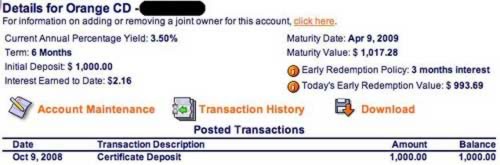
Looking at this screenshot, you can see that a certificate of deposit has an initial value (in this case, $1,000), an interest rate (3.50%), and a term (6 months). In other words, this is very much like a loan that I’m making to the bank.
You can also see that if I chose to redeem this CD early, I would sacrifice three months interest, whether earned or not. Because I’ve held the CD less than a month, if I were to break it now, I’d actually sacrifice part of my principal.
When this CD matures on April 9th, I will have $1017.28. Obviously $17.28 isn’t a huge return, but remember that interest rates are low right now. (Also consider that my $10,000 emergency fund were all in CDs, I would earn $172.80 in six months.)
Finally, it’s important to note that unlike a savings account, a certificate of deposit ends after a set amount of time. What happens at the end of the term depends on the arrangments you have (or have not) made with your bank. (See below.)
CD tips and tricks
Using a certificate of deposit is a great way to put your savings on steroids, but there are ways to make them even better. Here are a few tips and tricks that to help you get the most out of your money.
[blockLink]5[/blockLink] When the Federal Reserve cuts short-term interest rates, you feel the pinch in your savings account. Certificates of deposit are a great way to buy yourself “protection”.
When you see a rate drop coming, open another CD. For example, the Federal Reserve just cut short-term rates another 0.50% last week. I would be shocked if banks didn’t follow suit, lowering the interest on their savings accounts. ING Direct could go as low as 2.25%.
When you see an interest drop coming, take some money from your savings account and throw it into a 6- or 12-month certificate of deposit, locking in the higher rate. (My web research hasn’t revealed what causes CD rates to move, but they do not move in lockstep with savings accounts.)
Climb the CD ladder. Just as you might use dollar-cost averaging to profit from fluctuations in the stock market, you can use a “CD ladder” to profit from fluctuations in interest rates.
Say you have $5000 to invest. To build a CD ladder, you would invest the money in CDs with staggered maturation dates:
- $1000 in a one-year CD
- $1000 in a two-year CD
- $1000 in a three-year CD
- $1000 in a four-year CD
- $1000 in a five-year CD
As each CD matures, you immediately invest your money in a new five-year CD, effectively maintaining the one-year stagger, or ladder. You won’t earn the best possible rate of return, but you will earn a good one, and your income will be relatively constant. The CD ladder is also a form of diversification: you’re not betting all your money on one interest rate. (Mrs. Micah has an introduction to laddering CDs at ING Direct.)
Protect yourself with parallel CDs. One of the biggest risks to your investment in a certificate of deposit is the need for early withdrawal. What if something happens and you need to pull the money out? As we’ve seen, this can be expensive. Nickel at Five Cent Nickel suggests mitigating your risk with parallel certificates of deposit.
Again, assume have $5,000 that you’d like to put into CDs. Instead of opening a single certificate of deposit for the full amount, consider opening multiple CDs. You might open three CDs at once, for example: two $1,000 CDs and one $3,000 CD.
This gives you a buffer in case you need to get at the money early. If you find you need $500, you can break a single $1,000 CD and the rest of your money is safe from penalty.
Beware auto-renewals. Nicole wrote last week because she was surprised to find that her certificate of deposit at Countrywide had automatically renewed at the maturation date. Many (most?) banks will do this unless you instruct them not to.
If you know you’re ready to pull your money out of a certificate of deposit, be sure to contact your bank to find out the proper procedure for doing so. Nicole found herself locked into another twelve month CD when she needed the money now. If she broke the contract, she would be forced to sacrifice 180 days interest, whether earned or not.
(Note that Nicole’s story had a semi-happy resolution. She knows to speak up when something seems wrong. Countrywide wouldn’t let her out of the CD entirely, but “I was able to negotiate a compromise to transfer the money to a 3-month CD, rather than the 12 month CD. Although the interest rate is lower, I will be out in 3 months, which isn’t too bad.”)
Shop around. As with any financial decision, it pays to shop around for CD rates. You may find that your local bank actually offers a better deal on certificates of deposit than the online banks.
For example, my local credit union only offers 0.35% on its regular savings account, but its CD rates are competitive with (and sometimes higher than) ING Direct. Since I keep my checking account at the credit union, it might make sense for me to hold my CDs there. (In this case, however, they’re not high enough to make me switch; I’d rather track everything in one place at ING.)
Here’s my list of current CD rates from online banks.
CDs in practice
I’m new to the certificate of deposit, but I can already see some uses for it. My $10,000 emergency fund, for example, is currently earning 2.75%. I may instead create a series of parallel CDs, as described above.
Also, I’m saving for my Mini Cooper. That money is also earning 2.75%. I’m nowhere close to buying the car, though, so I might as well put it into a certificate of deposit, too.
Though certificates of deposit are new to me, I’m sure that most of you have been using them for years. What tips and tricks can you offer? Do you have favorite sources for CDs? How do you decide which money to keep there and which to keep in a savings account?
GRS is committed to helping our readers save and achieve your financial goals.Savings interest rates may be low, but that’s all the more reason to shop for the best rate.Find the highest savings interest rate from Ally Bank, Capital One 360, Everbank, and more.
This article is about Basics, CD Rates, Hints and Tips, Investing, Money Hacks
Disclaimer: This content is not provided or commissioned by American Express. Opinions expressed here are author's alone, not those of American Express, and have not been reviewed, approved or otherwise endorsed by American Express. This site may be compensated through American Express Affiliate Program.
Discover is a paid advertiser of this site. Reasonable efforts are made to maintain accurate information. See the Discover online credit card application for full terms and conditions on offers and rewards.
SEARCH FOR RECENT ARTICLES


I really have to start looking at CDs because I use paypal to hold my emergency funds, and it used to be above 5% interest, but now it’s almost below 2%.
This is a perfect and very timely post. Thanks J.D!
loading....
I’ve been considering setting up a series of CDs (a ladder as you refer to it) with my emergency fund. I’d like to get a rotation going where I have a 1-year CD maturing roughly every other month, and then I can gradually bump them up.
Since my goal is to have an emergency fund to cover 1 year’s worth of expenses, I’m not sure I want to go with longer term CDs. If I do need to survive for a year due to a layoff, I’d rather not have to worry about breaking CDs, but simply let them expire and take the cash over that year as I look for work.
loading....
“In fact, many (most?) banks penalize the interest amount, even if it isn’t earned (meaning you could lose part of your principle if you close your CD early).”
Dang. I’m going to avoid CDs at all costs. I would hate to lose my principles.
loading....
We recently transferred $5000 from our ING emergency account to an ING 1 year CD to get a better return. It was super easy.
loading....
Right now, dollarsavingsdirect.com is offering 4% if you open with $1000 (but there’s no minimum balance). It’s the same bank as emigrantdirect.com, so I’m not sure exactly why the latter is only offering 2.75%. In any event I now have accounts at both and I’ve transferred to dollarsavingsdirect.com to earn as-good-as-CD rates with complete liquidity.
loading....
Saving is good! It makes me feel a little more secure.
However, savers in the USA penalized with low interest rates.
The interest rates you quote on CD’s for example–the rate of inflation is higher. The interest you earn is taxable, too.
What’s a saver to do?
loading....
I have to agree with Don. I have a dollar savings direct account and wouldn’t dream of losing the liquidity for a lower interest rate. Even with the recent changes in prime, the rate has stayed at 4%. JD, I’m amazed that you haven’t made a post about this new product since the rate chasing thread had such a response.
loading....
One thing I like about ING is that their CDs have no minimum deposit requirement, so you can open them in amounts as small or as big as you like.
Our emergency fund is in a CD ladder — 12 CDs, each with a 1 year term, 1 CD maturing each month. Also at ING, if you let your CD automatically renew (or “roll over”) for a new term, they often will give you an extra .10% in interest — so, if their normal rate is 4.25% for a 1 year CD, when you roll over a CD, they give you 4.35%.
loading....
I’ve been using CD laddering for my emergency fund for years. I have 6 6-month CD’s, maturing sequentially over 6 months and auto-renewing.
The beauty of this is that I only have access to one months worth of my emergency funds at a time, preventing me (or at least making me think about it) from going through the fund too quickly.
Luckily I have not yet had to tap the funds and my fund has automatically increased with my cost of living (for my monthly bills at least).
loading....
Good timing on this post. I opened a $5000 6 month CD at HSBC (4% APY) on the 28th. This was a little more than half of our current emergency fund. In retrospect, I wish I would have done some sort of laddering or paralleling. Maybe next time..
loading....
But what happens if interest rates go up again? Just two years ago, high-yield savings accounts were garnering 5+ and HSBC was even offering 6% for a few months!
At that time, the CD were all barely above 4%.
If this happens, does it makes sense to withdraw from the CD and put it back into the savings account?
loading....
We’ve got a 0% interest car loan ($380/month), but we have $6000 in our savings account set aside to pay off that loan.
I have been opening 6,9,12 and 18 month CDs each month in order to set up a ladder.
Once the CDs start maturing we’ll be paying off our loan with a CD each month, and be able to stretch that $6000 a bit further.
All my CDs are with ING, since they don’t have a minimum amount to open a CD, and many other places have a $500 or $1000 minimum.
loading....
Ouch. Thanks for the spelling correction, those of you who pointed it out. I wish I could say it was a typo, but it wasn’t. It’s fixed now, though!
loading....
It may also be good to spread the CD’s out over time. For instance, If you have $6000 to put in, deposit $1000 ever month for 6 months in 6 month CD’s. For the first 6 months, you will be losing a little possible interest but after that you will continually have access to $1000 in case you need it.
Or if you are saving $500 per month, deposit the money every 2 months for the same effect but on a 2 month schedule.
This way, you have multiple smaller accounts in case you HAVE to draw them earlier but if it’s a small emergency under $1000, you can pay for the emergency on your credit card and then pay off the credit card within a week or two when your next CD matures.
loading....
I’ve got two $10,000 CDs I set up with 6 month terms. They’ve each rolled over once. I’ve “earned” $600 just by leaving it alone. It really couldn’t be easier. And because I’m a procrastinator, I’m pretty much guaranteed to miss the deadline for withdrawing the money (unless I really need it; that’ll keep it in the forefront of my mind) and it’ll roll over automatically.
I love the idea of the 12 CDs ladder!
loading....
For me the extra few dollars a year doesn’t outweigh having the money tied up with possible penalty for withdrawl. I prefer to use a money market mutual fund. This may change one day but right now I have to interest in locking in these historically low rates for any amount of time.
Side note: For all of the ING advertising on this site, including this article, I’d say the odds of ‘winning’ that CD weren’t so far fetched.
loading....
CD laddering is a great way to go, but I disagree with sticking with one bank for ease. With internet banking, it is easy to set up and track CDs at an array of banks. I have a 5 year ladders at 6 month increments. All 10 CDs started at my credit union. Now I have CDs at 8 banks based on who had the highest rate at the time a given CD expired. Bankrate.com lists the best rates. While ING offers 4.25%, GMAC offers 5.15% for the same time duration. Both are FDIC insured, and GMAC only requires $500. This is not a plug for GMAC but rather an endorsement to go with the highest rate you can get from an FDIC insured institution.
loading....
I put much of my savings for my house down-payment into CDs. My bank has special, higher interest rates for people who have at least $10,000 total (in all accounts) in that bank. These rates might not show up on sites like bankrate.com, so it could be worthwhile to check with your bank.
In general, the longer the term, the higher the interest rate, but a lot of banks have CD “specials,” with a special high rate for a certain term. For example, my bank currently has a special on 9-month CDs, for which they are offering 3.778% — much higher than the 1.833% for a 12-month CD at the same bank.
It is important to make sure the CD is FDIC-insured. If it is, it doesn’t matter what bank you use. You can pick the one with the highest interest rate from Bankrate.com.
loading....
Like others, we have 6 staggered 6 month CDs, each with enough to get through 1 month with no other income (e.g. in case we lose a job). But we _also_ have, not in CDs, enough to cover the non-expected/non-regular portion of our emergency fund. We’ve decide this is an important part also. We decide on a peak amount that we might need from our emergency fund, then put that much minus the monthly amount (which would come from the monthly CD) into this extra account. Now we just hope we don’t have a peak emergency _and_ lose a job, but we’re working towards that.
Also, we’re working towards moving those 6 6-monthers up to 12 1yr CDs, but that takes time.
loading....
One word of caution about opening multiple CDs at ING Direct –
If you fund the CDs using your savings account, this will count as a withdrawal. So you could quickly reach your maximum 6-per-month withdrawal limit.
Some wonder why to lock themselves into an ING Direct CD when DollarSavingsDirect is paying 4% APY for a liquid savings account. With the current rate environment, these savings account rates may not last much longer. With a CD, the rate is locked until maturity.
loading....
In Canada we do have CDs, their maximum term is less than one year and they usually have a higher minimum than GICs (e.g. $5000 for a CD and $1000 for a GIC).
Many of our local banks do offer a rate ‘bonus’ if you have other business with them, or are willing to move other business to them. I have seen the bonus as high as 0.75%, not bad if you are flexible with your record keeping.
loading....
Thanks for this article! I’ve held ING CDs for about 3 years and have been very happy with them. With the CD ladder, I’ve never had to break one yet – I just use or renew as they come up. Your advice about the rate drop inspired me to open another one just now!
Oh, and congrats on the ING CD – isn’t it fun to win stuff?!
loading....
Note: CD in Canada is actually called “Term deposit”.
GIC is more of an investment.
loading....
Thanks, folks, for the clarifications on CDs and GICs in Canada. I propagated some misinformation picked up during research. I’ve edited the reference from the article to avoid further confusion. You guys are awesome!
loading....
This may seem like common sense to most of you but I recently opened a CD with $10 under the assumption that I could continually add dollars to it over time like I do my savings account. Not the case. It’s a one time deposit, then you basically don’t touch it until it matures. Bad me for not reading first.
loading....
I have CDs with ING on a rotation schedule, my goal is to have 12 1-year CDs that mature in turn at the beginning of each month. I have 8 so far. The idea being that if for any reason my monthly income (paychecks) were disrupted, I could cash the CDs to cover my bills.
However, I find myself now in a bit of a bind because I need a few thousand dollars all at once for an emergency and I’m going to have to take penalties on a couple of CDs to get the funds. Still better than going into debt, though, right?
loading....
JD, great post. We have four CDs with ING. They come up every three months. We took a portion of our e fund and put it into CDs. We haven’t touched our e fund but one time in the past two years that we’ve had it. If the worst happened, we could liquidate our CDs and take the penalty. ING CDs are great products and easy to use.
I want to win one too!
loading....
Its also worth noting that one should read the fine-print on CDs. Most banks require that the money you put into opening a CD be “new money.” That is, money that isn’t currently held at the same institution.
Also, I’ve noticed some brick and mortar banks in my area advertise great CD rates, but when you go in to inquire about opening one they say that you also need to open a checking account with them in order to get the promotional rate.
loading....
@sammy: “The interest rates you quote on CD’s for example–the rate of inflation is higher. The interest you earn is taxable, too.
What’s a saver to do?”
Sammy, there are savings that are there for when you’d need money soon and there are investments where you could lose money but may get higher return. Still there are some safer options:
If you want some protection against inflation yet don’t want to lose money, you can consider government tax-protected securities such as I bonds that determine rate based on fixed portion (current 0 – ouch) and a portion based on inflation — but you are only to invest $5000 a year. There are also TIPs that pay a small interest and increase your principal by the inflation amount every year. You can find out about all of those if you go to http://www.treasurydirect.gov. Government bonds are safer than CDs as they have full tax power of the US government behind them.
If you can stand (a little) risk but not as much as in the stock market, you can look into bonds – both municipal and corporate. Because of current credit crunch, there are some attractive yields there. Just last week I bought $5000 worth of 10-year old AAA-rated municipal bond with a tax-free YTM (yield-to-maturity i.e. yearly yield that takes into consideration today’s cost of the bond) of 5.36%. This yield is gone now – my bond is already up – but there are still some 5.016% AA-rated bonds. This is tax-free; both federal and state if you buy your state’s bonds. If you keep to AA and AAA bonds, the chance of default is very low.
Corporate bonds are riskier, so you have to investigate the company. The yields now are very attractive, though, with some good companies paying 9.7% and 10.3% (e.g. American Express, Prudential, Goldman Sacks); Verizon is paying over 8%. If the company goes bankrupt, you lose your money, so there is some risk. I just transferred another $5000 into my brokerage account, and I am thinking of buying one of these bonds.
Now, bond interest is usually is simple interest simply paid to you as income twice a year. So you don’t get advantage of compounding, but then you can take the interest bonds pay you and invest it in something else.
Another thing. If you call bonds to maturity, you get your principal back (unless bond issuer declares bankruptcy); the interest gets paid to you as income usually twice a year. In the meantime, however, the value of the bonds fluctuate. Usually, the value goes up when the interest rates go down and vice-versa. So if at some point you decide you don’t want to hold to maturity, you can resell at whatever the value is. For example, if you need the money, or if the bond resale value goes up and you want to take advantage of it. BTW – the $5000 municipal bond I bought, I paid $4995 for, but now a week later it’s resale value is $5250 (which makes resulting yield-to-maturity smaller since the bond pays fixed interest amount; it was larger relative to $4995 but is smaller relative to $5250); if it goes up more I might even consider selling it. Of course, then I’d have to pay taxes on capital gains.
If you want money soon, you can build a bond ladder – some bonds that mature next year, some that mature some years in future. Again, if you need your money you can always sell the bond, but then you get whatever value it is selling for at the time which could be above or below you got it for.
loading....
I believe the section titled “Protect yourself with parallel CDs” is incorrect (at least it is with my bank).
If I took out a $5,000 CD, and a $1,000 emergency came up, I could recover $1,000 plus the penalty on the $1,000 and leave the rest in the CD. I don’t have to cash in the whole CD and pay the entire penalty.
I don’t know if this policy is common.
loading....
One thing about Savings bonds for emergency fund that might come up (it did once for me)… Most people don’t declare their interest income every year on their taxes, they just defer it until redemption.
What that means is if you have an emergency that you cash your savings bonds to pay for, you’ll owe extra tax come tax time. Now depending on the situation that might not be so bad. If you lose your job, you’re paying less tax anyway. But if it is just money for an unexpected expense, that might be different.
I still have a significant portion of my emergency fund in savings bonds, but I also keep a chunk in online savings accounts now so I pay part of my tax “as I go.” That is the part I would access first for emergencies.
loading....
Ok this is a dumb question but let’s say I open a 12 month CD for 4% and I have it automatically renew at the end of the 12 months. When it comes time to renew will it stay at that same rate or will it reset at that time to the current rates when it matures?
loading....
In my experience, the rate resets. These details are usually provided you, via mail/email, a few weeks prior to the CD’s expiration. With my credit union, you have an option at the outset for either renewal at current rates or deposit into your checking/savings account. The devil is in the details, hopefully provided at sign-up. If not, consider another institution…
loading....
Is there anything like a CD in the UK, anyone?
I must say I’ve never even heard of them.
loading....
Ron, Jeremy is right, the rate resets. You can’t hold on to a high rate forever. This is why you want to make sure that if you don’t want a CD at that rate, you don’t let the CD roll over. This is especially important since CDs can become much more attractive or much worse investments at any given time based on rate fluctuations.
loading....
I signed up for a CD from Emigrant Direct today. Actually, I noticed in their terms they say that the account (any account) can possibly be considered “abandoned” if there aren’t deposits or withdraws. That’s kind of scary.
One thing that I really wonder about with these online banks is, what do you do if you want to close your account? Is there a fee associated with deciding to leave their service?
loading....
My emergency fund is in a series of laddered CDs at INGDirect. But I didn’t open them all at once, I started out every paycheck opening a new 6 month CD with $50. INGDirect has no minimum deposit for CDs, and frankly, when I started this scheme, I was lucky to be able to scrape up $50 a paycheck for a CD.
A year and a $700 new computer later, I went from a negative checking account balance to 17 CDs totaling about $1600. Voila, I’m a *saver*!
loading....
Is the interest in a CD compounding or should I be taking monthly disbursements to my savings account to earn interest on my interest?
loading....
You can also check out risk-free CDs, which some banks offer (I have one at Bank of America). With the risk-free CD, you pay no penalty for withdrawing funds early (with funds available within 7 days)…so a tad less liquid than a savings account, but still much better than having to pay the penalty with a normal CD.
It has a slightly lower interest rate due to the fact that it’s risk free (but still better than a savings account), so I have $5000 in the risk free for emergencies and the rest of my savings in regular CDs. To be honest, I am probably being somewhat paranoid about putting away $5000 in emergency money, but I’d rather be safe than sorry.
loading....
The rate of return doesn’t seem worth it to me for the lack of liquidity. It’s barely better than a typical money market account where you have access to your money at any time.
I sincerely hope no one would lock up their money for 5 years at 4.25%
loading....
I have to wonder about people using a CD as an emergency fund. I fear people may have lost sight of the purpose of an emergency fund — either that, or they’re OK taking an early withdrawal penalty in the case of an emergency.
Keep in mind that an emergency fund is there for *emergencies* — what if you crash your car and need a new one, or burn down your kitchen, or get sick and have thousands of dollars in medical bills that aren’t covered by insurance, or lose your job? These are the reasons you have an emergency fund, presumably because you’ll need to be able to get at money quickly if these things happen. That’s something you can’t do with CDs (unless you accept the penalty).
I recently realized that my $10,000 emergency fund was overkill. It had become a generic savings account, and although I’ve withdrawn from it several times for genuine emergencies, I’ve never had to withdraw more than about $1000. I realized that the chance of me needing more than $5000 in an emergency is exceedingly unlikely (I’ve never spent $5000 on a single thing or event in my life except cars), so I reduced my emergency fund to $5000 and put the remainder towards other goals.
loading....
I agree with Tyler in part, namely having your entire emergency fund in CDs is not the best course of action. A true emergency fund should be more liquid than are CDs. I suggest a money market account for a portion of the emergency fund with the rest is laddered CDs. The money market funds can be used for sudden emergencies ($500 for a new radiator) while the CDs can hold the bulk of the funds equal to the 3-6 month equivalent it is suggested that people save for true emergencies.
This way, you keep your emergency funds in a safe investment while getting a bit higher returns than most money market accounts offer. Then again, this is all a tad academic as having emergency savings, in any form, puts one ahead of the pack and the cost of early CD withdrawal is much less than having to borrow.
Note: 3-6 month is aspirational and not a reflection of where I am at presently…
loading....
Lisa: the APY is already calculated for you, but yes it does compound. When a year is up, the APY will be whatever it is.
Eden: why not do both? If you don’t need all your money to be liquid, why not get a little bit extra on some of it? It’s not that hard to do with the online services.
loading....
Just a heads up: Capital One is offering a 3.75% APY on their online savings account through Costco. Here’s the link,
http://www.capitalone.com/directbanking/offers/costco/
Don’t know when this will last but the rate is better than locking your savings in a CD that’s earning less than 3.75% and is not liquid.
loading....
agreeing with angelo, the higher rates of cds provide a little bit more, so why not?
also the idea of laddering, in part, is to avoid market timing. like stocks, it is hard to predict interest rates. in 2002, you cd from 1998 locked in at 4.25% for a decade, looked pretty swell.
loading....
I also want to point out that Bank of America has a “No-Risk CD”. It has lower interest rates (right now lower than ING savings, but not always) than some of their other products, but given at most a week warning to the bank, you can withdraw any portion of your CD with no penalty.
I currently have the majority of my emergency fund in two of these CDs, though I’m thinking I might end one and move it to a traditional CD with a higher rate of return.
loading....
I have been wondering for a while exactly how CDs work. I have about $10k in ING Direct savings for no reason, and thanks to this post, I’m considering looking into a CD. Thanks for the post!
loading....
I have about 60% of my emergency funds in CDs that are divided to come due about a month apart. This leaves me with about 3-4 months worth of fast cash emergency funds, and if something really catastrophic happened, I can break open the smallest CD I need and leave the rest alone. I get the best of good interest rates and security if I need it.
loading....
What a timely article! I just got done setting up a CD ladder from my ING Orange account, they have a real cool page to do that all at one time. Figured I better get on the ball before rates go down even lower.
loading....
I think that when looking into the six month cds you have to consider something like an Etrade savings account at 3.30% interest. You are loosing .20% from the 6 month CD from ING, but it keeps you more liquid.
loading....