For the next week (or two), we’ll be sharing “audition” pieces from folks interested in being new staff writers at Get Rich Slowly. Your job is to let us know what you think of each of these writers. Pay attention, give feedback, and after a couple of weeks we’ll ask which writers you prefer. This article is from Michael Robertson, a writer and avid personal investor. It was originally published at GRS in April 2009.
So you want to buy stocks? Great! But you only have a small amount of money each month to invest? You’re worried about any potential returns being wiped out in the beginning by brokerage fees? You’re wise to worry.
Invest $100 bucks per month with a discount broker and you’re lucky if you pay commissions equal to seven percent of your investment. Seven percent! That’s a decent annual return, and you’re giving that up at the start. Yikes!
Of course, you could save that hundred dollars, month after month, until you have a pile of money to invest, but then you’re forced to determine exactly when to buy, forced to time the market. You know this isn’t a good strategy. You want to dollar-cost average your investments over time, investing a fixed amount each month, on a schedule, so that you acquire more shares when the share price is low, and fewer shares when the share price is high.
I want to share a secret with you. There’s a better way. Hundreds of companies that trade on the major stock exchanges allow you to buy shares directly from their transfer agents for very little or no money.
Buying without the middleman
Years ago, I began buying shares of Kellogg Company (K). In the beginning, I had only $50 per month to invest. Over time, I increased my monthly investment in Kellogg to $150 per month. That money is debited from my checking account by Kellogg’s transfer agent, Wells Fargo, and used to buy Kellogg stock through their Direct Purchase Plan. According to my 2008 year-end statement, I own 142.212 shares of Kellogg.
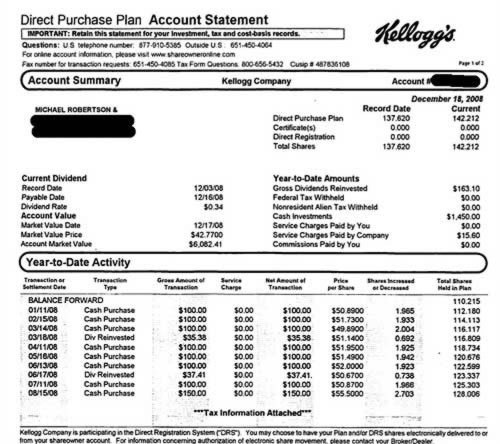
Over all of these years, for all of these transactions, I have paid no fees to accumulate these shares. Not a dime. All plan administration costs and share purchase costs are paid by Kellogg. Plus, every quarter, when Kellogg pays a dividend to shareholders, my dividend money is automatically used to buy more shares — at no cost to me. On December 16, 2008, a $46.79 dividend payment was applied to my account and used to buy 1.065 additional shares of Kellogg, at no charge to me!
I also buy shares of Pfizer, Inc. (PFE) every month through their transfer agent, Computershare. Pfizer’s plan also costs me nothing. I’ve slowly acquired almost 160 shares of the company, a little bit every month, without paying a dime in commissions or fees. Zip, nada. Like Kellogg, I get a statement in the mail every month, and I can track and manage my account online.
Of course, not all plans are completely free.
I invest $150 per month in General Electric’s plan through their transfer agent, BNY Mellon Shareowner Services, and they charge $1 per purchase. So, only $149 of my $150 is used to buy GE shares. Of course, that’s a lower cost than any discount broker. And my quarterly GE dividends are reinvested (used to purchase additional shares) at no cost.
Microsoft (MSFT) switched transfer agents in the middle of last year, from BNY Mellon to American Stock Transfer & Trust Co (AST). Unfortunately, in this case, the cost of my $100 monthly investment in Microsoft went from $2 to just under $3. Of all the plans I’ve looked into, the flat $5 fee I pay to invest $200 each month in Toyota (TM), is the highest I have seen. Toyota’s transfer agent is BNY Mellon, and I suspect the cost is higher because it is a foreign company, though traded on the NYSE.
To get a good sense of what companies offer direct purchase plans, visit Computershare’s website. This transfer agent administers an astounding number of company plans, and their site is the most user-friendly of the ones I’ve visited. You can search company plans by name, and according to plan attributes, such as “No Purchase Fees.”
But remember, any search on this site will return only companies for which Computershare is the transfer agent. If the company you search doesn’t come up, go first to that company’s website to determine who their transfer agent is, and whether they offer a direct purchase plan.
How to begin a direct stock purchase plan
So how difficult is it to begin a direct stock purchase plan? It’s not difficult at all. It’s every bit as easy as opening a brokerage account, and the process can be defined in eight simple steps:
- Determine what stock you want to buy.
- On the “investors” page of that company’s website, look for an FAQ link.
- In the list of FAQs, find one that regards either buying stock directly from the company or a dividend reinvestment plan.
- The corresponding answer will contain either a link to the company’s stock transfer agent, or a statement indicating that they do not offer such a plan.
- Assuming they offer a direct stock purchase plan, and there is a link to the company’s stock transfer agent, use it.
- On the transfer company’s website, you will find information specific to the direct stock purchase plan for the company in which you are interested. This information will include costs associated with participating in the plan, a minimum amount required to open a plan account, and the minimum monthly investment amount.
- If you are still interested, follow the transfer company’s instructions for opening an account. This will include entering your name, address, SSN, bank account information, monthly withdrawal amount, and whether you want dividends paid or reinvested (when applicable).
- You will soon be a shareholder.
Final words
So, why doesn’t everyone do this and why aren’t discount brokers out of business? There are a couple of reasons.
First, when you buy a company’s stock through a transfer agent, you don’t have to participate in a monthly purchase plan; you can make a single, one-time purchase of a fixed number of shares. But, regardless of whether you make a one-time purchase or sign up to invest monthly, you have no control over the respective trade date.
Not many people would feel comfortable committing to invest a chunk of money, say $10,000, in a company at an unknown share price. When you use a transfer company to buy shares directly, the transaction may not happen for a couple weeks, and the purchase goes through at whatever the price happens to be at that time. Of course, if your aim is to dollar-cost average your share purchases over a long period of time, this is not a factor.
Second, companies that offer these plans don’t spend money to advertise them. Contrast this with the inescapable pop-up ads for brokers like E*Trade and Sharebuilder on finance-related websites. Is it any wonder people think brokers are the only means for buying equity shares?
For the small investor who is ready to buy individual shares of a particular company, a direct stock purchase plan may be the smartest and most thrifty way to do so.
Invest wisely.
J.D.’s note: Before you invest in the stock of individual companies, be sure you understand the concepts of diversification and asset allocation. Buying individual stocks is great for some investors, but others are better served with low-cost index funds.
GRS is committed to helping our readers save and achieve your financial goals.Savings interest rates may be low, but that’s all the more reason to shop for the best rate.Find the highest savings interest rate from Ally Bank, Capital One 360, Everbank, and more.
This article is about Investing
Disclaimer: This content is not provided or commissioned by American Express. Opinions expressed here are author's alone, not those of American Express, and have not been reviewed, approved or otherwise endorsed by American Express. This site may be compensated through American Express Affiliate Program.
Discover is a paid advertiser of this site. Reasonable efforts are made to maintain accurate information. See the Discover online credit card application for full terms and conditions on offers and rewards.
SEARCH FOR RECENT ARTICLES


I feel like most people don’t know about this so I think it is great you wrote an article on it. My boss at work does the same thing with Exxon and Chevron stock which he is using to pay for his kids’ college costs. The low fees really help out considering he wanted to dollar cost average and reinvest dividends.
loading....
Exxon stock paid for a good part of my college costs too.
loading....
I like the idea of stock that pays, but I sometimes have ethical concerns. What suggestions do you all have for ethical stocks that are responsible to employees, environment and long term financial returns?
loading....
If you do a google search for ‘ethical stocks’ or ‘socially responsible stocks’ or similar keyword searches then you can come up with various lists. for example Dividend Channel has a top 25 list of socially responsible dividend stocks.
loading....
You can also sign up to DRIP funds that are not individual stocks depending on the fund. My ETFs are set up to reinvest as is my index fund. This provides diversification and means I don’t have to think that hard while matching the market, which is always a plus since I’m not into gambling and I’m in the market for the long-haul. (For my father, stocks are a hobby. But, on average, people who play with individual stocks don’t even match the market.)
One big problem with DRIPping (and automatic investment plans) in general, especially if you’re only in a few stocks, is that your portfolio can get out of whack in terms of diversification. When you keep buying more and more stocks from the winners, you end up with a larger percentage of these specific stocks in your portfolio, and a negative shock to one or even a few companies can really take your net worth down almost instantaneously. It’s important to keep in mind your current allocation when deciding where to invest new money, or to rebalance from time to time.
Fees are very important for long-run returns, but so is diversification. Diversification is important for managing risk. Don’t focus on one without thinking about the other. (And buying a Vanguard Target-date fund is a great way to manage both without having to think about it.)
loading....
Great comment Nicole. Direct Stock Purchasing Plans can be a lot of fun and help an individual learn about investing, but as you and J.D. point out there are dangers to putting a sizable investment for retirement, college, etc. into one or a couple of stocks even if it is only $100 a month. For around 4 years I had put $50 to $100 month into GE ranging from anywhere from $30/share to $45/share. With its diversification I thought it would be similar to a mutual fund with the fun and adventure of investing in a single company. I never realized how heavily tied it was to finance and in 2008 the price went from around $40 a share to the low teens and still hasn’t gone back over $20 a share. I’m thankful this wasn’t essential retirement or other types of savings. It was fun, but even investing in a couple of ‘solid’ stocks may cost you dearly without diversification.
loading....
For investors with small amounts, I’d suggest using commission-free ETFs instead. It’s also low cost, with a low minimum, and you get far better diversification.
TD Ameritrade for example offers a long list of ETFs on a commission-free basis, and I don’t believe there’s any minimum initial amount to open an account.
loading....
I would like to go for ETF route as well. Assessing performance and portfolio value is not easy going by direct route. I did read about this post from GRS archive before. Explored the opportunity. If an investment is not showing up on my Mint or Yodlee tool, I am not going to put my money there.
loading....
Never knew about this. Going to ask my husband what he thinks of this. So much to learn about how to invest one’s money for the future.
I find investing very boring.
loading....
If you find investing boring or frustrating, that’s ok. There are “lazy” portfolio solutions that will match the market at low cost for you. My favorite is the Vanguard Target-Date fund… they’re the lowest fee Target-date fund and all you have to do is pick one date, the date you think you might retire, and it takes care of everything for you– diversification, stock/bond allocation etc.
Given that most people who try to beat the market fail, there’s little reason to do anything other than try to match it with as little effort as possible.
loading....
The downside to this strategy of course is not having the ability to see all your investments in one place. Re-balancing a portfolio can be a headache. And in many direct-buy programs one may not be able to liquidate their portfolio quickly. These are the advantages of a broker.
By and large though, if you only have a few hundred bucks to be investing everyone month why are you putting it in individual stocks anyway?
loading....
I freaking had no idea about this. Popup ads and TV ads DO make it same like you can only go through a middle man company and can’t buy directly!
loading....
I enjoyed this article a lot. I learned something I didn’t know about investing – ha – ok there’s lots I don’t know about investing, but I find the subject dreadully boring and in dire need of pictures and cartoons to help make the material less stale. I’d love to hear more from this author.
loading....
Cartoons? Seriously??
loading....
Some people are visual learners.
loading....
Why not? It’s a great way to reach people who avoid it because it’s boring or they aren’t big into reading and also it can appeal to young people/kids. The earlier you grasp all this, the more time you have to take advantage of compound interest.
loading....
Me, I like Brokamp’s cat pictures.
loading....
I don’t think people with such small amounts to invest should be investing in individual stocks. Probably you should instead invest in a broadly diversified mutual fund. You can find low-cost funds with low minimums, which are sometimes waived if you sign up for monthly ongoing investments, often as little as 100$/month. Plus you will never pay a transaction fee if you invest directly with that company.
loading....
I knew this option existed, but I had no idea how to go about doing it. Once I get out of debt, except for my mortgage, I will be investing on a regular basis (following Dave Ramsey, so no investing until I am out of debt). I expect that after I have contributed to my 403b (maximizing company contribution) and Roth IRAs for me and my wife, I will have a little left over for additional investments, and this looks like a great way to be able to invest smaller amounts in quality companies without paying exorbitant broker fees. Of course I will also adhere to Dave’s advice of using no more than 10% of my investment dollars for individual stocks.
loading....
I had no idea this was possible. I am definitely going to look into this.
loading....
I find the topic of investing incredibly boring, but was able to make it through this article, and even learned something. So, well done!
loading....
Okay, I get it now. “Amy” and “Lisa” are made-up names. Question is: what’s the point? I smell a rat.
loading....
Obvious trolls are obvious. [I mean Amy and Lisa... obviously.]
Don’t feed them [i.e., ignore them] and they’ll go away.
loading....
… if you look back through other GRS posts, you’ll see I comment somewhat regularly. I don’t know anything about the other poster, Amy.
Just trying to give feedback about what I think of the audition pieces.
loading....
Please do be careful when using this method of investing and read the Plan Fees carefully. For example (in the case of McDonalds):
PLAN FEES
Initial Setup Fee $5.00
Cash Purchase Fee $6.00
Ongoing Automatic Investment Fee $1.50
Purchase Processing Fee (per share)$0.00
Dividend Reinvestment Fee $0.00
Batch Sale Fee $15.00
Batch Sale Processing Fee (per share)$0.15
Batch Maximum Sales Fee $50.00
Market Order Sale Fee $25.00
Market Order Processing Fee (per share) $0.15
Market Order Maximum Sales Fee $60.00
Therefore, if you end up selling these McDonalds shares, you are looking at $50 + $60 in fees right there.
Buyers Beware!
loading....
Violation!- If your auditioning for a staff writer position, it should be new content or atleast recent content(this year) not an article that is 3 years old. A link to this article would have been sufficient. It might be nit-picking but typically if your are interviewing for such a position you might ask to see many samples of their work over a course of time. We aren’t getting that context only what they are posting and perhaps a link to their own blog. I went back and realized that this also happened with Karawynn Long’s article. At the very least I would say the post should not be something that was previously posted on G.R.S. In essence the audition is an interview so anything goes, but an audition usually is different as your performance is measured against your peers judged mainly on the merit of said performance. I think there is an advantage for those that have previously posted on G.R.S. and no one in this type of forum should be able to rehash old information (regardless of the quality) in the context of an interview. I want to know what the quality of the information they are producing now vs. to be measured against their peers with whom they are competing.
loading....
John, of the folks auditioning for a staff writer position, three of them will be re-running previous material. I’m well aware of it and so are they (and so will be long-term readers). I don’t necessarily think it’s an advantage; I’m not treating it as one as I evaluate responses.
loading....
I don’t necessarily think they have an advantage, but I do think it would be better to see current articles (no matter how much I liked this article). If for no other reason, than to see where their perspective is today. So many of the articles are fairly personal, which is their appeal, so unless the old article is still indicative of their perspective then I’d rather see their new content. Afterall, if they’re selected then it’s their new content (presumably) that we’ll be seeing from now on.
loading....
I actually think it should be a disadvantage. Surely the audition pieces are supposed to show what the author will bring to the site? If the best he can do is to rehash a 3 year old post, sounds like a bit of a one-trick pony to me.
loading....
I didn’t know you could purchase stocks this way, either. I like the idea but dread having more paperwork to file. Do you know if there is a site that would capture all the individual stocks you own? Does MINT do that?
I already have an old 401(k) with Fidelity, a pension account held by Fidelity, and a Charles Schwab 401(k) with my current company. I don’t want any more paperwork but I would like to invest in individual stocks outside of my retirement accounts.
loading....
Good read. Well written and informative.
I would be interested in hearing the author’s rationale for utilizing individual stock purchase plans as opposed to index funds or how these purchases fit in with his larger financial strategy. For example, does the author do a lot of independent research on the companies with which he is investing?
loading....
I agree that investing in individual companies like this is not something the average investor, let alone a beginner investor should be doing. Picking stocks is hard (and mostly luck). People should be concentrating on diversification via index funds or ETFs and not loading up on any single company stock.
loading....
I agree. I do have a different perspective on stock and am willing to take on more risk than most on GRS or those that index but DRIPs have their place. Too slow of a process for me and the inability to track results at will on MINT would drive me nuts. Mint drives me nuts at times but I see that they are hooking in to Treasury Direct soon so that small and safe investors will soon be able to track their savings and I Bonds.
But, take a stock like Coke or another reliable brand for example. Have a kid research, follow, and invest in a DRIP from a young age and what you have as a result is an excellent learning tool at little cost and, for the most part, little risk. I have my nephew on Sharebuilder with very small purchases. We counter the fees by investing quarterly with his 3 month buildup to lessen the blow of the fee. That works too.
loading....
How much does this approach complicate tax returns or, should I say, the records needed to prepare the tax returns? For example, would one would be facing a very complex calculation to determine the capital gains on years of monthly purchases?
loading....
I made some DRIP investments back in the 80s (maybe 70s)and it was a nightmare when I went to sell because I hadn’t kept great records and pc spreadsheets didn’t exist. 1.24 share @ $13.73, .76 shares @ $17.93, etc. Try that with a calculator figuring basis and capital gains. Aggrah!
Would be easier today with spreadsheets and if you kept better records.
loading....
Yes, a hassle! And what’s worse is when individual stocks get bought out or split into different companies etc. I have one share of AOL that I will never sell because of the whole Time Warner thing. It just isn’t worth the ~$20. Of course, you can decide you’re never going to sell because of the tax hassle and then companies force you to figure out cost-basis when they go out of business.
More excellent reasons to invest in index and ETF. (Unless you get your kicks out of bookkeeping and accounting.)
loading....
Years ago I signed up for DRIP plans with a few stocks. I never followed through with investing much but just activated the DRIP on the initial investments.
3 drawbacks to direct investing in this manner:
Multiple accounts from various companies. You have to setup and manage an account with every company you invest in. If you’re properly diversified then you end up with a ton of different accounts. This is a bit of a hassle.
These plans are held outside of retirement accounts so you have to pay taxes on your gains when you sell. Theres no tax advantage of this kind of investing and you can’t do it from within a 401k or IRA.
Figuring taxes is complicated. When you do dividend reinvestment you buy shares every quarter. Then when you sell you have to account for all of those purchases and then figure out the cost of the shares you bought. THis gets complicated tax time. For example if I buy 100 shares of stock for $10 and sell for $20 thats simple. I paid $1000 and sold for $2000 so I have a $1000 gain. But what if I bought 100 shares in 1980 at $5 and then had DRIP setup for 30 years buying quarterly then I have 120 purchases of small amounts of shares spread over 3 decades. Now figuring your capital gains on that is not so simple.
loading....
I’ll echo Jim’s comment on taxes. I can attest to that from experience.
loading....
Love it. Want more of this type content.
loading....
I like this idea because it reminds me of the ONLY other time we talked about the stock market in school: fifth grade. We picked stocks and tracked them, and saw how much “money” we made over the course of the school year. I’m happy I can actually do that in real life, too. JD this is my favorite audition so far.
loading....
I never heard of this option before. I’m not a place where I’m ready to invest in individual stocks; I want to be able to max out my Roth first. I’ll definitely keep this in the back of mind. Thanks for the article
loading....
Wow, I’m always surprised when people find investing boring, or when people are convinced they don’t have time to learn about it.
There are very few ways to significantly build and maintain a high net worth without knowing how to invest your money.
Decent article, but I don’t like that the author condones automatically reinvesting dividends at market price.
loading....
This article reminded me of when another author (Robert Brokamp maybe??) talked about the advantages of buying stocks that pay dividends. Since capital gains are taxed at 15%, it was taxed at a much lower rate and (if I’m remembering correctly) was a nice retirement vehicle. Definitely riskier, even if you can avoid too many feeds, but interesting article. I liked it. A nice balance of facts and story.
loading....
This is great. I had no idea you could do this. I wish I would have known about this before..
Thank you!
loading....
This article taught me something which I never knew and would have liked to know. I vote for this staff writer.
loading....
For 15 years, I’ve been acquiring stocks through DRIP plans. I get started with The Money Paper. They kept running “specials” for people who weren’t members. I paid a $15-$20 processing fee plus the cost of one share of stock. It was the best thing that ever happened to me, aside from my firm’s 401(k).
I focused on stocks of companies I knew – McDonalds, Pepsi, and companies I thought sounded interesting – Ottertail Power. Without exception, all have done well for me.
At the same time, my banks went public and made stock offerings to me. I’ve done really well with them, too.
But with all this experience, I did not know that I could pick up stocks through a company’s transfer agent.
I, too, vote for this writer. Finally an article where I learned something new and useful!
loading....
Great article. I am planning to take this route but have few questions if someone here can answer. In the plan summary of any share there is a electronic purchase service of $7.50 a share for GE. Similarly initial setup fee of $10 & automatic reinvestment fee of $5. My question is does that mean if I plan to invest say $100/month, I will be charge with these fees in every months transaction? The author mentions that he hasn’t paid a dime in any of the fees by going this route. I am not getting that part of it as I can see the fees on the most of the shares that I searched.
loading....
One of the best pieces of investing advice that I wasn’t aware of!
Does that mean, this is for everyone? Of course not. It is for those want to do more after the usual 401(k), Roth IRA, investing in ETF and mutual funds. But if you don’t have the information, you don’t even know that such an opportunity exists. Precisely why information is the key. Any and all kind. http://gadgetopia.com/post/6819
This is why I keep coming back to GRS!
I like this author style for the following reasons:
- Lays out the premise of the post at the very beginning. Looking at the title I wasn’t sure what this was all about (as I said, I had no clue such an avenue existed). The first paragraph got me hooked.
- Gave 5 examples from his own life. Made it personal and anecdotal, while making a point about the benefits and costs of each. This gives the readers a well rounded view of what such an investment entails.
- Gives the step-by-step guideline how to open a DSPP
- The tip about the Computershare website was a clearly highlighted (but I’m not sure if this is done by the author or JD)
- Never says that this is the only way to go. More like “You have this option; use your faculties and invest wisely”
loading....
Thank you! I appreciate not just this knowledge, but that you’re sharing your personal practices. A balanced and informative piece that helps me as I gather knowledge that will help me dip my toe in the investment waters.
GRS: More pieces like this!!
loading....
And to think, I’ve been using an online discount brokerage! Though I wonder if purchasing stocks this way would disrupt the whole “timing” thing of technical analysis like this:
http://www.stock-marketeers.com/technical-analysis.html
Though I wouldn’t mind not paying the $9.99 brokerage fees!
loading....
Hi JD,
I know this is a old post but need some info on dsps.
I have been following ur blog for almost a year now and your articles are my daily vitamin supplements. I understand the drop but I just wan to know the tax consequences while selling. So if we buy a stock say for 3 years and then decide o sell it we have to mail the individual price of purchase or can we do cost bais like we do for mutual fund. I would appreciate if you can shed some light on the points to note while selling a dsp investment. Thank you
loading....