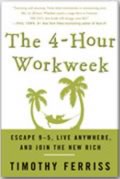
Book Review: The 4-Hour Workweek Print
Tuesday, 28th August 2007 (by J.D.)This article is about Books, Career, Retirement, Self-Improvement
When I picked up The 4-Hour Workweek, I was worried it was some sort of “get rich quick” book. The first few pages didn’t do much to change my mind.
The author, Timothy Ferriss, makes a lot of bold claims, such as: “How do you create a hands-off business that generates $80,000 per month with no management? It’s all here.”
But something happened during the first few chapters. When I read a book, I use small sticky notes to mark interesting passages. After the first 100 pages of The 4-Hour Workweek, the book was thick with stickies. By the time I was finished, I had used an entire pad!
Ferriss does make a lot of bold promises, and some of the details along the way do read like the confessions of a get-rich-quick scammer. But I believe that an intelligent reader can easily extract a wealth of useful ideas from the book. For me, it’s a keeper. I’ve read it three times already, and will probably read it again before the end of the year.
Let’s Make a Deal
After college, Ferriss took a soul-sucking sales job at a tech firm. He left to start a soul-sucking business of his own. He went from working 40 hours a week for somebody else to working 80 hours a week for himself. He hated it. The pay was good, but the business left him drained.
After learning about the Pareto Principle (more commonly known as the 80-20 Principle), Ferriss had a revelation: he streamlined his business, eliminating distractions and automating systems until it was not only more profitable, but also took less of his time. Much less. He took a “mini-retirement”, and then decided to write a book about “lifestyle design”, about creating a life that balances work and play, maximizing the positives of both.
The 4-Hour Workweek is divided into four sections, each of which explores one of the components to lifestyle design:
- Define your objectives. Decide what’s important. Set goals. Ask yourself, “What do I really want?”
- Eliminate distractions to free up time. Learn to be effective, not efficient. Focus on the 20% of stuff that’s important and ignore the 80% that isn’t. Put yourself on a low-information diet. Learn to shunt aside interruptions, and learn to say “no”.
- Automate your cash flow to increase income. Outsource your life — hire a virtual assistant to handle menial tasks. Develop a business that can run on auto-pilot. (This is the weakest section of the book.)
- Liberate yourself from traditional expectations. Design your job to increase mobility. This could mean working from home, or it could mean using geographic arbitrage to take mini-retirements in countries with favorable exchange rates.
The 4-Hour Workweek describes the specific actions Ferriss took to implement these steps. Sometimes these specifics aren’t particularly useful. However, I think it’s a mistake to let the details get in the way of his broader message. If you’re able to look past the details, to look at their meaning, you may discover principles that can change your life. For example, I don’t like much of what Ferriss has to say about automation. I question the virtue of virtual assistants, and I think that his business model works for his business but probably isn’t applicable to most others.
However, it was while re-reading this section the other night that I began to think about automating my personal finances, about making them paperless. By absorbing Ferriss’ ideas and not his specific details, I was able to apply this to my life.
A Kick in the Head
Most of the time, The 4-Hour Workweek is like a kick in the head. The flow of ideas is relentless. Here’s one of my favorites:
Emphasize strengths, don’t fix weaknesses. Most people are good at a handful of things and utterly miserable at most. [...] It is far more lucrative and fun to leverage your strengths instead of attempting to fix all the chinks in your armor. The choice is between multiplication of results using strengths or incremental improvement fixing weaknesses that will, at best, become mediocre. Focus on better use of your best weapons instead of constant repair.
Maybe this is obvious to most of you, but it’s a revelation to me. I spend a lot of time worrying about my weaknesses. Yet when I look at my life, it’s clear that everything rewarding and profitable comes from enhancing my strengths. Here’s another example:
Relative income is more important than absolute income. Absolute income is measured using one holy and inalterable variable: the raw and almighty dollar. Jane Doe makes $100,000 per year and is thus twice as rich as John Doe, who makes $50,000 per year.
Relative income uses two variables: the dollar and time, usually hours. The whole “per year” concept is arbitrary and makes it easy to trick yourself. Let’s look at the real trade. Jane Doe makes $100,000 per year, $2,000 for each of 50 weeks per year, and works 80 hours per week. Jane Doe thus makes $25 per hour. John Doe makes $50,000 per year, $1,000 for each of 50 weeks per year, but works 10 hours per week and hence makes $100 per hour. In relative income, John is four times richer.
Of course, relative income has to add up to the minimum amount necessary to actualize your goals…
I want to believe that if I had to choose between $70,000 per year earned with 70 hard hours per week, or $42,000 per year earned with 37 easy hours per week, I’d choose the latter. I’m not there yet.
A Garden of Tips
I don’t buy into everything that Ferriss writes, but I love how he shatters conventional wisdom. I love that he makes me think. Even if you reject his central thesis, there are dozens of tips and tricks here that can be extracted and used to optimize your life. Here are a few:
- Ask yourself, “If this is the only thing I accomplish today, will I be satisfied with my day?”
- How to double your reading speed in ten minutes.
- Why it’s more productive to carry around a written to-do list than to keep one on your computer.
- Learn the art of non-finishing. This is all about the sunk cost fallacy: just because you paid $10 to see Pirates of the Caribbean 3 doesn’t mean it’s a good idea to watch the entire thing.
- How to be more efficient with e-mail.
- How to reduce clutter from your life.
- If you can’t define it or act upon it, forget it.
- Life exists to be enjoyed — the most important thing is to feel good about yourself.
- Why geographic arbitrage is a great way to enhance your relative income.
- The value of a virtual assistant.
My Recommendation
Despite its flaws, The 4-Hour Workweek is a great book. I think that most people can draw something useful from it. Borrow it from your public library. If you like it and think you’ll re-read it, then wait for it to come out in paperback. I’ve already read my copy three times, but that’s because it’s perfect for when I am in life; I’m not convinced that others will extract the same value.
To learn more about The 4-Hour Workweek:
- AskMetafilter: Is the four-hour workweek feasible?
- I Will Teach You to Be Rich: The book that changed my life in two hours
- The Simple Dollar: Review: The 4-Hour Workweek
- Author Timothy Ferriss has an interesting blog full of tips like how to tie the perfect tie, how to check e-mail twice a day, and how to travel the world with ten pounds or less.
A final note: perhaps best of all, this book has a ten-page index. Why don’t more books do this?

RSS Feeds
Facebook
Twitter

August 28th, 2007 at 5:54 am
I am currently listening to the audiobook, but I am kind of nervous. He has had a lot of criticism online, and his book does have some stupid points, such as “be difficult when it counts to get preferential treatment”.
August 28th, 2007 at 6:19 am
It’s pretty much like any other self-help, performance-enhancing, time-management book out there…great one-liners that induce thought provoking questions about your own priorities (I had the same favorites as you). Thus, I agree that it’s not THE book per se, but A book w/ a good many effective nuggets of “life hacks”. Even if you just incorporated (as I did) the “if this was the only thing I did today…” hack, it’s pretty cool how relaxed I feel at the end of the day even if the entire to do list isn’t accomplished. FYI - Ben Casnocha also did a great a review of the book as well. Cheers!
August 28th, 2007 at 6:50 am
I will eventually read this book, just because it has created so much buzz. The thing that seems interesting is that the 4 hour work week can’t be a widely held way of life. It is a hack that some people will do, but everyone CAN’T do it. Someone was to actually have to work.
That makes me think this is a get ‘happy’ scheme, similar to a get rich scheme. Am I wrong?
I know I need to read it first, but that problem troubles me a bit.
August 28th, 2007 at 6:55 am
Nice review, shall check out the book. Thanks for providing links to the other reviews at other blogs.
Cheers,
FIRE Finance
August 28th, 2007 at 7:21 am
Thanks for the review! I’m very sceptical of the whole thing, but might still give it a try. This article was very helpful.
There’s just one point I think you misunderstood: The Pareto Principle is about focusing on the 20%, not the 80%
August 28th, 2007 at 7:31 am
Thanks, Toni. You’re absolutely right. I got the numbers swapped. I’ve fixed it now.
August 28th, 2007 at 8:04 am
Personally, I found this book to almost border on being offensive. I mean, he starts off the book by saying how he’s accomplished feats like being a kickboxing champion by _cheating_!
There are some valid points in the book, but they are surrounded by an unethical mentality and an approach to business that offends me. You can find the same points he makes in other books. I just didn’t find anything new that made suffering through his ego and selfishness.
August 28th, 2007 at 9:02 am
I did and do enjoy this book. It keeps me focused on designing my business around the life I want for my family. I just went through my employer closing the doors and filing bankruptcy. Listening to Tim’s book again has reminded me of the things I want to do. Sure he is creative and he is working more that 4 hours a week right now but his core concepts are sound. I really like his point that working a “job” eight hours a day is really a fallacy. If you can create 100 widgets in 5 hours and that is your assigned task why not only work the 5 hours for your salary. Employers and peers just cannot get this one.
He did not “cheat” he read the rules and used the written rules to win.
August 28th, 2007 at 9:18 am
I think I will likely read this book. Most of the books of this genre emphasize financial freedom by liberating oneself from the need to constantly trade hours for dollars. I already streamline my finances by making everything automated and paperless…but I think I can always use more efficiency techniques.
Does it discuss about the need to create residual or passive income sources?
-Raymond (MONEY BLUE BOOK
August 28th, 2007 at 9:42 am
I got this book last week and I’ve started reading it. I feel pretty much similar to JD. The one thing I will say is that while the overarching theme I believe to be kind of silly. I do agree that sometimes we need to take a step back and examine how we can be more productive, and to make sure we aren’t leading boring lives because that’s the “safe” way. Most of us could do with a little risk-taking every now and again. But some of it sounds like your classic self-gratification ideology.
August 28th, 2007 at 10:38 am
From Wikipedia: “In computer science the Pareto principle can be applied to resource optimization by observing that 80% of the resources are typically used by 20% of the operations.”
Just imagine if you eliminate the 20% of tasks that use 80% of your time, and focus on the 20% of tasks that make up 80% of your profit! In the best case, you use 100% less time, do 100% less tasks, but your gross only drops 20%. Free money!
I know happy people that work many 80 hour weeks, and I know lots of unhappy retired people.
“When I do good, I feel good; when I do bad, I feel bad. That’s my religion.”
— Abraham Lincoln
Nothing in the book sounds new. Just more self-help motivational catch phrases. Scrooge McDuck taught us all years ago to, “Work smarter, not harder.”
August 28th, 2007 at 10:39 am
I think yours is the most spot-on review of the book that I’ve read so far. Personally, I loved the book…but not because of the information contained in it (all the criticisms about rudeness and silliness, do, in fact, apply on some level). For me, it was a good kick-in-the-head as well…to think more clearly…to reprioritize.
Ferris is a very different guy from me. Different age. Different goals in life. I didn’t find myself relating to him very often throughout the book. So I wrote off pretty much all the specifics…and just benefitted from the attitudes and challenges that his story addressed.
I listened to it twice, and then bought the hard copy. Reading your review has reminded me again about some things I thought of while listening the first two times that I still need to address.
For me, it’s far from a perfect book…but it’s a keeper nonetheless…and I would recommend it to anyone just as a shock to the system, a solid resource to challenge your thinking, etc. Good stuff!
August 28th, 2007 at 11:09 am
I read the book a while ago and reviewed it on my blog, too. I liked the ideas a lot, but had some of the same reservations that JD and some of the other commenters expressed. Overall, I think the idea is to structure your life so as to maximize your own satisfaction.
The title and some of the bolder claims are mostly to generate buzz. I’ll agree that it’s worth reading, though, for the inspiration and the ideas alone. The one about emphasizing strengths was also a big one for me.
August 28th, 2007 at 11:28 am
Great review, J.D. I’m in the middle of Ferriss’ book right now, trying to keep up with the questions he suggests to ask yourself. I hope to report on the experience when I complete the book, but this is a great overview of 4HWW in the meantime. Thanks!
August 28th, 2007 at 11:55 am
John Chow has been giving these away like they are going out of style, LOTS of people seem to really rave about the content. I have it on my list of books to get when I’m done with my current stack.
August 28th, 2007 at 12:14 pm
Bryant Keefe @ #8 wrote:
“If you can create 100 widgets in 5 hours and that is your assigned task why not only work the 5 hours for your salary. Employers and peers just cannot get this one.”
Depends on the job. An straight hourly job will pay you less if you create your 100 widgets faster - or expect you to produce more widgets. A smart boss may be willing to make adjustments.
A salary job can be a better target for pay you the same for getting it done in less time. How you do that depends on the boss, cultural expectations, and perceptions. I’ve seen some extremely valuable devs work 4-5 hour days (or 4-day weeks). Management accepted it because they’d rather have the person than let a competitor have him. (Doesn’t hurt if the dev in question has a good rep in the business and/or does not need the money.)
Another way is to put in the face time so that you appear to be there as often as others. Be first to arrive, one of the last to leave - but you also take one or two 1/2 hour walks in addition to lunch. This works better if you are getting the work done.
At the moment, I’m making a bit less and have a bit less responsibility than I could have elsewhere. I also have a 7.5 hour day, 4 weeks vacation, and little need for overtime. Works for me.
August 28th, 2007 at 12:17 pm
Try to get it at the library, buy it used, or simply read it at the book store. It’s ok, but not worth the full retail price.
August 28th, 2007 at 1:18 pm
Thanks for this review - it confirms my feeling that the book really has something to offer beyond the ‘hook’ of the controversial title.
There’s been a lot of focus on productivity in the last few years since GTD became a buzzword and while productivity is a good tool if it leads you to a better and more enjoyable life, it’s not an end in itself.
August 28th, 2007 at 1:56 pm
[...] Rich Slowly personal finance that makes cents « Book Review: The 4-Hour Workweek | [...]
August 28th, 2007 at 2:05 pm
My husband (a civil engineer) has been “unjobbing” for a few years now, which sounds similar in principle to the book’s philosophy. He works for himself with no employees (much simpler) from an office in our home (partial tax deduction). He works 4 days per week, about 28 hours total, and gets just as much work done as he used to during his 45 hour weeks. He makes the same, if not more, income.
We have leisurely coffee in the morning, he makes the kids pancakes, then walks up the stairs to his office, where he’s available most of the time to the family, if necessary. He can schedule days off, special hours for activities and vacations as he chooses. It’s not a 4-hour week, but it works nicely for us.
My husband doesn’t work twice as fast or hard as before, but he does pursue the best paying and/or most enjoyable projects. And we’re careful with our money so he won’t have to work more. We’re happy with this arrangement!
August 28th, 2007 at 3:13 pm
FYI: from Penelope Trunk: 7 ways to decrease your hours. http://blog.penelopetrunk.com/2004/10/31/7-ways-to-decrease-your-hours-without-harming-your-career/
August 28th, 2007 at 4:27 pm
My wife started this book about a week ago during one of our book reading trips to Borders. She appears to love the concepts and actually purchase the book though as I recall that was because she accidently spilled her ice tea on it. But now she reads a little each day and laughs quite a bit. Still, she manages a business that takes 60 hours a week and because she isn’t very good at organizing things (primarily because she insists on doing everything herself)this book may save help her quite a bit. Meanwhile, I have followed the Travis McGee principle all of my working life. Work til you have enough then it’s time to vacation.
August 28th, 2007 at 5:44 pm
I think its very important to take into consideration how many hours (in office and out of office) is required by a job. A lot of highly compensated folks are highly compensated because they work a ton (nights/weekend/always “on call” via Blackberry).
August 28th, 2007 at 6:16 pm
This book was disappointing and a bit dumb…it did sound just like the other get-rch-quick schemes, and had a lot of “advice” that didn’t neccessarily fit…well..anyone for that matter. Too much fluff in my opinion. Very few real advice.
August 29th, 2007 at 4:53 am
I agree that some of the ideas in the book are a bit out of whack but overall I liked it. There are a great many ideas in there that are applicable to my life as well as most peoples if they can think out of the box.
August 29th, 2007 at 6:30 am
[...] Book Review: The 4 Hour Workweek Independently, J.D. came to the exact same conclusion about this book as I did in my review of the book. (@ get rich slowly) [...]
August 29th, 2007 at 8:02 am
Yours has been one of the best reviews on this book that I have read. And I appreciate what you said about the Virtual Assistance position being weak. Why? Because I’m a Virtual Assistant. Ferriss’ view is that you can get a VA from overseas (India, in particular)for a few dollars an hour to answer the phone and/or e-mails. My stance is that you get what you pay for. The purpose of having a professional Virtual Assistant is to have a collaborative “partner” who helps take the administrative burden from the micro or small business owner. Ya ain’t gonna get that from India.
August 29th, 2007 at 1:53 pm
Thanks for sharing your thoughts on the book. I’m currently reading it myself and plan on doing a review shortly as well.
Despite the wealth of knowledge in the book, I’m forced to say that my favorite line so far it “Defeated, I returned to the US and picked up Kick-Boxing, winning the national championship 4 weeks later, using the most unorthodox fighting style ever witnessed.”
Whether or not Ferriss is dead on in his advice, he’s one hell of a writer.
August 29th, 2007 at 2:09 pm
I’m really surprised when reading reviews and comments about this book how many people are “offended” or didn’t find it useful. It makes me wonder how much they really read this book with an open mind.
I’m only half way through right now, but I have to say that of all the books like this that I’ve read, this is BY FAR the best of the bunch. I read it with a pencil in hand and underline, underline, underline. I often find myself setting it down and just thinking for long periods of time about my life, the way I’ve approached it, and the way I approach money and my career.
Right now I’m in a situation where I’ve been contemplating going full-time freelance and maybe that’s why this book hits home so much for me. The concepts and the way he presents them have been nothing short of revolutionary to me–and I’m familiar with books like this.
Anyway, I guess to counter some of the above posts, I’d say, go out and get this book right now. Don’t wait for it to come to your library. I’ve found it more than worth every penny. I’m buying it for friends and having my whole family read it. I really like it that much.
That said, I don’t think the audiobook would be very good. Many of his paragraphs are chock-full of good, thought-provoking tid-bits–and I think listening to the book would lose a lot of the retainable value.
August 29th, 2007 at 6:03 pm
I was at first interested in reading this book, then after all the hype I started thinking it was a one trick pony. I think I’ll take your advice and check it out from the library.
August 30th, 2007 at 1:14 pm
Great review. I’m in the middle of this book.
When you first start reading it, you’re skeptical, but once you get into it, you start thinking about things. Which is good. It slowly pulls you in.
You’ll always find new books that might wrap up things we already know in a different way, and that’s ok. Keeps everyone on their toes.
September 3rd, 2007 at 10:43 am
Well said. I found your review in my daily Google alert on 4-Hour Workweek. I am a true believer of Tim Ferriss. Regardless of the skeptics out there, Tim is a big time motivator. I read his book and concluded - this is good stuff. Immediately, my wife Gillian and I launched http://www.Our4HourWorkweek.com to document our journey.
And by the way, your matra - “Get Rich Slowly” is awesome! We’ll pay tribute to you message on our site.
Pierre Cutler
Our 4-Hour Workweek
September 3rd, 2007 at 10:44 am
Well said. I found your review in my daily Google alert on 4-Hour Workweek. I am a true believer of Tim Ferriss. Regardless of the skeptics out there, Tim is a big time motivator. I read his book and concluded - this is good stuff. Immediately, my wife Gillian and I launched http://www.Our4HourWorkweek.com to document our journey.
And by the way, your matra - “Get Rich Slowly” is awesome! We’ll pay tribute to your message on our site.
Pierre Cutler
Our 4-Hour Workweek
September 6th, 2007 at 9:26 am
A lot of his advice doesn’t really seem to apply to folks who have little kids. Maybe I’m too “play it safe” to see how.
September 10th, 2007 at 9:56 am
[...] in Lifestyle Design — A couple of weeks ago, I reviewed The 4-Hour Workweek. Author Tim Ferriss has a fascinating blog devoted to lifestyle design, the art of creating the [...]
September 13th, 2007 at 11:22 pm
While Ferriss’ ideas and actions may be legal, they are not ETHICAL. What does that say about the America of today? Seems like everyone is just lapping up what Ferriss has to say without thinking about what they are really doing. And 90% of the ideas in the book are not new, search the internet, you’ll find that these ideas and concepts already exist. What really bugs me is how Ferriss sells himself as some kind of “guru” when all he does is rehash old ideas in a very unethical and dodgy manner. Caveat Emptor. See Wikipedia for more info on Ferriss, raises a lot of questions about his credibility.
Joe
November 27th, 2007 at 6:01 am
[...] Book Review: The 4-Hour Workweek @ Get Rich Slowly [...]
December 6th, 2007 at 3:58 am
Great review! I’ve got the print and audio versions, and I’d recommend them both. I think I only paid about $9 on Amazon for the hardcover, so it’s not unreasonably priced.
Tim definitely has an edge, but I think that might be what gets the message through to people. There really are alternatives to a situation you’re not happy with.
The fact that the title seems to have captured people’s curiosity to such a great extent suggests to me that people really aren’t happy where they’re at. If you’re curious, give it a try - there’s likely a reason for that curiosity, and the risk is low.
I think if you get one solid “keeper” piece of advice from a book, you’ve earned back the cover price many times. This one easily qualified.
December 26th, 2007 at 6:47 am
Hi!
I have not read his book yet. Though I like especially two of the things mentioned already about Virtual Assistants and focusing on your “relative income”.
If you are assigned to do a specific task and you can do it in a good quality and in a short time span, then that is worth more than if you wasted more than the aloud time to produce no result at all. Productivity is worth more than being “busy”.
So if you are assigned to build a house and you have 60 days to do it and you can find someone who can do your entire task in 30 days (with good quality)for less than you get paid by your client or boss, then why should you do it yourself? Seems counterproductive in a way.
February 8th, 2008 at 1:01 am
[...] Timothy Ferriss’ The 4-Hour Workweek: Escape 9-5, Live Anywhere, and Join the New Rich is a modern book similar to Terhorst’s. The author has a blog about experiments in lifestyle design, which is his euphemism for creative semi-retirement. Though I don’t agree with all that Ferriss has to say, he’s jam-packed with ideas. This is a good book for motivated young adults. [My review.] [...]
February 19th, 2008 at 7:24 pm
[...] successful The 4-Hour Work Week: Escape 9-5, Live Anywhere, and Join the New Rich. When I reviewed the book last August, I wrote that Ferriss’ ideas were “like a kick in the head”. I meant [...]
February 26th, 2008 at 6:49 pm
Never read the book but just commenting on articles I find relavent. I love this blog!
I’m in the military, and when i first started being more a supervisor and less a worker…I made a lot of mistakes and wasted a lot of time. I dare u to keep a piece of paper ( low tech ) in your pocket and write down the most important tasks for the day and check them off after completion.
You WILL accomplish more things in a more timely manner AND have lots more time for the rest of the day for menial tasks.
June 20th, 2008 at 8:53 pm
Joe: Which part of what Ferriss is doing do you think is unethical, and why?
August 23rd, 2008 at 12:02 pm
Today’s tip on how to save the world: Stop Multi-Tasking!…
With a hat off to my friend Dave Pollard for using the name of his excellent blog ( How to Save the World…
September 8th, 2008 at 10:09 am
Everyone has a new twist to getting rich. This book is certainly another unique method. Don’t spend the money on the book. Request it through an interlibrary loan request from your local library. It is already available at some libraries.
October 14th, 2008 at 6:56 am
At one point Ferriss states, “…I no longer respond to emergencies.”
Now THERE’S a trustworthy guy…WTF??
Like many have said here, the book isn’t necessarily a good blueprint especially if actually find joy in hard work or hard study, and especially because the “Auto-Pilot” section falls pretty flat for those of those who don’t want to sell a bogus material product… but it gives tons of websites for the people who feel ready to exploit the world.
While reading, I couldn’t help but wonder if it was ideas like his that sucked America dry and led to our current economic turmoil…then again you could always turn around and make the argument, “what you do with your money is up to you. If you choose to invest in society, that’s up to you.”
I don’t know how I would feel if $80,000 worth of my money was funding some rich white kid’s tango lessons…but hey..it’s my fault for trusting in BrainQUICKEN.
Anybody tried that stuff? Does it really work?
Screw it. Get money.
October 19th, 2008 at 9:47 am
Great review, I loved this book! These principles will truly lead to a limitless network of residual income opportunities in the future, if applied correctly.
October 19th, 2008 at 6:32 pm
Postman, that $80,000 was never your money.
The idea that part or all of everyone’s earnings belong to the government (or “society”) by default, and that anyone who arranges his affairs in such a way that the taxman steals less from him is somehow taking money from your pocket, is backward and repulsive, and has no place in a society of free individuals.
If you want to “invest in society”, whatever that means to you, give your own hard-earned money to a worthy cause voluntarily — and leave Tim alone to do the same, even if he thinks that means tango lessons. Don’t encourage governments to enslave and steal from others in order to support the causes that you think are important.
November 25th, 2008 at 12:36 pm
Yes, there are things in the book that maybe don’t address my own life or priorities in life or exactly how I’m going to use his information. BUT. I can honestly say that this book BLEW MY MIND. It opened up ways of thinking about my life and business that have been life-changing for me. I bought the e-book, the book on tape and the book.
Now, I have to admit that I don’t have concrete proof yet that these ideas will be successful for me, but I think in the minimum it has opened my eyes to the idea that: 1. I don’t want to live a deferred life (In fact, I quit my job and moved to France!) 2. That there are ways to organize yourself and business models that I can learn that I believe will help me to not have to work 60 hours a week and still struggle to make a living. Maybe I won’t make 80,000 a month, but If I can make $5-10,000 a month doing what excites me and living life more on my terms, I will consider this a huge success.
Have the creativity to read this and apply his ideas to yourself. Even in his challenges to do something daring each week, his examples are more suited to a 20-30 something young guy, not a 40 something married woman, but I still found myself challenging myself in ways that made more sense to me.
December 4th, 2008 at 5:46 pm
[...] you to subscribe to my RSS feed. Thanks for visiting!Tim Ferriss, author of The 4-Hour Work Week [my review], has a new television show debuting on The History Channel tonight. “Trial by Fire” [...]
December 16th, 2008 at 2:38 am
I’ve read the book and enjoyed it. The time management and ‘life is much more than corporate work’ sections were alone worth the cost of the book.
However, what I didn’t like was the business plan based around selling a product online. This turned my muse right off. In fact, it made my muse want to run.
So I was wondering if anyone’s tried to apply Ferriss’s business model to a service or a skill rather than manufacturing pills or a DVD. For example, has anyone tried out this business model with something like marketing skills, a massage business or even book and article editing.
Suggestions, anyone?
December 16th, 2008 at 10:02 am
Agreed, the online sales model isn’t for everyone. I also got a lot out of the book, but am not rushing to set up my very own Yahoo! store.
I think the main message of the the book is that your life doesn’t have to be spent sitting in a cubicle, working for someone else — and it sounds like you got that message loud and clear.
The steps that Ferriss lists — defining what you want, eliminating that which doesn’t get you there, automating the rest, liberating yourself from traditional expectations — ought to be helpful in any of the businesses you mentioned.
Certainly I don’t see why you couldn’t provide marketing services remotely via the Internet/phone/fax/FedEx, if you wanted. As for editing, a few minutes with Google will find you numerous web-based businesses which match up publishers with freelance editors and proofreaders (though I hear it pays to check what others say about them; some are a bit dodgy). Massage might be more difficult…
The main problem I see with the latter two is that they don’t scale. You can only edit one book or article at a time; and massage is obviously a one-on-one, by-the-hour sort of service — unless you’re planning to start a chain of studios, which doesn’t sound like a four-hour work week to me. Also, building up a regular clientele would be difficult if your goal is to travel Ferriss-style.
Still, even if the details don’t appeal to you, I think you’re on the right track in trying to adapt the high-level ideas to what it is you love to do. I’ve used his book as one of my inspirations in making the switch from cubicle dweller to independent option trader. Still early days, but so far, so good! Best of luck, Amanda…
December 18th, 2008 at 2:58 am
Hi Martin,
Thanks for your reply. In all seriousness, I listed the first random things, like massage and editing (anything service-based), that popped into my head. So they were just examples.
Actually, I’ve been working up an idea for seminars aimed at government departments and NGOs to learn Aboriginal communication styles and turn these into Aboriginal-centric ‘products’ that effectively communicate the NGO’s or g’ment dept’s service or function to remore communities (might be healthy food or anti-smoking messages, for example). (You might note than I’m an anthropologist who lives and works in outback Central Australia).
Sounds like you’re on your way to breaking out of the cubicle, Martin. That’s awesome. If you have any inspiring thoughts about service-based adaptations of Ferriss’s ideas, let me know.
Best wishes for Christmas & the New Year
I’m not really interested in either.
June 3rd, 2009 at 11:01 am
I work more than 4 hours a week, but I have to say it’s definitely possible to work 50% of the time for 90% of the income. When I started working from home, I could accomplish tasks in 1 hour that used to take 2 in the office. All those meetings, interruptions… they take so much time! I try to remember that when I’m billing, by the way, and it justifies my fees. One other thing I do that perhaps this book doesn’t mention, is that I keep my fees the same for a piece of work even as I get faster. I do website programming and speed definitely increases with experience. However, if it took me 5 hours initially to do it, and now it takes me 1 hour, I still charge for 3. It increases my income and still protects me from newbie competition, who’d have to charge 5… I pay my own learning costs, now, and this helps ensure I don’t eat those hours without pay.
The biggest problem is myself. Distractions, like, hey, why am I writing comments on this website… are a hazard of being online all day. I remind myself that I don’t get paid for goofing off anymore and try to keep myself on the straight and narrow. My current goal is to set a daily goal and if I can make my day’s target billings by lunchtime, then I’ll stop. I have to admit that it’s hard to really use my time in the way I’d like, though, since people seem to feel EVERYONE should work a 40 hour week. No one cares if you earn 75% of what you used to, it’s somehow not socially acceptable to work a 20 hour week. I’d take more vacation chunks if I thought my clients would accept it, but I notice they really like that I have the same ‘hours’ as everyone else. So the downside is that much of my free time is unpredictable and short. This is important if you’re setting up your work to support another activity like kids, writing a novel or drinking lattes versus international travel or something. The kind of work day you end up my be as important to you as the number of work days in total.
I’m currently trying to think of ways to allow more vacation chunks and concentrated workdays so I get long weekends every weekend. I think an assistant, as the book mentions, might be part of that solution, but maybe not. Anyone who replaced you 2 days a week can always aim for 5!