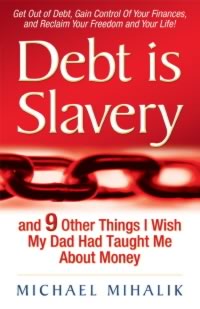
This is a guest-post by Michael Mihalik, author of Debt is Slavery (and 9 Other Things I Wish My Dad Had Taught Me About Money). Two commenters on this post will win free copies of his book. Read on for details!
Wouldn’t it be great to be financially secure — to never have to worry about money?
What would it take to get there? In fact, what exactly is financial security?
Ask ten people to define how much money it takes to attain financial security and you will probably get ten different answers. For some people, financial security is having $10 million in the bank. For others, it’s $50 million.
I doubt anybody would say $1 million. Being a uni-millionaire isn’t what it used to be. With the median home price in the United States around $220,000 (the median price in my hometown, Seattle, is pushing $425,000), there may not be much left after paying off the mortgage. Even having the full million in the bank earning 5% per year will only produce an income of $50,000 per year. That’s not bad, but not enough to jet around the world and party with Paris Hilton, Mick Jagger, and Diddy.
What about $10 million? At 5%, that will generate an annual income of $500,000 — without working. Now we’re talking some real money!
The problem with defining financial security in these terms is that having $10 million, $50 million or even $1 million is a pie-in-the-sky dream for most Americans. We’d all like to have millions of dollars, and it’s not bad to aspire to that goal. The problem is, if we define financial security by such large amounts of money, most of us will believe that it’s out of our grasp. Instead, we should use a realistic definition of financial security that can be achieved whether somebody makes $10,000 a year or $1,000,000.
First, let’s look at what financial security is not.
Financial security isn’t making or having a certain amount of money. There are many people who have made millions of dollars who are not financially secure. Stories about musicians, superstar athletes and multi-million-dollar lottery winners who end up in bankruptcy court are so common that they’ve become a cliché. If someone makes $500,000 a year, but spends $600,000, are they financially secure? Of course not.
Financial security also isn’t limited to being independently wealthy, having servants bring you martinis by the pool, and flying your private jet to Monaco to party with heiresses, super-models, and rock stars. If that’s what you want, then go for it, but this is a very narrow definition of financial security.
I prefer a broader definition, one that puts financial security within the reach of anybody with a desire to improve their financial situation, and a little bit of discipline.
To me, financial security consists of four things:
1) Being debt-free
Consider two women: Jill makes $35,000 a year. She has $250 in her savings account, and owes $10,000 on her credit cards. Joan makes $35,000 a year. She has $10,000 in her savings account, and owes $250 on her credit cards.
Which woman do you think feels financially secure? Which sleeps better at night?
Certain debt is understandable. Few people have the money to write a check for a car or a house. Borrowing money for an education or to start a business may also be acceptable, but borrowing money for other reasons is probably a mistake.
How many of you are still paying off the credit card debt for:
- The vacation you took last summer?
- The elegant, romantic Valentine’s Day dinner last February?
- The pair of expensive Italian shoes you just gave to Goodwill?
- Christmas presents your kids no longer play with?
- Electronic equipment that has since become obsolete?
When you owe somebody money, they have power over you. You go to work, even if you don’t want to, because you have to pay back your debt. If you don’t pay, you can be sued, your car can be repossessed, or your house can go into foreclosure. That doesn’t sound like security to me.
2) Being in control of your expenses
As I mentioned earlier, if you earn $500,000 a year, but you’re spending $600,000, you’re on your way to the poorhouse. If you control your expenses so that they are less than your income, you can save and invest the extra money, and you’re on your way to becoming financially secure.
3) Consistently increasing your savings/assets/net worth on a monthly basis
Most people have little to show for years or even decades of hard work. For whatever reason, they can’t or won’t save money and they’re one paycheck away from being destitute.
We should focus on saving money every month. It’s a great feeling to watch your savings grow, especially because the interest compounds without any extra effort from you. Instead of you working for money, your money can work for you.
4) Not being forced to work at a job you dislike just to pay the bills
Many people live paycheck-to-paycheck and are stuck at jobs they don’t enjoy because they have to pay their bills. If they quit their jobs or were laid off, it wouldn’t take long before they were in dire financial trouble
If you are debt-free, control your expenses, and focus on increasing your savings on a monthly basis, you can survive tough times, such as a layoff, for months, or even years, without a change in your lifestyle. You will also have the freedom to quit a job you don’t like and take your time finding a new job, preferably one that you will enjoy.
Financial security is an admirable goal for which we should all strive. However, it’s important to define financial security so that it is achievable for the average American. Being debt-free, controlling our expenses, increasing our savings every month, and doing what we love can lead to happy, fulfilling, and prosperous lives for us all.
Contest reminder: Michael was kind enough to pass along two copies of Debt is Slavery. Each person who leaves a substantive comment on today’s entries will be entered into a drawing to receive one of them. The two winners will be announced on Friday, October 19th. (Details.)


Getting all of our consumer debt payed off really helped my wife feel secure in our finances and it allowed me to work at a job I like instead of just for a paycheck. We are now able to start attacking the debt on our house. This will take us a little longer but I think seven years is not unreasonable.
Another interesting case for 1) compare two people, one where Joan owes $9750 - their net positions are the same (If I’ve added up correctly - pretend I have). Then the question of who’s better off becomes a little more complex. Is Joan’s greater available cash worth keeping where it is? Depends on a lot of factors, like how stable she thinks her income is, what sort of return/interest shes getting/paying.
Does our answer change is Joan has $20k but owes $19750? Now her repayments are much larger than Jill’s, but she still has the freedom of a huge cash back up - where should she put her money now?
I know that there isn’t a single answer to this.
Joe
Re #4.
I’ve had friends and an ex, who were always unhappy at their jobs. Most of them had much higher paying jobs than I did. I had a much lower paying job and a verbally abusive boss. Yet I was happy, while they were unhappy. It seems to me that happiness comes from within yourself. You can decide to be happy or unhappy. The effort is about the same. The results are not.
“4) Not being forced to work at a job you dislike just to pay the bills”
Check out Jeff Atwood’s post today on his Coding Horror blog:
http://www.codinghorror.com/blog/archives/000979.html
I’m in college right now, so such issues don’t plague me (right now). But I can only hope I find a job and a career that I can truly enjoy. I don’t think many people can say that they do, unfortunately.
After finally owning up to my problem and realizing this isn’t going away I started the journey of getting my debt under control a few months ago! I am realizing that this is not going to be easy and while I understand that I am the “cause” of the problem “small steps” are helping also. The small steps I have taken are keeping track of my expenses and setting up an emergency fund. I have been using “You Need a Budget” as my tracker and now have a few months under my belt to drill down and see where its going. Also started a savings account with ING and am having automatic withdrawals done 2 times a month. The amounts are not big but its a start! What I would like to do is get another job to use that towards debt pare down BUT I am kinda picky about this. I really would like to do some type of work from home BUT not sure what to do about this. I really do not want to have to GO to a second job as I have a job I like a lot BUT it wears me down so by the end of the day I am pretty beat! I am brain storming on this and this is my next goal in my goal.
Financial Security is having the resources to do what you want and live where you want, while not sacrificing your future to do it- for the rest of your life.
Given the choice, I’d rather not be driving 40 minutes each way to work 5 days a week, even though I’m pretty happy with my job. I’ve limited myself by the choices I have made though, primarily when I chose to bury myself in $264K worth of debt.
There are things I would rather be doing, and I will be doing those things some day, but for now I have to dedicate my time to working at getting out of debt, then working on that Financial Security dream. It’s obtainable for everyone, but you must clearly define what level of financial security will make YOU happy.
The funny thing is that we go so willingly into that slavery. I have been debt free only once (excluding the mortgage) since getting married 18 years ago. It felt great! I did go back into debt in order to finish my bachelor’s degree and then my MBA. Right now, my biggest non-mortgage expense is my 3 kids private school tuition. Education IS expensive, but ignorance is so much more so. The old saying “The borrower is servant to the lender” rings true across the ages, but in my opinion, debt isn’t slavery to the lender, but slavery to a lack of self control.
I’ve said for years that schools waste our children’s lives and brain power by teaching irrelevant information. The most relevant things we should be teaching today are:
1. Personal financial management
2. How to peacefully co-exist with a spouse
3. How to successfully raise children
4. Entrepreneurship
5. How to develop a good work ethic.
Can you imagine the state our country would be in if we taught and practiced those five items?
I know, I know. I’m living in nirvana, but I still think it could be done.
Why on earth is an income of $50,000 per year not enough? Since when has financial security had anything to do with the ability to jet around the world partying?
The median income in America is around $50,000 per year, and most people have significant work related expenses such as clothing and transportation.
As long as you reinvest a portion of the investment income to counteract inflation, one million seems like plenty to me. Even if you did drop $220k of that on a house, you wouldn’t have mortgage or rent payments then, which would make it even easier to live off the interest thrown off by your remaining $780k.
Although I know I won’t ever make a high salary, I still feel like I’m well on my way to financial security thanks to following these steps. However I struggle with fears in the back of my mind relating to health issues - my own and my family’s. None exist yet, but I worry myself about what would happen if (and when) they did. Not only could it ruin financial security, it could ruin dreams and lives. I would love to hear more stories of people who have done everything right financially and found themselves facing huge health obstacles - how did they handle them?
I am trying to learn from this blog how to become a more financially secure person. I don’t have a large amount of debt but I also don’t have the greatest credit rating. I still live pay check to paycheck (when I am even doing that, Bank of America always does there best to fee me into the poor house).
I think right now i am focusing on steps 2 and 3. It would be a dream to get to step four, but I am not there yet.
So, by Michael’s criteria, how are we doing? Let’s see:
1) Debt free: We’ve been working on this one. We’re down from 7 credit cards to 2! And while we still have some medical debt to deal with, those debts too a much less now.
I’d give us 75/100
2) Controling expenses: I feel we are in control from that aspect that we now rarely spend more than we take in. I’d give us 98/100
3) Savings: Yeah…could be better at this. While we have “left over” from each paycheck (and this after a set amount transfers to savings), it is eaten up by kids, cars, and care (as in medical). And we’ve not been sending as much to our mutual funds or 401k. I’d say 72/100
4) Job satisfaction: Now here’s where things get tricky. I am the SAHM, writing when I’m not homeschooling. My husband works in the computer industry. I’d say my job satisfaction is about 90/100; his averages about 80/100 - so together we’re about 85/100.
So that’s 75/100, 98/100, 72/100, 85/100 which leaves us with an average grade of: 83/100 or a lower B.
I’d be interested in seeing what advice Michael might have for helping those of us who are -almost- there.
#4 is a big one for my wife and I. We just took a $20,000 reduction in annual income (after taxes) because we wanted a better quality of life. To make this happen, we planned for this a year in advance. We paid off bills, saved, and made sure we were living well under our means before we did it. We are very happy with our decision, and I am very happy we were fortunate enough to be in that financial position.
There are most certainly as many definitions of financial security as there are individuals striving to obtain it. However, I think Michael has come very close to defining its essence.
Financial security means more than being able to buy the latest model car every year, living in the best suburbs or jetting off to the Bahamas regularly. To me, financial security by its very definition means a position in which I can be secure in the knowledge that the needs of my family and myself have been taken care of regardless of the possible curve balls life may throw at me. For this to be the case, I would need to ensure that:
a)My expenses never exceed my income
b)I save 10% of all income in an interest-bearing investment instrument with the goal to accumulate 12 months of living expenses
c)I use 5% of my income to invest in slightly higher risk equities (shares) to maximize investment income
d)I focus on increasing the percentage of my income derived from passive sources (interest, dividends, rental and business income) as much as possible until retirement. The ultimate goal is to have 75% of my income from passive sources when I reach retirement age, a percentage which coincidentally should meet my cost of living needs at retirement and will nicely complement my income from retirement planning investments.
If I stick to my action plan above, it will of course mean that I may have to forgo the pleasure of buying that brand new Porsche or living in the most sought-after suburb in my city. What it will also mean however, is that I will never have to experience the absolute terror of having spent beyond my means and being unable to meet my debt repayments. Remember that often people who look rich are really only poor people with a massive amount of debt.
Middle class millionaires don’t look like millionaires because of the fact that they use their funds to generate more assets which in turn generate more income instead of splurging on toys or the latest status symbol. They are quite content to live in middle class suburbs driving 10 year old cars while their personal net worth increases exponentially.
Living according to commonsense principles like the ones that Michael has outlined in his article, means that your financial future will be secure enough to allow you to concentrate on living and enjoying life to the fullest.
I think that #3 is the most psychologically rewarding part of being financially responsible. Since a disproportionate portion of my income goes towards rent (gotta love SF), I am increasing my (currently negative) net worth by steadily decreasing my debt. While having a brand new tv would certainly be nice, I decided a couple months ago that knocking a couple grand off of my credit card debt would be more rewarding, and I am still happy with my decision.
My financial goal was summed up quite nicely by Charles Dickens:
“Annual income twenty pounds, annual expenditure nineteen six, result happiness. Annual income twenty pounds, annual expenditure twenty pound ought and six, result misery.”
(From David Copperfield, 1849)
Financial life is a balancing act. Trying to keep up with the Joneses is a sure way to tip life into misery.
The process we have set up is this:
I divide our household income into three streams, and three accounts.
The first account pays the regular monthly bills … mortgage, car payment, utilities (levelized, of course), phones, internet, etc. We put enough into that account each month to cover those bills, plus a little more for rate increases.
The second account is savings, and we’re working to increase the amount going there.
The third account is what’s left over, and it’s enough to cover gas and groceries and entertainment and whatever else might come up during the month. When that account gets low, we slow down or stop spending.
This method lets us see better how much we actually have in available cash flow each month. We don’t put stuff on the card (or else we allocate an amount from the third account to cover it … and do so immediately).
The only monkey wrench comes from unexpected big bills, such as car repairs and medical bills. We’re working on how best to handle that, but for now it comes out of the emergency fund, which will be replenished from the amount going into savings.
This system seems to be working for us, because we have stopped the slow bleeding of funds, and we know everything is covered.
Now if we could just convince our kids to start doing the same thing!
I agree that being debt-free is the first step toward true financial security. I do disagree that some debts are unavoidable, depending of course on your situations and circumstances. You can buy a used car outright given enough time and saving. Even a house is an attainable expense without going into debt if you are willing to rent for that period of time (the cost analysis of whether this would be worth it of course is up for debate). Still, a great article.
I doubt I am alone in thinking that the problem some of us face is not just cutting back on expenses (we recently cut out our water delivery and TV service), but in not compulsively spending when we do start to become more comfortable.
Not only are my husband and I cutting back on frivolous spending, but we were recently able to pay off almost all our credit cards and start a savings account. We then were able to sell my car (that I owned outright) so that was extra money to put towards paying off HIS car. Soon we’ll get our Christmas bonuses - and the urge to spend on frivolous things is strong because we’re not having to struggle to afford those things for once. However it’s so important to keep our goals in mind - saving for a vacation and for a baby and house fund! The absolute joy of being able to put that money away, or put it towards our vacation goal, is much greater than being able to buy an extra piece of clothing or trinket. Not to mention the pride we’re having for ourselves and our newfound fiscal maturity!
I aspire to be like Joan. I know I’ll get there one day….until then, I’m living like Jill.
The things I’d stress most about saving are: A little bit can go a long way as long as you keep adding those bits. If you’re used to seeing nothing in your savings account and learn to put $50 a month into it, before you know it, you’re going to have a few hundred dollars in there (when you were used to having none).
As your savings grows, don’t spend it. Let it work for you. Bad things happen in life and someone has to pay for them. My family has been surviving on a single income for a long time, but when I was laid off several years ago, we had to eat through our savings. I was off for 15 months, but never missed a house payment. We’re still recovering from that, but we still have our house and our cars.
Don’t let people talk you into parting with your savings. Have a plan and stick to it. You don’t have to go out to an expensive restaurant to enjoy a meal with friends. You don’t need to spend thousands of dollars on vacations to make them memorable. Like the saying goes, “People to plan to fail, they just fail to plan”.
I view financial security as a fall-back that I could rely on. For instance, if I lost my job today, I would have enough liquid wealth that I could pay for all necesseities (mortgage, food, transport, etc) for a year.
Because to me, there’s nothing worse for a career than being desperate for any job.
Sound alot like of the same advice/teaching that Dave Ramsey advocates.
I like your definition of financial security, but I’m with Dan…if your points #1 thru #4 are in place, why wouldn’t a single mil in the bank paying out $50K in interest a year be enough to live on?
With me not working, our household income is about $53K annually. Things are tight, thus I’m looking for work now. But we have great insurance and retirement via hubby’s work. If we had no van or mortgage payment, I think we’d be living comfortably on 50K, with enough in accessible savings to cover the unexpected.
I think hating your job can actually be caused by the feeling of entrapment. My wife said that while she was working to help put me through school, she hated every minute of her job. Now that I’m working, she wants to go back to work and is considering the same position! Circumstances can engender all sorts of feelings. I would add (as I’m sure many people have before) that having an extra source or two of income -especially passive income- takes the edge off that feeling significantly.
Being debt free allowed me to move from a low cost of living area to a higher cost of living area to take a job that provides more satisfaction and a step up towards my future goals.
Before paying of debt, we would not have had the leeway in our finances to afford the extra monthly expenses. Becoming debt free was a lot of work and took a lot of sacrifice, but it has been well worth it. Looking back, it doesn’t seem like that much of a sacrifice.
Now, to keep building that savings…
We are working hard to get rid of our debts so we can be financially secure. To us, just knowing that we don’t actually own a lot of our things, is an uneasy feeling. And heaven forbid something happens to our income, we would be in a world of hurt.
Once our debts are paid off, then we will start saving so we could live off of just interest. That is a wonderful freedom indeed, not to have to work unless you actually want to!
Truly defining financial security is still hard even for those that think they have it. I’d like to use myself as an example. I’ve been out of college for 1 year now and have
2 cars to my name (both paid off)
0 school debt (worked throughout high school and college)
0 credit card debt (with about $40k of credit available)
$10k in savings
$4k in roth ira
The job I am currently at brings home ~$50k./year but I may soon be leaving for a lower paying job. I did not come from a wealthy family, in fact we were quite poor when I was growing up as most military families are. I live in an apartment with my gf (who is basically the financial opposite of myself) and I still feel like I am not financially secure. The simple fact remains that, much like the earlier example of what is financial security ($10million vs $50million), it is hard to truly define this “point” of security.
Financial security is a subject my husband and I have been talking a lot about lately. We’re doing well with our savings, and should both be able to quit next year to switch career streams. I think the biggest challenge has been to deal with the outlooks of our friends and family. It’s so difficult to remember that you’re content with a 21″ CRT for the 3 shows a week you like to watch when your friends are buying 56″ DLP High-Def sets! I really love the PF blogs like this one that help put debt/consumerism into perspective. One trick we used was to put everything in terms of time. It was a lot easier to say “NO!” to the television when we realized we could trim 5-6 months off the mortgage and save double the interest by using that money to prepay instead. (If we were more into television, our priorities might have changed). Keep up the great articles and comments (I often get at least as much from the comments) everyone, the impact is felt!
I clearly remember a conversation I had with my parents at the dinner table when I was an early adolescent. They were making some complaint about credit cards. They were not debtors by any stretch of the imagination, so I’m not sure what the substance of their conversation was, but I said, “I’m never going to go into debt!”
“Is that right?” My father asked. “How will you buy a house or a car?”
“I’ll just be rich enough to buy it with cash.” I said. I think at this point in time I planned to be a rich and famous something or other.
“Well, won’t that be nice for you,” said my mother.
Flash forward twenty years later, and I’ve got a (manageable and low-rate) mortgage and a still too-large student loan from earning a graduate degree while spending above my means as a student. I’ve also gone through enough credit card debt on stupid consumer purchases to feed and clothe a hundred people. I’ve also worked as a freelance writer and one year spent my estimated tax payment on moving from California to Seattle. I ended up having to borrow money from my grandmother to pay off $8,000 in unpaid taxes that year. I’ve also got only about $12K in an IRA and almost nothing in the bank.
In short, I’m neither rich nor have I been that bright about finances in the years since I was in college. Now, as I near 40, I’m starting to file through the chains of debt slavery. Actually–that’s a lie. I plan to do that at the beginning of 2008. I’m doing one last moderately financially irresponsible thing and going to Europe for a month. Then, I’m putting everything I’ve been spending on crap into savings, investments, and paying down my debt.
The thing about debt slavery is, is it’s so encouraged by the culture, you have to be vigilant to work against it. It’s easy to work and get lulled into spending to take the edge off of the unpleasantness of having to work. Which of course makes it so you have to work more.
But here’s looking forward to a smarter 20 years ahead.
To me, financial security is all about #4 above. I want to be free to work whatever job I want without having to worry about making ends meet.
I agree with others - it’s sad that our children aren’t being taught these things in school. As soon as a young person hits age 18, they are bombarded with credit card offers.
I still remember getting my first card and how free it made me feel. Of course I didn’t know at the time that a few days spending could lead to years of debt.
For me, I think that point #2 is the most important: It controls the rest.
I’m in the “just out of college” age, & the majority of my friends are the same. A lot of them are getting paid better then me, because I haven’t finished yet (going back soon-ish), but most of them are in far worse places then I am. Why? Money control.
So many of them have been buying things “because [they] deserve it,” ignoring what that really means. If you don’t live within your means, then we all know what happens.
You can stop worrying about point 1, if you keep point 2 in mind. That being said, of course there is debt that really is unavoidable, from time to time, no matter what anyone says. Some debt is even good! In many states (mine included) portions of your mortgage interest even get taken off of your income for income tax, so it’s like free rent! (actually at one point, i calculated out how much of a loss i could take on the home i bought in may: based on last years rent, over 3 years: $23,400. That would equal the amount of money i would loose in rent, never to be seen again. & yes, i consider the escrowed taxes to be part of the money payment. ;P)
As for point 3: A good way, in my mind, to keep easy access to savings, but still to have it there for emergencies is my current being worked toward plan: A) I want 3 months worth of income saved up for emergencies, minimum. B) I will keep 1 [one] month’s worth in a bank account that doesn’t have a local office [for me this is the State Farm bank, pretty decent interest on savings] C) Keep another 2 months of income in a 3 month CD (that i would, under normal circumstances, allow to automatically reinvest).
This plan does 2 things: One, keeps the majority of my saved up money out of easy reach, and Two, means that this saved up money isn’t actually loosing value [too much] compared to inflation!
On top of all this, i contribute the matching amount to my work’s 401(k). That’s hard, i have to admit, given that I’m only 26, I know i won’t see any of it for years and years, but i have it automatically deducted, so I never even have it.
Actually, to that end, i have most of my things automatic: Out of my paycheck i have the money for my car payments, my insurance, my condo fee, my condo payments [side note: it was incredibly cheaper to get a condo in my location then a house, and I'm only a 4 minute walk from work, and even with the condo payments, I'm only paying $10 more a month then i was last year in rent], my utilities (i went on the “budget plan” where they average out the payments over the year; they do this at no cost, and it means i know exactly what I’m paying month to month). This means that I’m never living beyond my means, as my means are being payed for already! The rest of my paycheck goes into my checking account. I use a credit card to A) get free money from the reward points, and B) even out the payments over the month. I never keep a balance on my card (might have to for the first time this month, unexpected medical expense, but not more then $100). I know this plan wouldn’t work for everyone (my mother shudders at it), but it’s a great one for me, and i wish more people would realize the advantages of having their bills be automatically payed!
I think the only real way to deal with #4 is to either live with someone else as a life partner where they can support your changes, or to go back to school. to this end, i think #4 is the hardest. I try to keep in mind what my grandfather said to me, “Allen, there are two kinds of jobs: Those you do for $ so you can do the things you love; and those you do for love, but you might not have much money. As long as you’re happy, it doesn’t matter which way you choose.”
Echoing Rico a bit, I think a fundamental part of financial security is having the confidence to recognise when you are secure. Last night I was idly thinking about things I regret not doing (going along to either of my graduations, taking a day off work to help my friend try wedding dresses, that sort of thing), and it’s incredibly annoying to know that I *could* have done these things, I just thought I needed to save/earn the money to do so. Fair enough, debt is a big issue, but the ‘how much is enough’ factor isn’t just about a figure for a particular lifestyle, and I’m a bit concerned that the emphasis, even for people who are secure is still on “reduce expenses, save more”.
Gaining financial security can be difficult for people with a low income. Living from paycheck to paycheck can create a hardship for low-income workers and their families. The purchase of necessities is put off because there is simply no money to buy them. Therefore, when a large lump sum of money is received hopefully many of them will use it responsibly to help themselves overcome some of these hardships. The purchase of an automobile, major car repairs, dental work, eye glasses and major appliances are all examples of this type of purchase. Not only does this money give low-income workers buying leverage, but it can create flexibility for families who use say a tax refund wisely by making the money go even farther. Spending $1,000 of a tax refund to pay off a credit card with 18% interest will save $180 a year. Spending $300 of the refund to purchase a washing machine could mean that a family would no longer spend $10 by washing clothes at the laundromat every week. The washer would pay for itself in thirty weeks and save the family $220 the first year they own it. They could then use that $220 to purchase other necessities for their family.
re: why wouldn’t 50k be enough:
It all depends what you want to do in your retirement. Do you want to travel the world, see those wonderful sights? Then it might not be enough very soon. Do you want to live in a city like San Fransisco, for it’s culture? Good luck trying to do that on only 50k a year, and &c.
However, in many places that would be more then enough: I know it’s more then I make right now!
I would add a Fifth component. Being prepared for the unexpected (no, I’m not an insurance salesman). Even a well structured financial plan can come crashing down if enough bad luck strikes.
Take my family for example. My husband is the wage earner and I am the home maker. We have 2 preschool aged kids. In addition to my husband’s income, we also get a decent amount of annual income from farming properties that we own. We have a mortgage and a car payment and we pay off our credit cards monthly. Could our financial “house of cards” come falling down?
Risk - Husband loses job. Answer: Emergency savings. We could withstand about 18 months of no income.
Risk - Husband becomes disabled. Answer: Disability Insurance. 5 years coverage should be sufficient for me to finish my financial education and get a good job at a CPA firm.
Risk - I become disabled. Answer: Since I don’t qualify for Disability Insurance, we would have to dip into Emergency Funds to cover the costs of hiring someone to do the stuff I can’t. Not the best plan, but its what we’ve got.
Risk: Husband or I die (or both): Life Insurance and up to date Will (we use a Living Trust, actually, but, if you don’t have a will, GET ONE. Especially if you have kids! DO IT NOW).
Now for the more complicated stuff:
Risk: Someone gets REALLY sick and hospital bills pile up. Answer: I only have a partial answer. Health insurance. However, even with a decent employer-sponsored health insurance plan (ours is a bit sub-par), you can still end up owing a lot of money. A major health crisis could eat up an Emergency fund very quickly. If someone has a better answer to that one, I’m all ears.
Risk - The stock market crashes and our retirement funds are decimated. Answer: We’re young and diversified. We can build it again - That’s one of the things I’ve learned from Donald Trump. He’s not afraid of risk because he believes in his ability to “build it up again.”
Risk - Court ruling cuts of 1/3 of agricultural water supply. Answer: Well, that is acutally happening right now. We’ll get through it by fallowing some crops to maintain others. It ain’t gonna be pretty for us and I expect a lot of California farmers to be going under in the next few years. Especially if we have a couple more dry rainy seasons.
Risk - Aliens from Mars invade. Answer: I hope they like almonds!
Just kidding. My last point is that it is atually impossible to prepare for every possible adverse event in life. If you try, you will probably end up paranoid and not very happy. On the other hand, there are risks that can be mitigated and I recommend doing so if possible. Did I mention GET A WILL?
Debt is slavery is a gross understatement.
Dad got a rude awakening early in his career. He was a doctor. The doctor who owned the clinic where he worked (and, for that matter, the town where we lived) referred a patient to him. Dad sent back the diagnosis. The other doctor did a surgical procedure that Dad explicitly said the patient didn’t need, and the patient died. Knowing he was in trouble the minute a malpractice lawyer saw Dad’s paperwork, the doctor came to Dad and told him to change the paperwork. Dad refused. The doctor made more threats, but Dad held his ground. Among the threats he made was that Dad could quit, and he could move, but this doctor would see to it that the house we lived in never sold, and he would have to declare bankruptcy.
Dad held his ground, we moved, and it took five years for that house to sell. We never had to file bankruptcy, but we flirted with it for for most of his professional career. He died at age 51.
I told myself I wouldn’t let myself get into Dad’s situation. In 1998 I got stuck in a bad job in computers. I always told myself it would get better if I rode it out, and for a time, it did. But in 2002, I bought a house. I was at a party, and my boss’ boss’ boss (I had five bosses, just like Office Space) was there. I mentioned I’d just bought a house. You should have seen the look on his face. The look said everything: “Great. Now I own you, and I can do absolutely anything I want to you.”
And wouldn’t you know it? Within months, I was on call 24/7. I was getting phone calls all hours of the night because people wouldn’t read error messages and do what the computer said to do. One night I got called every hour until 5 am, when I got smart and took the phone off the hook. Of course I was still expected to be at work at 9 and work a full 8 hours even though they hadn’t allowed me to get any sleep. Any time I complained, my bosses just came back with an answer like, “Well, this should be your motivation to get the systems working right.”
The problem was, two people before me had tried to fix the problem and neither of them could either. That’s what happens when you use products for purposes other than what they were designed to do.
In 2004, my then-girlfriend’s dad mentioned to me that he and his wife had paid off all their debt in seven years. He even told me how they’d done it. I liked the idea but didn’t see how it would work in our situation.
A few months later, a speaker at church presented a method of paying off debt using a rolling system. In my case, I had a car payment of $330 a month and a mortgage of about $1,000. The idea was to take whatever extra I could afford to pay on the car, and then when that was paid off, apply that entire total to the mortgage. I started doing that, and less than six months later, I owned my car outright and started putting a serious dent in that mortgage.
Not long after that, I lost my job. It was a combination of factors. But it didn’t matter much. I was getting married in a couple of months, she was in between jobs too, and any way I looked at it, we were in serious trouble.
Of course my vindictive employer didn’t care about any of that.
It took a while for me to find a steady job again, but I found one that was a lot more reasonable. My wife went the self-employment route and ended up a lot happier. After we got married, we rolled her debt into the system. It wasn’t long before we owned her car outright too.
We have a credit card, but we pay the balance off every month. At this point, we have no debt aside from what people would call “good debt”–our mortgage and her student loans. Assuming nothing drastic happens, we should have both the mortgage and her student loans paid off sometime next year.
My wife is happy working for herself. I’m much happier at my job knowing that in a year we’ll have no debt. That change happened almost overnight when a mortgage statement came in the mail and I realized the amount of money we owed was less than I expected to pay next year. It was like magic. I never said a word to anybody but people’s attitudes changed. Maybe I started giving off different pheremones, or maybe it was divine intervention. I don’t care. All I care about is that we’re almost free and I’m happier.
I know some people look down on us because we drive five-year-old Honda Civics and we aren’t undertaking dramatic home improvement projects. But all of them are going to be in debt for at least another 10 years, and probably a lot longer. They can talk all they want when we’re getting 20% more for our money because we aren’t paying any interest, and we can work any job we want as long as we make enough to pay for utilities and groceries and contribute the legal annual limit into a Roth IRA.
I have been thinking of myself as “debt-free” for a few years now, but recently posts like this one have had me reconsidering that position.
One example is student loans. I still have student loans, and am making payments on them. Why? Because I live in Canada, and the interest I pay on my mortgage is not tax-deductible, but the interest I pay on my student loans IS tax-deductible. The net effect is that the interest rate on my student loans is slightly less than the interest rate on my mortgage. Following the classic strategy of “pay down high-interest debts first”, I bumped up my mortgage payments.
Time passed, and I made some big changes. I moved out of my home, sold two-thirds of it to my parents, and went in with them on a new, larger home. The old house is being rented out. My parents and I then took out a home equity line of credit on one of the homes to provide enough capital for them to buy another house. Real estate has skyrocketed here since then, and my net worth is way up.
However, I still have the student loans. I now have a (gradually shrinking) balance owing on a home equity line of credit. And I am no longer making extra payments on either or the mortgages.
Now, if I were to sell either of the two properties, my share of the proceeds would be more than enough to pay off the home equity line of credit and the student loans. I would still have a place to live. So does this mean I am living “debt free” in a relative sense?
Lately I’ve been doing some hard thinking about what my financial goals should be. The number one thing that comes to mind is diversification. I am heavily invested in real estate at the moment, but outside of that my investments are minimal (a few hundred dollars in a stock that isn’t doing well, and a few thousand dollars in some illiquid shares of the company I work for — right now I would have to quit to sell the shares, and I do like my job!)
So I think I’m doing ok on all four of those points, but my head spins just trying to figure it all out.
My opinion is 50k would be plenty, if everything else is paid off. Anyways, I always heard that once you net the first million, the rest come in like fish.
Also- I think that financial security isn’t just being completely out of debt, many people are in debt with mortgages and such, and as long as the income and emergency funds are there I don’t see any reason that you can’t feel financially secure whilst being in debt.
Becoming Debt-free and realizing how much I’ve been a slave to my debts all of my life is something I’m really trying to focus on these days.
Ever since I’ve been in college, I’ve had to wrestle with debt. Originally I wrestled very badly - I can remember sending emergency payments off to credit cards to free up enough room to rent a car or a moving truck or the like - I was so bad at keeping track of my debts that I wasn’t paying my cards on time.
Later on, when I was married, my wife helped me keep the debt payments in line, but our debts grew when I thought they should shrink. I was making good money, so I kept spending, thinking that I’d take care of it ‘next month’… but next month never came, and the cards piled higher.
Recently my job - well, my previous job - had become very tiresome and boring to me. I dreaded heading into work, and I bought lottery tickets regularly with the hope that I might luck out and escape from the job - which I needed for my debts. I started working on reducing my spending, but it was difficult, because my unhappiness at work made me want to spend more to cheer me up afterwards.
Your blog has helped me, but what also helped was changing jobs. My current job, when I started, paid much less than I’d been earning before, with no insurance and little benefits… but the social and work benefits - working on challenging and interesting problems rather than yet another report - made it worthwhile to me to get that job. (It’s a start-up.)
But then I realized that I could live under that little money - I just needed to reorder my priorities and learn to better make do with what I have. My wife getting a job shortly after I changed helped - she was getting benefits for us and a little more money, but we’ve been working hard on reducing debt, reducing the clutter, and trying to find things that I’ve bought and never enjoyed - instead of buying a new book, read this old ‘new book’ that I haven’t read yet. With my re-aligned spending outlook I’m erasing my debt slavery, but it’s not easy - it’s much easier to slide back into old habits and just buy things.
So, what I guess I want to say, is that seeing an opportunity to fix my job lead to forcing me to fix my habits, which is leading to a more enjoyable life, I think.
Another aspect of being in debt that leaves you deeper in slavery is the need for medical insurance. Our family has had a very rough year and I don’t know how we are going to get the medical expenses paid anytime soon and these are the expenses after deductibles, copayments and the 80% paid. I don’t know how anyone could manage without insurance. If not for the medical we would have had several things paid off. I would feel good about a million dollars (extra after debts are gone, of course) for security because I could find ways to make it work for me and I’ve learned what is really important to actually have a life BUT I would still need to work (or my husband) in some capacity to ensure that we would have health insurance.
one thing i liked about Michael’s approach to this financial issue is the in-your-face acknowledgment that buying on time costs you. My parents never went into debt. I just wish they had taught me more about the reasoning — the don’t buy things on time lecture was the same as the don’t do drugs lecture. finite. no conversation. At least I didn’t use drugs, I can’t say the same for those credit cards.
My dad led my example on this issue. He bought every car for cash and paid off his house after about 15 years (on a 30-year mortgage). He to this day still doesn’t have a credit card! Interestingly enough, I still got a bit sucked in to the ‘normal’ way of doing things when my income started rising. I bought a car with a loan (although it was a Honda Civic, so not extravagant), and bought a big house. But I am now back to 0 debts other than mortgage and am working to pay that off. I don’t intend to add any more.
The title of this book could not possibly better describe how I feel at the moment. I’m a recent college grad trying to start a modest career with an assortment of debt sucking up each paycheck - hospital bills, student loans, credit cards. Since my income has become steady I have put myself on a strict budget - living the same way I did in college with the addition of car expenses for my commute. My major priorities basically follow the four points you’ve made.
My first goal is to get debt-free. This is an enormous task. I’ve been researching and reading blogs like yours for tips on making every cent count. I’ve even decided to start a blog of my own to track progress and share tips with friends.
Sticking to the budget is key. It can be really, really hard to get a decent paycheck and still limit food expenses to $25 per week! I’ve slipped up a few times but documenting every expense really forces me to feel responsible for it.
I truly cannot wait to use my money to make interest, not pay it. Even though being debt free is my main goal I make sure contribute a minimal amount to my 401(k) and I’m working on the emergency fund. One day I’ll be watching real savings grow. Can’t wait!
I am very lucky to have a job that I enjoy. However living paycheck to paycheck gives me zero time to bounce back in the case of a lay off. If something like that were to happen while I’m in debt I’d be crushed.
Thank you for keeping such a great blog. There must be tons of people out there like me who feel inspired by reading your posts. Keep it up.
Michael Mihalik listed 4 attributes of financial security. They are explicit and simple goals. Each corresponds to what the average American does poorly. Many people are in debt, not in control of expenses, do not save consistently and, whether they are aware of it or not, do not have much freedom regarding how, when, and where they earn their money. For this reason, and because most people find it easiest to learn simple and concrete steps, I think his list of goals is quite well chosen.
On the other hand, I believe that the list is a bit decpetive. Why? Because each of these goals are actually aspects of a single underlying principle. One of the things we all share as individuals is that we will one day die. Our time is limited. We do not know how much time we have, but we each have a limited amount. Financial security is about control over our own time. It is our most important scarce resource. Thus, it is the one that matters most.
When in debt, we are beholden to others. How many hours per week must you work to pay off your creditors? Changes in your expenses may dictate your behavior. Can external events influence how you spend your time? If you are unaware of the consequences of your own actions, will that control what you do? Though steadily increasing savings is not sufficient to attain financial security, it is nearly certain that those who do not do so will only be secure through luck. Finally, not being forced to work at a job you dislike is a corollary of freely choosing how you spend your time.
In the end, security is about time and happiness. How free are you to devote your time to what you enjoy? I agree with Mr. Mihalik that each of the goals he listed will increase ones level of financial security, and result in greater control of one’s own time. However, none of these individual goals is an end in itself. None is fundamental. It is important to understand this.
Since each person has a different set of goals and desires, each will define financial security in different ways. This can lead to confusion if we compare ourselves to others. We also are creatures of habit. It is easy to get trapped on a treadmill of consumption, debt, and work. As a result, we can step onto a financial security treadmill, allowing our time to be controlled by our devotion to saving and building for the future. That happened to me.
I started working early in life but started saving quite late. In my mid 30s I drastically changed my daily habits in order to get out of debt, start planning for retirement, and beginning to save and invest. It took the deaths of several family members and colleagues, and the loss of my job to make me realize that I had lost balance. I was a workaholic, focused on increasing or maintaining my income, remaining out of debt, minimizing my expenses, and maximizing my savings. I had hobbies that I enjoyed, and people that I cared about. However, in terms of freedom over how I spent my time, I was little better off than I was when I spent what I earned and carried debt.
I had worked 50-60 hour weeks since I was a teenager, and was tied to beepers and cell-phones even when I was not working. I had taken no long vacations since I was in high school. I loved my job, but was still not free to choose the way I spent my time. I had traded one treadmill for another. Surely, the path I was now on had a far more satisfying outcome. However the journey to that destination was indistinguishable from than the one I was on before.
It was not until my father died, 9/11 killed many of my colleagues and customers, and the company I worked for went out of business, that I realized how little my daily life had changed. I had savings now. I also had debt, but it was through a conscious choice (a zero interest loan for a purchase I had planned to pay for in cash). It took the loss of people I valued, and the loss of my job, to make me realize what I had been working toward. I chose to not look for a new job right away. Instead, I decided to take a couple of years off to study, travel, and carefully choose my next job. In the end, I got tremendous pleasure from my time off. I also decided to try my hand at a completely different career path, one which had far more risk, and less security, but in which I was self-employed.
The moral of the story is that I was able to gain a measure of freedom by following the same steps that Mr. Mihalik recommends. It gave me the freedom to take risks and to stop working for a significant length of time. However, it took a series of sad and painful events to make me realize that I had lost sight of the whole purpose of financial security. I had escaped being a wage slave only to find that I had become just as enslaved to the savings treadmill. I had gained a great measure of freedom, but like a long-caged bird had never noticed that the door was open.
Don’t get me wrong, I still have no debt. I control my expenses. I save an even larger percentage of my income. I have choice in work - but still work hard at what I have chosen. The difference is that I have not lost sight of my underlying goal. I continue to do these things to increase my future security and freedom. What has changed, is that I no longer lose sight of my present freedom and happiness along the way. I live more in the present, and as a result have found a better balance. In finance as in the rest of life, self-knowledge and balance are necessary to living well.
Do understand yourself and your goals. Do take steps to ensure you can reach your chosen destination. However, don’t lose sight of the fact that, in the ends, the journey itself matters more.
to me, there are two levels of financial security. The first is where my investments produce enough income on a monthly basis to cover my living expenses and still have a little money left over to reinvest. this makes certain that it is self perpetuating.
the second is the level where you cannot spend it fast enough to reverse the critical mass (unless you are horrible with money, at which point you wouldnt have set this up on your own)
i find financial security starts at #1. I am not there yet, but working on it. i am 26, paid off all debt except mortgage. I have minimized monthly expenses and shoveled all left over money (after retirement savings) into investment properties. right now they pay for my cell phone and 2 weekends a month of recreation.
hopefully this will continue until i reach the point where they can pay for my life. as each expense gets “lifted” off my shoulders, this should speed up.
It would seem many people confuse “financial security” with “fuck you” money. “Fuck you” money is enough that you never have to work again.
“Financial security” just means you don’t have to work a job you hate.
There seems to be an implicit understand in the U.S. that you are supposed to hate your job. And many, many people do.
They therefore think that they would only be happy if they had no job at all. Which is most likely wrong. People, IME, are happiest when they have the *right* job, not *no* job.
I was thinking about the fourth point:
“4) Not being forced to work at a job you dislike just to pay the bills”
All these points sound like they are just some decisions, and the actual problems lie in one’s attitude towards money. Having savings is of course vital in this situation, but you do have to get the savings somehow. I’m a student and many young people in my position don’t really have that option of setting their minds to the “right option”. You have to start somewhere, you have work consistently for a while to gatehr savings. Even if it is a job that makes you unhappy.
This isn’t a choice between good and bad money management.
I’m not so sure I completely agree with these ideals. By these standards I am financially secure at age 24. I can tell you right now that I still have to work somewhere five days a week, or my lifestyle would change considerably.
Separate thought: I really am not so sure I agree with the idea that my money is working for me. I have a tendency of looking at my savings as a loan that I’ve given my bank. Even in fluid money market accounts, they are using my money to make money, and then giving me part of the cut. Better than leaving under my mattress, I suppose. My current dream is to live within the system of banks until I can have enough to work for myself. At that point, I’ll be my own investment.
Part of this advice really rings true with me -
“Jill makes $35,000 a year. She has $250 in her savings account, and owes $10,000 on her credit cards. Joan makes $35,000 a year. She has $10,000 in her savings account, and owes $250 on her credit cards.”
I came from a poor family growing up. We didn’t have much. My mother was a single mom, and did the best she could, but at times we had to go on welfare and food stamps to make ends meet. What I didn’t see at the time was that although we didn’t have alot of *things*, we also didn’t have alot of *debt*, so in some ways, my family was a bit better off back then than we are now (many things, much debt). This was partly because it was harder to get into debt back then, but partly because the mentality was “if you can’t afford it - do without”. Looking back now, I realize that I still had it better then than lots of kids now, even though I felt deprived at the time because I couldn’t get $100 sneakers.
So I guess what I am saying is that, yes, I agree debt *is* slavery. Or at best a harsh mistress.
We are working on all of these points. We’ve made a big dent in our debt this year, though we still have a ways to go.
My husband got let go from his very good paying job in May, and we’ve been struggling to get our expenses under our now lower income. We’re getting there though.
Up until my husband lost his job, we were doing pretty well with saving money every month. We’ve cut back quite a bit with the lower income.
We’re working toward number 4. That’s our goal. My husband doesn’t want to take another job that he hates, yet he knows he probably has to in order for us to make ends meet until he can get his business off the ground. Having a goal of being self-employed in a field he loves is giving him the motivation to work just a couple more years in a not-so-great job, so we can get points 1, 2, & 3 taken care of before he takes the plunge on point 4.
jeffeb3,
There are other ways to make your money work for you instead of just lending it to a bank. There’s Farming, for example. You don’t actually have to *be* a farmer. We own 25% of an almond orchard (among other things) and my brother-in-law runs it (which is good, because I kill every green thing I touch). I wouldn’t recommend buying farmland in California at just this moment (see above post), but in about 3 years, I’d wager there will be some incredble bargains available. Real Estate is another example or Starting a Business. Of course, all of these involve risk (sometimes quite a lot of it), specialized knowledge (or the ability to hire knowledge) and a tolerance for stress, but opportunities are out there.
I hate to break the news to all of you, but you all have it wrong as far as financial security is concerned. You can have all the money you want in a bank or a financial investment, but banks can fail and investments can tank. You can own your own home outright but it still can be destroyed by fire or flood only to be told by the insurance company they ain’t gonna pay.
There is only one true source of financial peace and that is through God. You may be pooh-poohing right now and calling me an idiot, but people, without the grace of God, nothing is nothing. There is NO financial security without Him. He giveth. And He taketh away.
When I first started reading this article, I was thinking that $50,000 a year would definitely equal financial security for me as long as I was debt free. Right now my take home is probably half of that and I am about 1/3 of the way through a three year debt payment plan. And debt really is slavery. I think of all the things I would rather be doing than be chained to this job and this desk, but I just have to look at as a means to an end…I guess.
Gosh, I wish I could go back to the pre grad school days and be debt free again. But, then I wouldn’t have this job that I love. Debt is such a double-edged sword. I feel overwhelmed at times by my student loan debt even thought I have a responsible pay off plan set. I just want it gone- fast!
I recently switched from a great-paying job that made me miserable to a job that pays about half, but that I love. I’m much happier now, of course, but when I made the switch I was very nervous about the loss of income. I tightened down on my budget, and was surprised to realize that, at my “great-paying” job, there were certain workplace expectations that were really putting a huge strain on my finances - the right suits, the right bags, the right car, the right restaurants. Thank goodness I didn’t let any of it drag me into debt. But, now that I have let go of all that - brown bagging my lunches, cutting the “power shopping,” losing the car and walking to work - I find that I’m actually saving more, which is stunning. Not only did my old job strain me emotionally, but it was costing me thousands of dollars a year in lifestyle upkeep that I failed to factor into my “salary.”
Being indebted is losing power - as I said I am not in credit card debt, but, now that I’ve freed myself from those old trappings, I feel more powerful. I feel in control of my decisions and in better control of my life as a whole. And, I consider myself very, very lucky to be free. I could not agree more with this post.
Financial security… As stated above, what we want is happiness. If this means that your happiness is derived from being financially secure then you are on the right path.
I’ve been chasing security for 10 years being a private business owner. My business has changed a few times but only by degrees. I have had only one moment of success but I was living in my friends house for free and it allowed me to pay off everything I owed. I’ve never been much for extravagance but I like to buy quality and I’m not much of a bargain hunter.
I was very stressed out over money for at least 6 of those 10 years. Sometimes it got so bad, my friends didn’t want to hang out with me because all I could talk about was my depressing financial situation. I didn’t give up and get a job though. I knew one day I’d realise something and things would start to become clear.
Three years ago my father died and I was given half of the house (mortgaged the house and paid my sister half and took $60,000 and bought a rental house). I thought this sad turn of events was going to be that moment of clarity that I’d been waiting for. It turns out it was exactly the opposite. I had way more responsibility, still no real money coming in from my business and I was sucking the life out of my house which my grandfather had built.
I start to see a counselor to help me deal with my stress. The best thing she ever said to me was “how’s that working out for you”. This was in regard to me saying that I spent most of my time stressing out about my financial situation. After a year of hearing “how’s that working out for you”, I finally got it. I finally realised that my life, including my emotions, was my choice. After preaching to everyone I met for years about working for themselves and taking control of their lives, I was finally taking control of my real life.
I don’t have any less problems now than I did before but I don’t see them as problems anymore. Everything, including good things, is just a challenge, not good or bad.
My focus now is to be a passive income evangelist and help people realise that a challenge by it self is hard enough with out worrying about it. And no, it doesn’t happen overnight. It takes practice to shut off that inner voice that you’ve been feeding for years. It took a long time for that voice to gain all the power it has, the lucky thing is that it wont take that long to learn how to turn it off.
Learn to be happy first, clear the air and then focus on how you can grow your passive income streams. One day and one challenge at a time.
I just graduated from UCI in March. Most of my school tuition was paid by my parents. I lived at home all four years and commuted everyday. I used to feel that I missed out on the “dorm” years, but I feel so wonderful now when I reflect how much I saved from commuting.
I’ve just started reading GRS and I am hooked. Ever since I got my first real job last month, I’ve always been thinking about how I would start and end with financial security, including retirement. All the information and tips from you and others have been very educational and helpful.
The first thing I did when I got my job was pay off my credit card debt. Sure, $2,700 is like a speck compared to the debt of others, but when I was jobless, it was a huge burden on my mind. Paying off that debt rejuvenated my spirits.
At this point in time, I live at home with my parents which is a HUGE plus for me. I feel that I am currently in control of my money. I consistently limit my spendings and try to live frugally. I also keep in check of my earnings.
I just started my job a month ago, so I haven’t accumulated enough wealth to start investing into, say, a Roth IRA or other accounts/plans, but I’m working on it. My short-term goal is to save enough to start a Roth IRA before the year is over as well as start an emergency fund.
I’ve had two jobs during my college years. One which I totally disliked, but had to work because I needed to pocket money… One I loved (newspaper photographer) but it didn’t pay much at all… The thing I regretted the most was that I ended up wasting all my money on stupid things. Now I have a job that I really like. It has all the components of all the things I enjoy in my hobbies: computers and cameras. I’m unsure whether this is my career for life but I am satisfy with what I have now.
Everyday when I wake up and go into the office I tell myself: “You’re here, not to live paycheck to paycheck, but to reach your financial goals.”
WAR IS PEACE
FREEDOM IS SLAVERY
IGNORANCE IS STRENGTH
Fighting against the urge to spend really brings peace to your financial state of affairs. For some, it will take a total war to break their old habits, but knowing that you have a responsible, comfortable, emergency-resistant financial picture really eases the nerves.
It is very ironic that disciplining yourself to spend less results in freedom to spend–as long as it fits into your budget, spend away! Allowing yourself to spend results in “slavery”, as this author puts it; restricting yourself from spending results in freedom.
To use an ultra-simple investment strategy, such as snowball method of debt reduction, or index-fund based investment, keeps us from being bogged down in details that may overly influence us into bad decisions. To keep ignorant of each specific detail but fully aware of the big picture actually results in a strong financial position.
This would be Orwellian if some outside force compelled us to follow these “truths” to spend less and invest well–but when it comes from ourselves, it is a true freedom.
This is a great post, unfortunately it is lacking a contrairian view.. sorry it will be a little rough since I am at work….
Are you better to work through the 48-60 months of payments on your car as amortized or contribute extra funds to 401K & Roth IRA accounts which allow nearly $20K tax protected in one way or another?
You probably won’t find me arguing to pay minums on high rate CC’s however, painting all debt one color can be dangerous in the long term.
I am 27 and have what most people would call high debt. 3 cash flowing rental properties and 7%of my salary into 401K.. This has all been done on an income of less than $60K per year.
If I were agressive about paying off my residence or other payment debt, I would be unable to have reached the finacial position I am in today. I do not carry CC balances unless I can get 0% offers, in which I will carry balances and pay off in the time allowed.
I am not trying to brag, my view is that if I can spread out my asset base via debt, inflation will be my Bi&ch, I can realize any appreciation as a result of the debasing dollar and pay the notes back with less valuable funds…
Be aware of the opportunity costs of those dollar bills….
I agree with this definition of financial security. What I have to remember, and what our culture does not at all reinforce, is that it takes time. Like we learn in “Finance” classes like the ones I took for my business degree, to make a lot of money, you either need a lot of money to risk, or a whole lot of time.
My husband and I recently paid off all of our credit card debt. We still have some consumer debt, but the highest interest rate we pay is to ourselves at 9% (loan against 401(k)). This is a big milestone for us, and when I think back to last spring, when we started getting serious about this, I can see so many changes in us. When we began this, we could not see where we could cut expenses. We have never had cable TV, don’t eat at restaurants much, I haven’t bought clothes for myself in years, our kids wear hand-me-downs, etc. I used to get so frustrated when people insinuated that if we would just cut back our expenses, we would be fine. We weren’t fine, and there really was nowhere to cut. But we persevered, worked extra hours, scrimped and saved and ate on the cheap, and six months later we’re in a MUCH better position. We may even be able to keep our truck, which we’ve been trying to sell since we began this journey.
So what did we change? Nothing really. We just made sure that the money going out the door was going to the correct places, and just kept plodding along. We could have liquidated my old 401(k), but thought better of it. We’ve learned perseverance this way and we wouldn’t have learned it if we had just liquidated that asset. We’ve learned that we can count on each other and that it will eventually work out. And we’ve acquired an amazing amount of patience.
I think financial security has a great deal to do with the combination of starting early (if you haven’t started saving, start NOW) and understanding compounding interest.
My definition of financial security is easy:
It’s how long my family could continue to live our (fairly modest) lifestyle if our income were to drop to zero overnight. Right now, that number is about 2 years. In 18 months, that number will be 5 years. We have specific goals and a plan of action and we’ve really picked up momentum.
Paying down our last debt - our mortgage - aggressively while saving for retirement and our kids’ college are our main goals (our kids will graduate from college with zero debt, no matter what it takes). That, and anything we buy must be paid for in cash. No borrowing! If we have to borrow for it, we can’t afford it.
-J
I have a penchant for tech toys. Three years ago, in addition to our emergency fund, I started a tech fund (cash in a jar at first, then separate savings account), into which I put any left-over change and petty cash from the week. The hard rule is that tech purchases must come from the fund. This means that now, for me, a PDA costs *10-12 months* of savings. The time involved makes me think twice or even five times before buying tech anything. The fund also acts an emergency fund of sorts for tech. We used it to offset a replacement for our dead laptop in 2006. It allowed us to cut the portion of the new laptop cost placed on the credit card by 2/3. Finally, the fund makes me think twice about spending the cash in my pocket. I have to decide each time I want soda, for example, whether I want a new tech toy more than the soda. I like new tech things, but now I have a hard limit on spending and a very high bar, before buying anything.
-Adam
I haven’t been in debt since high school, but I also didn’t get serious about saving and never really got ahead. I always tried to have a slightly positive balance sheet for the month, and my savings would grow by a thousand or so some years or go down to nothing when I had to replace my car.
Then about a year and a half ago I read The Wealthy Barber and started a savings plan to pay myself first. I have 20% of my paycheck deducted right away and invested, half for retirement and half in a non-registered account. Other than that I haven’t really changed much. I still just sort of try to put a little away each month and sometimes I fail miserably, although overall my savings grows. But because of the “pay yourself first” plan my net worth has increased by tens of thousands of dollars in just over a year without any real change to my lifestyle. The fact that I never really “see” that money means I never spend it.
The other psychological trick I’ve used is to take money out of my savings account when it gets over $10,000 and put it in GICs or bonds. When the balance is low, I feel like I have less of a cushion and therefor I save more each month. Even though the money is still there if I need it, when I look at my bank balance seeing a number under $5,000 it feels like I have less of a cushion.
To me, financial security means not having to worry about money. Right now I have enough security that I don’t have to worry about bills or even temporary job loss. But in order to have complete security I would need to own a home outright and have enough passive income to pay the rest of my expenses. Otherwise, #4 is still an issue. I may not be trapped in a specific job, but a continuing income stream is still a consideration.
I don’t think jetting around the world and partying with Paris Hilton fall under the umbrella of financial security. That’s pie-in-the-sky dreaming. Financial security just means that you can maintain a decent standard of living. You don’t need a brand new Porsche every year, but you do need a car. You don’t need an iPhone, but you do need a phone. Unless you live in New York or California, $50,000 and no mortgage payments is plenty to get by on. If you want a more lavish lifestyle you still have the option to work, but the point is you don’t have to to get by.
My husband and I are looking at a lifestyle change ourselves. We’re both highly intelligent people, with technical backgrounds. We have two children, and I’ve put my career on the back burner to be a stay-at-home Mom and homemaker/farmer. He’s currently making 29k a year (which isn’t much, especially in the NYC area).
And we have debt. Oh, boy, do we have debt. It is slavery - you have people calling you at all hours because you can’t make the payments, you can’t get a parcel of land because your credit blows, you can’t even buy a car (with which to get to work and thus PAY OFF the debt) without help from co-signers. Heck, even a lease on an apartment is getting harder, as more landlords look to credit checks to verify the value of tenants (our rent has always been paid on time, if nothing else was, but the credit check still denies us new places).
It’s tough, and getting out of it will require major lifestyle changes.
We’ve promised each other we’ll be rich someday. Working our way out of debt is one of the first methods to do this, I think.
I second Dan’s comments (#8). $50k/year is a lot more than I live on right now - and I *do* live comfortably and travel the world and eat well and do only work I love.
I enjoyed this post a lot, but I think point 3 of the description of financial security needs a bit of modification. My net worth will almost certainly decrease this month, but I consider myself to be financially secure. Why? My income comes to me in lump sums a few times a year instead of weekly or monthly. With proper planning, it works as well, but I certainly can’t save every month.
I think point 4 is the truth for me. I don’t consider my self financially secure unless i’m at a job I like. The reason for this is because at any point you could just get fed up and quit, which means your income is gone and debt will follow eventually. If you are at a job you like, its probably because you enjoy the work, you are good at the work, and you feel secure there. I don’t know anyone who was at a job they liked and felt secure then got fired out of the blue. I’m sure layoffs happen and such, but there is typically some warning and at that point I would no longer be happy because part of my happiness is my security.
If debt is slavery, our entire country of the U.S. in in servitude. What has changed the most in the past forty or so years is the ease of credit. Anyone can get a credit card and ‘run it up’ lickety split. Our nation’s constant borrowing leaves us at the mercy of the note-holders. But I digress…
Our goal as a family is to be debt free. We have a mortgage, some school loans and a bit of credit card debt (that we’ll pay off this year). Being debt free gives you freedom, choices. You can make the choice to take that fulfilling but lower paying job if your house is paid for and your only bills are utilities and food. Car payment? That’s a scary one. My 1990 car with 210,000 miles is having more and more problems and needs replacing. There’s pressure to buy new, to have a warranty and all that, but the cost is so stunning that I don’t know if I could do it. Lots of good responses here, lots to think about !
This book seems to share the premise of the personal finance classic Your Money or Your Life. Consume only to the point of enough. The definition of enough is unique for each person. Everyone needs to make sure that their income exceeds expense, and that they save the surplus.
This is such an important message that another good book about it is a welcome addition.
Personally I struggle daily with my finances. I’ve been debt free (besides student loans, now paid off, and the mortgage) for a decade, but I still make the occasional mis-step. The key is to plod on towards the goal.
Thanks for the article, Michael. Great advice, and well written.
For me, point #3 is one of the biggest reasons to participate in a 401(k) or 403(b)program, even if your employer doesn’t match contributions. When the money is out of sight and mostly out of reach it is easier to save permanently.
Slightly off topic: I’ve always been amazed that, because the money is credited before taxes, the 401(k) contributions don’t cost as much as you contribute. The decrease in estimated withholdings actually pays for part of the contribution. As an example of what I mean: My wife just increased her monthly 403(b) contributions and her take home pay only dropped by 85% of the increase.
Also, point #2 is a prerequisite for #3. If the expenses are in control the savings should automatically happen. I constantly remind myself that an expense doesn’t have to be large to be damaging.
When I went to college, I was fairly well off for a teenager: I had $3,000 in the bank. That first year I lived on campus and had a full meal plan, so there were no needs unmet. It seemed like I was being moderate, with my only vises being pinball (daily) and pizza (once or twice a week). Although I had a job to provide some income, by the end of the school year I was down to $500. It had all been spent in $0.25 and $10 increments, and I’ll bet that I spent much more on pinball than pizza.
________________________________
Wishing you a prosperous future
Daiko
This Dave Ramsey caller fits in nicely w/ today’s discussion –
http://www.youtube.com/watch?v=nahi_hLPvSo
Financial security is a state of being. It’s an attitute and lifestyle.
Wealth creation, astute savings, savvy investing, smart living, environmental friendliness, community involvement and giving back are components of your financial lifestyle. Learn to live well and you will have financial freedom and happiness.
-Mark
This makes a lot of sense to me. With my husband & I having jobs that will never provide “get rich” incomes, this gives good points on how to maximize what we do make.
To be debt free and to work at a job I like are my goals! Thank you for a great post.
I think for me financial security will be when I can go about my day to day routine without thinking about my finances every 10 minutes. Where my spending and budgeting is a habit and no longer something I have to think about. Right now I am always thinking, “we need groceries, but the electric bill is due so we should only spend $40 instead of $60. I would rather be confident that I had the necessary money for groceries in my account because I no longer spent an extra $XX on something frivolous that put me over budget. Emergency funds etc. would be nice too, but just living a life of financial habits and not constant reminders would be great.
The amount of money you make rarely has an affect on your financial security it seems. The problem is now-a-days it’s tempting to be a consumer and want to always have the latest and greatest.
This is a lesson I’ve had to learn the hard way. Fresh out of high school I moved out on my own. I had a part time job and I ended up making more money that year than my mom (she’s a teacher so it wasn’t hard though :-P)
I had no idea how to manage my money so I never put any aside and always managed to spend all of it. Long story short I got in a car accident and am now almost 30k in debt.
Now I’m starting to learn how to better manage my money as I try to pay my debt off in less than a year. It’s a crappy way to learn this lesson, but I know it won’t get forgotten.
Financial security is being able to take care of you and your loved ones in any situation ie. accident, job loss, death, one stops working to stay home. The last one is very true as we are now less financially secure because one salary pays all bills and mortgage.
In my years of getting out of debt (paying off school loans, car loans, cc bills in full every month), I am reminded of the joke where a guy used a wish from a genie to always have enough money for whatever he wanted in his pocket. That struck me as a fantastic wish, and goal in financial security. Imagine being able to handle whatever comes at you at whatever age.
Bribing people for comments certainly seems to be working, JP. Keep it up!
I know of only one way to define financial security:
Having the resources to do whatever I want to do, whenever I want to do it… forever.
To me though, financial freedom is much more important than financial security. Right now, I’m living precisely the life I want, independent of financial concerns. That’s financial freedom.
Do I have financial security? Maybe or maybe not. Because if you define it the way I do, then the amount of money you need shifts based on what you want to do. It’s not so much a number, but a selection of lifestyles with price tags.
I can afford my present lifestyle, but I can’t yet afford *every* lifestyle. In fact, you could argue that no one can. Bill Gates wants to do some major good for the world, and he certainly has the resources to make an impact, but he doesn’t have enough to fix everything. No one does.
So, in that particular context, I believe financial security is an illusion.
On the other hand, if you take the more conventional route and define it as the amount of money you need to survive for the rest of your life, then I suppose you could set a number. But who wants to spend time thinking about nothing more than surviving?
First off, good luck reading through all these comments.
Now, on to the article…
Speaking from the perspective of youth (ripe age of 21), financial security is something my generation’s parents have not taught us. Financial security IS being able to live paycheck to paycheck, and at the most, a few hundred in savings that will be blown on some extravagant item that is unnecessary. My generation is the consumer generation; we take what we want with little regard toward the effects on the environment, the economy or our wallets. As long as we can find a way to pay for it -be it cash advance, credit or borrowing from the Bank of Mom & Dad- the product will find its way into our hands.
In relation to the article and the four points brought up, kids my age– no, adults my age, have no conception of those ideals. It isn’t until age twenty five (more often it seems to be thirty) when they are finally cut off from their parents apron strings, that reality hits. Overwhelming student/credit debts, entry level jobs and out of control expenses only spiral further until they hit rock bottom. Finally, they’ll start reading articles like this one and savvy up to all their mistakes.
If only financial education was implemented in our society.
Like so many others on here, I’m dealing with #4. My job is ok, it’s only sucking my life-force very slowly. But it’s not where I want to be in a year. And if I’m there for 20 years…it’ll be bad.
It would be nice to be financially secure enough to shop around for another job. I’m doing a little of that in my free time. And I know I don’t have to be offered more, we can make do on what I’m earning now.
I’ve been in debt, out of debt, and ended up back into debt. I was down to $2000 in cc debt, and very happy. I loved my job, loved my home, loved where I lived, everything was perfect. We had to move, and everything went upside down. I’m now over $40,000 in cc debt, and a bit unhappy. Our finances are much worse off, even though we both make more money than we did. $850 a month going towards cc debt.
I discovered that when a life change happens, it’s important to adjust your lifestyle QUICKLY and not continue to spend as when you had the money.
Luckily, I have another job that I like. And I’m close to family now. But I miss my old situation, and I hope to one day return to California. Or at least someplace cooler than Phoenix. This will not be possible until my debt is lower, or gone.
My point? Financial freedom equals cc debt freedom. In my mind.
For what it’s worth…
I AM A SLAVE…
My husband and I bought a house with an adjustable rate 2 years ago…345000. We thought it was our dream home. Before the adjustable rate went way up to 12% we found out the house no longer appraises to refinance because the market has crashed in our area.
We now have a HUGE mortgage…..
We did work hard earlier in the year and closed 3 credit cards and have about 8000 in credit card debt to go
We are trying to sell the home but again the appraisal may not come in for the buyers and the market is DEAD in our area.
We will be working hard to get control of this debt by unloading the home and pay the rest of the credit card debt
An aspiring saver should practice budgeting, self-control, saving (savings account, 401k, roth IRA…), paying down debt, focusing on needs other than wants… repeat, repeat, repeat.
I like the analogy between debt and slavery. I guess weight loss is also slavery. Being chained to the scale, credit cards, student loans, and auto loan. Better yet, what about the debt monkey? Always on your shoulders making you worry? I agree with 4 essentials to becoming financially secure: being in an enjoyable job, control of expenses, saving consistently, and most importantly being debt free. I’m still working on being debt free. Taking control of my expenses and saving consistently go hand in hand. After I get out of debt, I can consider switching to a more enjoyable job…basically get out of the rat race.
The bad news: I was just laid off.
The good news: My spouse and I have less than $20,000 to pay on our mortgage. We bought our place seven and a half years ago and have had no help from anyone else with the down payment or the monthly payments.
The results: I feel as if I have about one-tenth of the stress of someone in the same situation who lives from paycheck to paycheck. I’m sad about leaving my job and my coworkers, but I know I am not a debt slave, and I am confident that I can support myself and find interesting work to do.
To me financial security is when my passive income is greater than my day-to-day expenses. This is pretty much from “Your Money Or Your Life”. I work every day to get to financial independence.
Whatever amount of money in the bank that earns enough money to pay my bills is enough. Anything above that is gravy. If I can have enough money to pay my bills and still reinvest to make more, I’ll be really financially independent.
This may seem nitpicky to some, but I’d love to start seeing more people mention medical debt as the type of debt that is often unavoidable. Cars and homes are usually included, as they are here, but often if one has other types of debt, especially credit card debt, there seems to be a common assumption (or at least it seems so based on what I see written on many blogs and articles about debt) that it is due to overspending on material goods and luxuries.
There was just an article out a few days ago detailing the millions of Americans who are using credit cards to pay for necessities because they simply do not have enough to pay from their income only. I’m sure some of these people may be spending unnecessarily but many people truly are responsible and yet must resort to debt to pay for the necessities like healthcare and food.
Of course the author of this post can’t list every type of “acceptable” debt, and I don’t expect him to. My point is that overall, I’d like to see other unavoidable debt addressed more often. It seems to me, each time I read about debt, what’s said is, unless you have debt from a mortgage or car payments, you need to stop spending so much on your credit cards. Does this mean people should stop spending on necessary healthcare, or on food for their family?
I don’t think anyone means that, and yet the acknowledgment that many people’s debt stems from such sources seems lacking in many such articles.
I think the awareness that many use debt as a means of survival is very important to note and recognize and address. The assumption that credit card debt is almost always due to shopping for luxuries (expensive shoes, trips, etc.) or taking fancy trips is simply not accurate.
To me financial security means not having to work a job that you hate. Having an alternate income stream would allow people to really express themselves at work and not be afraid of losing their job.
I completely agree with this post and have known that this is true on some level for most of my adult life. Living according to this principle however has been more challenging and I like many Americans got stuck in a job I hated, where my life wasn’t what I thought it would be and I ended up spending beyond my means in an attempt to make myself feel better. One would think that is counter-intuitive and deep down I knew that what I was doing wasn’t very smart, but I would always rationalize it somehow.
Now that I’ve acknowledged that putting myself further into debt will only make my problems worse and that the only solution to my financial insecurity is to get out of debt, create a life where I’m doing work I love and save money, I feel better about myself and more confident about my life and future.
Interestingly I also feel more financially secure and powerful in myself since making the decision to change my financial priorities, even though I’m not actually financially secure yet by any means. Just making the strong commitment to change and taking steps down that road has given me confidence. Imagine what actually being out of debt with savings and work I love will do!
Being financially secure is my main long term goal right now. Where I work, I can see debt slavery in some.
I don’t want to live like that. I want to be able to quit my job and move in the drop of a dime. Great article.
I agree with these benchmarks of financial security. For me, an additional level of financial security comes when I manage to want the things I already have. (This is a lot harder than it sounds, of course!)
When I’m not constantly looking around for things to replace or supplement the things I already have, I find I feel much more at ease about our financial position. It’s only when I start making lists of stuff I want - home improvements, new clothes or shoes, travel destinations - that I start to feel like there’s not enough.
I read long ago that the secret of happiness is to want what you have. To me, that’s also part of the secret of financial security.
This particular article really hit home for me- it makes so much sense, and really, the idea of debt management makes SO much sense. It’s somewhat an ironic twist of fate that something that makes so much sense is often hard to do.
Living paycheck to paycheck blows. Working three jobs blows. Paying off the third of six credit cards, that was priceless.
Right now my husband and I have about 19k in credit card debt, and personal debt to his father to the tune of 12k. Sadly, a pretty good chunk of that is solely because we couldn’t find stable work. We scrimped (probably not as much as we could have, but having ONE thing to look forward makes scrimping elsewhere easier) but still developed massive debt.
Like the person above that is having trouble selling there house, we have a house that was fairly recently purchased, right before the market in our area fell. Thankfully, we’re only down about 15k, but we still worry that when we’re ready to move we will have no way to sell the property.
Debt=Slavery is a definite truth, and I’m anxiously looking forward to the day that we can make that final payment and buy our freedom.
I’ve always envisoned financial freedom as having a ‘roof over my head’ no matter what happens in life, with no fat mortgage or rent payment to meet month in month out. Once that’s out of the road then it’s time to kick back. Nice.
Within a year, I could wipe out my old consumer debt, acquire another 25K or so above and beyond my salary that could go into emergency savings and investments, and start putting an extra $500-700 a month towards my retirement savings. I would have the freedom to move to another city if I wanted to or to change my job to something I loved more, even if it paid less. I would be debt-free and well on my way towards financial security.
All I would have to do is sell my house.
Several years ago, when my life was much different, I bought this house. I thought I would live here until I retired and that I would have paid off the whole mortgage within 15-20 years through accelerated payments.
But a lot of things have changed in my life, and the house is now much more of a risk and a burden than it used to be. Even though I can swing the mortgage on my current salary, and I am reducing my consumer debt bit by bit and paying into retirement funds every month, I don’t have a lot of slack here, nor are my retirement savings where I would like them to be. If I lose my job, or if interest rates go up, I’ll be left scrambling. In just about every way, selling the house for a modest profit and pulling my equity from it is the most responsible thing to do.
It’s just really hard to give up a place that means so much to me emotionally. In addition, I would probably not be able to afford another house again unless I moved to a much cheaper part of the country.
Any words of advice on making the leap?
To me, financial security means my family and I have as long as we live all the necessities for a healthy, happy life for us, including: healthy, fresh food, access to necessary medication and healthcare, transportation to work and other places, downtime for rest and rejuvination, time and money for regular social events and get-togethers, access to education, housing, a safe neighborhood, time and resources for pursuing our passions and hobbies. (Prob. left some things out …)
“Few people have the money to write a check for a car or a house.” … I have, 3x now, all private party. Before I learned how to really save too.
First in 1993 a used 1984 Toyota Corolla for $2100, pretty much a beater. It lasted 7 years and would have lasted longer if I had checked the oil. >:[
Total repair bills were $2200, so $4300 divided by 7 = $615 per year.
Next in 1996 was a 1986 Dodge SUV which had waaaay too many mechanical problems; paid $4100 ran it one year, sold for $3700. Difference is $400 plus $1800 in repairs is $2200 for a little over one year with two 1500 mile trips and one around 600, plus several 500 mile trips. For that $2200 I would have been much better off with another Corolla!
Last one, which I still have, a 1990 Toyota 4Runner I paid $10,000 cash in 1998 and have spent $3,700 in repairs. It has over 200,000 miles (I put over 50,000 on it) and is still going strong. So $13,700 divided by 9 years = $1,525 per year. (I really don’t recommend buying a high mileage vehicle like this one was).
The Corolla was by far the best deal but it could not have carried the loads and gone on the roads that the 4Runner has. Biggest lesson is avoid American made if buying private party used cars; Toyota has an excellent track record, and you can also check the old Consumer Reports for other good models. An obvious caveat is to keep some money in reserve for repairs and have the car checked over by a trusted mechanic BEFORE you buy (both Toyotas were but the Dodge wasn’t). I would hesitate to purchase a used vehicle that was more than 10 years old.
If you can buy a new car you can probably buy a used car for the amount you are using for a down payment. Another caveat is get AAA if you don’t have people who can help you if your car breaks down. Keep in mind that ANY car can break down and plan ahead how you will deal with it if it happens, especially if you are going on vacation. I bought from absolute strangers every time and looked at quite a few other vehicles before I chose these. I am not a mechanic but I can change my own oil if forced to, and have no specialized knowledge of vehicles. If I can do this others can too.
#4 really resonates with me, and it’s really the driving force behind my efforts to break free of debt and save money. I don’t want to be chained down to a horrible job just pay off bills — especially consumer debt. I want to live life doing something that I enjoy both during the day and during the night. The odds of that are so much better if I’m in a place of financial security so that I can be picky about the jobs I choose.
ps. amazon.co.jp backorded my order for this book two times. I hope my name gets drawn for this
My 30’s have been defined by my debt and as I struggle to repair my self worth I think I have gained some perspective. We all tend to complicate things so much. We compare ourselves to our neighbors and are so easily distracted by envy and greed.
I read this article, as I’ve read so many others, and I can’t help but think, it’s so much simpler than that. Mr. Mihalik, you should have stopped at one, because that is all there is to it. There isn’t four things that define financial security. To me the path to finanacial security consist of one thing and one thing only.
“Neither a borrower nor a lender be.”
I think only someone who has been in scary debt can truly understand how simple financial security really is.
The absolute bliss of being debt free.
I can only hope to acheive it in my life-time, but this country doesn’t condone such behavior:)
I have an older brother who has been sadled with debt since he got out of college and I have taken the lesson since I got done with my student loans in 2003. now that I am on the verge of paying off 22,000 of private loans and earning another 20,000 of debt reimbursment from the government for my other loans I’m wondering what I should do next. My Roth IRA is set up, and so is another retirement account through the new york school system, and I’m not even done paying off my loans yet. Staying out of debt is a good habit, but what other habits do I need to set up to get me the 7 digits by the time I hit 55
I’m curious on how the rest of the book turns out. Though, this seems to be just another rehashing of frugal financial ideas put into another term-financial security.
I think financial security (not financial literacy mind you!) as you describe it here, is highly overrated. The real sense of security comes out of a tightly knit community that once provided protection corporations and insurance companies now sell it to us at extremely high prices (now that they destroyed the very community that gaves us those things). Rick over at Dry Creek Chronicles posted a great post on this topic a few weeks ago. You can read it here http://cumberlandbooks.com/blog/?p=991 if you’re interested.
For all intents and purposes, my wife and I are “financially secure”.
1) We only have 3 areas of debt:
A) Mortgage
B) A car note and
C) student loans.
I’ve been earning more in a high yield savings account than I’m paying on B and C, so I’m not too concerned about paying them off.
2) We both also have stable jobs, and I can typically find another job relatively easily (my longest job search took ~1 month…and that was during the holidays).
3) We’re both only in our mid 20’s but our net-worth is just a little over $80K. I don’t say this to brag, but rather make a point (which I’ll outline in a minute)
4) We have 6 months worth of expenses in savings.
5) We could pay all of our bills on just my paycheck. It would be tight, but it could be done. While we couldn’t necessarily pay all the bills on my wife’s paycheck alone, she doesn’t make much less than I do, and while her income will rise (raises, etc), I don’t expect our expenses to…especially since our biggest is our house, which we just bought.
Even with all of that, I don’t feel financially secure. For me, I don’t think I’ll feel completely secure until the following criteria are met:
1) Owe nothing to anyone (this includes a mortgage)
2) My investments are generating enough cash flow to pay for all of our expenses, while still growing. I’ll probably still work, but not NEEDING the job will help w/the feeling of security.
However, even then I don’t know if I’ll feel completely secure. You see, my wife has a medical condition, and I know that without insurance, no matter how “secure” we are, our finances could be ruined in a short time. I hedge for it, and while it’s not likely, it is a definite possibility, and b/c of that I don’t think I (and probably many others) will ever truly feel financially secure.
Oh, and btw, friday is my birthday
Great post. I particularly liked the comment about how common it is to see the ultra-rich self-detonate like the Lottery Winner Curse.
http://www.associatedcontent.com/article/70165/winning_the_lottery_curse_or_a_blessing.html
That type of thing happening is an excellent example of how a person who doesn’t have the sense to recognize that gambling is a tax on stupidity can be severely damaged by a windfall of cash.
[...] What Is Financial Security? I don’t think there’s a single tried-and-true answer for this. For me, financial security means that I’m not scared about tomorrow and that if I lost my job, it really wouldn’t worry me too much. (@ get rich slowly) [...]
I was in credit card debt of 2000 and house mortgage of 50,000 in debt about 5 years ago. I was drowning,especially when I left a job due to personal problems. It seemed the whole world choked up on me, chasing me for money. A series of bad decisions and bad influences led me to where I was at that time. I finally resorted to my father who helped me pay off all my debts. That day I vowed to return every penny I owe him. I am close to achieving that now. I did that by getting back into college, earning a degree and then getting into a proper job. Without my father, I would have been in alot of mess. This made me realise that tomorrow when my own children get into trouble,I must have something to help them out too.
My father saved money living all the frugal principles spoken in GRS. The only difference is he did not have a blog to remind him while I do. Thank you GRS for being that voice in my head that tells me to stay focus on my goals and strive higher.
I think it’s incredibly useful to define financial security in broad terms - a definition everyone can strive for. I’m not sure about being debt free, though. Would you rather have no debt and $300000 or would you rather have a $300000 mortgage and $600000 in savings and investments? I am not saying that you should mortgage your house to invest, but there is an advantage to the increased liquidity that is worth considering. I might say you ‘have the ability to pay off your debt at any given time and still live comfortably.’
I think I knew I had had a paradigm shift when instead of staying awake at night thinking of winning the lottery, I dreamed of a zero CC balance that I had paid down with diligence and good planning. I think the important lesson is, you need to learn how to stay finiancially secure while you are working to achieve that goal. Just my $.02.
[...] Get Rich Slowly om vad det innebär att vara ekonomiskt oberoende. [...]
I agree with most of what you say. But I comment that one thing this post doesn’t address is the inherent baselessness of notions of how much is enough. Jetting around the world is not financial security, it’s luxury.
I’m one of those people who would consider a million dollars to be financial security, because I think financial security means a minimum a person with both feet on the ground could live on. The meaning of financial security cannot reasonably change with one’s standard of living. That would be nothing more than redefining a necessity as a luxury one has become accustomed to. Cable TV, for example. And one of your examples– living in a place where the average home price is above that of the nation– is also luxury, disguised as a necessity.
I tend to think of “financial security” and “financial freedom” as two separate things. Security would be having your financial affairs in order, whereas freedom would be having enough money to sustain your quality of life indefinitely.
I think financial security is a state of mind based on something you believe you can totally trust.
The only time I ever remember feeling that way without reserve, was when I lived at home and my father was still alive. I think the trust was actually in him, because he was the kind of person you could literally trust with your life. In real dollars and cents, I don’t think there actually was that much logical basis for my confidence.
I have never gotten myself into any kind of financial straits in my entire life.
What debt I ever had, I paid it off on schedule and with no problems. Right now, even though I only have $218.75 in debt and my total net worth is over $500,000, I feel much less secure.
I think because I know how quickly anything can change, in a heartbeat.
To just let go and relax and say, “Oh, that [whatever catastrophe you imagine] will NEVER happen to me!”, is really the thinking of a fool. Nothing is assured in this world, not to anyone, not ever.
Victory: I guess I can claim financial security…
…as long as I can accept this definition of financial security.
Sometimes I feel I am poor because I cannot afford a new car in cash and spend a week in Maui or Puerto Vallarta every winter. The truth is I have an emergency fund that is decent, an…
I am starting to feel more secure since I’ve begun to pay my debts down. I have also saved nearly 1,000 in an er fund because even though I’m not getting the same return in interest as I’m paying in interest on my debt, having that much money available is important to me so that I don’t have to turn back to credit.
I’m already frugal as it is, but I need help with 3. Increasing my savings. I’ve already made a good headway with most of the items. But how do I do three, prices for utilities have increased drastically, my husband & I have swapped our gax guzzling cars for economical ones, our AC is already set at 26, but everything is going up except our checks.
I am looking at doing little part-time jobs to make additional funds, but so far no luck.
While I think this is a really good article, I still rail against the basic concept of “debt is slavery.”
Emphatically yes, credit card debt with an APR of 15+% is bad. This is not in dispute.
IF, however, you very consciously balance transfer your debt to a low (0-3%) card, and then either pay it off or re-balance transfer it, you in effect have more money.
I transferred my credit card balance to a 1% card several months ago. As far as I’m concerned, I’m actually making money off that debt, because instead of the larger amount of money I’d normally pay, I put part of that money in a high-interest savings accountm and earn almost 5%. (Note: Yes, of course, I still pay far more than the minimum amount due.)
So, this credit card is actually HELPING me get closer to buying my first home. If nothing else, when the rate expires and if I can’t (though I seriously doubt I won’t be able to) find another low rate, then I can put the compounded interest onto the card, and thereby pay down even more debt.
Know what a girlfriend of mine does? She pays an annual fee for an airline credit card, and uses it for most every payment she can (when she was in grad school, she used it to pay tuition). She also pays it in full each and every month. The upshot of her card, is that she earns enough points to generally get at least a couple free airline tickets each year (in addition to the automatic one I think they send her each year). SO, drumroll please, yet another way to make “debt” work for you.
What I’ve just described is not slavery. Yes, I do have to work — but not just for my debt — I’m not independently wealthy (yet) and I get restless if I have too much time on my hands (yes, I’ve done a “mini-retirement” where I took a year off — even travelling gets old after a while, and I LOVE to travel). I never have financial nightmares.
The other issue I have with articles like this (that just make debt sound like the antichrist), is that they often completely miss the idea that successful debt management has very positive aspects. Namely: how do you think you’re going to get a car loan or a mortgage if you’ve been living on cash for the last 10-15 years, and can’t prove that you can stick to a budget and *more importantly* pay your bills on time. Maybe you can get a higher interest loan, but then you’re paying far more money. This idea is really basic, and really important, and too often I see it overlooked in discussions about debt.
The real problem, as I see it, is that people don’t know how to use their money and use their debt, in order to become more financially stable. Credit cards are not evil — what is evil is not knowing how to manage them. It’s like saying guns kill. It takes someone to pull the trigger for a gun to kill — the guns themselves are not the problem. (Oh, and please don’t flame me for the last statement — it’s just an example.)
What someone else mentioned is what’s needed: people need to be taught how to manage their money. If you can’t control your spending, then the whatnot behind that behavior needs to be examined and altered. If that is the case, you can’t blame the actual credit card for your problem. It’s like working in a chocolate store — the chocolate doesn’t make you fat unless *you choose* to eat vast quantities of it. Just standing around chocolate will not make you fat. Just like having a credit card in your wallet will not lead to your financial destruction.
Oh, and re item #4: this is really a whole other topic. Suffice it to say, if you don’t like what you’re doing, change it. It’s really that simple. Yes, there can be risks involved, but isn’t your emotional health and happiness far more important? It’s not healthy to hate your job just because you see the job as your way out of debt. Yeah, you gotta earn money to pay the debt, but don’t hate the job because of that. Would you really be financially free (e.g. able to not work and be able to do whatever you want) if you didn’t have debt? Didn’t think that was true for most people.
Personally, I decided I want to work for myself, about 1.5 years ago. I spent two months searching and searching for clients (and only landing two, maybe three interviews). Then, I landed my first client, and I’m still working for them today. Later, I took on other clients, too. I LOVE working for myself. It was hard when I was searching for clients, and I wondered if I’d make it, but I persevered and I made my goal a reality. I had a couple financially tight months, but that short term hardship is nothing compared to where I’m at now.
Life is far too short to not enjoy what you do. I think it’s laziness and fear that prevent most people from truly following what they want, and that’s what people need to conquer.
I think I could live off a million dollars. Not only is $50,000 a year quite substantial for most people in Canada/US - you don’t need to party with Paris Hilton to be financially secure.
I don’t make much more than that working 5 days a week, yet I am able to save 13% of my salary into my RRSP (like a 401k) each year while still paying for my rent (soon to be mortgage), food, gym, restaurants, car payments and insurance. In fact, if it was guaranteed and if I didn’t have to save, I don’t think I could spend it fast enough.
I used to spen about 114% of my income. It wasn’t until I met my fiancee and started to think of home ownership, fatherhood and so on that I realised just how damaging it is. In particular, I estimate that two free and easy years in my early twenties have set me back by at least 5 years.
These days I am working hard to pay off my debt and build a nest egg. People often deride compound interest, frugality and regular savings but I’ve come to see that they the fundamental keys to financial security.
To have a net worth of zero is my main goal right now. One of the best tools toward this goal is having and using a net worth calculator, and recording your progress. You can then see just how much difference a few dollars spent or saved will make, and (hopefully) visual proof of your progress will only add to your comittment.
Wonderful advice. Debt is such a problem in this country, but the majority of people don’t think that much of it. But as the title of the book suggest, it really is a form of slavery.
Proverbs 22:7
“…the borrower becomes the lender’s slave.”
Thanks for illuminating how we can get locked into jobs and lifestyles because our debt.
This something that I wish my father , or anyone would have taught me. After numerous attempts to pay off my credit card debt. The raise in minimum payments and a lesser income have forced me into settlement mode and cutting expenses to the bone.Economic reality should be taught in the schools , but I would bet that it would be mroe controversial than sex education.
#4 is the most important one to me. My industry of choice will never pay me well, and I knew that going into it. I figure it’s better to learn to be good at being frugal in order to have a job I’m so crazy about, then do what my roommate is doing–working a job she hates while she gets an MBA she’s not really interested in so she can find a better-paying job that she still hates, all so she can travel once or twice a year. I’d rather have satisfying, content memories of every day at work and at home than one week of great memories from the beach and 51 weeks of stress and depressing Monday mornings.
It’s unfortunate that so many these days see debt as being a part of every day life. It is not. You choose to have it this way. Some make the mistake of getting credit at a young age and not use it wiselly. They struggle through their years to pay it off. Such a burden on the soul.
There are two types of debt - good debt and bad debt. Bad debt takes you away from finalncial security as it is used to fund a consumer lifestyle, for example to buy a holiday or a new car. Good debt is invested in assets and is generally used to increase your future income and asset base.
One of the smartest things my husband and I did was to avoid making additional expenditures based on raises or bonuses. For instance, at one time several years ago he landed a more lucrative job with another company. If memory serves me correctly, the increase in his salary was about $8,000.00 per year. The only thing we changed at the time, was how the rate at which we were paying down our debt.
Instead of continuing to pay the minimums and accumulate extra debt for “special purchases,” we actually tightened the belt. We made a spreadsheet of each of our debts, the balance, the APR, and the minium payments. We decided we would pay an extra $1,000.00 each month on debt and that we would stop using credit cards. We were now on a “no new debt” plan.
Listing the accounts that we owed was a startling experience. First, the total debt amount was unbelievable. Had we kept track of that all along, I’d like to think it would never have gotten so far out of hand. Second, the accounts that we might have paid extra on monthly were not necessarily the best decision. Instead of paying off the lowest balance first, we realized we would get more “bang for our buck” paying off the highest interest rates first. We would start with the first, and once that one was paid off, we would move on to the next in line, keeping our total monthly debt payment steady. So the second highest APR debt was paid off at an even greater rate. It sure felt good to say goodbye to our monthly bills.
When we were 2 years out from reaching our goal, we had unexpected changes in our family situation. We made some decisions that were penny-poor but family-wise. We didn’t have a lot of cash on hand, but due to our debt reduction strategy, we had an incredibly high credit score! So yes, we again ended up being over our heads in debt. This is a far cry from being foreclosed upon and homeless which may very well have happened if it were not for our hard work.
Educational loans are something I’ve been a bit back and forth with lately.
On one hand, the value of an education is extremely important and I don’t want to detract from that. On the the other, I want myself and others to be as debt free as possible. But, there are several people in my life right now where it *seems* like these loans hurt more than help them.
My brother-in-law didn’t get a degree in a field he wants to work in, and is now working a low paying job.
My brother is currently in school, and if he goes into the field he is studying, he will need to go to graduate school (more loans) before he will start making more serious money.
My coworker and his wife have more student debt between them than they owe on their house.
Perhaps I’m missing the long term view, but I worry about the cost of an education if it locks you in debt for years or decades.
It also reminds me that I don’t want my kids to have to face extremely large educational debt so I need to start saving for that expense now!
It is so good to see information like this. If young folks could grasp these concepts early on in life it would save them so much heartache.
My husband and I have been married 42 years. We have raised 5 children to adulthood, all have married and given us 14 grandchildren. We have never had a lot of money, but over the years have learned so much about how to manage what we had.
I was able to be a stay-at-home mom while our children were growing up. It took a lot of choices, sacrifice, and very careful spending, but so worth it. I agree with #51, God takes care of us. If we do our part, make the right decisions, and are generous, He won’t let us down.
About ten years ago my husband began using MVelopes as our budget/bill paying resource. It has helped us truly become very close to debt free. We have two accounts that carry 0% interest that we have used to provide money to help out one of our daughters that is a single mom and going to college to better her income potential. We have another credit card that we zero out each month. We charge all our day to day expenses on this and it earns us approx. 4% in rebates that can be used for car repairs or a new car purchase. We pay for just about all of our car repair with the rebates on this account.
We bought a new/used car in February (a 2002 Impala for $8,000) with a 1.9% credit card balance transfer. This rate is for the balance of the transfer, until it is paid. We used this in place of a 7.5% loan the bank offered us.
We work hard at living within our means. We look for discounts, early bird specials, matinees, coupons, rebates, you name it. I have always shopped very carefully, which has saved us many thousands of dollars over the years.
We are both close to collecting social security. At this time we both still work at jobs we enjoy. We have about $100,000 in accumulated savings, IRA, CD’s. We don’t expect to be able to travel the world, but trust that God will enable us to continue to cover our expenses and have some extra to enjoy this time in our lives. We both feel financially secure and very happy and content with the life we have enjoyed so far.
[...] lot of people have long term goals of being financially secure, but what does that really mean. It’s important to be clear what exactly you want from your [...]
[...] from two books to five books. The ol’ random number generator picked the following winners: AzBearin, Donna, Sevi, Little Miss Moneybags, and John [...]
I’m going to be showing how ignorant I am about saving money, but I’ll never know the answer if I don’t ask.
What do be do to save their money if they have more than $100K? The banks only insure up to $100K, so if someone can put $10 million in a bank, to get $500K per year in interest, wouldn’t that be a stupid risk if it’s only insured up to $100K?
So, where do you deposit that kind of money?
I think a fifth trait of financial security is the ability to give generously to the needs and causes that you feel make the world better. Time, physics, and obligations will not allow me to do everything I want to do to promote the causes that I espouse; however, I can financially support those who do this work and share in their fruits. To fulfill some dreams by proxy and achieving other dreams personally while meeting my obligations is how I would define financial security.
Mr. Mihalik’s argument is flawed at the outset when he says ‘Wouldn’t it be great…never to have to worry about money?’ My wife and I have the great good fortune to be about as financially secure as two people can be and still put one foot in front of the other on the face of this earth. Our public employee pensions give us $100K per year with an automatic 3% annual increase and full health and dental insurance for the rest of our lives. We own our house (worth $400K+) outright, and we have $270K+ in cash and equities, the latter all Roth IRAs. We regularly underspend our monthly income by $1-3K depending on circumstances.
So, can I stop worrying about money? Not for a minute, because it could all be gone very quickly if I ’stopped worrying’ and threw caution to the winds. I pay attention to the cost of every item I buy at the supermarket. Major purchases are given lots of thought and scrutiny, and frequently I realize that the expenditure would be imprudent. When I do commit to a major purchase, my palms are sweaty before, during and after the transaction. I check my investments frequently and think about them regularly. I listen to others’ advice, but I keep my own counsel and make my own decisions.
Mr. M. is quite correct that avoiding the accumulation of debt–particulary consumer debt–and systematic saving are the key to achieving what passes for financial security, but that is emphatically not the same thing as ‘never having to worry about money’, and I hope that he and the rest of you reading his piece can see this. On the contrary, everyone should always worry about money because then you don’t have to worry too much.
Financial security to me is where I am now: Not being in debt, including my mortgage! No charge card payments - no car payments - no home equity loan payments - no house payments. That’s freedom. That’s peace of mind. I’m in the black. No one gets a piece of my money anymore - no middle men to deal with, collecting fees and interest. My money is my own now, and so what used to be my mortgage payment and other debt payments now goes into my high interest earning savings account automatically every month. I have a nice emergency fund. I budget every month for my fixed expenses and for groceries, gas and entertainment. What got me into trouble in the past was not knowing how to budget for the non-monthly expenses. Now I do that. For example, I make a list of how much money I need each year for 1) Holiday spending; 2) Birthday gifts; 3) Insurance premiums 4) Vacations; 5)Property tax payments; (6) Car repairs (based on what I spent last year & add 10%) and (7) Home repairs - again based on what I spent last year and add 10% == and then I divide all of those estimates by 12 and that tells me how much I need to save per month for those items, and I do. I’m very happy to be on a budget because it ensures me that I won’t accumulate anymore debt, and money will be available to me every month and throughout the year. I don’t think that financial security is about how much income we earn — it’s about living within our means, paying off all our debts, and putting money into savings for the future. We have to come to grips with the fact that we have only a certain amount of money available to us and live within those limits.
To Cobaeno:
If you manage money that well, YOU should be writing a blog. If I ever have money to manage, I would want someone like you to give me advice on how to invest and manage it.