Three commenters on this post will win free copies Quicken Deluxe 2008 for Windows. Read on for details!
I’ve never been able to keep a budget. They’re a great tool for many people, but for me a budget is a recipe for failure. It’s too fussy. I can’t stick to it. When I don’t stick to it, I feel guilty. When I feel guilty, I want to spend more money. Still, I’ve found it’s helpful to have some sort of written financial plan. Over the past few years I’ve developed what I call a “spending plan”.
To me, a budget is a detailed itinerary. A spending plan, on the other hand, is just a list of places I’d like to go. It doesn’t have the same sort of rigidity that I associate with a budget. When I create a spending plan, I tally upcoming income and expenses, and then use these numbers as a guideline for determining my financial direction.
My spending plan
I suppose it would be easiest to just show you an actual spending plan I drew up three years ago. (This document is an important piece of financial archaeology. It’s the first spending plan I ever made, and it’s the first sign that I was ready to start getting rid of my $35,196 in debt.)
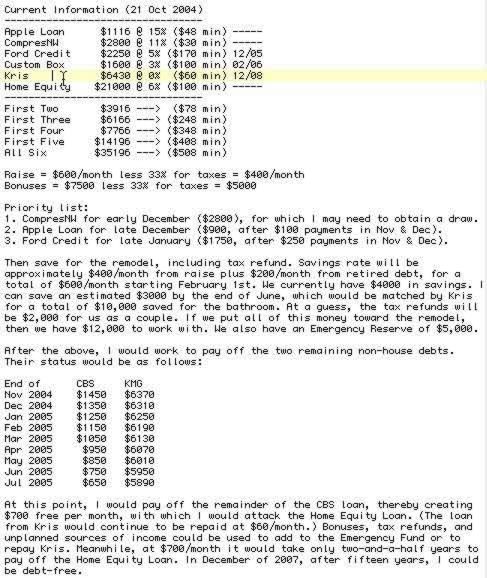
As you can see, I began by listing my debts in the order that I wanted to repay them. (This was before I knew about the debt snowball.) Next, I listed my expected sources of income. Finally, I brainstormed a possible plan of attack.
Despite the fact that I will meet the goal I set for myself in this plan, my path to this destination has been different than I had intended. Surprise expenses occurred. I didn’t adhere to the plan as well as I’d hoped. My income projections were too optimistic. The bathroom remodel cost twice as much as I had anticipated. Because of these things, I’ve made it a habit to draft a new spending plan every few months. This allows me to compensate for changing circumstances and changing priorities.
Your spending plan
If you, too, are wary of budgets, consider using a simple spending plan to give direction to your finances. The example above is more involved than it needs to be. Most of my spending plans now are about half the size. When drafting your spending plan, be sure to do the following:
- Project income. How much do you bring in every month? Will you receive any windfalls soon? For example, every winter I get a sizable bonus at the box factory. I make sure to factor that into my spending plan.
- List fixed expenses. Jot down those things for which you must pay every month: cable, telephone, gas, electricity, etc. These are the bills that you must pay to maintain your lifestyle. (I didn’t include these in my first spending plan — oops!)
- List your debts. When I put together my spending plan, I keep debt separate from the fixed expenses. My other bills stay relatively constant, but as you can see, I like to play with my debt numbers.
- Plan ahead. Do you have any large expenses on the horizon? When I made my first spending plan in the fall of 2004, I knew that we would be remodeling our bathroom the following summer. I made sure to plan for that.
Good financial habits make it easier to adhere to a spending plan (or to a budget). In order for me to stay on track, I need to track every penny I spend. I use Quicken to do this, but you can use MS Money, Wesabe, Mint, a spreadsheet, or simply pen-and-paper. When you track your spending, you can tell when you’ve gone off course.
Conclusion
A spending plan can help you track your financial goals. In turn, financial goals give your life direction, keep you from making foolish choices with money. Before I had goals for my money, I spent it on whatever struck my fancy. It was easy to fritter away my cash on books, comics, and video games, because I didn’t feel like doing so affected my future. I had no plan for the future. But when I drafted my first spending plan three years ago, the future suddenly became crystal clear.
If you do choose to implement a budget or a spending plan, review it regularly. I try to review mine at least once a month. Periodic review can help you stay on course.
Contest reminder: The folks at Intuit sent me three copies of Quicken Deluxe 2008 (for Windows) to pass out to Get Rich Slowly readers. Each person who leaves a substantive comment on this entry will be entered into a drawing to receive one of them. The three winners will be announced on Friday, October 19th. (Details.)
This article is about Budgeting, Money Hacks, Planning Wednesday, 17th October 2007 (by J.D. Roth)


RSS Feeds
Facebook
GRS Twitter


October 17th, 2007 at 11:17 am
Just this summer, partly inspired by reading this site, my husband and I decided to get out of debt. We use this kind of spending plan, rather than a budget.
We have 2 joint accounts: his pay is deposited directly into one, and mine into the other. We have distributed our spending (bills, groceries, etc.) between the accounts for many years but were completely undisciplined about using credit.
So we sat down with paper and pencil and wrote out a plan, starting with our monthly pay deposits and listing all the recurring bills like mortgage, utility, and credit repayment. Then we did the cash-in-envelopes system for a couple of weeks for groceries, gasoline, and spending money, to get a handle on what we were actually spending. Turns out he had been spending a lot more personal cash than I (but I made up for it on credit cards), so we redistributed the spending money into equal allowances.
We sit down every Sunday to go over our progress, with dated and numbered pages from the beginning in front of us. We take notes so that we remember our rationale for decisions in later weeks. We’re making progress, even though it’s only been a few months. The biggest bonus is knowing the truth instead of fearing the worst.
October 17th, 2007 at 11:20 am
I save everything I plan to, and pay everything I owe bills wise the day I get paid. I then enter it into Quicken (older edition) and then I know how much I have left. This works because the things I need are taken care of except for gas and food and the rest left over is what is in my “spending account” for the next 2 weeks. This is how I do it, it works for me and lets me save, and pay everything i need to and leaves me with whatever is left. When I notice I have more excess than I normally do, I either save more, or treat myself, most of the time it’s save more.
October 17th, 2007 at 11:23 am
When the Mrs. and I got married, I had $12K in debt (mainly credit card), but I had just started a new job with a significant pay raise (>30%). So with my wife’s salary and my pay raise, I used Excel (and the Quicken) to figure out how to reduce my debt.
I started using some 0% balance transfers and cut back on expenses (moving to the same city as my wife cut down long distance bills significantly). With a pay raise and a couple bonuses, I was able to pay off my debt in 18 months.
After the debt was finished we hardly used credit cards for the next 3 years. Everything went on the debit card. I would often take out extra money when buying groceries to avoid ATM fees.
Then we decided our finances were stable enough that we started using a credit card for bonus points. Our Amazon card rewards has paid for kids Christmas presents 3 years running.
Now I use credit card with bonuses (paid monthly) and schedule all bills to be paid through my bank’s BillPay (free thanks to my work). I haven’t had a bank fee or paid credit card interest in years.
October 17th, 2007 at 11:29 am
I’ve been trying the multiple account method that I’ve seen mentioned somewhere (probably in a comment!). We have a bills account, which I’m VERY GOOD at tracking, and a “fun” account, which I’m VERY BAD at tracking.
We’ve tried to develop a spending plan (like you, I feel budgets chafe too much), but I’d been overwhelmingly optimistic that we’ll be able to change our spending stripes cold turkey. Sadly, we weren’t able to, but we’ve been getting better, and making less excuses to ourselves for our spending behavior. That I’m proud of, but I know we could do better. We’re working our way toward it, but having better tracking habits (which I need to institute soon) will most certainly help.
Honestly, I’m sure it’s a “just do it” kind of thing, but I feel like more information on tracking spending would be helpful. It’s easier to “monkey do” when monkey sees!
October 17th, 2007 at 11:30 am
I have been trying to follow a suggestion from a Lifehacker reader to spend money on a 60/10/10/10/10 plan:
“Basically take 60% of your monthly check and budget that out for all your expenses. Rent, Transportion, Groceries, etc. Next, 10% should go into your retirement savings, you’re gonna need that cash! 10% should go into long term savings. This is emergency money in case everything goes wrong and you need quick access to real money. 10% more should go into short-term savings, say 1 to 6 months worth of savings, then you’d be surprised what toys you can afford! Then the last 10% should be your fun money!”
I use Quicken to track my expenses, but the one thing I haven’t been able to get a very good handle on (and would welcome any suggestions on) is how to organize my money, time-wise. I get paid once a month and then have bills due at all different points in the month–how should I organize everything so I’m actually spending according to my budget?
October 17th, 2007 at 11:32 am
As a long-time Quicken user and numbers geek, I’m sorry to say that Quicken’s budgeting tools are one of the weaker points of the software. It’s great at telling you where your money went, but not in deciding where it “should” go in the future.
When it comes to planning our family’s expenses, we just determine what percentage of our take-home pay will go toward major categories (e.g. 36% for housing, 12% for groceries) based on experience and desired lifestyle.
For any irregular expenses (e.g. insurance premiums, remodeling projects) I’ve setup separate online savings accounts with automatic transfers every pay period. I’ve found it helps us control our impulse spending when we know whatever balance is left in our checking is all that is available for fun/impulse items.
This approach has really reduced our money stress, because we simply look at the relevant account to see if we have the funds to cover what we want to purchase or if we will have to save some more.
October 17th, 2007 at 11:33 am
I’ve been using a “spending plan” similar to what you’ve outlined for awhile now, and it works quite well for those of us who aren’t so inclined to following a budget. A budget works for some people, but like yourself, I find it easier to track financial goals in less defined terms.
October 17th, 2007 at 11:37 am
i do not budget, for then there is only a set amount of savings to hit and alloted expenses for each category that you may feel no pressure to not spend all of.
what i do is more militant. i try to keep all expenses at the absolute comfortable bottom, all of the time. this leaves all excess cash available (which will fluctuate, but should remain higher than a planned savings of $200 a month or whatever) to put towards what I am currently saving for/paying down.
anything that takes cash out of my hand, no matter how little, is kept at the absolute minimum.
this requires more discipline though, as you have nothing in place to stop you from spending it all, except your own willpower.
i have decided to take the road less traveled, and am unwavering on this. this plan (keeping all expenses across the board to the minimum) will not work for everyone.
October 17th, 2007 at 11:38 am
This is so perfect! I was just talking to my wife the other night about this very thing. She seems to think we don’t budget, and I felt like we do. I never liked a strict budget - it is hard for me to stick to it exactly. It seems that I’ve been using your “spending plan” idea all along. Because of this, I might not necessarily know exactly how much I am spending or will be spending, however I can work toward my goals, and look back and see how well I’ve done over time. This is much easier for me than keeping to a budget. And I can say that for us it works!
Another thing we do is that when we see we have big expenses coming up (we just had our first baby and knew it would cost us) we can spend less, and even buy some of the more expensive items early because we knew spreading out the cost would help us keep to our spending schedule. And, I can testify from personal experience that it works - we have still manged to save more than we anticipated we would, even with large expenses. If we stuck to a budget we probably would have gone over our expected spending (making us feel like we failed our financial goals). In contrast, the spending plan is more flexible, and we were still able to move forward toward our goals while making the necessary purchases.
October 17th, 2007 at 11:38 am
I use YNAB to budget my income from last month. Using this plan, there are no surprises. I love how I can very easily track every penny as well as create accounts for saving up for various expenses like car insurance.
October 17th, 2007 at 11:40 am
I’m not sure if I read about it here or elsewhere, but I ordered You Need A Budget (YNAB) and it has been amazing. I also use it more as a “spending plan” than a “budget,” but the way it compensates for overages, and the basic idea of living on money you have already earned, has been revolutionary for me. It’s available at http://www.youneedabudget.com/.
October 17th, 2007 at 11:47 am
Gee, thanks for such a glass-half-full viewpoint for handling money. I have a definite allergy to budgets and numbers seem to gravitate away from my brain like a negative magnetic field. So many times I have vowed to keep track of my spending only to lose the battle at the end of the day as I wonder…was it $5.60 at the drug store and $65.50 at the supermarket or was it $56.00..oh well!
I’m going to give your “spending plan” concept a try. I sometimes wish there was a support group for people like me…you know,something like: Help for the Really Clueless when it comes to Money!
October 17th, 2007 at 11:49 am
We have used a spending plan/budget method, however, have only updated it once or twice a year - whenever something changed either income levels (we got a raise) or we paid off a debt. We would like to track it more closely in order to save ahead better for large purchases (another car).
October 17th, 2007 at 11:50 am
We have been working with low income women on a concept called “reverse budgeting” and have been using the curriculum called “Money Smart” developed by the FDIC. I believe your spending plan is also an applicable tool. The use of Quicken might be a little intimating to the folks with whom we work, but good old pen and paper or a simple print-out of an Excel spread sheet provides the visual needed to make an impression about why we need to track all of our spending in order to begin to repay debt and reestablish (or establish for the first time) good credit.
thanks for some good info.
October 17th, 2007 at 11:51 am
Ugh…budgets make my head hurt. My wife and I use a fairly simple method we first found on MSN, the 60% solution. The article is here:
http://articles.moneycentral.msn.com/SavingandDebt/LearnToBudget/ASimplerWayToSaveThe60Solution.aspx
Basically 60% of your income is put towards so called “committed” expenses. These are all of the bills, subscriptions, groceries, club dues, etc that you agree are part of your normal lifestyle. These may or may not all be “essential”. My cable bill is a “committed” expense, but totally not an essential expense. Other portions of the 60% are definitely “essential”. All of our taxes and insurance is part of our 60% committed expense. The other 40% is divided up into 10% blocks; retirement savings, long term savings, short term savings, and fun money (money to go to the movies, dine out, take the kids to the zoo.)
The key to this budget working is paying yourself first. We have 10% of our income going straight into our 401(k), 10% going into a brokerage account for long term investing, and 10% going into an ING account for short term investing. Since we never see that money, we can’t really spend it without jumping through hoops.
The only money in our checking account is the 70% that goes towards committed expenses and fun money. We have all of our bills divided up on a 4 week schedule, so the first Friday we pay half our mortgage, the second Friday, car insurance and electric, the third Friday we pay the second half of our mortgage, and the fourth Friday we pay Technology Charges (cable, phone, Internet). A couple of times a year we have an extra paycheck in a month. We generally save that money, but sometimes we pay ahead on some of our bills so we have a cushion. Whatever is left after our bills is what we live on for the week. We do keep track of all our expenses in Quicken, but our categories are Committed Expense:Gasoline, Committed Expense:Cable. That is mainly because I’m anal and still like to know where the 70% of my income is going.
October 17th, 2007 at 11:52 am
Can I just stand up for the budget for a sec? It’s tedious as all get out, but one thing I like about having one and looking at it often is that when my earnings change (every month), a budget helps me avoid “spend more when you earn more” syndrome. I like starting with what I actually need (ie, my budget), and then going to what I earn, in that order, so I can save the maximum each month.
It also gives you a wake up call about silly expenses (for me, pedicures in the winter–um, why?). I swear by a food journal when I need to watch my weight too–exact same principle.
October 17th, 2007 at 11:54 am
First off, I just want to say thanks to J.D. for making it so easy to enter the draws each day. Not easy in terms of the requirements for entry, but easy in that you somehow keep posting about stuff that is on my mind already!
For a variety of reasons, my finances had been a mess for about two years, and over the last few months, I chipped away at a mess of old receipts and mysterious transactions until I was caught up with everything. “The Next Step”, I thought to myself, “is to create a budget”.
Easier thought than done.
There are six adults living in my house. Two of them pay rent to me, and three pay rent to my parents (who own half of the house). I handle all of the finances for all transactions related to this house (as well as for the rental property I share with my parents).
I’m a nice guy. I don’t send out monthly reminders of how much people owe, demanding that they pay up immediately. (Two of the roommates are siblings, one is a friend I have know for nineteen years and lived with for eleven years. Being nice about stuff is automatic for me.) Complicating things is the fact that we all share food, but not ALL food; take-out and toiletries are individually purchased, for example.
This means that in addition to tracking bank account balances for my own accounts, I am tracking balances for money owed to me (or by me, in some cases) by eight other entities (people or couples).
In a given month, I may get lump sum payments from several of these people. I will have grocery bills paid for by any of my roommates that have to be portioned out equally. If I were to plot up my monthly cash balance, it would look a little bit like the profile of the Rocky Mountains that I see when I look west. I know that cash balance doesn’t really play into budgeting, but it sure does wreak havoc with my efforts to wrap my head around things. (I haven’t been able to come up with a decent estimate of my net worth in years. It shouldn’t be hard!)
I’ve been looking lately at alternatives to the traditional budget. I have found a few concepts that appealed to me, but I think this concept of a Spending Plan may be one of the best of the bunch.
Thanks for sharing!
October 17th, 2007 at 11:57 am
I’ve never made a formal spending plan, let alone a full-blown budget, but I put everything on Visa and track my spending religiously. I also set a general target for each month. In months when I have a large expense I try to cut back spending in other areas.
What this means is that I operate on a compressed version of the corporate spending cycle. At the beginning of a month when only my fixed bills are accounted for, I tend to spend more freely. As my Visa billing date approaches and my spending approaches (or exceeds) my monthly target, I start delaying or denying non-essential purchases.
The only change I’d like to implement is to track essential and frivolous spending separately, so I can set a more effective target. I generally don’t do much discretionary spending in the second half of the month, but things like gas and groceries can still push me over my target if I spent too much in the first half.
However, despite not saving as much as I might like I never spend more than I have, which means I don’t have to deal with debt. As a single guy with a good job and no kids, I don’t have a lot of expenses. I can miss my target and still save over $1500 in a month (including my automatic savings plan).
October 17th, 2007 at 12:01 pm
I don’t budget… I am just psycho about saving. I get such a high from putting money into my savings account that it keeps me in line.
This will have to change soon, as we are starting a family and I am going to stop working. Money will be tighter…
October 17th, 2007 at 12:09 pm
I like this idea of a ‘plan’ rather than a budget. Budgets make me go crazy, and feel so constricted, which makes me want to break out of it. But a plan, that I could get behind. I think we do have a plan–just not on paper–but putting everything down, sitting down, and talking about it–I think that will help us get there.
October 17th, 2007 at 12:09 pm
I agree that Budgeting is one of the weakest features of Quicken. Does anyone know if this has been improved for 2008?
October 17th, 2007 at 12:15 pm
I am not trying to suck-up here, but you have no idea how happy i am to see something like this. As I’ve stated before, i have just bought my first home (to save mucho mucho $s), but I really want to get ahead, to build up an Emergency Fund, to pay down the car (who’s value is only declining, as all cars do), to put more into retirement funds, &c.
This isn’t something most 26 year olds can ask their friends about. My mom has everything on a strict budget, so trying to explain to her that I am not sure I could work off of that sounds to her like I don’t want to plan for my future.
I’ve never really tried doing a straight budget before, so I am going to try that, but it’s a great comfort to know that there is a system like this one to fall back on!
I really like how fluid this system seems to be; if you don’t quite hit it, the whole thing won’t fall over! Given that most of my expenses are already auto-payed, implementing a system like this, or a very similar one should be easy.
October 17th, 2007 at 12:18 pm
My personal finance method is similar to Ryan’s in that I don’t have a target savings (actually student loan repayment) goal or target budget categories. Instead I try to keep my expenses to a (reasonable) minimum.
Lately I’m experimenting with a method of doing this that is sort of a cash flow budget. Every time I get a paycheck, I do a cash flow analysis that takes me to the next paycheck. I will literally write every day between now and the next payday out on a piece of paper and forecast what expenses I will have on each day. These expenses include everything that will come out of my bank account: mortgage payment, salon visit, ATM withdrawal, etc. I total all these expenses and add a $200 cushion, and I sweep whatever’s left into my savings account. My savings account will then be swept into a student loan payment.
I like this method because it provides the discipline of a budget without having to create artificial categories (no offense to the 60/10/10/10 people, but this method doesn’t make a lot of sense to me, since your reasonable living expenses might be more or less than 60% of your income and might vary from month to month). It also assures me that I’ll meet my financial goals without my having to look very far into the future at any given time. To assist with this cash flow budget, I’m trying to rely solely on my debit card and not use credit cards at all. I miss out on the credit card rewards that way, but I think this method will save me more than the rewards would earn me.
October 17th, 2007 at 12:20 pm
Thanks for sharing your spending plan. I do something similar by laying out expenses in Excel for the next several months to a year and forecasting balances. In conjunction with tracking net worth, it does well to keep me on track.
October 17th, 2007 at 12:20 pm
Great Post!
My husband and I have tried a spending plan. We added up our monthly expenses, then tried to set a system for what’s left over. We’re both not big spenders, but we waffle a lot over where to put the money that’s left. I feel like we usually randomly put it in various accounts just to quickly get it out of the checking account. I guess we need a savings plan on top of the spending plan!
October 17th, 2007 at 12:21 pm
One of the things to consider in the debt snowball calculation is paying off debts that you can expense on your yearly taxes. Home equity loans and mortgages should be placed further down the list than non-exempt items like car loans, credit cards, etc.
October 17th, 2007 at 12:22 pm
I don’t have enough income yet to really need a budget. Right now I’m living at home and going to college. Next year, however, finances will be tight. I’ll either be living off a stipend (around 13,000 a year) or savings (about the same). So budgeting will definitely be necessary. I like planning stuff, so I’m going to try a full scale budget. I think that is the best way to make my money go the furthest.
Right now I only make about $300 a month. $200 goes to savings and the rest I leave in my checking account for possible spending.
October 17th, 2007 at 12:23 pm
That’s a nice alternative to the traditional budgeting concept
I’m trying to do my best with keeping a budget and can say it really opens your eyes at your real financial situation and where are you heading. It makes no wonders (finding extra cash :), but enables to fight with the spender inside me
I write down my daily expenses in a great Project application on my Nokia smartphone and then budget in an Excel file.
October 17th, 2007 at 12:26 pm
I feel the same way as you about budgets. Every time I crack down on my spending I feel like crap because I think “I’ve worked 150+ hours so far this month, why the hell can’t I have this *insert impulse want*” And it is sort of true. What is the point of working so hard if you are unhappy? you can be unhappy not working too.
They way I use my “budget” is more to just define my expenses, not to limit my spending. I KNOW what my rent and cable, and internet, and car will cost me each month. I can guess what my electricity will cost. I know how much money I can expect on each pay check. So my budget only changes when one of the set incomes/expenses change. It just shows me where my money goes and how much “play money” I have at the end. it also lets me see where i can make cuts. I can go through my budget and say cut out my cable bill, or lower the electric bill and see what kind of return a few small changes will give me. This in turn motivates me to make a bunch of small changes, which can amount to a large return. Ive also started forcing my self to think that the work I do day-to-day is status quo. If i want something extra (like a new toy of some sort) I need to work more. It seems to work for me.
October 17th, 2007 at 12:26 pm
When I decided it was time to reign in our spending, I basically took this approach:
First, I made a list of all our recurring expenses (bills) whether they were monthly or not then I divided the non-monthly ones into monthly expenditures. I noticed then that I get paid every two weeks so I could get an idea of how much I needed to set aside each paycheck by multiplying the monthly cost by 12 then dividing by 26.
I realized this was kind of bunk though from the “getting started” standpoint as there are only two months that I get three paychecks, but at the same time, treating my expenses like I did not get those two checks was making things a bit tight unnecessarily.
As a result, I worked out a plan for how I would spend every paycheck for the rest of the year based on my bill due dates. I took a lot of stress away because no longer did I have one paycheck per month that was annhilated completely by rent and bills. Now, I was prepared and could be ready to pay things early if a particular paycheck was going to be tight.
Anyway, that has worked pretty well for me thusfar except we are going pretty consistently overbudget on food
October 17th, 2007 at 12:35 pm
@Anne:
I don’t want to be too confrontational, being a newbie to this site and all but…
You are right, the 60% of living expenses is an arbitrary number, but in reality, all budgets are based on arbitrary numbers. And to be fair, going in you can set your committed living expenses to whatever you want. 70%, 50%, 82.5%, but I think it is important to have the targets in place.
Look at it this way, a race is an arbitrary distance between point A and point B, but unless you define point B as the end before you start, how do you know when you finish the race?
Also, the 60% solution does take into account times when your living expenses may temporarily be higher than 60%. That is part of what the 10% to short term savings covers.
My biggest issue with your cash flow analysis model, which I have done in the past, is that it is easy to look at your nice, fat, checking account right after a paycheck hits it and decide this week I’m going to get a haircut, buy some new shoes, go to the movies, and end up only leaving yourself $50 to save. Paying yourself 30% first forces you to be more selective in deciding what is coming out of your paycheck for the next week. It is scary at first committing to have part of your income “taken away” up front, but honestly, you get used to it pretty quickly, and once those savings accounts start growing, it is more and more motivation to stick to it.
October 17th, 2007 at 12:36 pm
I never use a budget. I know the exact amount of our fixed expenses, income and the date of each payment and deposit. So I leave enough in the checking to pay any upcoming bills, the rest of the money I transfer them to our Money Market account. Unexpected expenses are few and most of them I pay with credit card so everything is on one statement and I can just pay the credit card bill off every month before due date. I usually just leave couple hundred dollar in checking for any emergencies.
Before we buy any thing, we think long and hard about it, planning and researching ahead. That way we can avoid impulse purchase.
October 17th, 2007 at 12:36 pm
Along with a few of the other comments above, I’ve recently started the 60/10/10/10/10 method - though I think the 70/20/10 method is more realistic for me.
As for tracking money — I recently switched to expensr — after trying MSN Money, YNAB, Mint, dimewise, Excel, and every other website/software/etc I could find. Expensr is easy to use and doesn’t have too many unnecessary features. It’s too early to tell if I’ll stick with it though.
October 17th, 2007 at 12:36 pm
After tracking monthly expenses for over a year, I’ve come to the obvious conclusion that the trick to “budgeting” (or whatever term you prefer) has little to do with regular expenses or the plan toward investment and debt reduction but everything to do with month-to-month variations in spending.
I’m not a fan of the emergency fund, preferring higher investment yield. Instead, we’ve built a Fun Fund, which we raid several times each year for vacations and fun purchases. Our essentials budget (including all regular bills and an average level of typical discretionary spending) has enough wiggle room, so at the end of each month, I simply compare actual expenses, investments, debt-paydown and funspenses (discretionary expenses, which includes eating out and anything that isn’t essential to basic living) and split the leftovers between them to balance each.
Anyway, I’m certainly not explaining it well, but the key is that having a simple mechanism for addressing monthly flexibility. I still haven’t found a great discussion of how to pull this off elegantly, but I think I’ve developed a plan that works well for me. I would love to hear your take on this aspect of money management.
Thanks,
Flynn
portland, or
October 17th, 2007 at 12:38 pm
Wow. That old budget gave me a bad flashback. Was that the old kind of paper you had to thread through the ends into the printer? Yikes!
October 17th, 2007 at 12:38 pm
We also use a type of 60% plan, which I call a “bucket” approach. We divvy up how much money we have coming in each month, carve out the regular expenses, and account for any one-time planned purchases (e.g., kids’ birthday parties). We then use historical data to estimate “buckets” for remaining expenses - e.g., $500 per pay period for groceries (we have four kids, folks!), $150 for personal entertainment, etc.
This is working fairly well for us. It’s working much better since I finally broke down and FORCED myself to keep a ledger book of all transactions. I’d been trying to use just our BoA Online Banking for years, and could never manage it. I’d quickly lose track of purchases, and end up getting us in the hole. Now that everything I’ve spent up to the last minute is noted in the transaction record I always carry around in my pocket, I feel much more secure about where we’re at financially. No more making a grocery purchase, and praying that the debit card doesn’t gget rejected. (Ugh, what a HORRIBLE dread that is.)
October 17th, 2007 at 12:42 pm
It seems that a lot of the problems that I’m reading about with a budget are tied to a misperception of what a budget is. It is not an instrument of torture. It is a tool to help you accomplish what you want to do financially. It does not MAKE you do anything, it helps you to do what you have decided you want to do. Now admittedly, this is sometimes like loosing weight. Knowing we should take action, but the personal commitment isn’t quite there.
Personally, my wife and I have worked through several different methods the last seven years of marriage. What we are doing now (and I think works really well) is based on the envelope system. We also have a set aside account for “big purchases” that the budget doesn’t account for. We found that much of the budget pressure we had felt in the past came from these bigger purchases that we hadn’t figured out a way to budget for. Now we have a prioratized list of purchases and when the big purchase account is big enough, we buy the next item. My wife is getting a new dining room set installed right now and she is a very happy camper.
October 17th, 2007 at 12:46 pm
I have been using YNAB since the beginning of this year and have loved it so far. Though I’m really not using it to “hard” budget. I often find myself shifting the budgets of categories around if one goes over. My hope is that after a while of doing this I’ll be able to look back over the data and really have a good idea of what each category’s budget should be and then work at them from a good starting point.
October 17th, 2007 at 12:47 pm
I have the dual problem of having an irregular income and being overly optimistic in my income projections/goals for each month. Having an 8-month old will tend to do that to a flexible work schedule.
I have been forcing myself to review/revise my budget/spending plan every month and after 6 months it is finally starting to normalize…reduction in number and magnitudes of errors each month.
Definitely an essential tool in getting control of your finances.
October 17th, 2007 at 12:48 pm
I’m not one to keep track of every single receipt. Instead, I use yodlee with my bank accounts, bills, and credit cards to keep a record of what I’ve spent, in addition to tracking an ambiguous “cash” category. I keep a general idea of where my cash goes (mostly grocery stores and cafes which just goes into “food”) but don’t track it down to the cent. I just make a note in yodlee that describes what I pulled the cash out for, like “food” or “travel”, then add it to the appropriate category.
So for the people who are non-budgeters and non-receipt-keepers, don’t despair. You can still create a spending plan without hoarding your receipts and running around like a mad person when you can’t find one… Down to the cent accounting isn’t usually worth my sanity and it may not be worth yours.
October 17th, 2007 at 12:49 pm
@Mike
Those are fair points, and I guess it all comes down to how each individual is motivated. When I get a paycheck, I am motivated to save, not spend. Sitting down and planning my spending for the next couple of weeks actually helps me curb the impulse buys. I think if I had a 10% fun money budget I’d be buying a lot more shoes and going to a lot more movies because I’d look at that 10% as a quota, rather than a ceiling. But I can see how some people might have the exact opposite experience and for them an arbitrary budget might make sense.
October 17th, 2007 at 12:49 pm
My wife and I do something similar, we don’t budget or balance the check book but we do enforce limits on spending to allow us to spend less than we make. We do this by multiple accounts (aside from retirement/college saving/emergency fund which comes off the top). One is for all the fixed/known expenses (mortgage/insurance/utils/etc/investments/savings).
The other is for living expenses (food/clothes/entertainment). The living expenses gets a fixed amount every month. Once we hit the limit we can’t spend until the next month (sometimes we cheat) but it does force us to think about how much we spend each month.
Prior to this we would spend all the money that was put in the account +some every month… Now we seem to have more left at the end of the month to put away for a rainy day savings…..
October 17th, 2007 at 12:50 pm
freecia - I agree that down-to-the-cent accounting is a PITA. My own technique is to round up to the nearest dollar. I use this in conjunction with Bank of America’s Keep The Change program, which actually *does* round up to the nearest dollar, automagically transferring this financial detritus to my savings account.
By month’s end, I have a nice chunk o’ change set aside. And my accounting is a snap to boot.
October 17th, 2007 at 12:53 pm
A budget is the one remaining financial discipline that I just can’t get the grasp of. And I can’t figure out why it’s so hard to start.
October 17th, 2007 at 12:55 pm
Budgeting just takes too much time for me.
The best financial habit I’ve ever developed is doing every transaction but recurring bills with cash. Not checks/debit cards, but the actual green(ish) paper and little round pieces of metal. I know it sounds extreme, but wow–you end up budgeting without even trying.
My wife got me started on it. She’s from Japan, which is still a mostly-cash society. People over there walk around with big wads of paper cash and coin purses. It’s crazy. My wife doesn’t even trust debit cards–the float time between the purchase and the money actually leaving the bank account makes her nervous.
What’s not crazy, though, is the trip your mind takes when you’re about to physically let go of the actual green for an impulse buy. I’ve all but stopped on-the-spot purchases. Even Burger King’s value menu gives me pause, and that’s food!
We don’t really keep track of receipts much, either; our accounts just end up a few hundred dollars bigger by the end of each month.
I know going all cash is too hard-core for many people, but anyone having spending issues should really give it a try. It’s like a nose piercing–hardly noticeable once you’re used to it (not that I’d know).
October 17th, 2007 at 12:56 pm
We did some round-number guessing at the beginning of the year, based on prior months’ spending. It needed some adjustment, but our spending plan is the basic “pay yourself first” plan. All retirement, house, etc. savings rolls off on payday, leaving in the checking account only the amount that we have to spend. Anything left at the end of the month rolls of for more fun longer-term goals (travel, furniture, etc.) It’s been a fantastic system for us: you can’t spend it if it’s not available.
October 17th, 2007 at 1:02 pm
It took me a long time to get a budget drawn up and now I am glad I got on that. I am checking it every possible second to see where I can cut or reduce. It truly helped me focus and stay well informed about my spending habits. I just use good old excel to automate things for me. I have a spreadsheet that does daily and monthly caculation. I then do pie charts or graphs to have a picturesque view of my spending habits.
October 17th, 2007 at 1:03 pm
I as a college student I have greatly seen the value of a budget. I have the opportunity (not burden) of paying for my own college. I have received a small amount of scholarship but not nearly enough to cover the cost of school.
I have the goal of graduating without any debt and so far as far as the eye can see towards the horizon I will achieve that goal.
Having a budget has greatly helped me to stay on target of reaching the goal. Having a budget helps you plan the expenses and seeing how much money is required to for the whole year. That way you can plan how much you need to make during the summer and throughout the year.
Hope this helps.
October 17th, 2007 at 1:08 pm
Budgets used to never work for us. Our pay would be different each time, or random expenses would come up that didn’t fit into the budget, etc. It was always very frustrating! When we started Dave Ramsey’s Financial Peace University and learned about the zero based budgeting it started working a lot better. I basically set a budget each time my husband gets paid. It is very flexible and takes me about 10 minutes each time. When expenses come up I just incorporate them into the budget. Maybe I don’t need to purchase any gifts this month, yet we have an unexpected medical bill. Maybe I have 2 birthdays and need to spend more on gifts. Either way budgeting the way I do allows me to make it work each month.
October 17th, 2007 at 1:09 pm
I’ve changed my approach to budgeting after using YNAB. When I first got it I ran all my numbers and then saw where the leaks were in my spending.
I then realized that I’m too minutiae-oriented to be happy using it often because I like to look at my books too frequently. So I ran it for a few months until I got a sense of exactly how much I can spend on frivolity and I haven’t run it again.
I know now if I spend more than $20 a week on things I haven’t planned on I’ll be in trouble. If I spend more than $35 a week on food I’ll be in trouble. The rest of my bills are auto deducted and my pay direct deposited. I ran the budget to set up how much to auto-pay to reduce debt and now simply use a spending plan for the remaining $55 per week cash flow.
So I guess I have devolved back to a spending plan from my high hopes of becoming a budgeter. I used the budget to set up a 3 year payment system that will run until stuff is paid off. After that I’ll revisit and see where to redirect the money chutes.
October 17th, 2007 at 1:14 pm
I don’t budget, and I’m not sure I ever have. Back in college and the first few years out of college, I would use Quicken daily to watch my net worth. I was also an avid fan of fool.com and learned all about living below your means. Quicken quickly told me whether my actions that day (paying a student loan, buying a big fancy dinner, etc) improved or hurt my net worth. This made me even more excited about investing and less excited about spending more on things that would be gone in a day (dining out) or depreciate quickly (new car).
I guess the type of budgeting I do is a version of fund retirement (to the max), savings, pay necessary bills first, and then live off the rest. This did me well until I saw the GRS post about paying off a mortgage versus investing the money. It inspired me to start aggressively paying off my mortgage. Now I try to live off even less and put all the rest towards the mortgage.
October 17th, 2007 at 1:17 pm
Ah, the budget.
Sounds so good until those unexpected fun things. I had started to plan one out, even taking account for my boyfriend’s expenditures as well. And then…
-Car accident (100% their fault)
-Rental car gets scratched in parking lot
-Insurance companies can’t agree on fault
-Body shop doesn’t like insurance
-New job across two cities (NO good bus routes)
-Trying to move from crime-ridden neigborhood
Sadly, for the first time since owning my credit card, I have a larger balance due then the balance in my checking account. Also, I’ve nearly maxed out my small limit.
All I can say is that I still am going to contribute $50 to my Roth IRA this month, and I’m not going to let any of my bills slip by.. even if it takes me FOREVER to get my car out of the shop.
Budgets can be lovely, but as you mentioned in the first paragraph, terribly inflexible. I will definitely try making a “spending plan” for this upcoming month.
October 17th, 2007 at 1:20 pm
Ah, after reading a few of the comments, I’d like to point out the “deferred gratification list” for the “I deserve it” moments.
Set a limit of how much you can spend in a month on “treating yourself” because you’ve had a rough week/deserve it. Everything else, put it on the wishlist, along with how much it is, and how much you want it (taking into consideration that you may have to give up other stuff to get it). Then when you HAVE the money saved up for items on the list, meaning it is literally money in the bank just for that purpose, that’s when you can think about buying it. Not at the store, not while you’re surfing online, not when your friend shows up with the latest thing. Have your spouse and kids do the same and you’ll find that there are many things you thought you wanted and would have bought, but after a bit of consideration, don’t really need or won’t use.
My personal weaknesses for treating myself are food, books, and gadgets. I have a food budget and a book budget, but grant myself $30 a month of “treat” budget which can fall into better food, more books, or is combined with another budget category to splurge a bit. Unnecessary things go on a “deferred gratification” list to be considered after everything else money related has been taken care of (bills, savings deposits, investments, etc). Right now, my list is 14 items long with everything from a $12 magazine subscription (I don’t want it that much to treat myself to it) to a $400 gadget. Some things I’ll add to my savings goals, some things I won’t want after a few days, and I already have a partial wishlist for the holidays. It not only saves money, it creates less clutter.
October 17th, 2007 at 1:22 pm
We tried a detailed budget.. and discovered that the little pigeon holes drove both of us nuts. So we now have a lump sum of ‘X amount’ that is what is reasonable after taken into account recurring monthly and is just ‘everything else’.. groceries, shopping, unexpected etc etc etc. That we track, and are aware of how far through the month and how far through the budget we are. It’s much more ‘by the seat of our pants’ than most budgets, and suits our very casual/flexible/spontaneous lifestyle very well.
October 17th, 2007 at 1:35 pm
I’ve never really had any problems with debt, but I definitely have problems with spending. I’ve always treated my finances as: “save this much and the rest will fall into place”. but eventually you get into the end where you can’t save that much.
I like the idea of really drawing out a spending plan, rather than jotting down notes on post-its about how to allocate paychecks :).
October 17th, 2007 at 1:41 pm
I too have always had problems with budgets. I just can’t bring myself to jot down every detail of what I’m going to spend and what I have to spend.
After accruing some debt to pay for our wedding reception, my fiance and I did start to put together a spending plan (we called it a financial plan) to help pay it off and to help ramp up our savings to buy a new condo. It has worked very well and here about a year and a half later, we are getting ready to close on Friday!
October 17th, 2007 at 1:43 pm
I, too, am not built for detailed budgeting, so I have been using what I term Guerilla Budgeting. I basically split up my paycheck into forths 1/4 to student loan repayment, 1/4 to saving, 1/4 to rent and 1/4 to spending and utilities (which are really low for me). Anything left over in the spending account after two weeks goes to savings. This allows me some freedom to spend without having to write down “1.85 coffee.” It is crude, sloppy and unsophisticated, but it works for me.
October 17th, 2007 at 1:44 pm
Like a lot of people I’m really bad at keeping a budget. However, in order to control my spending, I started to track them on a pretty large scale. I too use Quicken (but a pretty old version) to track my checking account. Every penny that moves in an out of it is tracked. But what about cash? Well, first of all it is tracked, since it went out of my checking account (marked as ATM). But for most of you (and myself), this is not detailed enough to really see where your money is going. For me, it works best to give myself a weekly “allowance”. This money (currently 70 Euro which is about $100) is spend on groceries, entertainment, clothing, gadgets etc. My regular monthly expenses (like rent and such) are not included in this (They are tracked in detail already). For me, this approach has several advantages:
) and stick it on my kitchen cabinet.
1. It’s simple. I just enter the amount I spend every evening.
2. It gives me (almost) instant feedback on how I’m doing. Actually, I print out an Excel Sheet every week with a graph on it (I get motivated by graphs
3. It works. Unlike more detailed approaches, this (very) simple budget seems to work for me.
October 17th, 2007 at 1:48 pm
My mom uses Quicken and finds it extremely valuable for keeping track of finances. I was impressed when it came to doing her taxes that all she had to do was open it up and everything was there at her fingertips. I have not tried it myself and still use the old pen and paper - maybe it’s time for me to upgrade, LOL.
October 17th, 2007 at 1:55 pm
I *am* a budgeter in MS Money, but recently I decided to tackle some of my major financial goals–pay off all of my non-mortgage debt (a few credit carb balances under $2k, half of a $4k HELOC tab for the new A/C in my house, and about $4500 on my used car loan), start an emergency fund, and start setting aside money for irregular expenses as described in the 60% Budget Solution on MSN Money Central and Lifehacker–all without touching the amount I was already saving for retirement in my 401(k) and Roth IRA (~20% of my gross income).
What I came up with was very similar to your spending plan, though it doesn’t cover the amount that is locked up in basic monthly living expenses and retirement savings. It’s more of a month-by-month itemized tally of how much I am alloting toward each of my financial goals, whether they are debt repayment or savings. I keep it hosted on Google Docs so I can access it from anywhere. I know exactly how much I am putting toward a particular goal each month, and cross out each completed payment as I make it. I also use the table to set up as many of the payments and savings transfers as possible automatically.
As I pay off each debt, the money that is freed up is put towards either another higher-interest debt or a savings goal.
I find it very motivating to draw a line through each payment item; it appeals to the completist in me.
I do check the plan every month in case I need to make adjustments, but so far I haven’t missed a mini-goal in the three months I have been tracking this way.
October 17th, 2007 at 1:57 pm
The hardest part I had in sticking with a spending plan/budget when I first started working was dealing with my bonuses. The first bonus I ever received I got after only working 5 months, and I definitely could have used that money to knock out my credit card debt (before it later got out of hand) or to pay off a student loan. Instead, I dropped all of it while on vacation with my parents in China on souvenirs.
I’ve been lucky enough to get a lot of traveling done in my life and when I was a broke college student I always hated the fact that I had to be very judicious with my spending on mementos. So the first big trip I went on with my “real job” I went nuts. I dropped quite a bit of money on all sorts of things from jade statues to hanging scrolls and then paid even more to have them shipped back to my apartment.
That trip helped me spiral into a lot of debt that I am now working my way out of. I’ve learned that I have to stick to my plans from now on and that bonus money needs to go to paying things off and to investing in my future, not instant gratification.
October 17th, 2007 at 2:05 pm
I have tried and like both Wesabe and Mint thanks to their ease of use, online access, and automatic updating of accounts. I particularly like Wesabe’s attention to detail when it comes to security. However, I like to enter my receipts into Quicken manually and later match transactions with data downloaded from my financial institutions’ sites. I will be thrilled if and when one of them ever add the ability to create and match transactions.
October 17th, 2007 at 2:07 pm
I’m budget-phobic, as well, and have something similar, but much more numeric.
Essentially, it’s a month-by-month spending plan in Excel.
The columns are months. I go out about a year or so. The top few rows are my overview/sum rows. I have my monthly income, other income, sums of spending, investing, etc.
Then the next few rows are the amount of money I will put into accounts — both savings and debt accounts. I have a few rows for each account that tracks monthly return/total amount/etc, though that’s not important for the spending plan.
What is important is that each column (month) references the column (month) before. So, the amount I pay into my credit card in November equals the amount I paid in October; and December equals November.
So when I make an adjustment, in salary or savings, it updates all future months. If I’m doing a one-off (like a large credit card payment), I adjust this month, then adjust the next month back. This allows me to see at a glance what I’m going to put into each account. It also allows me to “play” with the numbers. What if I put an extra 500$/month onto a credit card?
It’s really quite an elegant solution. Even though I use a personal accounting package, this does so much more than any cashflow analysis could do.
If anybody needs help, I could be persuaded to create a template and post it.
October 17th, 2007 at 2:11 pm
One tip I use to help me stay on track for saving is a take off of the “30 days rule” tactic.
I write my savings goals down, how much I want to save, and by what date, and I keep it where I will see it. Usually right next to my 30 days rule note.
Using that I was able to save up to buy a new car, pay off a lot of bills, and now I’m going to finally take a real vacation next summer.
October 17th, 2007 at 2:14 pm
Budgeting has always been something that struck my fancy. My sister is just the opposite. It is hard for people to understand that yes you can save money even though it looks like before you know it your money is gone. The way to do that is by planning. I like that people can actually make mini-banks in their own home. (These banks do not pay interest though.) By using envelopes, you can set aside money for different occasions. Once the money is gone out of the envelope, no more spending on that category. If you want, what is every left in any envelope can be put into a savings account, even if it is only fifty cents! This is a way to help focus on your budget because you are noting pulling the money from the same location for different expenses. Consider it a bank account for each occasion that you might have, especially those emergencies. I have seen it work, and you can do it to. I do it myself from time to time. Haste makes waste and planning helps control uncontrolled spending.
October 17th, 2007 at 2:21 pm
Thanks for sharing that J.D. I like the analogy you made about budgets and travel itinerary and spending plans being more of the places I like to go.
I tend to have lots of good ideas and I am well intentioned about saving, but it seems that I don’t plan ahead and that seems to eat up the money I made the great effort of saving.
I only have a school loan and I always pay off my credit card, but the next step is developing a plan to prepare for the long-term.
October 17th, 2007 at 2:21 pm
This would be great for our household. I have a 2 month old son and a I got my last paycheck a week ago. We will have to live by our budget or will go in to debt very fast. I am already doing some of the tips you have posted.
October 17th, 2007 at 2:28 pm
For me using Quicken and having a spending plan have been part of my personal finance success for the last three years. I was able to pay off my debts quickly and now that I’m debt free I have a ton (relatively speaking) of cash to sock away every month that used to go to debt service. My only issue now is that I may be saving TOO much money and not spending enough on myself. This may be an opportunity to re-evaluate my budget and allocate a few more dollars to entertainment expenses. I am very happy to be at the point where I’m worrying about tweaking my budget and saving a bunch rather than worrying how I will pay my bills.
October 17th, 2007 at 2:32 pm
I’ve found that planning for large fixed expenses that only occur a couple of times a year (i.e. fuel oil, car insurance, etc.) is the most difficult part of budgeting. How do you plan for those big expenses that occur yearly? Do you handle these similar to saving up for a car?
October 17th, 2007 at 2:33 pm
Perhaps I haven’t wanted to admit it to myself until reading this, but a budget isn’t exactly working out for me either. Some weeks it will be easy not to overshoot my budget, but then other weeks I can’t help but go over. This creates an inconsistent amount that I can throw into savings or other debt, and I would rather know for sure how much I can dedicate to those rather than having to wait and see how the week pans out.
October 17th, 2007 at 2:44 pm
My wife and I have been using quicken for the last year and half now to keep track of our finances and to help us predict how much we are going to make each month.
Something that we are doing to increase our savings is to set our budget based on two paychecks a month (we get paid every two weeks) so that four times out of the year (twice for each of us) we have an extra pay check to work with that goes entirely to savings/retirement in addition to our monthly contributions.
The other thing that we are doing right now is taking advantage of Washington Mutual’s Online Saving’s account (http://www.wamu.com/personal/accountchoices/savings/online_savings_account/default.asp) making 5% interest. We initially put all of our income into this account and setup recurring transfers to the checking account to cover expenses requiring checks (ie rent) . Then everything else that can be paid by credit is paid by credit, with the balance paid off in full every 20 days through a transfer from savings to checking. This allows us to keep a higher average daily balance in the savings account, accrue free points on our card, and because we’re using the credit card everything is setup for auto payments that means we keep the money as long as possible. This is convoluted and confusing and would not be possible without liberal use of Quicken’s bill reminder feature and transaction downloading.
A third thing that we use quicken for leverage 0% interest offers from credit companies for large purchases. We save up the money until we have enough to make the purchase outright, then use the 0% interest offer to make the purchase and pay the minimum for the duration of the offer, the whole time keeping the sum in our account to earn interest. Quicken allows us to make sure we don’t touch the money set aside for paying off the balance.
October 17th, 2007 at 2:57 pm
Budgets are wonderful. It eases so much stress from me the saver, and my wife the spender. I don’t get stressed when we have to buy something and she doesn’t get stressed when she wants to buy something.
Budgets can save marriages.
October 17th, 2007 at 3:08 pm
My wife and I do sort of a two-part budget plan. First, we take all of our known bills (best estimates in the case of things like credit cards) and we enter them into a spreadsheet with our estimated income for the month, to see whether we are in the black or red for the end of the month. If we are in the red, we know we have to work extra hours, or come up with some other way of making a few extra bucks for the month.
Once we have done that, or if we are already in the black, we go into Quicken (2005 version, I’d love to have the new one!) and enter those same bills, and pad the ones that we are trying to pay off (credit cards, car loan, mortgage) with the excess money we have left on the spreadsheet. We try to do this in a systematic way (paying off higher interest items first).
So far, this seems to be working. We’re steadily paying down our debt, and we haven’t had any major financial crises.
October 17th, 2007 at 3:15 pm
I worked from a budget for a while and was able to get into my new condo. however since I got in I haven’t done a budget til earlier this month.
I end up varying between a spending plan and a budget. I have the fixed amounts of what I want in each budget. I, then once a month usually after my cc statement closes which is around the 5th, go through and copy and paste the onlnie statement into the excel spreadsheet of the budget. With a few updates to change the - to + in terms of how the statement is written, I can find out how close I was to each of the goals / buckets. I think just keeping track is key since you can then use that to change your habits for the next month.
The only tricky bit is like Don J, I have people paying me rent and utilities so it is a pain to split they into different categories. I have just basically said I will budget the whole of the utilities rather than a 3rd and use their rent + utilities payment as another income source to break down.
The trick is to keep checking. giving your self a feedback loop to keep you aiming towards your goal.
October 17th, 2007 at 3:33 pm
We use a sort of hybrid-approach. We used Quicken to create a budget. All of our fixed categories are included as well as retirement and savings and then there are discretionary categories for eating out, recreation etc. We don’t really track the individual discretionary amounts though, so if we know that we are going to being spending more on recretational activities, books, or whatever, we will cut back on eating out for the month. This makes it a bit more fluid and we don’t feel quite as restrained as having a full-on budget.
October 17th, 2007 at 4:00 pm
Budgets are so beyond me! I can lay them out but I rationalize my spending to much. This plan seems to be more in line with what I need, I can see my goals and that I am taking away from them if i spend frivolously. Plus it doesn’t feel like a chore. I have yet to lay out my money plan I need to do, I feel I need to organize better in order to keep track of expenses.
Thanks for the post!
October 17th, 2007 at 4:06 pm
Budget are too harsh on yourself in most cases. I started using Quicken ~ 10 months ago, and back then I “budgeted” about $800 / month for spending on whatever I wanted, such as lunches, happy hour, golf, etc. I found that when I look back over the last 10 months, I really spend close to a $1,000 / month on such items. So, I adjusted my spending plan accordingly.
My fiance and I went though a “spending analysis” where we saw how much we take in every month, and figured out our savings rate after fixed expenses. This was our maximum savings rate. Then we tried to take a more realistic view and figured out what we spend in discretionary spending, and called that our minimum savings rate. Our goal is somewhere in the middle, basically keeping discretionary spending at a reasonable level.
October 17th, 2007 at 4:11 pm
I don’t keep a solid budget either. My wife and I just talk about our major purchases, and we track it through Quicken. I am thinking about looking at one of the other methods - Wesabe, Mint, etc. as a different way of tracking things. Quicken can be cumbersome at times.
October 17th, 2007 at 4:13 pm
A similar idea might be to create a savings plan. I currently am planning on attending law school. This is likely to cost around $150k in loans by the time I am finished, but saving for the cost ahead of time will help make this debt less of a burden. I am currently trying to make a plan that balances the short term nature of my savings and the best possible return. CD’s are great and I can get them at around 5.3% interest, but that ties up the funds for 12 months. I am currently trying to find all of the little leaks in our budget and plug them and put everything in a 6% savings account.
October 17th, 2007 at 4:23 pm
I’m one of those weird folks that doesn’t mind spending time tracking my money, but these days, it just doesn’t seem worth the hassle anymore (which makes me think that maybe I should invest in some of the software that my bank will export my statements into..) Back when my paychecks were tiny, I had a similar system - I have notebooks full of:
150
+200(pay 7/28)
-300(rent due 8/1)
=50$
-30$(food)
=20$(slosh)
Yes, it was that tight. I *wish* I was making it up! Usually, I’d go out about a month. (”slosh” is that money that doesn’t get allocated to anything except “oops”)
Now that I’ve got a little wiggle room, I use what I call my “set it and forget it” budget. I figured out how much everything was, roughly (through spreadsheets that make my husband think I’m completely around the bend), and I allocated. 401k comes out before I even THINK about my check, then ~10% goes to our house fund and ~8% to my “other savings” before I even see the money. I’ve figured out how much every thing else costs, then I get X amount a week in cash, which is supposed to cover everything from food out to books to movies to belly dance gear (which is a damn expensive hobby, BTW - I keep hoping it’ll pay for itself, but as a saver, the 300$ for the costume that lets that happen keeps giving me fits). In reality, the more wiggle room I have, the more I use it, and I think I need to re-evaluate. Right now, that’ll happen after I get my annual raise review….
October 17th, 2007 at 4:24 pm
I’m new to this site and it’s very interesting to read the various comments and suggestions. My husband oversees the finances in our family but throughout our 12 year marriage has wanted me to take a more active role and to take responsibility for some of the budgeting. For some reason I have never really been able to get a handle on this. We have tried the cash envelope system, separate accts, same acct, various division of bills. I never seem to be able to formulate something that works for BOTH of us. In the end he usually works things out but I am still in the dark about what money is coming in and what money is going out - and where. We have a mortgage, 2 car payments, college loans and 3 kids that we want to attempt to help out with their education someday. Pretty typical American family I guess. I look forward to learning more and sharing this with my husband as we continue on our path towards financial freedom.
October 17th, 2007 at 4:26 pm
My husband and I are also allergic to budgets. He barely tolerates my personal finance hobby as it is, and a detailed budget would be way too much (for me, too). Instead, we do a verbal spending plan every few months as we discuss where we are and where our money is going to go in the near future. It’s very helpful to have clear lines of communication this way, and I find that bringing things out in the open this way makes certain financial decisions easier. It also keeps us both focused on our savings goals. Our major financial problem was not debt (thankfully), but being too conservative having our money in savings accounts and CDs instead of investing it. By talking about our long-term money goals as part of our short-term savings budget conversation, we realized that saving well wasn’t enough, but that we needed to be more aggressive about investing as well in order to reach our goals. Now in addition to spending/savings goals we also have goals for our investments.
October 17th, 2007 at 4:29 pm
I like the term “spending plan”. The word “budget” somehow - is this cultural? - feels punitive.
For my spouse and I - we have been able to change our perspective over time from “here’s our limits for this category” to “if we can keep this expense down, or find other ways to accomplish this”, then we’ll have more money for our retirement, or we’ll be x% closer to our college funding goal, or x# of months closer to our next funded vacation.
It is hard though, when the impulse bug strikes, to remember those big lofty goals. I have taken to updating our overall plan on paper every few days, and carrying it around with me. Geeky overkill? Probably. But it really helps keep me focused.
I appreciate all of the references here to other online programs beyond Quicken - I am still looking for the tool that will create what I’m doing manually on Excel….
October 17th, 2007 at 4:30 pm
As a recent college grad, I’m just now starting to realize the importance of creating a budget for myself. It’s something I’ve tried to do many times in the past, but like you, it’s just too fussy for me. Last week, I created my newest version of a budget; and I think this one may finally work for me! I’m hoping to have all of my debt (aside from student loans) paid of within the year:)
October 17th, 2007 at 4:46 pm
Like Zephan (#48) said, having a budget (even if it is more of a method of estimating future expenses) as a student is great. Over several years of college, I have gotten better and better at estimating where my money is going and when, and that gives me targets to aim for for how much I need to be making and how much I need to be saving. Being a student and having widely varying income over the course of the year (full-time summer internships versus part-time student jobs during the school year) demands a greater degree of forethought for spending and saving.
Planning this helps me avoid getting into debt in the first place (regardless of student debt being “good debt”) - think of it as debt reduction on the backside than on the frontside.
October 17th, 2007 at 4:53 pm
The majority of my debts are paid off, so my spending plan is more of where my money is to be allocated each month (monthly bills and the like). A little different than a budget that limits where I can spend my money.
Having a variable income makes this a challenge, so a percentage of any overage goes into a special account that I can dip into to cover months where my expenses exceed my income.
October 17th, 2007 at 5:30 pm
I do a kind of reflective budgeting:
I carry a moleskin notebook everywhere for my notes and thoughts (GTD). Every time I make a purchase, I put the receipt in the back of the notebook.
When I empty my inbox every day (or two), I log into http://www.moneytrackin.com and enter the receipt totals into one of the several tagged categories I’ve created. Tags are great because a single item can have more than one tag. For example, I have “EatingOut” and “Groceries”, but both of those are also tagged “Food”. Once I’ve entered the receipt, I throw it away.
At the end of the month, or whenever I like, I can easily see how much I’m spending in each category. How much of my “Food” expense is due to “EatingOut”? Easy to see. Once I’ve got the data, it is simple to adjust future behavior.
I’ve found that even the act of entering all expenses into categories helps curb spending. It may sound retro, but the old act of analog entry is an asset in a world where we swipe and sign without having to even think about the numbers.
October 17th, 2007 at 5:36 pm
I am not naturally meticulous when it comes to numbers. I’ve made one or two attempts at a budget before, but got discouraged and stoppped.
Now that I’m reading a few money related websites, and I’ve educated myself a bit, I’m giving it another try.
A few weeks ago I put a box on our dining room table and we are dropping receipts in there every time we make a purchase. Then at the end of the month we’re re-conciling receipts,bank accounts, and all that stuff.
I’ve only done 1 month so far, but it is definitely eye opening to see where they money is going.
I feel like my husband and I make so much money, and we could accomplish so much if we set our minds (and wallets) to the task. So for now we’re tracking expenses, not fully budgeting. I’m not sure what our next step will be, that’s why I’m here, gathering ideas
Oh, and if anyone is wondering what our “high-roller” jobs are, we’re both teachers. I grew up extremely poor, so I feel lucky and blessed to have our salaries.
October 17th, 2007 at 5:36 pm
I have been tracking my finances using Money or Quicken for over 5 years now. Each year I followed the simple idea of spending less than I earn and investing the difference. At this point in time, I have accumulated a net worth of over $85,000. Keep in mind I am only 25.
Becoming rich is simple and easy. All it takes is time and discipline. The problem is that it goes against human nature. People are driven by instant gratification and their emotions, not some number in their bank account. The trick is understanding your inherent weakness. Take your emotions out of the process and just do what you know is right.
October 17th, 2007 at 5:44 pm
I also have problems with rigid budgets. My life has way to many variations for one to work well. Basically once a month on a completely random day whenever the mood strikes I list all my bills and calculate my income. Then I list all my debt and figure out how much I need to cover bills and how much should be left for debt paydown. then I take that number and add in projected income raises and come up with a new debt free date.
This is usually done in a totally haphazard manor scribbled on paper or written in marker on a piece of cardboard at work. It gives me an idea if I’m meeting my debt pay down goals. As long as that number is close and all my bills are paid I can assume I’m within budget and not spending extraneously. I have started using mint but mainly so I can check several accounts at one time in the morning before I go to work.
October 17th, 2007 at 5:45 pm
“I’ve found that planning for large fixed expenses that only occur a couple of times a year (i.e. fuel oil, car insurance, etc.) is the most difficult part of budgeting. How do you plan for those big expenses that occur yearly? Do you handle these similar to saving up for a car?”
Being a seat-of-the-pants sort of guy, I don’t save for things specifically. I have one savings account where I dump any left-over money at the end of each month. It’s my emergency fund/annual expenses/vacation/down payment/general savings account.
I don’t save a certain amount per month toward car insurance specifically, I just figure that it’s one of the things I’m saving for. Most months I put money in, but when I have a large expense I take money out. I find that having enough money in my savings account that I don’t have to worry about car insurance coming due means I don’t worry as much period.
October 17th, 2007 at 5:55 pm
I’m very good at budgeting… one day a month. On the first day of every month, I sit down and pay all my bills (or check in on the automatically drafted ones). Then, I manually transfer all the money I’ve earmarked for savings to my savings account. Whatever is left over is our operating budget for the month (food, gas, coffee, eating out, etc.), so I just check in every few days to make sure we’re not messing up. If I need to make a big purchase, I use my credit card and pay it off that evening from our “special stuff” account (one of the savings accounts I pay into on the first), which is where we put money for appliance upgrades, clothing trips (twice a year, we both hate shopping :P). etc.
We did a bunch of research on how much it costs us to live and that’s where we got the numbers for the system above. We mix budgets and spending plans, but we only do it about once a year unless something big comes along. I’ve found I can be very very organized if I only have to do major planning once a year, and budgeting one day a month. I’d never make it if I had to be that organized all the time!
October 17th, 2007 at 6:10 pm
We’ve tried budgeting before and never had luck with it either. Somehow there are always unforeseen ‘extras’ that fall outside of budgeted expenses and once we go outside of it for one thing then it just tends to snowball until the budget is pretty much a moot point anyway. I like your idea of a spending plan much better because there’s flexibility in it - it seems like budgets are just too rigid, like you’re almost set up to fail from the beginning.
Great site - I’m learning a lot!
October 17th, 2007 at 6:26 pm
Right now, my budget does feel like an instrument of torture. I think I was much happier back when I had something that more closely fit your spending plan approach. I had a good idea what my major expenses were going to be, what my income was, and how much I wanted to save. The rest of my money was mine to spend as I saw fit. Now, I find myself fretting far too much due to a far too rigid budget, and I’m thinking I may go back to my old system but track my expenses better.
October 17th, 2007 at 6:55 pm
I’m glad to see you going against the grain of traditional personal finance advice on this issue. I’ve never found the budget idea useful. My methods are similar to yours in that I keep track of consistent expenses, watch and categorize spending outside those expenses, reconcile it all each month, and set goals for savings. As a result my only debt is my mortgage, I have ample cash in the bank, IRAs, pension, etc. Works for me. The budget isn’t for everyone for sure.
October 17th, 2007 at 7:32 pm
I can’t use budgets either, they’re too tedious for me. I do however track all my expense down to a cent. I used to use budgets, but I found out that I know what I can spend without going over. At the beginning for the year I sit down and look at what we spent the previous year (I keep meticulous records of spending) and our income. Then I decide how much I want to save and give to charities. After that I make all my necessities fit into what’s left. I don’t budget for raises or bonuses, they go straight to savings. Each year I’ve been able to spend less in almost each category and save and donate even more. The only category that has gone up is utilities. We even started driving less to save money on gas and we actually spend $50 less per month this year than last.
October 17th, 2007 at 7:36 pm
My husband and I do not abide by a budget. Luckily, we do not have excessive, bad debt (beyond mortgage and some student loans) and we make healthy salaries. Each month, we filter as many of our expenses as possible through a credit card (many utilities, and pay it off every month. Instead of budgeting, we kind of have a holistic budget, where we aim to keep our total credit card bill under a certain amount depending on the circumstances of the month. If we’re getting close to going over and we still have some time left in the month, we will tighten our belts. Additionally, we discuss the amount of money we want to pull out with each paycheck to invest and have investment goals that we strive to reach. Having a big savings milestone in front of us is always a great motivator!
October 17th, 2007 at 7:41 pm
I have a spending plan, though I revise it every month, which might not be necessary since I receive a fixed income. I carry around a PocketMod (essentially a folded piece of paper) to record all my purchases every week. At the end of the month I total it all up and compare it to last month’s figures, and decide what kind of changes need to be made in my spending. It doesn’t lock me in to meeting or beating a specific number, but it helps me to know what to look for.
October 17th, 2007 at 7:45 pm
after kicking ourselves for months and months for not being successful at “budgeting,” it is great to see your spending plan idea - I think that’s basically what my husband and I do. We have goals. We know what our debts & bills are. We try to reach our goals, difficult though it may be.
Like many others have said, we also do multiple accounts. We have a joint checking, joint savings, and each have our own private checking accounts. We use the private accounts for little bits of fun money, keep the savings balance as high as possible, and then use joint for everything else.
October 17th, 2007 at 8:54 pm
I can’t budget to save my life, and I never get my act together enough to track cash expenditures in a meaningful way.
What works for my family is to automate savings deposits (15% to 403b accounts, 10% to ING accounts, and a couple hundred to kids’ college accounts.) I keep a slush fund in a low-interest savings account linked to my checking account to smooth out short-term cash flow, and we have an emergency fund in CDs. My husband and I are lucky that day-to-day finances are not an issue, and we are both fairly frugal so the system works quite well for us.
I also have a system to add odd bits of money to savings: our “extra” paychecks (from 5-paycheck months) go into Roth IRAs, job reimbursement checks go to extra principal payments on our mortgage, and reimbursements from our dependent care account go to the kids’ 529 accounts. Tax refunds go to special projects: one year we bought a new-to-us car; this year we will save it towards a kitchen renovation. It definitely adds up.