With gas prices rising, people are beginning to talk about fuel economy again. This year, there’s an added wrinkle to my own concerns. In April, I ditched my 2000 Ford Focus for a 2004 Mini Cooper. The old car used regular unleaded, but the new one uses premium. This is the first vehicle I’ve owned to use premium gasoline, and the price difference came as a shock to me.
But am I really paying more for fuel? Fortunately, there’s an easy way to check.
Last August, I began to use Fuelly, a single-purpose web application. All Fuelly does is let you track your fuel economy. That’s all it needs to do. I’ve been a devoted user for 10 months now, entering all of my stats at every fuel-up.
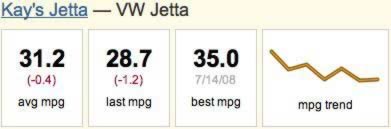
As a result, I have enough data to determine whether my Mini Cooper is picking my pocket for fuel. Here are the summaries for our three vehicles:

Note that the average fuel economy on my Mini Cooper is better than the best tank on my Ford Focus! (I wonder if some of this is due to the fact that the Mini has a real-time fuel consumption calculator. I use it all the time, and have become very aware of the kinds of things that help or hinder my fuel economy.)
The Focus averaged 25.7 miles per gallon. According to GasBuddy, the gas station I use most often is currently charging $2.61 per gallon for regular unleaded. At this price, I would use 10.16 cents worth of gasoline to travel a mile in the Focus.
My new Mini Cooper, on the other hand, is averaging 29.8 miles per gallon. Its premium fuel at the same gas station costs $2.85 per gallon. That means a mile of travel in the Mini uses 9.56 cents in fuel.
It would be nice if my car used regular unleaded, but it’s comforting to know that even though I’m paying more per gallon, I’m not actually paying more per mile.
Other personal-finance bloggers have come to love Fuelly, too. At his blog, MyLifeROI writes that for him, the ability to compare his mileage with other Fuelly drivers helped him learn that he had some bad habits:
After using the site for a while I realized my driving habits were causing my mpg to be about 3 less than the average across the site. I decided to start driving more consciously and since then I have brought myself up to 1 mpg better than the average! For myself, at an average of 1,000 miles per month, what does this mean for me? A savings of 4.5 gallons per month, or about $10. It also means I am most likely driving my car more sanely and decreasing the wear on my engine and transmission.
Fuelly is a great single-purpose financial website. Can you recommend others? I don’t mean financial managment applications like Wesabe and Mint, but focused tools like Fuelly or Zillow or PriceProtectr. I’d love to compile a list for a future post.
SEARCH FOR RECENT ARTICLES


JD,
This is no surprise. The MINI is a well-made car so it makes sense that it is more fuel-efficient (no scientific basis, just observations). Compare the engine size too. I’m surprised a lot of people don’t think about this. They look at the actual size of the vehicle instead. For example, my Honda Civic has a 1.6L engine, my husband’s Jeep Cherokee has a 3.7L engine – that’s more than double plus the heavier weight. Using this general rule, I get 2.3 times mileage at 36-40 mpg out of my Honda Civic than the Jeep Cherokee at 17 mpg. Obviously there are many other factors such as age, fuel injection etc, but this is a quick calculation.
loading....
I think it might have been when you first mentioned Fuelly that I started using it as well. I already had an idea what my mileage was, I figured it out after each fillup, but never recorded it anywhere. Can’t say that it’s changed how I drive, I already get better than average mileage, and often get better mileage around town than on the highway (I drive quite slow around town, saves gas and also is far more relaxing than being in a hurry)
Regarding using the premium fuel, its something you’ll get used to. My last two cars, for the last eight years, have been turbos that required premium. As such, when someone asks how much gas costs, I’ll mention the premium price. I don’t even bother looking at the regular at 20-30 cents cheaper, as I know that’s not what I’ll be buying.
loading....
I had used gasbuddy for a really long time, but when I started reading up on hypermiling and such it lead me to http://www.cleanmpg.com. It will graph your mpg, as well as give you a figure regarding how efficient your driving is vs the epa ratings. For example:
http://www.cleanmpg.com/index.php?page=garage&displayunits=MPG(US)&viewcar=2726
http://www.cleanmpg.com/garage/images/cha2726.png
http://www.cleanmpg.com/garage/images/2726.png
loading....
Thanks for posting this. I look forward to seeing long term trends in my driving styles.
loading....
J.D., you wrote: “It may seem silly, but I like not having to visit the gas station as often.”
Why is that silly? As an entrepreneur, your time is worth money. Not having to visit the gas station as often may have a real financial reward!
-Erica
loading....
I’m in the middle of writing an app to help with that situation where you walk in to a store and you say “Is that a good price for that item? How much was it last in that other store?”. The idea is that every time you shop, you record the price of the item and the amount of units (so it will calculate the unit cost), the date and the place.
That’s the basic idea behind it.
Some other ideas for it would be a social twist where you can check what other people paid for the same item, and a general way of tracking how much you’ve spent on any particular item, or category of items.
Also, obviously, the ability to access this information in real time from a mobile device.
loading....
As Erica noted above JD, it’s not silly.
Getting more miles per tank means less money you’re spending on gas, more money into your savings because the other car was wasting more. It would be silly to do otherwise.
It’ll take some time to recoup the costs of purchasing the mini by gasoline savings, true, but there comes a point where you have to say enough is enough.
We’re going to spend a few thousand dollars and buy a high efficiency natural gas furnace, which’ll replace the previous one which is about 40 years old. Should go from upwards of $300 in winter months for heating to roughly half that. In a few years it’ll pay for itself and will help the resale value of the house immensely!
Keep up the fantastic work JD, love this site.
loading....
I’ve been using FuelFrog.com for about a year, and it’s been fascinating to have specific info about my mileage (without having to do the math myself). It looks like fuelly might have a lot more detailed information, though, so I might have to switch loyalties.
loading....
J.D. Pleae check in to any scheduled repairs on your new used car. I would be sick if you didnt have it checked out and something happened to it.
loading....
@Nathan (#9)
I appreciate the words of caution. I’ve actually taken the car in once to have the local dealer look at it and perform some minor maintenance. (This was after GRS readers rightfully chided me for not taking it to a mechanic before I bought it.) It’s in good shape, and I intend to follow the maintenance schedule.
That reminds me that I actually need to check on something. The Mini has a little auto-reminder thing that comes on when you turn the ignition. It tells you when the next maintenance, etc. is due. Right now, it’s telling me that I need to add oil — in 14,000 miles. Can this be correct? 15,000 miles between oil changes? That seems impossible. I need to check the manual.
loading....
I use fuelfrog.com and can update it while pumping via text. it works nicely
loading....
My favorite thing about fuelly.com is that the mobile version of the site is pretty good. Just the basics to enter miles traveled and gallons of gas (and unit price if desired) each time you fill up. You enter and then it shows you the mileage for that trip. So you just need a web enabled phone in your car to make recording that information a snap — no paper!
loading....
Thanks for the tip on Fuelly, I’ll have to check that out.
I have to vouch for zillow.com. It helped us get free exposure on our for sale by owner home. Just got a contract on it last week in fact.
loading....
What a great service. I could see this being very useful and showing you when you car is in need of repair, tire pressure adjustments, a new air filter, etc.
loading....
I noticed on a recent trip that being able to fill my tank with 100% gasoline gave me about 5 mpgs over my homestate’s ethanol blend
Same price too.
loading....
“15,000 miles between oil changes? That seems impossible. I need to check the manual.”
Yes, it is entirely possible. Modern vehicles can go even further than that, depending on your driving habits. I think I went about 10,000 in my trailblazer before my first oil change. There were a lot of highway miles in there which probably extended my oil life some, but onstar sends me an email each month telling me the % oil life left, so there is no need to keep too close an eye on it. And this is coming from a big auto enthusiast.
That being said, its always best to double check the manual as well.
loading....
I use Road Trip on my iPod Touch. The Lite version is free and seems to do exactly what Fuelly does, but I love that I don’t have to be connected to the internet to access it. The paid version takes it a step further and helps with maintenance reminders, but I haven’t upgraded…yet.
loading....
JD:
yes, the 15K between oil changes is normal. I have a 2005 Cooper S; they use synthetic oil (so oil changes are about $100 but you don’t do them nearly as often).
Also a note on fuel and idling behavior: I was having a bit of a ‘stumble’ with the motor for a while after I got the car (just when starting from a dead stop, it would lose power, then kick in after pausing.) It was supposedly a computer/programming fix, but updating the software didn’t really help. I was advised by the dealership to put medium grade gasoline in the tank on every third fill-up or so. Has taken care of the problem beautifully. Maybe the non-supercharged model doesn’t have that issue… not sure. You can find all sorts of useful info and links on the Mini site/owner network. Happy motoring!
loading....
Thanks for the mention of Fuelly, JD (the site was my idea and I developed it with a friend). One thing we are working on is a twitter integration, so you can send a text message to our @fuelly account and have it post to your account.
loading....
Hypermilaging has practically become a sport to me over the last year or so. It’s really fun seeing the direct effect that your driving habits have on your fuel economy like driving 55 instead of 65, turning your car off while going through a drive through or at a long traffic light, and coasting to stops rather than speeding to them and slamming on the brakes.
I drive a 20 year old Ford Ranger and I consistently get 24.4 miles per gallon over a tank of gas and have gotten as high as 25.7. Pretty dang good for a beat up old truck I think!
This is one of those win/win situations where doing what’s best for your bottom line is also more sustainable.
loading....
I’ve been using Fuelly for the last few months, and am getting 30+ mpg on a car EPA rated for 20. Hypermiling, as Tyler notes, is lots of fun.
loading....
The Gas Cubby app for the iPhone is good too.
loading....
Does your Mini REALLY need to use Super Unleaded? I’ve never been able to tell a difference in any of my cars, and I’m skeptical if it really makes a difference.
I have been using mpgtune.com for over a year. Fuelly looks to be a nicer site than mpgtune.
I used to track my fuel efficiency (the old fashioned way – pen and paper) with every fill up for many years. I was addicted to tracking it. Then one day somebody asked me why I bother. I had no answer, so quit tracking. It was so freeing to not worry about writing down my fill-ups any more. Damn mpgtune got me hooked on tracking again.
loading....
My first car, a 1985 Buick Skyhawk, came with a broken gas gage. Many times I would arrive at the top of the hill to find my half-full tank now read completely full. Ahh, if only it truly WAS regenerating gas!
This cheap little beater didn’t have a trip odometer, so I recorded the mileage and fuel pumped from the very first tank in a journal. Not only was it a great way to track gas used, but I found it helped me identify mechanical problems early. If the steady ~27mpg of my dear old clunker suddenly dropped to 24mpg, it always meant there was a problem.
I now drive a hybrid that displays fuel consumed instantly, but I’m still in the habit of writing it all down at each fillup. It’s great to plot my mileage over time, see how seasonal variations impact the MPGs, and keep an eye on the health of the engine.
And it’s neat to have a first-hand record of how the gas prices have fluctuated over the last few years!
loading....
Long time reader, first time commenter. Check out http://repairpal.com for auto repair and service estimates. It’s like the Kelley Blue Book for car repair. There is an iPhone app too so you can get estimates on the go or find a shop if you happen to break down. (Disclosure: I do work here but this post seemed appropriate).
loading....
JD,
I forgot to mention that when I was going to school at PSU, I figured out how to drive all the way from one side of downtown to the other (S to N) without EVER stopping at a stoplight!
Give it a try the next time you’re downtown. If my memory serves me correctly, the magic number is about 14.5 mph.
loading....
I’m a fuelly fan also: http://www.fuelly.com/driver/itsastationwagon I used to do it the old fashioned way, but it’s more fun to see it on the graph, and see how my mileage compares with others.
loading....
The most efficient way to increase your MPG is often disregarded: car pooling. You effectively half your MPG every time you share your ride with another person.
Wanna take it even further? use public transportation! You basically amortize the energy used by the bus/train between hundreds of people or more.
I know that these solutions don’t work for everyone, especially in suburban areas, but maybe rellocating to an area where you don’t need a car just to buy groceries, or even better to get to work, is something worth considering.
loading....
I have a single-focussed web app, though it is financial.
It focusses on managing your savings based around the money envelope concept.
The general idea is that you dump all your savings into a single account in order to earn the most interest and then use MyMvelope.com to portion those savings in individual envelopes so you always know how much of the lump sum is for what.
We use it to save for non-monthly expenses like clothing and car services as well as holidays and desire purchases. We also use it to help teach our kids about saving with their pocket money – they each have their own “box of envelopes”.
http://mymvelope.com
loading....
I just write down the miles and how much I put in the tank every time I fill up. Then I try to beat it and go even further on the next tank.
Here in Finland, when we get our driver’s license, we have a whole lesson dedicated to economic driving and learn about how to shift gears and rev the engine properly in order to save gas.
loading....
JD –
Thanks for linking to my article!
The site helped me save $120 per year, which in itself is minimal. But as I elude to in the quote you posted, the savings from decreased engine and transmission wear may be far greater, however unquantifiable they are.
You seem to be right on target for all three cars, congrats!
I also want to highlight one thing that some readers may not pick up on: cost per mile. You mentioned it, but then can lead to better decisions/routing.
MLR
loading....
I really need to go check out that site…thanks!
loading....
How much should I trust the computer in the car to tell me how many mpg I got?
TS
loading....
I am SO going to check out this site! I don’t own a car currently but have recently started thinking about getting a smart car. If I do, it would be interesting to track Mr. Smarty Pants (yes, I already picked out a name for him) against the boyfriends Honda Accord. Thanks for pointing this one out JD!
loading....
Consider using 87 octane. Often luxury cars use Premium b/c they can squeeze a few extra horsepower out of the engine in doing so. So you may be able to save a few dollars by sacrificing a few hp.
Good luck, Ian
loading....
Just a tip for anyone who, like me, was sitting here reading this and thinking “I don’t really want to write down this info every time I fill up.” It occurs to me that I can just use my phone’s camera to take pics of the pump and odometer, and use those to input the data later. (I’m too cheap to pay for text messaging, so that’s not an option for me.)
This should also help to get my wife to keep track of the data on her car.
loading....
DanT:
That’s not too far from what I do. Though I don’t even like using the camera. I just use the recorder feature on my phone. Press record, say the miles, gallons, and cost/gallon. Then later (sometimes a couple weeks later) I’ll listen to the recording and put it into Fuelly.
loading....
I love Fuelly! I’ve been using it since I got my Smart car last September.
I just get a receipt printed from the pump, and keep a Sharpie in my car to jot the odometer reading onto the receipt. The receipt has all the other info I need, so I only have to write down one thing.
loading....
From your fuel mileage I would say that you travel on the freeway or highways more then city driving. One way of saving money while driving is to use your cruise control outside of the city limits. I drive a 08 Focus to work which is about 42 miles one way and all but maybe 4 miles is rural driving. By using the cruise control fuel mileage has increased from 33 mpg to 37 with a max of 39 mpg. This is driving at 57 to 59 mph.
If you look at the driving time between 55mph and 65 mph, which is speeding on rural roads, I am paying myself $3 a hour to drive to work at a slower speed. I’m only losing 14 minutes a day by diving slower and keeping more money in my pocket and you get to wave and smile at more people as they pass you.
For software to keep track of fuel mileage I made up one using excel. Not only can I see graphs but I also input the percentage of local, state and federal tax per mile which is costing on the average 23 percent of my fuel cost per mile. That’s right 23 percent of my cost per mile for fuel is taxes. As your mpg goes down the more taxes you pay. Look at how much more taxes these speeders and gas hogs are paying per mile, we should give thanks for the extra taxes they pay to keep ours lower.
loading....
TS @ 33
You should be fairly confident on the readings coming from your cars computer. The only thing to caution is that you need to make sure you are using the correct tire size for your vehicle. Installing larger tires or going with a low profile version will skew the readings the computer is providing. It also could jeopardize your tansmission in the long run.
loading....
Caitlin – that’s what I do. Man, it’s so annoying when a gas pump tells you “see attendant for receipt” and then you have to wait in line behind the fat dude buying lottery tickets and cigarettes.
loading....
JD,
You may want to research the difference between premium and regular grades of gas. Ever since I heard the guys on NPRs “Car Talk” say that there’s no reason to use premium, I’ve used only regular in our family’s Volvos and Volkswagon and have not had a problem in the year I’ve been doing so.
loading....
“You may want to research the difference between premium and regular grades of gas. Ever since I heard the guys on NPRs “Car Talk” say that there’s no reason to use premium, I’ve used only regular in our family’s Volvos and Volkswagon and have not had a problem in the year I’ve been doing so.”
There IS a reason to do so. If the owners manual requires premium that means that the car was tuned to run best on premium.
However many newer cars have knock sensors that will prevent pinging if you use lower octane fuel. The downside? You’re not getting all the power your engine is capable of. But since most of us (and probably all of us here) never accelerate with full throttle the lower power will never be an issue.
Just check first to make sure your engine has a knock sensor (your owners manual should say something about it). If you are using too low a grade of gasoline and your engine is regularly pinging, you are slowly destroying your engine, and the cost to replace it will certainly outweigh the cost of premium (which is typically only 5-10% more).
And just for reference I was an engine calibration engineer with one of the big 3 for 3+ years.
My advice? Check your manual to see if you can run regular gas.
loading....
Hey otherIan,
I’ve got dibs on this userid here. I’ve registered it in the GRS Forums.
In previous comments, I recommend losing a few hp to save a few $s and use 87 octane.
How about in order to avoid “Ian” looking dual personality, you add a letter to your name?
Cheers, your namesake (Ian)
loading....
“The downside? You’re not getting all the power your engine is capable of. But since most of us (and probably all of us here) never accelerate with full throttle the lower power will never be an issue.”
AHEM…. not true
The desire to accelerate under full throttle thing. Its an expensive hobby.
loading....
JD, Be sure to change out your MINI air filter at the suggested interval–we have a CooperS and it makes a BIG difference in the mileage.
Best,
Renee
loading....
Really good comments on this site. A few things I’ve learned about fuel efficiency: 1) Yes, gasohol will reduce your mileage….there is less energy in the same volume of fuel, but it’s much cleaner and better for your engine (and environment) in the long run. 2) A manual transmission, driven correctly will give an additional 10-20% in fuel savings over an automatic. I emphasize the word “correctly” since some people tend to overrev the engine and that will reduce efficiency. 3) Using the lowest octane of gas that will operate your vehicle can definitely save gas. However, if the car stumbles or pings, that can actually reduce efficiency and damage the engine in the long run. Octane is a measure of resistance to early combustion. Hence, the higher number resists early ignition more than a lower number. The higher up you are in elevation, the lower the octane you will need for your vehicle because there is less oxygen(85 insead of 87 in Denver, for example). 4) Check tire pressure when cold. They should be at least 32 psi for most tires. After driving at least 10 minutes, the pressure will go up 2-4 psi, so it’s important that they be checked BEFORE you drive. Also, make sure they’re all the same. You’ll be amazed at what a difference proper inflation will make in fuel consumption, however, overinflation can be very dangerous. DO NOT take them up to the maximum pressure recommended for the tire.
loading....
Octane has nothing whatsoever to do with “power” or acceleration ability. It is simply a resistance to ignition factor. An engine designed to operate at very high RPMs (like an airplane or NASCAR) spins so fast that the fuel needs to resist ignition long enough for the intake valves to be fully closed and the piston at Top-Dead-Center for maximum fuel burning efficiency and, hence, horsepower. If you listen to those engines, the spark timing is advanced so far that they rock and shimmy at normal speed.
A typical passenger car runs at 1,500-3,000 RPM unless you’re on the Autobahn at 130 mph. A NASCAR runs at 8,000-10,000 and uses a fuel rated at 105 octane (I think) for that reason. The same for airplane fuel, where a skipping or knocking engine can mean stalling and death.
loading....
I have been using MyMileMarker http://mymilemarker.com/ for over 3 years. It is another great webapp fuel tracker. It will graph out how often you get gas as well as the MPG for each fill up.
It also can project what the mileage of the car will be in a year, and the yearly estimated cost of fuel.
loading....
I somehow came across your post over a month ago and started using fuelly. It seems like one of my drivers is using substancially more fuel that the others. I’m assuming he is the lead foot of the group. I thought I would leave a thank you note. Thx
loading....