Kris and I live in a small, quiet neighborhood south of Portland. When the trolley line ran through here — between 1893 and 1959 — Oak Grove was actually thriving community, with shops and stores and more. (It’s true! I’ve seen pictures!) Now, though, downtown Oak Grove, such as it is, consists of a convenience store, a hair salon, a joint once named “the best dive bar in Portland” — and the home office of Get Rich Slowly.
There’s also another business in downtown Oak Grove: a small coffee shop that opened a couple of years ago. It struggled a little at first, but eventually business picked up, and it’s become a valuable part of our community. In fact, Kris and I think of the Oak Grove Coffeehouse as the only real hub our area has.
But there’s a problem. This summer hasn’t been kind to the Oak Grove Coffeehouse. The business is struggling. Jason, the owner, has been forced to cut back hours. He’s waiting for classes to resume at the nearby high school in hopes that the teachers and students will bring a cash infusion. But for now, things look grim. Here’s a recent Facebook post:
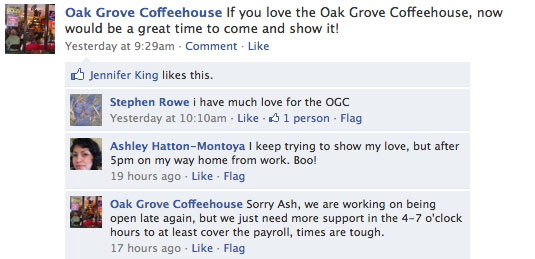
I’ll admit that I haven’t been supporting the coffee shop as much as I used to. Kris stops in once or twice a week on her way to work, but I’ve cut it out of my budget for both fitness and frugality reasons. (I’m living the latte factor!)
Why I buy local
Still, I feel passionately that small businesses are vital to the success of a community. It’s probably because my family has owned many small businesses in the past, but I do my best to support Mom and Pop operations whenever possible, and I try to avoid national chains of all types.
- I’ve always joined local gyms instead of national chains.
- Kris and I almost always choose local restaurants instead of national chains.
- I prefer small, independent bookstores to national chains. (Except that I use Amazon a lot, thus proving my hypocrisy.)
- Whenever possible, I choose independent movie theaters instead of the national chains. (I loathe big chain theaters.)
- I try to use small barber shops instead of national chains.
- When we lived in a small town, we used a small, local grocery store instead of a national chain. We don’t have that option now unless we want to drive 20 minutes.
- I use a local credit union instead of a national bank.
- Kris and I have never really had an auto mechanic, but she’s just started taking her car to the place around the corner.
- And so on.
When it comes to local businesses, I try to put my money where my mouth is. I vote with my dollars. Why do I buy local? For a lot of reasons, including:
- I believe that small, locally-owned businesses give character to a community. They improve its quality of life. Yes, every Starbucks you walk into is the same, and this makes a lot of people comfortable. But I like that independent coffee shops (or record stores or comic shops or bookstores) have a unique feel. I like that Flying Pie pizza is unique, and not just the same homogenous stuff you can get from Domino’s or Pizza Hut.
- I believe that buying local products from local merchants fosters community by enriching my neighbors, by supporting their endeavors. I’ve written a lot about the importance of social capital — mutual goodwill — and frequenting local businesses is a great way to strengthen social bonds.
- Small, locally-owned businesses are more likely to keep the money they earn in the community; it’s not siphoned off to the corporate offices in Akron, Ohio. And local businesses are more likely to use local suppliers. I’ve never found a local product at our nearby Safeway, for instance, but the local produce stand has fruits and vegetables from around our area. (They even had a bunch of Kris’s currants for sale recently!)
There are indeed times that I’ll eat or shop at a national chain, but if I have a choice, I’ll almost always opt for local. Yes, there usually is. (Though not always.) But the cost differential isn’t great. Even when I was digging out of debt, I was willing to pay extra to buy local. I considered a sort of “community tax” — a surcharge I paid to keep the local area vibrant and strong. That’s important to me, so I’m willing to pay a little extra to make it happen.
Not everyone feels the same way, of course.
The opposition speaks
Kris and I hosted the annual Roth family reunion last Saturday. It was a smallish gathering (only about 20 adults and 10 kids), but it was lively. Roths can be rambunctious, and we’re not afraid to debate with each other.
Over our sausages and sauerkraut, somehow the conversation turned to supporting local businesses. I forget why the subject came up, but it’s not surprising:
- My family owns a business that makes boxes in Portland.
- My cousin Ted is an artist who makes baskets and furniture.
- My cousin Bob has a company that builds granite countertops.
- My cousin Tammy runs a tutoring business out of her home.
- And my youngest brother is trying to get his own business off the ground.
As you might expect, because there are a lot of small businesses in my family, there’s a lot of “buy local” sentiment. But not everyone feels that way. During our rowdy conversation, Tammy made it clear that she’d rather shop at Wal-Mart than at her neighborhood stores.
“Oh, come on,” said Tammy’s brother, Ben. “There are people here from all sorts of political backgrounds, but I think there are two things we can all agree on: Monsanto is evil, and you shouldn’t shop at Wal-Mart.”
“Why shouldn’t I shop at Wal-Mart?” Tammy asked. “The stuff is cheap, and I don’t have a lot of money to spend.”
The argument discussion continued for several minutes: Tammy vs. the rest of the Roths. When Tammy learned that her brother Ted lives 2-1/2 hours from the nearest Wal-Mart, she was appalled. “I would not like that,” she said. “Where do you get your groceries?”
“Just the local store in town,” Ted said.
“And you’re paying through the nose, right?” said Tammy.
My brother Jeff jumped in: “But he’s supporting a local business, supporting the local economy. If local business isn’t supported…”
“Well,” said Tammy, interrupting. “Think what you want. I’m just not that into the local economy.”
Tammy has some valid points. National chains are successful for a reason. They’re cheap, they’re widely available, and they’re familiar. You know what you’re going to get and how much you’re going to pay. You know how the system works. Working with local businesses can sometimes be…interesting.
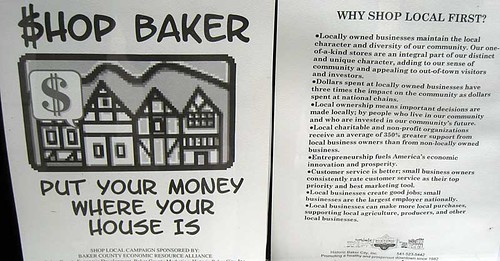
Do YOU buy local?
Family bickering aside, the debate over the importance of buying local occasionally gets debated in communities across the U.S. Last week, for instance, USA Today posted an article about towns trying to block chain restaurants in order to preserve character and protect local businesses.
I was curious what GRS readers thought, so last week I polled my Twitter followers and the folks at the ever-growing GRS Facebook page. I asked, “Do you go out of your way to support small businesses in your neighborhood? Why or why not?” Here are some of the responses:
- Michele Gilhouse wrote: I go out of my way to support local business because I want my neighbors and community to prosper. At times I know I pay more, but it doesn’t bother me.
- Jane Cny wrote: Yes, I support local businesses and have made a conscious decision to increase my support, including moving my money to a local back. I have been unemployed for over a year, and my dentist, my hairdresser and my dry cleaner have all lowered their prices for me to support me during a tough time. I can’t imagine a big business doing this. You can bet these people will continue to get my business!
- Cheryl Estridge wrote: I try too, but I also price shop and buy only from places that are offer the same goods for less $$$$. I won’t spend more money just to support a local business.
- Melissa Bush wrote: I prefer local stores, and when it comes to food and housewares it’s pretty easy to avoid chains. Clothing is a different story. Chains have too much buying power to let a small clothing store selling new clothing.
- Shari Theroux wrote: I try very hard to buy local whenever I can. Being a small town, though, I can’t always find what I need here and have to either travel or buy online.
- Janell Adamczyk wrote: Miss the days of the local shops – like when I was growing up in Chicago. You had almost all you needed down the street or a short bus ride away.
Most of the folks who responded on Twitter and Facebook try to support local stores over national chains, but a few do so with reservations. They’re wary of paying higher prices, and some have had horrible service experiences. (National chains usually have quality standards that keep service uniformly good.)
Conclusion
Let me make one thing clear: I don’t condemn anyone who does not or cannot buy local. I’m an ardent supporter of small businesses, and I hope that you will be too, but I’m not going to say you’re wrong if you have good reasons for shopping elsewhere.
All things being equal, I suspect most people would choose to buy local. But each of us has a different price at which local is no longer an option. For some, this point is immediate: they’ll always buy the cheapest option, regardless of other factors. Others — and I know a few like this — will buy local no matter the cost.
So where does my zealous support of local businesses leave me with regards to the Oak Grove Coffeehouse? What about the latte factor? What about my diet? I’ve made some compromises.
Twice a week for the past two weeks, I’ve walked up to the store on my way to the office. I buy a Mexican Coke and a cinnamon roll. (I don’t actually like coffee.) Now, I know that my $8 per week isn’t going to keep the place in business. But I hope that it helps a little.
Meanwhile, I’m just exercising a little harder to burn off those extra calories…
GRS is committed to helping our readers save and achieve your financial goals.Savings interest rates may be low, but that’s all the more reason to shop for the best rate.Find the highest savings interest rate from Ally Bank, Capital One 360, Everbank, and more.
This article is about Choices, Consumerism, Economics, Shopping
Disclaimer: This content is not provided or commissioned by American Express. Opinions expressed here are author's alone, not those of American Express, and have not been reviewed, approved or otherwise endorsed by American Express. This site may be compensated through American Express Affiliate Program.
Discover is a paid advertiser of this site. Reasonable efforts are made to maintain accurate information. See the Discover online credit card application for full terms and conditions on offers and rewards.
SEARCH FOR RECENT ARTICLES


I’m pragmatic about it. I won’t go out of my way to use a local business if it has an inferior product, but I often find local businesses superior for some things. Examples:
*) I generally shop at a chain supermarket, but once a week I pick up meat and vegetables from a farm shop which offers better quality and sometimes lower prices.
*) I train at a local martial arts gym, which offers far superior training to the nearest chain gym.
*) I use a local salon/hairdresser because they provide better service for the price than the nearest chain.
*) I use a local auto mechanic because I trust him more than the nearest price-gouging dealership garage.
*) I buy my shirts from Jermyn Street and have them tailored by a local tailor because I get a personalised service and he knows by now how I like my clothes to fit.
On the other hand:
*) I visit a chain cinema because the nearest ‘local’ one is too far away for me to bother with.
*) I buy most of my sports equipment from chain stores as there isn’t really any local alternative (though I have just discovered an independent martial arts store which I’m planning to visit soon).
*) I visit chain and local restaurants with about equal frequency depending on what I fancy, as there isn’t much crossover in my area. If I want Mexican, Italian, or a steakhouse, I have to visit chain restaurants. If I want Indian, Chinese, Thai, or Greek, I go local. If I want pizza I can choose between local or chain – I normally visit a chain if going out, and use local places for delivery.
loading....
This is just a generalization, but, in my experiences local stores/restaurants have cared much more about making sure I was happy with my experience to ensure I will return in the future. I’ve never had a national chain care the way locally owned have.
loading....
I’d probably buy local if I could, but in my town (suburb?) there aren’t hardly any local stores selling the stuff I typically buy. Also, I work full time and have a family. Only the large chains are really convenient because I don’t have time to drive all over buying bread here, a hammer there, etc.
I shop at a large chain grocery store most weeks (they do sell some local produce, though), and I shop at a super Target (which also sells some local produce) if I also have to pick up kids’ clothes or shoes or hardware or toys or automotive stuff. I almost never go to WalMart though because it’s so scummy and depressing and their kids’ clothing (which is what I mainly buy besides groceries) is such extremely poor quality.
We have some local bakeries that I try to patronize if I have extra time. We have several locally-owned non-chain restaurants and bars–I prefer these myself, but if I go out with my kids we always go to a chain like Olive Garden because they’re more family-friendly.
There aren’t any local kids’ clothing or toy stores. There aren’t any local bookstores (anymore) just B&N.
I take my car to a locally-owned shop for maintenance and repair–they’re honest and competent. On the other hand, a different locally-owned shop lost my business for good years ago after they damaged my car during an overnight repair and refused to take responsibility.
There is a locally-owned kitchen appliance store here, but when I remodeled my kitchen a couple years ago I ended up getting all the appliances from Sears because every time I went to the local store (I tried 2 times during normal working hours, M-F), they were closed. They didn’t have a sign saying when they were open either.
The farmers’ market is fun, but it’s only once a week, all the stuff is at least double the normal price, and there’s little variety (just lots of whatever’s in season) so it’s not practical for what my family needs.
The majority of the local stores cater to tourists (which there are a lot of in my town)–they don’t sell anything you’d normally buy–just overpriced gifts and junk.
loading....
Here in our neighborhood, it’s a bit of an unusual choice regarding shopping local for groceries.
If you go to Whole Foods, you’re shopping at a big national chain, but the actual produce (which is basically all we buy) comes from local growers.
Alternatively, you can go to the neighborhood family-owned grocery store…where all the produce is from corporate megafarms.
loading....
We buy at local store… (Well, the concept is different here in Europe. National is local and international is national. So this is national chain of small grocery stores.) … We buy at “local” store because we had found out that we spent less money since the store is smaller. They have everything what we need. They just don’t have the extra stuff we don’t really need (but would buy). Yes, SOME of the stuff is bit more expensive but our favorite brand of yogurts is cheaper (unavailable at some of the international chains). We also go shopping more often but we don’t care. We do not really enjoy shopping at large malls full of people fighting for stuff on discount and their huge carts. It’s stressful. Buying local isn’t. So supporting local store is working out perfectly for us.
loading....
While I understand (and am sympathetic to) the idea of buying local, I am also a bit wary of it.
I work in international development. For 40 years, we’ve been trying to persuade/force/coerce countries into shifting over their entire economic systems in order to better “produce”. The idea being that the “path to riches” for a country is to ‘let go” of their own local communities and set up a export-processing model to provide goods to the West.
There was (and in some cases still is) a lot of “if you want US/Canada/Europe government aid for your country, you’re going to have to show you’re committed to getting out of poverty”. Give up traditional industries, reduce diversification, and focus on your comparative advantage. You have the climate for growing bananas? Reorient your economy to focusing just on bananas.
While there are major flaws in that theory (for example, chances are, if you’re a small developing country, you’re in an area where lots of countries are good at producing bananas and the glut just pushes prices down), entire countries did just that, in hopes of improving their lot and their trade relationship with us.
And now, the focus is on “buy local”. Suddenly products from these countries just aren’t good enough for us anymore. It’s like someone keeps moving the cheese…
loading....
For 13 years, I worked for a big corporation at a desk and a lot of travel. I was absolutely oblivious to the small business community, until I quit my job to help my husband get his small business off the ground. It is incredibly hard to run a small business. It takes a lot of hours and the biz owner is usually very appreciative that you chose them over a big box store. Although some businesses are franchises owned and run by local people. I would hate for these businesses to be looked at like they are a big box store.
This post is a good reminder though that I need to be a little more mindful of my shopping.
loading....
My mom owns an independent toy store in my hometown, so I have a bias toward small shops. One of the ways she differentiates her store from Wal-Mart is by selling toys they don’t carry, from smaller, niche companies. In my experience, that’s part of how local businesses can remain competitive.
My husband and I end up supporting a lot of small shops simply because chain stores don’t cater to a lot of the things we want to buy. My Italian sausage comes from the local butcher because no one else makes it (and his prices are excellent to boot.) If I want Mexican popsicles, I have to go to a non-chain store. If we want anything for Chinese cooking, whether it’s vegetables that are not found in Western grocery stores, or whole ducks or frozen dumplings, we have to shop at one of the two local Chinese grocery stores.
On the other hand, I buy a few hundred books a year, and the last time I set foot in any bookstore must have been a year ago. Everything I buy is from used booksellers online. And, honestly, even if there was a local bookstore aside from Borders, I’m not sure I’d go. My clothes all come either from large chain stores or from an specialty foreign mail order company.
loading....
I usually buy local. It helps that I have to drive 20 minutes to get to a chain restaurant! No chain pizzas even deliver to my area.
Apparently, the group of villages where I live got together some years ago and decided to ban big chain stores. A few made it through, like CVS, but the nearest Target is a pretty far drive.
Still, I fully admit to shopping at chains when I must. The cute local pet store doesn’t care my brand of pet food. The local grocery store’s meat selection is overpriced and low variety, so I stock up at Costco.
loading....
I feel like a traitor owning an e-reader
Can’t buy e-books from a local book shop!
For me, clothes are the weakness. Local shops tends to cater to upscale, older crowds so I end up in chains
We don’t have that many local grocery stores, but we have a fantastic market, and I try to buy local produce in the stores. (Where I live, they make a good effort to support local growers).
loading....
I live in an urban area, so while buying local includes small mom and pop shops, a lot of businesses have their headquarters here, so national or international corporations ARE local for me. Lots of people live in Akron, Ohio (not me!) and depend on their job at the corporate headquarters or depend on the business from the corporate workers. I completely agree about the character of a town and such with buying local, but it’s not like buying anything from chain restaurants doesn’t help locals either…your chain restaurant still has a local person washing the dishes and serving your food, a local person owning a francise, the corporate owner just happens to be in another state, supporting that area’s local economy too.
I do completely agree with the character and such, but it’s easier to have sympathy for the one person you see at the coffee shop than the 125,000 starbucks employees throughout the country who would not necessarily be able to find local jobs otherwise. Supply and demand, if there is smaller demand for this coffeeshop, they need to do something to increase it since starbucks is still in demand…but if this local shop is hugely successful and opens a chain in another state, would you still want to go there to be “local”?
loading....
“They’re wary of paying higher prices, and some have had horrible service experiences. (National chains usually have quality standards that keep service uniformly good.)”
I have to disagree on this. I would pay much more to stay away from our chain stores and their horrible customer service. I hear great things about Walmarts and Targets in other areas of the country but ours up North are awful! If you want service, try the local grocery store owned by the same family for 150 years (yes, we have one left).
I buy honey, apples, and other goods from a local farm where I know the money is going to pay this family’s mortgage. I buy flowers from a florist who knows how many children are in the family, what holiday I am coming in for, and what types of arrangements each prefers… you can’t beat that kind of service anywhere.
While I do my best to support local businesses I am finding that some types of stores are not locally owned anymore, like pharmacies, clothing stores, and home improvement shops.
loading....
I like the way the article discussed both sides of the issue- it is hard to find balance shopping local and getting what you need at the price point that is comfortable.
Two things that I never see discussed during this debate are franchises and local employment. Many chains are franchises and are locally owned and operated. Chain stores employ people from the community and often expand their distribution systems behind them creating more local jobs.
I am curious how those two factors play into the debate of the impact of shopping locally.
loading....
I do try to support local businesses. Corporations do employ local people, yes, but local businesses tend to keep more money in the area (and often they treat their people better).
It’s not like I never shop at chains, but I do make a conscious effort to choose local businesses at least some of the time.
loading....
Though the local business sometimes charge a bit higherr than the chains, I still buy stuff from them. There are a few stores I go to since they’re nearer to my house and the owners know me (since I go there at least once a week), so that makes me feel appreciated and happy to spend money there. I always talk to the owners and from our conversations, they knew I’m a teacher so they are always very polite and would go out of their way to help me with whatevr I need (people in my community hv a lot of respect for teachers and I’m glad!) The best thing is local business would even throw in a couple extras for free, just coz it’s sthg nice to do and I find that very refreshing! Like my local mechanic retouching my car’s front bumper when I only paid to have the rear one done
Also, the convenience of not having to drive ten minutes and bravng through the traffic to get to the chain stores makes it an even easier choice.
Though sometimes I still go to the chains since the locals don’t hv what I need.
loading....
I definitely think that income and price point(s) play a role in determining one’s shopping choices. When I was a poor, debt-ridden student, cheapest was the top consideration. I wasn’t even aware of the impact that shopping local could have on community – and I wasn’t that motivated in any case.
Now that our financial situation has improved (and I have shopped at one too many chains) I prefer local over national/chain. But, as pointed out by previous commenters, the benefit to community – and the larger world-view – make the issue more complex than you might think. I think at this point quality and uniqueness are more important to me than price point, but I understand that others may not have that luxury.
loading....
I have a similar point to Christina. I live in Saint Louis – the home of Monsanto and Budweiser (although now InBev) and other businesses. So, does that mean I buy local if I buy Roundup? I know people who work at both companies, and it is in the interest of the city for both these businesses to thrive. Not only do they provide employment, they give to local charities. I dare say corporations in general give locally to charities.
Also, from an environmental standpoint it makes more sense for me to buy Bud Light brewed right here than to buy beer brewed by a microbrewery across the country. This is sort of a moot point, since we have an excellent microbrewey a few blocks from my house, but the point still holds.
But the buy local idea is certainly not lost on me. To me, the best argument you give is that local small businesses give a community character.
loading....
I have to admit that I don’t make my buying decisions based on supporting the local economy at all. People are people whether they’re here or across the world. The Amish guy who makes our furniture several states away gets good use out of the money we send him, just as much as the local guy who sells it to us.
Also we don’t buy much stuff.
I do try to buy local for food and will pay a premium to do so, but only because local food tastes better. I am really annoyed that the local dairy no longer does organic milk because it means the milk I buy now comes from several states away and just doesn’t taste as wonderful.
I like some local restaurants and not others. We don’t go to chains much. I like variety and I travel a lot, so local restaurants are a big treat. I’ll still hit up a chain like Pinkberry if given the opportunity.
loading....
I have this debate with my husband all the time — he wants to run into Target to get windshield wipers, so he doesn’t have to talk to anyone (where he was ultimately thwarted by the wrong sizes & no clerk to help him). I’d rather go to the local auto supply (an extra errand!) where they even offer to put the wipers on my car for me. Because it takes extra time (during business hours), and sometimes extra money, I am less likely to impulsively buy Stuff and will even think carefully about any “wants” or “needs”. And that auto supply sponsors a little league team, pays at least a dozen employees, has a local owner, hires high school students in the summer & trains them), and their taxes will help keep my property tax from skyrocketing.
We buy all our food from farms over the summer (& buy staples in bulk) so I haven’t been to a grocery store in 2 months. How’s that for saving time & money? And I have been canning our local produce (uh, there goes that extra time
) so I can eat local all winter, and continue to avoid the chain grocery store.
When I buy local, I try to buy directly from the source, when possible. And I just made a deal with a local beef farmer, so I will be getting my year’s supply of beef for the cost of a some hours of business advice and guidance. Which, needless to say, Walmart or Shoprite would never agree to.
loading....
I shop locally when I can. I do this because I believe that the quality and service is better, it is better for the community, and low prices are often offered at the cost of other things, like fair treatment of workers. Treating workers poorly and paying sub-par wages (paid to many agricultural workers) is not worth cheap lettuce to me.
loading....
Buying locally can also keep food quality high:
http://peterbryenton.typepad.com/phi_one/2010/08/dens-hens.html
loading....
I buy local for some:
the YMCA, I’ll pay $20 more a month than the next gym, but it’s walking distance from work and home (a national chain, but helps my community, as it is residential and does tons of community activities).
the fresh produce (there is a local chain of grocery store that has great meats, and local produce that generally beats to national competitors near me).
I buy non-local for some: Packaged stuff and personal care items are cheaper at the national chains.
loading....
But what about websites? Isn’t the small town in Portland enriched because many non-locals come to visit this wonderful site? How much poorer and worse off would I be if I limited myself to only local websites from in my town. And how many websites would survive if they were so limited?
loading....
I try to avoid box stores (not just walmart!) and the mall as much as possible.
Some things are easy to buy local/non chain, but some things aren’t.
This also means a lot of time spent on errands, which can save me money in the long run. If I need to go all the different stores, sometimes I just won’t buy the thing I “need.”
loading....
I do both. I support local restaurants AND make sure I tip well. We eat at chains when out of town. I buy produce at the westside market when in the area- but the rest comes from my commissary. My husband buys everything he can on line- while I head to the EXPENSIVE but local hardware store. Without his shop we would have all been in bad shape during the ice storm last year!
I am careful not to believe that chains are bad. They employ local people and have more checks on working conditions.
If I were you JD, I would stop in for a coffee and give a tip. It could be your way of “tithing”:>)
loading....
I try to shop local where possible. However, our small town in SC has been destroyed by wal-mart and other national chains. To the point that roads have been altered, and traffic flows away from the small business areas of main street. The infrastructure adjustment has forced the local guys out of business and in many circumstances you have no other choice then to shop at a national chain. Its really sad.
The problems is that entire generations of Americans have been raised on National chains. Its so bad that my company is having a difficult time attracting qualified talent. because we lack things like:
Apple store,
Star bucks,
Big flashy Mall,
Whole foods,
other shopping institutions,
and national chain restaurant of your choice.
Its really sad. We are watching the very erosion of the small business. It is not healthy for our economy at all.
loading....
Ah, I haven’t heard the phrase “Monsanto is evil” since my days of working on organic farms.
I go for a mix, depending on what I’m buying. When it comes to food, especially produce, dairy, and eggs, and a few other items available in Massachusetts, I like to buy local if and when possible. It actually ends up being more reasonable to stop at a farm stand to pick up some fruits and veggies than it is to choose from a disappointing selection at the supermarket.
But as for other needs, like toiletries and cleaning products, there aren’t really any choices besides nation-wide chains, at least in my area. I suppose I could buy items at the food coop, 30 minutes away, and spend much more. Something I want to reconsider.
I’ve actually posted a series, along with another piece or two, on choosing local, on my blog. I’m a big believer in it, but need to move away from my hypocrisy too.
loading....
We buy local as much as possible. Our farmer’s market sells a ton of stuff, not just food items, so I buy everything I can from there, down to hand soap and laundry detergent. There’s even a guy who makes the cutest, most clever t-shirts, and I bought a few baby onesies from him for my friend’s shower. I’ve given gift baskets full of biscotti, jam, and coffee–all from the market.
For other stuff, we sometimes have to frequent the grocery store, but the bulk of our food comes from the market. We make our own cleaning products, but of course we still have to by the ingredients from somewhere.
We also eat at local restaurants because, quite frankly, I can’t think of a major chain with halfway decent food. Just my opinion, obviously.
We’re also lucky to live in a vibrant city with a strong Go Local movement, however, which probably makes it easier for us than people in other places without as many options.
I like the idea of giving my business to a small fish and helping their business grow. I also like the idea of knowing the family that grows or makes what I buy. I get to learn about new foods, share recipes, and I really look forward to seeing them each Saturday and seeing what’s new.
loading....
Thank JD. This might be my new favorite post of yours. You’ve pretty much nailed every benefit, and it hits home here in Detroit & Michigan where local businesses play a crucial role in recovering our communities. Thank you.
loading....
I probably go out of my way to shop locally. Basically if I have a local vs. national option I choose local. But mostly its about convenience – which is why I often shop online. If I had kids or was very busy I’d be looking for a one stop option. But I don’t understand Wal-Mart for groceries. Everytime I go there, usually to pick up non-perishable health items, I look at the groceries. The produce it pitiful and full of more startchy items. The food is heavily on the prepackaged, processed side. I do find a lot of cereal and ice cream choices that I like. Dairy isn’t bad there, either, if I can find organic. But for the most part I can’t eat the food they sell at Wal-Mart.
loading....
I guess I wonder what everyone is buying at these chain stores. I just don’t find I need a Walmart or Target or Kmart very often.
loading....
If I’m buying Oreos or some plastic thing made in China or toilet paper, does it really matter if I shop local? I might as well get the cheapest price at Walmart, then I have extra cash to put into my retirement savings, give to charity, or spend on a local artist’s paintings. This of course if only true if I don’t use “saving” money as an excuse to spend more!
Is a Ford car made in Mexico better than a Honda car made in America? And does it matter anyway, since the car dealership and salesman is in my town?
And if I go to my “local farmer’s market,” and a farmer came from 3 hours away and now the communities where the farmers are from have to pay more for their produce since the fruit was all sold in the city, is that any better than buying supermarket fruit (which usually does have some “local” food anyway)?
Is it really better to know your money is helping pay the local store owner’s mortgage over the cashiers’ mortgages at the local Walmart? Local shops tend to not employ as many people (such as that coffee shop that cannot stay open late because they cannot afford the salaries, I’ve never seen a Starbucks not staffed with at least 3 people working)…not everyone wants to be a business owner, and those people need jobs too!
I am all for supporting local specialty shops (cheese shops, local clothing designers, artists) but if I can get the same or better quality for cheaper, I will.
loading....
(National chains usually have quality standards that keep service uniformly good.)
I don’t find that to be universally true. It’s just as easy for an employee of Big Box Store to blow you off or give you otherwise substandard service (regardless of whatever “standards” may be in place), becuase what do they care if you never come back? Look outside, the parking lot is still jammed. That’s why I avoid Walmart. They don’t need me, I don’t need them. I live in a mid-sized city with plenty of local and chain options. That being said, I try to strike a balance between the two.
I really enjoyed this post and I think it’s a conversation that more people need to have, more often and weigh their options carefully.
loading....
I love this post. You did a great job presenting both sides of a really emotional topic, and you make a good case for living the happy medium with your story. Awesome. And I’ll be sure to pass the word on about the Oak Grove Coffeehouse to friends in that area.
loading....
Hey, I work in Akron, Ohio. So when you buy a ‘good’ set of tires, I like the money coming back here. But I completely agree with the point of the post. A local mom-and-pop shop can’t make tires, but they can deliver a great coffee shop experience.
loading....
Hi,
Aside from my full-time job, I work at an independent (and feminist) bookstore a couple of weekends a month. Your comment that you like to support independent bookstores, but still shop at Amazon, is disturbing to me. Independent bookstores often have a smaller stock than bigger chains, like Borders/Barnes & Noble, and certainly a smaller in-store stock than Amazon.com. However, many independent bookstores can order any book in print, and have it ready for you in the same amount of time it would take to get the book from Amazon.
In addition to the reasons you list above, local businesses pay taxes to your municipality and state (unlike Amazon.com), helping improve the roads and libraries you enjoy. They also frequently donate to local charities, or provide space to host local events that keep your community interesting (book readings/signings; in the case of our feminist bookstore, a safe space for gay people, trans people, etc.), while larger companies tend to donate to political organizations or candidates, which doesn’t really help you, or your community.
I urge you to try to end your Amazon habit! I know that it’s hard, but more bookstores (even chains) are closing every year because people would rather buy through an Internet corporation than somewhere that’s been a cornerstone in there community for years, or even decades.
loading....
I adore Wal-Mart; we own stock and are frequent customers. When it comes to households goods, they cannot be beat. From a comparative pricing standpoint, I can save between .50 and $1.75 on that one item alone. Compound that saving with manufactures’ coupons and there’s no limit to the savings. I think Wal-Mart is committed to one thing lower prices. The disproportionate number of Wal-Mart employees who rely on state aid, their unsavory record on labor rights, and their role in undermining the American manufacturing sector – intellectually I digest all that, but practically I know I save $50-$75 bucks every month shopping with them.
Living in an urban oasis, sometimes I feel far removed from local establishments. I know on several occasions, I intend on going to a local deli or winery and before I do their doors are shuttered.
I am going to try and make more of an effort.
loading....
This is a complicated issue. The national chains all employ local people in each area. The large stores offer more jobs, especially for less-skilled workers, part-time workers and students/retirees. When a big box store in our area recently closed, lots of people were out of work.
We support both large chains and small local businesses and feel good about both.
I’m curious…J.D. – Does your family box store only sell boxes to buyers in the Portland area? And would Ted sell his art to tourists from away?
loading....
I shop locally all the time – majority of my yardsale and thrift store purchases are within a 5 mile radius of my house
loading....
It’s not always as black and white as “chain != local” would seem. The Mellow Mushroom (national chain) down the road is locally owned by a great guy. Not only is he passionate about his pizza, he loves his customers and he gives back to the community, especially through sports. Same with the locally owned Quizno’s (national chain) that we sometimes eat lunch at the TCBY (national chain) where the family will go out for some dessert. All locally owned by local people who have great passion for what they do and for their community.
loading....
I would love to support local, if any ‘local’ businesses existed in my area. The local coffeehouse died after a few months. No family owned bookstores or anything. Chains are the only thing left. Oh wait, there is one small hardware store that I go to,but that is it, unfortunately.
loading....
First post disappeared with an error message, so I’ll try again.
Yes, yes, of course we buy local. Who doesn’t feel good about the idea of buying local? The practice of it, though, is more complicated.
In practice, we generally buy local where we are in effect buying extra service and not just some mass-produced item. So, for example, yes to local restaurants, prescription meds, bedding plants, home repair and improvement, running shoes for my daughter (the local guy custom fits them). We primarily buy groceries at a regional chain, whose headquarters is 20 miles away. I love the seafood manager who custom orders for me.
But we also shop at Target. I buy commodity-type stuff from national chains. A roll of toilet paper is just a roll of toilet paper, and there is little reason other than nostalgia for me to buy it at a local store. Local businesses can’t compete on price alone – they have to offer service or atmosphere or something else extra, or they won’t stay in business. And for stuff that’s just a commodity, there is no “something extra” and I don’t think it really makes sense to have a local option.
A local business must be viable on its own merits; it shouldn’t exist – and almost certainly can’t for long – just on the charity of “buy local” sentiment.
Yes, I support local businesses, but I also shop at national chains. And I also remember that it’s local folks who work at those national stores, and their paychecks help the community as well.
loading....
I don’t know about Tammy’s Wal-Mart, but mine buys local. :-O Yes, I too was shocked to learn that the green beans, zucchini, corn, and more comes from a farm 30 minutes from my house. You know what else? Wal-Mart has bakers. :-O They actually bake whole grain loaves of bread right there on site that are just as wholesome as what is sold at the farmer’s market for 3x the price.
I do prefer local restaurants over chains, because I just think they are much higher quality. Ditto the hair salon, credit union, and others. I buy local when it makes sense for my pocket book, my schedule, and a matter of quality. But I’m not going to pay $10 for a widget at a local hardware store when I get the same thing at Wal-Mart for $1. Those small choices are what enable me to get rich slowly.
loading....
Funny – living in New York, there’s so many local shops to choose from that it’s really easy to avoid buying from chains. No one I know has a car, and Wal-Mart isn’t even an option (New Yorkers are not fond of the chain and have repeatedly thwarted their efforts to build here).
A few months ago I went to Target in Brooklyn and I was absolutely appalled at the prices. They were easily 30-50% more than I was paying at the local mom-and-pop stores and local chains down the street in Manhattan, presumably because no one bothered to do any actual price comparisons. It’s Target, it must be cheap, right?
In practice, if you add up the cost of owning a car and all the gas mileage to drive out to a big box store, I doubt it winds up being that much cheaper – when I run the math on moving to the ‘burbs, I always find a lot of false economies like that. I like New York’s small business economy, and I don’t have to go out of my way to support it. I still go to Kmart or Bed, Bath and Beyond to buy light bulbs, but most of my everyday purchases are local by default. And I enjoy that, but I don’t fetishize it.
loading....
Fascinating post, but even better comments. Particularly I enjoyed the international development expert who pointed out that on the other end of foreign produce are countries and their people struggling to get out of poverty. And the question to J.D. asking if those of us who don’t live in Portland should look for a web site from a local blogger is pretty insightful, too.
Having lived all up and down the East Coast, I can promise that not every Wal-Mart is created equal. In the Northeast, they were pitiful. In the southern Mid-Atlantic, they’re awesome. While their produce selection might be a little more limited, it’s almost always every bit as good as and half the price of the higher-end groceries, which also happen to be large national, or at least regional chains. Additionally there have been some articles in noteworthy publications recently about how Wal-Mart is purchasing more and more produce locally, when it makes economic sense to do so; and in turn they’re in fact sustaining a number of smaller farming operations basically because they’re a pretty reliable buyer.
That being said, there are plenty of good things about local businesses too, and I’d have to say that great service is usually one of them. If not, they probably won’t be in business very long anyway, because it’s not like they’ll often compete on price.
We have a local, family-owned-for-75-years farm supply store from which I’ve bought my lawnmower, trimmer, and leaf blower; and where I’ll get them serviced when the time comes. I like Home Depot, but for purchases like this you can barely find someone to help you, they don’t know their products that well when you do, and of course there’s no servicing the equipment there down the road. For those purchases from my local store, I did no research, no price comparisons, nothing. I just went to the store, talked to the most friendly older gentleman who’s ever waited on me, told him about my yard and needs, and purchased his recommendations. It was unbelievable how refreshing it feels sometimes to NOT research and compare everything to death beforehand. And each time I purchased an item like that there, I got a handwritten thank-you note a week later in the mail.
So, I guess for me, the local business with good service is often worth it because it’s a much more enjoyable, almost luxurious shopping experience. If I have room in my budget to pay for that, then it’s certainly enjoyable to do so. But I’m paying for that exceptional service, not necessarily acting altruistically.
loading....
I agree with all of the reasons you listed, but the real reason I shop local is that it’s a way of life and a style thing. A few weeks ago I was in Traverse City, MI for a wedding. The morning after, before the long drive back to Chicago, we went in search of breakfast. The guy at the hotel suggested either Denny’s, or this place called the Omelette Shoppe downtown.
Of course we opted for the Omelette Shoppe! It was delicious and cheap, and the best part is that when I later saw our friend who had gotten married, and had grown up in TC, she was so excited that we had gone to the Omelette Shoppe as she had been there a million times all through high school and now we had this special connection, I had been to her high school hangout. Can Denny’s give you that?
I think that the hardest thing to buy locally is clothing, which is why I buy some on Etsy and also try to frequent little shops when I can. Unfortunately, when it comes to jeans and tank tops and underwear, it’s the Gap.
loading....
Also, I’m certainly not an international development expert, but it’s my understanding that our push to have developing countries change their economy to grow only 1 or 2 things (bananas?) so that we can have bananas year round flown in from thousands of miles away has been really harmful to the people in those countries.
People who used to grow what they needed to survive now are putting all of their eggs in one basket, so to speak, and are vulnerable to the whims and fluctuations in the banana market.
The fact that my choosing to not eat bananas could cause someone in South America to starve, as the above person pointed out, is the exact reason that I believe in eating local – for myself and for that person in S. America – and I believe that there are people supporting that very thing in developing countries right now.
loading....
For me, buying at Walmart IS buying local. As a resident of Northwest Arkansas, I see the value that Walmart has added to our community, so I don’t mind dropping money on their inexpensive goods. However, I’m sure that Walmart does not spend nearly as much for community, business, and economic development elsewhere.
loading....
I buy from local shops when I can, but depending on your financial situation, it’s not a choice between local vs. chain. Sometimes it’s a choice between local vs. home. Examples: making your own coffee at home, cutting your hair at home, exercising at home, making all meals at home, etc.
loading....
I live in a big east-coast city where even the “local, family owned” grocery stores have 5 locations. They’re the closest grocery store to me and I usually shop there, but their produce is terrible. If I need to stock up on fruit and veggies I have to go to Giant.
I go almost exclusively to local restaurants. I don’t want the same flavor I can get in any city across the country; why live here and not take advantage of what I can only get right here? Every few months I may go to a chain but only because that’s where the people I’m meeting there wanted to go. My favorite restaurant is a Mexican place in a strip mall where only the servers speak English. Same for my favorite Chinese spot. When I eat there, I know that I am directly supporting not just people living in my community, but the American dream as a whole.
I buy my seafood locally and sometimes directly off the boat. Local produce is hard to come by, but I can get local corn in the fall. I used to go to the farmer’s market downtown, but I always ended up buying wants and not needs so I stopped going.
I have a lot of fish so I go exclusively to an independent pet shop which is way better than any chain. The prices are not lower but the quality of the products and pets is infinitely better.
The way I see it, chain stores don’t need my business. In fact, if they operate at a loss, that’s one way of getting money out of their corporate bank accounts and back into my community.
loading....