This guest post from Nicole is part of the “reader stories” feature at Get Rich Slowly. Some stories contain general advice; others are examples of how a GRS reader achieved financial success — or failure. These stories feature folks from all levels of financial maturity and with all sorts of incomes. Nicole is an active GRS commenter. She’s also half of the blog Grumpy Rumblings of the Untenured, where she and her partner-in-crime write about personal finance, novels, academia, and cats — among other things.
Four years ago, in November, my husband and I had one car (a tiny Hyundai Accent), a house that was too big, and not enough money to furnish the house. It was our first year with real jobs since leaving graduate school and we hadn’t quite caught up yet, especially with all the unexpected expenses that come when you buy a house. But that’s another story.
On top of that, I was hugely pregnant with our first child. We knew we were going to need a second car once our son was born because, on any given day either one of us could be called to use the car in case of emergency. With no parental leave (FMLA doesn’t cover first-year employees…that’s also another story), we wouldn’t be able to make commuting and baby care work with just one car. At the rate we were saving, we would have enough by January (just in time for our son) to buy a fancy new Honda Civic Hybrid so long as we didn’t bother to furnish any of the empty rooms.
A catalyst
We weren’t expecting to have to buy a car prior to the birth of our child. We weren’t expecting it in the same way we weren’t expecting an F150 in front of us to make a sudden unexpected stop on a 70 mph highway. Turns out the F150 has much better brakes than the Hyundai Accent. With physics being what it is, we ended up with a crumpled smoking front, and, since we had the minimum insurance we were on our own for repair and rental expenses.
All of a sudden, we were in the market for a car earlier than we had expected. (The F150 drove away completely unscathed.) After a few days in a dreadful rental PT Cruiser, we decided we were ready for a new car right away.

NOT Nicole’s motorcrash — just a stock photo for illustrative purposes…
Learning from past mistakes
Our first car-buying experience — several years before — had been miserable. The Hyundai salesman tried every trick in the book to wear down my poor husband and succeeded at adding $300 in additional fees (we got away easy!). They also got us to accept zero for our trade-in, a 5-year-old Accent that drove perfectly well, but needed body work that would cost more than the value of the car to get an inspection sticker.
In their defense, we couldn’t get anybody to take the old car as a donation, so maybe it was worth zero. Happily, my husband didn’t allow them to up-sell him a fancier car, even when they pretended the car he wanted suddenly wasn’t in stock and walked him by the ones with fancy power windows. (As he made to leave, they “found” the missing car.) We wanted to avoid that kind of experience this time.
So, we were prepared. We’d found the Motley Fool car-buying guide, and with a little updating, we were able to use their methodology to our advantage.
Step one: Finding financing
We couldn’t pay in cash this time without completely liquidating our emergency fund. We debated getting a cheaper car that we could pay cash for, but since we would have the cash in a couple of months, we decided to take out a loan, even for a depreciating asset. Using Edmunds and Kelly Blue Book, we had a general idea of what people were paying for the car we wanted. We decided to finance about $6,000 worth of the car.
Our first stop was at our local credit union to get pre-qualified for a loan. A day after we went in to apply, we found that we’d been qualified for a 5% loan. The same credit union was offering Term Shares (like CDs) for 5.05%, and our online savings account was also offering a little more. (Now it’s hard to remember those days when interest rates were more than 1%!)
If we’d known in advance, we would have financed more of the car! We’d been planning to pay the loan off early, but instead we put the money away in online savings until interest rates dropped below 5%. In the end, the dealership admitted there was no way they could beat that interest rate no matter how good our credit was.
Step two: Negotiation
The next stop was negotiation. I’m much better at negotiating than my husband is, mainly because it doesn’t give me a stomach ache. But, there’s hard evidence that car dealers offer worse initial deals to woman than they do to men. In fact, women are often advised to just bring a guy with them — even an unrelated one — when car shopping. Luckily, the Motley Fool method allows a way around that.
Using my husband’s junk hotmail account, I impersonated him — with his permission. That Friday, I emailed every Honda dealership within 100 miles. I told them we were in the market for a new 2006 Honda Civic Hybrid, no navigation, and that we were emailing every dealership in the area and were planning on buying one that Saturday from whoever gave us the best deal. Color and other details did not matter. I asked for a walk-away price.
Return emails trickled, then flooded in. Almost all were reluctant to give a price. Most suggested that I give my phone number so they could talk over the phone. I politely emailed back to say I would prefer to keep the transactions via email. Finally someone sent me a price. Jackpot.
With that price, I emailed all of the dealerships that had responded to the first round of emails. I told them I had gotten that offer as a price and could any of them beat it? Yes, many of them could. Some places offered navigation upgrades for more money, to which I politely responded I was only interested in the upgrade if it were the same price as the one I’d quoted. At least one dealership offered me what I wanted for $3,000 less. So I did a third round with the new price. The dealerships in the expensive city two hours away dropped out at that point — they couldn’t beat that price. Several other dealerships offered to match. The offers got closer with each round of negotiation.

If you buy a car Nicole’s way, you don’t have to deal with this…
Step three: Closing the deal
Finally, I emailed the local dealership in town and told them the best offer I’d received was in a city an hour-and-a-half away and quite a bit less than what they had offered me. It was worth $50 to me not to have to drive that far on Saturday. Could they give me the lowest price offered plus $50?
The local salesperson countered with how wonderful it is to have a relationship with a local dealership (note: not much of an incentive given its reputation for service). I emailed back saying that if they were willing to take the price I had named, I would buy the car that night instead of Saturday. The salesperson emailed back, “Let me talk to the manager,” as if we were actually negotiating in person.
Eventually, the salesperson agreed, and with the sun setting and ten minutes left before closing time, we shook hands and did a test drive. We came back the next day to finish the paperwork and actually get the car. In all, we spent less than 30 minutes at the dealership. The email negotiation did take most of the day, but I was able to get some work done in between emails, and during that time I was in control, not the dealership. Much more pleasant than our first car-buying experience.
Lessons learned
Based on that experience, here are my suggestions for buying a new car:
- If you’re going to get financing, get it before playing with the dealership. Credit Unions are awesome.
- Decide exactly what you want. Put a price item on any potential upgrades you might consider. Do not waiver from that unless they are willing to give you the additional benefits for free. This makes it easier to compare.
- When you start emailing dealerships, use a junk email address. Four years and many unsubscribes later, we’re still getting junk mail from various dealerships.
- In your emails, ask for the “walk-away price.” Dealerships will try to confuse you with prices that cannot be compared because they will add on different fees. Some of these fees are the same for all dealerships, but some of them are imaginary and dealer-specific. Asking for the walk-away price cuts through the garbage and gives you something you can understand.
- Don’t let them get you on the phone. The tricks they try sound much less convincing in email than they do spoken.
- Once you get a price, keep pushing for matches until you get tired of emailing or everyone has settled on one price.
- Use their tricks against them — tell them you have a specific deadline that they have to meet or they won’t get your sale. It also doesn’t hurt to make them feel like they’re getting a deal.
By the way, we love our Honda Civic Hybrid. I have to admit that after having spent most of my life with the cheapest model Ford or Hyundai, (and a good portion of my childhood in an ancient Volkswagen Beetle with holes rusted through the floor) I felt a little guilty having such a luxurious car. Intellectually, I know there are fancier cars out there, but they’re beyond my ability to imagine.
My husband loved all the fancy electronic gee-gaws even more than he had expected to, though after the initial fascination he started finding them distracting and has since turned them off. I hope that we get many more years out of it and my (repaired) Accent before we have to go through the car-buying process again. But when we do, we’ll be prepared.
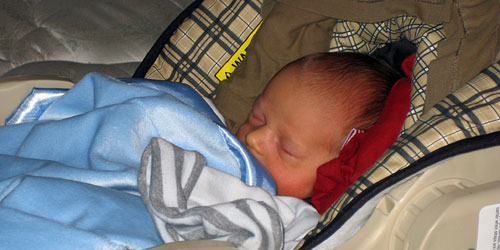
Nicole’s son loves his new car!
This article is about Cars, Reader Stories
SEARCH FOR RECENT ARTICLES


Anyone who thinks that you can only get a raw deal buying used — and conversely that you can’t get a raw deal buying new — has never bought a VW. They’re great cars if you get a good one, but there are a lot of bad ones… My sister had a Cabrio for a while but had it at the dealership for repair at least once a month for the year and change that she owned it.
And the assertion that people don’t sell good cars is silly. People sell good cars all the time because they want a new one. It’s often not a matter of good vs. bad but of new vs. used.
loading....
Darn it, Nicole. I was really looking forward to this article:
“101 Ways to Abort Your Gay-Married, Al-Qaeda-Loving Baby for $39 or Less”
Thank you for the rundown on this subject. I have seen it elsewhere (thanks to GRS), but your explanation of your process seems clearer. Congratulations and thanks, because whenever I do end up shopping for a car– I will be using this method.
loading....
I’m not sure how things are setup in the US, but in Aus it’s very easy to protect yourself from buying a used car from private sale:
~ The Local roads authority offers both a rego and stolen vehicle check for about $50. Stolen vehicle check also provides you with insurance if the vehicle does turn out to be stolen.
~ The Road side assistance clubs and most mechanics offer a very cheap checkup service (about $200), less if you have a good relationship with your mechanic. Carry one of those out and they’ll pick up 99% of any serious potential problems.
Basically if a private seller wont agree to me paying for the above to occur (especially the 2nd) We walk away as it means there is a problem with the car. The above process has saved us from purchasing two dodgy cars one had been written off and heavily repaired (not disclosed by seller) and the 2nd wouldn’t agree to a mechanics inspection. If your spending 8-10k on a car seems only prudent to me to protect yourself.
On the female negotiating thing, My wife does all our negotiating for everything although I do go with her. She is a hard negotiator and it can put a lot of salespeople off when she takes the lead, which I find highly amusing, especially when they keep glancing at me. We’ve had some cracker deals because of her
. So it can work to your advantage just make sure you know what your talking about and call the salesperson on any BS.
I normally wont poke holes in a story, however I would recommend you leave a little more room between yourself and the car in front. I can’t be certain of the exact car models years discussed in the article, however taking one of the worse case scenario’s (oldest vs newest):
1999 Hyundai Accent Brake Distance: 139 feet
2004 F150 truck Brake Distance: 150 feet
(both 60-0 mph)(happy to be corrected)
So as Yosemite Sam would say Back Off a little at least for your own safety
loading....
Nicole needed money for a car. If you need extra money, check out my latest article: 101 Ways to Make More Money
http://www.lifeandmyfinances.com
loading....
Good tips in the email negotiations with the car dealers.
I think the good vs new decision is a matter of personal preferences as much as finances. Theres pros and cons to either. But I think everyone should explore both options anytime they buy so they aren’t missing a deal. e.g. sure you value the newness of a new car but what about a 2009 for $10k less? or vice versa you may value the lower cost of a used car but what if the dealers rae dumping ’10 models for just $1k more than ’09s resell for?
loading....
Interesting to hear other peoples experiences. I love the car buying process, and cars itself.
I think it is common sense that used cars are a better deal than new, and a 1970 (!!) paper is not going to convince me otherwise. In the 70s a lot of cars were not expected to make it past 100k miles. A 2005 car with automatic transmission, ESC and rev limiter (95% of all cars) is hard to destroy or turn into a lemon, even if you tried. Because the cars computer will simply not let you take the car past its limits like you could in the 70s.
What I would like to add tot the conversation is CONSUMER REPORTS. I cannot say this enough. In this case, a CR membership would have told you 2 things:
1. The Hyundai Accent is bad buy, because most models lack ABS. With ABS, it would have been less likely you guys would have crashed into an F150.
2. The price your dealer paid for the Civic Hybrid. Great negotiation power comes with that info.
loading....
@51 Heather Ditto. The bad drives out the good. It’s only because of things like @53 is suggesting that a used car market exists at all. (Though with luxury cars, the owners may care less about getting a decent price for their cars, so that market it’s probably a better deal to buy used if you don’t share the premium for newness that many of those buyers want.)
@49 FiveSigmas– I wondered if anyone would notice.
@43 The only reason we got our current Hyundai Accent is because the old car wouldn’t pass inspection and it cost too much to repair. We didn’t have any place to keep it and didn’t want to pay insurance on it. (It also didn’t have a/c and I wanted a 4 door in case we had a kid in the future.)
Thanks again everyone for the comments! This has been a lot of fun!
loading....
I had a recent experience trying to buy a car – my parents wanted to come along to the dealership just to see the car, but that was the worst decision ever. We’re Asian, so we got assigned someone from a similar ethnicity, and then this guy proceeded to talk to my dad the entire time. He kept making comments, talking about features, tech specs to my dad when I wasn’t within earshot and when I finally asked him to repeat what he said, he began with, “As I told your father…”. I finally had to step in with a “Hi, I am the one buying the car. I am the one signing the loan, all on my own. You need to talk to me.”
… That lasted for about 5 minutes, then he went right back to speaking with my father. It finally dawned on him when we sat at the table and he wanted someone’s social security number to run, that I really was in the one in charge. Too late – he’d lost me by that point. And regardless, they didn’t have the color I wanted. His response was to make comments on my color choice and tell me that if it were up to him, he would go for the other color.
Long story short – I didn’t buy the car, but the dealership has put in an order for the car I want. And when I go in, I will not deal with any of the men in that dealership.
loading....
@Nicole: I agree with you that he is right on the subject of Asymmetrical Information and Adverse Selection. And I think he got the Nobel prize for those principles, using the car market as an example. Asymmetrical information = profit. It’s how our economy works. In a “perfect” market (aka symmetrical information) a profit margin would be 0% by default, on everything. Using his paper as an excuse to go out and buy a new car seems like jumping to conclusions.
I.e. it ignores the fact that used cars can be inspected by professionals weeding out the lemons, or can come with warranties, sometime for years. Or that people might buy from a reputable business. Or from CarMax offering to bring back the car within 3k miles if you like (aka after having it inspected).
You wrote: ” Plus my economics background suggests that at least for the non-luxury car market, buying a new car is about equivalent to buying a used car once you factor in the probability of getting a lemon.”
Sounds like you opted to not read the “criticism” chapter on the Wiki article which, in 2010 makes a ton of sense. With all the ways mentioned to weed out the lemons, do you really still think that it is “about equivalent”?
loading....
Great post. I never thought about negotiating a car deal through email. I can certainly see how this would avoid much of the unpleasantness of the process. I appreciate the tips (beware of gender bias, used junk emails accounts, avoid phone etc) as well. Best Regards,
loading....
@59 Niek– I address these in the grumpy rumblings blog post on the subject (specifically, those items are why there’s a market for used cars at all… without those things you mention and a few others, prices for used cars would be zero and there would be no selling). I’d be happy to discuss more there if you want.
loading....
Regarding the negotiation with salesmen, I found the following rule work pretty good for me: never buy on an impulse. Ever. There’s no deal that can’t wait for a day or two, every discount offered by somebody can also be offered by somebody else. If they say “this deal is only for next 5 minutes” to convince you, walk away (not necessarily literally – though that hepls too – but refuse to accept it). They either would say “or maybe tomorrow too and the next week or so” or they would see you’re not an easy mark and move on. having comission tomorrow for them is worse than today, but better than nothing, so if the deal is genuine it can be done anytime.
Maybe I missed a couple of deals of a lifetime this way, but I don’t think so. I know though I missed a number of cases where high-pressure salesmen tried to rip me off. Any deal that is good today will be good tomorrow, so unless it’s a matter of $20 or so, I always say “I’ll consider your offer and come back soon”. If the offer sounds good after a bit of thinking and condsidering and checking – then go for it. But never accept it right there, whatever they say (it’s actually may be useful to just tune out what they say, unless they say “we’ve decided to give you the car for free just because we love you” it’s probably not going to do you any good).
My last car purchase went relatively painless (and I *hate* bargaining and price negotiations) exactly because I refused to deal with on-the-lot salesmen and used email quotes instead. I was afraid nobody would be ready to give me an email quote but I found a number of dealers that offered me much better prices that the “best deal, only today” guys and they didn’t pressure me into anything – I chose the one I liked and they sold it to me with the price they quoted, no tricks, and I got what I wanted. Internet does wonders to these markets – I would never have patience to negotiate with a dozen of car salesmen otherwise!
loading....
Nicole, helpful article – thanks! I got bids by email before buying our last two cars, but I didn’t do the multiple rounds like you did. This is a good reminder to push a little harder.
And, by the way, I’ve had 2 Civic hybrids and have been really happy with them. First one was a 2003, which was totaled when an 18-wheeler hauling a bulldozer turned into my lane. The Civic lost that fight, but my daughter and I were completely unharmed. I was impressed. So I replaced it with a 2005 model, which has to date given me 85000 care-free miles. Also, I don’t think I’m “high-powered,” but I AM a corporate lawyer and happily drive my Civic, even though I park in it a garage full of Mercedes (Mercedeses?) and Lexuses (Lexii?). Finally, my Civic hybrid may not be nearly as posh as a Prius, but I like that it doesn’t annouce “greener than thou” like a Prius can.
loading....
This is a great post. We tried a number of things when my partner had her car totalled, but I still was frustrated that we had to deal with the hard sell.
One thing I’d recommend from when I bought my last-car-but-one– if you are single and your car is totalled, use the techniques here AND if you need to test-drive cars, be sure to rent a car or borrow one for a few days to visit dealerships. If someone is driving you around, or you are travelling to dealerships by bus, it’s all too easy to just say “ARGH! I’m buying _this one_ because i like it and the dealer doesn’t suck!” (Admittedly, I was happy with my Saturn, but… I probably could have gotten a MUCH better deal.)
loading....
I’ve bought new and I’ve bought used and I think there are advantages (and disadvantages) to each approach depending on what you’re looking for, what your resources are (time, money, competent mechanic available for pre-purchase exam and so forth).
In terms of your actual strategy, last time we bought a new vehicle (2009), besides using email (not as systematically as you did) I fairly quickly weeded out dealerships that only posted MSRPs (versus including invoices and/or an advertised sale price) on their websites, just out of irritation. Also, I found a number of salesmen (the choice of a gendered word is intentional; though there may also be saleswomen similarly impaired I didn’t encounter any) who really aren’t capable of communicating clearly in written English (i.e. sending a comprehensible email). Not sure if you ran into this or not but it did limit the usefulness of negotiating exclusively via email, for me (though in fact the dealer we ended up purchasing from, we worked with a salesman who could write a coherent email just fine. Coincidence? I suspect not.).
In my state (but not all, as I understand it), AAA members can get the price on a new vehicle that AAA would be able to get it for you, delivered — basically fleet price. I’ve used this once (when it got me a much better price than the dealer was offering) and not most recently (when we were buying in 2009 and found it didn’t help for what we were shopping for — still it was nice to check (and suggested we were getting a good price already). The nice thing is you can price the vehicle through AAA without needing to pay for the privilege … there’s only a modest ($55?) charge for the service if you actually buy through them).
I’m puzzled, though … first you were going to need to buy a new car b/c you needed a second car, then when your first car was totaled you bought a new car but no second car? Where’s that fit in?
loading....
Very long time reader, first time poster. I used this exact technique which I found at the time at edmunds.com to buy our 2008 Honda Odyssey. I also pursued the Costco auto buying program. Using this email negotiation technique got me quotes from over 7 dealers around San Diego County. The quotes varied by over $6000. I ended up with a fantastic vehicle at an unbelievable price and didn’t stress about the negotiation AT ALL. We went prepared with a Capital one blank check preapproved for the ‘out the door price’ (which is the ONLY thing you should negotiate for), but the dealer offered Honda financing @ 0.9% for 3 years, so we took that along with the negotiated price. I will never buy another car any other way. We got a new car for far less than even used ones from Carmax, etc. FWIW, Costco car buying program was about $1K more than we ended up paying. Thanks for sharing!
loading....
Great relevant story!!
Thanks–I’ll be sure to use some of this stuff in my next venture for a new car
loading....
Freaky. I bought the exact same car, with the exact same method (email negotiation). Only, my local dealership wouldn’t give me a better deal so I made the 45 minute drive. When you go through the internet sales department you may not get the absolute best deal, but I think it’s worth it. They focus on quantity sold while the showroom is focused on highest profit. Great article.
loading....
I definitely think finding your own financing is one of the best decision I made when it came time to purchase my second car. The first time around I got taken for a ride. Well let’s just say I wouldn’t let that happen again. It was my turn and it definitely worked out.
loading....
I did this exact same thing 2 years ago to get my Nissan Altima. Except with one twist.
I went to the dealership that had the best deal and the most cars (after the email negotiations). I called the 2nd place dealership from the 1st place dealership for one last shot at beating the price (they didn’t budge)…but I used that phone call to get the 1st dealership to throw in a leather seat upgrade. This upgrade is rather easy, i didn’t get the car that day (because the leather had to be installed) but when I picked it up the following day I was really happy at getting a good deal and nice plush leather seats.
loading....
Kudos for being realistic rather than resentful regarding dealerships and how they deal with women. Your creative approach saved you a lot of time driving to dealerships and frustration in dealing with some bozos. Sounds like you did everything right (even impersonating your husband) and were rewarded financially. However, you also successfully justified your new car with a pretty weak argument. But that’s okay, since I’ll always need people like you buying the new ones so there will be used ones when I’m ready to buy.
Thanks for spelling out your process in detail–many folks (not just women–men who hate haggling, too) will likely be able to benefit from your strategy.
loading....
Very impressive negotiating! I will be in the market for a car in the near future and will try this technique out. I’m most likely not buying it locally, so I should have even more leverage.
As a side note, I bought my last car rather haphazardly. It was a used car purchased through a dealer after a friend traded it in. I let the dealer handle all of the financing. It could have really screwed me, but I got lucky and they introduced me to the great credit union that I am with today. Not all dealers are bad, but a lot are.
loading....
Good tip. Unfortunately it won’t work where I live as car taxes are so high (200%!) that the dealers have to sell at a small loss (and gain from service and repairs), if they wish to sell anything at all.
The used car market is a different story, but there you can’t just email the sellers, as you really need to take a close look at every car offered.
loading....
Just like assuming buying a house is better than renting, assuming buying used car is better than buying new is poor conventional financial wisdom. Things change, there are so many incentives to buy new, the rationale behind buying a late model car is disappearing.
While the 1970s paper is interesting theory, I’d love to see statistics from 1970s vs. 2000s on the average time someone keeps a car. I have to think in the 90s and 2000s the “keeping up with the Jones” effect put a lot of good used cars back on the market after a few years of ownership (not to mention the increased frequency of leasing cars).
I certainly benefited by buying a 4 year old 98 Jeep Cherokee for about 1/2 the new cost and still drive it today. The purchase price works out to about $1,000/year, not bad in my opinion. My best car buying advice – like JD did – buy a car you will love driving or dream about at a reasonable price, maintain it and keep it forever.
loading....
Fascinating tactic! I’m also the car-buyer in the family, and I wish I’d done more work via email when we were looking for my husband’s last car. It was a new Hybrid as well, and while we DID eventually get exactly the price we wanted, it was a long and frustrating road past many local dealerships.
The dealer we finally purchased from has been great, however, and we’ll definitely return there in the future…But I think I might send out a few emails ahead of time, tho.
I bought my own car used from a dealer, and I actually loved it. I was looking for an uncommon vehicle (original-style Honda Insight), so I didn’t have a lot of potential sellers to work with. I was lucky enough to meet up with an old-school salesman who had been doing this for years. I arrived armed with lots of research, and he and I did the back-and-forth numbers dance gracefully and arrived at exactly the figure I was looking for. I honestly enjoyed the experience. It can be fun if you get a good salesguy, although they seem to be one in a million these days! =D
loading....
Thank you for setting out the process so directly and simply. I have been wondering about all of this for a few years and at last it makes sense!
Thank you so much for sharing your experience!
loading....
Great post. I just starred this in Google reader.
loading....
New cars have lower value when driven off the lot (and therefore ‘used’) because some value, or perception of value, is lost (assuming it’s a trade/sale and not a return)
*First, you may lose the warrantee if it is non-transferrable, or only partially transferrable.
*If it IS transferrable and you are doing a private party sale then you cannot provide as much service or convenience as a car lot. For example you cannot provide a different color or financing.
*If you trade back to a car lot then they need to re-sell it and need to cover both their profit, any work required to put into it, as well as the risk of additional expenses if it doesn’t sell immediately.
*If you have more than literally driven it off the lot then it has SOME wear and tear. One of our local dealerships *rents* out their new cars/trucks to organizations during a huge local event. The vehicles come back with 2-3k miles on them. They maintain the pedigree of new cars, but with a reasonable ‘used’ discount. I have seen the same idea used with new cars that had slight cosmetic damage (scratched, minor hale damage, etc)
I have seen new cars that were the best deal when all local and manufacturer rebates were applied. My first car was the last 1999 on the lot the week after Xmas giving the dealer incentive to move it on top of a manufacturer incentive. It was cheaper than used.
And I have gotten great deals on used cars. My current vehicle was bought through a dealer that had sold a dozen vehicles to my husband’s family. On a two year old vehicle I paid less than KBB TRADE-IN price, about $8k less than KBB dealership price, and less than half of the original new price. We worked directly with the sales manager and the deal was I could have any used car on the lot for $500-1000 more than the dealer paid. As the manager he got huge bonuses for volume so he didn’t care as much about the commission, as long as we didn’t want a bunch of hand holding (and who is going to complain about NOT being stalked all over the lot?).
The new/used is specific to the vehicle at the time. Sometimes there is a misjudge of demand resulting in huge manufacturer rebates. Sometimes there is an economic shift. We got our truck for a steal when people panicked over gas prices two years ago. It is a dynamic system, so there is usually someone willing to take the bigger hit for some reason. Sometimes that is the manufacturer, sometimes it will be private people.
Regarding the value of the 1970 study, I haven’t read it, but just because it’s relevant doesn’t mean it’s right. In other words it can use the car market of the time to illustrate a valueable economic point which is very relevant without being applicable to the car market now. It might be, but simply because it is still repected doesn’t mean it’s ipso facto relevant to this discussion.
loading....
The value of a vehicle can also be it’s value to YOU. If you don’t know much about cars and don’t have a good mechanic that warrantee can be worth it’s weight in gold. If you do your own car repair paying for that warrantee has less value when you consider how many problems typically come up in the first 25000 miles and you might do much better with a car at the far end of the depreciation curve (at least financially, comfort also has value).
loading....
Anne – #46
We used a car broker when my husband wanted a specific pick-up. We wanted a very plain – 2 door, long box bed that our camper would fit. All local car lots had fancier or 4 door or 2 bench seat models and none were interested in ordering anything else. The broker found the exact car we wanted about 150 miles away. It was worth the trip to us. We drove our car in, wrote a check and I drove our car home while husband drove home the new pick-up. We paid a modest fee to the broker – a very satisfactory experience.
loading....
Hi Nicole,
Glad the accident wasn’t more serious (I’m surprised the Ford came out of it unscathed!)
I personally think Honda Civics are cool (hybrid or no)… So sounds like a winner of a choice to me!
Now I’m off to check out your site
loading....
I bought a new focus in 2004. I had a blank check from Capital One ready to go with a killer rate. The dealer offered a bad rate but good price. I took the dealer’s offer and paid the car off in full with the capital one check. I called them and they said at the time of the call it still counts as new due to mileage etc…
loading....
I have never considered buying a new car personally, but I did get to buy my “company car” that I got through my employer. I wish I would have learned your technique three years ago!
I think one of the best things about doing it via email, in addition to saving a bunch of money, is that you’re able to connect with a bunch of dealers at one time with minimal stress and no pressure.
Thanks for sharing your experience.
loading....
I bought two cars in the last three years. One was a new 2009 Mercury Mariner. I used the cash for clunker’s program, and had a family member’s Ford discount. I love this vehicle. Ford has come a long way in the last few years. Many very innovative features like the capless fuel tank, keyless entry, and Sync Hands Free system. With that said, I normally do not buy new. My second vehicle was a used 2006 Volkswagen Jetta. Sticker price for that new was in the glove box. It cost somebody $28, 000. I got it for $12, 999. It came with some of the original warranty left on it and a certified used VW warranty that covered all the same repairs. AS much as I love the new Mariner, the VW is a great car and the much better deal.
loading....
Hi Nicole,
Great article on your negotiation strategy! I used a very similar techinique when I bought my last BMW motorcycle. Ironically about 1/3 of the dealerships I sent the fax too responded saying “they were BMW and BMW does NOT negotiate.” Of course the other six BMW dealers proceeded to prove them wrong and negotiate! ; )
I have to whole heartedly disagree on your used vs new discussion though. If your premise were correct then buying new is no better – you’ll still get the lemon!!
I have bought almost all of my vehicles used (over 55 different ones at this point in my life – I like cars, trucks and motorcycles and often own several at once) and have only had 2 lemons in all that time. For each of my kids we bought used cars and NEVER got a lemon! The key is to stick to proven models – grab Consumer Reports and check out their recommended used buys in your price range in their sping edition (April or March I think) .
It’s sad to see that you bought a new car for the supposed “safeness” from lemon hood and the gizmos and aren’t even using the gizmos. It just goes to show that having the “newness” is never a lasting feeling of fulfillment or pleasure. Yet one more reason to buy a good quality 4-5 year old car. Except of the two lemons I’ve owned I’ve never had major serious issues with my used cars – NEVER! With the two lemons as soon as I realized the situation I quickly sold them with full disclosure of their problems. Sure I lost some money but not near as much as having bought new due to depreciation and I didn’t have near as much money at risk like you would have if you bought a new car and got a lemon.
Second major error you are making in your thinking – buying with a loan. Never, EVER, buy depreciating assets with loans – NEVER!!!! One of the things I’ve passed on to each of my kids is that a key to financial independance is to pay cash for all depreciating assets, never carry a balance on a credit card and pay yourself first (10% minimum) with every paycheck. Each of them are well on they’re way to retiring very early just like their Dad! Yay!
Great post – thanks for sharing and being so open to input! Great expample of a quality GRS post!!
loading....
Thanks for this post! I am considering buying a new car in a year or so, and I hope this tactic proves helpful. I just tried to convince my co-worker to try this. I’m so curious to see this in action!
loading....
“Buying a new car is about equivalent to buying a used car once you factor in the probability of getting a lemon.”
I don’t know about that. My experience is that it depends on the make and model.
My experience is that it is true for more popular vehicles, which don’t depreciate enough to justify buying them used. Other vehicles, like minivans, tend to get more wear and tear and this may justify buying new. (A used minivan in good condition is no bargain–if you can find one.)
However, with other models going used makes sense. Many luxury cars depreciate rapidly, but are still good cars after a couple of years. Also, cars from the year before a style change often drop disproportionately in price, yet tend to be more reliable because the automaker has worked the bugs out of the old design by the final year.
loading....