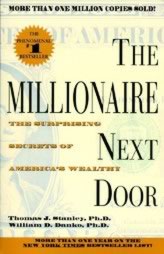
Some personal finance books promise to show the reader how to become a millionaire. The Millionaire Next Door (by Thomas J. Stanley and William D. Danko) is different. It is built on years of research, on a body of statistics and case studies. It doesn’t make hollow promises. Instead, it profiles people who have already become millionaires. This is a subtle but important difference.
Many people who earn high incomes are not rich, the authors warn. Most people with high incomes fail to accumulate any lasting wealth. They live hyperconsumer lifestyles, spending their money as fast as they earn it. In order to accumulate wealth, in order to become rich, one must not only earn a lot (play “good offense”, according to Stanley and Danko), but also develop frugal habits (play “good defense”). Most books focus on only one side of the wealth equation: spending less or earning more. It’s refreshing to read a book that makes it clear that both are required to succeed.
It’s as if people can be classified based on the following table (which is my own invention based on the authors’ findings):
| High Income | Low Income | |
| Frugal | wealthy | breaking even (spartan) |
| Spender | breaking even (lavish) | broke |
High-income spenders live in a house of a cards. Sure they have the money now to fund their hyperconsumer lifestyle, but what happens when that money goes away? It’s also difficult for low-income frugal folks to acquire wealth. They need to learn to play financial “offense”. But those with low incomes who spend are in the biggest trouble of all.
The wealthy, on the other hand, generally have a high income and a frugal mindset. They share other characteristics as well.
- 80% of America’s millionaires are first-generation rich. This is contrary to those who would have you believe that wealth is usually inherited.
- 20% of millionaires are retired
- 50% of millionaires own a business
The authors write:
In the course of our investigations, we discovered seven common denominators among those who successfully build wealth.
Those characteristics are:
- They live well below their means. In general, millionaires are frugal. Not only do they self-identify as frugal, they actually live the life. They take extraordinary steps to save money. They don’t live lavish lifestyles. They’re willing to pay for quality, but not for image.
- They allocate their time, energy, and money efficiently, in ways conducive to building wealth. Millionaires budget. They also plan their investments. They begin earning and investing early in life. The authors note that “there is an inverse relationship between the time spent purchasing luxury items such as cars and clothes and the time spent planning one’s financial future”. In other words, the more time someone spends buying things that look good, the less time they spend on personal finance.
- They believe that financial independence is more important than displaying high social status. The authors spend far too much time beating home this point: usually millionaires don’t have fancy cars. They drive mundane domestic models, and they keep them for years. (There’s an entire 31-page chapter devoted to how millionaires shop for cars. It’s tedious. It may be the worst chapter I’ve ever read in any personal finance book. And the authors go on ad nauseum about the average price per pound of various vehicles. There’s even an appendix showing the average price-per-pound for the most popular models.)
- Their parents did not provide economic outpatient care. That is, most millionaires were not financially supported by their parents. The authors’ research indicates that “the more dollars adult children receive [from their parents], the fewer they accumulate, while those who are given fewer dollars accumulate more”.
- Their adult children are economically self-sufficient. This chapter is fascinating. The authors clearly believe that giving money to adult children damages their ability to succeed.
- They are proficient in targeting market opportunities. “Very often those who supply the affluent become wealthy themselves.” The authors discuss how one of the best ways to make money is to sell products or services to those who already have money. They list a number of occupations they feel have long-term potential in this area.
- They chose the right occupation. “Self-employed people are four times more likely to be millionaires than those who work for others.” There is no magic list of businesses from which wealth is derived — people can be successful with any type of business. In fact, most millionaire business owners make their money in “dull-normal” industries. They build cabinets. They sell shoes. They’re dentists. They own bowling alleys. They make boxes. There’s no magic bullet.
The Millionaire Next Door is a flawed classic. It offers a fascinating portrait of the wealthy, but it buries this beneath mountains of detritus. The book is poorly organized, repetitive, and dull. (The section on car-buying seems to go on forever.) A patient reader will be rewarded with a glimpse at what it takes to become a millionaire, but I can’t help but feel this book could have been something more.
In the past two months I’ve read The Millionaire Maker (my review), Secrets of the Millionaire Mind (my review), and The Millionaire Next Door. I pray I’m done with “Millionaire” books for a while. (I’ve actually re-read Secrets of the Millionaire Mind since I reviewed it last month. It’s excellent motivation for my current place in life.)
Which of the three is best? The Millionaire Next Door has the best reputation. It provides solid information based on real-life examples. But it’s poorly written. Secrets of the Millionaire Mind is a powerful motivational tool, but it feels heavy on anecdote and opinion. Either of these could be useful, depending where a reader is in her financial journey. Either is worth borrowing from the public library.
(Note: I bought The Millionaire Next Door for $3.79 at a local thrift store. Thrift stores are excellent sources for personal finance books. Your public library is even better.)
This article is about Books Monday, 18th December 2006 (by J.D. Roth)


RSS Feeds
Facebook
GRS Twitter


December 18th, 2006 at 6:48 am
Although I have not read this book, I have read the follow up, The Millionaire Mind, which was very good. It was recommended to me by a multimillinaire friend! lol I have found that one to be hugely insightful, much more organized, and something I refer to frequently.
I did think the points made about parents giving adult children money hindering rather than helping was fascinating!
December 18th, 2006 at 8:04 am
I’ve read the book, along with The Millionaire Mind, and appreciate them both. Book on finance topics often serve as motivational pitches, but these two books provide a clear insight into the habits of the wealthy.
I’m surprised to hear The Millionaire Next Door being described as dull. I found it incredibly inspiring. Whenever I need a dose of financial medicine, so to speak, I flip open this book to re-calibrate my values.
December 18th, 2006 at 8:46 am
Absolutely agree with you on this book- I had heard most of the information repeated before on blogs like this, but was looking forward to reading it for myself, since it’s such a classic. I found it so poorly written, and like it had no clue who its audience was- was it targeted towards people who wanted to be millionaires or people who sell stuff to millionaires?
The one thing I found that was really illuminating, though, was the chapter on ‘economic outpatient care’, and how the gender of their children affected how much economic outpatient care they received. Looking at the data from a feminist perspective, one can see how the greater amount of economic ouptatient care for women has hurt the status of women in this country, especially among the wealthy, and propogated stereotypes about women who would rather shop with their husbands’ and fathers’ money than earn a living for themselves.
The book contained so many facts, but I would have appreciated more analysis on what the facts meant.
December 18th, 2006 at 9:25 am
I’m so glad you mentioned buying books cheaper or using your public library. I think it’s ironic that people who are trying to save to be rich would be willing to spend the money for a brand new book. Unless it’s brand new, you can find used books for much less and it saves more trees, it’s a win-win! Also, check out paperbackswap.com - I just signed up, and it’s a pretty neat concept.
December 18th, 2006 at 11:55 am
Millionaire Next Door is classic. I will keep this book forever. I am one of those that tends to fall in the “low income” bracket, but with some discipline and living below my means, I should be okay. I think people make personal finance way too complicated. “Spend less than you earn.” It’s simple.
Another underrated book that a lot of people do not know about is “Getting Loaded” by Peter Beilagus. Read it. I’m sure you will like it.
December 18th, 2006 at 12:03 pm
Peter “Bielagus”. Sorry I spelled it incorrectly the first time.
December 18th, 2006 at 12:25 pm
It’s slightly incomprehensible that you found this dull–I enjoyed it a great deal. I do agree that their conclusion that millionaires buy cars by the pound was faintly ridiculous, but I think the point of the car chapter was that most non-millionaires spend way too much of their money and time buying transportation devices.
December 18th, 2006 at 1:26 pm
When I read this book about a year ago, I enjoyed it but skimmed some of the more tedious sections. It seems to me that the book best works as a general guide to developing a mindset for wealth; I’m not sure I fully agree with some of the specific points or positions in the book.
The formula for determining the net worth or wealth that one ought to have [AGE X INCOME, then DIVIDED BY TEN], and the procedure for evaluating the result (UAW, AAW, PAW), are useful in a global sort of way, but not for the specific circumstances of many people. It seems to me that a more realistic procedure would chart expected wealth-age relationships to account for non-linear circumstances in youth and old age. Also, if a person saves a lot of money but keeps getting pay raises, that person may continually be termed an UAW; the formula doesn’t account very well for flux in income.
Another issue is inheritance: the authors say that inheritance should not be included in one’s net worth. It’s a nice idea to emphasize responsibility of the income-earner, but there are too many possible circumstances. For example, if he/she later in life helps to support the parents financially (i.e., huge medical bills, care facilities, etc.), then couldn’t any inheritance (such as a house) rightly be considered a part of the inheritor’s net worth? Some situations are just too complicated for one-line rules.
Another issue may be #4 above. It’s true that supporting the kids may do more harm than good in some cases, but there are many cases when such support really is an “investment” and allows the children to ensure high earning power.
Other points and positions are quite credible, such as the central idea that millionaires can be found in modest neighborhoods and modest houses. This part of the study really does unmask a lot of the “upscale living” that abounds in the U.S.; many people really are good at making a lot of money and then spending it on visible/tangible stuff and services that deceive others into thinking that true wealth dwells therein.
December 18th, 2006 at 2:50 pm
#8, were do the authors write that inheritance should not be included in the calculation of net worth? I recently read this book, and I don’t remember them mentioning anything like that.
December 18th, 2006 at 2:59 pm
I want to make it clear that I think the ideas in this book are great. I do think it’s a classic personal finance book. It does a great job of showing the real way millionaires behave in contrast with the way most people view them. I’ll forever view somebody with a flashy car as a big spender, not neccessarily somebody who is rich. The ideas here are fantastic. My complain is with the delivery, which is dry and tedious.
I should also note that I listened to the book on audio, which may have had an impact. If I were reading an actual book, I could have skipped the dull sections. When I actually re-read sections in my printed copy (the one from the thrift store), I was pleased to be able to skip parts I knew were tedious.
December 18th, 2006 at 5:52 pm
Hi #9, Since I don’t have the book with me, there is a chance the inheritance precept comes from somewhere else (the mind is the third thing to go)…. But I nonetheless recall that the precept comes from the authors’ formula on how to calculate net worth. From what I remember, the idea is linked to Point 5 in J.D.’s synopsis above: true wealth is built through one’s own work, not through one’s inheritance of the product of another person’s work.
December 19th, 2006 at 12:47 am
I wonder if the inheritance thing is that you shouldn’t pre-empt it. I mean, if you’ve inherited $100,000 then that is part of your net worth, but if your parents are currently worth $100,000 and you are their sole beneficiary then you shouldn’t as the money isn’t yours. Just a suggestion.
December 19th, 2006 at 6:52 am
The idea of omitting inheritance from net worth was purely about determining whether you’re frugal or not. If a significant fraction of your net worth is from inheritance, that doesn’t prove you’re frugal, just lucky.
Determining whether you’re a prodigious, average, or under-accumulator of wealth is calculated by multiplying your current age by your current salary divided by ten and then comparing that number to your net worth, less any inheritance. It has nothing to do with calculating net worth for any other purpose.
December 19th, 2006 at 8:16 am
This book reads like a fleshed-out statistical report. Sure it’s great to know that most millionaires have three children and wives who are either homemakers or teachers, but what does that prove? That the only thing separating us from a millionaire life is having three kids? I DON’T THINK SO. There’s precious little on how people actually become successful, just what ones who already are do. It’s some sort of fallacy of logic. Post hoc ergo propter hoc? Cum hoc ergo propter hoc?
December 19th, 2006 at 8:31 am
Dimes, it’s not even a very good statistical report.
It is NOT a random sample. Obviously, if they are tracking millionaires specifically, that limits the universe of respondents. Fine. But the conclusions in this book were drawn from the sample of millionaires WHO ARE MOTIVATED BY $100 SURVEY PAYOFFS. That can’t possibly be representative of the millionaire population.
Don’t get me wrong; I found the book interesting, and it did make me rethink some frugality issues, especially the car chapter. But it is not up to most research standards.
December 19th, 2006 at 9:30 am
From all the reviews I’ve read of this book and similar ones, I don’t feel the need to read it. It sounds mostly like a motivational-type book (similar to Kyosaki’s life works).
I’m not saying there isn’t good information in there. I just don’t think it would benefit me any more than reading reviews, and just following a few different PF blogs.
December 19th, 2006 at 12:58 pm
#15 - HC said it far better than I could have. There seems to be a fundamental flaw in the way the research was conducted. Further research is necessary to corroborate the findings. A valuable piece of work, but there may be important nuances missing.
Second point. The one eye-opening message there was for me after reading TMND was that I don’t want to be the millionaire next door. It now seems pointless to accumulate vast amounts of wealth relative to your income potential and not spend/use it. Not going bankrupt or not having to stress out about finances seem like worthy goals. However, this book seems to advocate an extreme level of saving that I feel is misguided. If I read the book correctly, I don’t want to be one of those millionaires. I don’t want to go bankrupt or have a divorce because of finances, but I don’t think I want to be on the other extreme either.
December 19th, 2006 at 1:21 pm
NLG — The book is far from being motivational hype. In fact, is the furthest thing from it. The authors present statistical analysis of how wealthy people behave and there is no salesmanship about it at all.
squished18 — While not immune from error I would need really compelling counter evidence to claim that the statistical methods used where in error, especially given that it was written by statisticians. As for the point of the book, it isn’t to glorify the behavior of the miserly. Most of the millionaires were confident about their life purpose and wealth was a consequence of their habits, not a goal.
December 19th, 2006 at 3:10 pm
squished18 said It now seems pointless to accumulate vast amounts of wealth relative to your income potential and not spend/use it.
True enough, what’s the point of having money if you’re not going to do something with it, but in fact wealth generates more wealth. And once you’ve built enough wealth to take care of your own needs, you can start giving away the rest, and that’s when things really get interesting. Bill Gates just gave away 35 percent of his fortune. That’s going to have a huge impact on children’s health and welfare in developing countries. My own plan for next year is to donate 10 percent of my income to charity, not that I’m a millionaire but my salary puts me in the top 10 percent of average US income and I can give away 10 percent of my income without too much belt-tightening. If you really want to change the world, building wealth is a great way to do it. There was an excellent article in this past Sunday’s New York Times magazine entitled “What Should a Billionaire Give — and What Should You? It’s worth reading. For me the only reason I’m even remotely interested in making serious money is to give it away to the people, projects, and causes I care about.
December 19th, 2006 at 3:37 pm
I earn minimum wage, how am I supposed to live beyond my means?
December 19th, 2006 at 9:47 pm
Duane Gran: “As for the point of the book, it isn’t to glorify the behavior of the miserly.”
I may need to re-read the book, but that was exactly the message I got from it when I read it. What was the message you picked up from it?
“Most of the millionaires were confident about their life purpose and wealth was a consequence of their habits, not a goal.”
I missed that part. (Not being facetious.) I’ll be looking for that in the re-read, but there didn’t seem to be anything about life purpose in the book when I first read it. Care to direct me to relevant passages?
December 20th, 2006 at 6:35 am
squished18,
In all fairness, I may be conflating my memories because I also read The Millionaire Mind, which expands on the statistics with stories from the people they interviewed. That follow up book paints a picture of people who are grounded in the way they value faith, family and community in such a way that wealth is a side effect of their habits. Because of reading both books I may be a bit too charitable in my handling of The Millionaire Next Door.
Come to think of it, TMND does send a strong message about fantasy versus reality and beats the reader over the head about the frugality of the typical millionaire, whereas TMM is more substantive about the whole lifestyle package.
I strongly recommend reading TMM, which can be skimmed rapidly if you have read TMND. Sorry if my response seemed obtuse.
December 20th, 2006 at 10:22 am
OK, I’ll put The Millionaire Mind on my to-read list. Thanks for the response.
December 21st, 2006 at 4:20 pm
I really enjoyed the detailed information on the habits of millionaires that this book provided–things like how the most common vehicle of a millionaire is a pickup truck and how millionaires often buy antique furniture because it lasts forever and is the only furniture that might increase in value. I purchased the audiobook, and really enjoyed listening to part 1. Part 2 was so similar to Part 1 that I actually thought I was listening to the same part all over again because of some computer glitch. But that wasn’t the case!
Terry–When I was supporting myself on a slightly above minimum wage job, I found that the best way to save money when you earn very little is to have roommates and share everything. Working at a restaurant also helped me because it can drastically decrease your grocery bill–that’s an added bonus that most minimum wage jobs do not have. On top of that, some restaurant jobs actually pay above minimum wage or have the possibility of tips.
December 28th, 2006 at 2:12 pm
I just got done reading this book and I’m really glad I did. If there’s one thing I got out of it, it was to learn to be frugal. However, I just don’t know if I can ever get myself to drive a used American made car.
January 27th, 2007 at 7:22 pm
[...] And finally, Get Rich Slowly has a great review of the book The Millionaire Next Door, with a summary of the 7 common characteristics of people who successfully build wealth. [...]
March 7th, 2007 at 9:18 am
[...] The authors interview and survey a pool of millionaires, attempting to find common connections among them. They discover that millionaires live below their means. They budget. They let their adult children make it on their own. This book introduces several key concepts, including degrees of wealth accumulation. It’s a bit tedious in spots, at least in the audio version. This is one of just a few books to cover both sides of the wealth equation: saving money and earning money. [My review.] [...]
March 29th, 2007 at 1:34 pm
[...] see references to and reviews of The Millionaire Next Door all the time on the various personal finance blogs I frequent. The [...]
May 29th, 2007 at 5:01 am
[...] The Millionaire Next Door (my review), authors Thomas Stanley and William Danko devote two entire chapters — 69 pages! — to [...]
March 6th, 2008 at 3:32 am
[...] is to be; enjoy it 75. Normal doesn’t exist; it’s all socialization put in your head 76. Live beneath your means 77. Avoid car loans 78. Clip coupons 79. Stay on the border of the grocery store 80. Tip 20% or [...]
October 13th, 2008 at 6:49 am
[...] Washington. We live in a land of opportunity. We get to chose our own career paths. According to ‘The Millionaire Next Door’ 80% of America’s millionaires are first-generation rich. We have our personal responsibility to [...]
May 29th, 2009 at 1:42 am
I am so sorry the majority of you all did not find this book useful, helpful, or educational. My financial planner gave this to me 12 years ago when I was a 40 year old newly divorced professional female with 2 young kids, Despite 2 high incomes my ex and I were living above our means, seduced by easy loans and a seemingly endless amount of credit. Thank goodness I took the advice in this book to heart before this latest recession. No one is saying dont have fun or dont but a vacation home or that car you want., just buy with money you have, not that magical fantasy money the bank wants to loan you..
June 16th, 2009 at 6:44 am
This is a great book. It makes it very clear that they way to accumulate wealth is to simply spend less than you earn. The authors do a great job of explaining this point by descrbing the differences between UAW’s(Under Accumulators of wealth)and PAW’s(Prodigious accumulators of wealth), which basically boils down to their spending habits. This book is great for anyone, no matter what stage of your life your in.
November 27th, 2009 at 9:00 pm
So I was halfway through the book and I’m like… the chapter on car buying didn’t seem so bad, and really it was just half a chapter.
Then I got to the next chapter. Turns out I was premature. Now I understand.
(I also wonder about their sample selection… someday maybe I’ll check out TMM to see if they can convince me in that book.)