Over the past month, I’ve covered the basics of Roth IRAs. I’ve explained what they are, how (and where) to open one, and which investments are best. Today in the final part of this series, I’m going to answer your questions. Remember: I am not a financial adviser. I’m just a regular guy trying to gather information to help you. If you need more specific answers, please consult a CPA or an investment professional.
All of the questions below were submitted by Get Rich Slowly readers via comment or e-mail. If your question isn’t here, please drop me a line so that I can research an answer and add it to the list. This article isn’t the place to begin if you’re new to Roth IRAs — start here, instead.
- Can I have more than one Roth IRA? For example, can I have one at ING and another at Vanguard?
- You can only have one Roth IRA; however, you can multiple Roth IRA accounts. (As Dylan phrased it: “It’s like J.D. can have multiple blogs, but there’s only one J.D.”) You can have as many Roth IRA accounts as you’d like.
It’s a little inefficient to have multiple accounts spread around, but I can see reasons to do it. I will probably open a second account with Vanguard by the end of the year. (My first account is at Sharebuilder.)
Note that your contribution limit ($4,000 in 2007) applies to all of your IRA accounts collectively; they don’t each get a $4,000 limit. In other words, you can contribute $100 each to 40 different Roth IRA accounts, but not $1000 to each of them.
- Which is better: investing in a Roth IRA (with after-tax dollars) or investing in a 401k (with pre-tax dollars)? Does it make a difference if there’s an employer match? And if I already have a 401k through work, then why would I want to add to a Roth IRA?
-
The traditional answer to this question is to invest in the following order:
- If your job offers a 401k, contribute to that each year until you’ve reached the limit of the employer match. Never turn down free money!
- If you still have money to invest, contribute to your Roth IRA.
- If you still have money to invest, then max out your 401k.
- Once you’ve contributed all you can to these investments, then invest however you see fit in regular, taxable accounts.
The answer for your situation may be different. Some people like to have all their accounts in one place. If you’re this sort of person, you may benefit from simply putting all your money into a 401k and not worrying about a Roth IRA.
My CPA says, “When debating a 401k vs. a Roth IRA, why not check with your employer to see if they offer a Roth 401k, which combines the best of both worlds?” Also note that you can actually invest in both a 401k and a Roth IRA as long as you meet the requirements for both programs.
- What happens if I contribute too much to a Roth IRA?
- If you contribute more than allowed, you are subject to a 6% excess contribution penalty. However, you have until the annual contribution deadline (generally April 15th) to withdraw any overage from the account before the penalty is assessed.
- How does the IRS know that you contributed to a Roth IRA? How does it know if you contributed more than you were allowed?
- For the answer to this question, I checked with my CPA. “At the end of the year, the investment company submits Form 5498 to the IRS. It reports the amount that you invested. For example, it might say, ‘In 2007, J.D. invested $4,000 in a Roth IRA.’ The IRS computers then match this form electronically to your tax return to check for discrepancies. If you’re over the income limit, your return will be flagged.”
- Can legal U.S. residents who are not citizens open an IRA? Is it a good idea? What if I don’t plan to be in the U.S. at retirement age?
- Anyone with earned income in the U.S. can contribute to a Roth IRA — citizenship is not required. However, for greater flexibility, you may want to consider a traditional IRA or other investment accounts, depending on your goals.
- I have a bank account in the U.S. Can I start a Roth IRA if I live and work in another country? I’m afraid to save in my country’s currency because inflation will ruin my investments.
- No — you must have earned income in the United States in order to open a Roth IRA. However, you can open a regular taxable investment account using U.S. dollars. You won’t get the tax breaks, but if you’re primarily looking to escape inflation in your own country, this might be a good choice.
- Can I really withdraw money from my Roth IRA without penalty.
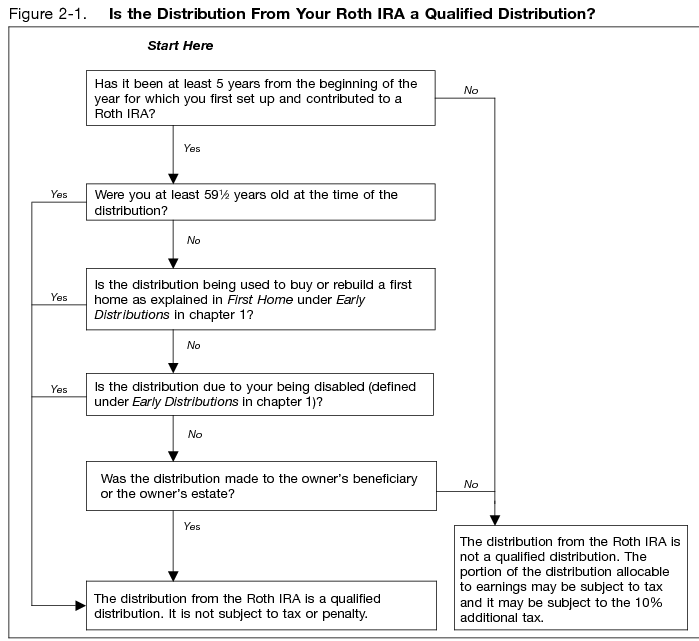
- Yes, up to a point. You may always withdraw your contributions without penalty or taxes. For example, if you contributed $4,000 last year and the IRA is now worth $5,000, you can take $4,000 out of the account (leaving just the $1,000 in earnings) without consequence. There are taxes and penalties, however, for early withdrawal of earnings for non-approved uses. However, it’s important to note that once you withdraw the contributions you have just 60 days to replace them and after that the money can never be replaced again.
- I’m self-employed and I make more than the maximum allowable for a Roth IRA. Does a SEP-IRA make sense?
- This is another question I bounced off my CPA. He says that a SEP-IRA may make sense, but that it will depend on your individual circumstances. Basically, self-employed people can contribute roughly 20% of their first $200,000 of pre-tax earnings to a SEP-IRA. However, they must contribute the same percentage for all employees. If you are the only employee, or if you don’t mind giving all employees the same retirement benefits, then this may be a good choice. This is another case in which you should consult a financial adviser.
- What options are there if I earn too much to contribute to a Roth IRA?
- If you make too much to contribute to a Roth IRA, be sure you’re maxing out your 401k, if you have one. You can also contribute to a traditional IRA. Both of these are excellent options. (But note that if you have a 401k at work, your contributions to a traditional IRA may not be tax deductible.) For more discussion on this topic, check out this thread from the GRS forums.
- I heard that in 2010 the income limits on Roth IRAs will expire, and that it’ll be easier to roll a traditional IRA into a Roth at this time. Do you have any info on that?
- As the law is currently written, in 2010 the income cap will be lifted on conversions from traditional IRAs to Roth IRAs. But 2010 is a long time from now. There will be a new political environment in 2009. Congress can change current laws, and there’s a good chance they will. Still, if you’re willing to play the odds, putting your money into a traditional IRA now for a potential rollover in 2010 might be a profitable venture.
- My wife is a stay-at-home mom and doesn’t have any earned income. Does this mean she cannot have a Roth IRA?
- To every rule, there is an exception. If you’re married and filing a joint return, then both spouses can max out IRAs from a single income (so long as the other Roth IRA requirements are met). Read more about this subject in the GRS discussion forum.
- Is it possible to roll a 401k into a Roth IRA?
- It is possible, but you have to be careful. It’s not a one-step process. Also, it’s difficult to do with an active 401k account. A mistake along the way could cost you a lot of money, so it’s a good idea to consult a financial adviser for help. There’s a lengthy discussion of this subject in the forums.
- I opened a Roth IRA at a local bank, but I noticed that I’m only getting a 1.98% return. This seems unusually low. Should I withdraw my money and move it to Vanguard, Fidelity, or T. Rowe Price?
- Your money is probably in a savings account or certificate of deposit. Your bank may offer additional financial services — check with them to see where else you can put the money. Barring that, yes absolutely move the money to a different location. You may have to pay a transfer fee, but it’s worth it.
As Mandy writes in the forums, “Traditionally banks are one of the worst places to invest because they typically offer high-load/high-fee or very conservative investments and charge higher service fees than most other brokerages. Banks are for banking, not investing.” (See Which investments are best for a Roth IRA? for ideas on where to put the money.)
- I want to open a Roth IRA, but am confused by the mutual funds offered by different companies. For example, ING Direct offers six funds, and another bank offers only five. What’s the difference? Which should I choose?
- Only you can answer that question. Here’s how I would approach this problem: I would first locate the investment I want to purchase. Is it an individual stock? Is it real estate? Or is it, as I encourage, an index fund? Once you’ve decided on an investment, then find a company that will let you buy the investment from within a Roth IRA. This shouldn’t take too much effort. Zecco
, for example, will allow you to purchase any publicly-traded security at basically no charge. If, like me, you decide you like Vanguard’s mutual funds, then open an account directly with Vanguard.
- Can I really use my Roth IRA to buy a house?
- Sort of. You can’t purchase your home with money that’s inside a Roth IRA, but, with certain restrictions, you can take money out of the IRA to do so. As I mentioned earlier, you may always withdraw the full amount of your contributions. You may also withdraw up to $10,000 of earnings in order to purchase a first home.
In many cases, complex Roth IRA questions are best answered by a qualified financial professional. Each person’s situation is different. It’s difficult to give one-size-fits all advice in the context of this blog. Use the National Association of Personal Financial Advisors to find an independent fee-only adviser, or check with the Garrett Planning Network.
Meanwhile, if you’d like more information, check out the following:
- While preparing this entry, I found an excellent Roth IRA guide. It’s thorough but clear.
- Take a look at IRS Publication 590 - Individual Retirement Arrangements.
- Factors to consider when choosing between a Roth IRA and a Regular IRA
- USA Today: Answers to questions about converting from a traditional IRA to a Roth IRA
I’ll pass along additional Roth IRA information in the future. If you have further questions, leave them in the comments here, and I’ll do my best to research the answers for you.
|
The GRS Introduction to Roth IRAs series Part 0: How compound returns favor the young Part 1: What is a Roth IRA and why should you care? Part 2: How to start a Roth IRA (and where to do it) Part 3: Which investments are best for a Roth IRA? Part 4: Questions and answers about Roth IRAs |
Thanks to all of the people who helped put this series together, including Vincent, Sabino, Dylan, Mandy, and tindyhands.
This article is about Investing, Planning, Retirement Thursday, 12th July 2007 (by J.D. Roth)


RSS Feeds
Facebook
GRS Twitter


July 12th, 2007 at 6:39 am
Just when I thought I knew everything about a Roth IRA, you make a post like this. Thanks!
The home purchasing point was new to me, and it’s interesting to consider using a Roth as a vehicle for storing money for a down payment (while making sure retirement contributions are set aside as well).
I am just starting to save for a house downpayment, but it still doesn’t seem worth trying to use a Roth IRA for that. Say I make 7% interest on the $10,000 I withdraw to put towards a down payment. Then I’ve made $700 in interest, which is tax free, but is only saving me about $175. To me, it doesn’t seem worth the hassle.
I suppose that’s for people who had originally saved the money for retirement but instead want to use it for a down payment, which doesn’t seem like a very wise choice.
July 12th, 2007 at 7:06 am
Personally, I wouldn’t use the money from my Roth IRA to purchase a house, either, but the option *is* there.
July 12th, 2007 at 7:48 am
That house-buying option may encourage people to put more money in their IRA than they otherwise might without worrying that they might later have wished they had saved some of it for a down payment instead.
**
Great article. I have one more comment on the decision between IRA and 401K. I would prefer an IRA or even just investing the money outside of any plan over investing in a 401K that has only options with high fees, only (or too much) company stock, or only annuities rather than stocks or bonds. If there was company matching, that would probably make up for those disadvantages, but beyond that, no.
Remember that if you just invest your money yourself, the investment is in after-tax dollars, and the growth (dividends and capital gains) are generally taxed at a lower rate than income, so it’s still a good deal.
July 12th, 2007 at 2:51 pm
Thank you so much for this information! My husband just left his company, and I was wondering if he could roll his 401k into a Roth IRA. Now I know that we can!
July 12th, 2007 at 9:34 pm
thanks for this excellent series. It came at a perfect time as I was researching my retirement options.
July 13th, 2007 at 10:18 am
There’s also a Roth 401(K) that was started this year. Same contribution limits as the Traditional 401(K), but you don’t get taxed later as with a Roth IRA.
July 13th, 2007 at 11:09 am
[...] The Get Rich Slowly blog wraps up a series of posts that covers everything and anything you ever needed to know about Roth IRAs. [...]
July 13th, 2007 at 11:51 am
Man, this is brilliant. Thank you. Now that I’ve looked into a couple of the options you’ve mentioned I realize I don’t know how to find an IRA that lets me choose socially responsible mutual funds. Any ideas?
July 14th, 2007 at 8:00 am
[...] Rich Slowly - Questions and Answers about Roth IRAs. JD’s article is a good resource for someone looking for more information about Roth IRAs, [...]
July 15th, 2007 at 4:29 am
My husband and I are currently living in another country, already have Roth IRAs and we were both earning money in the US up until June. So, are we allowed to contribute this year, but not in future years when we are not earning money in the US?
July 15th, 2007 at 5:24 am
The last answer is out-and-out wrong.
“Can I really use my Roth IRA to buy a house?”
You CAN purchase real estate within a Roth IRA (or a traditional IRA), but only for investment purposes, meaning it cannot be a residence for you or your immediate family. You also have to find a trustee for this; it’s not that difficult, but definitely more work than just buying Vanguard funds!
July 16th, 2007 at 7:42 am
RE: I have a bank account in the U.S. Can I start a Roth IRA if I live and work in another country? I’m afraid to save in my country’s currency because inflation will ruin my investments.
I’m a US citizen who currently works in another country, and was looking into starting an IRA because my company doesn’t have a contribution-based retirement plan I can use. Does this “US income only” rule apply to Roth IRAs only, or normal IRAs also? Can you also link me to where it says that you must have “US income” to contribute? Poking around Vanguard’s site, it’s not something I’m finding as a requirement, though I know it’s an unusual circumstance.
July 16th, 2007 at 10:42 am
Another wrinkle to the 401(k) / Roth IRA debate is to look at your marginal tax rate. When I had a marginal tax rate of 38-46%*, I totally maxed out the 401(k) - well past the employer max - because I’d rather put the 38-46% into my 401(k) than send it to the Treasury.
If my marginal tax rate had been 10% then a Roth might have been a better deal…once Roths came into being, of course
*Due to nonqualified stock options which are treated as ordinary income…
July 16th, 2007 at 4:11 pm
Er, well past the employer MATCH, not employer max.
August 1st, 2007 at 7:52 am
I have both an Roth IRA and a 401k. The question that remains for me is should I invest them differently? I currently have both in the Fidelity Freedom Fund 2050. Is that smart or should I move one into a different mutual fund?
September 27th, 2007 at 10:48 am
What if you start out under the maximum earned income per year, and you have only invested half of the allowable amount into your Roth. Your earned income then suddenly jumps past the max. Can you still keep your Roth IRA?
October 23rd, 2007 at 5:14 pm
[...] Questions and Answers about Roth IRA’s [...]
October 24th, 2007 at 2:01 pm
[...] The GRS Introduction to Roth IRAs series Part 0: How compound returns favor the young Part 1: What is a Roth IRA and why should you care? Part 2: How to start a Roth IRA (and where to do it) Part 3: Which investments are best for a Roth IRA? Part 4: Questions and answers about Roth IRAs [...]
October 31st, 2007 at 2:53 pm
Serving over 27 years in the air force, my husband passed away two years ago. I haven’t worked in over 8 years. My son and I were left lump sums of money from life insurance policies, with wish i ‘paid’ off my home. My question is am I able to invest in a roth ira account without a job? Again, the ONLY income I have is from social security for my son and I, which my ss check cease July ‘08,’ because my son will turn 16. And my V.A. benefit and SBP benefit, which my SBP benefits are taxed. I DON’T know what to do. Before his death, my husband closed out his roth ira account. All suggestions will be greatly appreciated. Thank you.
November 28th, 2007 at 5:45 pm
I wrote a similar article today about this - I have been wondering about my ROTH and more importantly, if I could open another one because I’m very disappointed in how the current one is functioning - but yes, very good post - I can take a stab and #15 and #16 for you:
#15 CHR - It’s up to you on the investment - it looks like the FFFHX is a very new fund but has a good expense ratio and is a LargeCap Growth fund - Sounds like you’re young and if the fund is performing like you want, you should be good for now (as far as diversification, it is a mutual fund, so it is inherently diversified already!)
#16 Jeremiah - I’m not 100% sure (but maybe 98.28% sure as I’m not a financial guru), but it is based on what you make through the year, so if you’ve contributed $2000 up until June and then your income jumps to a combined 200k yearly, take into account that you will only be making HALF of that 200k in the calendar year (because you’ll only get paid that salary from June-December) so it might fall at around 175k for the year - and if that’s the case, I’d try to offset your MAGI score by dumping MORE into your 401k to be eligible for the ROTH as long as you can - granted, it’s a good problem to have making that kind of $$$, and you can still contribute to a Traditional IRA if you’re forever over that limit -
Hope that helps -
Hank
December 28th, 2007 at 10:28 am
If I earn $100,000 a year and my wife not working, and we filed tax jointly,
Questions: Can I max out the $15,500/year contribution limit for 401(k) plan with my employer? Can I also max out the $4000/year contribution limit for Roth IRA for my wife and I, totaled $8000 for Y2007?
January 25th, 2008 at 7:56 pm
I want to assist my married children in getting a Roth started. I will make contributions for them while they are young and poor but I would like to have some say should something happen to them. Can I be the beneficiary of the account I contribute to?
February 18th, 2008 at 6:37 pm
[...] The GRS Introduction to Roth IRAs series Part 0: How compound returns favor the young Part 1: What is a Roth IRA and why should you care? Part 2: How to start a Roth IRA (and where to do it) Part 3: Which investments are best for a Roth IRA? Part 4: Questions and answers about Roth IRAs [...]
June 9th, 2008 at 12:30 pm
I was wondering if someone could clarify something for me. From what I understand I don’t think the section about withdrawling your contributions penalty free is correct. In your example you have a Roth IRA in which you contributed $4000 and it is now worth $5000 ($1000 in earnings). Your account is made up of 80% contributions and 20% earnings. Any withdrawls that you make will be made with that ratio. So in your example when you withdrawl $4000, $3200 will be penalty free, but the IRS will treat $800 (20% of your withdrawl amount) as earnings and penalize you accordingly.
June 9th, 2008 at 12:51 pm
Kevin, I don’t think that’s how withdrawals work. It’s my understanding that you withdraw 100% contributions and then earnings. More here.
July 10th, 2008 at 5:03 am
Can I contribute to my Roth IRA while living in another country? I moved in April.
January 31st, 2009 at 9:43 am
Can I buy individual stocks with my roth ira contribution?
March 18th, 2009 at 7:51 am
I got terminated from my job last August 2008 which put me in a deep financial situation in paying my mortgage. Is it okay if I cash my IRA which is worth $136,000 and how much do you think I would get in gross money after taxes and penalty?
June 16th, 2009 at 4:29 pm
I am a reader from the UK, is it possible for a UK resident to open a roth IRA or is there a UK equivalent?
July 16th, 2009 at 7:37 am
Like many of your readers, I make too much money to contribute to a Roth IRA. I opened a non-deductible traditional IRA last year, and I intend to roll my traditional IRA into a Roth IRS next year (NB: I don’t have any deductible IRA contributions).
I’ve been buying a REIT index fund (automatic investing) for the past 18 months or so.
I’m sure it will come as no surprise that the balance of my IRA is now lower than the amount I’ve contributed to it. I’d imagine it will still be lower than the amount I’ve contributed to it in 2010, when I roll it into a Roth IRA.
My question: if my traditional IRA balance is lower than the amount I’ve contributed to it at the time I make the conversion to a Roth IRA, can I deduct the loss from my income by reporting a tax loss on my tax return?
I know I couldn’t do so if I were converting a traditional deductible IRA to a Roth IRA, since the funds are only taxed at withdrawal (so there would be no tax loss), but since I am only converting non-deductible funds, there IS a tax loss. I’ve searched high and low, but I haven’t found any articles or commentary that address my situation. I’m sure there are other readers in the same boat.
Can you please point us in the right direction? Thanks very much.
November 13th, 2009 at 12:55 pm
I’m 67, want to know what options I have about roth iras?
February 6th, 2010 at 7:09 pm
I have 5,000 in a Roth IRA since 2002 in Priamerica invested in mutual funds. I did not understand the concept of investment in mutual funds and now I am surprised to find that the value of this investment is a little over a thousand dollars.
I read that the contribution to a Roth IRA can be withdrawn at anytime, but the earnings only after age 59 1/2 and after 5 years have passed. I am 67 and the 5 year period has passed.
Now that I want to withdraw both the contribution and the earnings, both these have dissappeared, it is the “balance of the account” that can be withdrawn.
Is that how it works with investment in Mutual Funds?
February 14th, 2010 at 7:50 pm
Are there penalties or taxes on withdrawals after age 59.5? I want to know if I can use my Roth to pay off Parent Plus loans once my eldest has graduated from college. I will be 60 when he graduates.