An Introduction to the Crossover Point
Thursday, 9th August 2007 (by J.D.)This article is about Money Hacks, Planning, Retirement
Trent at The Simple Dollar recently wrote about the Crossover Point, a notion popularized by the book Your Money or Your Life. The Crossover Point is simply that point in time at which your investment income exceeds your monthly expenses. For most people, this never occurs.
YMoYL is about getting readers to the Crossover Point. The authors want people to achieve Financial Independence, which they define as “having enough — and then some”. They ask readers to track income, expenses, and investment income, plotting each of these on a wall chart. The entire book is about finding ways to get the investment income line (low on the graph) to meet (and then cross over) the expenses line.
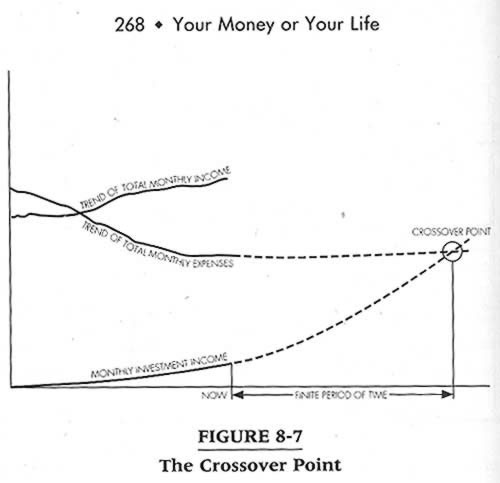
This is esoteric, I know, but it’s important. Reaching the Crossover Point means that, if you wanted, you could stop working for money. You could retire. You could work for self-fulfillment. You could travel the world or write a book. If YMoYL were a novel, this would be the climax of the story:
The Crossover Point provides us with our final definition of Financial Independence. At the Crossover Point, where monthly investment income crosses above monthly expenses, you will be financially independent in the traditional sense of that term. You will have a safe, steady income for life from a source other than a job.
But how can you find your Crossover Point without a lot of fussy calculations? Ryan Stewart dropped a line to share a web app he developed that allows users to play with the numbers. He writes:
I recently read a post on The Simple Dollar that reintroduced me to the ‘crossover point.’ (I first read about it in Your Money or Your Life in 2001). When reading the post I thought, “I wish I had this spreadsheet so I could see what my crossover is.” So, I did what any self-respecting geek would do and I created an online calculator for the world to see! I thought I’d share it with you (and hope you’ll share it with your readers).
In many ways, the Crossover Point is just a fancy way of saying “Retirement”. If you’ve never played with a retirement calculator before, take some time to play with Ryan’s crossover point tool. And then — if you haven’t already — go borrow Your Money or Your Life from your public library.
I’m curious if any of you are actually following the YMoYL program, graphing your monthly income and expenses. Have you begun tracking your investment income? What’s it like to see it climbing toward the Crossover Point?


This is something that’s been at the forefront of my mind recently. My wife and I took the route of paying off our house early, and foregoing certain investment opportunities (outside of the real estate obviously).
Our bills are quite low relatively, and this “crossover point” may well be in reach, given a dedication to tracking expenses and income.
I appreciate you sharing this information. The spreadsheets will come in handy, and I plan to borrow this term when regarding future planning. Thanks again!
I never read the book but I use paper and pencil spreadsheets to keep track of all my investments and all my spending. I don’t plot these expenses monthly though at the end of each year I look at total and monthly figures of spending, saving, and investment income.
About once a quarter I break out the graph paper (from old role-playing days) and plot the principle from each of my investments/holdings. I add to the same graph each quarter in case I was not clear. Nice to see the cumulative graph over the years.
So that is sort-of close to the book’s methods, as I understand it.
This is an interesting concept, but not a new one. Basically, you want your passive income to meet your expenses. Kinda like how Derek Foster built up his dividend portfolio to the point where he could retire at age 34.
I want to mention that I struggled with writing a much longer piece about The Crossover Point. It’s a fascinating concept. As I mentioned above, it’s basically another way to say “retirement”, but it puts the concept in a perspective that I hadn’t seen before.
Reading YMoYL and then coming to the discussion of the Crossover Point was eye-opening. “That sounds really simple,” I told myself. “It can’t be that easy.” But it all makes sense. The trick is that of course it’s not that easy — few people ever reach it. Cutting expenses and boosting investment income are an ongoing process that take years (probably decades).
I was happy to see that Trent had written about the concept, and that Ryan had created a crossover point calculator…
Thanks for the mention JD. This [arguably overly simplistic] chart is a great motivational tool for me. I hope it is for your readers as well.
I’m certainly open to any suggestions for improving it - your readers can contact me via the ‘about’ page on the site.
Awesome, good job with this. I’m going to post a link on my round-up tomorrow. I had a calculator, but this is much easier.
The important caveat is that in order for you to really be able to stop working, the monthly investment income you’re receiving at your crossover point must be low-risk. You have to be able to depend on that same amount (or more) coming in every month. And the problem is that low-risk investments have low rates of return. You can of course kick-start it by investing in the stock market and real estate and other risky ventures, and then if you’re lucky then you can pull out and put the money somewhere safe. But if you follow the Your Money or Your Life approach and stick to low-risk investments right from the start, it could take many decades to reach the crossover point. I’m way too old (48) to try this, as by the time I hit the crossover point I’d be at retirement age anyway!
I read this book a couple weeks ago and while the crossover point explanation was interesting, I found the conclusion of the book really disappointing. After spending so much time explaining how to get your expenses down to meet your investment income, you’d think the authors would explain how to beef up your stream of investment income. Instead, they simply tell you “buy government bonds” — and that’s it! Did I miss something?
This is simply not true… If you retire when you hit your break even point, you have 2 problems:
1. Your income is now fixed at your annual rate of return * your “nest egg”. If you spend your entire interest earnings every year, your nestegg won’t grow, and inflation will eat you alive.
2. Even if you re-invest a portion of the interest to keep up with inflation, you will need to pay capital gains taxes on the investments you’re now living off of, not to mention the cost of benefits that you’d need to pay out of pocket.
Your REAL break even point is when:
investment income - inflation rate * savings = gross job compensation (including benefits).
At that point, you could afford to quit, spend ~96% of your investment income, and reinvest ~4% to account for inflation.
That’s the only way to become truly independently wealthy.
No, you didn’t miss anything. What you found is this great book’s glaring weakness. “But government bonds” is dated advice, and not a smart move in today’s market. The author’s concepts are sound, but the implementation is lacking. Unfortunately, Joe Dominguez has been dead for several years, so the book hasn’t been updated. As a launching pad, it’s great, and it’s helped many people — including me and Trent at The Simple Dollar — overcome debt and take control of our finances. But his one key assumption is untenable.
At some point I’ll write a detailed review of YMoYL. Before I do, I’m going to spend time at the Simple Living Forums, the book’s official discussion spot. I’m sure that this problem is well-known there and has been discussed a lot. In fact, a quick glance at the forums reveals a current discussion on this subject.
Sdub, when you read the book you see that the authors offer strategies for avoiding inflation (many of which involve lifestyle or behavior changes that not everyone would be willing to make). I do think there are inflation-related issues that they haven’t considered, but basically they’re saying you can live for decades on a fixed income without having to worry much about inflation, you just have to make some compromises. If you’re not willing to make those compromises, then you have to take steps to ensure that your monthly income keeps pace with inflation.
I’d like to know if other people in my boat are able to save 20% or more of their income. My husband and I make about $53,000/yr, but after income taxes actually bring home about $37,000. That is not much money to support a family of 4. Even here in the midwest where cost of living is very low. We work hard, rarely go out to eat or do any activities that cost money. We NEVER go on vacation. We own both of our vehicles free and clear, and are very frugal with our money. Yet there never seems to be anything left over. What we do manage to save goes to property taxes at the end of the year. Any suggestions??
I really like YMOYL and think it has some very useful perspectives. When I first read it in my 20s I did track every penny and did some graphing. I’ve always been a quantitative person, love numbers, and grooved on that level of *focus*.
Fifteen or so years on, with the way life looks now…I look at that graph and it’s hard not to laugh! If only it were so simple. Or maybe I should say: it was that simple when I was single and childless, with a relatively steady (though small!) income. And no sense of the kind of curveballs life can throw, I might add!
Now there are just too many variables to even think about trying to “draw the dotted line” of projections. I’m a contract employee and my husband’s job is grant-funded, so income is likely to be variable in the long-term (there’s a nice euphemism for you!)
We have two young kids and that introduces huge “wild cards” for essentially the next 20 years. Day care, after-school care, extracurriculars, maybe braces, college savings, college spending? Assuming the youngest will be financially independent of us when she’s 23, my husband and I will be pushing 60 when the kids are “off our books”.
Projecting returns on investment income in the market is a fool’s game, and even returns on really safe places to park money are surely going to ebb and flow over the next N years. And I’ve been a homeowner long enough now to know that projections about our rental income can be thrown for a loop by any number of incidentals.
I still love number and may start toting up our “monthly investment income”. (It’s one of the only ways to track our money that I don’t currently examine.) But the idea of projecting to a crossover point? I don’t think so. Not that it wouldn’t be an entertaining exercise, but it’d be more or less worthless. For our family, anyway.
I’m enthralled with this concept. Makes me want to sharpen that investment income curve and invest a bunch more!
This is very close to what I’m trying to do with my own finances. The difference is that I’ve figured out my crossover point amount (estimating on low-risk, fixed value investments) and set a deadline as to when I want to reach that point. I know I need to both pay down my debt and save 30% of my salary in order to get there. It’s going to be a challenge!
As for tax, inflation, and health insurance concerns, I’m planning on working part time to cover all of my expenses. My whole idea is to stop working full-time, not stop working entirely.
I guess we could technically be there. If we cashed everything out, moved to a small town condo, and stopped saving for retirement, we could still make ends meet without working. Real estate inflation would probably eventually undo it all, though.
Save more, invest more. The problem is that our lifestyle always changes making it harder for us to reach a crossover point. I have a full time job with benefits and a side business and dividend income and little debt. I’m happy!
Actually, Vicki Robin and some of her colleagues recognized that the emphasis on bonds in step 9 of “Your Money or Your Life” doesn’t always work well for everyone, especially in today’s investing environment.
There’s an article addressing this at the YMoYL site:
http://www.yourmoneyoryourlife.org/gh-step9revisited.asp
Halfway down the page there’s a table laying out various investment options.
Angie, you don’t have to do any projecting. If every month you just calculated the amount you actually earned that month, the amount you actually spent, and the amount your investments actually returned, you would have a very wiggly but still interesting graph.
After a while, you would probably have a fluke month where your investment earnings reached your spending level. Then you would have more and more of these months. Then most months would be like that.
You could also plot twelve-month averages or something to get smoother lines and get a better idea of your typical spending, earning, and investment proceeds.
Jaime,
What I find works for me is to do the “pay yourself first” thing. My 20% savings comes out of my bank account the same day my paycheck goes in, so it never really feels like my money. Granted, I’m a family of one so my expenses are a lot lower. Maybe 20% is unrealistic for your situation and you should aim for 10%.
What really worked for me was that I started doing this shortly after I got a big raise. I was able to go back to my previous level of spending fairly painlessly because I hadn’t gotten used to having more money. If a raise isn’t likely in the short term, maybe you can ease into it. Start with $50 a month and increase the amount slowly so it doesn’t feel like a drastic change.
plus i don’t think ymoyl factors in having health insurance, which is crazy. i have a heart condition and would probably be dead without insurance. as long as we have jobs my wife and i pay about $7-8,000/year for insurance that is paid through our jobs. it would probably be more for this quality of insurance without our employers group plan. plus it’s easy to be frugal with oneself, but it’s hard to be a complete tightwad when it comes to gifts for other people, especially when they live in the non-frugal world. plus i’ve come to the conclusion that even though i feel cable tv/satellite is a rip-off, we get a certain level of enjoyment and daily entertainment from our pvr and having classic movies from TCM and IFC and PBS and some of the other nature and science and documentary shows, not to mention our favorite network dramas.
i’ve watched our investment income (it recently finally got to be over $100 per month), but i don’t think it will ever be enough for us to live on month to month. we’ll just have to keep working. it’s nice to be able to eat out once in a while. my wife is constantly pushing for me to buy organic produce. vacations are nice and culturally expanding, getting to really see how a different culture lives, getting to see national museums that belong to each of us. some hobbies cost some money whereas others do not. c’est la vie.
Huh. Very interesting concept. But stop working? No thank you!
I think I’m one of the very few who isn’t looking forward to retirement. I work in an industry that I absolutely love and one that is constantly growing and changing, you never get the same thing twice. Not working just doesn’t appeal to me so long as I can continue to do what I do.
Although according to Ryan’s calculator, I should reach my crossover point by the time I’m 55. Not too bad.
Hurrah, I didn’t know there was a term for ‘retiring really really early’ (I’ve been working towards a Crossover Point at just before 40, mostly ‘cos I’ll have v. low overheads).
But agree with Elissa- the closer that goal gets, the less I can imagine not working. (even though I’m not “doing what I love”, I love what I’m doing). I’d hoped to transfer to the voluntary sector but my experience is that they don’t know what to do with skilled (professional middle management) volunteers- is there any resources out there for people like us?
@sdub and @brad
Brilliant follow-on to a great post.
sdub, I’d like to do some algebra on the left-hand side of your equation, nothing heavy, here we go:
Original
investment income - inflation rate * savings
Make Substitution
savings * rate of return - inflation rate * savings
Combine like terms:
savings * (rate of return - inflation rate)
Now we can see how ’sensitive’ this expression is to small changes in the inflation rate. For example, a small increase in the inflation rate may require tens of thousands of extra dollars saved to maintian the same purchasing power from the passive income stream.
Enter Brad’s comments, and this as a follow-on: We often use the blanket average of 4% for the inflation rate quantity, but what is the inflation rate really? And can we limit our exposure to it? Some say yes. The inflation rate is based on the Consumer Price Index. I believe it is a summary statistic published by our government, but if this is not the case, someone will post a correction. Regardless of it’s origins, you and I are unlikely to experience a degradation in purchasing power at exactly the same, and for that matter, the published rate. Why? Because goods and services aren’t affected by inflation in lock-step with respect to one another and we don’t all consume the same blend of goods and services. If we pick our consumables such that we maximize their utility per unit of money, then the effect of inflation is minimized. (This is a long winded way to repeat the, ‘be frugal’ message.) In any case, the numbers geek can easily estimate the degradation of the dollar’s value that they personally experience. It won’t even require a complete accounting of purchases. A decent estimate can be hammered out fairly quickly. This may be preferable to using 4% as a rule, especially since the savings goal is so dramatically affected by small changes in the inflation rate.
We can’t eliminate our exposure. Also, the inflation rate varies outside of our control, to be sure. Still, if we study inflation and it’s true effects on our lifestyles as individuals, we have much better data against which to plan our independence.
For more on inflation including historical data, see http://www.inflationdata.com
[...] at Get Rich Slowly has a very good introduction to the “crossover point” as found in Your Money or Your Life. My guess is that this is the goal we’d all like [...]
@CatWhisperer
Good points. I do like that form of the equation better…
savings * (rate of return - inflation rate) = gross income
You can look at it several ways… perhaps at your “crossover point”, you don’t quit your job, but rather take a lower-paying, more fulfilling job, your change in gross income would be smaller, and your savings requirement smaller. Also, as @brad pointed out, you’d want to move your investments into safer, lower return choices, which also affects your savings requirement.
Another version of the equation that takes both into consideration, including a notion of your “personal” inflation rate, which may be lower than 5% would be:
savings * (safe rate of return - personal inflation rate) = change in gross income.
So you can see that if you wanted to go from a job that payed $75k to one that paid $30k, including benefits, etc, you plan to invest your money conservatively at 5% from now on, and your personal expected inflation rate is 2%, you would need to have $1.5M in savings.
Interesting discussion…
[...] Get Rich Slowly provides an Introduction to the Crossover Point [...]
[...] The Simple Dollar wrote a good article describing the basic concept of the crossover point and Get Rich Slowly followed it up with another great guide. [...]
[...] An Introduction to the Crossover Point - J.D. over at Get Rich Slowly presents the classic crossover point. I’m quite familiar with this since it was one of the presentations I used to give in order to scare encourage people to become clients with one of the sleazy financial (I use that term lightly) firms I used to work for. Bonus points if you can guess what firm that is. [...]
this is a great concept to opening peoples eyes to the hope and truth that it can happen for them.
Adding two additional components makes this even more possible.
The first would be to reduce the expenses - ie: Get out of Debt, pay off credit cards and mortgage. Don’t risk your credit rating in this by negotiating or settlement practices. This should also increase your lifestyle - not decrease it.
The second would be to expand your awareness of what investment means. Since the world has been dominated by the pervasive wisdom of the financial services world (Wall Street) we forget that an investment can be made in many areas.
Many experts recommend that everybody set up a home based business. Whether this is a hobby/business, eBay sales, MLM, own a rental unit or any other endeavor, the tax advantages brings the Cross Over Point closer.
http://www.livingreal.com
[...] Money or Your Life: Step Nine Revisited Last Friday, I mentioned the Crossover Point, that point in time at which your investment income exceeds your monthly expenses. I learned about [...]
[...] An Introduction to the Crossover Point, Get Rich Slowly [...]
[...] An Introduction to the Crossover Point, Get Rich Slowly [...]
[...] we reached our crossover point (the average annual return from our investment portfolio exceeded our annual expenses, plus [...]