Do something different this holiday season. Check out
my list of 34 great gifts you can make yourself!


“What do you do with all that produce?” one reader asked recently about our garden. “Do you really eat it all, or does it go to waste?”

We eat it, but not at once. Though we enjoy a lot of the food fresh from the garden, we preserve most of it for later. I’m fortunate that Kris loves to can, and so we enjoy the fruits of our labor year-round.

Canning was once a vital skill for American families, though it’s now something of a lost art. Writing in The Gastronomical Me, M.F.K. Fisher describes an American kitchen circa 1912:

There was a series, every summer, of short but violently active cannings. Crates and baskets and lug-boxes of fruits bought in their prime and at their cheapest would lie waiting with opulent fragrance on the screened porch and a whole battery of enameled pots and ladles and wide-mouthed funnels would would appear from some dark cupboard. [...]

Grandmother and Mother and the cook worked with a kind of drugged concentration in our big dark kitchen, and were tired and cross and at the same time oddly triumphant in their race against summer heat and the process of rot. [...]

I have a feeling that my Father might have liked to help with the cannings, just as I longed to. But Grandmother, with that almost joyfully stern bowing to duty typical of religious women, made it clear that helping in the kitchen was a bitter heavy business forbidden certainly to men, and generally to children.

And so, too, canning seems to be forbidden to me, except when I do something stupid, such as the other night when I picked all nineteen pounds of apples from our tree at once. In these instances, I am required to help with the canning. (My mistake with the apples turned into 3 quarts of applesauce.)

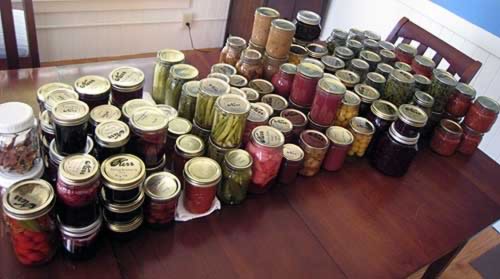
Yesterday, Kris organized her pantry, which allowed us a chance to inventory this summer’s work. So far, she’s put up:

  • 16.5 quarts (approx 16.5 liters) green beans — “It’s too bad you don’t like green beans,” Kris told me. Yes, it is.
  • 7 qt. dill pickle spears
  • 7.5 qt. salsa, which I do like, especially this batch
  • 2 qt. pickled beans
  • 4 qt. spiced apple chunks
  • 4 qt. cinnamon-apple wedges
  • 5.5 qt. canned cherries
  • 7.5 qt. blackberry pie filling — good grief!
  • 3.5 qt. berry applesauce, which is very good
  • 3 qt. spiced applesauce
  • 21 qt. barbeque sauce, most of which will be given away
  • 3 qt. pickled plums in spiced syrup
  • 1 qt. pickled tomatoes
  • 1 qt. dried pears
  • 1 pint dried plums
  • 2 qt. pizza sauce, which she made yesterday and smells delicious
  • 2 qt. strawberry syrup
  • 1 qt. cherry-blueberry preserves
  • 1.5 qt. strawberry jam
  • 2.5 qt. spiced blackberry jam
  • 1.5 qt. berry jelly
  • 1 qt. peach-elderberry syrup
  • 1 pt. red-currant jelly

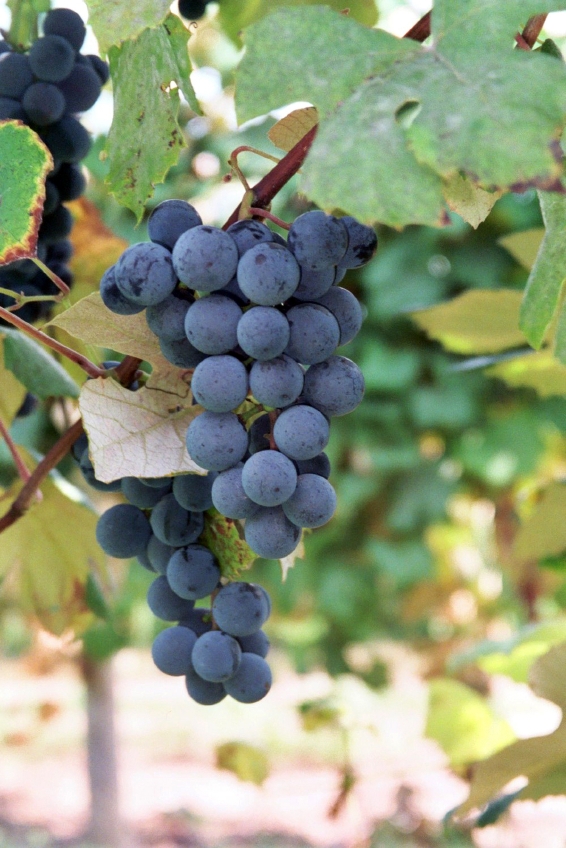
Kris has also put away about 2.5 quarts of freezer jam, 12 quarts of frozen berries, 4.5 quarts of freezer pasta sauce, and 4 quarts of frozen vegetables (tomatoes, snowpeas, beans, zucchini). Before the summer’s through, she hopes to put up another batch of salsa and maybe make something with pears (if she can find a source for the fruit). When the grapes are ripe in a couple weeks, we’ll certainly make grape juice.

This may seem like Little House on the Prairie to some of you, but it’s not. Canning fits our way of life. There are startup costs involved (jars and equipment), but once you have the stuff, preserving the produce you harvest from your garden (or that you pick elsewhere) is an effective way to stretch your food dollar.

The main ingredients for each of these products have come from our garden, from friends and neighbors, from U-Pick farms, or from our local organic produce stand. (Canning food you buy from the grocery store or at the produce stand will taste good, but it’s not cost-effective.)

For more information on canning, check out:

I asked Kris if she could recommend a book for beginning canners, and she suggested the BALL Complete Book of Home Preserving. She also likes Blue Ribbon Preserves: Secrets to Award-Winning Jams, Jellies, Marmalades, and More. Your public library probably has copies of both books.

You may also be interested to read:

51 Responses to “Frugality in Practice: Home Canning”

  1. Jane Says:

    Wow! What a fantastic supply of great food you have. Well done Kris. I borrowed the Ball Complete Book of Home Preserving from the library this summer and it truely is a fantastic source of information. I highly recommend it too.

  2. Will Says:

    Wow that IS a lot of great food! I am thinking I might try this at some point because I love going to the farmer’s market but sometimes don’t use everything before it goes bad. It would also be nice during the winters here in Maine to have some fresh summer vegetables. Thanks for the post!

  3. Richard Says:

    Heh, last night and this morning we canned 22 Qts. of pickels.

    8 Qts. of dill chips and
    14 Qts. of bread and butter spears.
    And 2 Qts. of green beans.

    Our garden is small and diverse enough that we’d been able to keep up with everything up until we took a 4 day trip last week and found an invasion of cukes when we got back…

    This was the first time that we really took care of our garden (last time we didn’t weed) and it was pretty amazing how prolific squash can be and how much watering corn needs. It certainly gave us a better idea of how much of different veggies to plant next time.

  4. Solomon@ThingsI'mGratefulFor Says:

    I picked over a kilo of blackberries today, from the fields that back onto my house, in less than half an hour. I’m planning on freezing rather than canning, though.

  5. liz Says:

    My mom is great - she still cans stuff for us; the biggest thing that I love are canned peaches; she’ll also do tomatoes (for tomato sauce), and she’ll also can mustard beans and pickles.

    For beans, usually, my mom just blanches them and throws them in the freezer…

    But in all honesty, unless you are getting the veggies and fruit for a really really good deal, sometimes canning is not the best use of your money. For instance - is it really worth the cost to spend $3/lb for peaches, and all the money and time for canning, when you can just go to the store and buy a can of peaches every once in a while?

    My folks ran into this this year - they are not young, and my mom usually does a massive canning of dill pickles - but they don’t eat them too much. My mom made the executive decision this year to not can pickles, and to instead just go and buy a jar when they crave them.

  6. Annie Jones Says:

    This is great! We subscribed to a CSA farm over the summer and were able to eat most of what we received. However, I did freeze some of the veggies for later use (green beans, berries, etc.) We didn’t get enough to do canning, but I have canned in the past and enjoy it.

  7. Elizabeth Says:

    How did Kris freeze the zucchini? I thought that it would dehydrate and not dethaw right if frozen.

  8. Adam Says:

    Is this a form of pack ratting?

  9. Kris Says:

    Elizabeth @#7: I followed a reader suggestion and froze the grated zucchini in two-cup aliquots for future bread and muffin recipes. I have never done this before, but I figured it was worth a try when a monster zucchini got away from me.

    Adam @#8: Ha! I suppose it might be! I love gazing at my pantry the way Jd relishes his shelves of comics. But most of this food gets eaten or shared. Kids especially seem to love the applesauce, pears and apples, and we go through the pickles, jams and tomato products ourselves. I don’t do everything each year, so I try to make enough of each product to last us about 2 years.
    By next summer, the basement will be full of empty jars and the pantry shelves will have room for more garden bounty.

    (Although I do admit I found some boysenberry jam from 2001 when I reorganized. That’s much older than I usually keep things.) Kris

  10. Kirsten Says:

    I am always put off making jam by the cost of the sugar. Have you kept track of those costs? Perhaps it’s not as much as I think it is.

  11. Hank Osborne Says:

    That is awesome! My wife and I just did our first round of canning. We canned 5 jars of apple butter. We plan to do more canning, but are starting off small with some apples we picked last weekend in western NC. Both of our families canned when we were children and we want to teach the practice to our children. Thanks for sharing.

    I would be interested to see a breakdown on the cost of canning _____ (filling in the blank) vs. the cost of buying the same quantity of that product in the store. I know there is no price we can put on home grown and knowing what is in your jar, but it would be nice to know how much more or less it costs to do at home.

  12. Carlin Says:

    I am 22 and have, along with my 24 year old roommate, have canned various things (so far Apple Butter, various Jams, and dozens of quarts of Apple Sauce). When we tell people about it, or pass out our bounty, they are rather disbelieving. They view it as an art of the past, not something that my generation can be doing as well.

    This weekend we moved my Grandmother into a retirement community and I inherited her big old pressure canner! Now I am excited to do even more canning.

  13. Brett McKay Says:

    I was talking about this with my mom the other day. She grew up canning as a girl. It was basically an all day event. My grandma would wake all the kids up at 6AM and they would can and bottle fruit and vegetables from their garden all day long.

    I’d like to get into that sort of thing. I just don’t know how to do it. I’m letting my Mormon forebearers down.

  14. Lanna Says:

    Oh, I always recommend the Ball Complete Book. My latest favorite is also Stocking Up by Carol Hupping - some other neat recipes and other growing/harvesting tidbits that are fun to have on hand. My grandma canned like she was preparing for nuclear fallout, and I’ve apparently inherited that tendency, which is kinda fun, just not at 3am on my 3rd round of applesauce. ;)

  15. anna Says:

    *hypnotic message to J.D. and Kris*

    you are getting very sleepy. You must stop everything and send me the blackberry pie filling. When I snap my fingers, you will awaken, and you will have an overwhelming urge to send me the pie filling.

    But not green beans, sorry. :P
    You could probably save even a little more money: I bet some of those canned goods would make great gifts this holiday. A jar of spiced applesauce and those “recipe in a jar” for applesauce cake? I’d stay on you holiday card list forever.

    What’s the chance of doing a reader giveaway for the blackberries? (I think I shorted out my keyboard from the drool.)

  16. Stephen Says:

    Very jealous! (But in the best of ways…we have a small kitchen…too small to can in right now!)

    Any way to extract the salsa recipe from you? If it comes out well after canning, it has to be good and I am currently on the lookout for one that will work.

  17. Caitlin Says:

    I have never canned but I have made blackcurrant jam with freshly picked blackcurrants and that was absolutely fantastic!

    @Kirsten, the cost of sugar is not much compared to the cost of jam - this can literally last you all year from a couple of pounds of fruit. Plus homemade jam makes a great gift to friends, so you can save money on gifts as well.

    I have just read Barbara Kingsolver’s Animal, Vegetable, Miracle and her summer chapters are all about canning and preserving. It’s a lovely book - well written and accessible and inspiring in lots of ways.

  18. Adam Says:

    We’ve been canning for some time now. Most of our information comes from my Alma Mater: http://extension.usu.edu/foodsafety/htm/publications/by=category/category=319

  19. My Daily Dollars Says:

    I’m impressed! I agree . . it’s easier than you’d think to can and so satisfying to have everything stored up for the winter. It’s true, the cost is much less than you’d think. Also, you can control the ingredients. For example, you know that there won’t be any low-quality corn syrup in your jam!

  20. Kris Says:

    I really should keep detailed records about canning costs– maybe next year! As JD said, the start up costs can be intimidating, but I have gotten most of the costly supplies used. I did invest about $50 in a Victorio food mill when we planted the apple trees. It should last me years.

    Here’s a cost breakdown for my recent batch of applesauce:

    12 pounds apples: free– from our trees, the cost for pheromone-traps is already figured into this year’s garden cost.
    3 cups sugar: Sugar is actually very cheap, in my view. If you buy a 10-pound bag, it runs about 22 cents per cup. 66 cents for 3 cups.
    1/4 cup lemon juice: about a dollar
    1 1/3 Tbsp assorted spices, which I buy in bulk, about 10 cents.
    Jars and reusable canning equipment: free. I use jars over and over and friends give them to me. The canning equipment has all paid for itself by now.
    New jar lids for four wide-mouth jars: 80 cents
    Unknown cost of using the gas stove?
    I don’t count my time because I would not be earning income in these hours. I actually count this as a leisure activity!

    Total cost: $2.56 natural gas. Let’s round it up to $3. This made 3 quarts, or 105 ounces of spiced applesauce, at 3 cents per ounce.
    Looking on my grocery store’s website, applesauce on sale is 6 cents per ounce, so the same amount of applesauce would run $6.30.

    A huge cost savings? No way. But my applesauce is organic (costs up to 17 cents/ounce at the store), mostly local, and seasoned perfectly to my taste– and made without artificial anything. I reuse most of the packaging material instead of tossing waste (even if I recycle the plastic container). Plus, I just like doing it!

    Mass-produced applesauce is very inexpensive, so the cost saving will be minimal. But gourmet jams can be as much as 32 cents/ounce. Using free berries, and even counting the lids, sugar, lemon juice and pectin, I figure you can make it for under 10 cents/ounce. And nothing beats your own jam!

    Like many aspects of do-it-yourself, the lower price is an added bonus, rather than the main goal. Happy canning!

  21. kendra Says:

    We do quite a bit of canning too each summer. This year we’ve done mostly plum jam and nectarines with a few pickles. We still have umpteen jars of applesauce, pears and tomato sauce to do.

    If Kris wants something to make her lids look a little bit more cheerful, I designed these canning lid labels for my blog readers. You are welcome to enjoy them too:
    http://asonomagarden.wordpress.com/2008/07/21/canning-lids-download/

  22. J.D. Says:

    @Stephen

    We’ll post the salsa recipe next Saturday. Kris has it typed up already, though, so if anyone’s planning to do some canning before then and wants it, I can send it to you via e-mail. Just ping me.

  23. Anita Says:

    I think it’s great that you do canning, I used to help my mom can and also freeze vegetables. And although it might not be cheaper now, nothing compares to Canned Peaches or anything for that matter especially since you know exactly what your
    ingrediants are.

  24. Brent Says:

    J.D. & Kris,

    My wife, Liz, and I get great deal out of your website and really appreciate it as an educational source. At times, it seems that we are living a very similar life to the two of you, only on the opposite end of the country in central Pennsylvania.
    As a kid in the 1960s/70s, I used to help my mother plant and tend a large garden every year. Each summer and fall she would can and freeze a significant amount of our family’s fruit and vegetables for the next year. Interestingly, we just started doing this ourselves these past couple of years. Seeing Kris’s larder is really motivating. We also experience harvesting, canning, and freezing as liesure activities and great times to work together on a common interest. It reminds me of the people that were quoted in the Orion Magazine article “The Gospel of Consumption” who perferred working a shortened work week. It enabled them to do things like canning as an extended family and provided a path for connection of family members. Pretty cool.

  25. db Says:

    @ Kris & JD:

    Kudos on all the great canning! Here is my list of all the ways this a great beyond just being more cost-effective per ounce:

    1. It’s more sustainable. You make an initial investment in the supplies up front, but after that you can reuse the jars over and over. It drives the costs down AND it minimizes storage container waste in the landfills.

    2. You have more control. Since you know how you grew your fruits and vegetables, you know exactly what sort of pesticides/chemicals you are being exposed to (or not).

    3. You can pick the food fresher so it’s healthier/riper. Even ripe food in the stores has been off the vine for a while. Unless you’re buying your produce locally, even fresh doesn’t measure up to the sort of freshness out of your garden.

    4. You are doing a great thing for the earth in reducing the transportation costs associated with your food. It’s all from your garden, so no gas was burned shipping your food to a store or driving to a store to buy it.

    I’m sure I could come up with more. But you’re my heroes! I’m jealous.

    My mom used to can and she made the most delicious zucchini and carrot pickles ever. I don’t know why she stopped.

  26. Boomer Says:

    Sounds like you really like this batch of Salsa. Would you care to share how you made your salsa? I’m struggling with a good recipe for it. Thanks!

  27. Jess Says:

    Uhh JD, why is there a WoW ad on the feed today? *tsk I thought that you gave that up.

    Google Reader KNOWS ALL!!! :P

  28. elena Says:

    We get a box of canned jams, jellies, pickles and relish every Christmas from a beloved aunt.
    It is heaven. I do secret trades for my favorites. Canning is a lovely thing to do.

  29. Amy F Says:

    I just canned 10 qts of tomatoes yesterday (1/2 bushel from the farmer’s market) and have plans to do you-pick apples and raspberries this week.

    I’d really like the berry applesauce recipe!

    Our garden hasn’t produced enough to can, but I’ve been bulk-buying from the farmer’s market and you-picking to get our favorites. This season we’ve canned: 20 1/2 pints rhubarb jam (rhubarb is free), 20 qts dill pickles, 1 1/2 bushels tomatoes (about 20 qts whole tomatoes and 20 pts spaghetti sauce), and 11 pints applesauce. I’ve also frozen a bushel of green beans, a gallon of blueberries, a gallon of raspberries, 12 additional cups rhubarb, and I’ve got 13 green peppers waiting to be chopped and frozen tonight. I’ve never done more than jam and applesauce, so it’s been a big year. My four year old does remarkably well with an apple slicer/corer/peeler.

  30. Donna Freedman Says:
    Hi J.D. and Kris,
    I grew up canning and gardening but now live in a Seattle apartment with zero space for growing and zero time to get a P-Patch garden plot. So my canning is all (free) fruit, all the time. I suggest that anyone looking for free produce do what I did: Put an ad on Freecycle. People who aren’t using the fruit or who have too much of it may be amenable to your taking some. I proposed it as a trade: Give me enough fruit to make jam and I’ll give you a jar of it.

    (I didn’t think of doing it for vegetables, but maybe I will next year.)
    I advertised really late in the summer, but still ended up with enough free fruit to can nine pints of pears, six pints of plums, three quarts of applesauce, six jars of apple butter, five jars of plum-pear jam, a dozen jars of plum jam, and I honestly don’t know how many jars of blackberry jam (it’s been put away in a couple of cupboards and I’m too lazy to hunt it down). I’ve also frozen a bunch of blackberries for winter shortcakes and to add to bread pudding.

    The jam jars are different sizes, from 4 to 16 ounces, so I’m not sure what it adds up to — but there’s a lot of it. (Next year I’m keeping a log, I swear.) I’ll give much of this away as gifts; it’s especially good for those people who already have everything.

    Just finished my penultimate batch of plum jam and my apartment smells WONDERFUL. This year I tried making it without commercial pectin and was pleased with the results, although it meant more boiling and stirring. While I cooked this batch I did the math and figured out that it cost me about 16 cents per 8-ounce jar. The sugar was on sale, and I got a splendid deal on jars, rings and centers at a yard sale earlier this summer. And the fruit, of course, was free. :-) Watch yard sales and thrift shops for canning supplies, but also rummage sales and estate sales — people are cleaning out attics and garages.

    Recently there was a coupon for Ball canning products in the Sunday coupon section: Buy three boxes, get one free. I had two coupons so I bought eight boxes of centers (96 total) for just over $11, or about 11.5 cents apiece.

    I urge people to give preserving food a try — but be warned that it’s pretty addictive. Even though I probably have enough blackberries, I still want to go out and pick some more because, well, they’re growing right around the corner. And they’re free.
    Like I said: Addictive.

  31. Annette Says:

    I haven’t seen anyone mention the difference in taste. For us, a jar of fresh canned peaches is like a jar of sunshine, even the expensive store bought ones in the glass jars don’t come close to the summer ripe taste of home canned peaches. While other preserves also have improved taste when done at home, the biggest difference in taste for us is in the peaches. We also grow our own beef and pork, and while the beef is good, home grown pork has a flavor nothing I buy from the store comes close to.

    To the person who felt this was hording, sure is, just like money in the bank. Recently Money ran an article on the the best financial advice you ever got. One of the comments was, if you only had $1000 to invest, put it in non-perishable food. I compare my pantry to a good emergency fund, and it gives me the same satisfaction as a barn full of good hay. Nothing like the secure feeling of a full emergency fund, full pantry and freezer and a barn full of hay as winter looms around the corner. While not many people crave a barn full of hay anymore, most people have room for some summer fresh preserves.

  32. Becky Says:

    I would also like the salsa recipe and I did want to do it this week, but I suppose I can wait…. (I’m reading from Poland. Salsa over here is something like $6 for a small jar of Old El Paso.)

  33. Ryan McLean Says:

    All of those jars must have cost you alot of money??

  34. Chris Says:

    Canning equipment can be very inexpensive. I got my Boiling-water-canner (practically new with rack)at a garage sale for 3.00.

    I get tons of canning jars from older relatives who no longer process their own foods. You can also find them at garage sales and thrift stores. These last forever. Just check for any cracks or chips, especially around the rim. Cracked or chipped jars should not be used.

    I also got tons of new lids, still sealed in the boxes at a garage sale. 11 boxes for 2.00. That was a score!

    I do a lot of trading. My neighbors give me free pears if I give them pear jelly, applesauce, etc. I give my BIL hot pepper jelly and he gives me fresh-caught salmon, smoked salmon, pheasant, etc.

    I guess you could call canning pack-ratting. At least it’s a constructive form of pack-ratting. It’s a way to save money, support my local farmers at the u-picks, and enjoy home-canned food that tastes soooo much better than anything you can buy at the store. Also, here in Michigan, you need to have some sort of emergency foods. There can be times in winter when you don’t want to (or can’t) venture out for a week at a time. Okay, and the pretty jars of jams, fruits, tomatoes look so pretty on the shelves too!

  35. EscapeVelocity Says:

    Have you tried dehydrating? I’m curious to try it–hear it preserves nutrients better than canning does.

  36. Christy Says:

    I totally love this. I thought I was the last person under 40 into canning. :) Its awesome. It’s hard work in short bursts but so very satisfying. I absolutely love the post about bartering for free fruit. I never thought of that.

  37. Mary Says:

    I actually just finished up my first canning experiments - 6 half-pint jars of spiced pear butter from free pears that I got from my boyfriend’s sister’s mother-in-law’s tree. (Third-hand, but still.) I also used local Pennsylvania white wine in the first step.

    There’s an apple tree on my walking route to work and I’m seriously thinking about asking the nice people who live in the house if I can go pick their apples in exchange for some eventual apple butter.

  38. David Says:

    Taking the idea of buying in bulk and repackaging in smaller containers, my mom once bought a #10 can of chili sauce (it was very cheap) and processed it into pint jars. That was last year and we still have jars of it around. Also, for freezing stuff, I highly recommend the Food Saver vacuum sealing stuff. The initial outlay is high, but the quality of frozen food frozen vacuum sealed compared to just plain plastic bags is beyond compare.

  39. partgypsy Says:

    You can send me the green beans!

  40. Becky Says:

    My daughter’s friend’s mom has apple trees. This year the fruit is abundant. I’ve been giving her 1 liter for every canner full I make from her fruit (7 liters).

    I’m glad and I think so is she. My mom got me the Victorio Strainer at a yard sale for a couple of dollars a few year back and it is WONDERFUL. Everyone loves turning the crank and it seems like a miracle how that ugly stuff comes out and the applesauce comes out the other side.

    The jars CAN be expensive at first (ha) but if you let people know you want to do it, I’ll bet that there are plenty of people in the area who would look out for jars at yard sales/sales for you.

    Here in Poland we just use the jars that they sell other things in. They don’t have the system that we have in the states. You can reuse the lids as well. It really is cheap. But I do prefer the throw away lids as they seem to be more mistake proof.

    I have a zucchini confetti relish that I make that people here love, so I make a couple of double batches to use as presents.

    Yes, it can be addicting, but it is a fun addiction and one that my kids love.

    The taste of my homemade peach jam and what we can buy…no comparison, mine is better. On the other hand, I prefer store bought canned peaches. Weird, huh?

    For those of you just starting, my advice is to start simply. Make jam the first year to get your feet wet, using only the boiling water bath, then advance to actually canning other things like pickles, vegies and fruit concoctions. Getting a pressure canner and doing green beans is another step. It’s not really hard is only really in your imagination. It just takes time. If most people would cut out their tv time, they’d have the time they need. It’s only seasonal.

  41. Jennifer Says:

    I love to can and every year I do more and more of it. Yesterday I canned 9 pints of pears. Today I have canned 10 quarts of applesauce and I will do about 10 more tomorrow. Also this summer I have made blackberry jelly, blackberry/raspberry jelly, blueberry jam, pickles, 2 batches of salsa 1 spicy, 1 not, and am going to make apple jelly later this week.

    I would second Kris’s recommendation on the Ball Blue Book of Preservation - it really is a must have if you want to can. It has all the info you need for just about anything. Canning is not nearly as hard as people think and it is very satisfying work. When I finally sit down after spending a few hours canning and look at the jars neatly lined up on my counter cooling I can’t help but smile at the thought of all that good food being eaten by my family this winter. I love it!

  42. Brian Says:

    Hi there,

    Thanks for this post; I really enjoyed it. We’ve done canning before (salsa and applesauce) and we love the results. The only problem for us is time. How many hours did all of that canning take?

  43. Bobbi D Says:

    This is one of the most inspiring posts ever! My sister in NC can’s, but I have never had much luck. I think it may be time to give it another try though. To all of you who can, my hat is off to you, thank you!

  44. Anca Says:

    FYI, there’s a 3-page canning how-to in the latest issue of Bon Appetit magazine (p. 116).

  45. Hermgirl Says:

    Mmmmm, spiced apple chunks and cinnamon apple wedges!

  46. Ben-David Says:

    Allow me to be the contrarian here:

    I now can a lot less than I used to. Part of this is because I now live in a milder climate, but… To those with gardens I say:

    rethink your garden layout,
    try compact/container seed varieties,
    and explore climate-extending techniques.

    In many areas of the country you can eat fresh veggies earlier and later than you think - by selecting early/late varieties from a seed catalog instead of settling for what the garden center offers. And by using inexpensive season-extending methods.

    Look into Square Foot Gardening and Raised Bed Gardening - both of which make it easier to use cold frames, mini-greenhouses, black plastic mulches, polytunnels, row covers, and other season extenders.

    If you have enough space for trees, you can select varieties that spread the harvest out. A lot of garden and orchard advice is geared towards commercial farmers who want a large, uniform crop ready all at once. Instead, the home orchardist/gardener wants the exact opposite.

    I now only can seasonal items that cannot be dried - largely berries and fruits that ripen in a short time window. Since I live in a place with hot, dry summers, I dry more peaches, grapes, and apricots than I can. Instead of laboring in a steaming hot kitchen in the heat of the summer, I put the fruit in trays and let the sun do the work for me.

    Canning is a lot of work, and can use a lot of energy in processing. In many areas of the US, it’s not the optimal solution for food production or preservation.

  47. Ruthie Says:

    To avoid the heat in the kitchen (since we don’t use AC) I can everything on a propane grill side burner. I try to batch as much of my canning together as I can to keep the water hot, and only half a propane tank will do all of my summer canning.

    I looked at our grocery receipts last month and realized that because of our own garden, our normal eating budget was down by $100! So I looked at some sales of things we eat every day (certain cookies and pretzels that always go in lunches) and I spent that $100 that I saved because of the garden on those sales, effectively saving $50 by stockpiling those items. This month, because of the garden, some strategic stockpiling, and my own canning, our grocery bill should be half what it normally is.

  48. Green Says:

    Hi there–

    So glad to see that so many others are into canning too! Out of my large family, I’m the only one who still does it.

    We are currently working on 2 bushels of plum tomatoes bought from the local farm stand, which we are turning into sauce via vintage canning equipment from my grandmother’s day. (Next year we will plant enough so that we don’t have to buy any.)

    I’m curious about other people’s tomato sauce canning technique: the books usually say that the jars should be boiled after filling them and putting the lids on, but we’ve never done that, and we’ve never had problems with the lids not sealing or the sauce spoiling. Does anyone else just fill the jars with boiling-hot sauce, close them up, and let them seal on their own?

    Thanks for such a great site, btw.

  49. Mr. Obvious Says:

    I’m curious about other people’s tomato sauce canning technique: the books usually say that the jars should be boiled after filling them and putting the lids on, but we’ve never done that, and we’ve never had problems with the lids not sealing or the sauce spoiling. Does anyone else just fill the jars with boiling-hot sauce, close them up, and let them seal on their own?
    —-
    I’d never do that. I always boil or pressure-can everything that I jar.

    All it takes is one batch of botulism to ruin your family’s day.

    As for the costs of canning: the biggest recurring cost is the darn lids, which seem to go up in cost every year, and are never on sale. You can get jars easily from the paper…its a dying art and people are always looking to get rid of jars.

    Canning is not so much a cost saving technique, but more of a value added technique…the savings can range from moderate to minimal to nominal (especially if you factor in your time), but the flavor of your own canned products is far superior to the stuff you buy at the store.

  50. Lanna Says:

    I always water bath or pressure can everything that goes in the pantry. Yeah, I’d prefer not to meet Mr. botulism. I believe that putting the lid on hot foods was how folks used to can (like people used to use the rubber rings, inversion, wax, etc.) but I believe there’s since been more research done on it and the water bath and pressure canning are safer.

    As for cost savings… I did u-pick for strawberries ($1/lb), green beans (5gal bucket for $5) and so on, in addition to “free” stuff from neighbors and their trees and my own backyard (and since I’ve started saving my own seeds, that cost has gone down as well!). Considering I’m able to make and can things that are at the peak of their flavor and nutrition and lacking in high fructose corn syrup (I detest those commercials), it’s just a world of difference. Feeding my young kids the good stuff is almost priceless. My 5yo *loves* green beans, and will happily tell anyone and everyone that his favorite vegetable is broccoli. :) My 2yo will munch down an entire apple from the tree in the yard, and would try to sneak strawberries from the strawberry beds this summer. It’s just a fabulous way of life for us - and one way for me to keep grocery costs down since we’re a one-income family.

  51. Matt Says:

    We recently got into canning. One tip: getting the canning jars at a resale shop like Goodwill can save 30 - 50% then buying them new.

Leave a Reply

Subscribe without commenting

Subscribe to comments on this post via RSS feed.