How Much Does the Stock Market Actually Return? Print
Tuesday, 16th December 2008 (by J.D.)This article is about Investing
This post is graphics-intensive. To see the entire thing, you may have to click the “more inside” link.
The recent market turmoil has the naybirds out in force, and they’re decrying the long-term viability of stocks. I think this is nonsense. Though I try not to be dogmatic around here, today is an exception. Today I am going to sing the praises of the stock market.
Learning from the experts
When I began to turn my financial life around, I made a habit of reading books about money. The more I read, the clearer certain patterns became. I wrote about these patterns in my very first post about getting rich slowly.
I’ve continued to read personal finance books, including books about investing. And I’ve continued to detect recurring themes. One of the most prominent themes — present in most investing books and present in most conversations with real-life financial planners — is that, in the long term, stocks produce attractive returns. They may fluctuate in the short term, and may even decline by 50% in a single year, but historically, they yield an investment return of about 10%.
But I’m no financial expert. I’m just an average guy who is trying to build his wealth. Let’s see what the actual experts have to say. In this post, I’ve included excerpts from four of my favorite books about investing.
From Yes, You Can…Achieve Financial Independence (2004)
This book by James Stowers contains some of the most complete information on investment returns that I’ve found. And Stowers presents it in interesting ways. Here’s what he says about comparing the short term to the long term:
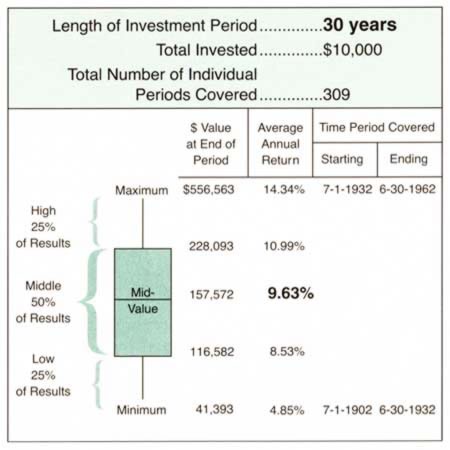
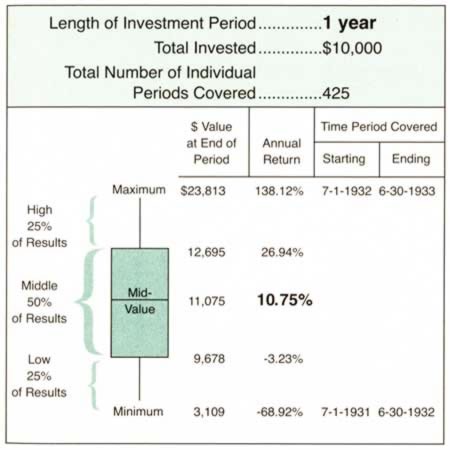
[A $10,000] investment made on 01 July 1932 would have realized, one year later, the worst one-year result out of 425 [periods tested]: minus 69%. Most people, if they had experienced those poor results, would have assumed that this was an indication of future performance and would have become discouraged. Many would have traded their investment back for dollars and tried to find another place to invest their money.
Had they had confidence in the long-term opportunities of the Dow and left their investment undisturbed for another 29 years (30 years total), it would have been worth $556,563. The original investment, which began with the worst one-year result, grew at an average annual compound rate of 14.34% (the best 30-year result). As you can see, it is unwise to assume that short-term investment results are an accurate indication of long-term performance.
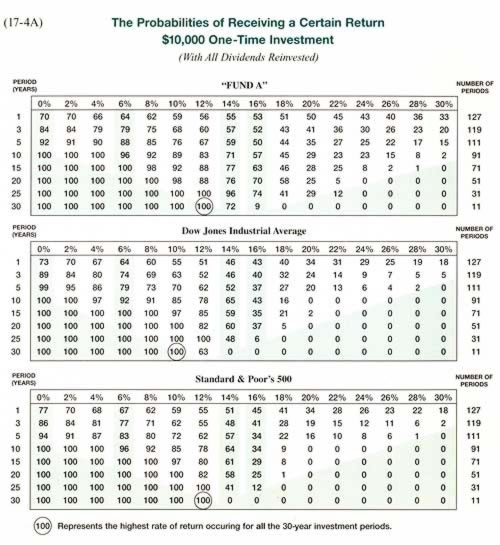
The following charts indicate the probability of obtaining a certain return from a $10,000 one-time investment. The top line of each chart indicates the one-year probabilities. So, for example, there’s an 55% chance that the S&P 500 Index will produce a 10% return over a one-year period. There’s an 85% chance of obtaining that return over a decade. But, historically, there is a 100% chance of earning that return over a 30-year investment career. (Ignore “Fund A” — it’s irrelevant to this discussion.)
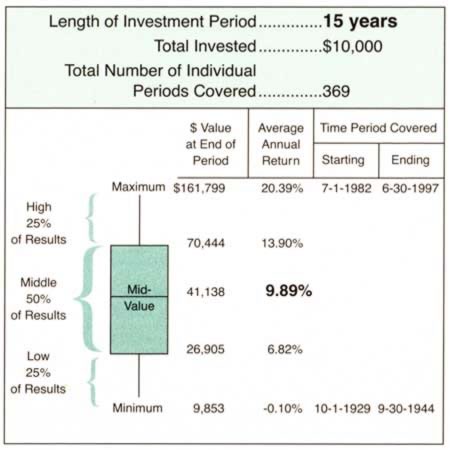
These next three charts provide snapshots of 1-year, 15-year, and 30-year investments from January 1897 to December 2003. The “individual periods” have quarterly start dates. Each chart breaks returns into quartiles. Watch how the numbers move to the middle — at about 10%.
From Saving and Investing (2005)
Michael Fischer’s slim volume remains one of the best and most under-rated finance books of the last few years. It’s a shame it doesn’t have a wider audience. Fortunately, Fischer’s Saving and Investing channel on YouTube continues to grow. (1350+ subscribers now!) Here’s his take on the impact of time on investment returns:
The impact of time (7:15)
From his book:
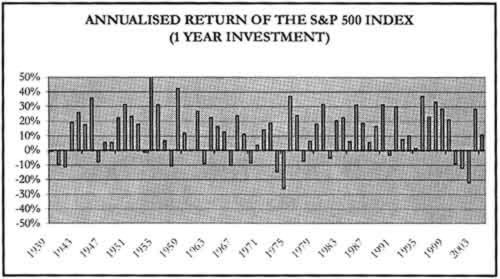
In order to capture positive long-term returns from a volatile asset like equities [stocks], it has been easier to predict the result when the asset is held for a long time. Over short time periods the returns are very difficult to predict, and jump around a lot. A longer time horizon significantly increases the likelihood of having a good result.
One implication of this is that when we invest in volatile assets like equities, our investment horizon should be longer to increase our chances of achieving a positive result.
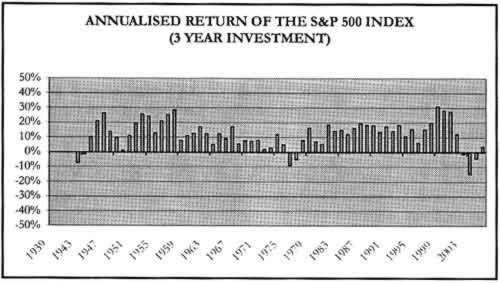
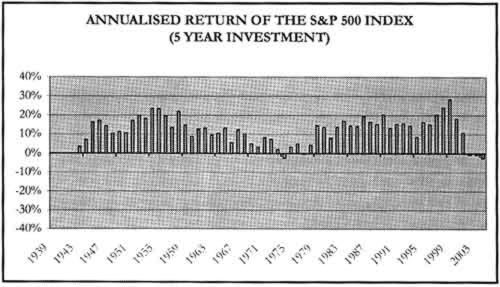
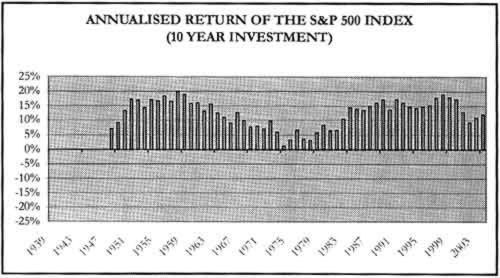
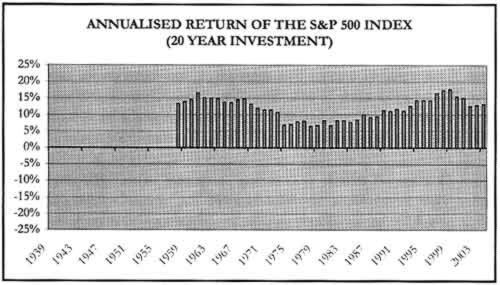
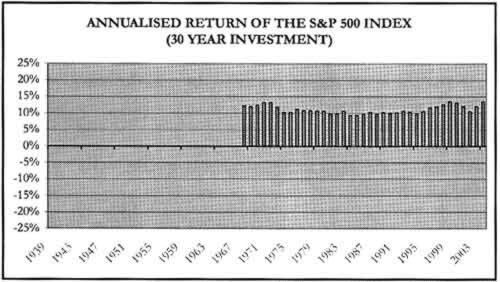
Here are series of charts tracing the annualized return of the S&P 500 Index for a variety of time periods ending from 1939 to 2003. Notice how the one-year returns are all over the map. As the investment horizon increases, the returns become smoother.
From The Four Pillars of Investing (2002)
If I could recommend one book to those who want to learn about the stock market, I think it would be The Four Pillars of Investing. The author doesn’t sugar-coat anything. As he describes the history of speculation, he explains that there’s every possibility that the U.S. stock market’s past performance could simply collapse in the future. All the same, he cannot offer a better long-term investment:
Short-term risk, occurring over periods of less than several years, is what we feel in our gut as we follow the market from day to day and month to month. It is what give investors sleepless nights. More importantly, it is what causes investors to bail out of stocks after a bad run, usually at the bottom. And yet, in the long-term, it is of trivial importance. After all, if you can obtain high long-term returns, what does it matter if you have lost and regained 50% or 80% of your principal along the way?
This, of course, is easier said than done. Even the most disciplined investors exited the markets in the 1930s, never to return…If you want to earn high returns, be prepared to suffer grievous losses from time to time. And if you want perfect safety, resign yourself to low returns…High investment returns cannot be earned without taking substantial risk. Safe investments produce low returns.
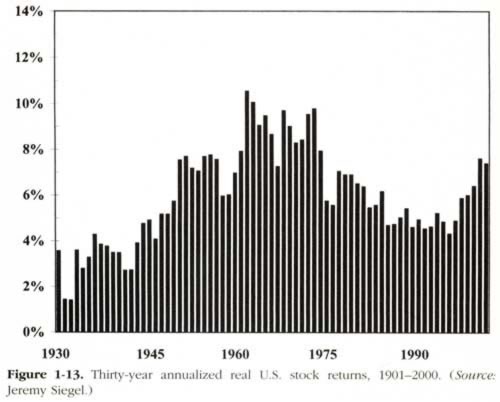
In this chart, Bernstein shows the 30-year annualized inflation-adjusted return on U.S. stocks.
From The Random Walk Guide to Investing (2003)
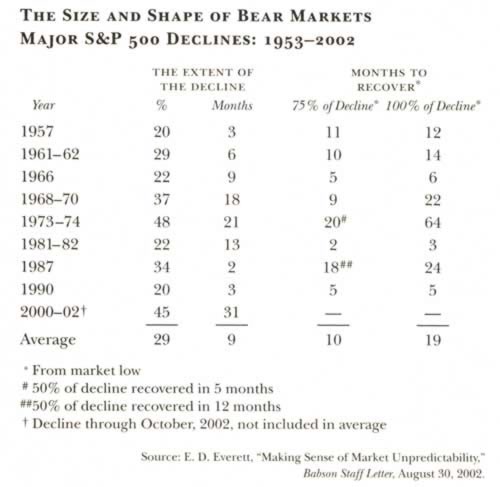
Finally, financial guru Burton Malkiel also makes the case for stock-market investment. Like the others, he notes that the stock market can (and does) enter prolonged periods of declining value:
Common stocks have been the big winner, providing an average annual return of about 10 percent. This 10 percent return includes both the dividends and capital gains resulting from growth over time in corporate earnings and dividends. But these generous returns have been achieved at the expense of considerable annual volatility, which is a good indicator of risk.
In some years, stocks have lost more than a quarter of their value. And sometimes there have been three years in a row of negative returns, as was the case from 2000 to 2002. In fact, equity investors have suffered through several severe bear markets over the past fifty years. The chart below shows the magnitude of the declines as well as the number of months it took the stock market to recover.
Later in the book, Malkiel writes:
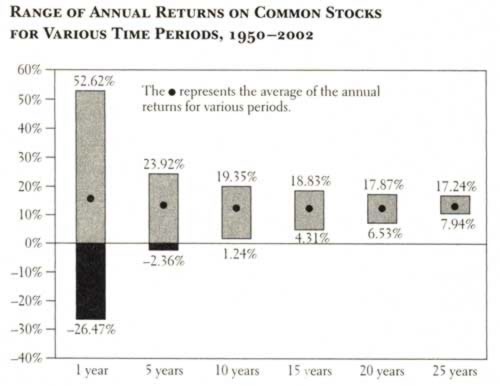
It turns out that the longer you hold your stocks, the more you can reduce the risk you assume from investing in common stocks. The chart below makes the point convincingly. From 1950 through 2002, common stocks provided investors with an average annual return of a bit more than 10 percent…
Even during the worst 25-year period you would have earned a rate of return of almost 8 percent — a quite generous return and one that was larger than the long-run average return from relatively safe bonds. This is why stocks are a wholly appropriate medium for investing in long-term retirement funds.
The bottom line
All of the books say the same thing: over the long term, stocks have returned an average of about 10% per year. Obviously, there’s no guarantee that they’ll continue to offer these sorts of returns, but there’s no reason to believe that they won’t, either.
Yes, 2008 may blow a lot of these charts out of the water. But you know what? I have confidence (some might call it “faith”) that, in the years ahead, we’ll see a regression toward the mean. That is, the returns will tend toward the historical norms to which we are accustomed. If you do not share this confidence (or “faith”), then I’d argue that your risk tolerance is too low, and you should consider other investments.
It’s a stock-market crash at the back end of your investment life that will hurt you — if your asset allocation isn’t appropriate for your age — not a crash at the front end. A crash at the front end has, historically, been a good thing. What does this mean? If you’re in your twenties or thirties, the statistics would seem to indicate that your best bet right now is to buy into the stock market. That’s what I intend to continue doing.

RSS Feeds
Facebook
Twitter


December 16th, 2008 at 5:30 am
I’m glad I’m beginning to invest money into the market then. However, would you recommend mutual funds then over buying individual stocks for getting 10%+ returns on investment?
December 16th, 2008 at 5:31 am
As a 25 year old, the share market has looked more and more discouraging. I’ve been an advocate for real estate for the majority of my adult life. As both real estate and stock markets dip, I’ve found that it’s a lot easier to get into stocks now, than it is to get ahold of property. I can still invest a couple of hundred dollars in the stock market, while things look gloomy, but I need more capitol to get started in real estate.
December 16th, 2008 at 5:36 am
Is there any reason why you’re cherry picking US stock market, and from a narrow time period? Look at Japan which from 1921 - 1996 (75 years), had -0.81% real capital appreciation. If the 10% is real, then shouldn’t be observed across different types of countries on the planet, in multiple scenarios? The fact that it hasn’t suggests to me that it is not sustainable. In fact, no market has ever had the type of growth the US has from 1897 - 2007 (not even the US prior to about 1900), which suggests that the US performance may be anomalous and atypical.
December 16th, 2008 at 5:36 am
Great article JD and you hit the nail on the head. If you’re young, buy as much as you can now. The comment about ensuring your portofolio is appropriate for your life cycle is also very important.
A stat I recently read indicated that equity markets had returned approximately 9.4% over the last 10 years (ending 2007), however the average equity investor only recieved 4.5%. The reason why? They tried to time the market and pulled out when things got rough, the result is sub-par performance.
Time in the market, not timing the market is the key to successful long term investing.
Thanks for posting this today, we need more advice like it.
December 16th, 2008 at 5:45 am
Tell the Japanese about that 10% return 100% of the time over 30 years. The Nikkei is ~8,000, and its been 19 years since it hit around 30,000. They have a lot of work to make up in the next 11 years, but we’ll see how it goes. It’s funny how similar what we are going through now is to what the japanese went through in the late 80’s, and yet they had one of the biggest savings surpluses in the world, and now we are the biggest debtor nation in the world. It will be interesting to see how things turn out for us over the next 19 years.
December 16th, 2008 at 5:46 am
Thanks for the post.
I have consistently urging the younger people to buy stock because I predict positive results in the future for them.
It’s a long term thing but it works.
December 16th, 2008 at 5:49 am
@Frugal
Each economy is different. So we can’t compare say, the US with the Japanese economy, because the institutions, culture, etc, lead to a different game with different rules.
I’d find it hard to believe that a unsustainable bubble would last 100 years. I agree with JD, in that, if you are young right now, buy, baby, buy
December 16th, 2008 at 6:02 am
But…. sometime history has little to do with the future and this time the dollar is over extended. The US has plundered the wealth of the world and the value of the dollar will drop to reflect our production. At that time, when the dollar loses 90% of its value, who cares if stock’s return 10%?
December 16th, 2008 at 6:22 am
the wording is not just “consistently higher returns” — it’s “consistently higher returns than bond returns”.
when you look at it this way, it could be that for the past X years, American investors have consistently mis-priced equity issues. we have undervalued the companies, and so they always outperform what our initial valuation of them is.
if this is a “market out of equilibrium”, i’d say that everyone investing in index funds would be a good way to “correct” the equilibrium — therefore driving the rate of returns on stocks down to the rate on bonds.
of course, this is probably a long way off, but i believe that with individual retirement accounts, access to cheap internet brokers and a general increase in the number of families buying into the stock market, the return rates will come down.
you don’t have to be an investment genius — or be wealthy and connected — to invest in the markets anymore. the “round lot” and “broker’s fees” have gone the way of the dodo.
December 16th, 2008 at 6:25 am
Really stellar post! This collection of charts and graphs is the best I’ve ever seen for demonstrating the value of long-term investing. The message is clear - you may see some variability in the short term, but long term you are practically guaranteed a 10% return.
As a young investor, this gives me the confidence to keep putting my money into the S&P index (with Vanguard, of course!), even during this downturn.
December 16th, 2008 at 6:32 am
JD, thank you for this post. Pictures go a long way toward helping people to understand and internalize the facts.
Also, I can’t help but shake my head at how some people can stare such a wide amount of data in the face and say “Not this time! This time will be different!”
From another equity zealot, great job.
December 16th, 2008 at 6:33 am
It’s interesting, bordering on amusing, how many people act with certainty about what the future holds.
Humans are terrible at forecasting any event beyond the present moment, especially those events beyond absolute control.
JD’s observations are logical and prudent, primarily because they are absent of “prediction.”
“History does not repeat itself, but it does rhyme.” ~ Mark Twain
December 16th, 2008 at 6:42 am
Let me be clear: I’m well aware that past performance is no guarantee of future results. There is a possibility that the stock market will continue dropping and never recover.
However, I believe that’s a slim possibility. I also believe that the doomsayers come out during every recession. Don’t believe me? I just picked up a book the other day written during the late 1970s that could have been written by a modern-day prophet of doom. He was wrong then. I have to believe that his counterparts are wrong today.
Again: I believe that the market will continue to follow its past performance. If you do not, then make your investment decisions based on your beliefs.
December 16th, 2008 at 6:46 am
Over the previous 100 years, our market has been largely based on the production of tangible goods, and a large workforce of median-income blue collar jobs. The next 100 years will be completely different in that respect.
To say we know that 10% annualized returns will be there if we just stay invested is denying a little bit of reality.
The game has changed dramatically, and we do not know what is coming. We could be staring down exactly what the Japanese are facing. We could be talking 15 years from now about that huge rise up to 14,000 that we will never see again. Staying in improves your odds of seeing that 10% annualized versus pulling out, getting in, pulling out, getting in - IF the market does what it has done before.
Read the post for what it means to you, it’s an excellent summation of data and knowledge. It is NOT a prediction of the future.
Ultimately you have to believe in the market or not, based on your gut, your faith, your mind and your money.
You’ll either be right, or wrong. The good news is you’ve got a 50% shot.
December 16th, 2008 at 6:48 am
I am heavily in the market, but it is not a sure thing.
We always see stock market facts from the 1930s to the present. It is a period where the gold standard was dropped, consumers were driven to negative saving, and corporations stretched into riskier and riskier investments to produce higher profits. Remember that even Rome fell, England was the super power in the world 100 years ago… and that with all our debt China makes our life possible. Most of all, remember that most of this data is produced by people that make money by having you invest in the market.
And remember the everlooming disclaimer… past is no indicator of future results.
December 16th, 2008 at 7:18 am
This is a great all encompassing post on the virtues of stock investing. I couldn’t have done better in a book than what you did here. I’m linking back to this and saving myself the trouble of having to write about why one should invest in stocks.
December 16th, 2008 at 7:20 am
Let me try to emphasize JD’s comment down here in another way: the best predictor of future behavior is past behavior UNLESS you have additional information that indicates otherwise. So basically, if you drop a rubber ball, it should go up and down the way it always has, unless you know something that makes this ball drop different from every other ball drop (it is cold, the ball is not actually rubber, etc.).
If you think you have solid information that indicates this stock market drop is unlike every other one we’ve seen, then don’t invest. Otherwise, except that it will do the same thing it has done in the past and do invest. I’d be in the latter group, if I were a poor academic. *grins*
December 16th, 2008 at 7:24 am
I too am a proponent of the stock market, mostly because I want to believe that I can use it as a tool to make money over the long term. Still, I’m skeptical when people give me figures based on the returns of someone who started investing in 1897. I get it, the only concrete thing we have to go on is history, but this isn’t the Industrial Revolution, and the market is much more saturated now than it was then.
December 16th, 2008 at 7:28 am
The charts shown aren’t really accurate. The periods chosen have a disconnect smack dab in the middle.
In 1971 Nixon eliminated the Gold Standard. This ushered in a new era of gov’t sponsored/managed inflation. So from 1971 on we have seen a consistent slippage in real purchasing power. In order to make those charts meaningful, you would need to back out the effects of inflation and deflation. Then the Post 71 gains become less impressive, and the horrible 30’s less horrible.
Investment in stocks is still the best game in town. But buy and hold certainly isn’t!!! All studies of financial markets say the same things:
1) Expenses affect mutual fund performance more than management.
2) A portfolio that is well constructed via asset allocation takes out much of the manageable risk.
3) Periodic re-balancing acts as a safe market timing mechanism. It forces you to take profits and to buy more of assets that are out of favor. and if you use seasonality, you can help increase your returns even further.
December 16th, 2008 at 7:32 am
I have about 15-20 years to go until retirement and am scrambling to make up for inadequate early investments, plus I’ve lost a bundle in RSPs in the recent market meltdown, plus I may need to sell my house soon at less-than-peak value.
But if I come out of this with 50-80K that has to go somewhere, I may try sinking 10K into an indexed stock fund and leave it alone for a couple of decades. I’ve already lost 16K on paper in my RSPs, so 10K doesn’t look like a huge hit any more.
December 16th, 2008 at 7:40 am
Interesting post. I’m a stock market investor too, but I think it’s interesting that you left out one of your, and my, favorite writers. “Your Money or Your Life” believes putting funds entirely in T-bills. What’s your take on that?
December 16th, 2008 at 7:43 am
Heh. This is the same thing Dave Ramsey has been telling listeners and readers for several years. Investing in good growth-stock mutual funds is statistically likely to earn 10-12% (he says 12%).
My risk tolerance is pretty high when it comes to long term investing in such mutual funds. The key is to find funds that have been around a long time. There’s plenty out there that have 20-30+ year track records of 10-12%. CD’s, bonds, money market accounts all have lousy rates of return in the long term because they’re “lower risk” - don’t use them for serious investing for your retirement.
December 16th, 2008 at 7:49 am
A few thoughts/questions in my mind reading this:
1. One of the authors talks about reinvesting dividends. I’m curious whether fewer companies in the S&P pay dividends now than in the past, and whether less opportunity for dividend reinvestment would lower the return rate? Dividend reinvestment is how we’re buying into the market right now. We’re stashing cash into the e-fund otherwise.
2. If you listen to “old timers” who made money in the down markets, they were the buyers of undervalued, cash-rich, healthy, conservatively-run companies when the market and their stock prices were low. The trick is to have enough cash at the low points to buy when everyone else is throwing away everything and stuffing their money under their mattresses. Is this market timing? A little.
December 16th, 2008 at 7:54 am
Kandace wrote: Your Money or Your Life” believes putting funds entirely in T-bills. What’s your take on that?
Even Vicki Robin, one of the book’s authors, has offered revisions to this original piece of advice. There is a new version of Your Money or Your Life (and it’s wending its way through the postal service to my door), and I fully expect chapter 9 to have seen major revisions.
All the same, the YMoYL philosophy would not accept stock market investment, not even in index funds. Why not? Because your capital is not safe. One of the key points in chapter nine is preserving your capital, and market risk just cannot guarantee that.
I think this is a fascinating topic, though, Kandace, and worth discussing in the future. I’ll try to tackle it in January or February, after I’ve read the new version of the book.
December 16th, 2008 at 8:01 am
I think the same old rules apply. Anything you need in the short term (3-5 years) you’d better keep fairly liquid (CD, high interest savings account). Anything beyond that might be safe for investing in the stock market. Retirement (assuming you are looking 5 years out) can go into stocks, too. This is the plan I’ve always tried to follow, I just wish I’d have listened to myself more on the short term liquidity.
Personally from everything I read and hear I think we’re near or at the bottom (Dow 7500). There may be rallies and the declines, but we’re around the bottom. Question is, how long will we stay there? I think this one will be around a while - 1 year at the least, 3 at the most. But just like the 1920s, things will never be the same again.
December 16th, 2008 at 8:02 am
@Kandace, re YMOYL investment advice: If you can find money markets, 30-year t-bills, and CDs yielding 8-13%/yr, like they were when Joe Dominguez wrote about them — in the 1980s and early 90s — I’d suggest that’s still a pretty good strategy for making money! He was writing for how he grew his money safely at that time. He also lived on next-to-nothing, and probably lived very comfortably by pulling out less than his safe investments produced.
Today, well, it’s hard to live on less than 3% of your investments (”high interest savings account” typical returns). I’m not sure what his advice would be now — save more principal? Keep a small income stream going to avoid overspending savings? Annuities? Keep a bit in the stock market for long-term growth? Dunno, but there are lots of opinions out there.
December 16th, 2008 at 8:09 am
Its hard to compare two different type of cultures and how they will react, everyone is talking about stock market now because everyone just went through a bath and some are still going, this will bottom out and the strong will come out, its just a matter of patience. Its called Business Cycle, businesses grow, businesses shrink.
December 16th, 2008 at 8:09 am
I agree with the idea that the stock market offers the best return “in the long run.” The problem is that few of those who make this point define clearly what is meant by the phrase “in the long run.”
At times of normal valuations, you can be virtually sure of seeing a strong return within 10 years. In those circumstances, it makes sense to invest heavily in stocks.
At times of insanely high valuations (valuations were very high from 1995 through the first part of 2008), it can take 20 or even 25 years for a stock investor to catch up to those invested in Treasury Inflation-Protected Securities (TIPS) or even money market funds. I believe that most investors should always maintain some stock allocation. But I think it is foolish and irresponsible to go with a stock allocation much above 30 percent during times when valuations are where they were from 1995 through the early part of this year.
I view most of the conventional investing wisdom of the past 30 years as being comprised of half-truths. There are many powerful insights contained in it. But there are also serious analytical errors (the worst is the idea that it is reasonable to ignore valuations, but there are others). My hope is that the recent price crash will open up some minds to the idea of considering some alternations in the conventional wisdom. If we see that, I believe that we may be heading into a Golden Age of middle-class investing in the years ahead.
Rob
December 16th, 2008 at 8:12 am
@Frugal Bachelor
You make an interesting argument about the Japanese market. Does your calculation include dividends? Was 1921 a bubble and 1996 a terrible bear market? Or is there some tax or other government policy that redistributes corporate earnings?
I ask because I didn’t really see how all Japanese companies could possibly be worth LESS now than they were in 1921. I couldn’t find GDP data for those exact years, however I did find this Wikipedia reference: http://en.wikipedia.org/wiki/List_of_regions_by_past_GDP_(PPP)#1998
My understanding of the article is that they have factored out inflation in their GDP estimates. My interpretation of the data is that from 1913 to 1998 Japan’s real GDP grew by a factor of about 20. That seems believable as the population of Japan has more than doubled in that time and there have been a lot of technological improvements since 1913.
So, why would all Japanese the companies be worth less now that they are collectively producing 20X more? As for the sustainability of 10% growth- I would argue that it is sustainable as long as both population growth and technological improvements are sustainable.
-Rick Francis
December 16th, 2008 at 8:19 am
Most of these “experts” don’t take into account the changing nature of the U.S. economy. For most of the time period studied the United States was a manufacturing-based economy and an emerging market. Over the past decade or so the U.S. has moved toward a services-based economy and has moved from an emerging market to a mature market. This is akin from moving from a small-cap stock to a blue chip.
Overall, the U.S. equity market simply doesn’t have the growth capability to produce the returns that have been produced in the past. Stock prices are not random, they are driven by earnings. As earnings slow, stock prices level off and then decline.
To expect 10% returns out of a market that doesn’t have the underlying fundamentals to continue to produce those returns is setting oneself up for failure. Going forward I expect ~6% annualized returns from stocks, which is little better than bonds, with considerably more risk and return variability.
December 16th, 2008 at 8:35 am
I too recognize that the stock market is the pnly casino in town. I too would point out Japan and inflation. Both cause by the government. Like the laws of thermodynamics about entropy, you can’t win and you can’t leave the game! Only solution is work, diversify, and yell at your congress critter every chance you get! imho.
December 16th, 2008 at 8:43 am
I like the advice above that suggests if you lack “faith” in the return of the market to its historical earnings, then you should look for other investment options.
Risk is an inherent part of life. Managing risk is something everyone needs to do in accordance with their individual level of tolerance. Good stuff!
December 16th, 2008 at 9:08 am
“I’d find it hard to believe that a unsustainable bubble would last 100 years.”
It might if for that 100 year period you were the dominant player in manufacturing (we were once the top creditor and exporter to the world), the dominant player in reserve currency (presently still are, but that’s weakening by the day) and the dominant player in terms of military strength (still are, but that is not sustainable in my view without the other two).
I’m not suggesting a collapse in the US economy. But it stands to reason that there is a good chance that like Rome, like Germany, like Spain, like France, like Britian, that our status as the leading empire in the world will also fade. When it does, things will be different.
The notion that 10% returns is guaranteed if you wait long enough is about the biggest bit of b.s. I’ve ever heard, by the way. Scientifically, 100 years of data observation is a pittance.
December 16th, 2008 at 9:13 am
“I would argue that it is sustainable as long as both population growth and technological improvements are sustainable.”
Neither of which we are realizing btw. Population growth in this country is essentially immigration. Our birth replacement rate is nearing the deadly rates of Europe. (Thank you sexual revolution! Long term consequences of separating the pleasure and procreative aspects of sex be damned!)
As for technological improvements, I’d suggest two things: (1) you are over-estimating how much there really has been and (2) you are over-estimating how much is possible going forward. Bottom line: a service-based economy isn’t capable of the same productivity growth precisely because technology can’t do as much there. Think about it. Technology based productivity growth, in my view, demands a manufacturing industry.
December 16th, 2008 at 9:18 am
I agree with Steve, and so does Buffet, predicting a 6% market return in the future, and said future returns will not keep up with the past. Talk about get rich slowly.
From the annual report…
I should mention that people who expect to earn 10% annually from equities during this century – envisioning that 2% of that will come from dividends and 8% from price appreciation – are implicitly forecasting a level of about 24,000,000 on the Dow by 2100. If your adviser talks to you about double - digit returns from equities, explain this math to him – not that it will faze him. Many helpers are apparently direct descendants of the queen in Alice in Wonderland, who said: “Why, sometimes I’ve believed as many as six impossible things before breakfast.” Beware the glib helper who fills your head with fantasies while he fills his pockets with fees.
December 16th, 2008 at 9:20 am
JACK wrote: The notion that 10% returns is guaranteed if you wait long enough is about the biggest bit of b.s. I’ve ever heard
Who said anything about “guaranteed”? The moment somebody starts guaranteeing returns of that magnitude, run away.
But I do agree with this, which is something I’ve been saying for years:
I’m not suggesting a collapse in the US economy. But it stands to reason that there is a good chance that like Rome, like Germany, like Spain, like France, like Britian, that our status as the leading empire in the world will also fade. When it does, things will be different.
December 16th, 2008 at 9:25 am
@Brian (#35)
Great quote. Do you have a link to it? I read this in the past year, but couldn’t find it the last time I looked.
For the record, I happen to think Buffett is probably right. Stock returns won’t be as high as they have been in the past. My point is that historically, U.S. stocks have returned 10%, and I believe they’re likely to offer strong returns in the future. But they may be closer to Buffett’s 6%.
December 16th, 2008 at 9:45 am
I find it really interesting how people are so fixated on this notion that the US is an ‘empire in decline’. Why then do US gov’t bills yield 12% over the past year? If you really believe the US is in decline then invest abroad.
December 16th, 2008 at 9:50 am
Why do some people compare the US to Japan? Japan may be one of the major economys of the world but I think it would be ridiculous to say that both would have the same results? In terms of capital resources (physical and human), I would think that the US has far more potential.
December 16th, 2008 at 9:52 am
From what I remember, Buffet’s 6% estimate was based on where the market was last year. I believe he has revised his estimate based on this year to something like 8-9%.
December 16th, 2008 at 10:00 am
To reiterate comments above:
1) ALL of the data in this post happens to focus on market information from the GREATEST ECONOMIC BOOM in the history of mankind (1850-2004) in the country that happened to benefit the most/create it.
2) Funny thing is, the idea of a 10% “guaranteed” return over every 10 year period has JUST BEEN DISPROVED as of LAST MONTH. DOW is down about 2%, SP500 down 24%, NASDAQ down 24%. Factor in 10 years of inflation and those loss rates increase substantially. Sorry, J.D. but I find your NOT including this information to be completely disingenuous.
3) We can learn a lot from the citizens of dozens of other developed and booming economies who had had paltry or negative returns during the 20th century. Remember, those economies were GROWING and yet the markets barely beat (and often lost to) inflation.
4) This does NOT mean do NOT invest in the market. It does mean that true diversification involves more than just owning equities. Remember, investment banks and corporations have a conflict of interest - “investing in the market” = GIVING THEM $$$. JD is a great source of information, but I still feel he’s been “captured” a bit too much by the idea of market investing. OK, so what’s my point - DIVERSIFY. Bet on the entire world economy growing (a safe bet, in my opinion), hold real estate, own commodities, own collectibles. A person owning a home in Portland over the last two years, for example, has had a much safer time of it (losses in the 7-8% annually range) than someone holding real estate in Las Vegas. Conversely, someone owning gold in Las Vegas has had a much better time of it than someone in Portland who only invested in the stock market or owned a home. Diversifying evens things out.
December 16th, 2008 at 10:02 am
Well, despite Buffett’s predictions, he’s been buying. He’s publicly stated that he thinks stocks are cheap right now. Here’s a great article from The Motley Fool that highlights his past and current predictions: Is Buffett Insane?
December 16th, 2008 at 10:08 am
Based on the amount of risk you are willing to take, your return can vary from a flat 0% all the way up to the sky.
I have had years where my low risk/low activity gave me a weak 6% return while now, even in this muddy turmoil I’m able to average 30% return for 2008 so far.
The Stock Market overall might show a high, or low number, but that is based on the broader average which is not what people invest in. People invest in specific companies (be it tech, health, mining, etc) and those have varied returns.
And what is considered a “safe” return? Nothing is safe on the market and its more so proven now after big companies failed overnight in the past few months.
December 16th, 2008 at 10:15 am
For those of you that don’t or won’t invest in the stock market, where do you invest that is so much “better” than the US stock market???
December 16th, 2008 at 10:29 am
@ Ben(#44)
Oh…you know the usual “black market” invesments… ; )
December 16th, 2008 at 10:35 am
WillametteJD wrote: Funny thing is, the idea of a 10% “guaranteed” return over every 10 year period has JUST BEEN DISPROVED as of LAST MONTH. DOW is down about 2%, SP500 down 24%, NASDAQ down 24%. Factor in 10 years of inflation and those loss rates increase substantially. Sorry, J.D. but I find your NOT including this information to be completely disingenuous.
Again, nobody is talking about guaranteed returns, especially over a 10-year timeline. What I’m trying to point out is that, historically, the longer you’re in the market, the greater your returns. The graphs above clearly demonstrate that even 30-year returns can be as low as 1% annualized. But on average, they’ve been just under 10%.
Also, I will take a century of data over three months of data any day. Somebody earlier told me that a century of data is statistically insignificant. If that’s true, three months isn’t even worth looking at.
Finally, I’m not ignoring the current market. Far from it. I have included the most recent data in my library — but my library only includes books that have been published, not those that are forthcoming. I’m not attempting to sugar-coat the current situation. It’s not disingenuous to not include this information — it’s just not possible with my resources. If you have the charts and data, then please share them.
Here’s the best I can do using Google Finance (these numbers do NOT include re-invested dividends — I don’t know how to get that info):
Dow Industrials
12/08/78 - 811.50
12/09/88 - 2143.49
12/11/98 - 8821.76
12/12/08 - 8629.68
10-year annualized return: -0.22%
20-year annualized return: 7.21%
30-year annualized return: 8.20%
S&P 500
12/08/78 - 93.63
12/09/88 - 277.03
12/11/98 - 1166.46
12/12/08 - 879.73
10-year annualized return: -2.78%
20-year annualized return: 5.95%
30-year annualized return: 7.75%
As you can see, the 30-year annualized returns are still about 8% despite the recent market downturn. And that’s before dividends. (If anyone knows how to get that data with re-invested dividends, please let me know.)
All the same, I do agree that diversification is best.
December 16th, 2008 at 10:46 am
Note that even with negative returns over the past ten years, that’s not the worst market return over a decade. From 01 July 1929 to 30 June 1939, the market return -3.77% annualized (thought that includes dividends, and my numbers above do not).
December 16th, 2008 at 10:48 am
The stock market is inherently risky. But so is stuffing your money in a mattress. For those who feels doomsday is just around the corner, what makes you think your money will be worth more when you pull it out from the under the mattress?
December 16th, 2008 at 11:42 am
I think you’ve done a good job trying to illustrate a difficult concept.
However, I would argue that the real problem is people basically taking a blind, buy-and-hold approach and missing out on lots of opportunities.
If you can’t actively manage your investments, stocks are too volatile and not the right place to be.
December 16th, 2008 at 12:06 pm
Then why do passive index funds outperform active funds (which are run by professionals) on average?
I think the previous comment makes a broad general statement which is simply not true. Active management can bring greater returns, but only good active management. Not even professionals, on average, properly actively manage stock funds.
December 16th, 2008 at 12:41 pm
Actively traded funds end up eating into what ever gains the investor makes. My understanding is that the more active the portfolio; the more you are paying in fees, thus less in gains. I am a novice when it comes to investing and I don’t mind putting in the time and effort it takes to learn about investing so that.. in time… I can make sound investment decisions on my own. Hopefully, reducing fees and expenses and maximizing returns.
Not easy! But very interesting!
December 16th, 2008 at 12:54 pm
The best investment you can make is in yourself. Nobody will ever care as much about your money as you do. Invest in your OWN business where you have control and can get the best cash on cash return.
December 16th, 2008 at 1:28 pm
I think Steve had a great point above about the US moving from an emerging market to a mature market. I’m no expert, but I’ve felt since I was a teen that the US wasn’t going to be as successful in my adult years as it was in my childhood and before I was born. This just rings true to me.
But whatever the long-term returns, I do think we are at a low right now and this is a great time to be buying in to the market. Which is where I am. Yay risk tolerance!
December 16th, 2008 at 1:36 pm
@Plex: This isn’t a completely fair statistic. Most stocks (about 64%) underperform the market too. Add in the fees, and that explains why most mutual funds underperform.
Has anyone ever seen an analysis of total average gains by mutual funds vs. the return of the market? I think it would give a much more accurate picture than the statistics on how many mutual funds underperform.
December 16th, 2008 at 1:40 pm
I’m not sure what the author considers to be the time frame for his ‘reversion to the mean’,Clearly, if you are using the last few years, then we’d be there… But if you go to Yahoo Finance and pull up a chart going back to the 30’s, you’ll see a DOW reversion to the mean which would put us at about 4000, or 1/2 of where we are right now.
I think the best that can be said of this post is that the author has stated quite clearly that he is no financial expert.
Check out Pomboy, or Louise Yamada before you jump on this ship. Expect the DOW to hit 6000 by the end of next year and ask yourself if you really want to lose 30% of what you may still have by then.
jegan
December 16th, 2008 at 1:41 pm
I tend to look at stuff like this a bit differently. The generally accepted figure for long term stock market returns in the UK is 4% above inflation, on average. Housing in the UK (restrictive planning laws, in short supply) has grown at around 2% above inflation.
What else could the average investor be doing with their money? Bonds? Savings accounts?
I genuinely think that the stock market will be higher in 30-40 years time than it is now and over that time period I expect it to (probably) do better than cash or bonds that’s why I invest in stocks. I don’t have the capital to invest in property or that could be a real alternative (and it may be in the future).
December 16th, 2008 at 2:10 pm
Here, here.. Worry about only that which you can control. Your earning potential via education, vocation, etc. is the single most important financial aspect of your life… I guess expenses might be MORE important, but both are very controllable. Great call!
As far as investing… If you have a reasonable time horizon (call it 10 years), you could probably do MUCH worse if you only were invested equally in VTI, EFA, and EEM and rebalanced every 5 years… As you get older throw some bonds in the mix..
Control your income, control your expenses, control your fees, and control your taxes as best you can and you’ll be GOLDEN.
December 16th, 2008 at 2:48 pm
I love comment #57:
Control your income, control your expenses, control your fees, and control your taxes as best you can and you’ll be GOLDEN.
Preach it, brother!
December 16th, 2008 at 3:18 pm
*Watches JD tiptoe through the minefield*
Obviously we will all make the decision of asset allocation based on our personal evaluation of the markets. The flip side to the “risk tolerance” coin is “risk management”. You must have a balanced portfolio because while an outcome may not be LIKELY, it is usually POSSIBLE.
At work we use a tool for department resource allocation. A potential failure mechanism gets a score for likelihood (1-5) and a score for severity (1-5). The numbers are then multiplied and the items with the highest score are tackled first. I approach my personal finances and portfolio in a similar manner. What are the potential payoffs of an investment? How likely is it something bad will happen? And how bad would it be if it did?
Arguing over what will happen is silly. There is no way for the argument to ever end. We will all read and believe what we will. But since there can be no solution it is an endless cycle.
December 16th, 2008 at 3:19 pm
@throughnothing (#5)
You forgot to mention that the Nikkei was also trading at an average of 78 times it’s yearly earnings (P/E ratio)
Right now the US market is a bit below 13. Which, to the average Joe, indicates we probably are not in for anything close to as bad as what Japanese investors experienced.
To note, the average P/E for the US market over the last decade is somewhere around 15. The lowest ever recorded was around 6, which means we could still see the market drop 50% from where it is today, or more.
December 16th, 2008 at 3:21 pm
Another interesting perspective on stock market returns is provided by Malcolm Gladwell’s “Dependency Ratio.”
Gladwell basically says that the ratio of people in the workforce to people not working in a population is a very strong indicator of a country’s (or company’s) future. Apply that to the USA, keeping the baby boomer generation in mind, and you get a rather pessimistic picture of the US economy’s future.
See here for the article: http://www.newyorker.com/archive/2006/08/28/060828fa_fact
December 16th, 2008 at 3:39 pm
The growth of the US Economy was based on manufacturing and exports. I think the real play is to find the countries that are growing and have a heavy ratio of exports to imports.
The United States is the next Enron. I started to short the market @ 12,000 and shorted the HECK out of Oil @ 130 (my biggest position in my life and traded on margin for the first time in my life). I also have moved all of my US currency into Swiss Francs.
My only financial advice is to friends for the past few years : Look at the US as a company. Look at the money in vs. money out and tell me if you think it is going to survive. Would you invest in a company that requires this much debt to survive? Look to invest in the countries that are anti-union, anti-minimum wage and have a large positive trade deficit and no major trade sanctions. Once you narrow that list determine which ones have high concentrations of people that easily can deliver water, transportation & electricity. Stay away from the big ones (China, Russia, India, Brazil) but look in South America.
Superpowers change. It is OK. Large gaps of separation of wealth are OK. As long as you are on the upside of it
December 16th, 2008 at 3:59 pm
Tea,
Thanks for the link. In the case of GM (and to the others of the Big Three), I agree with his assessment about at least a significant part of their current problems.
December 16th, 2008 at 4:45 pm
One of the best GRS articles I’ve ever read. Thanks JD!
December 16th, 2008 at 5:21 pm
Wow, that dependency ratio article is interesting. Another piece of the economic puzzle made clearer. It really gets at the heart of the meaning behind dependency ratio statistics.
One thing I noted though, not all retired persons are dependents, they have to be people that are being directly supported by others currently working, such as through a social program like social security or a pension. This is another reason why Africa’s 1:1 dependency ratio is so bad for them, the dependents are all 100% dependents, children, rather than only partial dependents (retirees through some sort of social program).
December 16th, 2008 at 5:50 pm
Alright, another comment on the dependency ratio article (sorry for sidetracking).
I noticed that the article pointed out that a national/industry pension would likely save GM from bankruptcy. While this may be true, that doesn’t mean that it is still a good option either. Case in point, social security, a classic example of a national dependency program with the exact same problem now facing GM. It will eventually have more dependents than contributors, resulting in deficits.
The only way to avoid deficits is to make sure that a worker gets out what they put into such a program. This is essentially why 401k’s have replaced pensions, and I really don’t expect we will see pensions resurface again (unless people lose their sanity). That doesn’t mean something even better than 401k’s may eventually be developed, that is even a likely bet after enough time passes.
December 16th, 2008 at 7:52 pm
From the first graphics, it essentially shows that there is a 0% probability of making at least 20% annualized by investing in index funds. Index funds are not ideal! In that case, I’d rather have invested in a guru like Warren Buffett. He’s shown over 20% annualized in the past 40 years.
December 16th, 2008 at 11:11 pm
Great post! And interesting discussion via the comments.
December 17th, 2008 at 12:06 am
Appreciate the follow-up, J.D. On par I agree with your analysis , but I found it very strange to not include the current situation (since it is at the forefront of all our minds) initially. Thanks for the additional data. As you said, all the same: diversity (including buying equities).
December 17th, 2008 at 4:04 am
Thank you thank you thank you. No, this isn’t a guarantee of the future, but people have been saying this for hundreds of years. Every time some new downturn or fiasco happens, it’s the same thing: “The fundamentals have changed,” “This changes everything,” “Nothing will ever be the same,” “The old rules don’t apply,” etc. And guess what? Every time, we’ve gotten through it and that 8% return has been there in the long term.
December 17th, 2008 at 8:37 am
When I started contributing to my 401K earlier this year, I couldn’t shake the feeling I was gambling. I tried to make a conservative portfolio, despite the advice from ‘experts’. My conservative portfolio plunged, so I shifted my new contributions to a government money market fund. Again, despite the advice of experts. I’m glad I did - my conservative portfolio plunged 40%. I can’t imagine what an aggressive portfolio recommended for my age would have done.
You should invest in the stock market after doing your research, and invest in healthy companies. This is advice I agree with. The American economy as a whole is NOT healthy. Thus putting money in the stock market is a gamble because we don’t KNOW which companies are healthy. If experts can’t figure it out, then I sure as heck can’t. I’m sure I will invest in index funds again, but not right now. I need to see that the economy is stabilizing. I only see signs that it is not yet bottom. I don’t know if I will have a job in 6 months, so I need cash in hand more than I need to take risks.
I don’t buy this group mentality that if I don’t contribute, then the economy won’t recover. I gave up my consumerist lifestyle long ago, and I’m sure as heck not going to start racking a balance on my credit card to “save” the economy. Nor am I investing my money in an unhealthy economy. I mean, look what happened with people who listened to Madoff. Look at all the dirt this crash is uncovering. No thanks…I’ll participate after the house has been demolished and rebuilt.
December 17th, 2008 at 8:55 am
I’m a bit skeptical (it’s really one of my best traits) of the 17-4A chart. Specifically, how are there 11 30 year periods? Seems like there should be 127 years, - 29 years (you can’t count until 30 years have passed) should be 97-98 periods. Did he explain that in the book? I hope he didn’t pick ones to support his results.
Good points though. Makes me feel better about investing in October of last year (ungh, should have dollar cost averaged).
December 17th, 2008 at 4:11 pm
I’m about to enter the workforce for the first time, and you bet your behind that I’m taking all the 401K match my employeer is going to throw at me (100% of the 1st one percent, 50% of the next 5%). At my age (22), the stock market isn’t even a gamble. Its a discount store with huge store-wide sales. I’m putting every extra penny in the stock market, and I know I’m going to get huge returns for this!
December 17th, 2008 at 5:46 pm
@Ellie: While IN PRINCIPLE, I agree with a 22 year old going whole hog on the 401k up to the match. It’s like “free money”.
HOWEVER, I would caution some exceptions that might temper that “advice”:
(1) an Enron-like 401k where you have to take 100% company stock and your locked in for eons. There were many horror stories out of that debacle that you should study.
(2) Investment options that are horrendous. High fees. Limited choices. Private label funds. Incestuous relationship between the company and the 401k provider. I have heard many sad tales of woe where the employee lost their money and suffered from terrible ROIs.
(3) Any “fishiness” with respect to all the hands involved in the transactions. I’d be looking for SPIC or such insurance and what the LIMITS are. SIPC of 300k on a million dollar 401K ain’t good enough.
(4) Labels on choices that may or may not reflect the underlying investments. I’ve seen “fixed income” that was leveraged; small caps that had options in the portfolio; a bond fund that was leveraged and optioned.
(5) Unit trusts, annuities, insurance “products” in the “401K”. No joke, I’ve seen an annuity with its cruddy load 2% mutual funds advanced as “required” for a 401k. (I called a friend at the SEC on that one.)
In summary, there is a POLITICAL risk in 401Ks now. The congresscritters are talking about “taking” them in exchange for an “enhanced” Social Security benefit. I think this would cause blood in the streets, but never underestimate the perfidy of a politicain who thinks there is money to be “stolen”!
So, proceed, but remember the old psuedo-Russian movie proverb, “trust but verify”. So I say to you: “Trust but verify”!
The market is a crooked casino. But it’s the only game around for you.
May I also plug my formula: “Success for your generation is: (1) ruthless financial discipline — no bad debt; (2) a life long interest in learning — education — a degree — they can’t take it away from you; (3) a white collar job in order to save big bux; (4) a blue collar skill for hard times — never saw a poor plumber; (5) one or more internet based businesses — your store is always open; (6) a free time hobby that generates income; and (7) a large will-maintained network of people who can “help” you.”
Hope this helps … … everyone.
December 17th, 2008 at 9:24 pm
JD,
you post is nice, but your idea is utterly flawed.
First you need to factor in inflation. You can’t just disregard this.
Second you need to factor in fees and commissions. Sure low load index funds will help, but I’ve never seen a “fee free” trading account or fund.
Third you need to figure in taxes. 401K and IRAs will help, but these have a yearly cap.
Its’ very distinguish of you to just brush all these aside.
December 17th, 2008 at 10:54 pm
The amount of research you put into this post is really impressive- you have done quite a job,diving into a very complicated subject, and stimulated some very intelligent conversation via the comments.
To put my thoughts succinctly isn’t always my strong suit, but I’m with Steve - an estimated 6% return, at such a high risk…makes you wonder if the stock market is worth the roller coaster ride?
December 18th, 2008 at 1:07 pm
Like Wayde McKelvy, I am equally impressed with the amount of research here. The bigger issue, however, is taxes. The tax laws were written for business owners not employees. Businesses spend what they need and pay taxes on the balance. Employees pay taxes first and then get to spend/invest what is left.
There are pros and cons to tax deferral in qualified plans, but the point is this: employees will always get HAMMERED
December 18th, 2008 at 2:56 pm
Just remember to re-organize your investments as your age progresses. If you were nearing retirement age and still had your money in a volatile place, and you saw a downturn like we’ve seen lately, your nest egg would be in serious jeopardy.