Andrea writes with a question about emergency funds:
Does it make sense to keep six to eight months of expenses in an emergency fund? I always thought so. However, when I was doing my MBA, a classmate told me that emergency funds are unnecessary if you have a home equity line of credit. She said it makes more sense to use it to pay down your mortgage. If you lose your job, use the line of credit to tap your home equity.
In her opinion, you were doing nothing more than pulling out money you would have otherwise used for the emergency fund. Although you would have to pay interest on this money, she anticipated that the years of avoided interest on the mortgage would outweigh this. (e.g. if you didn’t have to pay 6% mortgage interest on $30k of your previous mortgage.)
Does this make sense?
I think that Andrea’s classmate has an intriguing idea. For many people, it may make sense to keep a smaller emergency fund, and to put the extra money into a mortgage (or into other investments). It depends on your risk tolerance.
When I wrote about how and why to start an emergency fund last summer, I noted that there doesn’t seem to be any expert consensus on how much one should keep on hand:
Some say you need save a year’s salary. Others believe $1000 is sufficient. Most advice tends to fall someplace in the middle.
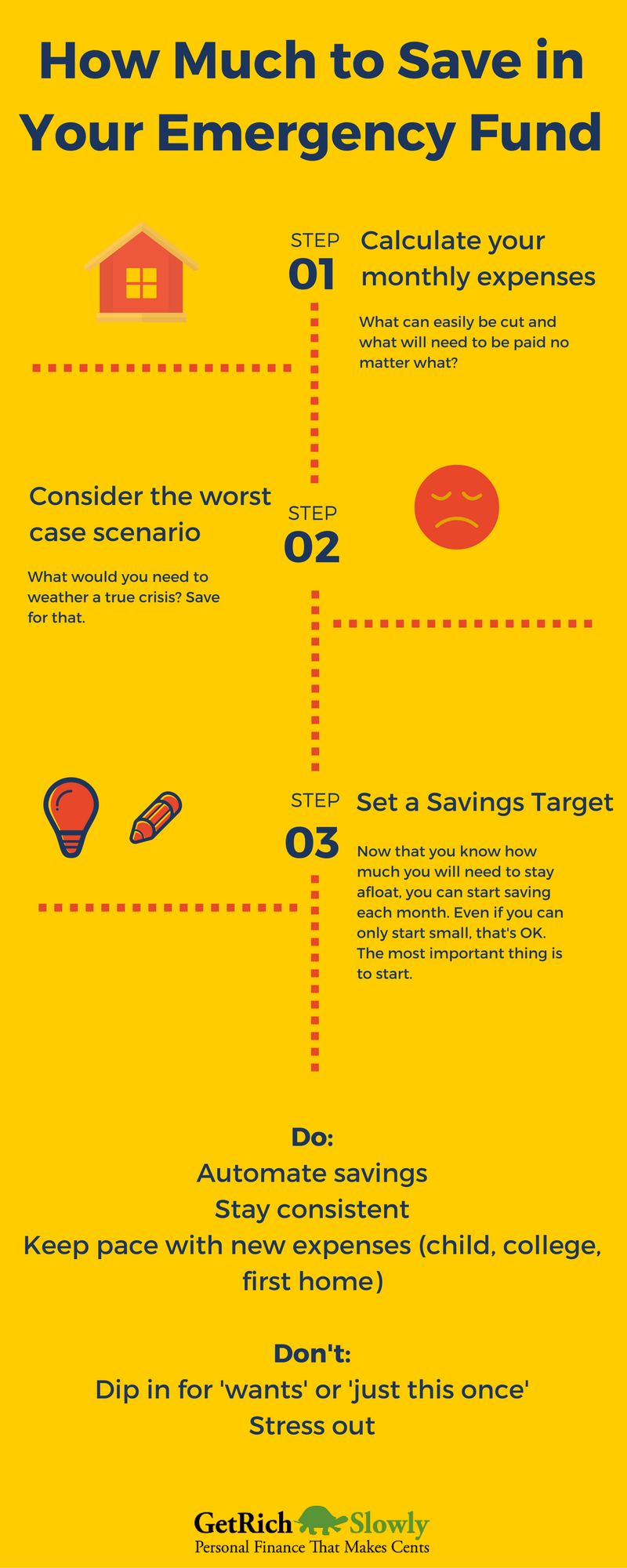
How much do you really need? As usual, I recommend that you do what works for you. There is no one right answer. Examine your situation — your income and your needs — to decide how much you should save.
I’ve read a couple of books that advocate keeping only a small amount immediately liquid. These books argue that there are few catastrophes that would ever require you to come up with more than a couple thousand dollars on short notice. Insurance will mitigate many problems. For everything else, there’s time to obtain capital: to tap into home equity, to sell stocks, etc.
My advice continues to echo Dave Ramsey:
- Establish a $1000 emergency fund.
- Pay off your debt.
- Boost you emergency fund to cover about three months of expenses (more if you are risk averse).
How much do you keep in your emergency fund? How did you choose this amount?
This article is about Ask the Readers, Basics
SEARCH FOR RECENT ARTICLES


I’m a renter, and my available credit lines only total $1,300, so using credit as an “emergency fund” is totally out of the questio for me. I currently have about 7.5 months of my take-home pay sitting in cash in a designated emergency fund. It would last me significantly longer if I were in hardship situation and living a truly bare-bones lifestyle. I’m in my mid-twenties, living in a very fluid rental market, in a very fluid time of my life job-wise, so the extra peace of mind is great.
loading....
Many consider unemployment as an emergency, and I do as well, but what about a medical situation where you can’t work? I know of a young lady who was diagnosed with cancer. Many days away from work and many treatments later, she seems to be back on the mend. Her insurance would only cover a portion of her treatments, and she didn’t have any income for the weeks she was out of work. I call that an emergency! To consider using equity as “insurance” is crazy!
loading....
I’m in a two-income family, too. Maybe I’ve got a morbid imagination, but believe you me I can come up with some nightmarish scenarios where in short order neither of us are pulling in an income, at least temporarily.
If I were, heaven forbid, on leave from my job because I was constantly at the bedside of my terminally ill husband or child, there is NO WAY I’d be willing or able to handle home equity gymnastics in order to keep the lights and heat on at home.
We have never had crushing job loss or major upheaval from a natural disaster, for which I am grateful. But I have had a taste of life-threatening emergency for one of my kids (thankfully it ultimately turned out to be easily remediable, and not a long-term problem), and it put our whole lives in a tailspin.
One of the reasons why you have an emergency fund in a place where it’s easy to retrieve if you need it is because if and when that emergency materializes, you may not have the energy and emotional reserves to deal with something more complicated.
For the record, our emergency funds (half in savings, half in laddered CDs) is enough for about 3 mortgage payments, or about 2 months of all living expenses. I’m aiming for 6 months but think it’ll take a year or two to get there.
loading....
It’s funny that you post this question as I was only just having this discussion with a friend. He believed that the money I have just started putting away each week for an emergency fund ($20) would be better put into my mortgage. I disagreed with him and said that for me the process of seperating some money out into another account for one purpose was much easier to manage and also gave me a greater sense of being in control. I think this is basically what all the people above said when they agreed in not using credit and mortgages as emergency funds have said. I think maybe we need to have a discussion of what is an emergency and how people who have an emergency fund use it.
loading....
[...] through it today, I noticed this post about How much one should keep in an emergency fund. Having personally experienced having to use a (well under-stocked) emergency fund after moving my [...]
loading....
I’ve got to side with db and others. You can get savings accounts or CDs online at 5%+ — if your mortgage is only 6%, your opportunity cost is only 1%+ at current rates (depending on how your savings interest is taxed), and if rates go up it may start to make more sense to save more than put it into the mortgage. Plus savings accounts are nice liquid investments, giving you easy access in an emergency situation.
And for those who are concerned that having such a large stash of cash will tempt you to splurge on a trip or other frivolous item, that temptation doesn’t go away if you have enough credit to do it. In fact, I would suggest that forcing yourself to save up a 6-month supply of cash will give you a much better fiscal discipline than telling yourself you’ve got enough credit / equity to pull you through.
loading....
Forgive me, but why would paying back your HELOC (or even just a regular LOC – it doesn’t have to be a HELOC) be any more complicated than paying down your mortgage?
loading....
I’ve sort of hedged my bets by putting some money toward my mortgage and keeping some more liquid. So I’m not totally on board with the idea of using a HELOC/LOC. Despite being a consultant, I’ve had some dry spells, medical emergencies and even unemployment (I wasn’t consultng at the time), as has my husband. And I tend to be pretty cautious.
I suspect my friend is more confident in her decision, because she bought her home for around $300k with $100k down around 6 years ago and now it’s worth around $700k.
loading....
@Andrea:
The issue is that a HELOC, or any line of credit, is debt. Debt in my book is something to avoid. You may well find the payments easy. The issue is having to make the payments.
The key, I think, to building wealth is to make choices that avoid installment payments of any sort. So I’m in that camp of person that thinks even a mortgage is something to get rid of as soon as possible. I’d much rather have a small amount of bona fide cash and no payments, than a big amount of net worth that is tied up on paper and payments.
I don’t really care what your MBA friend is doing — we really don’t know her situation. She could be doing great, or she could look wealthy but be tied up in massive debt.
loading....
I think that there isn’t one strategy that suits everybody (and probably, people are not following the strategy that suits them best).
Not everyone feels that debt is an inherently bad thing, not everyone mishandles credit, not everyone is happy with opportunity cost, and the converse is also true, not everyone is comfortable with debt, not everyone can handle credit and not everyone is concerned with opportunity cost.
Having a strategy to use in an emergency that will provide access to cash, is much better than having no strategy. Nobody knows for sure whether their strategy will be optimal in any given emergency so if the strategy you’ve chosen is thought through and doesn’t keep you awake at night then its probably ok.
loading....
@plonkee: Well said.
@Andrea: read plonkee’s post. Your friend’s strategy may be a great one for her but not for everyone else. Sure, $30,000 in savings and $30,000 in home equity are both assets valued at $30,000. But taking out a home equity loan is not the same as drawing down a savings account.
I can definitely see how someone in a stressful emergency situation (whatever it may be) would only be more stressed out by having to take on another debt payment at that time and by knowing that even though she’s currently jobless or sick or whatever, she will in the future have to come up with another $30,000 + interest in addition to her other debts. But some people would be fine with that, and the HELOC might be a good solution for those people.
loading....
@plonkee: I think that is the key. Just by having a strategy for emergencies whatever it may be is good
loading....
If there is a credit crunch, as might happen if the subprime meltdown extends to prime markets, then HELOCs will be much harder to come by, and existing ones might be much restricted.
Not so long ago, banks were tighter with credit and would only lend against a mortgage for ‘practical’ purposes such as home renovations, etc. If those standards return, then a low-interest HELOC may not be there when you need it for emergency funds.
Though you might think a credit crunch unlikely, emergency funds should not depend upon what is likely. An emergency is by definition unlikely, and an emergency fund by definition is a highly liquid, guaranteed source of cash. A loan which depends upon a lender’s willingness to lend a given amount at a given time does not therefore qualify.
loading....
A bank can cancel the borrowing privileges of a HELOC at any time, for any reason. They’re more likely to cancel it if the economy sours. Coincidentally that’s the time you’r emost likely to need emergency cash.
And how exactly are you going to make payments on the HELOC?
loading....
An emergency fund is for insurance, and that insurance has a cost associated with it. Whether it’s opportunity cost because it’s sitting in a money market or cost is in the form of increased risk form of using available credit or liquidating other investments, it has a cost. Just like there are no shortcuts to riches, there is no free insurance, just different ways to go about it.
There is no absolute mathematical solution because there are too many unknown variables, if there were, we wouldn’t be debating this. This, like many other polarizing financial concepts, will have advocates for both sides expressing religious-like zeal for their position.
Know your costs, know your risks, know your alternatives and then make a decision that best suits you.
loading....
My understanding is that HELOC and refinances are typically “Recourse” loans in many states. That is, only initial purchase home loans are “no recourse” in these states. “No recourse” means that the loan is secured by the asset (house) and the lender has “no recourse” to your other financial assets if you are foreclosed on.
With a “recourse” loan (potentially any refinance or a HELOC), if you can’t make the payments and are foreclosed on and should the sale proceeds not pay off all the loans, the lender can choose to still come after you for the remainder owed. This scenario seems like it would become more likely in a time of declining house values, particularly with a larger use of HELOCs.
The bankruptcy laws were quietly changed significantly several years ago also. I don’t understand the differences, but the banks were the ones lobbying for the changes. AFAIK, credit card debt is still discharged under bankruptcy but HELOCs are not. So the banks advertising for people to HELOC their way out of credit card debt amy not be very altruistic.
Another fun wrinkle: If you can’t pay the mortgage, the bank may accept a “short sale”, where the proceeds don’t completely pay off the loan. The bank in this case has decided to accept less than the amount owed, forgiving some of the debt. It turns out that the forgiven amount of the debt is treated as INCOME by the IRS for income tax purposes. The bank will report it because this is the only way the bank gets to write off the loss for its taxes.
In these days of extreme stress in the housing market, these edge cases of foreclosure, short sales, and bankruptcy laws become much more important to understand. If your emergency has the potential to end up that badly, make sure you investigate the details.
loading....
[...] you’re comfortable with. Frankly, I’m blogging about this topic right now because of an interesting and heated discussion I got into on GetRichSlowly, wherein one person’s (crazy!) idea of an emergency fund is a HELOC. This [...]
loading....
How much you need in an emergency fund is determined by how long you think the emergency will last, how long it takes to regenerate that emergency fund, and the likelihood of another emergency happening during the time when you are regenerating that emergency fund. If you think an emergency is going to last 3 months, and it takes you a year to build back up the emergency fund, and you think that during that one year time, you might have another emergency lasting another three months, then you should have an emergency fund that will last you 6 months.
Read my article here:
http://wisdomfrommywife.blogspot.com/2007/03/how-much-should-you-put-in-your.html
loading....
Well I wasn’t having luck with trackback, so I’ll post the link here.
I’ve blogged on this in my home trench: How about that emergency fund?
Wherein you’ll get a lot more background to understand exactly why I’m thinking the way I do on this.
Remember, it’s an emergency because it happens unexpectedly, so you can’t control how it happens to you.
db
loading....
I have a nice solid number that I like to suggest: At least $4000. It’s based off my own personal experience, and obviously people should adjust it to their own lives. But here’s where I got that number:
My sister’s dog had an intestinal blockage, and it cost them $4000 in emergency vet fees. This is the largest, unexpected, “need the money right away” expense that I’ve seen in my family, so that’s why I go with $4000.
loading....
As I mentioned, I still haven’t jumped on board with what my MBA friend suggested. (And I only mentioned her situation, because I thought perhaps someone with no debt other than a $200k mortgage and several hundred thousand in assets might have a different take on things.)
But let’s say you put $30k against your mortgage and arrange for a LOC, not a HELOC. Yeah, the interest rate will be a little bit higher. But it isn’t tied to your home. And now let’s say that the $900 a year you save on your mortgage by chucking in $30k is then set aside in a bank account. (I’m in Canada – no interest write off) So you’ve got extra equity in your house (if you need to draw on a LOC) and you’ve got some money set aside to help with interest. What about that?
I must admit that I’m a conservative. However, I did pay down my mortgage by $30k once I set aside $30k in an emergency fund. So I’m twice as prepared and I figure I can always pull out that extra $30k if I need it.
loading....
I think what constitutes an emergency is different for different people. If you’re in your first job living paycheck to paycheck and cannot turn to your family for help, then a million tiny things (like a hole in your work shoes) can count as emergencies, and they can happen almost monthly.
For me, the following things feel like emergencies:
1) Some annual or semi-annual expense comes due. I save monthly for this. (I choose the amount by looking at my current expense.)
2) Something breaks, but I want to keep having it. This still always surprises me, even though I know that things break. I am now saving a certain amount per month for household repairs, car repairs, and my next car.
For the house repairs, I used some rule of thumb (2% of the value of the house per year, I think) and then increased it with inflation. For the car repair, I used the average cost of my first car and now my current car (which is double). For health stuff, I’m starting with $100, which is just a random amount I will modify later.
And I have homeowner and auto insurance, but I try never to use that because they will raise your rates–I mainly use it for bankruptcy prevention. Oh, also I could break. I have health insurance and have finally starting saving a certain amount each month for health costs.
3) I lose my income. I am unlikely ever to be laid off because I work for the state, so I don’t actually worry about that. But I do have long-term disability insurance plus enough sick leave saved up to cover short-term disabilities. It would also be nice to be able to just quit at any time, but for now I satisfy myself with saving for retirement in 7 years and 10.5 months, not that I’m counting, yes I am.
I so far have been saving the maximum IRA contribution (in addition to my employer’s forced pension savings), but I just added some for a new ROTH 403(b).
There are other horrible things that can happen, like you have to travel to visit needy relatives, or you really want to give money to friends or relatives, etc., but these will always surprise me. My current plan is to borrow funds from one of my other categories for that. I can only remember one of those things happening (several times) and that’s wanting to subsidize a relative for a once-in-a-lifetime opportunity, usually a family trip that they can’t afford. I’ve just taken that out of my own travel fund.
My money is actually stored mostly in stocks, but with $500 in a local checking account for very good liquidity and $1000 – $2000 in a high-interest online savings account which usually gets tapped when one of those annual payments comes due. These amounts were selected based on past experience.
It’s true that stocks are risky, and that just when you’re getting laid off (or in my case, my relatives are getting laid off) is when stocks are plummeting. But I figure that if my stocks grow 10% or more per year and then drop 25% right before I need to sell them, I probably still have more money than if they’d been growing at 2-5% a year the whole time and then not plummeting right before I need them.
I have also used credit cards sometimes when several things happened at once and I didn’t want to sell my stocks but I still had my job.
Okay, I think I’ve answered both of your questions. Thanks for asking them; I’ve enjoyed reading these.
I especially like reading what exactly is considered an “emergency,” because no one ever talks about that.
**
Don’t loans against home equity also have big fees?
loading....
There are several reasons for the often cited “three to six months of expenses” guidline. 1) If you are out of work due to illness/injury and do not have short-term disability insurance, your long-term disability insurance probably takes effect after 3 to 6 months. 2) Conventional wisdom held that if you lost your job, 3 to 6 months was enough time to find employment. 3) In the event of a disaster (i.e. home is no longer habitable), 3 to 6 months allows time for insurance processing. 4) It is generally a large enough savings to cover unanticipated immediate needs (i.e. sewer back up in the basement).
While #4 may still be true, the other three points are often not. #1: today, most job benefits do include short-term disability, and in fact the long-term benefit is a bigger problem (Social Security integration — that’s a story for another time!) #2: time between jobs will vary widely depending on your career, qualifications, willingness to relocate, etc. (A 2-income household is both a blessing and a curse: one unemployment means you only lose ~50% of income, but it makes relocation more difficult.) #3: we have all heard horror stories about people along the Gulf Coast who are still waiting for insurance payments 18 months after Hurricane Katrina.
In the end, you want to ask yourself what your “emergency fund” is really for, and that will guide you toward the necessary amount.
loading....
[...] Mar. 26th: Ask the readers: How much in an emergency fund? [...]
loading....
There are so many reasons this is a bad idea.
The primary one is what if the “emergency” is something that damages the house? An emergency fund is not simply a form of protection from the loss of a job.
I have more than $50k in a money market mutual fund. It is an emergency fund but it also serves as a nice cushion to even out unusual cash flow situations. When we had to have our roof replaced last year I paid the $10k out of that fund and then slowly built it back up.
It’s nice to be able to not have to specifically save for large purchases since you don’t always know when they will occur. You definately don’t want to be in a situation where you need to tap a HELOC to pay for $2000 worth of unexpected car repairs.
Trying to squeeze every last dime of interest out of your investments is foolish in the long run because eventually you will get burned and all your extra savings will get eaten up in some unforseen event you are now unprepared for.
loading....
I live and work in Tokyo, so my situation is a little different than most. My original plan was to put away approximately three month’s worth of my salary for an emergency fund before building up an investment fund of approximately 1,000,000 yen (a little less than $10K) and getting cracking.
However, the DISMAL interest rates (0.5%, 0.6% or so…and I’ve looked for better) have caused me to rethink my plan in slightly more aggressive terms. I have about one month’s worth saved up already, so once the credit card is cleared off next month, I plan on doing some relatively low-risk investments (e.g. index funds, possibly currency) to try and get a return of somewhere between 5% and 10%. This will also serve to get my investment feet wet and, once I’ve got a fair amount riding in some safe, easily-accessible investments, I’ll start looking towards more high-risk/high-return strategies.
My thinking behind doing so takes into account the facts that a) it’s very hard to get fired in Japan; b) if the unthinkable happens, companies are generally very understanding and, if that fails, state insurance is very robust; and c) you would get about the same return on stuffing your money into a mattress as you would on putting it into a standard savings account.
I guess the point, then, is that you really have to consider first what exactly your emergency fund is FOR and, once you have, consider just how much risk you’re willing to tolerate. As an individual with a very low debt level, I’m willing to be a little more risky–if I had a family riding on my ability to provide, though, you can bet that the story would be very different.
loading....
i break the traditional e-fund into e-fund and contingency or income disruption fund. I’m dead set against HELOC, because you are not guaranteed to getting a HELOC. Let me see, you have no income source and you are applying for a loan = not a good combination. Since you cannot guarantee you are going to get a HELOC, nor can you guarantee how much interest (what’s your credit rating?), this is setting yourself up for a complete disaster. the idea of having cash reserves is so you negate all these factors when you need the money the most.
for me, e-fund is for major repairs or medical/dental issues. contingency fund is for income disruptions. it is variable from person-to-person based off of your job volatility. so the amount will depend. i shoot for mid-level scenario of two major things (i.e. medical/dental and car/house repair) plus income disruption. the e-fund needs to be liquid, whereas the contingency fund can be semi-liquid in laddered cd’s or such, since it is a month-to-month need basis. you have to assess what is likely to occur. if you have an old car or an old water heater in the house, the probability increases of needing cash for a repair. if you have health issues, the probability of needing to seek medical care is higher. if you have older parents or sick parents, you might need cash on hand to buy plane tickets. again, there should be a difference between emergency funds and income disruptions funds.
loading....
we have 1 month expense emergency fund immediately available in a money market.
we are setting up a good cd ladder. right now we have a 3 month ladder and we are looking to have a monthly ladder. that is to have a cd mature every month, that way if we have an emergency longer than a month we have access to the funds and are gaining more interest than a moner market.
loading....
I’ve been pondering this a lot lately. Last week I paid of my HELOC, so my only debt is my mortgage. I have about $3500 in a liquid savings account; and $1000 in a brokerage account that is slightly less accessible.
My dilemma is whether to put the amount I’ve been paying monthly on my HELOC toward more liquid “emergency” funds, put it toward eliminating my mortgage (@5.25%), or put it toward my retirement investments. I already put 10.5% of my income into a 401(k).
The answer is different for everyone, isn’t it. Personally, I’d love to be out from under my mortgage. At the same time, I can’t easily pull cash out of my home other than taking an advance on my HELOC. What to do, what to do…
loading....
Andrea the one who suggested using equity line of credit lives in Canada. Nuff’ said.
loading....
Andrea, I disagree. You’re NOT ahead. Why? Because you are not “pulling money out” – you are BORROWING AGAINST YOUR HOUSE, AND IT HAS TO BE PAID OFF. By doing what you’ve described, you’ve given yourself a second mortgage and put significant additional risk on the roof that’s over your head. If you’re unemployed for a long time (your definition of “emergency”) and can’t make a couple of payments, you’ll lose your house very quickly. I’ll never understand why so many people put their home at risk in this way. Same thing with credit cards – you’ve got to pay them back sooner or later. Why take on that risk? I don’t own a home, but if I did I’d never ever set up a HELOC to serve as an emergency fund, nor would I rely on credit cards.
I’m currently building up my checking account with the goal of always having $1K there. That will be the first line of defense – to cover things like winter heating and car repair, so that I don’t have to use the EF for smaller things. My emergency fund is currently 3 months of living expenses, and I’m working on getting it to at least 6 months. I keep my EF in a bank savings account – not the best interest, but the large balance means I can do all my everyday banking without worrying about monthly service charges, plus the convenience of a large ATM network if I ever needed to tap the EF.
loading....
Well, things have changed since this post! I have friends with excellent credit whose HELOC has been pulled completely. Several folks I know in very “secure” jobs have been laid off.
But, for me, I finally hit $1,000 in my emergency fund (Dave Ramsey’s first benchmark), and I am excited! Its not enough, but its a milestone!
loading....
We are a one income household and my emergency fund target is 6 mos. of take home pay, which I roughly consider my living expenses (i.e., after deductions for taxes, ins, 401k and diversion of a small amt to a general svgs a/c). I have almost 5 mos. saved and it’s a big relief to have rebuilt the fund after using a big chunk of it for home improvements last year (no, they weren’t emergencies). I’d prefer my emergency fund to be sitting there strictly for emergencies, but quite frankly I don’t do a budget and haven’t tried to determine/calculate how much to put aside for home and auto repairs/maintenance. I’m new to this site, so I’d be interested in seeing if there’s anything here about how people do that and where they stash that money (separate bank accounts, etc.)
I also disagree about using a HELOC for emergencies – after all, my idea of an emergency fund is to not have to lose my shelter, and the potential inability to repay the heloc is akin to inability to pay the mortgage.
loading....
We are shooting for 4 months necessary expenses. This does not include things like cable TV or ballet lessons for our daughter. It’s for food, utilities, mortgage, and internet to find a new job. 4 months expenses for us would also equate to the amount we’d spend on a reliable used car in the event our 95 Jeep decides to die on us.
Above all, emergency funds need to be LIQUID. Stocks can go up and down. Murphy’s Law dictates they will be down when you need the funds. Put it in a high yield savings account or CDs.
loading....
I can tell you from personal experience, have 6 months expenses in an emergency fund. Two years ago we bought a beautiful house that we could easily afford on my husband’s salary and profits from his business of 12 years. We put 20% down and have a 30-year fixed mortgage so we had plenty of equity – and I saved 8 months’ expenses into a set of laddered CDs. Well, last summer one of his big clients broke a contract, stiffed him for a lot of money, and his company couldn’t recover because of the down economy. He stopped drawing salary in November and the business went down in December. I was working by then, but not making much. We had huge mortgage payments to make on a home that had lost 25% of its value, tuition commitments for our kids’ school, a lawyer to pay to protect us from the business bankruptcy, and everyday living expenses to meet too. Running up balances on our credit cards or a home equity line would have been the most foolish thing we could have done.
Sadly we now have to declare personal bankruptcy because of the business debts. But with our emergency fund we were able to keep our personal credit clean and our heads high. The good news is that my husband has a job again (after 6 months) and my business has picked up…and although we will have ultimately lost a lot of money because of all of this, we have a renewed commitment to re-building those reserves, divorcing ourselves from the “rat race” and concentrating on achieving financial independence as quickly as possible. I hope others will read this story and consider it a cautionary tale and a wake-up call…good luck to all!
loading....
I was working toward the 3 months of emergency funds and was doing ok. But Murphy decided to vist me. An abcessed molar which needed a root canal. Ouch two ways. Foolishly I had not signed up for dental unsurance at work. So a big bite was taken from my emergency fund. I learned the valve of having this fund. I also will get dental insurance at the next open enrollment. Thanks to JD and all of you for your wise thoughts and information!
loading....
I have to totally disagree with having a HELOC for an emergency fund. As has been mentioned several times, in the event of a real emergency (hurricane, tornado, flood, etc), banks will clamp down on their HELOC’s or cancel it all together. In addition, with tightening lending standards these days, banks are ready to just willy-nilly give access to equity that may be in your home. I think it might be best to have one open and unused just in case something truly catastrophic happens in your personal life (health deteriorates, etc). We personally shoot for 6 months of take home pay to be in savings and laddered CD’s at our bank. We also have a seperate savings account for budgeted trips and events during the year, so if push came to shove we could cancel those planned trips and use that money as well (which is not included in the 6 month calculation above). So I would vote we have almost 8 months in liquid assets. We are a military family, and although everyone thinks that is like the most stable income on the planet right now, you never know where/when the next major move could come, and each time I have to find a new job at his new duty station. So there may be extended time periods where we are living off one income, which we can do and still save and invest, but not nearly as much as we want. Also, since we rent each time we move, we generally need a security deposit, plus an additional 1 to 3 months of prepaid rent to reserve a home in a new area. This adds up quick! So in years we move (which is every even year right now), we divert savings and investing to a “moving” account that pays for these expenditures, including a trip to the area to go house shopping. So our “odd” years are ones in which we save the majority of our cash for investing and the even years are the moves (which usually follow with at least 3 to 4 months of me being unemployed). So our emergency fund continues to grow, but our savings and investing amount tends to change depending on whether or not we have a move that year.
Just for informational purposes: We have moved 5 times in 8 years of marriage. We went from FL to Norfolk to Rhode Island to Pensacola, to Mississippi, and 2 different stations in Washington state. LOL. We are now facing a move to San Diego for 2 years, then Monterrey Bay (yeah the closest move we have had yet! Just 4 to 5 hours north!), and then to Washington DC, then probably to Hawaii, and then to Belgium. From there, who knows. LOL. Got to love the military. LOL.
loading....
Based on my my life circumstances (young,single,condo-renter) my primary concern that would see me tapping an emergency fund is loss of employment.
Do others include things like unemployment insurance payouts or accrued vacation (that would be paid out upon loss of job) in their emergency fund calculations?
EXAMPLE:
Expenses (monthly) – $2,500
After-tax unemployment insurance (monthly) – $1500
Accrued vacation – $4,000
In this example, how much would you save in cash if you wanted a 6-month emergency fund?
loading....
I have a friend who got laid off in May 2009. Today, Jan 2010, my friend is still aggressively looking for another job. Every credit card has been exhausted just to cover her mortgage all these months. Her house would be paid off 6 years from now, she has exhausted her resources to keep from losing it. So, how much is enough during a recession? You do the math, but I can tell you that books that say that you need “a couple thousand dollars” should be thrown into the fireplace.
loading....
Wow, interesting to see the changing mentalities over the course of 3 years. I love the comments that state that credit is all you need in the event of the emergency. (Sarcasm.)
loading....
I’d like to bring this thread back to life to ask if people have changed their approach given the state of the economy. We are a two income family, no children and we own our home. We are a few years into a 30 year mortgage. We have saved a year’s worth of basic living expenses in an online savings account, and I sometiimes worry that that isn’t enough!
What is everyone else doing these days?
loading....