Saving at the supermarket: 15 great grocery shopping tips

“Why can’t I get hot cereal?” I asked. “I love hot cereal.”
“I know,” Kris said. “But you buy it all the time. You buy it faster than you eat it. Just last week, you bought another box of that blueberry oatmeal from Trader Joe’s. You never remember what we have at home. You need to shop with a list.”
She has a point.
A shopping list is a useful way to remind yourself what you do and do not need to purchase. But most frugality experts emphasize shopping with a list because it prevents impulse purchases. Impulse purchases wreck grocery budgets. In Why We Buy: The Science of Shopping, Paco Underhill writes:
Supermarkets are places of high impulse buying for both sexes — fully 60 to 70 percent of purchases there were unplanned, grocery industry studies have shown us.
More than half of all grocery purchases are unplanned! No wonder creating and sticking to a list can bring down grocery costs.
But that’s not the only way to save money at the supermarket. Over the past two years, I’ve published a lot of tips for saving money on your grocery bill. Some of these have been obvious — others less so. All of them can help you save at the supermarket. Here are some of the best:
Make a List — and Stick to It
- This is the cardinal rule of shopping. The list represents your grocery needs: the staples you’re out of, and the food you need for upcoming meals. When you stray from the list, you’re buying on impulse, and that’s how shopping trips get out of control. Sure, a magazine only costs $5, but if you spend an extra $5 every time you make a trip to the supermarket, you waste a lot of money.
Compare Unit Pricing
- The biggest package isn’t always the most cost-effective. Stores know that consumers want to buy in bulk, and so they mix it up: sometimes the bulk item is cheaper, sometimes it’s more expensive. The only way you can be sure is to take a calculator. Our grocery store posts unit pricing for most items, which makes comparisons easy.
Ditch the Basket or Cart
- If you’re dashing into the supermarket to pick up milk and bread, don’t use a basket. Baskets induce people to buy more. If you’re limited to what you can carry, you’re more likely to avoid impulse purchases. Only use a basket (or shopping cart) if it’s absolutely necessary.
Don’t Examine Things You Don’t Need
- The more you interact with something, the more likely you are to buy it, says Paco Underhill in Why We Buy: “Virtually all unplanned purchases…come as a result of the shopper seeing, touching, smelling, or tasting something that promises pleasure, if not total fulfillment.” Do you know why grocery stores place those displays in the aisles? To intentionally block traffic. They want to force you to stop, if only for a moment. It only takes a few seconds of idly staring at the Chips Ahoy! to convince you to buy them. Stay focused.
Live on the Edge
- Health-conscious shoppers know that the perimeter of the store is where the good stuff is. The baked goods, dairy products, fresh meats, and fruits and vegetables are generally placed along the outside edge of the supermarket, while the processed stuff can be found up and down the aisles. But shopping the edges isn’t just healthier — it’s cheaper too. Stock up on the fresh food first, then venture to the middle of the store.
.jpg "The local Safeway produce department")
Discard Brand Loyalties
- Be willing to experiment. You may have a favorite brand of diced tomatoes, for example, but does it really matter? Go with what’s on sale for the lowest unit price. You may find you like the less expensive product just as well. If you try a cheaper brand and are disappointed, it’s okay to return to your regular brand.
Choose Generic
- Better yet, try the store brand. Generic and store brand products are cheaper than their name-brand equivalents and are usually of similar quality. But do you know why you’re reluctant to try generics? The power of marketing. Most generics have unappealing packaging. If they cost less and taste the same, who cares?
Use Coupons Wisely
- Coupons really can save you money. But you have to know how to use them. Clip coupons only the things you need — staple foods and ingredients — not for processed junk food. Learn to use special coupons. Once each month, one local store sends us a “$10 off a $50 purchase coupon”. We know it’s coming, so we plan our trips around it.
Make One Large Trip Instead of Several Small Ones
- Each time you enter the grocery store is another chance to spend. By reducing the frequency of your trips, you’re not only avoiding temptation, but you’re also saving money on overhead (time and fuel).
Buy From the Bulk Bins
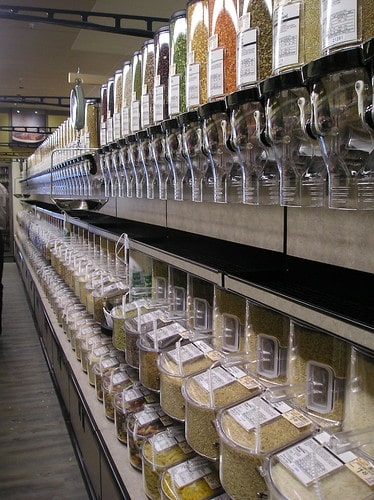

Check Your Receipt
- Make sure your prices are scanned correctly. Make sure your coupons are scanned correctly. Sale items, especially, have a tendency to be in the computer wrong, and yet few people ever challenge the price at the register. You don’t need to hold up the line: simply watch the price of each item as it’s scanned. If you suspect an error, step to the side and check the receipt as the clerk begins the next order. If there’s a problem, politely point it out. It’s your money. Ask for it.
Shop Alone
- In Why We Buy, the author notes that people tend to buy more when shopping in groups than when shopping alone. “But men are especially suggestible to the entreaties of children as well as eye-catching displays.” Kris complains that we always spend more on food when we shop together. She’s right. If possible, shop alone.
Use a Grocery Price Book
- A grocery price book is an ongoing list of the items you most commonly purchase and how much you paid for them. This list allows you to detect price cycles, spot bargains, and plan your shopping trips for maximum savings. A price book allows you to practice strike-point shopping.
Shop on a Full Stomach
- Studies show that folks who shop when they’re hungry buy more. This is certainly true for me: If I go to the store for milk on a Sunday morning without eating breakfast, I’m likely to come home with donuts and orange juice and Lucky Charms, too.
Walk or Bike
- In our recent discussion about how to pay yourself first, Ross Williams suggested another way to reduce impulse purchases. By walking or biking to the store, you can automatically limit your spending. “It’s amazing how focused you can be when you are limited to one shopping bag full of groceries,” he writes. “Once you are very conscious of each purchase, it seems to carry over even to the small items where space isn’t really an issue.”
Any of these tips can help a savvy shopper save money at the supermarket. But when combined to create a cohesive shopping philosophy, they have the power to slash your grocery budget significantly. I’m not promising that you’ll be able to feed yourself for $15 a week, but you might be able to save enough money pay down your debt or to jump-start your savings!
Here are some related articles:
- How to save hundreds by playing the drugstore game
- The lazy man’s guide to groceries on a budget
- Grocery store vs. farmers market: Which has the cheapest produce?
Kris requested I offer some final pointers for the gentlemen. “Check with your wife before you go shopping,” she says. “Check with your wife before you put anything into the cart. And remember: Just because you like a food doesn’t mean you need to buy it every time you go shopping.”
Bulk food photo by mattieb.

Become A Money Boss And Join 15,000 Others
Subscribe to the GRS Insider (FREE) and we’ll give you a copy of the Money Boss Manifesto (also FREE)
