Mortgage Prepayment Made Easy: Own Your Home in Half the Time Print
Tuesday, 12th February 2008 (by J.D.)This article is about Choices, House and Home, Money Hacks, Planning
Because I recently eliminated all of my non-mortgage debt, I have a significant positive cash flow. The $1,000 per month I was putting toward debt can now be used for investing. I’m making maximum contributions to my Roth IRA, of course, but that still leaves several hundred dollars each month available for other purposes. This has forced me to evaluate my financial goals.
Mortgage prepayment options
For the past year, Kris and I have discussed making accelerated payments on our mortgage. I’ve written about this choice several times at Get Rich Slowly, and it seems clear that mathematically it makes more sense to invest the money. However, it’s also clear that eliminating a mortgage offers a tremendous psychological boost. I’ve never heard anyone say they regret owning their home outright.
I’ve researched a variety of mortgage acceleration schemes:
- Refinancing from a 30-year to a 15-year mortgage is appealing, but the interest rate drop (from 6.25%) isn’t enough to make this worthwhile.
- I could sign up for my bank’s bi-weekly payment program, but I don’t like the enrollment fee, and I don’t like the increase in paperwork.
- We could make an extra payment every year, or pay an extra $100 per month. But I feel like we could do more.
Ultimately, we decided to use the method described by Charles Givens in his 1988 best-seller Wealth Without Risk:
You can pay off your 30-year mortgage in half the time without refinancing by making extra principal payments. On the first of the month when you write your regular mortgage check, write a second check for the “principal only” portion of the next month’s payment.
You can also use a prepayment calculator to figure out additional scenarios.
Wealth without risk
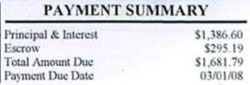
For most of homeowners, the principal portion of a mortgage payment is quite small. For example, our February mortgage bill was $1681.79. Of this, $1119.16 was designated for interest, $295.19 for escrow (taxes and insurance), but only $267.44 for principal.
Using Givens’ plan, if I include an extra $267.44 with my payment, I’ll also knock off the next month’s payment from my mortgage. That $267.44 accomplishes the same thing $1681.79 usually does, but at 16% of the normal monthly cost. That’s a bargain.
The advantages this method are:
- It has a sliding degree of difficulty. At first, the extra principal payments are lower. But as we pay down the mortgage, these extra payments increase. We have time to “grow into” these increased payments.
- It’s easy for us to back out. If we decide our money is better used elsewhere, we can simply stop making extra principal payments.
- Every time we make a payment, we’re essentially making two payments, cutting the term of our mortgage in half.
After discussing the pros and cons, Kris and I have agreed to follow a modified version of Givens’ plan. To make things simple, we’re using round numbers. During 2008, for example, we’re going to pay $2,000 toward our mortgage each month, which gives us an additional $318.21 against the principal.

Every January, we’ll adjust how much extra we’re paying. If our budget gets too tight, we can cut back at any time.
The drawbacks
To be fair, Givens doesn’t recommend this method for low-interest mortgages like ours. He clearly states, “Never pay off low interest mortgages — those under 9%. Instead, use the extra money in a better investment.” He wouldn’t advocate using this method on a 6.25% mortgage.
The March 2008 issue of Consumer Reports has a brief exploration of this topic. Their conclusion?
Many people find peace of mind in paying off their mortgages and owning their homes outright, especially as they approach retirement. That can make an investment in your mortgage a worthy choice, psychologically if not financially.
Still, the bottom line, according to our Money Lab, is this: Although there are exceptions, chances are you’ll be better off putting extra money into a good mutual fund, not into prepaying your mortgage.
“Did you see this article?” Kris asked me, after she finished reading it.
“Yes,” I said. “What do you think?”
“I don’t care” she said. “I want to do both. I want to invest and prepay the mortgage.”
“So do I,” I said.
Financial freedom
If we have a substantial emergency fund, if we’re fully-funding our retirement plans, and if we’re saving for other goals, I believe that paying down the mortgage makes sense for us. We understand that we’re sacrificing some theoretical (and probable) future investment returns, but we’re also working to create a financial situation that’s easier for us to maintain in the long run.
If we have no mortgage, that’s $1400 less each month that we have to pay in expenses (we’ll still need to pay taxes and insurance). Since we split the payment, that’s $700 less per month that I have to pay. Without a mortgage, my fixed expenses would be about $600/month. My total expenses would be about $950/month. This would provide tremendous freedom, granting me an opportunity to try things that I might not otherwise be able to do.
Another form of diversification
Every investment book I’ve read says that a smart investor diversifies his portfolio, putting some of his money into each of several different types of investments. I view prepaying the mortgage as diversification. Sure, the stock market will probably beat the 6.25% I’ll earn by doing this, but it’s guaranteed money. To me, it’s better to put my money into my mortgage than into bonds, certificate of deposit or a high-yield savings account. Especially if we’re entering a recession.

RSS Feeds
Facebook
Twitter

February 12th, 2008 at 5:42 am
I’m curious about the costs that you say are associated with switching to twice-monthly payments; does the bank add fees or something? I chose twice-monthly payments because the savings on interest over the long term are significant. In addition to twice-monthly payments I’m also making extra payments toward my principal but using a somewhat different strategy than yours: instead of making those payments every month, I sock away what I can into an ING account so I can earn interest, and then once a year I will make a big payment from that toward my principal. The advantages of this approach are 1) I can earn interest on those payments instead of giving the money to the bank immediately, and 2) there’s nothing like seeing your principal suddenly drop by a large amount.
Like you, I have a low-interest mortgage (5.24%) but I’m paying it off as fast as possible. As you say, it’s not just a psychological matter, it’s a quality of life issue: the sooner I can pay off my house, the more freedom I will have to cut back on my work or switch to other work that pays less but is more enjoyable. My fixed monthly expenses will drop by more than 50 percent, so if I decide to stick with my current job I’ll also have a lot more free cash to save and invest. The drawback is that I’ll be a lot closer to retirement when I do finally pay off the house (hopefully in less than 10 years from now, but still that means I’ll be in my late 50s).
February 12th, 2008 at 5:53 am
Brad, good question. I’ve added a bit of clarification. Yeah, there’s some fee to sign up for this. We did a similar program on our last mortgage and there was no fee, but our current mortgage has one. Also, I don’t like the idea of having to write a mortgage check every two weeks. I realize these are minor annoyances, but they’re enough to make me like that option less than the plan I chose.
February 12th, 2008 at 6:03 am
My fiance and I are planning to build a house in about two years on a lot we purchased last year. I think I’d like to pay off the home early, too. I get the logic behind investing instead of prepaying the mortgage, but it IS a psychological thing. I paid off all of my credit card debt last year, my fiance is getting his paid off this year, then my vehicle will be paid off next (his is already paid off). To then tackle the mortgage and to know that we’ll (hopefully) be 100% debt-free in maybe 15 years just sounds like a wonderful thing…so freeing.
February 12th, 2008 at 6:04 am
Paying off a mortgage is *not* mathematically inferior to investing. Paying off a mortgage is guaranteed to save money. Most investments are not guaranteed to make money. The investment that is closest to guaranteed is a government bond. At current interest rates, paying off a mortgage mathematically makes sense, when doing an apples-to-apples comparison.
Read Consumer’s Reports closer, they say “chances are” you will do better by investing. They acknowledge the risk involved in investing. Before making these kinds of decisions, know what risk you are accepting. If the risk is suitable, then invest, if not paying off your mortgage may be a better choice.
February 12th, 2008 at 6:07 am
Brad,
Many banks/mortgage companies allow you to use a bi-weekly payment option so you only have to pay 1/2 your mortgage once every two weeks but they’ll charge something like $3 each payment.
J.D. and Brad,
Brad says “the sooner I can pay off my house, the more freedom I will have to cut back on my work or switch to other work that pays less but is more enjoyable. My fixed monthly expenses will drop by more than 50 percent, so if I decide to stick with my current job I’ll also have a lot more free cash to save and invest.”
First let me start by saying I’m just a young’n, I’m 26 so I might not be wise :-). I’ve had my mortgage for almost 3 years now (4.99% fixed 30yr). We’re all at different places in life, but I have to argue with your point. You want to reduce your mortgage balance so you’ll have freedom to cut back on work… but wouldn’t you rather have $20,000 in a fund earning interest rather than have $20,000 less owed on a mortgage and (hopefully) more equity? We all know the truth is that the best financial move is to NOT prepay in our cases, prepaying is a mind-mistake. We’re looking at the wrong goal. In our minds we want to get rid of debt, we want to own this house and be done with it. Instead, we should be thinking “I want to accumulate enough cash/wealth to pay the mortgage with one check”. So what can we do? How about creating our own fake mortgage? Setup your automatic transfers into the account of your choice in the amount of the mortgage pre-payment you decide and watch it grow. Think of it as a liquid offset to your mortgage balance, without losing “control” of the money. Now you can get fired from your job, keep the house, and have money to live on.
From: http://finance.yahoo.com/expert/article/yourlife/37252
“First, no one ever spent a sleepless night because she had millions in the bank and stocks but didn’t have her home paid off. On the other hand, if you pay off your mortgage and deprive yourself of liquidity, you could be in for some miserable times.
As I see it, if money is even the slightest bit tight, hold onto it and pay off the mortgage month by month. There’s nothing magically good about having a paid-off mortgage, but there’s something seriously bad about not having ready liquid assets even if your home is paid for.”
We have to think smart here!
February 12th, 2008 at 6:09 am
Do not forget about deducting your mortgage interest on your taxes. When you figure that in, the 8% ave return in the stock market looks a little bit better.
February 12th, 2008 at 6:20 am
@ Kaleb and JD: That’s crazy about the banks charging more for biweekly payments. My mortgage is with ING, so there are no fees of any kind, which is great, and my transfers happen automatically twice a month from my ING account to the mortgage. I didn’t realize other banks charged for this.
@Kaleb: While it’s true that there’s an opportunity cost in terms of lost investment income when you prepay a mortgage, you also have to remember the savings in interest (not just principal). On a 30-year mortgage, the amount you ultimately pay in interest can be more than your original loan, in other words, hundreds of thousands of dollars. Unless your investments have a similar time horizon (i.e., retirement), and unless they are guaranteed to bring in a higher return over that time horizon than what you’ll pay out in interest on your mortgage, you may not be all that much better off investing the money.
February 12th, 2008 at 6:22 am
Great post. I subscribe to both beliefs: the mathematical superiority of investing, and the psychological boost from paying down debt.
And despite advice from most financial resources, I decided in the past to pay extra on my mortgage every month. That is, until the last few years.
I talked with a tax guy who agreed paying off debt was important, but he explained a severe disadvantage to prepaying the mortgage: your mortgage starts over every month. If you make an extra 3 payments every year, and one year fall on hard times, do you think your bank is going to remember all the extra payments? No. To them you’re either on time or delinquent, never “ahead”. If you get hard up and miss several mortgage payments and the bank forecloses, you forfeit all that extra work you put into paying off the mortgage early.
However, if you decide to invest that money (which is most likely growing faster than your mortgage would have been shrinking), it can be tapped if you fall on really hard times.
So what I decided to do was a hybrid. I created an account specifically for my extra mortgage payments, put the amount in my budget, and autopay that account every month. To me that account represents the potential shrinkage in my mortgage. Each month it grows, both from interest and the automatic payments. Of course it takes discipline to not use that account for anything else, but in the age of credit cards, most smart financial advice requires a hefty amount of discipline.
If I stay in my house long enough, one day that account will be larger than my mortgage. At that point, I can write a giant check to the mortgage company anytime and do what so many others mistakenly claim: own my house.
February 12th, 2008 at 6:23 am
Nothing wrong with paying off your house! The thing about investments is there is risk involved. Sure, there is risk in owning your house, but if you pay it off early that is a guaranteed return. You could lose everything with the investments.
We’re paying as much as we can on our 2nd mortgage (8.125%) simply because I base our investment returns on a conservative 8% return. Sure there is the tax deduction issue, but we probably won’t be able to deduct the full amount.
February 12th, 2008 at 6:34 am
On thing they don’t talk about much is the situation we are in. We’ve owned our house for 5 years now, but my husband has gotten his masters and now we’re looking at moving to an area where we will have to pay 50% more for a comparable house than what we have now. We’ve paid off about 5% of the loan in the 5 years we’ve lived here. In the next 5 years of living here, we would pay off more because we would be working on the 2nd 5 years of the loan, and it would snowball from there. But if you buy a different house every 5 years and pay the current price of real estate at that time, you can be retiring and still owe big money on your house. If we were to stay where we are, our house would increase in value, but we would only be paying on what we initially bought it for. So I’m thinking it might make sense to make those extra payments especially if you aren’t planning to live in the same house until you die.
February 12th, 2008 at 6:37 am
@rich: I like you, let’s be friends. This is exactly what I mean!
I just got out of credit card debt this month ($11,000 or so paid off in 6 months). Now, like J.D. I have tons of extra money each month. If I prepaid my mortgage $2,000/mo, I’d have it paid off in less than 5 years. But if I saved $2,000/mo and got 6%, I’d have enough CASH to pay my mortgage off in 5 years, and that’s not counting the tax deduction! It’s the same thing, but with more security! It’s the smart thing to do!
February 12th, 2008 at 6:39 am
I have just purchased a house, I was not able to put down enough, so I have to pay PMI on the loan until I get it to 80%, does that make enough difference to be worth paying extra until that 80% mark is reached? My payments are about 1300/mo and I believe the PMI is around 90/mo that is lowered each year.
February 12th, 2008 at 6:40 am
Great point, Tana. I’m actually preparing a review for a book called The Kitchen-Table Investor by John Wasik. He has a section that explores various scenarios, explaining if it makes sense to accelerate mortgage payments or not. He actually says that it makes more sense to prepay a mortgage if, like me and Kris, you plan to stay in the same place a long time. In the scenario you describe, his advice would be to rent, I think — it’s generally cheaper and gives you more flexibility. If you have time to build equity, then it makes sense to buy a house.
February 12th, 2008 at 6:44 am
@Kaleb
I agree that your plan makes a lot of sense. But, again, I look at this move as a form of diversification. I wouldn’t do this if it were my only form of investment. Right now I have a three-pronged approach: retirement funds, high-yield savings, and mortgage acceleration. By spreading my funds out, I’m able to pursue different goals at the same time.
February 12th, 2008 at 6:45 am
Gotta agree with Rich:
“The mathematical superiority of investing and the psychological boost from paying down debt.”
There’s a “win” with either of these. Pick which works best for you and go with it.
February 12th, 2008 at 6:49 am
I just refinanced to a new type of mortgage that allows you to put money in to an equity account that lowers your payment but still allows you access to the money if you want or need it.
I didn’t like the idea of paying extra money on my mortgage and not being able to get the money back if I wanted it…or not having my payment adjust because of it.
The mortgage has a payment that’s recalculated every month based on the balance you have that month.
It’s a perfect place to park cash, or emergency funds, or savings…because you’re getting the immediate benefit of that money reducing your payment every month.
Much better than keeping money in a CD or Savings account etc.
February 12th, 2008 at 6:51 am
I don’t agree that the mathematics support investing over debt repayment. The fact is that all investment decisions have to considered in the context of the risk involved. There is no guarantee that expected investment returns will actually happen whereas the debt interest is fairly certain.
Personally I do both in a ratio that I’m comfortable with.
Mike
February 12th, 2008 at 6:54 am
I think this is a personal decision. If you are more comfortable with a mortgage, then you are better off investing the extra money. If the thought of owing a bank hundreds of thousands of dollars in some cases makes you sick (like myself) then you are better off paying off the mortgage as soon as you can.
February 12th, 2008 at 6:56 am
Excuse my ignorance here, but what tax would you have to pay on that 8% investment return? Once that is factored in how much is your real return after tax. That is what you should use to compare to your mortgage interest rate to see if it makes sense to pay it off.
Perhaps another overlooked factor is everyone buying houses they can’t afford. If you need a 30 year term to buy a house, in my mind you shouldn’t own it. 25 year term should be the max and better yet do it in 20 or 15 years.
I tend to agree with JD. Invest what you can in retirement accounts and then kill off that mortgage. The amount of interest savings you can get in your first 10 years is HUGE.
My two cents,
Tim
February 12th, 2008 at 6:59 am
Willie, don’t forget that the mortgage interest deduction is only valuable if you’re a fairly “rich” person. My mortgage interest deduction has never beat out the standard deduction.
Without a deduction, removing the expense of the mortgage is worth more than the same return on an after-tax investment (because you’d have to pay the taxes out of your gains). So that 6.25% starts to look very competitive against stock market returns. Since he’s maxed out the Roth, this could really be the relevant scenario for him.
February 12th, 2008 at 7:12 am
Remember to make sure that the second check goes only toward the principle. I think David Bach mentioned using this method in “Smart Couples Finish Rich”, but a few times his second check was not applied specifically to the principle. You have to keep an eye on those mortgage companies!
February 12th, 2008 at 7:15 am
@brad: re: “instead of making [extra principal] payments every month, I sock away what I can into an ING account so I can earn interest, and then once a year I will make a big payment from that toward my principal. The advantages of this approach are 1) I can earn interest on those payments instead of giving the money to the bank immediately…”
Pardon me if I’m misunderstanding what you’re saying, but the way this is written, it doesn’t make much sense to me. If you put the money in an ING account, it starts earning maybe 3.5% interest? If you put the money towards the mortgage principal instead, you are saving perhaps 6% in interest on that money. This savings is immediate.
I understand the psychological benefit of seeing the balance go down in one fell swoop, and I can see why it is nice to have cash on hand for flexibility–but from a pure numbers standpoint it doesn’t make sense to keep cash in a bank account if you intend to use it to pay down your mortgage.
February 12th, 2008 at 7:17 am
Don,
Ever since owning a home between mortgage interest, taxes and charitable contributions, I never have took the standard deduction. I do not consider myself a “rich” person.
Also if you contribute to a mutual fund monthly for years, you only are paying taxes on the dividends you receive at the end of each year. If you invest in growth stocks, many of these companies do not declare dividends so your tax liability is very minimal. Granted when you cash out you are going to pay taxes but your investment has had time to multiple and grow.
February 12th, 2008 at 7:18 am
I’ve often wondered about the escrow part of a mortgage. Why do people roll in their insurance and taxes into their mortgage? Isn’t that basically taking out a long-term loan to pay those instead of paying them out of pocket with no interest when they come due?
February 12th, 2008 at 7:18 am
For higher income families, the mortgage interest is a huge deduction.
Also, military and clergy families have a”parsonage” benefit, where the costs of their housing comes off the top of their return. So it’s not in some households’ “interest” to pay off early. Of course no one should strap themselves into mortgage payments so high they can’t afford them. Unfortunately we are seeing the results of that all over the place…
February 12th, 2008 at 7:19 am
I’ve had a mortgage with Countrywide and now with First Horizon. They both had fees when you set up autopay. Turns out this is pretty dumb when you consider nearly every bank has FREE bill pay.
For example, with a HELoan we were doing every two weeks with zero fees that way. Later, when I switched jobs and got paid just once a month, I changed the payment to reflect that. Super easy! You can even to one-time payments as well.
I also pay a bit more than my regular payment but that’s more for convenience than anything else: $1000/month is a lot easier to budget than $981.03/month
February 12th, 2008 at 7:20 am
Honestly, I am kind of tired of being told that prepaying the mortgage is foolish. As JD says, do what works for you. Everyone has different goals and different situations. For example, when we first moved in to our house in 1997, we put down 10% as a down payment and thus had PMI to pay. At the time we did not have children and we were both working. We were maxing out all of our retirement funds and had a very healthy emergency fund. So, we started paying extra on our mortgage in order to get to 20% equity and get the PMI off. That was accomplished right before we had our first child and I became a SAHM. With the reduction in our income that came with me staying home we no longer prepaid our mortgage. However, when the interest rates started dropping like crazy, we were able to refinance for a rate that, combined with our earlier prepayments, made it possible to refinance into a 15 year mortgage for the same payment we already had. We are now in a place with our mortgage that we are paying more than half of each payment as principal and the mortgage interest deduction, while still helpful, is not nearly as big a deal as it was when we first bought the house since we are paying less than half the amount of interest we were at the beginning. We have part ownership of a piece of property in another state that is currently up for sale. When it sells, the amount that we will receive will more than cover the remainder of our mortgage. My husband and I have already decided that we WILL pay off the mortgage at that point. That is the right decision for us despite what the numbers might say. After all, personal finance really is not all about the numbers…
February 12th, 2008 at 7:22 am
Great article! My wife and I are paying off our debt right now via the ‘debt snowball’, then the emergency fund with be funded..and then I’ll revisit this post about paying off our mortgage. But, good tips, I forwarded this post on to quite a few folks I know.
February 12th, 2008 at 7:24 am
@Kaleb, quite the assumption you’re making that you can pull in 6% over the next 5 years. One of several crucial points in deciding to attack the mortgage, that’s a guaranteed return.
@Brad, in your first post you state the “advantage” of earning interest on your mortgage prepayment for the year, I fail to see the advantage when your mortgage is 5.24% vs. ING at 3.1ish%, truth is you’d “earn” more interest by shaving it off your mortgage month-by-month. But your later post re: interest would seem to indicate you should get this.
Myself, I’m full steam ahead on paying off the mortgage, and you can see lots of the points discussed in my reasoning. Mortgage is 5.625%, HYS is 3.6% and dropping (plus that’s APR vs. APY, so actually a bit wider discrepancy, let’s not get started on that).
Wife and I fully fund our Roths, she has pension and 403b at work, I get full company match in my 401k, and our allocation is quite *ahem* aggressive, as we don’t plan to withdraw any of it for at least 25 years. Enter the diversification. While one can argue about the short and longterm future of “the market”, there’s always the chance it will all to go complete **** at any time for any amount of time. Meanwhile, if we can chuck a few grand towards a guaranteed return, seems smart, particularly as this is our “short-term” money, we may need it in the next 5-10 years, and ironically this will be facilitated. We have a 7 year balloon up in Fall ‘09, at which time we can pay to refinance or have it paid off earlier (where we’re tracking) and start banking the payments. Of course we also have the option of pulling another mortgage out whenever if need be. Lastly, we’ve never paid over $4500 in annual interest (modest midwest living FTW), while the standard deduction is over twice that, so we see NO tax benefit whatsoever by paying interest. Anyone’s going to have a real hard time convincing me this is a foolish plan.
February 12th, 2008 at 7:26 am
One thing to consider that is gaining traction in the United States is a Mortgage Accelerator program (united first financial offers one). This has been a very popular program in EU and AUS for some time, but is only good if you are living within your means (something not common in many American households). It essentially works like a bank account. You transfer all your deposits to a HELOC receive a debit card and checks to draw this from. If you use this as your day-to-day bank account you should be able to pay off your mortgage (on average) in a third of the time.
February 12th, 2008 at 7:30 am
I wrote about money merge accounts in October. Some people love them. I didn’t want to get tied into a long-term commitment, so I didn’t consider one. The flexibility of a self-administered program was important to me.
@Leslie — Yes, “do what works for you” is very applicable to this sort of decision. The truth is, whether a person chooses to invest or to pay off her mortgage early, she’s making a smart decision. Both offer significant returns. It’s like having to choose between a trip to Hawaii or a trip to Italy.
February 12th, 2008 at 7:31 am
http://www.unitedfirstfinancial.com/
February 12th, 2008 at 7:46 am
One reason to pay off one’s mortgage is, as someone mentioned, precisely because it is a monthly bill — and one that, if you get into a financial bad spot, you can’t turn off, as you could the cable bill or a cell phone. And since you will always need a place to live, why not have one that you don’t have to worry about losing (as long as you can keep paying the taxes, of course).
The psychological boost of seeing our mortgage go down was huge, much more real and satisfactory to me than watching the intangible numbers in our retirement accounts (which have gone up and down over the last 20 years…). That money won’t feel real until I retire and start to use it; in the meantime knowing the house is paid for is a huge security blanket, and makes our retirement planning budget estimates that much less (you can even factor in using the house for income in retirement through a reverse mortgage).
February 12th, 2008 at 7:50 am
this is a bit like the debt snowball, it may make more mathematical sense to invest the money, but feel better paying off the mortgage.
another way to look at investing rather than prepaying your mortgage. if you invest instead of prepaying your mortgage it’s like borrowing money to invest. if you’re willing to accept the risks mentioned above so be it.
personally, i do a bit of both. (don’t want all my eggs in the one basket)
February 12th, 2008 at 8:02 am
@Anne and Dave C: you’re right. I’m a dummy
I must not have been taking into account the fact that the bank recalculates the amount of interest for each payment based on the actual remaining principal, but in fact that must be what they do.
February 12th, 2008 at 8:12 am
I also subscribe to JD’s notion that prepaying your mortgage is one element of diversification. My wife and I max out our 401Ks, I have an IRA and she has some low-cost managed funds. We invest in commodity ETFs, and we prepay our home mortgage aggressively (like…4x Givens).
February 12th, 2008 at 8:23 am
@CMR
Have you or anyone you know tried United First Financial?
It sounds like a decent idea but I am skeptical.
February 12th, 2008 at 8:27 am
Here’s another idea. Talk to your present mortgage company and see if they have something called an “Accelerated Ownership Program” wherein they will, FOR FREE, re-calculate your mortgage and give you the prevailing interest rate for a lower term (if you so prefer) WITHOUT CHARGING YOU A SINGLE DIME. The only thing you’d be on the hook for would be any notary fees for getting the documents notarized and sending it back to them. We just did this with Wells Fargo and are down to a 15-year term (down from 6.25% to 5.375%) with only a $23 difference from our previous monthly amount. This is awesome, but they dont really tell you about it until you ask! Best of luck
February 12th, 2008 at 8:31 am
DH and I have been paying extra money on our mortgage for two years and will continue to do so at an increasing rate. Every year when DH gets a raise, 1/2 of the monthly net increase will be applied to extra principal payments each month. Since we’ll be budgeting for a larger payment than we actually have, if we come upon hard times, we can cut back to the actual payment and have some wiggle room. The other half of the raise will be for COL increase and increase retirement savings. This may not make sense to some, but for us it works and facilitates the accomplishment of our financial goals.
February 12th, 2008 at 8:32 am
I like your thinking on 6.25% being a guaranteed return - and you won’t find anything near that in an online savings account these days! I personally believe the freedom of owning your own home outright would far exceed the mathematical advantages of using that money to invest.
February 12th, 2008 at 8:41 am
JD,
Don’t forget the power of inflation. You are prepaying to eliminate payments 20-30 years in the future. Since you have a fixed mortgage, the payments in the future are the same as today but in real terms, they will be “reduced” by the inflation rate. For example a $1681 payment today will only “feel” like $907 in 25 years at a 2.5% inflation rate. Or if you assume 3% it is only about $803.
My wife and I are in our early 30s and our incomes are increasing faster than inflation while our mortgage is fixed. We thought about prepaying our mortgage and did an extra $200 a month for about a year or so before deciding against it because:
1. we could invest it in something else
2. we weren’t sure if we’d stay in the house for 30 yrs
3. there isn’t any tangible benefit (i.e. no payment) until 15-20 years down the line.
4. In 20 years, our payment would seem relatively small because of inflation so there would be less need to eliminate it.
February 12th, 2008 at 8:42 am
You’d have $1,386.60 left over, not $1,7000
Taxes and insurance won’t go away (OK, you could not insure your house since you own it outright … but that’s a large risk for the investment of your lifetime).
February 12th, 2008 at 8:42 am
“Using Givens’ plan, if I include an extra $267.44 with my payment, I’ll also knock off the next month’s payment from my mortgage. That $267.44 accomplishes the same thing $1681.79 usually does, but at 16% of the normal monthly cost. That’s a bargain.”
I believe the correct way to look at it is, you’re knocking off the LAST payment at the end of the loan term, not next month’s payment. I think it’s worth doing for a number of reasons, but it’s not quite the “bargain” you’re claiming.
February 12th, 2008 at 8:45 am
I just wanted to chime in again re: CMRs pimping of United First Financial. At worst, it’s a scam. At best, they provide nothing you couldn’t figure out and do on your own and then overcharge you for it. DON’T fall for it. If interested, I’ve got a link of my own for the truth on UFF: http://www.fatwallet.com/forums/messageview.php?catid=52&threadid=741118
February 12th, 2008 at 9:01 am
This is an interesting tactic to prepaying the mortgage. Even if I can’t do this every month, paying double the amount of the principal when I can is a great idea. Thanks!
February 12th, 2008 at 9:04 am
I have a very modest, low interest, fixed-rate, 20-yr mortgage so it doesn’t really make sense for me to pay it off early.
However, for the psychological boost, I make an extra mortgage payment every year. Instead of coming up with the whole chunk of change at once, I take the amount of one month’s total payment and divide it by 12, and then add that amount to each monthly mortgage payment. It will cut about 4-5 years off my payment term, and costs about as much as a dinner and a movie for 2.
February 12th, 2008 at 9:14 am
We should weight the comparison with proper calculation. I do have my own calculator scripted a while back, but unfortunately it’s in another language and I don’t have access to my own FTP at the moment.
Base on my calculation for a $200,000 mortgage at 5.5% interest rate for 30 year fixed, and started back in January of 2006.
Current payment: $1,135.58
If you begin making additional payment starting January of 2008 at $250 a month.
New monthly payment: $1,385.58
Payoff period: 20 years and 10 months
Interest saved: $69,244.82
Essentially by making $250 additional payment a month, you have saved almost 70k in 9 years.
February 12th, 2008 at 9:17 am
I guess you can just google a calculator:
http://www.real-time-rates.com/r/help/extra_payments.asp
February 12th, 2008 at 9:23 am
good post. I feel like with your transitioning to full time blogger, some of the recent posts have been a little fluff heavy. This is a good, thought provoking post.
February 12th, 2008 at 9:23 am
I’ve never heard of this strategy before, but it makes complete sense. Being that I am in my 20’s, information like this is so wonderful to learn before making the decision to purchase a home.
Given that I was only 5 years old when this book was written, it’s amazing to me to think that that information would still hold true today… but it most definitely does.
Thanks for sharing - Great advice!
February 12th, 2008 at 9:31 am
I can understand the psychological pull of having the mortgage paid off. I have an unusual mortgage, it is interest free. I imagine everyone would say do not pay off ahead of time. I know that in my head. But every month I make the payment I still think how great it would be to have that cash in my pocket. So I have to constantly remind myself that the head is right here even though in my gut I just want that darn payment gone!
I did for years use the extra payment each month strictly for the principal when I had auto or other loans. It sure did make the loan melt away, but the banks did not like it, they always wanted me to apply the extra to the interest. I admit I never did understand that.
February 12th, 2008 at 9:37 am
b-bo wrote: I feel like with your transitioning to full time blogger, some of the recent posts have been a little fluff heavy. This is a good, thought provoking post.
Thanks. I, too, feel like some of the recent posts have been fluff-heavy. And it’s precisely because right now I don’t have the time to spend on the site that I want. While I’m training my replacement at the day job, I have less time to spend on GRS, and I find myself “out of the groove” with writing. (In order to stay sharp, I feel like I have to write nearly constantly.) Currently, I’m writing mostly on Tuesdays and Sundays, trying to get everything done for the week. It’s not working very well.
The good news, though, is that there’s light at the end of the tunnel. As soon as the new salesman is trained, I’ll have lots of time for writing.
February 12th, 2008 at 9:48 am
We did this (paid off the house in 7 years) and I wish i’d not done it. i had a 5% interest rate and would have been much better off putting the money in to Roth IRA or something… we not get basically NO tax deductions, at least before we could write off the interest
February 12th, 2008 at 9:52 am
Barring major unexpected expenses, my wife and I will pay off our mortgage this year. I bought the house in 2002.
While theoretically we would be better off investing the money, it’s pure theory. I subscribed to that theory in the late 1990s and I lost half my savings in the aftermath of the dot-com bust and 9/11. If I had put even half of the money into my house, we would own it now.
The return on investment paying off a mortgage is guaranteed.
Additionally, you can’t put a price on the freedom. Have you ever lost your job? I lost my job twice in one year, due to working for employers who were having financial problems. (One of them has too much debt–its operating profits for the year barely cover the interest on its debt.) At the time I didn’t own my car or the house. That was $1,500 worth of payments I had to make every single month. Without those payments, I could have gone without work for months while I waited for the right opportunity. As it was, I had to take whatever job was available. So I ended up taking a job initially with a company that was in trouble and I was back on the market four months later when they did a mass layoff of people who met certain criteria (and I was one of them). I knew that was a risk going in. Then I waited two months for another opportunity, and the only thing available was a 45-minute drive from home. Did I want it? No. Did I have a choice? NO!
Or let’s say I’m sick of my career field and want to change. If I own my house and my car, I can afford to take an entry-level job and do that. I can probably even afford to go back to school if that’s what’s necessary. Or I can afford to start my own business even if it only looks like I could make $1,500 a month on it initially.
I don’t care what the interest rate is or what inflation is doing, as long as you’re on the hook for $1,000 worth of payments to somebody–anybody—every month, somebody else owns you.
That’s OK if your job is secure, but I know very few people whose jobs are truly secure anymore.
February 12th, 2008 at 10:02 am
Thanks for this post; I am still a renter, but reading articles like this one will help guide me when I’m finally in the house-buying stage.
When I do buy a house, I think I will pay off my mortgage quickly as well, simply for the peace of mind and not having to work because of debt. BUT of course I would want to make sure that my IRA and 401k are still being funded, and that I’m also putting money into liquid savings. That way I’ll still have cash on hand and my retirement secure, and not have everything locked away in a house.
Oh and JD even though you think you haven’t been writing as well, I still appreciate your blog! I mean, you write something new everyday, and you don’t see that in every blog.
February 12th, 2008 at 10:22 am
@KC: The taxes and insurance are not paid out of the money you borrow, but out of an escrow account that you pay into. Basically, the lending institution sets up a savings account (and some even offer interest on the money you deposit) that you paying into monthly on your mortgage payment. They then, in turn, pay your taxes and insurance from that account. You do not pay interest on your taxes or insurance payments, however.
February 12th, 2008 at 10:49 am
Skimmed through the comments and didn’t see anything addressing this - but instead of saving $1700 a month when your mortgage is paid, you really are only saving about $1400 - you’re still going to have to pay homeowners insurance and property taxes. Still a savings, but worth noting. Sounds like that will up your fixed expenses from $400 to $550 a month.
February 12th, 2008 at 10:52 am
@KC: You’re not paying interest on the escrow part of a loan. In fact, you actually get paid a little interest on your escrow balance. Think of it as a free budgeting tool. One way or another, you are going to have to pay the taxes and insurance each year. If you don’t have an escrow account, then you must be disciplined enough to look at your taxes and insurance and set aside enough in your budget to cover those payments. With an escrow account, they do that planning for you and tell you that your monthly payment is $x for principal & interest, plus $y for taxes & insurance. On our house, current taxes are approx $4300/year (all numbers rounded for simplicity) and insurance is another $800. We pay an extra $425 each month as our escrow payment. The extra amount is for a small amount of cushion. If the overage gets too large (because of declining taxes maybe (yea, right!)), they’ll issue a refund check and change our payments. If the costs go up, they’ll notify us and our payments will increase.
February 12th, 2008 at 11:02 am
a few things to think about:
1) your mortgage payments are typically fixed in size and front loaded in interest. suppose you have a 100 month mortgage, and you prepay enough to drop off the LAST 10 months. the money you save is the interest on THOSE LAST PAYMENTS. since the payments were front-loaded in interest, you aren’t saving as much in interest as you might think. (ie - you pay a lot of the interest up front)
2) though the money saved in prepaying a mortgage may appear inferior to investing in, say, an index fund, there are a lot of extra returns you get on the mortgage. for example, if you pay to live in a good school district, then your kids go to a better high school, which may get them into a better college, etc. this is implicitly included in the mortgage payment, but is not reflected in your savings for prepaying the mortgage. this may apply more to picking up a mortgage in a more expensive neighborhood more than prepaying the mortgage, but i think the ideas are similar.
February 12th, 2008 at 11:23 am
d^2, that’s why a great calculator is needed for such computation. One shouldn’t guess in these scenarios that can be easily calculated.
February 12th, 2008 at 11:27 am
What do you think about using that extra money to invest in another property that could be rented? You’d then have two properties, and be paying the mortgage for only one. You could then eventually sell the rental property and use the equity to pay off the mortgage balance on your home or put toward retirement or other investments.
February 12th, 2008 at 11:34 am
If anyone is thinking of doing the bi-monthly payments, make sure you read the fine print. I tried it with my former mortgage company (WaMu) only to find out that they were just holding my first payment until the second one came in and making one payment at the end of the month on my mortgage. And they wanted to charge me a fee to do it! I obviously canceled it immediately. Grrr!
February 12th, 2008 at 11:48 am
Two comments:
1 - A 20 year mortgage is a good compromise if you can refinace to a lower rate, but don’t want to commit to the 15 year. There is a pretty big difference in payment between 15 and 20 year mortgages.
2 - One benefit of not going all out to pay off the mortgage that I haven’t seen mentioned is that you need to learn to invest. Ideally, most of us will have $1-2 million or so when we retire to live on. We need to know how to invest that and make it last. What are you going to do when you see $100,000 disappear over a couple of weeks because the stock market gets a jitter? A loss is be easier to handle when it is $1000 or $100. You need to be investing smaller amounts now (dealing with ups and downs, other investments doing much better, lots of noise about what you should be doing, etc). Also after 10 years of this you will have a much better idea if it is a good idea to pay off your house early or not. Your investments will have a track record. If you put all your efforts into paying off the house, you will be putting off learning (hands on, with your own experience) to invest until your house is paid off. It seems to me that it would be best to take your $500-1000 and continuously invest it for the next 10-15 or so and use it to learn how to invest small sums and the patience to have it grow over time (unfortunately not without dips). If you put the $1000 to paying off your mortgage, maybe you get it paid in 8 years or so, but then you need to invest $2300 or so every month. This requires a bit more guts than $700, but if invest along the way when the house is paid off, you will have experience with investing $700 a month and more confidence. And like someone else said you’ll have savings in your investments that you can use to pay towards the mortgage earlier if that is what you want (if you prove to yourself that your long term investment gain is indeed below the mortgage rate).
Anyhow, I know you weren’t planning on paying the mortgage off as the absolute highest priority, but I hadn’t seen learning to invest given as something to consider. A lot of people cut back on their 401k contributions in 2002 and didn’t restart them until recently. It takes some guts to ride out the hard times and the more money at stake the worse it is. You can read a lot about investing, but you need to experience it with real money. You need to invest enough to eventually learn how to deal with large amounts or your not going to meet you goal to get rich slowly.
Bryce
February 12th, 2008 at 11:54 am
Hi,
This comment does not really fit with the above post, but I keep reading your blog and wondering if you can help.
My husband and I recently purchased Total Money Makeover. We want to live by the Makeover rules, but we are having a difficult time even getting our budget to work. In order to save $1000 towards our emergency fund or to even start working towards paying more towards our mortgage, we need our monthly budget to be out of the negative. Is there any way that I could email you our budget and you could help us evaluate it or you could post it on your blog and have others tear it apart? We are wondering how much of the difficulty comes in being “used to” spending money in such certain ways that we can’t see a way towards change. Or maybe, we just are going to have to slide by until my husband gets another job. My working is not an option right now, because I have four-year old triplets and a baby on the way.
February 12th, 2008 at 12:04 pm
It’s better to stash the money in an account and pay off the mortgage in one payment. That way you have the cash in hand and it’s more security job wise (running this blog).
February 12th, 2008 at 12:19 pm
This is interesting however the way I think of it is:
1) the more money I put on the principle the more money I don’t earn interest on
2) the less interest I pay - the less I get to write off on my taxes (another great bonus)
3) the more money invested in the house - the less liquid I am - this is the reason the mortgage companies are hurting (I’d rather earn appreciation on the value of the house with someone else’s money)
4) Personally I’d rather see my personal savings grow - with interest and everything and then if I’m feeling like owning my house outright I can pay it off in one lump.
Anyhow - these are my thoughts… your mileage may vary.
February 12th, 2008 at 12:30 pm
Let me provide a Canadian spin on the issue:
Mortgage interest is not tax-deductible in Canada. However, any appreciation on one’s primary residence is not taxed. Otherwise, outside of an RRSP, interest is taxed at the marginal rate for income, while capital gains are taxed at half that rate.
That means that on a 5.25% mortgage, any prepayment results in a NET gain of 5.25% at virtually no risk. A high-yield savings account of GIC (both of which are interest-bearing and thus taxed at the highest marginal rate) for a taxpayer with a federal & provincial combined marginal rate of 46% (the highest rate in Canada) would have to get a return of 8.2%(!!!) to get the same risk-free return.
Now let’s assume the money gets invested in stocks instead, where capital gains would be taxed at 23% in the same bracket. The stocks would have to return 6.7% to get the same result. While this is achievable, it is tied to a significant amount of risk. Stocks do not always go up.
So let’s say with a balanced mutual fund one could get a return of 8 percent over the long run, which is very realistic. Would you trade one additional percent of growth (after taxes) for the risk of stocks?
The situation may be different in the U.S., but up here, prepayment is a very good idea.
February 12th, 2008 at 12:31 pm
Another way of looking at this is that paying off the principal is an additional hedge against the risk of losing your job or otherwise finding yourself in a position of not having monthly cash flow to pay off the mortgage.
Said another way, if you lose your job in 15 years and have paid off the mortgage, you have a lower balance in your retirement accounts but someplace to live. Had you put that in a retirement account, if you lose your job in 15 years you could wind up having to cash in your retirement if the emergency fund runs out.
Effectively, by prepaying, you are making a bet that at some point over the next 15-30 years, you may hit a financial rough patch.
February 12th, 2008 at 12:39 pm
[...] Pre-Payment [Link] Jump to Comments J.D. Roth over at the Get Rich Slowly finance blog made a good post today regarding pre-paying on a [...]
February 12th, 2008 at 12:52 pm
@John, But, you can’t refinance your home if you don’t have a job. So if you lose your job and run out of cash from your emergency fund, where does the money come from?
Someone explain why banks loan you the money if they can get 8% from the stock market? If it’s such a safe bet, then why can’t I get a loan to buy part of an index fund? If it’s so easy to get 8%, then why would a bank give me a loan for only 6%?
It seems to me, that you get very good deals on taxes if you invest in your retirement. So I’d pay that before or at the same time as the house, but if banks are making billions making safe bets on mortgages (present months excluded) then why wouldn’t I want that same return?
February 12th, 2008 at 12:57 pm
My husband and I went with a similar plan, we are paying extra principal each month which basically cuts the term of our mortgage (26 years left on a 30 year mort.) in half. We are still thinking about a refi but we also like the flexibility of this plan.
We made the first extra payment to Wachovia last month. I’ve noticed that this month my regular mortgage payment which is normally allocated and applied on the 8th has been stuck in a suspense account since 2/8. I’ve already called Wachoiva once and they said the normal mortgage payment would be promptly allocated/applied to principal and interest but its still sitting in the suspense acct. I’m going to call Wachovia again tommorow if the payment is still not properly pplied. I wonder if paying extra principal triggers extra holding of the normal mortgage payment so the bank can collect extra interest… growl and frown.
February 12th, 2008 at 1:10 pm
Great information. If every homeowner put this plan in place the day after they closed on there home. Then we can beat the banks at their own game. And foreclosures would be at a market low instead of a market high.
February 12th, 2008 at 1:12 pm
@Tana
“We’ve paid off about 5% of the loan in the 5 years we’ve lived here. In the next 5 years of living here, we would pay off more because we would be working on the 2nd 5 years of the loan, and it would snowball from there. But if you buy a different house every 5 years and pay the current price of real estate at that time, you can be retiring and still owe big money on your house.”
This is only true if you take out a 30-year mortgage every time you move. If you do that, then it’s effectively the same as staying in the same house but refinancing to a new 30-year mortgage every five years. In both cases you never pay off the mortgage because you’re always stuck in the first five years.
What you should do is treat your new mortgage like a continuation of your old one. If you’ve paid off five years of a 30 year mortgage when you move, then you should only take out a 25 year mortgage on the new house, and if you move again five years after that only take out a 20 year mortgage, etc. Or even shorter if you’re making extra payments.
Obviously, this is impossible if you’re moving to a much more expensive area. More money is more money, so you either have to take a longer term or pay more each month, and the latter may be flat out impossible. But otherwise the way to avoid the permanent mortgage is to avoid lengthening the term, even when you move.
February 12th, 2008 at 1:14 pm
Dave C was quick on the draw to start the United First Financial bashing. United First Financial is a viable option for paying down your mortgage faster regardless of what you read about it on some of the forums around the internet. It’s easy for folks to hide behind the anonymity the internet provides and bash a product they don’t understand, have no experience with, and/or are threatened by. The United First program works but isn’t for everybody. Can you pre-pay your mortgage on your own without United First’s program? Absolutely. But can you do it with the same accuracy that the United First program can while maximizing savings over the time period required to pay off your home? I don’t think so. If you want more information on United First Financial get in touch with a certified agent to get the latest, most accurate, information.
February 12th, 2008 at 1:26 pm
My house is just the place where I live. The interest, taxes, insurance, and PMI is slightly less than it would be to rent, thus I bought a house. I get the added bonus of a moderate tax benefit (just barely exceed the standard deduction) and potential price appreciation. People who keep talking about paying off their mortgage seem to be more in love with their house and the idea of having it paid off than anything else. If that’s where your priorities lie that’s fine with me, but you won’t ever catch me paying off my house until I find a place I want to own for longer than the 15 year loan term. My investments (stocks, bonds, REITS, etc) are what will build wealth.
Another way to frame this decision is this: making accelerated payments on your mortgage is in a round about way equivalent to investing in bonds. You are effectively getting a bond yield where the primary risks are inflation, interest rates, and default. Paying off a mortgage on your home is NOT an investment in real estate but rather an investment in a BOND issued to yourself. You default on your mortgage (lose job, natural disaster, etc) you will be defaulting on the bond and loose your early payments. Thus, you are probably throwing your asset allocation out of whack from its ideal. This analogy may not sink in for everyone but you must realize that you are shifting risk from the lender to yourself rather than decreasing it all the way until the last payment has been made and you have the deed in hand.
I strongly recommend everyone keep their mortgage, invest, and when you find the house you want to die in buy it cash. Feel free to shoot me an email (adfecto (at) aspire2wealth.net) if you need more clarification.
February 12th, 2008 at 1:51 pm
Another issue is liquidity of money. If you prepay the mortgage, you are increasing your equity in the house, but that money isn’t really easily accessible. Whereas an investment in a mutual fund is much more liquid.
One other commenter mentioned that it might be only 1% difference in return (in Canada), but over the course of 30 years, a 1% difference (say between 6% and 7%) is actually fairly large. You would have about 40% more money with the 7% gain than with the 6% gain. I think the difference would be a little bit higher in the US due to the mortgage interest deduction. And again, you really don’t see the big benefits (i.e. owning your house and eliminating the mortgage payment) for 15 to 25 years.
February 12th, 2008 at 2:10 pm
We are slowly paying down our mortgage. When I refinanced in 2003, we went from a 30 to 20 year loan. I saved $64,000. I asked the man what made the difference, and he said that it was the time, not the rate which counted the most. So, we send money in every now & then as we can. We don’t have to, and I used JD’s “throw chunks of money at the mortgage every now & then” excel thingy and basically for every dollar we send in, we save a dollar. (thanks for the spreadsheet, JD!) Our mortgage is not huge, because we bought a small house. We plan to pay it off in time for the kids to start college. That way we have a bit more flexibility when we need it.
February 12th, 2008 at 2:31 pm
I haven’t had time to read all the comments, but two things came to mind when I read your post: you mentioned you are maximizing your ROTH IRA, so I am assuming you are contributing $875 per month ($5000 divided by 12). My question is why don’t you contribute the extra cash flow into your ROTH now, and let the compounding do its magic? I maximized my ROTH IRA on Jan. 2 rather than spread it out.
My other comment is that I chose not to have my property tax and home insurance taken out each month. I take what I would have paid, put them in high interest yielding money market account (Vanguard Prime Money Market Account), and keep the interest the money earns.
Really, really enjoy reading your posts. Keep up the good work.
February 12th, 2008 at 2:38 pm
[i]Refinancing from a 30-year to a 15-year mortgage is appealing, but the interest rate drop (from 6.25%) isn’t enough to make this worthwhile.[/i]
I strongly disagree with this.
There are lenders out there that will refi for total closing costs = $200 plus title insurance plus interest (you pay the interest anyway).
A couple weeks ago you could have had a 15 yr. mortgage for 4.625%. That’s a 1.625% savings, and is huge! For a paltry up front cost of $1000 /-.
February 12th, 2008 at 2:39 pm
Liquidity does depend on where your money is, but if your money is in a pretax plan or in an IRA, you may be subject to withdrawal penalties.
February 12th, 2008 at 2:42 pm
I think it’s great that you are carefully considering the best way to pay off your mortgage quickly- it is diversification and the rate of return on a CD is only about 5% so it makes sense for a guaranteed investment. Liquidity is the only potential problem, but your other investments and emergency fund should cover that.
>Refinancing from a 30-year to a 15-year >mortgage is appealing, but the interest rate
>drop (from 6.25%) isn’t enough to make this >worthwhile.
That really surprised me as I just refinanced and found it would help out significantly in both time and interest payments. I went to http://www.banksite.com/calc/prepay and did some calculations to see how it turned out… unless I’ve made a mistake it seems that a refinance would be mathematically better than just repaying.
From the numbers your article I estimate your current principle is 214664.
If you refinanced to a 5%/15 year mortgage you would have to pay an additional $310.95 month. You would also need to come up with the closing costs, I estimated $4000 in non-refundable closing costs, which is likely a bit high. Escrow should be a wash but you would also need a few thousand to fund the new mortgage’s escrow until you get the money back from your old escrow account.
So assuming that you DON’T refinance but put a lump sum of $4000 down and made an additional payment of 310.95/month on your current loan the calculator predicts 201 months (16.75 years) to fully repay. The extra 1.75 years of payments add us to about 35,000!
Of course if you refinance you won’t have an option to NOT make the extra payment, so that is a consideration. The other risk is that if you move within a few years the closing costs will be a loss.
-Rick
February 12th, 2008 at 2:47 pm
I haven’t read all the comments, but of the many I have read no one also mentions that the mortgage interest not paid by paying the mortgage off early in reality is a gain. That gain is not taxed as income.
So if you are in the 25% tax bracket that investment you choose instead of paying off early needs to beat an approximately guaranteed rate of 7.75%. Nearly 8% guaranteed is a HUGE return!
The S&P 500 over the last 10 years has earned what. 6% /-?
February 12th, 2008 at 3:19 pm
I am an old fart… here is my story:
My first house I made the monthly mortgage payment (principle and interest), then I added FOUR principle payments. The loan was for 25 years. As time went by I could not afford four principle payments and had to cut back to three. I ended up paying off the mortgage in about 7 years.
Because I did not have a mortgage I was able to purchase a vacation home on Cape Cod, MA. I am living in that house now having sold the first house. I have remortgaged this house twice and have it almost paid – owe about 30K. This house went up in value about 475% since I purchased it (21 years).
I consider it a good investment. I could pay off the mortgage at anytime, but no need to now. I was very happy and contented when I paid my first mortgage off and never regretted it.
February 12th, 2008 at 3:25 pm
Careful: paying off your mortgage is not really diversifying. Diversification is about spreading your investments across many assets. By owning your house, you are very likely investing a large % of your money in only one asset - your house.
Also, paying off your mortgage is not really a guaranteed return (as others have pointed out here). Contrary to public opinion, housing prices can and do fall (stay tuned in the US economy to see just how far they can fall.) If you pay extra principal off on your mortgage and your house falls in value by the amount of the principal repayment, you have just lost 100% of your money.
February 12th, 2008 at 3:30 pm
I did put it in perspective by using actual calculation. To make a sound decision, this query needs to be calculated as oppose to speculate.
My example above with only additional $250 dollar monthly payment on 200k loan is saving upwards of 70k in interest alone.
February 12th, 2008 at 4:27 pm
@k - head over to the forums and post your budget there. There are so many people who are willing to help.
February 12th, 2008 at 5:21 pm
This month’s Kiplinger magazine had an article about prepaying mortgages.It talks about the cost of ownership/upkeep–typically between 1-3% plus interest when considering prepaying versus investing. I tend to think of my home as less of an investment asset and more as simply shelter that will require money to maintain. I will always need shelter. Appreciation on a well maintained house will be a bonus if we need to sell. We are chosing to prepay and invest too. It feels right. Our house will be paid off in 19 months. Time will tell if we have made the right choice. Obviously we really like our house. Bank of America was offering a no fee refi for a while–we happily switched to both a shorter term, lower interest mortgage two years ago.
February 12th, 2008 at 5:36 pm
I use something called Offset Account (in Australia). This account allows to redraw and incurs low fee. Both our salaries come into this account and interest is calculated on daily basis and credited monthly. So with a combination of 60 interest-free days credit card and minimum withdrawals from this account, I see that the interest portion I pay monthly is considerably low and I am hoping to pay off the mortgage in 10-12 years.
February 12th, 2008 at 5:47 pm
Maybe you have talked about this before, but what is your reasoning for why you “split the payment”?
February 12th, 2008 at 6:21 pm
Hello, my first time here. Great topic. I invest in real estate part time (among other things) and am a firm believer that real estate is the best investment. To me, the stock market is like flying blind, though I admit I haven’t studied it as much as others.
I know the real estate market is “down” but investing is still sound when using sound investing techniques. Those who simply want to buy low and sell high don’t truly learn the profession.
As I see it, if we’re talking about simply investing in stocks, bonds, etc. to save and earn interest and then make a lump sum to pay off your mortgage is not reasonable. Like mentioned above, the safe investment in paying down your mortgage and saving on the interest is a better value-to-risk option (again, for me that is).
If you want to invest in something that will pay down your mortgage, then you should invest in . . . mortgages (again, there’s more to investing in real estate than buying low and selling high).
If you sell your house or invest in a property, consider selling it and taking back a 2nd mortgage (if the buyer has decent credit).
Let’s say the 2nd mortgage you are holding for them is $50k with an APR of 9% and payments of $450/month. Now you’re not only earning 9% on your money (much more than 6.25%) but best of all, you have $450 to use to pay toward your principle!
What happens if they don’t pay you? Foreclose. What happens if the bank with the first forecloses? You buy it. Why not? You own $50k in equity.
February 12th, 2008 at 7:01 pm
The 6.25% interest rate on the loan is actually 72% of that. Since you get to deduct the interest expense; the interest rate paid needs to be reduced by your tax rate. So, let’s say you are in the 28% tax bracket; the real interest rate on the mortgage is 4.5%. There are many places that you can receive better than a 4.5% return on your money for little or no risk.
The money put towards the payoff can yield no more than the 4.5%, whereas other investments have substantial upside potential. I’m making payments on schedule, maximizing all possible tax deferment options (ROTH, IRA, 401K, 403B, and others), and investing the rest in a diversified mix.
February 12th, 2008 at 7:07 pm
I didn’t see this mentioned: PLEASE remember to mark ON THE CHECK the amount of money you want applied to extra principal. If you do not, you could end up prepaying your mortgage INTEREST. My sister did this for a while, and didn’t mark the principal since she was paying online. Her money was misapplied and it was a headache to get it fixed, and her bank refused to backdate the correction, meaning that she didn’t get the savings she planned.
Read the fine print, talk to your bank ahead of time, and write it on the check!!!
February 12th, 2008 at 7:28 pm
@k- if you want, i’d be happy to take a look at your budget and offer some suggestions…my wife and I have been volunteer budget counselors for ~6yrs+ with Crown, but we use lots of Dave Ramsey material in our counseling, so am very familiar with and recommend his approach.
February 12th, 2008 at 7:39 pm
bi-weekly mortgage payments explained:
I scanned the comments and didn’t see this, so if I missed it, pardon the duplication.
-Most banks charge a fee either by pmt or a setup fee or both, amounting to several hundred $’s, all the while touting the Thousands you will save.
-while the $avings is real, it’s a complete scam to pay for it and 100% profit for the bank/lending institution and here’s why.
-How it works…Paying bi-weekly means you make 26 payments per yr, dividing by two means 13 ‘complete’ payments vs. the 12 you would make with monthly payments, thats it.
So, you make 1 extra month of payment per year on a bi-weekly plan, which does amount to thousands saved over life of the loan, but nothing you can do yourself with a little discipline.
BTW JD, I highly recommend the approach you’re taking of paying next months principal this month. It’s easy, it’s a gradual increase over time as your income increases, and it works.
When comparing investment return vs. guaranteed return on paying down mortgage, don’t forget to include inflation as well as taxes. So if you get 12% investing and subtract 5% for taxes and inflation you get 7%, not a whole lot better than 6% on a mortgage, so seems less appealing to me.
February 12th, 2008 at 8:02 pm
Here’s my thoughts in numbers:
Tax Savings
—————————————
Standard Deduction (Married filling jointly): $10,700
Interest for $150K home @ 6% 1st Year: $8949.87
So tax savings for having a mortgage = $0
Return on Investment
—————————————
Using 8% as standard return
8% * 70% (subtract the 30% for taxes) = 5.6% return
And if you like to trade stocks, subtract 30% for taxes, another 15% for capital gains: 8% * 55% = 4.4% return
So using our previous example, 6% > 5.6% > 4.4%. Paying off home makes more sense.
Return on Real Estate
—————————————
If you did not purchase a home in one of the “bubbles”, you can more than likely expect a return on real estate at least that of inflation (runs between 2% - 3%), so the $150,000 home returns between $3K - $4.5K in the first year. And although every one mentions that homes can lose value, it’s just like the stock market - good investments (non-bubble) will eventually go up. If you live in California or Florida, this probably is not true.
Home Paid Off Doesn’t Mean No More Bills
—————————————
Even with my home paid off, there’s still property taxes and home insurance. That’s tiny compared to a full mortgage (at least for me - depends on where you live), but it’s something you have to consider.
February 12th, 2008 at 8:47 pm
Becky@FamilyandFinances you are correct. When you make bi-monthly payments the lender will generally hold the money until a full payment can be made. They invest that money until the payment is due. So, in effect, you may be paying a fee and the lender is earning interest on your money.
Another thing most people do not know is that your payment is not really due until the late payment date. I formerly worked for a banking association that had a mortgage division that supported the banks. I was made aware that they were laughing at the fact that I made my payment on the 1st of the month when everyone else in the company paid it on the 15th.
Another thing, I believe all lenders require escrow accounts. They want to ensure that you keep your taxes current and your home insured as they are the one who stands to lose if you fail on either of these.
February 12th, 2008 at 10:27 pm
You have a larger mortgage interest deduction on a 30 yr mortgage by the 15th year than you have on a 15 year mortgage. So if you want to pay a mortgage off in 15 years, choose the 30 year mortgage, and make the extra payments to a sidefund (or investment). At the 15 year mark write one check to pay off the mortgage. This way you continue to get the maximum interest deduction. Also if you hit a financial bump in the road in this scenario, you can draw off of the money in the side fund. Do the math. Donzi
February 12th, 2008 at 11:31 pm
My experience with WaMu is that they will apply your “principal payment only” check to future payments at the drop of a hat! I tried making extra principal payments by check writing that on the line, and they applied it to a future payment. I did the same thing again, adding a billstub and writing down the amount to be paid to principal on the stub, and they still applied it to future payments. I had my bank’s bill pay send them money shortly after making a monthly payment, and the same thing happened. They have their own autopay system where you can set up an autopay to take money from an account every month, but it pretty much has to be the same amount of principal added every month. I wanted to do the snowflake method of paying extra money when I got it. $200 here, $7000 there. Instead, I had to check online about 3-4 days after every payment, and then call up WaMu to have them reverse their “mistake”.
It’s now been 6 weeks and one day since making the final payment on my mortgage, and I have not yet seen any statements from WaMu saying I have a zero balance, other than the one I got at the bank when I gave them the payoff check. They’re required to send you all your payoff paperwork within 6 weeks. Hmmmm!
One of the benefits of paying off your mortgage is the guaranteed return, no matter how small it may seem, it is guaranteed. Because of the wonderful idea of paying off my mortgage, I was really motivated to cut my expenses and save up as much as possible to pay off the mortgage. I did cash in some investments (which have since would have lost a lot of money had they been invested!!) but mainly I made some long term changes, such as shutting off cable, getting rid of a storage unit, ending certain subscriptions, etc. I would not have been so motivated to try drinking powdered milk if the savings would have gone into an investment that may have been “lost” in a down market the next day anyway. I am one to invest aggressively in my 401(k) and other retirement accounts, so investing in my own house is a good diversification (for me).
Now that my house is paid off AND I have reduced spending in other areas, my emergency fund will last me a heck of a long time. Thank you, JD (and other contributors to GRS)!!!
February 12th, 2008 at 11:56 pm
I am a customer service representative at a mortgage bank (yes, you love calling up and yelling at me) and I wanted to put my two cents in on everything people have been saying. Lots of good advice out here, I only wish you guys were the ones calling me on a daily basis.
With regards to prepaying the loan compared with investing the money. Neither of these tactics are a bad idea. Whichever you feel comfortable with will benefit you in the long run. Each has its own unique benefit. Prepaying the loan a little bit each month, or in a lump sum annually will accelerate the amortization schedule on your mortgage(30 yr, 20, yr, 15, yr, etc.) saving you tons in interest in the long run. Most people don’t realize that when they finance a home, that the interest they pay is greater than the principal balance they take out. So anything you can do to reduce that is great savings. It’s a general feeling in the industry that the market will rebound… eventually. When that will happen, who knows. This current mortgage situation is unique in the fact that so many loans are defaulting due to many reasons (take your pick… predatory lending, ignorant borrowers[unfortunately the most common reason], rising rates, etc.), gaining as much equity as possible to safeguard yourself from falling property values and an unstable market in general is an extremely valuable asset. Nobody knows what’s going to happen so why not put yourself in the best possible situation. As they say, hope for the best but prepare for the worst.
Bi-monthly payments… don’t bother. Stupidest thing banks offer. 9 out of 10 banks charge for the service, and if yours doesn’t, in an effort to safeguard the bottom line they will soon. There’s usually an enrollment fee and a service charge each time the bank drafts the payment. The payment isn’t sent to/credited to the mortgage until the FULL payment is received not the first ‘partial’ payment. Translation: The bank earns interest on your money for 2-4 weeks… you do not. A large bank might service anywhere between 200,000 and 800,000 loans. Approx. $1,000(average payment… maybe) x 800,000 loans… that’s alot of interest they make… then it happens again next month. Prepaying the loan monthly, or making 1 full payment each year towards the principal does the same thing the bi-monthly programs do. But it’s free.
Interest on Escrow… don’t count on it. Somebody commented on it, it’s very uncommon. Whether you have it or not depends on the state you live in. For those that do have it, interest earned on an escrow account is usually so small it makes no difference as to whether you have it or not. We’re talking cents a month here… maybe a few dollars a year. If you can discipline yourself and pay taxes and insurance on time, do it. Create a money market account for your own personal escrow. Earn interest and make your payments from there. Remember the banks RESERVE THE RIGHT (remember the home is the collateral on the loan so the bank WILL protect its investment) to pay delinquent property taxes and expired insurance policies (lender placed policies are ALWAYS outrageous) and force place an escrow account on you. This causes a large monthly payment increase because not only is there a negative balance in your escrow account, there SHOULD be a positive balance so the bank can pay taxes and insurance moving forward. This causes the escrow account to be substantially short at its inception.
I guess the bottom line is if you’re disciplined and responsible… you can really make your mortgage work for you. Whether you invest the money or prepay the mortgage, you’re only helping yourself so keep it up.
February 13th, 2008 at 1:07 am
Great read!
In addition to the “risk of investing” and “peace of mind” arguments, there’s another psychological reason to choose paying off a mortage over investing.
With investing, you may tend to think of your returns as extra income which is of course what it is. And it’s human nature to want to spend some of that extra income. Although you might plan to save enough investment earnings to “beat” the rate on your home mortgage, you might be tempted to spend a big chunk of it on a brand new shiny car.
So unless you are a very disciplined, investing might cause you to lean more towards consumption than you would otherwise. Still many people choose the shiny new car (along with tons of other material things) over being free from debt. Of course, you can pay off debt as well as invest so it’s about finding the right balance for you.