The Extraordinary Power of Compound Interest Print
Wednesday, 2nd April 2008 (by J.D.)This article is about Basics, Investing, Savings
If you’re young, you may not think you need to open a retirement account. You probably think it’s easier to worry about it five years from now. Or ten. You’re wrong. No matter what your age, now is the time to begin saving for retirement. In The Automatic Millionaire, David Bach writes, “The single biggest investment mistake you can make [is] not using your [retirement] plan and not maxing it out.”
Saving is the key to wealth
If you do not spend less than you earn, and if you do not save the difference, you cannot build the wealth you desire. The rich are not rich because they earn a lot of money; the rich are rich because they save a lot of money.
You may be skeptical — I was once skeptical, too. But over the past three years I’ve read a lot on the subject of wealth-building. Books like Stanley and Danko’s The Millionaire Next Door make it abundantly clear that it’s not a high income that leads to wealth — though obviously a high income does not hurt — but the ability to save. Those who become wealthy do so by spending less than they earn.
If saving is the key to wealth, then time is the hand that turns the key to unlock the door. There is no reliable method to quick riches. There are, however, proven methods to get rich slowly. If you are patient, and if you are disciplined, you can produce a golden nest egg that will hatch later in life.
The power of compounding
The best way to ensure your future financial success is to start saving today.
“The amount of capital you start with is not nearly as important as getting started early,” writes Burton Malkiel in The Random Walk Guide to Investing. “Procrastination is the natural assassin of opportunity. Every year you put off investing makes your ultimate retirement goals more difficult to achieve.”
The secret to getting rich slowly, he says, is the miracle of compound interest. Even modest returns can generate real wealth given enough time and dedication.
On its surface, compounding is innocuous, even boring. “So what if my money earns 3.85% in a high-yield savings account?” you may ask. “What does it matter if it averages 8% annual growth in a mutual fund? Why is it important to start investing now?”
In the short-term, it doesn’t make a huge difference, but on the slow, sure path to wealth, we take the long view. Short-term results are not as important as what will happen over the course of twenty or thirty years.
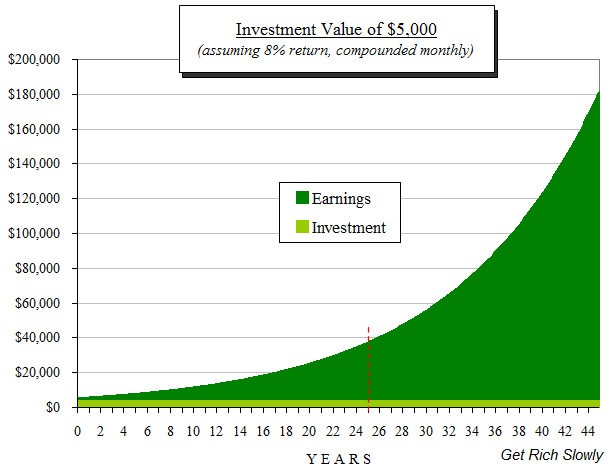
For example, if 20-year-old Britney makes a one-time $5,000 contribution to her Roth IRA and earns an average 8% annual return, and if she never touches the money, that $5,000 will grow to $160,000 by the time she retires at age 65. But if she waits until she’s my age (39) to make her single investment, that $5,000 would only grow to $40,000. Time is the primary ingredient to the magic that is compounding.
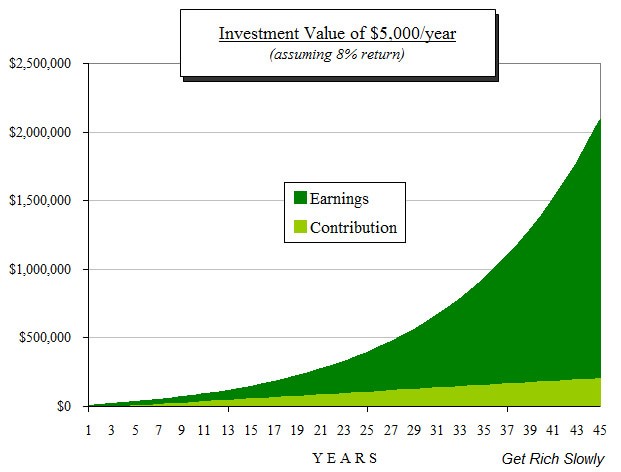
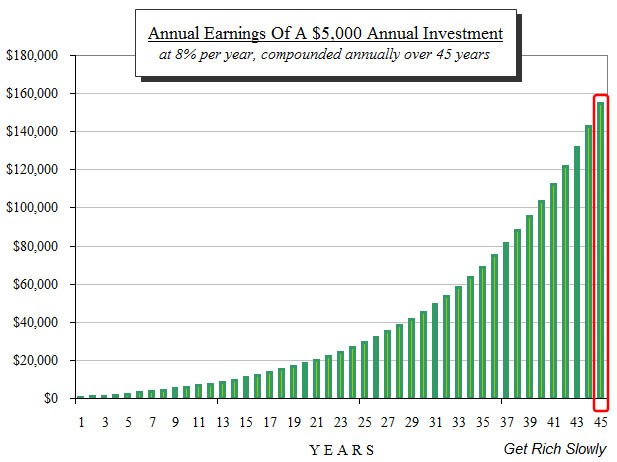
Compounding can be made more powerful through regular investments. It’s great that a single $5,000 IRA contribution can grow to $160,000 in 45 years, but it’s even more exciting to see what happens when Britney makes saving a habit. If she contributes $5,000 annually to her Roth IRA for 45 years, and if she leaves the money to earn an average 8% return, her retirement savings will total over $1.93 million. A golden nest egg indeed! She will have more than eight times the amount she contributed. This is the power of compound returns.
The cost of waiting one year
It’s human nature to procrastinate. “I can start saving next year,” you tell yourself. “I don’t have time to open a Roth IRA — I’ll do it later.” But the costs of delaying are enormous. Even one year makes a difference. Here’s a chart to illustrate the cost of procrastination. Again, we’re using 20-year-old Britney as a basis.
![The power of compounding is on the side of the young [Chart demonstrating the effects of compound interest]](http://www.getrichslowly.org/images/compoundspreadsheet.jpg)
If Britney makes $5,000 annual contributions to her Roth IRA, and she earns an 8% return, she’ll have $1,932,528.09 saved at retirement. But if she waits even five years, her annual contributions would have to increase to nearly $7,500 to save that same amount by age 65. And if she were to wait until she was my age, she’d have to contribute nearly $25,000 a year!
To make compounding work for you:
- Start early. The younger you start, the more time compounding has to work in your favor, and the wealthier you can become. The next best thing to starting early is starting now.
- Make regular investments. Don’t be haphazard. Remain disciplined, and make saving for retirement a priority. Do whatever it takes to maximize your contributions.
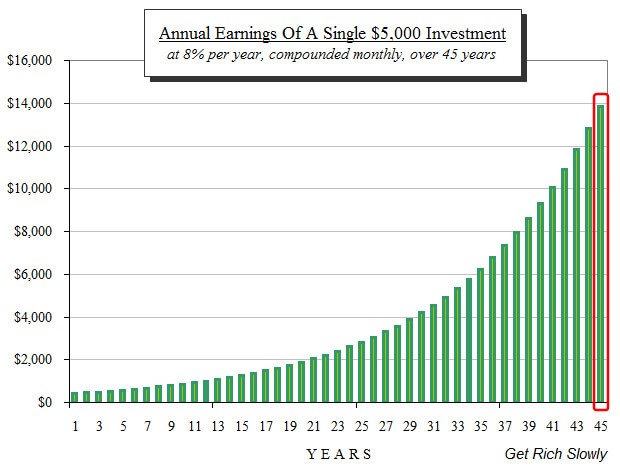
- Be patient. Do not touch the money. Compounding only works if you allow your investment to grow. The results will seem slow at first, but persevere. Most of the magic of compounding returns comes at the very end.
Compounding creates a snowball of money. At first your returns may seem small, but if you’re patient, they’ll become enormous.
This article is part of Financial Literacy Month. Look for a companion guest post on compounding later today.

RSS Feeds
Facebook
Twitter

April 2nd, 2008 at 5:16 am
One strategy I’ve taken up the past few years, is to max out my 401(k) as quickly as possible. I work at a company in an industry that regularly has layoffs, usually around mid-year and the end of the year. When I figured out that I could max out my 401(k) by August if I went to the max 30% 401(k) withholding my company offers. I figure that that will mostly cover a year’s 401(k) savings in time for a June layoff, just in case I don’t get much more into a plan the rest of the year. I don’t see a pension in our future, and my grandparents lived to be 80, 90, 92, and 95, so I want to squirrel away as much money into tax-deferred accounts as possible.
We try not to dip into taxable savings to cover the withheld funds, but even if we do, that’s moving the money from taxable accounts to tax-deferred accounts, some of which is matched, so that’s OK as far as we’re concerned.
Obviously, we have to have a sustainable monthly cashflow (net income - expenses) and an emergency fund to do this, because having 30% plus health insurance plus taxes taken off the top means the net pay gets reduced by quite a bit for the first 2/3 of the year.
Just thought I’d share this idea — I hadn’t heard of anyone else doing this.
We also put a chunk of money into 529s for the kids when they were babies, so we’re hoping that will cover something if/when they decide to go to college.
Here’s to compounding!
April 2nd, 2008 at 5:36 am
I don’t have the option of contributing to an IRA through my employer. Can you do this on your own? If so, should you, and how? I have to admit to being totally clueless on this. I have some money invested, but otherwise I am basically sitting here waiting until I get a “real job” (I’m currently on a graduate fellowship).
April 2nd, 2008 at 5:50 am
This is my first year in a “real job” as Sarah says above, and I’ve maxed out the UK equivalent of the Roth IRA - a cash ISA. The max amount allowed is equivalent to $6000 this year, but is going up to $7200 after the 5th of the month.
I plan to max this out each and every year and let compounding do it’s thing, however this type of account is cash based and so (while being very safe) it’s only likely to provide a 6% return or there abouts. It’s possible invest in a stocks and shares ISA instead (and various index and managed funds are available for this purpose), which could probably hit the 8% return used in JD’s example. However I’m concerned about linking my future to share performance. I know you have to look at the market in 10 year chunks minimal, not the current market fiasco, but personally I might be happier to settle for a smaller nest egg which is in no real danger of turning sour when I’m not looking!
April 2nd, 2008 at 5:55 am
@Sarah - you’re in the perfect position to start a Roth IRA. You can do it on your own, and since you’re not making much now, the tax situation works to your benefit. Read up on JD’s series of Roth IRA posts by starting here: http://www.getrichslowly.org/blog/2007/10/24/roth-ira-vs-traditional-ira-which-is-the-best-deal/
Yes, you can do this on your own, even if you’ve been uninvolved in the past. And JD’s best line in the post is right on: The next best thing to starting early is starting now.
April 2nd, 2008 at 6:01 am
This post is a classic lesson in leverage. In this case, the “lever” is time: As the length of time increases, the power of leverage increases exponentially…
On a separate, but related note, it sure is a shame that the term, “leverage,” has evolved into a representation of “using other people’s money” for financial gain. Leverage is quite useful and may be used in a context of money, time, knowledge, wisdom, influence, and more…
“Give me a lever long enough and a fulcrum on which to place it and I shall move the world.” Archimedes
April 2nd, 2008 at 6:13 am
I needed this post right about now, so thanks for writing it.
I’m in the middle of ALMOST opening a Roth IRA in order to be able to contribute for 2007, but I was also thinking about skipping 2007, and just trying to max out 2008. Now that I see the difference a year makes, maybe I’ll try to max both! April 15th is quickly approaching…
(Now, of course, picking which one is the hardest part.)
April 2nd, 2008 at 6:18 am
Very good post! Thanks to compound interest, the people who save early do have more retirement savings. Mentally, starting early has a greater impact as well. I’ve found that people who have been putting a couple hundred dollars into their retirement account every month since their early 20s are used to putting that money aside and have no problems continuing saving.
However, those who started later see the benefits much less and have much more trouble sticking to their plans.
April 2nd, 2008 at 6:22 am
As a side note, I’m compiling my Roth IRA posts into an e-book. I wrote this piece as the introduction to that book.
April 2nd, 2008 at 6:29 am
A great post, one which has helped me make a decision between saving money or using it to pay off debt - thank you!
April 2nd, 2008 at 6:46 am
“The next best thing to starting early is starting now”
Definitely the best line in the post. Someone told me the same thing years ago in a different way:
“The best time to plant an oak tree is 15 years ago. The second best time is RIGHT NOW.”
April 2nd, 2008 at 6:54 am
Wow,
I went and found an online calculator to figure out how much my little nest egg will be.
Im currently 19 and I contribute $10,500 annually to my SIMPLE IRA.
40 years @ 8% = 3 mil
45 years@ 8% = 4.5 mil
Hot damn! I love compounding interest
Keonne
April 2nd, 2008 at 7:01 am
I’ve taken some comfort in the fact that the 8% year isn’t a sure thing–it makes me feel better that I haven’t lost quite as much as I might have if only I’d started earlier…
I’m thinking this because yesterday a CD of mine came due and the MOST I could get from the bank where that money is sitting is 2.5%. (I know, I know, I should move the money somewhere that would pay more, but electronic banking isn’t close enough to the mattress for me…)
April 2nd, 2008 at 7:30 am
I am new to the retirement plans. Just started a ROTH IRA last month after reading this blog but I still have questions.
My retirement funds is in a target date fund (since I am not experiences with the stocks)but I notice, the more money I put in, the more value I lose because the current stock market is so down.I am starting to question how my IRA suppose to compound? I feel I am compound losing right now.
Should I keep on putting money in there? (It is a 2040 fund to be exact)
Also,what stock you guys would suggest to put my IRA in if not a target date one? I heard many good thing about S&P500 but the price is so high right now. I am not sure if it is worthy to put money into it.
(Thank you for any advise)
April 2nd, 2008 at 7:31 am
Very nostalgic post, J.D. It took me back to old skool GRS.
April 2nd, 2008 at 7:34 am
There’s a reason why posts on the power of compound interest are usually well-received. Most people don’t realize how powerful a wealth-building tool it is! Even if they think they do, it usually takes an illustration like that post to make them truly realize what they’re missing out on.
One more thing. There’s a flip side to compound interest. That flip side is compound interest that you are CHARGED for purchases on your credit card. Avoiding that is as crucial as taking advantage of earned compound interest.
April 2nd, 2008 at 7:48 am
What I don’t get is where the 8% comes from? Over the last 10 years the market has been flat. If I invested $5000 ten years ago I would have a grand total of probably less than $5000 because of fees. I’ve been looking into where I should put my retirement money and it’s not easy.
April 2nd, 2008 at 7:50 am
We’ve started as early as we can — 23 and 22. One of the things we are going to request from our friends and family when we plan to have kids (several years down the road) is money to put into a custodial account. Imagine what $1,000 at Age 0, given 60 years to compound, would result in? We’ll also do a 529 plan, but I really want to save $1,000 and see what happens.
For the curious, at 10% return, that’s $304,481.
April 2nd, 2008 at 7:50 am
I’m a recent college graduate with student loan debt. I was planning on quickly paying off my loans and then start saving, but now I’m not so sure. What should I do?
April 2nd, 2008 at 7:51 am
I’ve been on the fence for a while about whether to start a Roth IRA now or in a couple months when we move into a new house. I think it’s going to be June when I start them for us, because then we will be sure that we have enough money to cover our down payment and our closing and moving costs. I’d hate to have to dig into the Roth for extra funds after I open it.
The real question: is it better for my wife and I to fund separate Roth’s or are there any advantages to setting up a joint?
Daniel @ Young and Frugal
April 2nd, 2008 at 8:31 am
Great site. I’ve got a question I’d love to ask, specifically about the Roth IRA:
Say a person had earned income in previous years, and contributed to a Roth IRA… but this year had no earned income, for whatever reason. What’s to prevent the person from going ahead and contributing to a Roth this year as well? It’s not declared on the 1040 (which would show the earned income problem), so who would step in and say “no”? Somebody way down the road, at the time when the Roth is tapped decades later???
I’m sure there’s a good argument against the above – something obvious that I’m missing. Can anyone fill me in?
April 2nd, 2008 at 8:49 am
@Daniel@YoungandFrugal: You can’t have a “joint” Roth or Traditional IRA. IRA = Individual Retirement Account.
So fund one, and put the other person as the beneficiary if you die. Fund it to the max, and then open up a second one.
April 2nd, 2008 at 8:50 am
What a great article. I wish I could turn the clock back, which I cant, so instead I’ll wish to win the lottery to make up for lost time
April 2nd, 2008 at 8:56 am
@Daniel and No Debt Plan: A more fair way in the possibility of divorce is to fund one for you and one for your wife equally, instead of fully funding one and not the other. Hopefully this wouldn’t be an issue, but as they are individual accounts, one can’t be too safe.
April 2nd, 2008 at 9:05 am
Whenever I read posts like this, I get an intense sadness, because I feel like I am already behind everyone else who is posting here. I am currently almost 30 and I have never been in a financial situation where I can contribute to a Roth IRA or 401(k) account. Part of this is because I have been in school for almost a decade now (4 years undergrad + 5 years grad school) and a student’s salary is not enough to support any type of saving. I feel like I’ve made a stupid decision to further my education and attempt to do something I love to do (post-secondary teaching) instead of investing in my future. The worst part is that I’m actually educated enough to understand what compound interest actually does, but am powerless to do anything about it.
April 2nd, 2008 at 9:09 am
Sheldon wrote: What I don’t get is where the 8% comes from?
Excellent question, Sheldon, and worthy of a follow-up post. Long-term, the market has increased in value at an average annualize rate of X%, where X is 6% or 8% or 12%, depending on how you’re making the evaluation. (In the post that comes later today, the author uses 13.4% as his number.) I choose 8% because it seems reasonable to me based on my research. But you’re right — this topic deserves a deeper discussion. It’s a part of basic financial literacy. I may even try to write about it for tomorrow!
@Jim E
Though your IRA contributions aren’t declared on your tax return, they are reported to the IRS. You should receive a statement from your investment firm every year. The IRS gets a copy of this, too. Besides, it’s never a good idea to try to pull one over on the IRS. The consequences are dire.
April 2nd, 2008 at 9:22 am
@JD:
Got it: the IRA contribution is reported to the IRS, who presumably will check the contribution amount against what the tax return says is allowable. Simple answer to a simple question; thanks!
April 2nd, 2008 at 9:23 am
@Jamuraa
Don’t be sad!
Don’t dwell on the past. Instead, focus on what you can do now or in the future. If you’re still in school, you might not be able to contribute to your retirement. That’s okay. Your investment in your education is just as valuable. It’ll allow you to catch up in the future. Just be aware of the power of compounding, and seek to use it to your advantage when you’re able!
Personal finance is all about trade-offs. And while the power of compounding is not to be ignored, sometimes one has to opt for another choice, such as education.
April 2nd, 2008 at 9:37 am
This was a great article.
I was thinking of a way to turn all of my nephews attention to personal finance without putting them to sleep, the oldest one is going to be 17 in a month.
I sent them a link to this article as well as a copy of ‘The Richest Man in Babylon’.
My hope is that even if they just pay lip service to this, the fact that they know this info will be indicting to them and help them to get back on the right path.
April 2nd, 2008 at 9:55 am
Jamuraa,
I too was in grad school and my husband and I did not contribute to anying till we were in our 30s (post-secondary teachers). The lessons in frugality you are learning in grad school will be useful for the rest of your life! We have contributed every year since we started working–yes, you are losing your 20s as a time to invest, but there is no substitute for the great job of teaching. We want to work forever!
BTW, will be starting my own blog on this very subject next summer–be on the lookout!
April 2nd, 2008 at 9:57 am
This is so frustrating to me, because I don’t have a 401k anymore through the small business I work for, and I do have an ING account for long term savings, and I rolled my 401k from a previous job into a trad. IRA that I fund monthly, automatically. I save a little over 30% of my take home every month, but I am 28, a graphic designer, and I am no where NEAR maxing out my IRA. And I don’t really see a way to cut corners to get there. Charts like that don’t make me feel good about what I am doing, they make me feel bad that I am not doing more, and time continues to slip away.
April 2nd, 2008 at 10:15 am
I love my Roth IRA. One thing that you also need to remember at this time is Don’t Panic!
I have been getting questions about whether it is time to cash out a retirement plan before the market crashes. The answer is NO.
As mentioned in this great post, the idea is to keep investing for the long term. And in the long term, the stock market gains…
April 2nd, 2008 at 10:15 am
@Sam:
Investing really isn’t that frightening once you start doing it. If you have a pension, that will be invested in stocks and shares, not in cash because the return on cash is dangerously low over the long term. Nothing is risk-free.
I wouldn’t normally self-promote, but I have just written a series on investing in stocks and shares ISAs for beginners, and I’m sure you can become comfortable with a suitable level of risk.
April 2nd, 2008 at 10:25 am
JD-
Possibly your best blog yet!
I always wish I had started saving earlier…who doesn’t. But I’m glad the wife got me to start when I did. It’s never too late. As you said, don’t dwell on the past…mentally it will make it tougher to invest. Focus on the future and you’ll mentally be much more ready to start today.
April 2nd, 2008 at 10:26 am
Mrs. The Point - I have similar concerns and sometimes feel like I’m throwing my money away investing in my IRA which keeps going down lately. Which is why I haven’t fully funded it for 2007 yet and am still on the fence about doing so.
The thing that helps me, is remembering that you are buying cheaper shares now since the market is down, so you can buy more of them with the same amount of money. Buying more shares should make a bigger difference when the market goes back up!
You have to be in this for the long haul, and ignore bad times. But it’s something I struggle with too.
Anyone else have advice for those of us who are having a hard time throwing more money at an IRA that is losing overall value?
April 2nd, 2008 at 10:35 am
My question: You are talking about “compound interest”, but seem to be referring to investment accounts.
As I understand it, “compound interest” refers to a fixed interest that is guaranteed, and builds steadily over years…like the interest on a savings account. But with a 401k or IRA, neither the principal or a profit is guaranteed to be there.
I understand the point being made, and agree. But is it correct to call investment income/profits “compound interest”?
April 2nd, 2008 at 10:37 am
What most people don’t realize is that the majority of the long term returns on stocks came from dividends. With most stock dividends paying less than 2 percent right now it makes sense to put your money into safe bonds.
With safe bonds you do not have to worry about market fluctuations because your bonds will come due at face value at maturity.No one seems to place much value on not loosing money.
In reality if you lose less, then you do not have to take the risks to make more. Bonds provide that alternative to risk taking, which can become an addition in and of itself.
We have successfully used this strategy for our selves and our clients. We finally wrote about it in our latest book: BONDS: The Unbeaten Path to Secure Investment Growth.
It really doesn’t matter if you invest in bonds in an IRA or in a regular cash account. If you are in the 25% marginal tax bracket or higher, you can purchase muni bonds and not pay taxes on the income.
View education as an investment in yourself to enable you to get a job that you love and provide yourself with the intellectual flexibility to take advantage of opportunities and changing times.
I started to write about bonds from the perspective of an anthropologist, my graduate school training. It has served me very well.
BondGuru
April 2nd, 2008 at 10:39 am
That’s a great question, Susan. Compound interest and compound returns are twins. The same principles apply to each, but they refer to different things. In the post, I tried to use three terms: compound interest, compound returns, and compounding. Though the title does say compound interest (because that’s the term most people are familiar with), in the post itself, I’ve tried to keep the terms in their correct locations. I may or may not have succeeded.
April 2nd, 2008 at 10:49 am
I am not so old that I don’t remember when I was that age, and people kept telling me save save save.
But did I listen?!?
I’m kicking myself now!
Lisa
April 2nd, 2008 at 10:54 am
I’m aware of how compound interest can make you wealthy, but my problem is that it takes all your life before you are wealthy.
The people I read about in the Millionaire Next Door were old dudes before they became wealthy. And they spent the majority of their lives working well over 40 hour weeks at lame jobs and living an extremely frugal life.
I’m all about being frugal, but I just can’t get myself into the idea of pushing myself to save 10 percent of my income when there are so many more attractive things I could spend it on like school and travel. I nearly died a year ago and my body already feels old. I do want to have a home and food and basic necessities when I’m retired, but how am I going to use millions of dollars when I’m an old lady? And what if I don’t even live that long?
April 2nd, 2008 at 11:33 am
Heather-
It’s too bad you feel that way. Sometimes pushing away small immediate gratifications mean you get to experience such great ultimate rewards.
Of course, most of the world agrees with your immediacy, and as such, we have 7 year car loans, 5 years “no interest” furniture loans, and bankruptcy rates increasing every year.
April 2nd, 2008 at 11:46 am
Having a nice nest egg as you approach retirement is a great thing but what if you die right before you retire? That would truly suck. All that money that you had planned on spending in your golden years would go unused by you.
That said, I’m still planing on saving money every month for my retirement 35 years away. I just really hope I’m not shot or run over at age 65.
This would make a really chilling twilight zone episode actually. Have a character who spends his/her entire life saving money for a wonderful retirement die of a heart attack right before they retire.
April 2nd, 2008 at 12:33 pm
Heather, I hear you. (Brian, I understand your response, too, and agree with it generally, but in response to Heather, I think it was a bit glib.)
Deciding where to draw the line between enjoyment in the moment vs. saving for the future is a very personal decision that will be different for everyone. No matter what you decide for yourself, though, one way I’ve read which might help you is to do a budget (as rough or detailed as you want), figure out what your monthly expenses are, and with the remainder, allocate a certain percentage of it for savings and a certain percentage for pure FUN.
That way you’re kiling two birds with one stone. You know you’re saving, and you can spend what you’ve already decided will be your “enjoyment dollars” without feeling guilty in the slightest.
Hope that helps!
April 2nd, 2008 at 1:35 pm
Yes it would suck to die (just before retirement or otherwise) but at least you can then leave your fortune to those you love and insure that they will be able to attend college, retire and otherwise have lives without financial worries.
If not to a love one then leave the money to a cause or charity that you care about. At least something that you believe in will be able to prosper due to your efforts.
I chose this route over leaving my survivors with a pile of bills and otherwise in the lurch.
Then again, maybe it’s more satisfying to give that money to GM, Countrywide and Toshiba on the installment plan.
April 2nd, 2008 at 1:39 pm
maybe mine was a bit harsh, but it disgusts me to see how everyone has an over-active tendency to only look at what they get at the moment. This board is called “get rich slowly” for a reason. Wealth, at least lasting wealth, is not immediate. It’s made over time. When you are able to delay pleasure, the pleasure ends up being that much stronger.
And to the question of “what if i die before i retire”? Ummm…I doubt you’ll think too much about the fact that you didn’t have a chance to spend the money you saved….you’ll be dead.
April 2nd, 2008 at 1:41 pm
Justin, this morning you asked:
“I’m a recent college graduate with student loan debt. I was planning on quickly paying off my loans and then start saving, but now I’m not so sure. What should I do?”
When I was in this position, I split the difference and paid the loan payments as they came due, but also saved for retirement. I wasn’t able to max out retirement, but I didn’t want to lose out on the compounding advantage. Ultimately it depends on your individual situation factors like: the amount of your loans, the interest rates on your loans (how oppressive are they?), your opportunities to save (pay rate, access to 401k). But I can share that my loans are long gone and forgotten and meanwhile I can already see results of starting early, even taking into account the current turmoil, and that I started during the tech bubble years, and that I didn’t max out, and that the contribution caps were much lower in the 90s.
But for those grad school folks, it is worth it to be working toward your goals professionally too. My husband spent years in grad school, started contributing when he started working full time and we have about the same amount now - he was able to save larger amounts - higher limits when he started too.
If you start when you can, you are already ahead.
April 2nd, 2008 at 2:31 pm
@Heather:
I was pretty much “live for now” before DH and kids, so I get where you’re coming from. However, I hate to think of anyone working at 75 to pay for basic living expenses. You can enjoy your life without living like there’s no tomorrow. My dad pointed out to me early that if you contribute just 1% to your paycheck to a 401(k), you won’t even notice, because that amount is removed before taxes. Suppose that 1% is $50. But you’re probably only reducing your net take home pay by $35. And you can increase it as you can.
I don’t think our lives are bleak because we’re frugal. We spend money now on what we care about (travel, foreign languages, music, art, education, theatre, indoor and outdoor activities, food, minor-league hockey games) and not where we don’t (cable, 1st run movies, lots of new name-brand clothes, lots of toys, impressive home and cars, dining, junk food). Your priorities will be different, but there are likely places where you can cut back that won’t feel “cheap”.
BTW — I watched my aunt die of ovarian cancer just 2 years before she and and my uncle were going to retire and travel and volunteer. I would prefer to have enough money to retire much earlier, myself, just in case!
April 2nd, 2008 at 4:46 pm
@Brian:
“maybe mine was a bit harsh, but it disgusts me to see how everyone has an over-active tendency to only look at what they get at the moment. This board is called “get rich slowly” for a reason.”
I agree with you completely. It’s just that in response to any **specific** person, we never know exactly what their situation is, so I feel it’s not fair to judge them. Especially when Heather said “I nearly died a year ago.” We have no more info. than that, but I can certainly see how a near-death experience would make someone want to appreciate life to its fullest in the moment.
But in general terms, I think you’re absolutely right.
“And to the question of “what if i die before i retire”? Ummm…I doubt you’ll think too much about the fact that you didn’t have a chance to spend the money you saved….you’ll be dead.”
LOL–good point!
April 2nd, 2008 at 5:35 pm
@Sarah
I have my Roth IRA with Dodge and Cox. You’re in luck because they just reopened their Dodge and Cox Stock fund to new investors. It’s a value fund and it has done very well for me and has very low expenses. (800) 621 3979.
I have my traditional IRA with T Rowe Price. I have it in their Equity Index 500 fund. They have a very low minimum if you add to it every month (dollar cost average).
800 225-5132.
Invest in either of these funds and you will be able to sleep at night.
Hope this gives you some ideas.
Best of luck.
April 2nd, 2008 at 5:54 pm
Thanks for all of your answers to my question. I guess it was written in haste, because I do think it is valuable to save oney and plan for retirement, I’m just not so much worried about starting right away if all I’m losing is a chance to be a millionaire.
I do want a decent nest egg, something like a few hundred thousand dollars that could be put into CDs or bonds so that I could live off of the interest. But to start now on saving for that would mean I would have to get a full time job and leave my son with someone else. To me it is worth giving up many years of compound interest for things like that…children, family, education, etc. To me, being a millionaire at retirement is nothing in comparison to reducing my time at life-sucking jobs and enjoying time in the present. I’m not saying I need to get into debt or spend beyond my means to live a fullfiling life.
My problem is not that I spend too much, it’s that I don’t make enough (our family income is around the poverty level). With little income, I have to make decisions like choosing between saving for retirement or buying organic foods for my baby. Or between visiting my husband’s family or saving for retirement. To me, the organic food and visiting family is more urgent and the retirement can be saved for later when my son is older and I can work more hours. Or after I’m more educated and can make more money per hour.
The main point is that although I believe having a retirement plan is important, I don’t see the value in being incredibly wealthy at retirement, especially when it means compromising a peaceful and fulfilling life now.
And even though I say that, I still love this blog and appreciate all the info it has provided!
Peace.
April 2nd, 2008 at 6:34 pm
Great post! I’ve linked to it on my blog.
April 2nd, 2008 at 7:12 pm
Heather, there is a distinction between being rich and being independently wealthy. If you are rich, you have a lot of money. If you are independently wealthy it means that you live within your means and are not dependent on others.
You might enjoy the book Your Money or Your Life by Joe Domingez.He talks about the trade-offs people make between having time and doing what you want to do, and making money. Your choices are reasonable, you just have to understand the consequences.
Also, if you get in the habit of saving even a little on a regular basis, it will come easier to you.
BondGuru
April 2nd, 2008 at 7:29 pm
Heather -
I highly recommend you check out some investment calculators which are linked to throughout this website (or just google ‘retirement calculator’). A few hundred thousand dollars will probably /not/ be enough money saved if you intend to just live off of the interest. If you have $300,000 saved up and retire at age 65, it will likely only last you 10 to 12 years (even if you live off of the equivalent of $40,000 or so per year), if that long.
This website
http://moneycentral.msn.com/retire/planner.aspx
estimates that if you have a little over $300k at age 65 and retire, you’ll run out of money around age 79 - assuming that the government gives you $13k per year in social security (which may or may not happen by the time any of us retire!). Without that $13k per year, your money will run out at age 73. 8 years is not a long time to live on $300k in savings! So, a million dollars or more at retirement isn’t really “wealthy” for people who plan to live more than 10 or 15 years, especially if they would like to travel or anything like that in retirement.
I’m not trying to bring you down, just trying to show that many of us who are young grossly underestimate how much retirement will cost! (I’m 23, and I include myself in this category.)
April 2nd, 2008 at 8:39 pm
I’m 54 now. Man I wish I had listened to someone when they told this to me when I was 24. My wife and I have started saving but we are way behind. Better late than never but oh man. What a waste of Money.
April 3rd, 2008 at 12:43 am
Hi, I discovered your blog very recently and have been benefited to a large degree due to the learning I extracted from it.
In this post,should we not talk abt the impact on inflation and hence the real interest rate. for example, in India the inflation is much higher than the savings yield, and hence even after compounding, the investor would be losing wealth although gaining in currency. The interest rate is also critical while thinking about any investment. What are your views on this?
April 3rd, 2008 at 3:47 am
OK, here’s a question: should I be saving my money or using it to pay off my debt?
April 3rd, 2008 at 6:58 am
One other thing to note is that Roth IRA currently has income limits, so it is also advantageous to start investing early in your career before your income rises above the Modified Adjusted Gross Income (MAGI) cap.
April 3rd, 2008 at 7:53 am
Hi. Those investment calculators always seem to overstate what one needs. Personally, I’ll be happy to die broke (I come from a long line of “don’t expect an inheritance” folks).
Just think about how much less people would need to put away for retirement if we had a reasonable national health care option. I certainly hope we develop one soon!
April 3rd, 2008 at 8:52 am
@elisabeth
So you’re happy with other people taking care of you. As long as you don’t have to take care of yourself.
I’m sorry, but I rather you die broke before having to pay for your health care.
This is coming from someone who lived under a National Health Service.
This rational makes me sick.
April 3rd, 2008 at 9:22 am
@plonkee
That would be very useful - although some 90% of the US advice around here is directly transferably to UK finances (see today’s article for example, makes plenty of sense!) I would definitely feel more comfortable reading a UK perspective on the stocks and shares ISA. A friend of mine is doing the same thing as me only contributing to one of those rather than cash, and he’s sweating a little at the moment. However I think we both know long-term his investment plan will beat mine!
April 3rd, 2008 at 10:37 am
Mike Kingscott, here is the answer. Yes!
April 3rd, 2008 at 10:57 am
@ elisabeth -
There is a difference between “dying broke” and dying with a huge amount of debt that someone else will have to pay off for you. Leaving that kind of debt to loved ones or society isn’t fair to anyone. And that national health plan? You’ll still be paying for it, just through higher taxes instead of through your insurance premiums and co-pays. Nothing is free. (But then again we all know the US government is an excellent money manager and is known for making bureaucratic decisions that are favorable for the general public, right? Oh wait . . . )
@ Mike Kingscott -
Check out Wesabe.com. Its a personal finance site with tips and information, but includes tons of message boards where you can ask questions of other members and explain more about your personal situation. (No one can answer your “save or pay debt” question without knowing some more background information. Or rather, people can answer, but they won’t know what is actually best in your situation.)
April 3rd, 2008 at 11:09 am
Relax — I don’t have any debt now and don’t intend to leave any when I die broke. BUT I’d still rather have all of us taxpayers paying for health services for all of us than some of us paying for the emergency room and other costs of having so many people unemployed. I suspect JD doesn’t want to turn this blog into a discussion of national health care, but I will say that I think I can get rich slowly even while I live in a society that doesn’t let anyone suffer from a lack of health care.
April 4th, 2008 at 10:37 am
The differences in the returns are truly amazing. And part of me agrees with elisabeth on the health insurance question… in the hospital where I work part-time we recently had a patient who stayed just over a week in intensive care and ended up with a bill of well over a million dollars, because of the overwhelmingly high cost of his life-saving treatments. Unless he was independently wealthy, which he did not appear to be, this illness could likely lead to his financial demise. Sobering…
Jerry
http://www.leads4insurance.com
April 4th, 2008 at 12:24 pm
That chart makes a fantastic point! If only someone had shown me this chart in high school.
April 8th, 2008 at 9:03 am
Saving money is great. Investing money is wise. Starting business is a MUST to became richer…remember is not money that make you rich is business skill what really make you rich. It’s a lifetime learning thing…
April 25th, 2008 at 11:41 am
I am convinced if people truly understood the principle of compound interest that a lot of people would be wealthy, and we wouldn’t be in the credit crunch we happen to be in. It was Albert Einstein said it is the most powerful force in the universe there is something behind that.
Brice
http://financialzip.com
June 15th, 2008 at 8:28 pm
Thank you for your blog post about the effect of compounding interest. I cited your article in a blog post of my own regarding what to do with money that is made online. In my mind, I believe that money made online should be transferred, through EFT, into a bank whose presence is most pronounced on the internet. ING Direct comes to mind.
http://www.shop-network.org/blog/internet-banking-makes-dollars-not-cents/
September 10th, 2008 at 10:12 am
I wrote a primer on the power of compound interest, which you can find here:
http://www.btgnow.net/2008/08/compound-interest-is-free-money-part-3-time-is-money-friend/
Time is definately of the essence when you consider the power of compounding. I’m still working on a way to figure out what to do if you hadn’t started investing early (and I think I have a prety feasable idea). Hopefully one day I’ll crack the code and everyone can be millionaire, not just the early birds!
September 11th, 2008 at 11:19 am
Einstein did not develop the theory of compound interest. That he did is a myth.
Read BONDS: The Unbeaten Path to Secure Investment Growth to find out how to make compound interest work for you.
You may not make 10% on your money, but you won’t lose money either if you invest in safe bonds.
September 11th, 2008 at 5:16 pm
@Hildy:
Yes, actually you can lose money, just not the way most people think:
Safe bonds such as Treasury Bills (bonds backed by safe governments like the US or Canada) will be safe in the sense that they will likely not cause you to lose any of your initial investment. Of course, there are many bonds that are incredibly risky as well, so an investor shouldn’t start thinking that ALL bonds are safe investment vehicles.
Even with “safe” bonds, however, there is something called interest rate risk: it’s the risk that inflation will rise faster than the interest rate the bonds are offering. For example: if you bought a bond today that paid 5% per year for 5 years, and for the next five years the annual inflation rate was less than or equal to 5%, you’d either make a little bit of a positive return (if inflation is less than 5%), or you’d be just keeping pace with inflation (5%). If the annual inflation rate during those 5 years is GREATER than 5%, then your bond payments are lagging behind inflation and your are losing purchasing power.Inflaton is outpacing your returns, and you are in a very real sense losing money in the form of lost purchasing power.
The value of your bond will also have decreased if you tried to sell it to compensate the person you sold your bond to.
The book you pointed out sounds interesting though, I’ll definately have to to check it out.
September 15th, 2008 at 2:42 pm
You are correct in stating that there is a risk of inflation in every investment, including bonds. Interest paying bonds, however, soften the blow if the interest can be invested at the higher rates. That is how an investor gets growth in bonds- through the investment of interest and the reinvestment of returned principal at higher rates.
For the serious bond investor an even more serious problem is the decline of interest rates. Though the bonds might appreciate, all the interest is invested at lower rates, and maturing bonds must be reinvested at lower rates. This risk is exacerbated by keeping your assets liquid and in short-term maturities. Investors tend to overlook this problem and focus on the effects of inflation.
In BONDS: The Unbeaten Path to Secure Investment Growth, we outline different bond investment strategies for many investment situations and types of investors.
January 3rd, 2009 at 10:02 am
I quoted you on my blog the other day and credited you and everything.
“The rich are not rich because they earn a lot of money; the rich are rich because they save a lot of money.”
Please let me know if that is not ok. This was an excellent post that I had to pass along!
January 4th, 2009 at 6:39 pm
The rich have money for many reasons, Liz. However, they will remain rich if they do not understand the power of compound interest. They must save enough to continue to replenish their depleting capital.
Those of us who start out with no money must save. If you start early enough, a small amount of money can make you a millionaire.
The savings must be invested in bonds or another investment that provides a stream of income. I prefer bonds because bonds pay interest without any additional work on my part.
Conservative, plain vanilla bonds are less risky as well. The income from the bonds or other investments must be re-invested to have growth. The growth comes from the compounding of the income, paying interest on interest.
This is different from putting money into stock and hoping someone will buy you out at a higher price. It is the stalactite hanging from a cave wall, continuously dripping water onto the stalagmite below.
Thank you for posting my statement on your website, Liz.
Please check out my book BONDS: The Unbeaten Path to Secure Investment Growth, Bloomberg Press, 2007.
April 15th, 2009 at 8:23 am
I prefer equity fund or mutual funds because the higher returns. Government bonds and Treasury bills are also good if you need to invest it short time. However, time is also a major key player in compound interest so start early!
April 17th, 2009 at 10:58 am
You have to work for the IRA the first 4 months out of the year, just to pay income/sales tax for the year!
There is something very wrong about that…
April 17th, 2009 at 10:59 am
I mean the IRS…
April 17th, 2009 at 4:00 pm
There is a new class of bonds coming to market. They are municipal bonds that are taxable and will grouped under the title Build America Bonds (BAB). They are suitable for retirement accounts and for people seeking taxable income. They will be municipal bonds, supported by your taxpayer dollars and revenues received by municipalities. The Federal government will be supporting the issuance of these bonds through tax credits. They are new, so the yields may be attractive.