The polls that appear in the Get Rich Slowly sidebar are far from scientific, and a lot of the time they don’t yield anything interesting. But sometimes they turn out a curious piece of information.
At the end of April, the poll question asked, “How many months to do you have in your emergency fund?” This was the same question posed in mid-January. This poll also ran concurrently at Money Rates, a site with a much older readership than GRS. And what were the results? Let’s take a look. Here’s what you said in April:
| How many months do you have in your emergency fund? (May 3rd) | ||
|---|---|---|
| GRS | MR | |
| less than 3 months | 38% | 12% |
| 3-6 months | 26% | 14% |
| 7-12 months | 13% | 25% |
| more than 12 months | 14% | 36% |
| what’s an emergency fund? | 9% | 12% |
| 1724 total responses | ||
And here’s what you said in January:
| How many months do you have in your emergency fund? (Jan. 28th) | ||
|---|---|---|
| GRS | MR | |
| less than 3 months | 2% | 3% |
| 3-6 months | 17% | 14% |
| 7-12 months | 45% | 40% |
| more than 12 months | 23% | 19% |
| what’s an emergency fund? | 13% | 24% |
| 1270 total responses | ||
Now, I realize a poll like this isn’t scientific, and it’s difficult to draw any actual conclusions, but wow. Even without tight controls, it seems pretty clear that readers at both sites (but especially here) have seen their emergency fund dwindle over the past few months. (Actually, the older folks at Money Rates are divided; some of them have built savings recently.)
I know my own emergency fund suffered a setback recently. As I wrote last month, our sewer line needed some work. Taking your advice, we had multiple plumbers bid on a fix. They actually came in around the same price ($2500), so we went with the outfit we’ve been using to deal with our plumbing emergencies. To pay for the work, I tapped my emergency fund.
In the olden days (2007, for example), this would have caused me great stress. I didn’t have much in savings. In fact, I had less than $1,000. But since paying off my debt, I’ve been able to pad my emergency fund to over $10,000 — plus I have a whole bunch saved in other targeted accounts. Sure, this money is set aside for a trip to Europe and for an eventual new car, but if I needed to, I could use it to cope with a crisis.
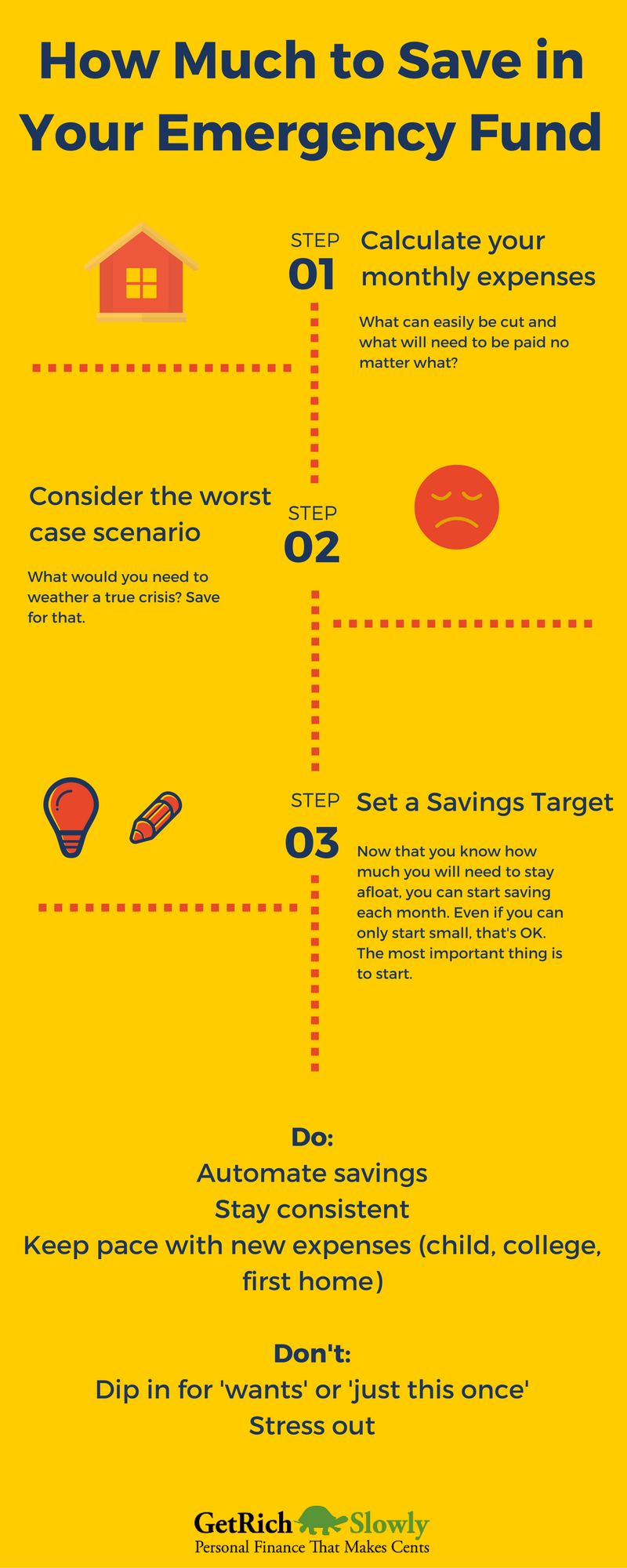
Maybe it’s time to review some emergency-fund basics. If you’re new to the concept, follow these guidelines when setting up your rainy-day fund:
- Pick a bank. I’m a fan of local credit unions and community banks, but I also like high-yield savings accounts at online banks. (My emergency fund is at ING Direct, though there are plenty of other options.) It doesn’t matter where you save; the important thing is that you do save.
- Build a buffer. If you’re still in debt, it’s probably best not to stick a lot in savings. You should set aside $500 or $1000 to deal with annoying emergencies like a car that breaks down, but the rest of your money should be thrown at your debt.
- Resist temptation. When you have a big chunk of change sitting in the bank unused, it can be tempting to use it for other things. Maybe you want a new television to watch the World Cup. Or maybe you want to purchase a new grill for barbeque season. Don’t. Resist the urge. Use your emergency fund only for emergencies, otherwise you defeat the purpose.
- Save more. As your debt dwindles, and as you get better control of your finances, build your emergency fund. Many financial gurus recommend hoarding six months (or more) of expenses. I’m not sure there’s any one set figure that works best. Instead, I recommend picking a number that helps you sleep at night. For me, that number is $10,000. That seems like a lot of money to me, and if anything disastrous happened, it would help me and Kris survive for a long time.
And, of course, don’t forget to save for your other goals. Your emergency fund is important, but you also need to set money aside to pursue other dreams, such as your daughter’s wedding, that trip to Japan, or the boat you’ve always wanted. (As I’ve mentioned many times, I’m a fan of targeted savings accounts for this kind of planning.)
Having said all that, I’m dying to know: How much do you have set aside for emergencies? Has your rainy-day fund dwindled over the past year? Is it because of the economy? Do you feel scared because your savings is starting to shrink? How important to you is saving for an uncertain future?
This article is about Savings


Sounds to me like the demographics are changing. People who weren’t thinking about money back in January are seeking information now. Better late than never!
loading....
To answer your questions, when my husband and I got married we agreed on a round number that we would keep in cash (half each as we have separate accounts) as an emergency fund/freedom fund (in case we wanted to move randomly or quit our jobs for a bit). It’s equivalent to about a year’s worth of expenses if we didn’t buy extras. He already had this money available and I sold my house so put it aside from the proceeds. This way, we could buy another car with cash if needed, and both lose our jobs for a while. Our jobs are quite stable and we aren’t particularly worried about not finding another job. So we probably have more money set aside than needed, but it makes us feel comfortable. On top of that I’m also saving to go to Europe for a few months in 7 or 8 years ($100 a month towards that X 10 years). And I’m saving more cash money as I’m going back to college in the fall. We’ve never had to tap our emergency fund as we spend a lot less than we make. There are also retirement/FI savings on top of all that. We’re pretty lucky to be in the situation we’re in. But we make smart choices as well. We could easily be up to our ears in debt if we did the newlywed big house, two new cars, big wedding, big honeymoon thing, but none of this interested us.
loading....
My ‘emergency fund’ took a hit because our taxes were more than anticipated.
Generally, ours ebb and flow throughout the year. I have to take some out, then I have to build it back up. So for me, it just depends on when the question is asked.
loading....
I’ve never really liked the term “emergency fund”. During university, since I alternated school and co-op terms, I always made sure that at the end of a co-op term, there was enough buffer to cover my expenses for the 4 months of school and then one month until I got my first paycheque, in case it took a month to get paid.
After my last co-op term, I made sure to have enough of a buffer to cover my moving expenses to where I would start my full-time job after graduation. Since things have stabilized, my first goal is to establish a buffer of 6 months expenses, since that is how long I would take off if something happened to my job, though my job is fairly stable.
I prefer the snowball approach to savings. It makes me feel better to have one goal reached, so first I will fill up my buffer and then I will work on my down payment account since there is no way I would buy a house/condo without 6 months of expenses saved up in case of any problems.
loading....
Here’s another possibility.
People increased the size of their e-fund at the start of the recession have begun to pull it down.
In 2007 we had a 6 months emergengy fund. As the recession mounted we increased the size to 12 months for 2008 and 2009. Now we are slowly spending in back down on items like home improvement and small vacations that the kids will remember. When it gets back to 6 months we will be back at the status quo.
I’d wager there are others like us. Responder #2 appears to be another example.
loading....
I think Cindy may be onto something… Perhaps you’re getting more “newbies” now than back in January. The overall participating was 50% higher this time around, too. It’s an interesting result either way, but I wouldn’t read too much into it.
loading....
Maybe people are actually building their EFs since before only 13% had between 7 to 12 months, and now it is up to 45%. I have been steadily building my own EF and I am up to about 3 months. It is a slow process!!!
loading....
To answer your question, we’ve got about $15,000 in our emergency fund, which represents about 3 months of expenses for us.
But I have a question to throw back at you, J.D. – I’m curious how your household handles big “emergencies” (like the sewer system), given that you maintain separate finances. Do you and Kris each have your own “emergency fund,” and you split the $2,500 cost of the plumbing work? Or do you both contribute $100/month/each to a common “emergency fund?” Is it worth the hassle? Situations like this are precisely why my wife and I decided it would just be easier to merge everything.
loading....
It could also mean that people have gotten a better grasp of exactly what they are spending and how much they need. Or maybe they are just more pessimistic now than before and estimate that what they thought would cover 6 months actually only covers 3 months of expenses.
The past year I’ve added some expenses to my daily life but I’ve cut back in other areas so my total expenses are about the same and my emergency fund still covers 5-6 months of expenses.
loading....
@Steven: Read it again, you’ve got it backwards. 45% of readers had 7-12 months in January. By May, the number of readers with 7-12 months had dwindled to 13%.
I know you only comment here to spam links back to your own blog (like all wannabe, “me-too” bloggers), but fer cryin’ out loud – don’t be so lazy. At least put a little effort into your blog comments and read the darn article!
loading....
Right now, I have about 7,500 in the emergency fund, about 2500 short of my own $10k goal for disasters. This was tapped recently to pay for a wedding expense that popped up way earlier than I was anticipating and I didn’t want to have it sit on my credit card building up interest.
That $10,000 will see my soon-to-be-wife and I through a lot in the event something truly terrible happens, but it’s still not enough to make me feel 100% safe.
Thankfully, my almost-wife just got a full-time job that pays substantially more than her previous part-time job. So now the goal is to have 1 year of her salary in savings (around 30k) before we even start on non-emergency savings items like a house. On our current plan, we’ll have this saved in about a year and a half.
I may be going a bit over-board, but I figure that if we both lose our jobs, we would then have enough money set aside to survive for a very long time should work remain elusive.
loading....
I’m actually in the middle of building mine.
In January, I may have had $5000 in my e-fund? Now, I have about $9000. Mine is definitely growing.
loading....
Our emergency fund is only for emergencies. Our fund is six months living expenses in a cash account. Repairs to house has a good fund unto itself .Our house repair account is 1% the value of the house (not the land or the barn) monthly in a repair account. That way we don’t have to panic when the roof needs to be redone or we need the septic tank fixed….but we have been doing this for long before “emergency fund” idea became popular.
loading....
We had to draw down some funds to pay the IRS, but we are working to refund and plan to keep adding. Right now we have @$25,000 and our plan is to increase to about $32,000 by the end of 2010.
loading....
My emergency fund balance has not significantly changed in the last 2 years: 12K in a MM and 6K in savings account. It is 1800 a month for my budget so I keep about 10 months.
I have had to dip into it for some unexpected car repairs but that was replaced next two paychecks.
loading....
I have a month’s worth of income in my emergency fund. Every other spare penny is going to pay down debt. But I also work more than one job, so in the event I got laid off from one of them I would still have some income coming in. Otherwise I think I would try to save a little bit more. I look forward to the day I will be debt free and can really build up my savings!
loading....
I was thinking that some people had possibly ‘raided’ the E Fund to invest in the bargains that can now be found, but the survey was taken in April, a month before this last major dip in the stock market.
Best guess for cause due to responses here…paying taxes (or actual ‘emergencies’?).
loading....
Our emergency fund has been getting a number of severe hits due to household/vehicle issues lately above and beyond what we’ve budgeted for maintanance. While I want more in my fund we are struggling to build it back up, but it really feels like one step forward two steps back. There seems to be a never ending list of expenses that need to saved for, both long and short term, on top of us feeling the need (almost hammered in daily by many forms of media) to save even more for retirement, college, etc.. So there is a lot of pressure to keep the fund increasing over time.
loading....
@Holly I am very tempted to buy some stocks! I really wanted to buy last March… and didn’t stocks go and jump 40% since then? But I like that sleeping at night thing. I’m now torn between building the fund further or paying down my mortgage.
My EF hasn’t grown much since January, but I no longer have a $200 car payment every 2 weeks, so it could theoretically last longer.
loading....
Currently have 12months. Was 6 months in March, but pulled another 6 months worth out of my brokerage account cause it seemed the market was overpriced and I was feeling anxious. 12months may be excessive in my case. Single, no obligations, no mortgage, no debt. But it helps me sleep at night.
I have to agree with a couple other posters on why the big discrepancy between the two polls: reader demographic is changing (noted by the large increase in responses) as well as tax obligations.
loading....
We have 3-6 months in our emergency fund. However, my husband is finally quitting a job that pays well, but he has hated for years, in the next week. So we will probably use up some of our emergency fund (which I hate to think of!) and will have to build it back up when he finds a new job.
loading....
When my husband and I were renting we had about $1,000 in our emergency savings. Over the course of a year, we grew the account to about $4,000. Then when we decided to buy a home, we knew we needed to grow our emergency savings a little more just in case. It’s now sitting at $7,500. As we determine new goals, our emergency savings changes. We knew we wanted a little extra cushion to protect things that are important to us, such as our home. Now we will be shifting gears to save in a targeted account for a car and eliminate small remaining balances on credit cards.
loading....
We’ve got 2 months worth of bare-bones expenses in the bank. It’s hard to work on building that up when we have debts to pay off, but I’ll be going back to work in a month, and most of my paycheck will go towards savings. I guess we should shoot for more like 6 months, especially since we’ve got a car that will need to be replaced in the next year. Hmm.
loading....
My emergency fund took a hit when a storm blew through last month. The cost of tree removal was “tree”mendous. Glad I had the emergency fund to fall back on. Now I’m in the process of getting it built back up.
loading....
newbie here! I’ve only been reading GRS a few months, and until I found this blog I did not realize the emergency fund was the missing number in my financial equation – I handle my monthly expenses well, and I’ve been frugal my whole life (out of necessity)- but whenever “life” happened I would end up behind the eight ball, because I did not have any savings to deal with the unavoidable little crisis. So, maybe newbies like me are effecting the poll numbers – my poll response in Jan would’ve been a lot different than May.
loading....
In Canada we have a new savings vehicle called a TFS (it grows tax-free). I build up emergency funds during the year and then every January I am allowed to dump another 5 grand into the tax-free account. That money becomes “untouchable”, so I have to build it back up again in my emergency fund.
loading....
This is an interesting conversation, and I’m now thinking that perhaps we have too much set aside. We are DINK, and have a significant amount set aside in the emergency fund, probably a year’s worth of mortgage/food/car payment etc. We’ve been tempted to take a chunk out and pay off the car loan (around 15K). What is preventing us from taking this step is the knowledge/understanding that we’re more likely than not underwater on the house. We have no plans at all to move, but if we HAD to, we would need that money to close.
Is the question “what constitutes an emergency”? Emergency for us means job loss. For others it’s the car breaking down. This is really vexing sometimes.
loading....
We depleted our emergency savings to pay back a debt to my parents, and then because we had a couple of house related emergencies, but we should be able to fill it right back up when we get our tax refund. We like to keep a magic $10,000 as well.
I disagree with the zero dollar emergency savings lady. I get her point that if you are in debt and not saving for retirement, you don’t need to be building a six-month emergency savings account. But as you have advised, at least have $500 in emergency savings as a buffer while you pay off debt.
She goes on to justify NOT having an emergency savings by saying most unemployment lasts 4 months. Well wouldn’t that be the best reason in the world to have 6 months of emergency savings? Unemployment is *exactly* why we keep approximately 6 months in savings. And the flexibility she’s talking about, we wouldn’t eschew that either, meaning we could last even longer than 6 months if things got really desperate.
loading....
Our goal is $40,000, which is one year of basic expenses. At one point last year, we were at about $10,000, but then we had a family medical emergency, and the fund took a severe hit. In addition, we ended up taking $1,000 out for a household repair, and, foolish or wise, another $1,000 out for an investment opportunity. So, in January, we were just under $3,000 (ouch!) but have since built the fund up to $5,400. I was saving quite a bit to a couple of other funds (vacation and household stuff… the latter was not very large when the household repair that came out of the EF was made), but we are becoming concerned about the stability of my husband’s job, so I am diverting money away from those funds and trying to put as much into the EF as possible.
loading....
I’ve personally seen my emergency fund stay about the same as I’m throwing all extra cash at my mortgage to hopefully pay it off by the end of the year (which will then make double the amount of time our emergency fund with float us if needed).
I however am still buildling my other savings accounts on top of emergency fund for planned expenses. We all know our home will need maintenance, new roof, new water heater, new furnace so it’s not really an “emergency”. I have a savings account for: car maintenance, new car, home maint., misc, vacation, charity, etc and every month a specific amount of money gets put into those accounts. That way I’m not dipping into our emergency fund to pay for maintenance items I know were coming eventually.
It can be hard to build these separate accounts and an emergency fund at the same time, but it’s important to not build an emergency fund and then get complacent about other spending, or we’ll find ourselves spending our funds for things that aren’t really emergencies because we knew things might come up. Then we have to go to task building our emergency fund again.
As someone who’s self-employed it’s vital to keep on top of things with the ebb and flow of our income. I save a percentage of all income for taxes/equipment upgrades, I have a business emergency fund as well, to float the business expenses for 1 year, and I save any extra cash at the end of each good income month in a separate dry season savings fund just in case we don’t make as much during the down time (if it doesn’t get spent it gets sent in on the mortgage).
It’s important to figure out what makes you feel comfortable and work with that. I’ve learned that I need a large cushion in the bank because of our seasonal cash flow and for my own sanity. Others may be fine living with a $5000 emergency fund, I couldn’t sleep at night, mine must be much much larger.
loading....
One big problem with the polls on grs seems to be that it is possible to participate multiple times to a poll. Or has that been fixed by now?
I remember that I once answered a poll many times throughout one week. This can alter the results dramatically.
loading....
Even if it is the “emergency fund” people will rationalize any spending on it. My guess is that in January, the December credit card bill, and the 2009 taxes had not been paid yet. Then, when everyone is short on cash, taxes, mortgage payments, and $5 lattes become “emergencies”.
No personal experience here, I keep my fund for emergencies only, like that new boat I’ve been needing…
loading....
Just realized that some people may have also taken $ out from their EF to use for the purchase of a home since the homebuyer’s tax credit expired 4/30.
loading....
I have about 10K in my emergency fund even though I have debt. It’s student loan debt and I’m on track to pay it off way earlier than FedLoan estimates. Still, I like to have that 10K in savings. I’m not married and I wouldn’t want to have to rely on my retirement-age parents if anything expensive were to go wrong.
loading....
My personal emergency fund is “how much would it take to start over if everything fell apart” where “everything” means losing my job and my relationship and having to move house suddenly. So it’s about $6000.
My partner likes for the number in his bank account to go up every month. I finally got him to let it level off at a number that is 6 months of our current expenses, or 12 months if we tighten up the budget a lot.
I figured out from reading here and at Five Cent Nickel that he thinks of *all* of our cash savings as an “emergency fund” and that’s the basis of a lot of our arguments – he wants to pay any unusual expenses (like the new countertops) out of current cash flow and never take money out of savings. So we talked about it, and we agreed that this fall when our son starts school and our daycare expense goes away, we are going to set up a separate emergency fund account, at an agreed level, and then put other money into a spending account (or maybe separate targeted ones.)
I think 6 months is a good number, though – the most likely emergency is unemployment and that would come with some income, like unemployment insurance or part time work, and we can cut our budget quite a bit if we have to.
loading....
My husband and I have just over $26,000 in our emergency fund as laddered CDs – (4) 12 month accounts with one coming due every 3 months. Our regular saving has about $6000 for quick availability. Holding the funds in this way means we’ll always have the money available, but not SO available that it’s easy to grab for non-emergencies!
loading....
I’ve recently stopped adding to my emergency fund, as I think given my lifestyle any more cash would be redundant. I’m going to start throwing far more of my money towards debt. Still, it is a very timely topic – it’s very tempting for me to just save and save, and I have to remember to put my money to work for me.
loading....
We started out with 5 years of normal expenses in our “freedom fund” (cash + liquid assets), and are now down to 4+ years after a 4-month work break. We have other non-retirement assets that we can liquidate if we have to (real estate), in addition to the freedom fund. Working in tech, layoffs are a certainty, so we’ve been preparing for 10 years or so.
And, we may be investing some of that money in a business of our own, so the freedom fund may be getting a lot smaller, soon!
I disagree somewhat with the idea of a zero-dollar emergency fund. It’s not good to rely on credit to dig a deeper hole for the little crises that come up. However, I agree that the flexibility of having access to credit in case of a crisis is very important. If I were in a lot of debt, I would keep at least 1 months’ expenses in cash, for the sake of flexibility and access. The cash can float minimum payments for a few months and cover necessities, if necessary.
As for the idea that we miss out on opportunity costs if our cash reserves are too high: I think it depends how big the e-fund is and how quickly you need access to it. Some of our reserves are in the market, but we have about 9 months in cash. I’d rather miss a little opportunity to know where I stand for the next several months.
loading....
My way of thinking about emergency funds and investment funds changed after having breast cancer and a year of treatment. I’m in my fifties and have a high chance of cancer recurrence within the next five years, so “long-term” investments have little meaning to me. I put the minimum into an IRA each year on the advice of my accountant, and the rest goes to my high-yield online savings accounts. I don’t put money into a 401K or anything that would incur a penalty before withdrawal at age 59 and a half, with the exception of the minimum contribution to an IRA. I stay very clear of the stock market. I have more than 100,000 in an online high-yield (what a misnomer!) savings account. I spend more now on travel and enjoying life than I ever have. That’s my ultimate investment. I have no debt, and my monthly expenses are $1800/month, including rent. I rent a beautiful apartment in a state (NV) where living is amazingly inexpensive–I moved here from the Bay Area to be near one of my children. I miss many things about the Bay Area, but living near my grown son is priceless. And I am so glad that when I was young and very healthy I got a life insurance policy with very high payout for my children.
Great subject! Thanks!
loading....
Thankfully, ours is at the same level it was last summer. I love not having to use our emergency fund!
loading....
Target accounts? Tell me more about these… they sound interesting but you just blew past it. Do you have specific savings accounts for car, trips, etc? Couldn’t you just lump them all in the same account and just make a savings account budget?
More on topic, i cant imagine dipping into my savings. We have $10,000+ but I know that if an emergency came around, I would do everything before i dipped into that account. Saving money (like paying off debt) is ADDICTIVE!
loading....
Our EF is about $13000 and it grows by about $2500 every year. That translates to a little over two months of expenses. It would be a bit higher, but we’ve actually had a couple emergencies, such as DH’s mom winding up in the hospital and having to fly cross country a couple times to take care of things.
However, like other posters, this is a true EMERGENCY fund. I have savings for car repair, home repair, and medical bills, and I’ve started setting aside money for a new car. And like JD I have vacation and other non-vital savings that are also a line of defense in case of catastrophe. Those dollars more than double my reserve.
loading....
I’m one of the newbies that Cindy (#1) mentioned. I’ve been reading the blog for about a year, but have only recently started to notice the polls.
I’ve got just over 2 months saved up, which is about double what I had back in January.
I have always managed to stay out of consumer debt, but aside from my retirement savings I wasn’t very good at saving. In November or December, I finally set up a separate savings account for my emergency fund. The current balance would pay for just under two months at my current spending, but I’m sure I could stretch it to 3 months in a pinch if I lost my job.
I have a very secure position with a small company, and I’m a carless renter, so there aren’t really any other types of emergency I should need to worry about. (I’m a Canadian, so a health emergency is unlikely to be a financial burden.) If something breaks down in the apartment, it’s their responsibility to pay for repairs.
As such, I’m building my emergency fund slowly. My main goal this year was setting up automatic payments to my retirement fund and giving more thought to where my money is being spent unnecessarily. Next year I’ll pad the emergency fund more aggressively.
loading....
Some people (possibly even myself, I can’t remember what I did in January) may have been expanding their definition of “emergency fund” in January (due to fear) and broken down into more targeted savings as they began to feel a little more stable in jobs/lifestyle.
For example, my husband and I had $32k in liquid savings in January and about $35k now. However, in January I may have considered all of that emergency funds if one of us were to lose our job. In reality, most of that is targeted savings ($15k for down payment – plan to purchase this month, $10k for replacement car purchases, probably in the next 1.5 years, etc).
The actual “emergency fund” allocation is only about $2,000 (only about one month of living expenses, but we do have Roth IRAs and credit cards we could tap if needed). We definitely plan on beefing that up significantly as soon as we finish spending money on the house we’re buying, especially since the baby is due in a few months ($2,500 in targeted savings for medical, 20% co-insurance up to $2,500 maximum).
I figure since I have targeted savings for what most people consider “emergencies” (including possible tax liability, car repairs, etc.) I feel comfortable with where we are at now. If one of us were to actually lose a job, we could easily adjust our expenses and pull from targeted savings (our mortgage payment, including PITI and $100/mo for repairs will be about what we pay in rent for a 1-bedroom apartment right now). We should also get a pretty hefty tax refund next year (due to the baby, although we missed out on the house tax credit) and will use that to beef up the emergency fund.
loading....
I think there could be a good distinction between an “unemployment fund,” which would cover “normal” living expenses (but at a minimum rate), for 6-12 months (well, depending on how old you are — the stats on how long it takes older workers to find a job are grim!), and an “emergency” fund which would be for emergencies and could be more along the line of a couple of thousand dollars or so and wouldn’t be touched unless all other funds were unavailable…
loading....
I have a single savings account that amounts to about 3 months’ worth of expenses. I refer to it mentally as my “other retirement fund” (I also have a 401(k) and a mutual fund). It’s not really a retirement account, since it won’t add up to much, but when I think about using it in the distant future vs. for immediate wants, I hesitate to take any money out! It doubles as my emergency fund as well as a trip saving fund, but in fact I’ve only drawn from it twice in three years: once when I was moving and needed some extra cash for transitory expenses, and once when my camera broke and I wanted to replace it (I’m a serious amateur photographer).
loading....
My current problem is that I am saving for too many things at the same time. I have a wedding account goal, a down payment goal, then a misc savings goal. I have several different accounts – which drives me nuts sometimes. So maybe I have unknowingly screwed up the poll if in Jan I added all my savings together (which could be used for an emergency) and then in April I reported a different way.
Should my emergency fund be kept completely separate from all other savings accounts?
loading....
I have $24,000 in my EF, which represents six months “comfortable” expenses (I don’t have to give up my gym membership, for example). This seems like a lot of money and I’ve been wondering if I should move it from ING to CDs, but the rates aren’t good there either so it’s parked for now. It did take me about two years to save this money. I may be getting married this year so I’ll likely discuss with my SO and rethink the amount here. We’ll be sharing more expenses so it’s possible I’ll free up some of that money to pay down my mortgage or re-do our bathroom. TBD.
Now the automatic transfer that used to go into this account, goes into my Travel account!
loading....
Careful — you might be dramatically misinterpreting the results of your survey.
These are percentages of the total number of people who participated in the poll. It’s possible that, contrary to your post, people’s emergency funds have INCREASED because they’re moving from the low category (less than three months) to a higher category. With your poll, there’s no way to track movement from category to category over time.
I know you start by saying the results aren’t scientific, but you are still drawing inferences from the numbers when the numbers are completely meaningless as presented here.
Recommended reading: http://www.amazon.com/How-Lie-Statistics-Darrell-Huff/dp/0393310728
loading....
We don’t have an emergency fund, we have a long-term savings and a short-term savings. We have a monthly goal for both that we sometimes meet, sometimes don’t. The monthly goal for the long-term account is more than double the short term one (say 500 and 200 a month).
Short term savings is for trips, large purchases (something too big to cover with the monthly income), and the rare occasion we’re short in a month. It fluctuates between $1k and $4k.
Long term savings is emergency fund/future mortgage down payment/possible business startup investment. It’s basically money we don’t have a use for now, but know will come in handy at some point and only should be used on something that’s a huge deal (buying a house, starting a business, or emergency). Of course if we did one of the first two we’d leave a chunk for emergencies. The balance of this account is always growing as we are never allowed to take out of it except for the above reasons.
loading....