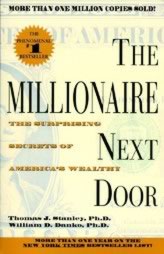
An Interview with Thomas Stanley, Co-Author of “The Millionaire Next Door”
Published on - February 23rd, 2011 (by Robert Brokamp) This is a guest post from Robert Brokamp of The Motley Fool. Robert is a Certified Financial Planner and the adviser for The Motley Fool’s Rule Your Retirement service. He contributes one new article to Get Rich Slowly every two weeks.
A while back, I mentioned the book The Millionaire Next Door to one of my colleagues at The Motley Fool. “That book changed my life,” she gushed. For some people, it really can be that powerful — even fifteen years after it was first published.
In this post, I present an edited transcript of a conversation I had with Dr. Thomas Stanley, co-author of The Millionaire Next Door and author of several other books, including Stop Acting Rich, published in 2009.
Robert Brokamp: In a few sentences, who is the “millionaire next door”?
Thomas Stanley: If you talk about the prototypical person, he’s a guy, mid- to late-50s, owns his own business, went to a four-year public college, was a B or C student, saves relentlessly, lives in a neighborhood where he has four to five times more wealth than the guy next door. He does make more money than the guy next door, but has similar consumption habits; the neighborhood has a lot to do with that. These people are not into status, they are not into designer brands, so they are the epitome of why people collect wealth. There is a certain lifestyle that they adopt. It is not just a matter of putting [money] into mutual fund A or B or going with stocks or having a private business necessarily.
It really is a lifestyle. Income only explains about 30% of the variation in wealth. So they are doing something other than just making money and accumulating wealth via investments.
RB: What if someone says to you, “Big deal if I spend everything I make. I live a better life than these frugal ‘millionaires’ who have big bank accounts but don’t have any fun”?
TS: If you look at the statistics on happiness in life overall, those people who live below their means are happier than people who don’t. Some people may tell you they are happy because they’ve got that leased BMW or they wear thousand-dollar suits or have a closet full of clothing, but that’s not what happiness is.
The problem is that people think, “Well, if I just had that sports car, or that thousand-dollar suit, or a $700 pair of shoes, and a club membership, I’d really be happy.” But in the study we did of 933 millionaires more recently since The Millionaire Next Door, I looked at the 46 makes of cars in America and looked at happiness as a function of owning one or not owning one, and there is not one correlation. Even by chance you’d think you’d get one or two, but none. There is no correlation between what people drive and their level of happiness.
The happiest people are the people who have substantially more money than most of the people that live in their neighborhood. So they don’t worry about keeping up with the Joneses; they are the Joneses.
RB: A line you had in your most recent book, Stop Acting Rich, from a study by Dr. Glen Firebach, says that people with higher incomes tend to be happier, but it’s not income alone. It’s income relative to your peers.
TS: Absolutely. Also, for many people, it’s really about achievement. In other words, there’s a tremendous amount of pride on the part of someone who owns a business. I just wrote up a little thing about a fellow that I interviewed. He’s in janitorial services. He has crews everywhere cleaning office buildings and factories. It might not sound like a very exciting business and maybe it’s not a big-status business, but the fact is, he does very well in life. Plus he’s very, very proud of that. So his pride comes from building a business, his family, and things like that. His pride does not come from the car he drives or the house he lives in.
So once you understand that — and you understand how many millionaires in this country live in homes that are under $400,000 — then you start to wonder: Who are those people that live in million-dollar houses? Well, a lot of people that live in million-dollar houses have very big mortgages, and the price of the house is a very high correlative of everything else that you spend money on.
But people say to me, “How can they be happy if they live in a house that is $250,000, $300,000, $350,000, $400,000? They can’t possibly be happy, even though they are millionaires!” No, 95% of those people are very happy. They are at the highest level of satisfaction overall, so they get their satisfaction from things other than products and services.
RB: I’ll pick up on that in a little bit. Your studies show that a disproportionate number of millionaires are business owners and self-employed. So what do you say to someone who says, “Then obviously I need to start my own business”?
TS: Most people should not be in their own business. For a lot of the people who started their own business, it was a slow process, just as it was for me. I was a tenured professor, and over time I did a lot of consulting and writing. For me to go out on my own, it wasn’t a big leap because I had been doing a lot of that anyway. Most people do it that way.
But the other thing is that there are a whole lot of folks out there in this country who are millionaires [but not self-employed]. For example, I mentioned in the latest book about engineers. Engineers typically are people who are frugal. They view products in terms of their performance characteristics and their durability. So they are big on Toyotas and Hondas and cars like that. And they do quite well. Plus, they [engineers] are analytical; they’re very good at investing, typically. Educators do well also. So there are a lot of folks out there who are disciplined and who know how to play the game. You don’t have to own a business.
RB: There was an interesting anecdote in Stop Acting Rich about a woman who you said was about 113 pounds and she could still buy these smaller, economical cars, whereas Americans in general get bigger as they get older, and they have to buy bigger cars. I was curious, have you seen any sort of correlation between wealth and health?
TS: Absolutely. We asked people who were wealthy to evaluate their level of health throughout their adult lifetime. Then we also looked at weight, male and female. What you find is that one in 10 millionaire men are over 225 pounds, and most of those people are 6’1” and over. Only 10% of women are over 170 pounds, and most of them are 5’10” and over. So most millionaires are disciplined not only in terms of money, but also in consumption of food. If you think about it over a lifetime, somebody who doesn’t spend a lot of money eating and in restaurants and drinking and all these other kinds of things — I mean, the geometric return [i.e., compounded return] on that over a lifetime is really significant.
People spend too much money in restaurants. I see these people that are office workers, they’re out there going to lunch every day, sitting down for an hour or hour and a half. It’s time, it’s money.
So, yes, we found in the correlations that weight is related inversely to health. Most wealthy people are not overweight. They are healthier than most people.
I wrote a blog in response to a Wall Street Journal article about this company that would facilitate investors buying life insurance policies, assuming that the owner of the policy — who is, say, 80 — is going to die in a year, so they will buy the policy from him. You know what I wrote? I would never buy a policy from a rich person; they live too long! I also wrote I don’t want to look at my investments in the obituaries; I think there’s something morbid about that.
RB: Over the years, have you seen a lot of under-accumulators of wealth “get religion”? What does it take to get these people to change?
TS: I do see a change. The problem is that most people are so involved in the everyday war — getting to work, working 50 or 60 hours a week, making enough money to support a family, and everything else — that they really don’t read a lot of things. But I think the beauty of The Millionaire Next Door is that it’s empirically based with all the data, and that does have an impact. We got gobs and gobs of email and letters from people who said, “This did change my life.”
What happens is there is one frugal person in the household and one not-so-frugal. That becomes a problem. So you have to switch people over. I think [that’s possible], but you have to have credibility with people — that people believe these things and they accept them. But it is not only “I can read a book and change.” If you’re an alcoholic, you shouldn’t hang around with alcoholics. Well, if you live in what I call a high-consumption neighborhood, it’s difficult to change. Often it [requires going] cold turkey. It’s downsizing, it’s making some changes radically in your environment, but it’s worth it. And I see that.
RB: Your books looked at the purchasing habits of millionaires — items such as watches and suits and cars. Have you been able to look at some of the more modern gadgets? What are the habits of the “millionaires next door” in terms of cell phones, iPads, laptops — those types of things?
TS: No, I haven’t done that.
The problem you have in this country is these people spend all this money on iPads and laptops and everything else…for what? To play what? Fantasy Football?
The problem is that most people that buy all that stuff are not industrial users. There’s no tax write-off, there’s no benefit; it’s not a capital good. They’re not using it to make money. I see people at Christmas time at four o’clock in the morning lining up in front of stores. They wouldn’t get up at four o’clock in the morning to go to work.
GRS is committed to helping our readers save and achieve your financial goals.Savings interest rates may be low, but that’s all the more reason to shop for the best rate.Find the highest savings interest rate from Ally Bank, Capital One 360, Everbank, and more.
This article is about Books, Gurus
Disclaimer: This content is not provided or commissioned by American Express. Opinions expressed here are author's alone, not those of American Express, and have not been reviewed, approved or otherwise endorsed by American Express. This site may be compensated through American Express Affiliate Program.
Discover is a paid advertiser of this site. Reasonable efforts are made to maintain accurate information. See the Discover online credit card application for full terms and conditions on offers and rewards.
SEARCH FOR RECENT ARTICLES


I absolutely love all the data within “The Millionaire Next Door”. According to this book, getting rich is easy. Simply live below your means and invest for the future! Do this day in and day out, and you will be rich too!
loading....
Understanding that the habits of people around us can influence our spending is key. I noted that point came up twice in the interview.
When I counsel people saving to buy a home, I ask them to think about who they hang out with and what they do when they get together with friends. It’s very hard to exercise self-restraint when you’re already at happy hour with a bunch of folks who aren’t trying to save.
We also need to remember that watching television also puts us into a “high consumption neighborhood.” People who grew up watching Friends have no idea what a real NY apartment looks like and costs. TV can really skew our expectations.
loading....
“The Millionaire Next Door” and “The Millionaire’s Mind” are my favorite books. I live in the Eastern Europe, but money principles are similar everywhere. Thank you very much for this interview.
loading....
Reading this book did change my outlook on a lot of things. Quite a bit of the findings were discouraging though because I don’t really have the “millionaire personality”. I’ve tried to work into my life things I know I can change and try not to let the rest get me down.
loading....
Well, I’m only a 5’3″ female, so I guess I’m doomed to be broke….
loading....
More proof that engineers make the best mates.
loading....
Excellent and insightful. Is there more to the interview?
Too bad Thomas Stanley wasn’t asked about the formula. But could be a blessing in disguise, else the comment section will turn into a dog fight again.
loading....
Yay for engineers!
I’m actually halfway through this book on the recommendation from Robert in his last article. It’s wonderful! I’m hardly a millionaire (I think I’m a thousandaire perhaps), but it’s good to know that my habits can be rewarding over the long run.
I also like Dr. Stanley’s point about owning a business. It’s not easy and it’s likely to fail. However, it’s the hard work and the trial and error that will eventually lead to success. And most importantly, that drive to “be your own boss” and “control your own destiny”. Yeah, that sounds nice.
~Chris Gammell
loading....
I think the weight correlation should be taken with a grain of salt. Many poor neighborhoods just don’t have access to stores with healthy foods and good produce. I don’t think it’s entirely fair to say it’s just a matter of “being more disciplined about food” for them. Of course, the correlation may still be true for middle class vs. millionares.
loading....
Meg,
It is not a myth, it is true, The myth is that poorer neighborhoods do not have access to healthy foods, fruits and vegetables are evrywher, you kjust have to look for them..
loading....
Picking up on Meg’s comment, there is also substantial evidence that fat people get paid less (wage discrimination), which would affect the ability of even middle-class fat people to build wealth.
http://www.bigfatblog.com/node/1047
loading....
I need to re-read this book – I remember enjoying it quite a bit.
I found the part about how can people living in a $250k-$400k house be happy? I know in some parts of the country that is a shack, but in the majority of the country that’s a nice, NICE house – especially if it was bought during the recent downturn or before the bubble.
loading....
has anyone else read the sort of parody version, “The Cheapskate Next Door” by Jeff Yeager? I just finished it and thought it was absolutely hilarious–maybe not as informative as “The Millionaire Next Door,” but also a lot less dry–and I’m curious to see what other folks thought
loading....
Pamela made an excellent point about television providing unrealistic expectations. Now a 20-something whipper snapper, I grew up on TV and had fictional ideas of money and how it worked. I as well have read “The Millionaire Next Door”, and it provided me with a dose of reality. It gave more of a concrete understanding of how long term and short term goals are both important.
loading....
@ Jane, #4:
I was confused by that line, also, but I think this is what the author was trying to say:
He was stating that the female millionaires who are over 170 were mainly those who are 5’10″ or taller.
It should read ‘millionaire women’, not just ‘women’, just like the previous sentence reads ‘millionaire men’.
loading....
“I see people at Christmas time at four o’clock in the morning lining up in front of stores. They wouldn’t get up at four o’clock in the morning to go to work.”
I think that pretty much sums it up.
loading....
I am not sure I would want to be the Joneses in my neighborhood. I would feel guilty thinking that my neighbors are spending all their money trying to keep up with me
loading....
The Millionaire Next Door has certainly had a profound impact on me, and has made me realize just how few of the actually wealthy truly live a glittering lifestyle. More of them are the guy next door who started his own business – or the engineer who invests and saves – and lives a frugal lifestyle. It’s encouraging to see, and helps enforce that we’re now headed down the right path. Great interview!
loading....
I just read TMND, and found many great things in it, but the book itself is a bit boring– charts and charts and charts and statistics. It would have been more readable I think if they had focused more on the conclusions than the raw data.
One thing that critics of the book have mentioned is that it leaves out people with different lifestyles than the stereotypical millionaire. This is because they choose a “type” to embody their statistics. However, because the book is descriptive and not prescriptive (oh, the endless charts), it’s up to you to draw your own conclusions from it. Maybe “Stop Acting Rich” is more of a “how-to” book, but I haven’t yet read it.
I had to stop and figure out what lessons I can transpose to my own life from the chart-fest. The most valuable lesson was to live well below my means and use money to grow money. The most valuable piece of data was that wealthy people have about 10 years worth of “go to hell” money for their level of income. And that’s where I want to get to, even though I went to grad-school in an unprofitable field (ha!) and didn’t invest anything in my 20s– I just got debts!
Now, about this interview, I love this:
“I see people at Christmas time at four o’clock in the morning lining up in front of stores. They wouldn’t get up at four o’clock in the morning to go to work.”
That was hilarious!!! Sometimes I have to get up at 4am (or even 3) to go to work, but I’d never do it to buy crap.
loading....
“The happiest people are the people who have substantially more money than most of the people that live in their neighborhood.”
And these millionaires know how much money their neighbors have, how? And why is their happiness influenced by how much money their neighbors have/don’t have in comparison?
And about this line:
“I see people at Christmas time at four o’clock in the morning lining up in front of stores. They wouldn’t get up at four o’clock in the morning to go to work.”
I gotta ask: who are these people? I never see them and I don’t believe they represent the majority. Yes a lot of people are in credit card debt but they are not most. Yes some people have to have the latest iphone, ipad, tech gadget when it first comes out, but they are not most. I’m really tired of the extreme consumption habits of a few being applied to the masses. These people are not typical but they are being used as the standard to “prove” how consumeristic (if that’s a word) American society is.
loading....
I actually witnessed about a dozen or so people camped out with lawn chairs & blankets outside of a department store at about 8pm on Thanksgiving – the night BEFORE Black Friday. They really do exist…
And, I don’t think he is trying to imply these examples apply “to the masses”. Rather, he’s using these cases as examples of people who will make extreme efforts to spend money on things they don’t need – and probably can’t afford – but they won’t spend the time and effort trying to improve their financial situations in life. At least, that was my take…
And, “Stop Acting Rich” was a great book! Loved it!
loading....
@shorty j-
I’ve read Jeff Yeager’s “The Ultimate Cheapskate” and got some good laughs and insights. I didn’t know about “The Cheapskate Next Door.” I’ll have to put that on my library list – thanks!
loading....
So, if people accumulate a lot of money by living frugally and under their means–and don’t use the money on anything, this makes them happier? Happier about what, exactly?
This makes very little sense.
loading....
In response to Andrew (#19 right now), I understand how strange and off-putting this concept of saving money but not using (all of) it is. When I read the book, I felt that way too. But on further reflection, I think the millionaires next door finds happiness in their family and in their work. Having a good solid cushion of money just sitting there gives me incredible peace (not that I’m a millionaire by any stretch), and I’d imagine it would give the millionaires peace and happiness and pride in accomplishing it. Also, it never says that the millionaires are living in tiny shacks and driving jalopies. A house that is “under $400,000″ can still be beautiful, and driving a Honda can still be fun. I enjoy knowing that my car is not going to break down. For me at least, the feeling of security is the one that brings happiness.
loading....
As someone who particaptes in the formula figths, I’m glad it wasn’t mentioned. Perhaps that is on purpose that it wasn’t mentioned in the interview!
If so, bravo, I’m tired of hashing out with people who justify the extremes on the ends of the ranges outside of middle age.
I like the idea of moving to a poorer (relative to you) neighbourhood to increase happiness.
I suppose you’d also have to pick one that is low in crime and not hideously ugly with vagrants/graffiti/garbage dumps etc. and not so far from your work or the negatives might outpace the increased happiness you get from living with lesser beings.
Isn’t that Schadenfreude tho? Being happy because other people around you aren’t as well off as you are? Sorta seems like a moral dilemma there to derive happiness from favourable comparisons to others but I believe it is true. If not a Puritan-Christian-American moral trait value anyway.
@ Andrew – I think happiness can come from security, and sitting on a pile of money knowing they could use it to bail themselves out of any problems life throws at them gives them happiness. Does that make sense?
loading....
I love the Millionaire Next Door. I’ve read the Millionaire Mind and Stop Acting Rich too, but I think MND is the best. I was amazed reading it how much it described my parents.
I think this quote from the article sums up why a lot of people have lots of stuff, but not much saved:
“I see people at Christmas time at four o’clock in the morning lining up in front of stores. They wouldn’t get up at four o’clock in the morning to go to work.”
I certainly don’t get up at 4am to go to work, but it’s a great point.
loading....
@ Andrew
I think the point is that there is a peace of mind and ease that comes from living off the overflow of your investments rather than living paycheck to paycheck, which (I can attest) makes you miserable, stressed out, and restless, no matter how big the paycheck.
People who are comfortably funded to live at a their socioeconomic level will be happier than those who have to be overstretched and indebted to do the same.
The problem we have is that we tend to move “up” in the world according to our monthly paychecks instead of doing it according to the overflow from our wealth and investments. If we could learn to live on the tip of the our personal “wealth iceberg” we would have a very different culture.
loading....
@ Jane, I think you misread the context of that line about height and weight.
@Vanessa, I can’t believe you haven’t ever watched the news around Christmas time or when a new i-something is released, as they always show the crazies lined up outside, and there are ALWAYS a bunch of them.
At any rate, excellent interview. For those making snide comments, I think his purpose was to show that what “most” people think millionaires live in, drive, etc. is not reality. Of course, there are some millionaires that fit that bill, but not the majority. And he doesn’t state that they live in ghettos, just that they don’t live in the most expensive neighborhood that they can possibly afford, rather a notch or two down from that. I also think that those who are being most critical are probably trying to defend their own spending habits or justify their lifestyles.
loading....
We don’t fit the stereotype of the millionaire next door regarding residence but are happy where we live. We live in a small fixer upper house in a nicer neighborhood. We don’t make as much as our neighbors, who are pretty much professors or professional types, but they also carry huge mortgages. So there is alot of (good natured) ribbing where we are called the resident bohemians, but express disbelief/envy what we bought our house for and our mortgage payments. So maybe there is some reverse jones envy going on.
loading....
@Vanessa
My husband’s relatives hit the 4am black Friday sales and the day-after-Christmas sales. We always hold down the fort for them when we visit for the holidays, snug in our beds. (We’re more Cyber-Monday folks.)
loading....
Millionaire Next Door does not buy Apple products.
loading....
While I understand that living paycheck-to-paycheck is awful (I, too have done it, and it sucks), and that having “go-to-hell” money is great, I just wish that people would realize that no amount of money can buy absolute security from the calamities that life will bring. That’s all!
loading....
I’ve been mulling over this for the past half hour or so, and I came to realize that either us or the book authors are conflating two different concepts. I’ll try to sort this out while I write.
As social animals, we are status-seeking creatures. Being on top of the social pyramid means (in a primal sense) first dibs on food, less stress, greater chances for our offspring, etc. It is our natural instinct to get as high as we can on that pyramid (there are other instincts, of course, but this one is pretty basic). For those not familiar with this notion, please watch “Meerkat Manor”.
When most people say “live like a millionaire” they don’t mean “have a million in the bank”, they mean “live on top of the social pyramid”, accounting be damned.
The authors of this book however identify the term “millionaire” from the point of view of accounting, that is, having “millions”, What they found out is that these accounting millionaires do not live on the absolute top of the social pyramid.
However (here’s the quirk), we don’t live in small tribal communities anymore. We live in very large societies with their own sub-tribes and subcultures within.
As it turns out, though the authors don’t explicitly come out and say it, their “millionaires” who don’t live in the absolute top of the pyramid, are nevertheless on the top of their local social pyramids. They have more money than their neighbors, associates, etc = more serotonin = less stress. That’s how their wealth equation (approximately) makes sense. Status is both local and global. “Lives of the Rich and Famous” is the absolute signifier of status, but we operate in local networks.
The problem that we have as civilized cave dwellers is that we think that by crashing the door of the country club we will automatically be allowed to stay in it. But money being the complicated thing that it is, many of us buy the status symbols (as our primal brain indicates) and compromise our long-term prosperity in the future, even at times our immediate survival (getting evicted from the macmansion and going homeless).
I think the real question behind “getting rich slowly” is not how to manage our money, but how to manage our status-seeking drives to where a) we don’t self-destruct in the status race, b) we learn to be more accepting of our social status, and therefore happier, and c) we learn to carve our own social pyramids where our status drive is satisfied (i.e., work on the mailroom but be the captain of the softball team).
Moreover, having a media culture that displays the status symbols of the wealthy for all to see, we lose sight of our local networks and try instead to emulate the people on TV/magazines/etc.– but only as a way to impress the neighbors!
Biology rules over accounting any day. Until we realize that, we’re just scratching at the surface.
Obviously I can’t sort all these ideas clearly in a rushed blog comment, but I think I’m on to something here
===
edit: @ Andrew
of course man, we can all be wiped out by a meteorite in the next 15 minutes, and catastrophes do strike, but since we can’t plan for every catastrophe it only makes sense to plan for reasonable scenarios. if the meteorite never kills us, the ones who planned reasonably will do better. if the meteorite kills us, then hey, we’re all dead so who cares. i guess this is a financial (not theological) variant of Pascal’s wager .
loading....
“The problem you have in this country is these people spend all this money on iPads and laptops and everything else…for what? To play what? Fantasy Football?
The problem is that most people that buy all that stuff are not industrial users. There’s no tax write-off, there’s no benefit; it’s not a capital good. They’re not using it to make money.”
This comes across as very condescending to me (and I don’t own an iPad or a laptop by the way). Just because you can’t get a tax write off or profit from something doesn’t mean there is no benefit to it. If you can afford an iPad and enjoy using it, what is wrong with that? Just because fantasy football isn’t important to you doesn’t mean it isn’t very enjoyable to others. I’m sure you own things that I would never spend my money on but that doesn’t mean it was a stupid purchase. It just means we have different priorities.
loading....
My parents ARE the millionaires next door. And they are not quite representative.
They earned and saved their money – they didn’t inherit it. They have what most would consider a modest lifestyle. They don’t travel, they don’t buy luxury jewelry or watches or designer clothes.
But their house costs a fortune (utilities, taxes, maintenance, and insurance) to operate; they have three (or is it four?) cars; and they spend more on healthcare than most. The latter, by the way, I consider a GOOD thing. They spend on HEALTH care, not DISEASE care.
I fully expect, however, that by the end of their lives most of their assets will have been depleted by medical and long term care expenses. Our family history does not support a prediction of sudden death … more likely, it’ll be a long, and expensive, decline.
They are happy with their lives and I suppose that does support Mr. Stanley’s findings. Theirs is not the life *I* want, however.
loading....
Andrew -
Unless the stock market crashes again (and with all the craziness w/ oil it well could), we anticipate being MND’s by the end of 2012. Last year, we had 20k in unforeseen expenses (mostly medical) which we paid out of pocket. The point of saving all that money is security.
Not everyone has fancy dreams of skiing in the Alps or owning a vacation home in Costa Rica. Driving dependable cars, having dinner at an Outback once in a while, taking the kids to Disneyworld every couple of years – these are the simple things that bring many MND’s a lot of happiness.
loading....
My great aunt and uncle were multi-millionnaires when they passed away. The house my great aunt was born in was the same house they lived in once married. They kept a watch over her mother until her death. They both worked until retirement – her in a factory (think Rosie the Riveter) and him with his own backyard business as a lawn mower repairman. Never had children, never travelled. They invested in the market. The neighborhood went to pieces around them but they stayed. As a little girl going to their house was always gross and scary. They were classic “hoarders” of the great depression era. I think they were happy but so terribly cheap. I wish they had enjoyed their money a little more.
loading....
I think owning a business is a major component to success and happiness in life. Working for someone else and in an organization with politics and attitude can be very depleting. Everyday I think more and more about making the jump..
loading....
Fantastic post! The kind of stuff that keeps me coming back for more.
loading....
Thanks for the interview!
Loved TMND – was a lifechanger. Agree with Pete, it opened my eyes to how wealthy people really managed and built their wealth.
Reading it helped me take control of my own financial future.
I’ve read all T. Stanley’s books – keep them coming;)
loading....
VERY OFF TOPIC: is it me or do comments take about 10 minutes for the form to submit?
/ot
loading....
Mom of five–
Funny, but I can’t quite remember mentioning “skiing in the Alps or owning a vacation home in Costa Rica.” My point was that I can’t fathom happiness being guarenteed by just sitting around on top of a heap of money.
Driving dependable cars, and having dinner at an Outback once in a while are all well and good (actually, Outback is an awful restaurant that serves unhealthy amounts of artery-clogging low-quality food–but I digress) but there has to be more–
loading....
First, I am amazed that the author somewhat dismisses a 30% gap in income. “Income only explains about 30% of the variation in wealth.” That’s pretty substantial gap in income/wealth. If everyone moved to a 30% poorer neighborhood and lived according to a similar lower cost of living, they would be 30% more wealthy, which is a lot by itself.
Second, correlation is not causation. Not everyone is meant to own their own business. I suspect there are a lot of people that start a business and ultimately fail, and never become millionaires in the process. So really, the author is talking about being a successful business owner over a long period of time, which is a lot easier in hindsight.
Third, I think it’s a little crazy to rant against computers as a luxury. The costs of a laptop vs. a desktop are not so great, and the costs of computers are going down — not up. It’s 2011. What do you suggest instead, a typewriter?
Fourth, I think it’s a funny observation about people’s willingness to wake up early for shopping sales. But the problem is not lack of desire to be successful, it’s a lack of control how to get there. The sad part is that the path to buying a new television is a lot clearer than the path to a good job and financial well-being. In this economy, can anyone really take a job or business as a sure thing? Sales on the Friday after Thanksgiving, however, are as certain as death and taxes.
loading....
On the standing in line at 4am topic. That’s not a regular thing. If my job told me I had to come in at 4am once a year that wouldn’t be a big deal. I would have a hard time doing that every day but I wouldn’t line up at a store at 4am every day either.
loading....
I think people are reading too much into the ipad comments, the fantasy football comment, the 4am line at the store comment, etc.
Instead of nitpicking at each example and looking at the potential absurdities of each case in what amounts to straw man arguments, let’s read with tact and make a polite attempt to understand what he’s driving at.
I think the tactful reader will quickly realize that the interviewee is presenting general examples to make a larger point: that we as a society (not you or me in particular) are much more focused on leisure and consumption than on being productive.
He’s not looking at why you personally bought a laptop, or how rewarding is fantasy football to one particular person’s life. He’s simply criticizing a social trend towards putting work and wealth building in the back burner while we enthusiastically and carelessly dissipate our wealth (and transfer it to China).
loading....
I’m always interested in comments regarding TMND (which I read long ago and hold close to my heart), and how many people want to dismiss what it says. If you don’t believe or agree with the concepts of the book, that’s fine. Go on your way, do your own thing, find your own bliss, etc. Me, when I want to learn how to do something, I believe the people who have actually done it. Having followed and succeeded with the tenets of the book, I do have to say that having more money really doesn’t equal happiness – but debt almost certainly equals unhappiness. So…I’m sticking with the money. :0D
loading....
My husband is a thin engineer! (and uncommonly frugal) Things are looking good haha
This reminds me of my grandparents… they saved and saved and saved throughout their life. Now they’re in their 70s, highly active and living in a beautiful home by a golf course. They travel on cruises and across the US multiple times a year with their kids and grandkids. They’re also very generous.
I dunno if they’re millionaires, but I want to be just like that
Now that I think about it, my grandfather was a thin engineer too. Interesting.
loading....
I sometimes wonder about the end game.
I’m probably older than most of the Gen X, Y, & Millenials that cruise these internet forums, so maybe I have a slightly different viewpoint. I’m curious to see if and how the millionaire next door concept evolves as the millionares get deep into their lifespan. If you continue to live below your means until your death, you need to consider the financial, social, and personal effects of your heir(s) suddenly becoming wealthy. There’s never much discussion about that end of the timeline.
loading....
#43 – That is such an interesting thought!
Although I haven’t even started having children yet, when planning my own financial future I consider what I would like to leave for my children. Predominantly, I want to give them good educations. I would like them to be able to attend good schools and graduate with degrees that will help them create a solid future for themselves without starting life buried in student loans.
Beyond that, I intend to live my life well, which includes saving and being sensible now and hopefully reaping those rewards later. If we end up leaving a lot for our children when we pass away, then that’s great, but if most everything is spent on us enjoying our retirement we will still have provided for them well by making sure that they can provide for themselves without counting on unexpected windfalls.
Regardless of my own plans, I would be very curious to read studies on how most inheritances are handled. My guess would be that a lot are blown through, and that it depends largely on how things were handled in their upbringing.
loading....
PigPennies,
In TMND, the authors specifically speak against paying for your offspring’s education in fancy schools. And your grandchildren. One granny gets very mad at them for admonishing against her wanting to pay for her grandchildren to go to a wealthy school.
Here’s an actual excerpt:
“I’m as indignant as hell. What am I supposed to do with my money? My daughter’s family is having a rough time making ends meet. Do you know about the problems with public school around here? I’m sending my grandchildren to private schools.” (p. 145 of my version)
I am with granny on this one. TMND authors made some good observations but also some flawed stuff in my opinion. And don’t get me started on the formula, either.
loading....
I am at the bottom of my social pyramid–my friends mostly have much higher incomes and at least some and perhaps most of them have much higher wealth, too. But that’s just how I like it. They have these high-stress long-hours jobs (that they love) and then invite me over to join them in playing with their toys. Oh, yeah.
I don’t live in their neighborhoods–I live somewhere more affordable. But I don’t really know my neighbors. I’m at the bottom of that pyramid too, though, because I don’t like mowing the lawn.
loading....
@El Nerdo — thank you! Yes!
TMND is not a roadmap to financial freedom. It is a lesson on the common characteristics of those who have found it.
loading....