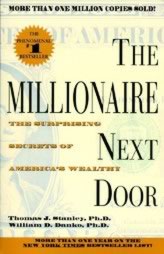
An Interview with Thomas Stanley, Co-Author of “The Millionaire Next Door”
Published on - February 23rd, 2011 (by Robert Brokamp) This is a guest post from Robert Brokamp of The Motley Fool. Robert is a Certified Financial Planner and the adviser for The Motley Fool’s Rule Your Retirement service. He contributes one new article to Get Rich Slowly every two weeks.
A while back, I mentioned the book The Millionaire Next Door to one of my colleagues at The Motley Fool. “That book changed my life,” she gushed. For some people, it really can be that powerful — even fifteen years after it was first published.
In this post, I present an edited transcript of a conversation I had with Dr. Thomas Stanley, co-author of The Millionaire Next Door and author of several other books, including Stop Acting Rich, published in 2009.
Robert Brokamp: In a few sentences, who is the “millionaire next door”?
Thomas Stanley: If you talk about the prototypical person, he’s a guy, mid- to late-50s, owns his own business, went to a four-year public college, was a B or C student, saves relentlessly, lives in a neighborhood where he has four to five times more wealth than the guy next door. He does make more money than the guy next door, but has similar consumption habits; the neighborhood has a lot to do with that. These people are not into status, they are not into designer brands, so they are the epitome of why people collect wealth. There is a certain lifestyle that they adopt. It is not just a matter of putting [money] into mutual fund A or B or going with stocks or having a private business necessarily.
It really is a lifestyle. Income only explains about 30% of the variation in wealth. So they are doing something other than just making money and accumulating wealth via investments.
RB: What if someone says to you, “Big deal if I spend everything I make. I live a better life than these frugal ‘millionaires’ who have big bank accounts but don’t have any fun”?
TS: If you look at the statistics on happiness in life overall, those people who live below their means are happier than people who don’t. Some people may tell you they are happy because they’ve got that leased BMW or they wear thousand-dollar suits or have a closet full of clothing, but that’s not what happiness is.
The problem is that people think, “Well, if I just had that sports car, or that thousand-dollar suit, or a $700 pair of shoes, and a club membership, I’d really be happy.” But in the study we did of 933 millionaires more recently since The Millionaire Next Door, I looked at the 46 makes of cars in America and looked at happiness as a function of owning one or not owning one, and there is not one correlation. Even by chance you’d think you’d get one or two, but none. There is no correlation between what people drive and their level of happiness.
The happiest people are the people who have substantially more money than most of the people that live in their neighborhood. So they don’t worry about keeping up with the Joneses; they are the Joneses.
RB: A line you had in your most recent book, Stop Acting Rich, from a study by Dr. Glen Firebach, says that people with higher incomes tend to be happier, but it’s not income alone. It’s income relative to your peers.
TS: Absolutely. Also, for many people, it’s really about achievement. In other words, there’s a tremendous amount of pride on the part of someone who owns a business. I just wrote up a little thing about a fellow that I interviewed. He’s in janitorial services. He has crews everywhere cleaning office buildings and factories. It might not sound like a very exciting business and maybe it’s not a big-status business, but the fact is, he does very well in life. Plus he’s very, very proud of that. So his pride comes from building a business, his family, and things like that. His pride does not come from the car he drives or the house he lives in.
So once you understand that — and you understand how many millionaires in this country live in homes that are under $400,000 — then you start to wonder: Who are those people that live in million-dollar houses? Well, a lot of people that live in million-dollar houses have very big mortgages, and the price of the house is a very high correlative of everything else that you spend money on.
But people say to me, “How can they be happy if they live in a house that is $250,000, $300,000, $350,000, $400,000? They can’t possibly be happy, even though they are millionaires!” No, 95% of those people are very happy. They are at the highest level of satisfaction overall, so they get their satisfaction from things other than products and services.
RB: I’ll pick up on that in a little bit. Your studies show that a disproportionate number of millionaires are business owners and self-employed. So what do you say to someone who says, “Then obviously I need to start my own business”?
TS: Most people should not be in their own business. For a lot of the people who started their own business, it was a slow process, just as it was for me. I was a tenured professor, and over time I did a lot of consulting and writing. For me to go out on my own, it wasn’t a big leap because I had been doing a lot of that anyway. Most people do it that way.
But the other thing is that there are a whole lot of folks out there in this country who are millionaires [but not self-employed]. For example, I mentioned in the latest book about engineers. Engineers typically are people who are frugal. They view products in terms of their performance characteristics and their durability. So they are big on Toyotas and Hondas and cars like that. And they do quite well. Plus, they [engineers] are analytical; they’re very good at investing, typically. Educators do well also. So there are a lot of folks out there who are disciplined and who know how to play the game. You don’t have to own a business.
RB: There was an interesting anecdote in Stop Acting Rich about a woman who you said was about 113 pounds and she could still buy these smaller, economical cars, whereas Americans in general get bigger as they get older, and they have to buy bigger cars. I was curious, have you seen any sort of correlation between wealth and health?
TS: Absolutely. We asked people who were wealthy to evaluate their level of health throughout their adult lifetime. Then we also looked at weight, male and female. What you find is that one in 10 millionaire men are over 225 pounds, and most of those people are 6’1” and over. Only 10% of women are over 170 pounds, and most of them are 5’10” and over. So most millionaires are disciplined not only in terms of money, but also in consumption of food. If you think about it over a lifetime, somebody who doesn’t spend a lot of money eating and in restaurants and drinking and all these other kinds of things — I mean, the geometric return [i.e., compounded return] on that over a lifetime is really significant.
People spend too much money in restaurants. I see these people that are office workers, they’re out there going to lunch every day, sitting down for an hour or hour and a half. It’s time, it’s money.
So, yes, we found in the correlations that weight is related inversely to health. Most wealthy people are not overweight. They are healthier than most people.
I wrote a blog in response to a Wall Street Journal article about this company that would facilitate investors buying life insurance policies, assuming that the owner of the policy — who is, say, 80 — is going to die in a year, so they will buy the policy from him. You know what I wrote? I would never buy a policy from a rich person; they live too long! I also wrote I don’t want to look at my investments in the obituaries; I think there’s something morbid about that.
RB: Over the years, have you seen a lot of under-accumulators of wealth “get religion”? What does it take to get these people to change?
TS: I do see a change. The problem is that most people are so involved in the everyday war — getting to work, working 50 or 60 hours a week, making enough money to support a family, and everything else — that they really don’t read a lot of things. But I think the beauty of The Millionaire Next Door is that it’s empirically based with all the data, and that does have an impact. We got gobs and gobs of email and letters from people who said, “This did change my life.”
What happens is there is one frugal person in the household and one not-so-frugal. That becomes a problem. So you have to switch people over. I think [that’s possible], but you have to have credibility with people — that people believe these things and they accept them. But it is not only “I can read a book and change.” If you’re an alcoholic, you shouldn’t hang around with alcoholics. Well, if you live in what I call a high-consumption neighborhood, it’s difficult to change. Often it [requires going] cold turkey. It’s downsizing, it’s making some changes radically in your environment, but it’s worth it. And I see that.
RB: Your books looked at the purchasing habits of millionaires — items such as watches and suits and cars. Have you been able to look at some of the more modern gadgets? What are the habits of the “millionaires next door” in terms of cell phones, iPads, laptops — those types of things?
TS: No, I haven’t done that.
The problem you have in this country is these people spend all this money on iPads and laptops and everything else…for what? To play what? Fantasy Football?
The problem is that most people that buy all that stuff are not industrial users. There’s no tax write-off, there’s no benefit; it’s not a capital good. They’re not using it to make money. I see people at Christmas time at four o’clock in the morning lining up in front of stores. They wouldn’t get up at four o’clock in the morning to go to work.
GRS is committed to helping our readers save and achieve your financial goals.Savings interest rates may be low, but that’s all the more reason to shop for the best rate.Find the highest savings interest rate from Ally Bank, Capital One 360, Everbank, and more.
This article is about Books, Gurus
Disclaimer: This content is not provided or commissioned by American Express. Opinions expressed here are author's alone, not those of American Express, and have not been reviewed, approved or otherwise endorsed by American Express. This site may be compensated through American Express Affiliate Program.
Discover is a paid advertiser of this site. Reasonable efforts are made to maintain accurate information. See the Discover online credit card application for full terms and conditions on offers and rewards.
SEARCH FOR RECENT ARTICLES


The weight thing rings true. My father-in-law is a high-earning “UAW” who runs his own business and has no spending control. He is pushing 64 and to my knowledge, has $10k in retirement savings, total.
He takes lavish vacations while his house falls apart. He’s the same way with food. Binges in spending, binges in eating. There’s a moderation/maturity/self-control aspect in a lot of things he has never mastered.
I imagine Mr. Stanley has observed the same thing in his research.
loading....
@Andrew – “there has to be more” – well, there’s the joy of knowing you can walk away from a bad job or a bad boss. The ability to help other people when they need it. Pursuing the work and learning you actually want to do. Not having to worry about ups and downs in the economy.
I’m a big fan of both The Millionaire Next Door and the Cheapskate Next Door – the joy comes from other sources, but the safety net of cheapskate skills and MND assets makes it a lot easier to pursue the non-stuff joy comes from.
loading....
I thought the weight correlation was interesting. Self control and self discipline at the core of that….I would venture to guess you wouldn’t have many alcoholics or substance abusers, either.
I wonder about the “hoarding” issues with frugal types. It seems like the depression-era hoarders may not be from the same mold as the millionaire next door. It would be my guess that the millionaire next door is a minimalist for practicality and cost.
loading....
Great interview, “The Millionaire Next Door” is one of my favorite reads.
“Those people who live below their means are happier than people who don’t” is an excellent point. Wealthy people and high-income earners do tend to have spending habits that allow them to live within their means.
loading....
Well, I feel like I could write a book about this but I’ll make it short.
Generalizations, by their nature, tend to lack clarification.
I grew up with older, depression-era, immigrant grandparents who had 9 children, no education (some English), menial labor jobs and left 2.5 million dollars (in 1984), chiefly from real estate investments of rental properties. (My grandmother said “buy real estate, they don’t make it anymore!)
My father never earned more than a middle-income wage (what’s that anymore?), left minimal savings, a 100K insurance policy when he died young. But he lived life and was happy with himself and his family. We never needed, or as I recall, wanted, for anything. We have sweet memories, he loved life.
My in-laws are very wealthy (objectively), frugal and extravagant at the same time (does that makes sense??) and value every day they have left as well as their loved ones. My husband grew up with frugal habits but knowing he had support of his parents and a safety net like few people do. They are very generous to us and charities, both in time and money.
I’ve made a lot of money as an employee, been broke, owned my own successful business, been in incredible crushing debt (business not consumer) and now back to making good money.
I try not to make generalizations about each of those stages. For me, it’s been a journey. And I hope I’ve learned not just about me and my feelings about “wealth” and money but about others’ views as well.
loading....
I am a millionaire and have a frugal mindset. I did not buy the TMND book. Each week at the market while my wife looks at the flowers I read a chapter of the book in the book section of the store. Small bite of knowledge and a week to digest it. No cost.
loading....
I’m sorry, but TMND was one of the worst financial books I’ve ever read with too much hype and too little substance. It just simply comes down to live within your means, save every dollar you have, and live a long and dull existence. Maybe my millions will be made by writing a book with that one sentence and blank pages to write down all the experiences you missed in life by being a miser.
loading....
Living frugal just means being able to save while spending.
Being able to save means, among other things, it is cheaper to purchase large items (e.g. appliances, cars, even houses). I discovered the amazing fact that if I could afford to pay interest, I could afford to pay cash and hence no interest (or pay off my CCs every month). I just had to, for a short period of time, reduce my spending until I got ahead. That’s it. Cold turkey is a great approach, but I did it when I was young and single, so it didn’t impact anyone but me. Life became a lot cheaper, a whole lot cheaper, when I quit buying on credit.
My kids roll their eyes at the notion of “saving for retirement” but they are enthusiastic about “saving to become financially independent.”
Stanley’s books have been a great source of ideas for making good choices (i.e, “Things That Work”
)
loading....
I wonder if people who complain about the formula not working for them consider the possibility that maybe, just maybe, they might not end up as millionaires? If they do, it’s very likely that on their path to millions, they will cross over from UAWs to AAWs and finally to PAWs.
I think the same could hold true for the weight observation – the more disciplined you are about money and the better you are at accumulating wealth, the better access you have to good food and healthier choices.
Stanley’s observations aren’t judgements, just his interpretation of the massive amounts of data he and his team collected/processed.
@SuperT, TMND spends a lot of time talking about Economic Outpatient Care, how most millionaires didn’t inherit their fortune, and how some people who depend on handouts from family end up as UAWs.
loading....
As a CPA that works with several “closet” wealthy people (in other words, you wouldn’t know by looking at their clothing, cars, etc), I find this book to be very accurate. I see a lot of Toyota Camrys, Honda Accords, and the like…very few luxury cars.
Not necessarily all business owners either – a lot just worked at regular jobs and lived frugally, it is pretty inspiring to talk to these folks.
loading....
I think a new version of the book should be considered. Just my .02.
loading....
@Twin:
“Each week at the market while my wife looks at the flowers I read a chapter of the book in the book section of the store.”
You are a dirty rotten thief. If you want to read the book, but are too cheap to pay for it, that’s what libraries are for.
I wonder exactly what percentage of your “millions” you accumulated using equally dishonest and despicable means.
loading....
I wonder with regard to the weight observation which comes first, the weight control or the money. I could easily see that those with more than enough money and financial security would have access to better food, health care etc. I know plenty of people who lose some weight once they have other aspects of their lives together and on the right track so I wonder if the weight control is a contributing factor to wealth or part one of the benefits.
loading....
I enjoyed this post, and I think I need to read this book. But the first line was a turn-off for me …
In a few sentences, who is the “millionaire next door”?
Thomas Stanley: If you talk about the prototypical person, he’s a guy, mid- to late-50s, owns his own business, went to a four-year public college, was a B or C student, saves relentlessly, lives in a neighborhood where he has four to five times more wealth than the guy next door.
Was it so necessary for him to say that MND is a GUY? Why was that necessary? It’s sort of thoughtless sexism. I think he meant to say, “most millionaires next door RIGHT now are guys” but I couldn’t help but find this language a little exclusionary.
Just a comment though. I’m not exactly offended, it just seemed like a poor choice of words. I’m still interested in reading the book, etc.
loading....
I love The Millionaire Next Door, and this is a great interview. The biggest thing I got out of the book was that you shouldn’t live in a house that costs more than 2 – 2 1/2 times your annual income. I loved all the surveys, and the stats. It really makes you realize what being a “millionaire” really means. It’s more about being happy than spending your money to get “stuff.”
I loved your review a couple weeks ago, and I love this interview.
loading....
I grew up in a single parent house. I came from a long line of abject poverty. We moved often due to rent increases. I went to 13 different schools by the time I graduated from high school. My mother worked hard, long hours cocktail waitressing (because it paid relatively well in tips) while she went to school. She was the first person in our entire family to ever attend college, graduating at age 34. You can understand why I thought wealth was unachievable unless one came from wealth. The idea that I could ever achieve anything remotely like wealth seemed absurd.
TMND absolutely and completely changed my outlook on life and my perspective about wealth. I only wish the book had been published a decade earlier!
The book helped me identify my financial behavior and to better understand my relationship with money. It helped me clarify my financial goals, and to stop behaving in ways that were obstructing my path to financial success.
TMND is not a roadmap to wealth, and in any case, YMMV. For me, it was profound because it busted some myths that surround wealth.
It helped me realize that a large McMansion with shiny new SUVs in the driveway may represent a large debt load and exhausting work hours, not actual wealth. I’m not embarrassed by my thrifty behavior, quite the contrary.
I recommend TMND to people on a regular basis – and get it from the library!
loading....
I found the MND online for free in a pdf file- just google it and you will see many links.
I read it on pdf, it was a great read.
loading....
@Inder
Agree. I am not offended by the millionaire being a “guy” stereotype, but that makes me think funny thoughts. Is the stereotypical female millionaire the wife of a MND? If so, why is it not even mentioned?
RE housing. I think the “buy a house that is 2 – 2.5 times your income” is hardly achievable these days, partly due to the low mortgage rates (that prop the housing prices up). In my neck of the woods the median house cost is 3-3.5 the median income for the area. So you either have to earn more than a median or home school your kids, which in my case is unrealistic. No whining – I am a renter myself, just stating the facts.
Nice book overall, but feels dated now…
loading....
@ Lincoln (41) -
I think you misunderstood what the author is stating when he says “Income only explains about 30% of the variation in wealth.”. That statement does not relate to an income difference of 30%. It means that if you look at the factors that influence wealth, the factor income only has limited influence. Making more money is nice, but it does not predict becoming a millionaire that much. This of course we already know, since it is not about how much money you make each month, it is about how much money you have left at the end of the month. Becoming a millionaire is 30% about making more, and 70% about spending less.
loading....
I personally loved the comments about people buying technology to play fantasy football and standing in line at 4 am for “stuff” – that is so telling of our society’s obsession with stuff. While I do own a computer (an apple! gasp!) I usually buy a “new” computer used. I don’t have a smartphone (i don’t even have a contract phone- I use net10) and I think ipads are very expensive toys that are fine for people with an emergency fund, no credit card debt, and some retirement savings. How many Americans have that?? But I think his point was that people are spending their money or their credit on these items when they are really used for at home leisure and luxury rather than work purposes, so since they are not bringing in money, it is questionable to spend so much. For example, cell phones with very high bills and bells and whistles – when you work in an office with a computer and internet and phone and email all day could be wasteful. I use a net10 regular phone (non-”smart” i guess) and pay about $25 a month. My friends pay $80 plus for their iphones a month, after paying hundreds for it new and getting locked into a 2 year contract. I could see spending this kind of money if it was for work, business, etc. but to play fantasy football on your phone in bed? Yeah.. So I totally get that statement and think it is a great point.
loading....