The GRS garden project: How much does a garden really save?
Kris and I are huge fans of gardening. We grow our own flowers, herbs, fruit, berries, and vegetables. We’re not able to supply all of our needs, but we do what we can. For the past two years, I’ve argued that this is an excellent way to save money if you have the time and the space. But is it really?
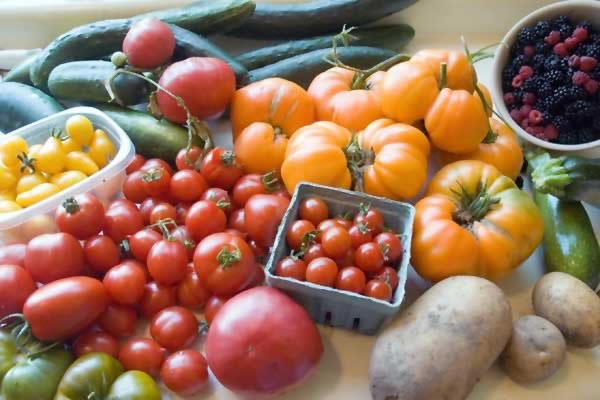
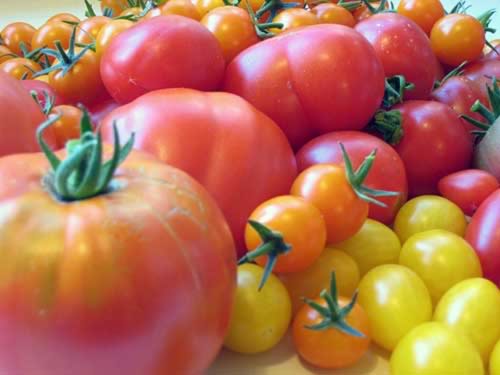
An actual weekend harvest from August 2006.
During the next year, Kris and I plan to track all of our work and expenses in the yard. I’m not going to tabulate how long it takes to trim the laurel or the boxwood, but I will track the following:
- The cost of seeds and fertilizer.
- Our approximate water usage.
- The time we spend planting, weeding, and harvesting.
- The amount of food we harvest.
- The cost-equivalent from the local grocery store.
For example, when Kris places her seed order in the next week or two, I’ll note how much she spends for a packet of tomato seeds. I’ll keep track of how much she uses her grow lights (using my handy Kill-a-Watt electricity usage monitor), how much water and fertilizer we consume, how many tomatoes we harvest, and how much that would have cost us at the store.
I’m going to compile a whole lot of data.
On the last Saturday of each month, I hope to provide an update of our progress. At the end of the year, we’ll see our savings, and how much it cost us to save it. This isn’t going to be a precise experiment — there are too many variables involved. But our results should be able to tell us just how worthwhile our gardening hobby is.
Past entries on gardening include:
- Gardening 101: Plan Today for Summer Success (an article from my wife)
- Frugality in Practice: The Garden in Spring
- An Introduction to Square-Foot Gardening
Our first step? Browsing the seed catalogs to decide what we want to grow this year!
January 2008 Update
January is always a slow month in the garden, but it’s also full of promise. It’s time for our first chores of the year!
Pruning and Staking
Early in January, Kris and I spent fifteen minutes together in the yard re-staking our fruit trees. We have two apples, a pear, and a prune. They’re inclined to grow a little crooked, so every spring we make sure they’re securely fastened to their stakes. It looks like we should also be doing this every autumn. Cost: $0. Time: 0.5 work-hours.
Last weekend, I pruned our grapes and caneberries. This is always a little scary — I don’t exactly know what I’m doing. But once I get started, I’m able to fake it. With the blackberries and raspberries, it’s obvious that last year’s canes are dead. With the grapes, I just make it up as I go along, pruning the vines back to the wire, leaving a couple buds on each spur. This is a fun job for me. I love to prune. Cost: $0. Time: 0.75 work-hours.
The Seed Order
In the middle of the month, Kris placed an order for seeds. As usual, she exchanged ideas with a couple fellow gardeners, and they pooled their resources. A packet of seeds contains more than we need, so it’s nice to be able to share the cost with friends. Kris says she won’t plant anything until March, but I know that as soon as we get a sunny day or two, she’ll be itching to get to work. Here’s a glimpse of her spreadsheet:
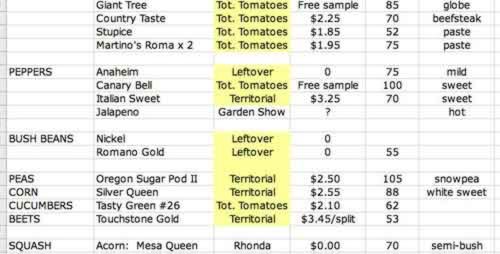
“How long did it take for you to order the seeds?” I asked Kris when I started writing this article.
“I don’t know,” she said. “Maybe three hours.”
“Three hours?!?!?!” I was flabbergasted.
“It’s not like it’s hard work,” she said. “I’m just sitting there with the catalogs, dreaming.” That’s my wife: dreaming about seeds. For our purposes — and in order to get a nice round number at the end — we’re going to say that she spent 2.75 hours selecting and ordering seeds. Her cost was $27.30.
(Update: We use Totally Tomatoes for that fruit, and Territorial Seed for most everything else.)
Year-to-Date Total
January was quiet. We spent 4.0 hours working on our fruit and vegetable gardens, and spent $27.30 total. February will see more action. We need to fertilize certain plants, prepare our indoor planting material, and prune the fruit trees. Best of all, we’ll plant the peas. Things won’t get really time-consuming until March, however. (Well, there’ll be plenty of other yard-work — it just won’t be food-related.)
February 2008 Update
The Yardwork Begins
Like last month, there’s very little to do in February. It was still quite cold at the beginning of the month, but by Valentine’s Day, the bleak Oregon winter relented. We had some gorgeous sunny days with highs near 15c (59f). This was a cue to do our first serious yardwork.
We spent about 15 hours in the yard in February, mostly cutting back our 60+ rose bushes, pruning the boxwood, and picking up winter debris. But we did find some time to work on our food-producing plants, as well.
Preparing for Spring
First, we picked up the oak leaves that had buried our strawberry plants. The strawberries are allowed to run wild in the rose garden, sending their runners to-and-fro. A friend gave us 50 plants for free when we moved into this house in 2004, and now we have too many to count. We fertilized the berries last fall.
We also pruned our fruit trees — the plum, the pear, and both apples. Afterward, we weeded the potato patch and pulled ivy from around the blueberries. To finish up the weekend, we put up the pea trellis, and planted 72 seeds of Oregon Sugar Pod II. Come June, these will make a tasty snack, and at very little cost.
Last week, we took the time to test the pH of the soil around our blueberry plants. Blueberries like acid soil, so we’ll have to give them some special fertilizer in the next week or so.
Despite many hours spent in the yard, only 2.5 of them were devoted to our food-producing plants. We spent no money on this project in February.
Year-to-Date Totals
So far in 2008, we’ve spent $27.30 and 6.5 hours caring for our fruit and vegetable gardens. March will see more action. We need to fertilize certain plants, prepare our indoor planting material, and plan the vegetable garden. And any day now we’ll see our first peas poking through the earth:

March 2008 Update
In my mind, March is filled with gardening activities. Not so much, as it turns out. I think April will also be light.
Planting Seeds
Though we didn’t do much in March, we finally got to see some action from the plants. On March 1st, Kris planted the tomatoes and peppers (and some flowers). She spent 90 minutes sowing the seeds in special bio-domes. (“I don’t normally advocate one product over another,” she says, “but I really like these.”)
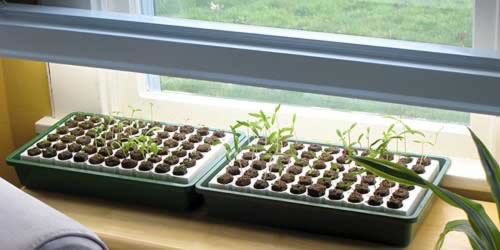
After the seedlings have made a good start, Kris hangs her grow lamp.
We placed two trays of seeds in our south-facing bay window. After they sprouted, Kris set up a grow-light to give the seedlings even more energy. (March is not exactly sunny in Oregon.) On March 24th, she transplanted the strongest seedling of each variety into a 4″ pot.
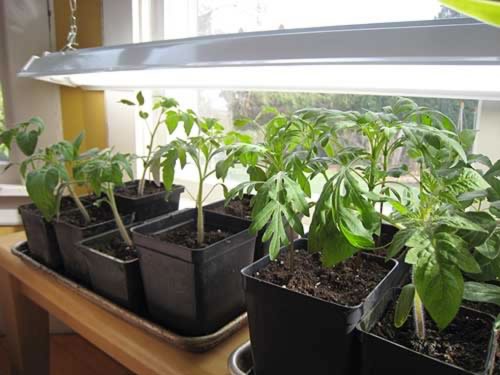
Can you believe they’ve grown so much in just three weeks? Amazing!
On March 15th, we fertilized the strawberries with Strawberries Alive. On the following weekend, Kris raked the leaves from the vegetable garden (we use them as a cover during the winter) and spaded one area. I’ll use the rototiller to work the earth in a couple weeks.
Through all of this, my peas have been growing slowly. (They’re so cute!)
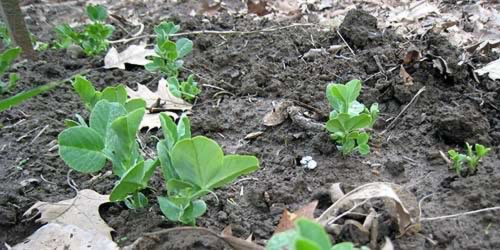
I’m a little worried about the spotty germination, but I’m sure we’ll have plenty.
Also this month, we picked up a fully-functional upright freezer (the same form factor as a refrigerator) for free from one of Kris’ co-workers. This is a jackpot. It gives us a lot more room for food storage.
Conclusion
During March we spent $113 on organic pest controls and fertilizers for our fruit and vegetable crops. We also spent $16 to buy potting soil and a soaker hose. I used my Kill-a-Watt to measure the power consumption of the grow lamp, but it only uses a few pennies of electricity per day. Let’s call it a buck for the entire month, bringing our expenditures to $130 in March.
April 2008 Update
“It was the best of times, it was the worst of times…” — Charles Dickens, A Tale of Two Cities
April finally saw some action in the yard, but not the sort we’d hoped for.
The Hail You Say!
Most of the month was quiet. Our vegetable starts continued to thrive under the growlights. By the end of the month, the tomatoes had been transplanted into gallon-sized pots and were over two feet tall! Kris was itching to get them into the ground.
Average last frost is about April 15th, but this year, especially, has been strange, with snow in the Portland area in mid-April. Kris checked the weather forecast for night time lows and decided that it was worth the risk. Keeping the plants indoors any longer was also a risk; left inside, they would grow spindly as they stretched for real light.
Kris had the day off last Monday, and the weather was sunny and warm; she couldn’t resist. She spent two hours planting her tomatoes out in the vegetable garden. She dug a deep hole for each, mixed in a bit of fertilizer, gently patted the plants in, and placed the tomato cages around them.
On Tuesday, things took a turn for the worse. As I was leaving to drive to my presentation at Western Oregon University, it began to hail. The hail wasn’t big, but it fell heavily for ten or fifteen minutes. A fierce, cold wind battered the garden. “Yikes,” I thought. “Kris’s tomatoes are in trouble.” To make matters worse, Kris came home sick with a nasty head cold that kept her in bed the rest of Tuesday and all day Wednesday. Her defenseless plants were left to the elements.
Sure enough — the plants have been shredded. Most of the branches are broken and drooping on the ground. The slugs, sensing their weakness, have moved in to finish the job. Kris still holds out hope that a few days of sun (which we’re slated to receive) will help the plants pull through, but the truth is we may have to pay cash to buy new starts. And if we do, they won’t be the heirloom varieties she’s nursed from seedlings. (Kris’s note: I’m playing nursemaid for a week or two before I decide what to do. Today I sprayed the ailing tomatoes with a foliar fertilizer to see if that will help revive them. Nine of the ten plants still have their growing tips in fairly good condition, but all the side branches are sad. Woe is me!)
Meanwhile, the slugs have devoured her cucumber seedlings, too. Kris is not happy. (In fact, distraught may be a better word.) The peppers and acorn squash look okay, and the beets are sprouting nicely. The potatoes we started from the end of last year’s harvest are doing well. Ironically, most of the flower transplants look like they coped well with the hail and wind. Still, tomatoes are hardy things, to a point, so they may just make it afterall.
What started as an excellent month for the Get Rich Slowly Garden Project ended in relative disaster. Still, it’s early enough to still make an investment in nursery tomato plants, if necessary, to have a productive harvest later on.
Other Chores
Aside from the setback with the vegetable garden, we spent some more time in the yard during April, preparing our food-producing plants for summer. I spent half an hour hanging pest traps on the fruit trees, and Kris and I combined for an hour of work tying up the berry canes. (The raspberries and blackberries have gone berserk, by the way. They love the moderately warm, very wet weather we’ve been having. Wow.)
We did make a few small purchases during the month. We spent $25.98 for a new hose, as well as $2.53 on a couple of herb seed packets. (We spent $21.50 at the annual plant show yesterday, but that’s an expense for May. If you hope to grow a garden this year, now is the time to check for plant sales in your area. They’re an excellent way to find quality vegetable starts and expert advice.)
Also, our strawberry plants have begun to blossom. Some of them are enormous. In just a month, we’ll be harvesting our first produce!
Conclusion
During April we spent $28.51 on garden-related expenses. We spent 5-1/2 hours working on our crops.
We have a lot of yardwork ahead of us in the next few weeks, including much that is food-related. I’ve learned that I didn’t prune my grapes properly, so will have to repeat that task. I need to plant my corn (possibly this afternoon). We may need to replace the tomatoes. And with luck, we’ll harvest our first strawberries before the end of May!
May 2008 Update
Today I picked the first two strawberries from our garden. They weren’t particularly good strawberries — there’s been plenty of Oregon rain lately, and they were rather flavorless — but they were strawberries, the harbingers of summer. They signify the start of five months of food harvest from our yard.
Final Orders
As you’ll recall from last month’s update, April ended with a bang. A late-season hailstorm damaged Kris’ tomatoes. We were worried that they all might have been destroyed, but in the end only two needed to be replaced.
During the first weekend of May, we visited the Oregon Master Gardeners plant sale. Though Kris starts most of her vegetables from seed, she cannot resist a chance to wander the stalls looking at other options. This year she spent $21.50 on jalapeños, zucchini, basil, oregano, and thyme.
We also placed two garden-related orders online this month. We spent $23.59 at Park Seed on supplies for next year. (We’re counting this as a cost for 2008 in order to compensate for the material we purchased in 2007 but used this year.)
We also placed a $65.80 order with Spray-N-Grow to purchase a variety of fertilizers, as well as a product called Sluggo. Unfortunately, the Sluggo isn’t working very well so far.
In Oregon, slugs are a nuisance. (They’re our unofficial state animal!) We can’t use the ever-popular beer traps because the rain renders them ineffective. Our garden is too big to use copper tape — it doesn’t seem to do much good. Nothing organic seems to work either, when it’s raining daily. The slugs have been chomping Kris’ cucumbers as fast as she can plant them. My corn is beginning to sprout, but the slimey beasts are licking their chops over that, too. (And then the corn has to make it past the blue jays.)
Time in the Garden
Kris and I both spent time in the vegetable garden this month, but not as much as I had expected. She spent about four hours planting things and applying a foliar fertilizer. I spent an hour spading the soil (no rototiller for me this year) in order to prepare it for the corn, after which I planted the seeds themselves. I also spent half an hour weeding the grapes. Combined, we spent only 5-1/2 hours working on fruits and vegetables in May. (Kris says she would have spent more time if it hadn’t rained so much!)
I keep expecting the time we spend on this project to explode, but so far it hasn’t. Just wait until blueberry season arrives, though. It takes forever to pick those things…
Interlude
Sally Herigstad at MSN Money highlighted our garden project in her recent article listing five foods it’s cheaper to grow. The foods? Fruit trees, lettuce, herbs, vine vegetables, and bell peppers. She also lists five to leave to experts: potatoes, carrots, celery, asparagus, and wheat. Thanks for pointing to our project, Sally!
Garden Tour
While Kris and I may not be putting a lot of work into the garden yet, the plants have shifted their efforts into overdrive. They loved the warm, wet Oregon May. The berries are bearing, the fruit trees are fruiting, and the vegetables are growing like gangbusters.
Last week, Kris took the camera outside to photograph some of her favorite plants. First up is one of the tomatoes:

“This picture is sad,” Kris told me. “Look at how the plant is still missing most of its lower leaves!” I’d like to point out the tomato paraphernalia: the sturdy tomato cage and the two-liter bottle staked next to it (for watering during the summer). In the background, you can see an acorn squash beneath a plastic cloche.
The second photo shows my beloved caneberries: blackberries, raspberries, and marionberries. This probably looks like a wall of green to you; that’s what it looks like in person, too.

If you could see through that wall of green, you’d spy a twenty-foot row of grapes. Around the corner, we have four fruit trees: two apples, a pear, and a prune. This looks like the first year we’ll get a sizable fruit crop.

Finally, here’s a photo of Kris’ pride and joy, her red currant bush. The berries are green now, of course. That’s okay. We can wait.

There are many other plants we could show you: the herbs, the potatoes, the peas. Ah well — maybe next month.
Conclusion
During May we spent $110.89 on garden-related expenses. We spent 5-1/2 hours working on our crops.
“I don’t know,” I said after tabulating the numbers tonight. “We’ve spent $300 on the garden already — there’s no way that’s going to pay off.”
“But most of the monetary expense is done now,” Kris said. “All that’s left is caring for the plants. From now on, it’s all about the harvest. I think you’ll be surprised.”
I hope so. To date, we’ve spent 21 hours and $296.70 on our garden, and all we have to show for it are two watery strawberries!
June 2008 Update
It was a miserable June for gardeners in northwest Oregon. The first two weeks weren’t just wet — we’re used to that — they were cold, too. The local media dubbed the month “June-uary”. Residents were quick to embrace the term. The cool weather pushed back a number of crops. Strawberry farmers groused. Blueberries and raspberries are three weeks late.
But now the sun has arrived. We’ve been harvesting strawberries and peas all month, and I picked the first blueberry this morning. (Not very good — it wasn’t quite ripe.) Raspberries should be on in a week or so, I think, and judging from the copious blossoms, we’re going to have a bumper crop. Meanwhile, the pear, plum, and apple trees have set loads of fruit. By the end of the July we may even have some vegetables.
In short, though the month got off to a slow start, we should be rolling in produce before long.
Time in the Garden
Our gardening chores have become more routine. Now that all of the crops have been planted, all we do is:
- Weed
- Fertilize
- Harvest
Between us, Kris and I spent about seven hours this month performing these tasks. I’ll admit that Kris is the weeder and the fertilizer. We both harvest, which is a chore I enjoy. There’s something zen-like about moving among the strawberries. (And just wait until I pick blueberries — I find that highly meditative.)
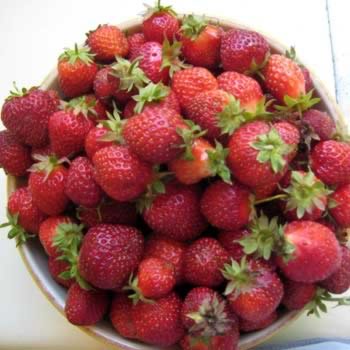
First Harvest
We harvested our first strawberries on May 31st, though we’ll count them in June’s totals. (Likewise, we harvested our first currants today, but will count them for July.) During the past few weeks, our harvest has comprised:
- 11.74 pounds (5.325kg) strawberries
- 2.35 pounds (1.067kg) snow peas
This will seem like a bounty to some of you, and like a pittance to others, but it’s what our garden produces. It’s what we have space for. Actually, I believe both crops were substantially reduced this year due to the weather. Even the peas struggled. (Peas don’t usually struggle in Portland.)
Snow peas at the local grocery store were $5.99 per pound throughout this month, so our harvest was worth $14.08. The strawberries are more difficult to price. Purchased from Safeway in two- or four-pound containers, they could be had for $2.50 per pound. Kris picked twelve pounds at a local farm for 85 cents per pound. But I’m going to use the grocery store’s one-pound price ($3.99) because our harvest came in roughly one pound increments. That’s another $46.84 worth of food. (I welcome advice and debate over this methodology, by the way — I don’t actually know the best way to compare prices.)
In total, we harvested $60.92 of food from our garden this month.
Conclusion
During June we spent 79 cents on the garden (for a packet of lettuce seeds at Winco). We spent seven hours working on our crops.
Last month I wrote that I doubted we could recover our expenses on the garden. This month, after only small harvests of peas and strawberries, it seems like there’s no question that the garden will save us money. I’ll bet we harvest $300 in tomatoes alone!
After six months, we are $236.57 in the hole on this project.
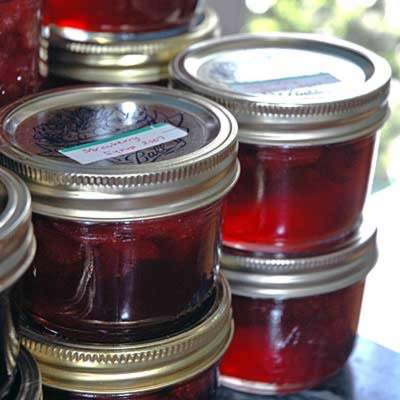
Earlier I mentioned that Kris picked twelve pounds of strawberries at a local farm. U-Pick produce is an excellent deal if you don’t have a garden of your own. A family trip to pick berries can be an excellent outing for children, and it can yield some delicious jams and syrups.
July 2008 Update
It was a berry, berry good month at Rosings Park (as we call our happy half acre). Gloomy June faded into memory, the sun came out, and the berries ripened. This is the time of year when there’s little to do in the garden but water the plants and harvest the produce. There’s plenty of work to preserve the food, however: canning, freezing, and drying.
Raspberry Disaster
At the beginning of July, we discovered we had no raspberries. We usually get several pounds from our over-zealous canes, but this year we only got a few nibbles — they weren’t even worth weighing.
We’re still not sure what went wrong, but the most likely cause of our raspberry disaster is poor pruning on my part. Our guess is that I either pruned the canes back too hard, or, more likely, pruned them too late. We do expect to see a fall crop (and probably a good one), but our summer crop of raspberries never materialized.
Sharing Food
This project is interesting because it has forced us to decide how to classify certain costs and “profits”. For example, we don’t actually grow cherries on our property, but the neighbors let us harvest 12.5 pounds (5.649kg) of fruit. Should we count that in our totals? At about $2.99/pound, that’s $37.38 of cherries!
We’ve decided instead to keep a separate tally for produce received through other methods. There’s certainly a cost savings involved, but we didn’t actually grow it ourselves.
Meanwhile, we’ve found a way to deal with our excess berries while also compensating for our inability to grow carrots and lettuce. We’re trading berries for greens grown by one of Kris’ co-workers. This is a great deal for both parties. For accounting purposes, we’re ignoring this deal, however. After we harvest the berries and weigh them, it doesn’t matter what happens after that.
The Fruits of Our Labor
Here’s the complete tally for this month’s garden production.
- 0.79 pounds (0.360kg or about 1 pint) strawberries @ $3.13/pound = $2.47
- 2.92 pounds (1.326kg) snow peas @ $5.99/pound = $17.49
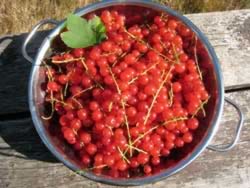
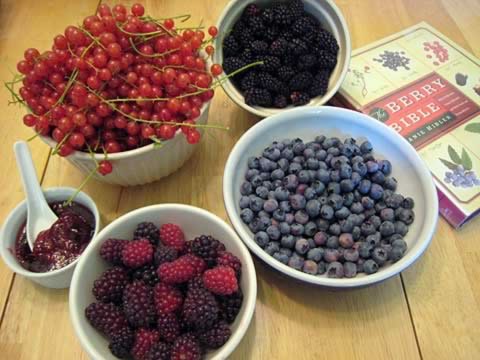
- 5.91 pounds (2.681kg or about 8.5 pints) red currants @ $3.99/pint (~300g) = $35.66
- 5.23 pounds (2.376kg or about 8 pints) blueberries @ $2.99/pint (~300g) = $23.68
- 1.52 pounds (0.689kg or about 3.5 pints) gooseberries @ $3.99/pint (~200g) = $13.75
- 6.52 pounds (2.965kg or about 10 pints) caneberries (blackberries, boysenberries, and marionberries) @ $2.49/pint (~300g) = $24.61
- 1.27 pounds (0.575kg) of string beans @ 1.99/pound = $2.52
- 5 zucchini @ $0.50/each = $2.50
- 2 cucumbers @ $0.50/each = $1.00
For the purposes of this project, we’re using “best match” pricing. Based on GRS reader suggestions, we’re obtaining typical pricing from our local farmers market. In some cases, we use pricing from a local organic produce stand. In all cases, we’re trying to be fair, but this is more art than science.
Our total harvest in July yielded $123.68 in produce, including 31 pints of berries.
Time in the Garden
This month Kris spent about an hour each weekend fertilizing and keeping tabs on the garden. Together, we spent one hour this month tying up the tomatoes, spreading mulch, and other chores. But most of our time was spent picking berries. We combined for about six hours harvesting our produce. We spent eleven hours total working on our crops this month.
Summary
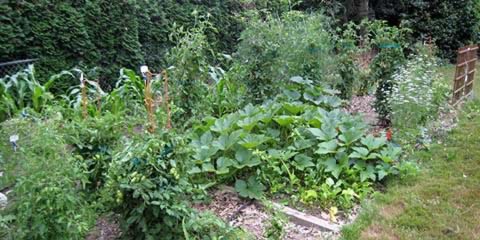
During July we spent $20.94 on the garden for three bags of soil to go around the roots of the blueberries. (The bases of the blueberries are mounded, and the soil tends to erode, exposing the roots.)
As July draws to a close, the tomato plants have reached the top of their cages and are loaded with green fruit. The Sungold cherry tomato will be first to ripen (we’ve nibbled a few already), followed by Stupice. The cucumber and zucchini are beginning to produce regularly and the corn is thriving. In the herb bed, the elderberries are growing dark and gleaming, and the nearby fruit trees each bear a load we’ll enjoy late in the summer.
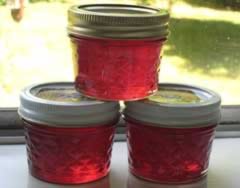
Kris has put away snowpeas and grated zucchini in the freezer, along with several batches of freezer jam (my favorite). She’s also put up several varieties of cooked jams and jellies, canned cherries in light syrup, pickled green beans with dill, garlic and ginger, and has dried cherries, blueberries and currants for future use. (One of her co-workers came over on Wednesday to learn how to can pickled beans.) We’ll be glad to have this summer’s bounty during the long rainy winter.
August 2008 Update
The berry harvest continued this month at Rosings Park, our happy half acre south of Portland. Blackberry time is my favorite time of the year. And though August is often too hot for me, I’m willing to suffer the heat because I know it means the start of canning season. Sure enough, Kris has been putting up salsa and applesauce and all sorts of pickles and jams. Yum.
Also, much to Kris’ delight, we finally harvested tomatoes this week, an entire month behind schedule.
The Dark Side of Gardening
Here’s one of the sad secrets of gardening: mid-summer can be frustrating. If you don’t stay on top of things, the garden can get away from you. Here’s an actual quote from Kris mid-month. We were on the couch watching Olympic diving when I transcribed the following lament:
I didn’t pick the blueberries. The beans need to be picked so they’ll keep producing. The cucumbers are coming on. I need to water things because it’s going to be hot this week. I need to get our extra zucchini over to the neighbors. I didn’t even pick Patrice’s apples. She offered me three times, but I’ve been too busy, and now they’re done.
Remember: we have a modest garden. We grow food for fun. This project will determine whether there’s a cost benefit as well. But even a modest garden can produce a lot of food. With my mother in the hospital and Kris’ parents in town, we didn’t have much gardening time during the first two weeks of August. For a while, there was a danger that we’d lose control, but we managed to persevere!
Supplementing Our Harvest
We spent nothing on the garden this month except our time. Between us, we spent about eight hours picking berries and veggies. (Kris also did a bit of fertilizing early in the month.)
We did, however, supplement our harvest in a number of ways:
- We visited a nearby farm for U-pick beans.
- We picked up some tomatoes and other vegetables for canning from our favorite produce stand.
- Best of all, friends and neighbors gave us apples (or allowed us to pick them).
We’ll continue to exchange produce with other people, giving away our surplus and enjoying the bounty of other gardens. In about a month, I’ll be able to harvest Concord grapes from the neighbor across the street. The juice from these is fantastic.
The Fruits of Our Labor
Here’s the complete tally for this month’s garden production.
- 0.76 pounds (0.347kg or just over one pint) blueberries @ $2.99/pint = $3.46
- 18.04 pounds (8.184kg or 27-1/4 pints) caneberries (blackberries, boysenberries, and marionberries) @ $2.49/pint (~300g) = $67.92
- 3 pints elderberries, for which I can find no cost comparison
- 2 plums @ $0.42/each = $0.84
- 4 beets @ $1.99/bunch = $1.99 (approx.)
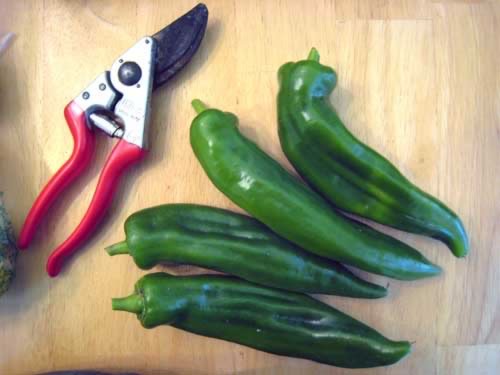
- 4 Anaheim chili peppers @ $0.30/each = $1.20
- 6 zucchini @ $0.49/each = $2.94
- 11 cucumbers @ $0.49/each = $5.39
- 1.23 pounds (0.560kg) of green beans @ $2.49/pound = $3.06
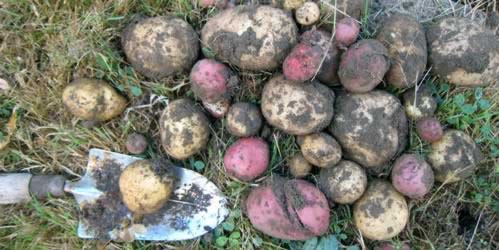
- 3.48 pounds (1.580kg) of fancy potatoes @ $1.00/pound (approx.) = $3.48
- 4.53 pounds (2.053kg or nearly 7 pints) cherry tomatoes @ $2.49/pint = $17.03
- 8.35 pounds (3.789kg) tomatoes @ $1.99/pound = $16.63
Our total harvest in August yielded $123.94 in produce, mostly from berries and tomatoes. Note that for grins and giggles, we’re tracking the yield (in pounds) of each tomato plant. I’ve been dying to know how much a single tomato plant can produce in a year.
Note: For the purposes of this project, we’re using “best match” pricing. Based on GRS reader suggestions, we’re obtaining typical pricing from our local farmers market. In some cases, we use pricing from a local organic produce stand. In all cases, we’re trying to be fair, but this is more art than science.
Summary
We spent no money on the garden this month! We’re now within $20 of our expenses for the year. By the middle of this week, we’ll be clearing “profit”. We’ll be able to begin computing how much our labor is valued at. (Though we do this because we love it, not just to save money.)
This month, we didn’t keep track of the apples and cherries and other produce we obtained through other methods than our own garden.
As the summer wends its course, food production will remain high, especially among tomatoes. We’ll also begin harvesting fruit before long: pears, plums, grapes, and apples. As usual, we won’t have copious amounts of any of these (except tomatoes), but just enough to relish the pleasures of gardening.
September 2008 Update
September generally brings the largest harvests for our garden. That was true again this year, but not by as much as we hoped. The bad weather at the beginning of the season means that things just aren’t ripe yet. Kris has been encouraging her tomatoes for weeks. I’m dying for the grapes to be ready. (They’re almost there!)
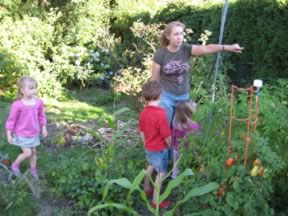
Kris gives orders to her garden elves. Photo by Lisa.
We did harvest a lot last month, the bulk of which was tomatoes and tree fruit. We had so many tomatoes, in fact, that Kris was able to enlist the help of five-year-olds Albert and Annika to help harvest. They did an amazing job picking cherry tomatoes.
Like Investing in Fruit
September’s nice because there’s almost no garden maintenance. All we have to do is stroll out to pick the food we want. During the middle of the month, Kris and I had a mild misunderstanding. I thought she told me to go pick all of the apples from our trees, but she really told me to pick a few for some jam. I came back into the house with 19 pounds of apples, which was far more than she needed. We made a spontaneous batch of applesauce.
Actually, Kris did a lot of canning this month: marinara sauce, applesauce, salsa, pickled plums, and more. As usual, we supplemented our own harvest with free food from friends and neighbors (25 pound of pears here, 15 pounds of plums there), as well as things like onions and garlic from the produce stand.
Now, as the rains begin and the harvest draws to a close, our pantry and freezer are both packed full. When we make a blackberry cobbler in February, take pickled “dilly beans” to a potluck or pop open a jar of spicy salsa on a chilly afternoon, we’ll be extending the benefits of our garden year-round. Our home-canned goods will help defray food costs over the next eight months until we can expect another strawberry crop to kick off 2009’s garden bounty.
The Fruits of Our Labor
Our total harvest in September yielded $152.75 in produce, largely from tomatoes. Here’s the complete tally for this month’s garden production.
- about 3 pints elderberries, for which I still have no value
- 1.95 pounds (0.886 kg, or 2.95 pints) caneberries (blackberries, boysenberries, and marionberries) @ $2.49/pint (~300g) = $7.35
- 2.82 pounds (1.276 kg) Italian plums @ $1.49/pound = $4.20
- 5.64 pounds (2.560 kg) pears @ $0.99/pound = $5.58
- 26.52 pounds (12.038 kg) apples @ $0.99/pound = $26.25
- 6 Anaheim chili peppers @ $0.30/each = $1.80
- 3 zucchini @ $0.49/each = $1.47
- 1 cucumbers @ $0.49/each = $0.49
- 4 measly ears of corn @ $0.50/each = $2.00
- 692 grams of Interlaken seedless grapes, which would sell for about $3 at the local farmers market
- 6.50 pounds (2.951 kg or nearly 10 pints) cherry tomatoes @ $2.49/pint = $24.49
- 51.09 pounds (23.195 kg) tomatoes @ 1.49/pound = $76.12
Note: For the purposes of this project, we’re using “best match” pricing. Based on GRS reader suggestions, we’re obtaining typical pricing from our local farmers market. In some cases, we use pricing from a local organic produce stand. In all cases, we’re trying to be fair, but this is more art than science.
A Little Bit of Whining
I’ll be honest. I’m a little disappointed. Once it became clear that this garden was going to “make money”, I wanted it to kick ass. It hasn’t done that. Don’t get me wrong — we love having fresh produce outside our front door, and we enjoy the work with the plants, but I was hoping for more.
I think there are a few ways we can improve.
- For one, we can focus on plants that are more productive in our climate. (Look for a complete exploration of this topic in December or January.)
- For another, we can begin refining our gardening methods to emphasize frugality. As I noted at the start, we haven’t altered any of our normal habits for this project. In the future, it might be worth doing so.
- Finally, we can have better weather. Oregon’s Willamette Valley had a short summer this year. The rainy grey skies lingered an extra month, and now they seem to have arrived two weeks early. That loss of six weeks (and especially those first four weeks) has a huge impact. That means our tomato harvest is stunted, and that we only had four ears of corn come to maturity.
This year, we initially made a large financial outlay for two types of organic pest traps for the apple trees. They proved successful; our apples were practically worm-free! As the two trees mature and bear larger crops, the number and value of the apples will increase as the cost of the traps will drop (because some parts are reusable from year-to-year).
I almost want to repeat this entire project next year to see if we can spend less and harvest more! (Maybe we’ll do it behind the scenes, providing totals at the end of the summer.)
Summary
We spent nothing on the garden this month, and very little time. It doesn’t take long to harvest 19 pounds of apples or five pounds of tomatoes. September is the closest our garden will ever come to “pure profit”.
There is still food left to harvest. Though the rains have set in, we may have more tomatoes. (There are plenty on the plants, but the cool weather is likely to prevent them from ripening.) There are potatoes left to dig, and the acorn squash is ready to pick and dry for winter storage (to be tallied in October).
Most importantly, we have grapes to pick. We only have 20 feet of young grape vines, so we won’t have many from our yard. But the neighbor has vast swaths of Concords growing wild. I wanted to pick them last weekend, but he insisted they were two weeks away. I plan to pick them next Saturday. I just hope these rains don’t ruin the flavor. (Will rain do that to grapes?) There are few things I love more than fresh Concord grapes. (Especially fresh free Concord grapes.) They make amazing grape juice and Kris wants to put up some grape jelly.
Kris has made notes on her garden plan to help her organize her seed order for next year. Only a few short months until the seed catalogs arrive! And she has begun an experiment to grow a few herbs indoors this winter. Stay tuned on whether that is worthwhile.
October 2008 Update
October can be something of a relief for gardeners. The bulk of the harvest is finished, and all that remains is to pick the last straggling fruits and vegetables, and to begin cleaning up. While it’s sad that the harvest is winding to a close, it’s comforting to know there’ll be a respite from the work for several months. Plus it’s a chance to start dreaming about next year, all of the changes and improvements to be made.
And, believe it or not, the success of next summer’s garden begins today.
A Pile of Crap
Last weekend, Kris and I received an unexpected windfall of sorts. John, our neighbor across the street, hooked us up with some free shit: He brought us a trailer-load of horse manure.
We had been planning to use some sort of soil amendment in the garden next spring, but hadn’t yet worked out the cost or the kind. John knows somebody who boards horses, and when she sweeps their stalls, she’s left with piles of hay and sawdust — and horse manure. Apparently she has so much of this stuff that she’s just giving it away. (We offered to pay John for his trouble, but he refused. We’ll bake him some home-made bread instead.)
On Sunday morning, John wheeled in a trailer containing about three cubic yards of this stuff, so Kris and I spent an hour spreading it over the vegetable garden. We’re happy to have finished this task already, especially in such a frugal fashion.

I shoveled while Kris wheeled and spread.
Sizing Things Up
“How big is your garden?” e-mailed one reader during the middle of the month.
“I don’t know,” I said. “But I can find out.” I went outside with a tape measure to discover:
- Our main vegetable bed is roughly 15 ft by 34 ft (4.57 m x 10.37 m), or 510 square feet (47.4 sq. m.)
- Our herbs occupy an irregular space of about 50 square feet (4.65 sq. m.)
- Our berry patch is in 126 square feet of space (11.71 sq. m.)
- Our caneberries have their own space, about 24 linear feet about 4 feet wide, for a total of 96 square feet (8.92 sq. m.)
- Our grapes are in a similar space parallel to the caneberries
- Our four fruit trees are spaced throughout the lawn
Not counting the fruit trees, that’s a total of 878 square feet (81.61 sq. m.) devoted to gardening. Those of you in the country might think this garden is small; those on city lots (or in apartments) might think it’s huge. For us, it’s just right.
Final Harvest
Our total harvest in October yielded $130.77 in produce, most of which was tomatoes and grapes. (Our grape vines are just beginning to mature. The yield from the plants should increase markedly in the future.) Here’s the complete tally for this month’s garden production:
- 32.41 pounds (14.716 kg) tomatoes @ $2.49/pound = $80.70
- 2 small pumpkins @ $0.50/each = $1.00
- 9 acorn squash @ $0.50/each = $4.50
- 2 cucumbers @ $0.49/each = $0.98
- 14 ears of corn @ $0.50/each = $7.00
- 0.58 pounds (0.264 kg) carrots (volunteers from last year) = $0.50
- 0.31 pounds (0.140 kg) red sweet peppers @ $2.99/pound = $0.93
- 0.72 pounds (0.325 kg) golden beets @ $1.99/bunch = $3.98
- 8.92 pounds (4.048 kg) Niagara grapes @ 3.00/pound = $26.76
- 3.96 pounds (1.800 kg) fancy potatoes @ $0.99/pound = $3.92
Note that this does not include the 40+ pounds of Concord grapes we picked from one neighbor, nor the 5+ pounds of high-bush cranberries we picked from another.
I should also mention that we had pretty much given up on the corn. The poor weather in the spring stunted its start, and then it was battered by a summer storm. Plus we didn’t plant a lot of it. Ultimately, however, we were able to harvest almost 20 ears total (between September and October), which isn’t a lot, but the stuff was good. Instead of giving up, we think we might actually try to grow more of it next year.
Note: For the purposes of this project, we’re using “best match” pricing. Based on GRS reader suggestions, we’re obtaining typical pricing from our local farmers market. In some cases, we use pricing from a local organic produce stand. In all cases, we’re trying to be fair, but this is more art than science.
Summary
We spent a little more time in the garden this month, but again had no monetary expenses. The numbers for this month’s harvest also include $25 for the fresh herbs that we’ve harvested throughout the year (chives, basil, cilantro, sage, thyme, bay leaves, marjoram, oregano).
All that’s left now, really, is to perform garden clean-up. We’ll probably have several hours into the garden in November, but I doubt we’ll have much time in December at all. That’ll give me a chance to write a summary of the lessons we’ve learned, and to provide some tips for others who would like to try this!
Though we’ll spend more time in the garden this year, we’re unlikely to spend more money, and we’re unlikely to harvest anything else. We’re fairly certain that the numbers above are close to the final numbers for the year. We’ve spent $318.43 on our food and harvested $606.97 worth of produce. Roughly, we doubled our financial investment in this project.
Kris has already started one project for next year: She’s begun to grow herbs from seed to have a winter indoor garden (with grow light). The basil, cilantro, dwarf dill, thyme and oregano are off to a good start. Herbs are some of the most cost-effective plants to grow in a home garden. Even if you have limited space, a window-box herb garden can be an easy and economical way to dabble in the hobby.
November 2008 Update
This month’s garden update is small. As winter approaches, there’s less for us to do, and all that we harvest are herbs (and those only occasionally). Our major garden task this month was raking leaves. For most people, this is simply yardwork, but for us it’s a chance to work on the vegetable garden.
Last year, we bought a used chipper-shredder. We use it to grind up the many twigs and branches that fall on our property, but in mid-November, we also use it to shred the fallen leaves. With just a few hours work, we were able to create a thick layer of mulch for the vegetable garden, which we placed atop the horse manure our neighbor gave us last month. In late April, I will till all of this stuff into the earth just before we plant.
Speaking of next year, Kris and I have decided that we will do this project again in 2009, continuing to provide monthly updates. We enjoyed it more than we had expected, and believe a second year of data would be instructive.
But I’m getting ahead of myself. First, here are the final totals for our garden harvest this year.
Berries ($225.74)
We don’t have a lot of berry plants, but those that we do have are good producers. They’re low maintenance and provide a lot of fruit for the space they occupy. I’m actually tempted to remove the 25-year-old blueberries to replace them with younger plants of a different variety.
- 12.53 pounds (5.688 kg) strawberries = $49.31
- 1.52 pounds (0.689 kg) gooseberries = $13.75
- 5.91 pounds (2.681 kg) red currants = $35.66
- 5.99 pounds (2.719 kg) blueberries = $27.14
- 26.51 (12.035 kg) caneberries (blackberries, raspberries, etc.) = $99.88
- 6 pints elderberries, for which we still have no value
Vegetables ($294.59)
Our vegetable crop was stunted this year by the lousy weather in Oregon’s Willamette Valley. We’re not the only ones who suffered. Nearly every gardener we know moaned about the poor yields, especially with tomatoes and peppers.
- 5.27 pounds (2.392 kg) snow peas = $26.87
- 2.50 pounds (1.135 kg) green beans = $5.58
- 11.03 pounds (5.008 kg) cherry tomatoes = $41.52
- 14 zucchini = $6.91
- 10 chili peppers = $3.00
- 7.44 pounds (3.378 kg) fancy potatoes = $7.40
- a couple of pounds of beets = $5.97
- 0.31 pounds (0.140 kg) red sweet peppers = $0.93
- one huge volunteer carrot = $0.50
- 18 ears of corn = $9.00
- 16 cucumbers = $7.86
- 9 acorn squash = $4.50
- 2 small pumpkins = $1.10
- 91.85 pounds (41.700 kg) tomatoes = $173.45
Fruits ($66.63)
Our fruit trees are young. We planted them four years ago, and they’re only just beginning to produce substantial crops. This was also the first year that the grapes produced a harvest. I’m tempted to pull out some of the grape vines to replace them with Concords, which I love. But as long as our neighbor across the street will let us pick his fruit, I don’t need to do this.
- 26.52 pounds (12.038 kg) apples = $26.25
- 5.64 pounds (2.560 kg) pears = $5.58
- 3.32 pounds (1.507 kg) Italian plums = $5.04
- 10.44 pounds (4.740 kg) grapes = $29.76
We also harvested at least $25 worth from our herb garden during the year.
Summary
And so we come to winter, that time of year when gardeners sit forlorn, gazing at the cold, frozen ground. Only the lingonberries remain to harvest. This year, Kris has started herbs from seed indoors, which gives her some sense of gardening. She’s talking about adding an Asian Pear tree to our small orchard. But mostly, now is a time to leaf through seed catalogs and think about the crops we’d like to grow next summer. Our dreams of August’s bounty pull us through the dark rainy days ahead.
2008 garden summary:
| Month | Time | Cost | Harvest |
| January | 4.0 hours | $27.30 | — |
| February | 2.5 hours | — | — |
| March | 3.5 hours | $130.00 | — |
| April | 5.5 hours | $28.51 | — |
| May | 5.5 hours | $110.89 | — |
| June | 7.0 hours | $0.79 | $50.83 |
| July | 11.0 hours | $20.94 | $123.68 |
| August | 8.0 hours | — | $123.94 |
| September | 2.0 hours | — | $152.75 |
| October | 5.0 hours | — | $155.77 |
| November | 6.0 hours | — | — |
| December | — | — | — |
| Totals | 60.0 hours | $318.43 | $606.97 |
Next year our costs will be lower, as one type of pest-trap for the apple trees can be reused.
January 2009 Update
Even with the other stuff going on in our lives, Kris and I found time to begin planning our summer garden this month. Soon the winter days will warm, teasing us with thoughts of working in the yard. But true gardening weather won’t arrive for about three months.
The Fruit of Our Labor
There may not be much gardening to do during the winter, but we still eat plenty of food we’ve grown ourselves. Last week, Kris made several fruit smoothies and a fantastic berry cobbler from blackberries she froze in August. (Just thinking about this cobbler again makes me drool!) We’ve also been consuming canned pasta sauce and salsa, cream of tomato soup, pickles and applesauce.
Meanwhile, we’ve also made use of the herb garden we’re growing indoors this winter. We have a container filled with basil, cilantro, dill, and oregano. This is an easy (and cheap!) way to add a touch of freshness to our cooking.
Seed Order
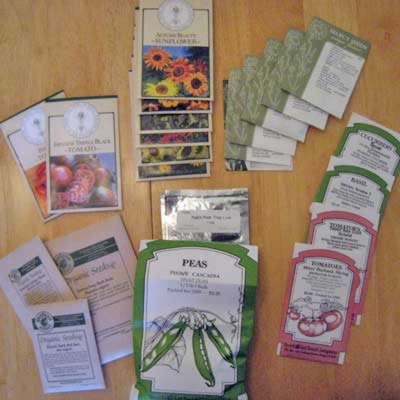
The real highlight of the month, of course, is placing the orders for seeds and supplies. Based on GRS reader suggestions, we’re trying Seed Savers Exchange for the first time this year, along with our other normal sources.
As in 2008, Kris created a spreadsheet to track her purchases (and the seeds she saved from last year). Our seeds have arrived, and now must wait patiently for the beginning of March. That’s when many of them will be started under our grow-lights.
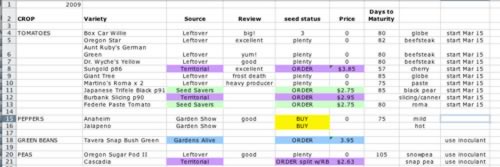
January was an expensive month for our garden. We spent $25.75 on vegetable seeds (and 25 strawberry starts). Kris spent $42 on flower seeds (which we do not track for this project). And, finally, we spent $105.40 for fruit trees and supplies (such as lures for pests).
New Trees!
After some debate, Kris and I have decided to add three more fruit trees to our yard. Our happy half acre already contains two apples, a pear, and a plum. Next week, we’ll drive out to One Green World (a fantastic source for fruit trees — they ship everywhere) to pick up two different varieties of Asian pear and a self-fertile semi-dwarf sweet cherry (as opposed to a pie cherry).
To us, cherry trees are problematic. We love the fruit, but the trees are a hassle for a couple of reasons:
- Most cherry trees need another nearby that blossoms at about the same time in order to pollenate correctly. Because ours self-pollinates, we avoid this problem.
- Cherries can be invasive. At our old house, the neighbors had a 50-foot cherry on the corner of their property. The damn thing sent deep into our yard, which meant we had volunteer cherry saplings all over our lawn. The worst part: the tree was so tall that only the birds harvested the fruit. We’re going to cope with this by placing our cherry tree near the street, and choosing a semi-dwarf size that will max out at 15 feet.
Kris and I have also discussed expanding our vegetable garden by tearing out more of the lawn. I don’t think we’ll do that this year, but it’s an option for the future. Our unusual extended snowstorm may have done damage to our crops, so we’ll keep a close eye on how the berry bushes, asparagus, and perennial herbs emerge this Spring.
Summary
One of our goals for 2009 was to try to reduce costs, but it’s possible we’ll end up spending more than in 2008. Already, we’ve spent nearly half what we spent last year. We’re okay with that. Our $66 expenditure on three fruit trees is a one-time thing. Once these trees are established, they’ll cost almost nothing to maintain, and they’ll produce fruit for decades.
February 2009 Update
We spent a lot of time in our garden this month, which was unusual considering that it’s February. In fact, the twelve hours we spent working on our food crops was the most we’ve worked in a month since I began tracking the numbers in January of 2008. We don’t mind. A little effort now will pay off big in the months and years ahead.
New Trees
Much of our time was spent prepping for and planting three new trees. A small fruit tree can be an excellent addition to the suburban yard. A mature fruit tree is an attractive piece of landscaping that can offer a summertime bounty with minimal effort. (The downside is that they can be messy.)
The cost of a fruit tree is mostly up front. A sapling generally runs about $20 and takes a little work to plant. Young trees produce no fruit for the first few years, but eventually patience and effort are rewarded. Our existing fruit trees — two apples, a pear, and a plum — are entering their fifth year, and will yield fine crops this summer.
On Valentine’s weekend, we planted three new trees. We added two Asian pears (chojuro and ya li) in the “orchard” area of our property, which was originally a filbert orchard, became an expanse of grass, and now has six fruit trees. We planted a cherry (lapins) near the road. (Cherries can be invasive; we reasoned that by putting the tree near the street, it would be less of a hassle.)
After planting the young fruit trees, we took time to prune their mature siblings, and to prune the berry vines and the grapes. Pruning the berries is labor-intensive. For one thing, they’re thorny. For another, they’re a twisted mess. Kris’ sister helped us untangle the brambles, cut out the old wood, and tie the good branches to our berry trellis.
Sowing Seeds
We also began our vegetable garden this month. Two weekends ago, I double-dug (double-digged?) a bed for the sweet peas. (When you double-dig, you’re essentially loosening two layers of soil, which helps the plants to grow.) We installed three pea trellises, and we’ve been planting one batch of peas each weekend. I’ll put in the last batch tomorrow. I may have to re-plant some of the earlier peas, though, because the blue jays have discovered they make a tasty snack.
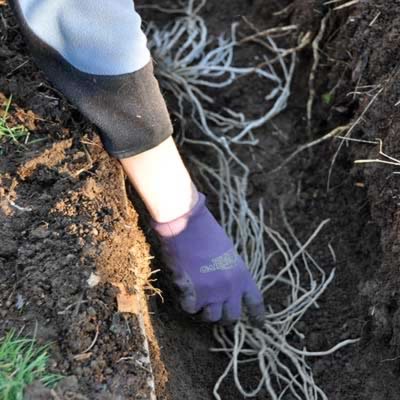
You may recall that Kris is unhappy with the current performance of our four-year-old asparagus plants. Last weekend I double-dug a second area of the vegetable patch to act as a new asparagus bed. This spot should have better drainage. Here we planted 15 crowns of asparagus (Jersey knight and Mary Washington jumbo) and several dozen red onion sets. We won’t be able to harvest the asparagus for a couple of years (the plants need time to develop), but we’ll use the onions in salsa this summer.
In the herb garden, Kris pruned the rosemary and the lavender. She’s quite pleased because her chives are peeking up. Very soon now, she will begin her vegetable seeds indoors. Many people have requested that Kris document the process, so I think we plan to have a mid-month update on how to start plants from seed. Stay tuned!
Summary
“Our expenditures in time and money are way up this year,” I told Kris after I finished compiling this month’s numbers. I was Very Concerned. But all Kris said was, “Yay!”
To her, more time and money spent on the garden now means bigger harvests in the future. I’m not convinced. Still, Kris assures me that we won’t have many other garden expenditures until May. (Which would bring our costs back in line with last year’s pace.)
Note that this month we harvested and used some of the herbs that Kris has been growing indoors all winter. In fact, we just had a mess of basil in our baked ziti last night!
March 2009 Update
In Oregon, the month of March is unpredictable. Every gardener is itching to get outside, but it’s wet and cold with a few precious — and fleeting — moments of sunshine. In those sunny moments, you can bet you’ll hear a lawnmower going!
I’ve spent a lot of semi-productive time in the flower beds this month, checking on the progress of my perennial flowers, most of which seem to have come through our extremely cold December just fine. While they’re just peeking up from winter, it’s a good time for me to assess which plants are getting invasive and where the bare patches are that will be filled by the plants I have started from seed indoors.
Indoor Gardening
On March 1st, I started seeds for basil and eight types of flowers. Four weeks later, some of them are ready to be moved into 4″ pots. I also started some mesclun salad mix in our indoor herb container, and harvested the end of the winter’s basil and dill (leaving the oregano, which looks great).

On March 15th, the day arrived that I look forward to all winter: tomato planting day! I plan to have twelve tomato plants this year (nine varieties in all). By the last day in March, each seedling was happily growing under fluorescent lights in the windowsill. Just a few days ago, I began seeds for two types of squash and some cosmos flowers.
Outdoor Gardening
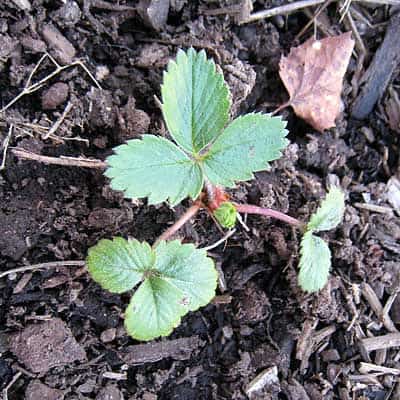
The peas and onions we planted in February have sprouted. Mid-month, into the vegetable patch went seeds for three kinds of beets and more salad greens, and among the roses I planted an additional 25 strawberry plants. Neither the beets or the lettuce have sprouted (it’s been cold!) but I am confident that they’re on their way.
Plant Swap
When J.D. writes about our gardening endeavors, he typically concentrates on the herbs, fruits, and vegetables. He loves to eat! But much of my time is devoted to the flower garden. The expansive flowerbeds on our property were filled with 125 rose bushes when we arrived. After giving many away, relocating others and accidentally killing a few, we’re down to about 60. In their place, I have gradually added perennials, bulbs and self-sowing annuals.

In April, my friend Rhonda is hosting a plant swap. Each participant will bring plants dug from her own garden, and take home others. A few guests are coming empty-handed because they are in new homes without gardens, but I am sure there will be plenty to share.
This month, I spent a couple of hours digging and dividing, and now have about 30 pots to swap. This is a fun way to frugally multiply your landscaping! Since most of the plants that people bring to swap are “vigorous growers”, you can bet that it will only be a few years before they’re ready to be swapped again with someone new.
Summary
The edibles garden took little time this month — about 4 hours — especially if you don’t count the many trips I took outside just to squat and peer at the soil where I had planted seeds.
Based on last year’s tests, we estimate that we spent just $1 in March to run two fluorescent shop lights. We anticipate an inexpensive April as well. J.D. had a minor freak-out when he saw our February expenditures, but looking back at last year’s totals, by now we’ve only spent $10 more, gotten $15-worth of herbs from the winter window box and planted three new fruit trees. That’s a bargain!
April 2009 Update
April was a slow month for our garden. We didn’t do much. Part of this is because we’ve become more efficient. But another part is because we did some of our chores earlier this year.
Kris has been antsy to get plants in the ground. I always tell her that May 1st is our target date, but she’d plant out on the first of April if she could. Last year she put her tomato starts out a few days early, and that was a mistake. They were pummeled by a freak hailstorm and never did produce much. This year, she decided to wait.
She did, however, do a little bit of work. She planted beets, radishes, and lettuce. She transplanted her tomatoes into bigger pots. And she produced a garden map that outlines where she intends to plant things.
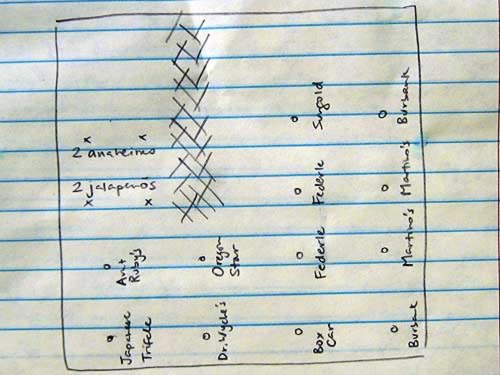
Kris has mapped out where she’ll plant tomatoes and chili peppers
My only garden work was a frustrating hour spent rototilling the compost and leaves and horse manure into the soil. It was frustrating because we have a large, willful rototiller that seems to have a mind of its own. Our actual garden isn’t very large, and we currently have created a sort of maze around the asparagus and onions. That makes it difficult to maneuver. I did manage to get the ground worked up, but it didn’t happen without cursing!
Speaking of cursing: Last year, our gooseberries were mauled by a sawfly infestation. This year, the sawfly larvae are back, and they’re not only devouring the gooseberries, but the currants as well. The gooseberries we can live without, but not the currants. Kris is researching organic pest controls.
Garden Tour
We may not have much to share about our garden this month, but we do have some photos. The last few days have been sunny, so we’ve had a chance to photograph our garden in its early stages. Here, for example, is the (mostly) blank canvas:
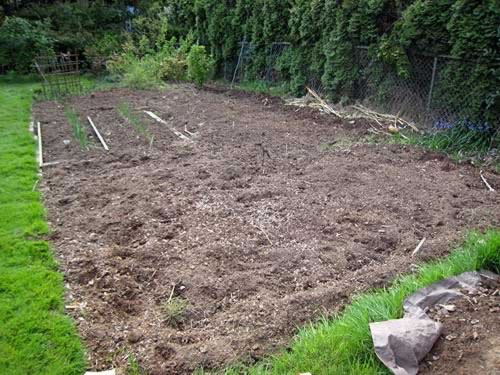
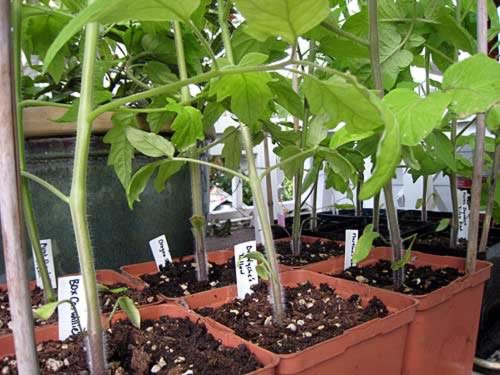
As a reminder, the area of our vegetable garden space is roughly 15 ft by 34 ft (4.57 m x 10.37 m), or 510 square feet (47.4 sq. m.). This actually isn’t very big, and we’ve considered enlarging it. As I mentioned before, Kris planted out her tomatoes yesterday, so this space is no longer empty. Before she planted them, however, Kris set her tomatoes outside to “harden off”. I know this photo doesn’t really show it, but these things are enormous after only six weeks of growth:
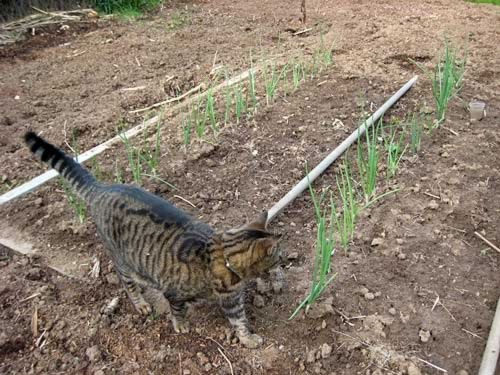
Meanwhile, we do have some crops up. We’ve recruited help to maintain them. Meatball has been tasked with patrolling the beets, radishes, and peas, and Simon has been given charge of the onions:
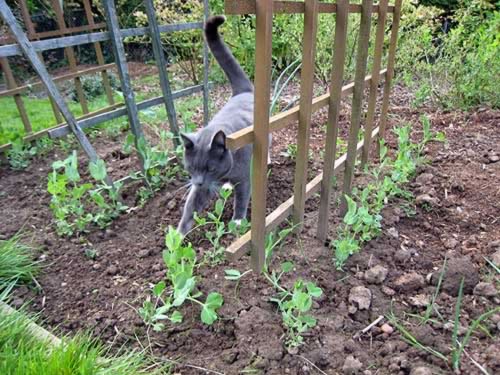
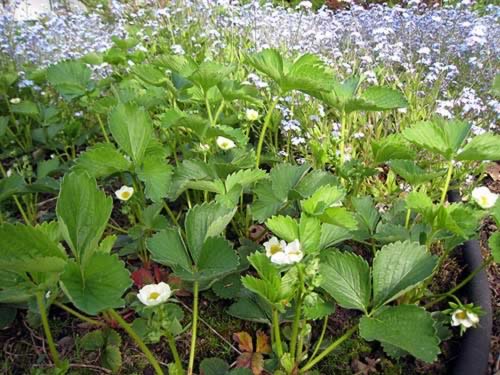
The peas and onions aren’t the only things growing. This is the time of year that berries begin to go berserk. They’re not producing fruit, of course, but they’re beginning to show promise. The blueberries are laden with blossoms (especially the Toro, which are our favorite). So too are the strawberries:
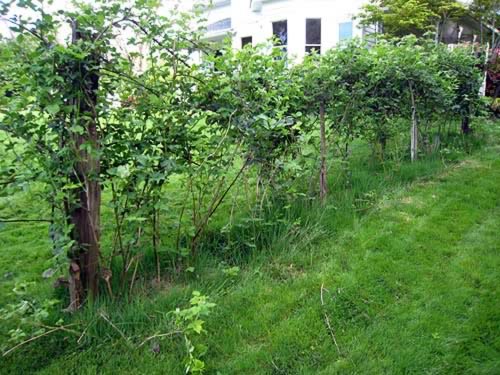
Our caneberries have begun their vigorous growth. No blossoms yet, but lots of new shoots:
Though I don’t have photos, our fruit trees have also begun to bloom. We have two apples, three plums, a cherry, and a pear. We’ve set out pest control in a few of these, and that’s all we’ll really have to do until harvest.
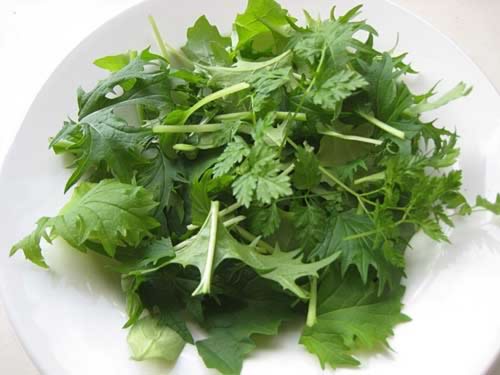
Finally, here’s a salad that we made from herbs and lettuce greens that Kris grew indoors. This is a perfect example of how you can harvest home-grown food in a small amount of space. (You can’t harvest a lot of it, but you an harvest some.)
Summary
The edibles garden took little time this month — just 3 hours. We didn’t spend a dime. We harvested a single asparagus spear (which Kris consumed raw), but we won’t count that in our totals.
May 2009 Update
What a difference a year makes! Our fruits, berries, and vegetables had a slow start last year (and then were further slowed by a cold, cold June). This May was warm — very warm. Our food crops loved the weather, and they’ve shown explosive growth.
First Harvest
The sunny weather produced lots of growth. The peas and raspberries and blueberries and fruit trees all look amazing. We’re going to have huge crops. We have a couple of small snow peas on the vine, and the tomatoes are blossoming. But only three crops have yielded fruit through the end of May:
- In its fourth year, our asparagus finally produced a crop. It wasn’t much of a crop, but it was a crop. We harvested 31 spears (about 520 grams). I went to the grocery store last night and measured five bunches of asparagus. They averaged 20 spears, about 500 grams, and cost $2.99 each. I figured that our asparagus was worth $3.11.
- Kris added some strawberry plants to our patch. (Our strawberries live intermingled with the roses.) They’ve been producing fruit for several days, which means they’re a week earlier than last year. So far, we’ve harvested 325 grams (0.72 pounds) of strawberries worth about $2.86.
- We’ve also begun to harvest radishes. “The radishes are a failed experiment,” Kris told me today. “They’re easy to grow, but we don’t like them, so we can’t count them for the project. In fact, I hate the radishes so much that I have to spit them out in the sink whenever I try them.” So, we won’t count this third crop as worth anything.
That puts our May harvest at $5.97, which isn’t much, but it is still $5.97 more than we harvested in May last year.
Challenges
Though our garden is going well this year, we’ve experienced some minor annoyances:
- For the second year, the gooseberry sawfly larvae stripped the leaves from the gooseberries. Kris is cutting her losses. She says the gooseberries can come out, which makes me happy. Those things have nasty thorns. Besides, I can now plant two more blueberry bushes! (I love my Toro blueberries — very productive in a small space.)
- Kris is still waging a war against the slugs. This is an annual battle, one in which she’s tried nearly every recommended remedy. The slugs are threatening her precious cucumbers, marigolds, and sunflowers. But this year she’s trying a new strategy: she’s losing the battle to win the war. She planted more of each variety than usual, and is just accepting that she’ll lose a certain number.
- Finally, we’ve had some equipment failures. Our spray nozzle broke. Kris tried to fix it, but it was beyond repair. The same is true of the soaker hose, which sprung a gusher at the connector.
These aren’t major problems, obviously — they’re just minor annoyances. We try to take care of our equipment, but there are a few failures every year. Partly because of this, May was an expensive month. (It was also expensive in 2008.) We spent $98.55 on garden supplies, including herbs and vegetable starts.
Summary
I spent zero hours in the garden this month. I did a few quick tasks, but no major work. Kris made up for that. She tells me she spent 15 hours on food-producing activities last month. I’m skeptical. That’s 40% more than our busiest month in 2008 (July). On the other hand, she did do a lot of work out there. (She tells me that just as some GRS readers warned, the horse manure we spread last fall has produced a fine carpet of weeds, which she hoes daily.)
June 2009 Update
It’s the beginning of summer, and that means our garden is lush and green and growing. It also means there’s nothing exciting to write about. We’ve begun to harvest a couple of things, but mostly our chores have become routine. We weed and fertilize while we wait for the crops to ripen.
One problem we’ve encountered this year is weeds. There are always some weeds to be pulled, but as many GRS readers warned, spreading horse manure on our vegetable garden caused more weeds to sprout. Kris is the weed-puller (and plant-fertilizer), so she puts the most hours into the garden. She spent four hours working on food crops this month, while I spent three, all of which were harvest-related.
Harvest
As our harvests begin, I want to remind you of our methodology. For the purposes of this project, we’re using “best match” pricing. Based on GRS reader suggestions, we’re obtaining typical pricing from our local farmers market. In some cases, we use pricing from a local organic produce stand. In all cases, we’re trying to be fair, but this is more art than science.
Also, last year we established through repeated measurements that a pint of berries weighs roughly 300 grams. I’ll use this approximation frequently throughout the summer.
Those ground rules established, here’s our harvest for the month of June:
- 13.55 pounds (6.151 kg or about 20.5 pints) strawberries @ $2.99 per pint = $61.30
- 5.17 pounds (2.344 kg) snow peas @ $2.99/pound = $15.45
- 0.31 pounds (0.139 kg) raspberries $3.49/pint = $1.62
Our harvest this month was worth a total of $78.37. In June 2008, we harvested $50.83 worth of food. That’s a 54% increase in the value of our crops!
Despite the correct pruning we gave them this year, our raspberry harvest looks as though it’s going to be pitiful. The culprit? They’re overcome by the monstrous marionberry vine that has taken over the entire trellis. We may relocate the raspberry canes, so will evaluate the yard for a suitable spot and decide later this summer. However, there is a silver lining; we love marionberries (a type of blackberry-boysenberry cross).
Summary
And so the profit portion of our project has begun! July, August, September, and October will be even more productive as we begin to pick our caneberries, our tree fruit, and, especially, our tomatoes.
As always, we’ve been supplementing our own produce with food picked elsewhere. Last weekend, our friend Jolie joined us for a trip to the strawberry patch. Kris and I picked 24 pounds of berries (about two flats), for which we paid just over $20.
On Friday, our neighbor came over to let us know that her cherries were ready to harvest. We’ve decided not to preserve any cherries this year, but we picked about 10 pounds just for snacking.
July 2009 Update
Welcome to Oregon, where for the past week it’s been hot. How hot? Here’s the temperature graph from the National Weather Service for Monday, Tuesday, and Wednesday:
The heat hasn’t prevented us from working in the garden. We’ve been watering the thirsty plants, and we’ve begun harvesting their fruit. It’s hard to believe that just three months ago, this was a bare patch of earth. Now it’s grown so lush that it’s difficult to photograph:
But how have our harvests been? Let’s find out.
Currently Currants
Remember how last year Kris and I couldn’t find a price for our currants or gooseberries? They’re just not available here in Oregon, so we used the same figures for them as we did for our other berries. But earlier this month we stopped at an Asian supermarket, and they had both gooseberries ($2.99 for 6oz.) and red currants ($3.49 for 6oz.).
So what?
Well, in July we harvested 8.362kg of red currants from our two bushes, which is 18.42 pounds. That’s a lot of currants. Look again at that price in the last paragraph. $3.49 for 6oz. translates to about $9.30 per pound. In other words, we harvested $171.43 worth of red currants this year.
Holy cats!
I have new advice for how to make a garden profitable: Plant red currants — and lots of them!
But what can you do with eighteen pounds of red currants? Kris made two batches of red currant jelly with the most beautiful ruby red color you’ve ever seen. She’s going to enter some in the county fair in mid-August. We also had two friends come glean the extras. Plus there were currants left over to freeze!
More Harvest
While the currants gave us a bumper crop, other plants were less productive. The gooseberries didn’t produce much. And for the second year, they fell victim to the gooseberry sawfly. Kris and I agree: Those things are out of here! I’m going to dig them up and we’ll replace them with more blueberries.
Speaking of blueberries, they weren’t very productive this year either. I’m not sure exactly what the problem is, but we’ve harvested less than half the blueberries we did last year. Our raspberries were pathetic for the second year running; they just can’t compete with the vigorous marionberry canes.
Still, harvest season is in full swing. Here’s the complete tally from our garden in July:
- 18.42 pounds (8.362kg) red currants @ $3.49 for six ounces = $171.43
- 0.95 pounds (0.430kg) gooseberries @ $2.99 for six ounces = $7.55
- 4.91 pounds (2.229kg) snow peas @ $2.99/pound = $14.58
- 1.09 pounds (0.494kg) green beans @ $1.29/pound = $1.41
- 5.91 pounds (2.681kg) caneberries (blackberries, etc.) @ 2.49/pint (~300g) = $22.25
- 79 cucumbers @ $1.29/pound (about 5 cukes) = $20.38
- 11 zucchini @ $0.50/each = $5.50
- 6 red onions (negligible value)
Our harvest totaled $243.10, but most of that was from the red currants. Without those to salvage our stats, we would have finished behind last July. That’s okay, though. The tomatoes are just about to come on, and we’re going to have a lot more of them than we did last year. The fruit trees will also give us bigger crops than last year since they’re a year more mature.
Summary
As we often do, we also picked fruit from friends this month. We picked cherries from the neighbor across the street, and on July 3rd we drove out to raid the cherries belonging to our friends Ron and Kara, coming home with thirty pounds of mixed Queen Annes, Bings and sour pie cherries. Yum! We also made use of some early apples for a juicing experiment. This “free” produce isn’t included in the numbers below.
August 2009 Update
After late July’s blistering heat, August has been relatively cool around Portland. Our fruits and vegetables have been producing excellent crops. Kris is constantly busy in the kitchen, canning and preserving food. We’re eating fresh salsa all the time. And hard as it is to believe, I’m almost sick of blackberries.

Fresh berries in a bowl of cereal == a great breakfast! Photo by Kris.
This is actually the best year we’ve had for blackberries. They started producing at the end of July, and there’s been a non-stop flood ever since. Sometimes — in mid-winter — I think I want to plant more blackberries. But during the month of August, I’m reminded that this is a silly idea.
The blackberries aren’t the only prolific producers this year. Our young plum tree is going gangbusters. It yielded its first small crop last summer, but this year it’s really loaded. And Kris’s cucumbers are the most eager growers of all. She has more cucumbers than she knows what to do with and has been taking the excess to share with co-workers.
Also, our tomatoes are doing much better than last year. The cool June in 2008 stunted the crop. We only had 12.88 pounds of tomatoes in August. This year we picked 31.39 pounds of the fruit — and even then we felt this was a little low.
Not everything has produced well, though. July’s heat ended our blueberries early. In fact, we’re unhappy with the blueberry/gooseberry/currant patch, so we’re going to rip out most of the plants and replace them with new ones. Our current blueberry plants are transplants from the neighbors, and they’re 25 years old. They’re weak producers. Time to put in something that will produce fruit worth picking.

Summer harvests can be beautiful. Photo by Kris.
Still, harvest season is in full swing. Here’s the complete tally from our garden in August:
- 19.34 pounds (8.780kg or 29-1/4 pints) blackberries @ $2.49/pint (~300g) = $72.87
- 3.00 pounds (1.361kg) elderberries, for which we have no value
- 1.61 pounds (0.729kg) plums @ $1.49/pound = $2.40
- 4.20 pounds (1.906kg) pears @ $0.99/pound = $4.16
- 0.44 pounds (0.200kg) apples @ $0.99/pound = $0.44
- 2.15 pounds (0.975kg) new potatoes @ $0.99/pound = $2.13
- 2.06 pounds (0.937kg) beets (~3 bunches) @ $1.99/bunch = $5.97 approx.
- 6 zucchini @ $0.49/each = $2.94
- 93 cucumbers @ $1.29/pound (about 5 cukes) = $23.99
- 0.56 pounds (0.256kg) green beans @ $2.49/pound = $1.39
- 31 chili peppers @ $0.29/each = $8.99
- 1.63 pounds (0.738kg) cherry tomatoes @ $2.49/pound = $1.84
- 29.76 pounds (13.509kg) tomatoes @ $1.99/pound = $59.21
Our harvest this month totaled $186.33 worth of produce — and that’s without some freak crop blowing the lid off the values. (Last month, we discovered that our red currants are worth quite a bit, which distorted the totals for July.)
This year, for the first time ever, Kris entered some of her produce at the county fair. Her dilly beans took first prize (out of ten entrants). When I picked them up after the fair was over, the woman who returned them to me raved about the beans. “They were so good,” she said. “I had to copy down the recipe.”

Kris’s prize-winning dilly beans. Photo by Amy Jo.
We continue to receive “free” produce from here-and-there. Friends and neighbors share their surplus, just as we share our surplus with them. Last weekend, for example, the old couple next door brought over a wheelbarrow load of pears. The seventy pounds of fruit they gave us kept Kris canning all day Saturday, and yielded 16 quarts of sliced pears in syrup, 7-1/2 quarts of pear sauce, and 5 quarts of dried pears.
Things are looking good! Better weather in 2009 combined with more effective efforts on our part has created a far more profitable garden project. And again, that’s even though we’re not particularly frugal gardeners.
September 2009 Update
After a long productive summer, our September in the garden was kind of anticlimactic. Sure, we continued to harvest our home-grown food, but neither of us was particularly “in” to the garden this month. It was a chore instead of an obsession. September can be that way sometimes.
Still, there’s always something happening with our home food production. This month:
- We’ve been harvesting lots of apples and plums. It took four or five years, but our Jonathan apple tree has finally turned productive. We pulled down nearly 40 pounds of apples this year! And the plum tree was loaded.
- The blackberries are still producing, but we’re sick of them. I can hardly believe I’m saying that (blackberries are my favorite), but I’ve had enough berries. And besides, they’re not very good this late in the season. We stopped harvesting them long ago.
- Kris has been using her food dehydrator to preserve lots of dried pears and plums. This is a great way to extend the harvest and to provide fruit for snacking during the winter. (We also canned lots of applesauce and pickles.)
- As threatened, we tore out the old blueberry plants. They’re over 25 and their production has slowed tremendously. I’ll tear out the gooseberries next weekend. We’ll buy some new blueberries to replace these plants.
Now we’re just waiting for the grapes to ripen (soon, very soon) and the harvest season is done. Kris and I are both disappointed that, for us, this has been the Summer of No Corn. We didn’t grow any ourselves, and we didn’t have another convenient source. When people did give us corn, it was terrible. Ah well — there’s always next year.

But what you really want to know is how much we “earned” from our garden in September, right? Here’s this month’s tally:
- 37.00 pounds (16.798kg) apples @ $0.99/pound = $36.63
- 2.51 pounds (1.140kg) pears @ $0.99/pound = $2.48
- 5.57 pounds (2.528kg) Italian plums @ $1.49/pound = $8.30
- 0.69 pounds (0.315kg) caneberries (blackberries, etc.) @ $2.49/pint = $2.61
- 1.01 pounds (0.460kg) grapes @ $3.00/pound = $3.04
- 0.61 pounds (0.278kg) green beans @ $2.49/pound = $1.52
- 64 cucumbers @ $1.29/pound (about 5 cukes) = $16.51
- 29 chili peppers @ $0.29/each = $8.41
- 18 squash @ $0.99/each = $17.82
- 27.46 pounds (12.468kg) tomatoes @ $1.99/pound = $54.65
As always, we also enjoyed some of the harvest from our friends and neighbors. We obtained 28 pounds of plums from other folks, a bunch of onions from my cousin, and about 30 pounds of fresh-caught salmon and halibut from the millionaire next door when he returned from Alaska. (And Tina offered us as much corn as we wanted, but we weren’t able to pick it.)
I’m a little worried about October. Last year, we harvested over $150 in produce because the tomato season lingered. This year, though, tomatoes are essentially over. Kris and I don’t expect to harvest much more than we already have. Who knows, though…maybe we’ll be surprised. Still, our harvest total for the year is already greater than our total for all of 2008, so we’ve made improvements!
October 2009 Update
As those of you who follow me on Twitter already know, it’s been a l-o-n-g Saturday filled with all sorts of misadventures. Murphy’s Law has been in full effect this Halloween. I’d meant to post this month-end garden summary around noon, but now will have to do. In fact, there wouldn’t be a summary at all except that my wife sat down and wrote it for me. Here’s what Kris has to say about the month of October…
October arrived with the typical cold and damp, bringing Portland’s garden season to a close. During the fall and winter we’ll enjoy the hearty foods we’ve packed away from this year’s crops, until by early spring we’re ready to begin anew.We’ve been eating fresh fruit and vegetables from our garden patches since May’s first strawberries. Not bad!

The Last of the Tomatoes
We harvested the last of the garden produce this month.Rain and wind don’t mix well with ripening tomatoes, so I picked 15 pounds of semi-ripened tomatoes to take inside. Stored in a cool place between layers of newspaper, some of these will turn out to be fairly delicious.The rest will rot.
The cucumber plants coughed up enough for another month’s worth of salads, and the beets were ready for roasting. (In fact, I’m roasting some in the oven even as I write this.) In addition, I tore out the jalapeno plants and dried the peppers in slices in the dehydrator.Some went to our neighbor who loves spicy foods; the rest will go into winter cornbread and soups.
Usually I collect the fallen English walnuts in our front yard, but the squirrels have been especially voracious this year!And my volunteer vine turned out to be a birdhouse gourd that gave me two mature gourds for fall decorating.

The Fruits of Autumn
I spent time in the mud ripping out cucumber and squash vines, then the beans and tomato plants, and tidying up the apple trees. We also dug out the beleaguered gooseberry plants and three poorly-producing 25-year-old blueberries.We invested $84 in five new blueberry bushes of various types and sizes.(We’re trying to stagger the berry harvest so it lasts as long as possible.)As we rake leaves in our yard, we’ll spread them onto the garden bed to mulch the asparagus and keep down the weeds over the winter.
In the waning hours of sunshine, early October in our neighborhood smells of Concord grapes.We wait until the scent tells us they’re ready, then head over to the generous neighbor’s yard to pick all we can use. Our own young vines produced a good crop as well. This year, J.D. gathered about 30 gallons of mixed purple and green Concords.I made juice (22 quarts) and grape jelly.It’s a long day but so worth it every time we open a jar.We also made another batch of applesauce from twenty pounds of fruit brought back from an orchard by a friend and fellow canner.
This summer’s total for canned food: 140 quarts of assorted pickles, apple/pear sauce, juices, jams & jellies, salsa and fruit.My pantry is full to bursting!I love being able to eat this local bounty during our winter, rather than buying produce that’s been shipped from far away.
In addition to the canned food, the freezer is stacked with berries and assorted sauces, and dried fruits and herbs are stored in a dark and dry place. All this “free food” keeps my grocery spending in check even when we’re not eating directly from the garden.
Monthly Totals
The fall is when I tally the herbs for the year.Our herb garden provides me with sprigs and snips all year.The annual herbs are finished (basil, stevia, cilantro) and others die back until spring (lemon balm, oregano, mint, lavender) but the perennials will keep going for our winter kitchen use (rosemary, chives, bay leaf, sage & thyme).Throughout the summer, I’ve dried lavender flowers, mint and lemon balm, stevia and raspberry leaves for making tea infusions. Altogether, I estimate that the herb garden has produced at least $50 of harvest.
Here’s the tally for October’s harvest:
- 56 jalapeno peppers @ $0.29 = $16.24
- 18 cucumbers @ $1.29/pound (about 5 cukes) = $4.64
- 5 bunches mixed beets @$2.99/bunch = $14.95
- ~9.64 pounds of tomatoes @$1.99/pound = $19.18
- 8 pounds grapes from our vines @$3/pound = $24.00
- Assorted herbs, all season $50.00
- Costs: 5 blueberry bushes ($84)
2009 Totals
| Month | Time | Cost | Harvest | Month | Time | Cost | Harvest | |
| Jan 09 | 3.0 hrs | $131.15 | — | Jan 08 | 4.0 hrs | $27.30 | — | |
| Feb 09 | 12.0 hrs | $36.67 | $10.00 | Feb 08 | 2.5 hrs | — | — | |
| Mar 09 | 4.0 hrs | $1.00 | $5.00 | Mar 08 | 3.5 hrs | $130.00 | — | |
| Apr 09 | 3.0 hrs | — | — | Apr 08 | 5.5 hrs | $28.51 | — | |
| May 09 | 15.0 hrs | $98.55 | $5.97 | May 08 | 5.5 hrs | $110.89 | — | |
| Jun 09 | 7.0 hrs | — | $78.37 | Jun 08 | 7.0 hrs | $0.79 | $50.83 | |
| Jul 09 | 7.0 hrs | — | $243.10 | Jul 08 | 11.0 hrs | $20.94 | $123.68 | |
| Aug 09 | 12.0 hrs | — | $186.33 | Aug 08 | 8.0 hrs | — | $123.94 | |
| Sep 09 | 2.5 hrs | — | $151.97 | Sep 08 | 2.0 hrs | — | $152.75 | |
| Oct 09 | 8.0 hrs | $84.00 | $129.01 | Oct 08 | 5.0 hrs | — | $152.77 | |
| Total 09 | 63.5 hrs | $351.37 | $809.75 | Total 08 | 54.0 hrs | $318.43 | $603.97 |
February 2011 Update
Spring is around the corner. I think. After spending three weeks basking in sunny skies and temperatures of 20-30 degrees (yes, I’ve taught myself to think in centigrade!), it’s something of a shock to return to Oregon’s five degrees and rain. Still, I know warmer weather is just around the corner — and that means it’s time to garden.
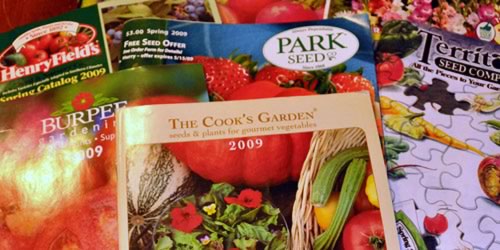
Ordering Seeds
Kris has already started to think of the garden, of course. Her mind makes the leap just after Christmas, when the first of the seed catalogs starts to arrive.
In January, she went through her seed supply — her leftover seeds and seeds saved from last year’s crops — to determine what she needed to order. In the end, she chose:
- Green beans
- Beets
- Turnips
- Peas
- Pickling cucumbers
- Pumpkin
- Zucchini
She spent a total of $24.15 on seeds, ordering mostly from Territorial Seed Company, which sells seeds specifically targeted at “the maritime Pacific Northwest”. (If you can buy your seeds from a regional company, do so. You’ll get plants better suited for your growing conditions.)
Kris has a system for buying seeds. If it’s a new variety she’s trying, she buys the smallest package possible. If it’s a kind she knows she likes, she buys enough to plant for the next two to four years. She saves the extra seeds in the fridge (in an air-tight container).
We’ll plant more in the garden, of course. As usual, we’ll pick up tomatoes, basil, and peppers at the Master Gardener sale at the end of April. These plants will have a good head start, and will let us try a few new varieties.
Kris estimates the seed-buying process took about two hours.
Early Work
While Kris was buying seeds, I spent some time getting the garden ready. With the help of the boy we hired for a weekend, I tore out some of the old plants, weeded some patches, and — gasp! — cut our blackberry canes to the ground. (This won’t kill them. It’s like pressing the reset switch. They were out of control, and this will give us a chance to guide their growth. But it does mean we won’t get many berries this year.) We spent maybe two hours total doing this. (Meaning, I spent two hours on this, and I paid Ian $20 to help.)
This weekend, Kris intends to plant the peas — if the weather cooperates. The ground is very wet, and there seems to be more rain on the way. (What is this? Oregon?). She’ll also start seeds indoors for her flower garden (nicotiana, zinnia, cosmos, marigolds, and so on). The flowers are mostly from seeds saved in previous years, though the flower-garden costs aren’t included in this project. (Flower gardening is one of Kris’ favorite hobbies.)
Next month, Kris will start seeds indoors for food crops: cucumbers, pumpkin, and zucchini. She times when she plants the seeds based on when she intends to plant them outside (which is May 1st), and counting backwards to get the weeks needed according to the seed-packet instructions.

At the end of April, we’ll attend a “garden exchange”. This is the third year our friend Rhonda has organized a plant swap. Everyone brings their extra plants and seeds, sets them out for others to see, and then takes home what they want or need. In anticipation of this event, Kris will plant extra flowers and vegetables for trading. (She’ll also dig out some perennials to share.)
A garden exchange is a fantastic, frugal way to share plants, but now is the time to organize this if you live in a cool climate. Don’t wait until the last minute.
Favorite Fruit Smoothie
It’ll be a while before we have fresh berries, but we’re still able to enjoy the fruits of last year’s harvest. In fact, Kris has been using our supply of berries in yogurt smoothies. Here’s her recipe:
- 1.5 – 2 cups plain low-fat yogurt (homemade, if you have it)
- 1 banana
- 1-2 cups assorted berries (strawberries, blueberries, blackberries, or a mix)
- juice from one orange
- 2 Tablespoons of berry jam (or honey)
We don’t grow the bananas or oranges, of course, and we don’t harvest the honey. But we grow the berries, make the jelly, and, thanks to Jolie Guillebeau, we make our own yogurt. And in just a few months, we’ll have fresh berries to use in the smoothies.
Monthly Totals
With the cold weather and our trip to Africa, the 2011 garden project is off to a slow start. (It’ll pick up over the next few weeks, though.) We’ve spent a total of 4.0 hours and $44.15 on this year’s food-producing garden ($24.15 for seeds and $20 for hired labor).
It’s interesting to note that there’s really no “typical” year so far.
- In the first two months of 2008, we spent $27.30 and 6.5 hours on our garden.
- In the first two months of 2009, we spent $167.82 and 15.0 hours on our graden.
- In the first two months of 2011, we’ve spent $44.15 and 4.0 hours on our garden.
If you had ask me to guess before I started this project, I would have thought that each year would be much like the year before. Apparently, that’s not the case. I’m eager to see how this year’s costs and harvest unfold…
March 2011 Update
March is usually a time for Kris and me to get back to work in the garden. The weather warms, and we get to watch as our first sprouts poke through the soil. This year? Not so much. It was a cool, wet month.
The average temperature in March was about 46 degrees Fahrenheit — which is below normal for this time of year. In fact, Portland just had a record stretch between 60-degree days. The last such day came in early December. We usually get a couple of 60-degree days in February, but if the clouds hadn’t parted on the afternoon of March 31st, this year we wouldn’t have had a warm day until April.
Meanwhile, rainfall was nearly 75% above normal for the month. If that rain had all been concentrated over a few days, we might have done some work in the garden. But it wasn’t. It rained 28 days in March. Twenty of those days saw 1/10th of an inch of rain or more. It was so wet last month that the peas we planted after returning from Africa simply rotted in the ground. And now it’s too late to plant replacements. So, we probably won’t have peas this year. (Which is sad, because I love peas!)

As you’ve probably deduced, between the cool weather and the heavy rainfall, Kris and I did nothing on our garden in March. In fact, we did nothing in the yard. The lawn did get mowed — but not by us. It’s been far too wet for my mower. But we were making dinner last Monday night, when Kris asked, “Is somebody mowing the yard?”
Sure enough. There was the Real Millionaire Next Door on his riding lawnmower. I went outside to chat with him. He just got back from his winter in New Zealand (where it was summer, of course), and he’ll be here a month before heading north to Alaska. He’s like a migrating goose. But he’s a goose who mows our lawn and brings us salmon, so it’s always good to see him.
This garden update is pretty lame, I know. Trust me: There’ll be more to report for April. And May’s installment will be packed!
How’s the weather where you are? How does your garden grow?
April 2011 Update
After a long vacation in February and a wet, dreary March, Kris and I finally were able to do a little work on our vegetable garden in April. Sort of. The weather remained chilly and damp throughout the month, so we didn’t get as much yardwork done as we’d like. (The average high temperature for April 2011 was 4.5 degrees below normal. The average low was 2.1 degrees below normal. Rainfall was 5.04 inches, almost twice the average for the month.)
Waiting for the Sun
Though we couldn’t really plant anything until the last day of the month, Kris has been itching to get in the garden, so she’s been doing a lot of maintenance and clean-up. She and I put a total of twelve hours into our food-producing gardens in April (though eleven of those hours were hers). Most of these hours were spent pulling weeds, digging out old overgrown herbs, and getting the gardens ready for planting. (We opted against using the rototiller this year, so it took longer to prepare the plots.)

A big, furry weed in the middle of the chives.
In mid-April, we attended the neighborhood plant swap, where we were able to pass along plants we no longer need (or want) while picking up others that might be more useful. Kris brought home parsley, tomatoes, and lovage (a celery-tasting herb). She also scored lots of perennial flowers. (But we don’t track flowers in our garden project, thank goodness. That’s purely for fun.)

At the plant swap, Mike and J.D. enjoy some fleeting moments of sunshine.
At the plant swap, our friend Craig gave us three kinds of lettuce seeds and some plant-marker stakes made out of old mini blinds. (What an awesome idea!) Though we never have success with lettuce, Kris planted some indoors, and we’re giving it a go. She also has some basil started in a window box.
Blossoms and Sprouts
Meanwhile, most of our fruits and berries have begun to blossom, and our early crops are finally starting to show some life. The apple trees, for instance, are in full bloom, as my allergies can attest:

In January, we cut back our blackberries and raspberries hard. (“You’re not going to get any fruit on those this year, you know,” my real millionaire next door told me. “I know,” I told him. “It’s a price I’m willing to pay.”) Now, though, the caneberries are sending up lots of new growth.

The grapes and blueberries currants are blooming, too. The peas are up, though they’re behind, and we’ve harvested a few spears of asparagus.


The peppers are in a container this year so that they can have warmer soil than the rest of the garden will get. We’re hoping this will make them more productive.

Kris’ frugal greenhouse: A garbage bag over the pepper pot
The tomatoes are currently in Kris’ mini greenhouse. They’ll stay there until the garden soil warms — our night-time temperatures are still in the low forties, about five degrees below normal — or until they get too big, whichever comes first.

In short, we’re being patient. When the weather turns warm, we’ll be ready to plant things out. If we’re lucky, by the end of June, we’ll be writing about sunny days and sweet, delicious berries.
Monthly Totals
At the Oregon Master Gardeners plant sale, Kris spent $28.25 on plants for the vegetable garden. She bought:
- nine tomato plants
- one cucumber
- four chili peppers (I picked out two of the plants)
Kris also bought some herbs. “But they’re decorative herbs,” she tells me. “They’re for the flower garden, not for the herb bed.”
I also spent $15.98 on a bag each of potting soil and compost, bringing our total expenses to $43.23.
All we harvested in April was about 263 grams of asparagus. Asparagus goes for $2.99 a pound at the local natural-food store, which means we’ve reaped about $1.73 in “revenue” from our garden so far this year. We won’t really start getting our money’s worth until June, when the strawberries begin to ripen. (I can hardly wait!)
May 2011 Update
In my mind, Oregon has mild springs: plenty of rain, sure, but also lots of sunshine and hints of the summer to come. Since we started the garden project, though, that just hasn’t been the case. Our springs have mostly been cool and moist — just like our winters.
May was again — surprise! — cool and moist. There were some sunny days, and our rainfall was around average, but the temperature was much cooler than normal. (Well, long-term normal, not recent normal.) Still, our garden isn’t as stunted as it has been in years past.
The State of the Garden
Despite the weather, our garden is thriving. As you’ll recall, Kris bought lots of “starts” at the garden show on the last day of April. She set out the tomatoes to harden off (allowing them to become acclimated to the great outdoors), and eventually moved them to the garden. From seed, she planted green beans, cilantro, cucumbers, zucchini, and pumpkins. She also planted nasturtiums — edible flowers — from seed. And sunflowers (though we don’t plan to eat those!)
Indoors, we’ve been growing lettuce, which is rare for us. We’ve tried lettuce (and carrots) before, but for some reason, we never have success. But our friend Craig, who is a fantastic gardener, gave us some lettuce seeds saved from last year’s crop. We planted them indoors and now have quite a crop.
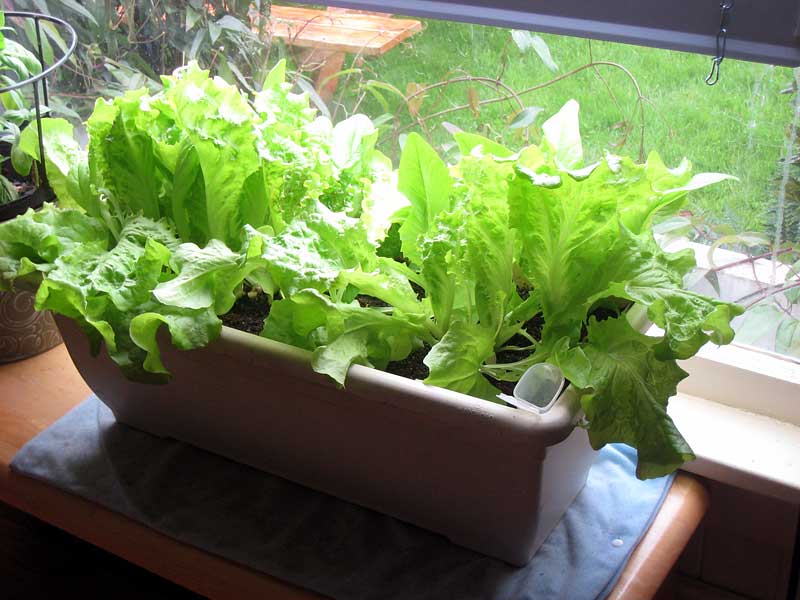
For the first time, we’ve grown lettuce that actually tastes okay. It’s not great, but at least it’s not bitter. Meanwhile, some of the cucumbers are still under cloches (made from two-liter soda bottles) because it’s been too cold.
Kris has been hoeing her garden and performing routine maintenance. I haven’t had time to tend to my berries (the blueberries are overrun with weeds!), though I did find time to trim the tall grass in the caneberries and grapes. And last weekend, Kris and I spent half an hour working together to tie up the blackberry canes.
Interlude
While working on the berry canes last week, we disturbed a nest of baby spiders. “Holy cats!” I said. “Look at those guys. There must be a hundred of baby spiders.”
“They’re not really babies,” Kris said. “They’re more like teenagers.”
“I wonder what they eat,” I said. And then I had a thought. I ran inside to grab my camera so that I could shoot the following short video.
I went outside this morning to look at the spiders again, but they were gone — every single one of them. I don’t know enough about spider life to know if they were eaten, washed away by rain, or simply grew up and moved off of their mother’s fencepost.
Monthly Totals
Our costs in May were relatively low when compared to past years. Kris spent about six hours working on the food crops this month. “I’d love to spend more,” she tells me, “if the weather would cooperate.” It looks like she’ll get her wish. The forecast for this weekend is sun, sun, sun — and the long-range forecast looks promising, too. I spent about an hour in the garden, giving us a total of seven hours worked this month.
Our only monetary cost was $10 that Kris spent on a large rhubarb plant, which she’s installed in a corner of the garden. (I’ll never know why, though!)
During the month of May, we harvested three things:
- 1.95 pounds (0.886kg) of asparagus at $2.99/pound = $5.84
- lettuce for two salads (we’re not going to track the “profit” from our lettuce, though we’ll write about how much we use)
- some chive blossoms for chive blossom vinegar, which Kris will use for marinades and salad dressings
June’s harvest will be our first of any size for the year, as we begin to pick the ripening berries. And, of course, July and August will bring us a bounty of fruits, vegetables, berries and herbs!
We’ve spent a lot less on the garden this year than in past years. That’s because we haven’t spent anything on infrastructure. In 2008 and 2009, we had some major expenses for hoses and tomato cages and so on. We’ve had none of those costs this year. In theory, our infrastructure costs should be minimal now that we own most of the things we need to grow our garden.
June 2011 Update
Summer is finally here in our corner of the Pacific Northwest: The birds are chirping, the insects are humming and the garden is producing.
June started cold and wet but has gradually warmed enough to make Kris think this year’s garden is going to be successful. And she needs a successful summer after two straight years of poor tomato harvests — our pantry needs restocking! But those tomato crops are a long way off. At the moment, we’re enjoying our strawberries, peas (both snow and snap), and the lettuce from the window box we keep inside under a fluorescent shop light.

The tomatoes have burst into blossom, promising heavy harvests in late summer
The strawberries have been a morning staple this month (mixed into yogurt with homemade granola), and the peas are delicious straight from the vines or cut for a crispy addition to our salads. But as much as we like these early crops, the best is yet to come. The zucchini are almost big enough to harvest — maybe this weekend — and the currants are ripening to a gorgeous ruby red. The promises inherent in blossoming crops are making our mouths water: cucumbers, tomatoes, potatoes, blackberries, raspberries and elderberries, as well as peppers and pumpkins are all blooming like mad. (Do your job, bumble bees!)
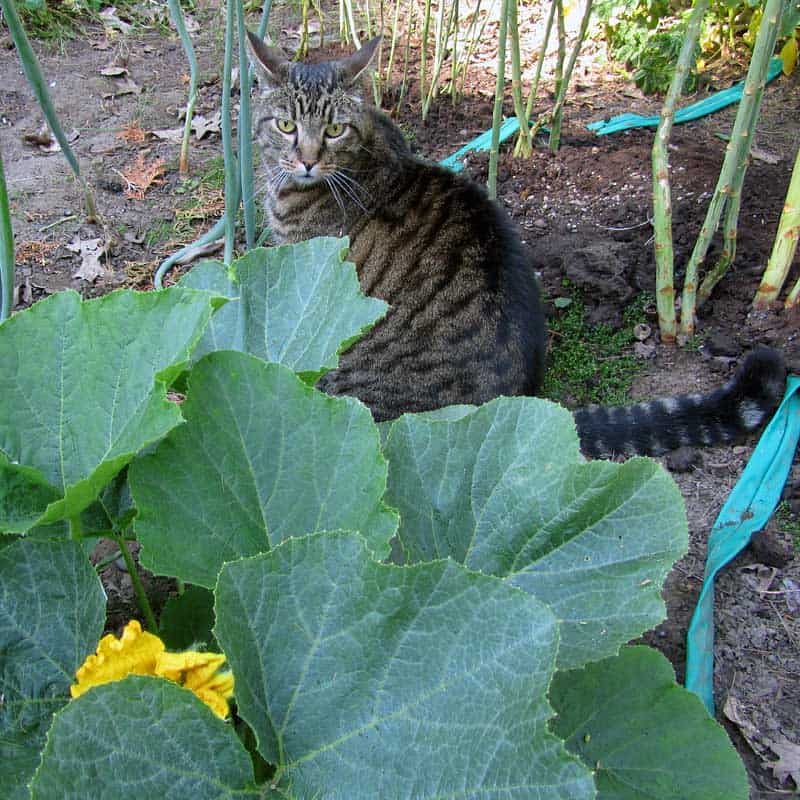
Simon stands guard by the pumpkin plant
From the herb garden, we’re harvesting basil and oregano. The oregano gets dried in the sun, and the basil is added fresh to pasta and pizza. Meanwhile, the apple, pear, and plum trees show potential for sizable crops — if the weather cooperates.

Drying oregano in the sun (between two window screens)
You may remember that we cut the berry canes back hard this year. Well, you’d never know it to look at them! They’re out of control! We’re expecting a small berry crop this year, but I need to get out there and tie up the canes before they take over the neighborhood. And we spent some time this month weeding our patch of young blueberry bushes and adding bark mulch. The mulch was our only garden-related expense for June ($36), but I think we’ll need to actually add another layer in July.

Despite being cut back hard, the blackberries are eager to produce.
Based in part on GRS reader feedback, we’re looking for some help with the yard and shrub maintenance since I’ll be traveling more. That will leave Kris able to focus her energies on the food and flowers as the summer continues. Altogether, she estimates we had about eight hours of garden-related labor this month.

Our potato patch is enthusiastic this year
Our harvest for June included:
- Romaine-type lettuce for six big salads, roughly equivalent to one head = $1.49
- 3.38 pounds (1.535kg or about 4 pints) @ $2.99/pint for local organic at our farm stand = $11.96
- 1.10 pounds (0.501kg) peas (snow and snap) @ $1.69/pound = $1.86
- Oregano and basil = roughly $0.75
That’s a total of $16.06 worth of food harvested from our garden in June, but it’s barely getting started. The next few months should see a bounty of tasty, low-cost food. Yum!

Simon patrols the herb garden to keep it free of squirrels
July 2011 Update
We had a strange July in our garden. First, the cool weather lingered longer than it ought to have. It wasn’t cold and wet, but the days were cool. Then we were gone for much of the month: Alberta, Colorado, Washington. Finally, our harvest was much smaller than in previous summers.
Part of this was because gave most of our currants to a friend, and our new blueberry plants (we replaced the old ones last year) produced fruit, but it went unharvested. (Translation: I wasn’t around/didn’t remember to pick the fruit, so we got none. This is a dumb way to garden.)

July Totals
The low production, the donated fruit, and the wasted berries meant our numbers for the month were pretty pitiful. Our harvest for July included:
- Strawberries: 310 grams at $2.99/pint = $2.42
- Peas: 1474 grams at $1.69/lb = $5.49
- 12 pickling cucumbers (1403 grams) at $1.99/lb = $6.15
- Red currants: 990 grams $3.49 per 6 oz. = $20.32
- 12 zucchini at 50 cents apiece = $6.00
- Green beans: 1446 grams at $2.99/lb = $9.52
That’s a total “profit” of just $49.90, which is way behind the previous two years we’ve tracked the numbers. (This total doesn’t include the cherries we picked from neighbors and friends. That 13 pounds of fruit was worth roughly $32.)
We also had some minor expenses in July:
- Garden sprayer for fertilizer = $12.99
- Liquid calcium supplement = $5.99
The good news? August has been awesome so far. We’ve harvested a lot of beans, peas, cucumbers, and more. If the sun continues to shine, we’ll have a great tomato harvest. And the fruit treas are loaded! In three weeks, we hope to be sharing some big numbers with you.
Zucchini-Basil Pesto
This section was written completely by Kris.
I don’t know about your garden, but mine produces way more zucchini than I can ever eat. And although my basil is thriving, it’s put to shame by the zucchini. How happy was I to find a frugal pesto recipe in our local paper that uses plentiful zucchini as an extender in a Zucchini-Basil Pesto? It replaces expensive pine nuts with more affordable almonds, but don’t skimp on a good quality cheese—it really kicks up the flavor of this mild summer pesto.
(makes two cups)
- 1 tablespoon butter
- 1 large shallot, peeled and sliced (2/3 cup)
- 3 to 6 medium garlic cloves, chopped
- 3 tablespoons almond slivers or chopped almonds
- 1 medium raw zucchini, cut into 1/2-inch dice (7-9 ounces)
- 1 cup fresh basil leaves, packed
- 4 teaspoons lemon juice (preferably fresh)
- 1/2 cup grated Parmigiano-Reggiano cheese
- 1/4 cup olive oil or canola oil
- 1/2 teaspoon salt and freshly ground black pepper to taste
To make the pesto: Melt butter in a medium sauté pan over medium-low heat. Add the almonds and shallot and cook until the shallot is softened but not browned, about 5 minutes. Add the garlic and sauté until fragrant, 45 seconds. Transfer the almonds, shallots and garlic to a blender and add the zucchini, basil, lemon juice, and cheese. Pulse until finely chopped. With the blender running, slowly add the 1/4 cup olive oil, stopping to stir the ingredients occasionally. Blend until smooth and season with salt and pepper.
I’ve adapted the recipe slightly to my taste and I use the lesser amount of garlic because I can find it overpowering. Feel free to make changes of your own and play around with it! This pesto would be good with pasta, grilled chicken, or as a dip or sandwich spread. This recipe makes about two cups — a pesto recipe using only basil would need about four cups of basil leaves instead of the one cup required here — and freezes well in small portions.
August 2011 Update
August finally felt like summer here in Portland. The entire month was sunny and warm, and there was very little rain. The garden rewarded us with productivity. Our harvest in August wasn’t huge, but we expect to pick a lot of fruits and vegetables in September.

A harvest of beans
Still, we did begin to harvest many favorites, including nearly four kilograms (or nine pounds) of green beans! Our harvest for August included:
- Zucchini: 29 at $0.50 each = $14.50 (plus nearly as many donated to friends)
- Tomatoes: 9.01lbs (4.090kg) at $1.99/lb = $17.93
- Green beans: 8.68lbs (3.959kg) at $0.99/lb = $8.59
- Peas: 2.88lbs (1.309kg) at $1.69/lb = $4.87
- Cucumbers: 22.25lbs (10.102kg) at $1.49/lb = $33.15
- Yellow onions: 2.52lbs (1.144kg) at $0.99/lb = $2.49
- Jalapeño peppers: 14 at $0.50 each = $2.80
- Elderberries: 3.52lbs (1.599kg) at $2.99 per pint = $16.45
- Blackberries: 2.60lbs (1.182kg) at $1.99 per pint = $5.97
That’s a total of $89.45 worth of food harvested from our yard, and that doesn’t include the stuff we gave to others or that we harvested from elsewhere.
For instance, Kris and her friends picked apples at the house next door. We ended up with about 50 pounds of fruit, enough to can three gallons of juice and four pints of apple butter. Plus, Kris picked enough roadside blackberries to make two batches of jam. Yum!
Speaking of canning, Kris has been hard at work storing up the food from our yard (and from the local produce stand). She’s canned zucchini bread-and-butter pickles, dill pickles, ginger pickled beans, and a variety of jams. She entered some of last year’s goods in the county fair, and came away with prizes for her plum jam, bread-and-butter pickles, and pickled carrots. Plus, her sour cherry jam won a special award. (It’s just that good!)

The products of a single canning session
We’re looking forward to a big harvest in September. The forecast is for hot, clear days, which should keep our garden producing. Our fruit trees are laden with apples, plums, and pears, and there are still blackberries to be picked. Plus, by the end of the month (or perhaps early in October), we’ll start to harvest grapes.
It’s a wonderful time of year to be a gardener.
Weeds
This month, the cats weeds got out of control. As you’ll recall, we used to have four cats weeds but one died last February. We were doing fine with three, but when my mother had to move out of her home, we adopted her two cats weeds, giving us five. That’s a lot of weeds.
To make things more interesting, if you follow my personal blog, you know that we’re dealing with a new weed over the past ten days. A rabbit appeared in our yard one morning and adopted us (and our cats) as his own.

Two new weeds in our garden: Silver and Blackberry
Nobody in the neighborhood claims this rabbit weed, nor have our attempts to find his owners on-line come to fruition, so Blackberry (as we call him) is living on our property for now. He’s a cute little sucker, as this video demonstrates:
That’s enough weeds for now, though. We don’t have room for any others!
We had no expenses during August, and we worked very little in the garden. Our only time was spent harvesting.
September 2011 Update
Our late summer this year meant that our crops were delayed, but when the sunshine came, it came on strong! I was very busy in the kitchen in September, but not so busy in the garden itself.

An almond-pear tart
My records show that since the beginning of the month, I’ve preserved 126 pints of food for pantry and freezer, bringing my year-to-date total to over 263 pints (131 quarts). Not included in those numbers are the dried pears and plums I’ve been able to make from this year’s bumper plum crop from our tree and some of the 50 pounds of Bartletts shared by our neighbor, Roberta. And the fresh fruits and vegetables have meant I’ve purchased only lemons, limes, and onions at the store over the last month; of course, we all know J.D. has purchased pineapple, blueberries, and watermelon!
My pantry is now stocked with jars of applesauce, spiced pear sauce, and apple juice, apple butter, pear butter, pear-vanilla preserves, and plum-anise jam. The freezer has nine quarts of herbed tomato and onion pasta sauce and four pints of oven-roasted tomatoes with olive oil and sea salt. Added to the many pickled items and jams from earlier in the summer, we’re in good shape for the cold and gloomy Oregon winter months ahead! I’ve also made a good number of jams to give to friends for this year’s holiday gifts.

Italian prune plums from our tree
Starting to Clean Up for the Season
On one of our last sunny September days, I tore out the bean bushes and cucumber vines. They probably would have produced a bit more (the beans were still flowering), but I was in a mood to clean. Out came the smaller of the two zucchini plants, the dried pea vines, and the gourd vine once I had harvested this year’s gourd crop. Other than that work, the only labor for the month was the time spent harvesting — about 5 hours total.

Potatoes from our garden
What’s Left to Come
I’ve only collected about half the potatoes and will dig the rest in October. There are still tomatoes on the vines, but our recent rains may make them split and rot before they ripen. And time will tell about the Concord grape crop as well. I’d love to make some Concord grape juice and jelly — we’re out of both — but without J.D.’s help to harvest it, it will be quite a project. And there are still a number of jalapenos and habaneros turning bright colors on my plants—waiting to be picked and turned in to something much too spicy for me to eat myself!

Tomato sauce, step one
After spending so many hours over a hot canning pot in September, I’m ready for the gardening season to end and the enjoying season to begin. Here’s our total harvest for the month:
- Bartlett pears: 5513 grams, 12.14 pounds @ $1.69/pound = $20.52
- Cucumbers: 3465 grams, 7.63 pounds @1.49/pound = $11.37
- New Potatoes: 3405 grams, 7.5 pounds @ 1.49/pound = $11.18
- Jonathan apples: 48 pounds @ $1.49/pound = $71.52
- Italian Prune plums: 16662 grams, 36.7 pounds @ $1.49/pound = $54.68
- Jalapeno peppers: 680 grams, 1.5 pounds @ $1.99/pound = $2.99
- Tomatoes: 32742 grams, 72.12 pounds @$1.99/pound = $143.52
- Zucchini: 12 at 50 cents apiece = $6.00
- Interlaken seedless green grapes: 2274 grams, 5.0 pounds @2.99/pound = $14.95
- Five decorative gourds: $2.50
That’s a grand total of $332.68 worth of produce in September! That’s a record harvest for any single month, and doesn’t include the 20 pounds of apples and 50 pounds of pears we picked up from friends. Maybe that’ll help make up for the slow year we’ve had so far. Let’s look at the annual totals.

Lunch – a bacon-tomato salad
October 2011 Update
Our gardening season is complete for 2011. After an initial burst of cold and rain, our October weather was surprisingly pleasant. The garden plot has been cleared and is ready for us to rake leaves over it for the winter. The birds are enjoying the dried sunflower heads, and I’m waiting for a hard frost to cut back the asparagus ferns.
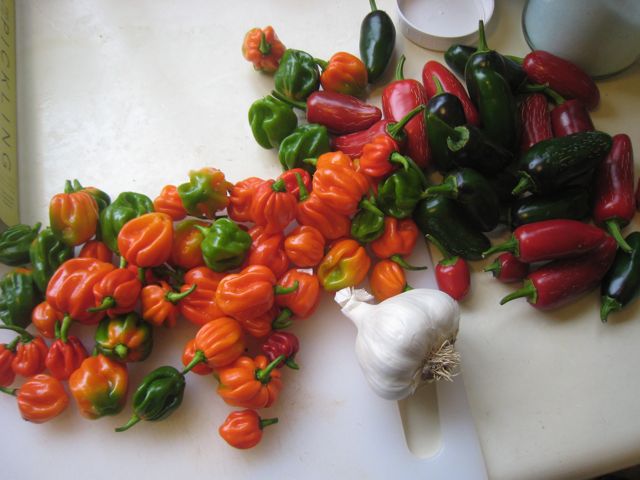
Habaneros and jalapenos—made a garlic chili relish for the people who like things HOT!
October means grapes around here, as well as the end of the apples and tomatoes. I made final harvests of our chili peppers and potatoes, and I’ve been carefully meting out my precious remaining plums and last batch of fresh salsa from the fridge. It will be many long months before we have any fresh produce from our own yard.
Final tally for food put-up to date: 333.5 pints! That’s a lot of jars, and the pantry under the stairs is stacked high — more boxes are stored in the basement. That also includes the preserves that will be part of this year’s holiday gifts to our friends — we love our tradition of exchanging homemade treasures. I look forward each year to planning what I will make to share. As my friends are increasingly good at humoring me by returning my jars, and the fruits/vegetables are generally free, the cost of these gifts “boil down” to sugar and pectin! (Ha — that’s a canning pun!)
The pantry under the stairs
Oregon’s many wineries are worried about a poor harvest this year, but our grapes had their best year ever. In addition to harvesting from our own vines, I was able to pick about 30 pounds of Concord grapes from our neighbor (the millionaire next door) and made J.D.’s favorite juice and jelly to welcome him home.
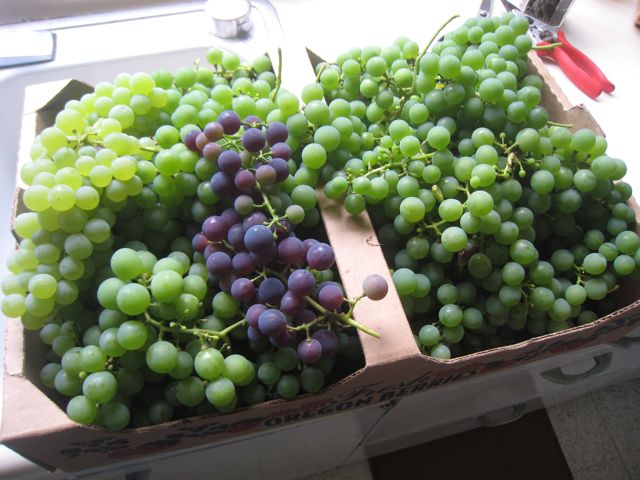
One part of the grape harvest—that’s about 10 pounds
Garden clean-up and harvesting totaled about six hours of labor for the month. Here are the numbers:
- Tomatoes: 4726 grams (10.41 pounds) @ $1.99/pound = $20.72
- Seedless and seeded grapes: 24 pounds @ $2.49/pound = $59.76
- Jalapeno and habanero peppers: 1151 grams (2.54 pounds) @ $1.99/pound = $5.05
- Zucchini: one! = $0.50
- Apples: 7.7 pounds @ $1.49/pound = $11.47
- Potatoes: 9.5 pounds @ $1.49/pound = $14.16
- Herbs (all summer’s worth: rosemary, basil, thyme, sage, & chives): $50
That’s a total harvest worth $161.66 in October with no out-of-pocket expenses.
Lessons for the year
Some of our crops this year were small (currants, blackberries), bringing our annual harvest value down. But despite that, this year’s overall profit is higher than for the other years we’ve tracked our progress. Why? First of all, our costs were very low this year — we’ve got the main garden infrastructure established and didn’t need to purchase many items. In addition, I was very selective in my choice of seeds and plant starts this spring. And perhaps even more importantly, our maturing plants are producing substantial crops of asparagus, apples, plums, and grapes.
I look forward to next year’s crops from these perennial plants, as J.D. and I have been discussing taking a year off from the vegetable garden of annuals in 2012. I’ll turn my attention to the somewhat neglected flower beds instead and we’ll enjoy eating the pantry down. I think I may have enough jam to last us until 2018!
2011 Totals
Here are this year’s totals through the end of October.

Final Word
This garden project is not a formal experiment. Kris and I are long-time hobby gardeners, and we have set ways that we do things. This year, we’re trying to incorporate some new ideas from GRS readers, but most of the time we’ll do things the way we have for more than 15 years.
We’re not trying to be 100% organic (though we are mostly organic through our normal practices). Nor are we trying to be 100% frugal. Instead, we’re trying to see just what our garden costs and produces based on our normal habits. We hope the results of this experiment will help us find new ways to economize and to improve our crops.

Become A Money Boss And Join 15,000 Others
Subscribe to the GRS Insider (FREE) and we’ll give you a copy of the Money Boss Manifesto (also FREE)
