How to Make Separate Finances Work: An Interview with J.D. and Kris

Published on - June 7th, 2011 (by J.D. Roth)
Every couple has its own way of managing money. Some folks share their finances completely. Some — like my wife and me — keep their finances completely separate. Most couples fall somewhere between these two extremes.
Writing for the June issue of Redbook magazine, Virginia Sole-Smith highlighted what she calls the new money rules for couples. Experts don’t agree on how couples should manage their money, Sole-Smith says. That’s because there’s no “one size fits all” solution. What’s most important is to find a system that works for you and your circumstances:
Clearly, the real experts are you and your partner, and it’s critical to find an arrangement that suits your exact situation, as pairs who bicker over bills once a week or more are 30 percent more likely to get divorced than those who squabble about it less, according to research from Utah State University.
Her article profiles four couples who have developed unique systems for managing their personal finances — including the laundry agreement Kris and I use.
Due to the nature of the article, Sole-Smith couldn’t possibly include all the info we provided when she interviewed us by e-mail. She had two paragraphs to explain our system, but we wrote over 2000 words. Rather than let all that info go to waste, though, I thought it’d be fun to share the entire interview here at Get Rich Slowly. This may answer some of the questions we often get from new readers.
Redbook
How old are you? What are your occupations? How long have you been married? Do you have any kids?
Us
J.D. is 42 and a writer. Kris, who will turn 41 in late June, is a scientist. We’ve been married since August 1993. We have three cats but no children.
Redbook
Can you give a ballpark figure for your household income and, if relevant, who contributes the bigger portion?
Us
Kris makes about $60,000 per year. J.D.’s income is too varied to give a meaningful answer. Sometimes it’s less than that, but some years it’s much more.
Redbook
I’ve seen on the blog that you keep finances separate. What was the inspiration for this decision?
J.D.
I’m not sure it was an actual decision at first. We dated — and then lived together — for several years before getting married. We both contributed equally to household expenses, but from our individual accounts. When something was out of whack — say, I wanted to eat out more often than Kris — then one of us would pick up the slack based on who was causing the increased expense.
When we got married, our system worked fine, so neither of us felt any pressure to merge finances. Plus, Kris didn’t like how I spent my money. She didn’t want my foolish expenses draining the money she’d worked hard to save.
Kris
I knew from the start that J.D. and I had different money skills and financial habits. Since we didn’t plan to make one spouse financially dependent on the other, it made sense to us that we were each in charge of our own salaries. Of course, major purchases were shared, but I could follow my “saver-tendencies” to prepare for a rainy day even during the years that J.D. was living paycheck-to-paycheck.
If I had felt that he was spending “my” money as well as “his” money, it would have been incredibly stressful for me. Now that he’s reformed his spending habits, there’s less of a reason to keep things separate, so the lines have blurred a bit.
Redbook
How does that work in practice? How do you decide who pays what bills? How many bank accounts do you have? Basically, what are all the nitty-gritty details of the day-to-day money management stuff?
Us
We each have our own checking accounts and savings accounts. We each pay some of the utility bills (we divided them up so they are roughly equivalent on an annual basis) from our own separate accounts, but when we were doing lots of remodeling on the house we had a joint account to pay the contractors. Kris buys most of the groceries while J.D. usually pays when we eat out. J.D.’s income is larger now, so he tends to offer to pick up the tab for more of the “splurges”. For day-to-day stuff, J.D. keeps a spreadsheet to show various expenditures and once in a while one of us will write out a check to the other one to even it out.
Redbook
How often do you talk about money and how much do you know about your spouse’s financial situation at any given time? For example, even though everything is separate, do you keep each other in the loop about the state of various credit card bills or payments sent? Or are things so separate that you don’t even know what the other person makes?
J.D.
I have a general idea of what Kris makes and a general idea of what she spends, but I don’t know the specifics. I have no idea what her monthly salary is — just her annual income. (And yes, I can divide by twelve to get a rough guess.) I’ve never looked at her credit card bill, and I’ve never checked to see how much she’s spending on anything. I trust her. I don’t need to check up on her. As long as she’s contributing her share of the household expenses, she can do whatever she wants with her money!
Kris
Pretty separate in terms of the day-to-day bills and expenditures but we have an overall picture of the other’s financial state. My mind is much more at ease than when he was struggling with debt. I feel free to mention it if it looks to me like J.D. is making too many impulse purchases, but he has become much more self-aware about his spending habits and triggers and monitors himself.
Redbook
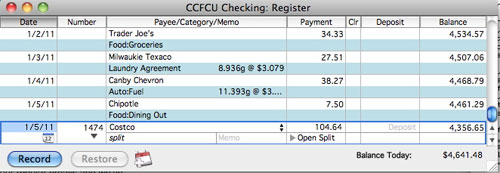
Of course, we want to talk about the laundry agreement. J.D., I already have your take on this from the blog post (unless there’s anything you want to add!) but Kris, it would be great if you could weigh in on how this works from your perspective.
Kris
I love it. I got to trade a task that I don’t mind at all (laundry) for a chore I hate (gassing up the car). Now if I could only get him to put his socks in the laundry hamper!
Seriously, I think all successful relationships have cooperation like this to some degree — ours is just more overt than some. In some families, one person does the earning while another runs the household. In others, one partner pays the bills while the other fixes the car. Why not make the most of the individual strengths to make life run more smoothly?
Redbook
Anything else super quirky or unusual about how you manage money besides the laundry deal?
Kris
To us, none of this seems quirky or unusual! I can’t imagine being in a relationship where one partner or spouse controls all the finances. We know couples where one spouse gives the other an allowance. That works for them. Our way works for us. Some people (commenters on the blog) seem to think that separate finances means that we aren’t fully invested in our marriage, but that simply isn’t true.
J.D.
Here’s another one related to the fact that I’m a slob: We have a housekeeper that comes in every two weeks. I pay for two-thirds of that cost, Kris pays for one-third. I think she’d actually like me to pay 100%.
Also, we used to be very anal-retentive about splitting grocery receipts. We shopped together, and after every trip one of us would sit down and itemize the expenses. What did I buy? What did Kris buy? Which were joint expenses? Whoever paid would then be re-imbursed by the other person.
We did this sort of thing with a lot of expenses, actually. But after we moved to a new house in 2004, things gradually changed. We didn’t merge finances, but we stopped being so detailed about balancing them. Instead, we sort of developed “bailiwicks”. That is, Kris started paying for most of the groceries, but I paid for eating out. Kris bought a lot of the household necessities, but I was in charge of entertainment. And the vacations we’ve been taking are funded by the money that I make during the good years.
Redbook
How do you think your financial arrangements impact your marriage? I think I saw something on the blog about how this ensures that you fight much less about money — how and why?
J.D.
Oh, I think this absolutely prevents fighting about money. I used to say that we’ve never fought about money — not once. But we had a fight a couple years ago about how much to spend on remodeling, I think. Still, the principle holds. Because we trust each other, and because we both uphold our end of the marriage, we don’t fight about finances. Now, this may just be because of who we are, but I think the separate accounts has a lot to do with it.
Kris
I’m the lucky one because over the years, J.D.’s money habits have grown to be closer to my own natural tendencies. He’s had to do the hard part of changing. J.D. and I each value our marriage, and each other, but we also value our own individuality and what makes us different people. We don’t have to overlap completely to love each other deeply. Our independence to make our own decisions (and mistakes) about our finances is mirrored in the independence we try to give one another in other areas as well.
Redbook
Can you imagine any scenario where you would want to handle money differently or merge finances to a greater degree?
J.D.
Good question. If it ain’t broke, why fix it? Maybe if there were some Big Life Event. If we were to move to another country — which we’ve talked about — maybe then we’d merge finances. Or maybe if one of us became gravely ill. Or if we planned to have children. (I’ve talked with folks who kept separate finances, but abandoned that once kids came on the scene.)
Kris
If we had children, we would have had to re-assess this method of money management. But I think I would have still wanted to have separate accounts, and also joint accounts for specific purposes.
Also, since J.D.’s salary has climbed much faster than mine has, if we want to take a major trip together, we’ll come to an agreement about what proportion each of us will pay. If I had to pay my entire share of 50%, we wouldn’t get to travel as much as we both would like. This is something that we’ve just started over the last year, and it still requires some mental adjustment on my part. In return, I try to help J.D. with his blog when I can.
We have separate retirement investments, and it will be interesting to see how that works out when we get to the age where we start drawing from them. At this point, we’re both where we want to be in our retirement savings.
J.D.
I agree that retirement is a big question. I suspect that we’ll need to pool our resources more when we’re finished working.
Redbook
J.D., since you write about finance and hear from readers on this all the time, do you think the way married couples are managing their finances has changed in the past five years or so? And if so, what are you seeing, and what are the factors at play (recession, more women working, etc)?
J.D.
I don’t think anything radical has changed in the past five years, but I think things have changed radically in the past twenty or thirty years. Yes, more women are working. There are more stay-at-home dads. Couples are seeing that sometimes traditional methods aren’t necessary for the modern world.
Tradition is fine if you value it and it’s useful; but it doesn’t make sense to cling to old habits just because “that’s the way they’re done”. I think many people in their twenties and thirties (and even their forties) recognize this, and they’re willing to try new things to see if they work. That’s a good thing.
This article is about Interviews, Relationships
SEARCH FOR RECENT ARTICLES


This sounds almost exactly like the way my husband and I manage our finances. At some point, we did get a joint credit card to put certain joint expenses on (groceries, home improvement stuff, eating out), but we each have our own checking and saving accounts and additional lines of credit. He takes care of certain utilities and I take care of others so that they roughly even out. It’s worked out fine for us, and I can’t ever remember having a fight about money, either.
loading....
Neat interview!
We’re a one-pot couple. http://nicoleandmaggie.wordpress.com/2010/08/17/couples-and-finances/
We have never ever fought about money.
loading....
We are 100% joint and have never fought about money also.
I track the money, DH is SO GOOD (!) about asking if we have money available for purchases. I know that our system wouldn’t work for most people–I have an amazing husband.
Our system is based on compromise though. If he asks for things we can’t afford I try to make a way to move things around in our budget so that at some point we can do the thing or get the thing he wants.
We each get $15 every Friday to do with as we please.
loading....
Interesting. We do things completely separate too, but the day to day is a bit different. I track everything for both of us, so know more about our spending and assets than he does. He’s just not that interested as long as he’s saving a decent portion of his income. He pays the rent; I pay everything else. We use the same credit card for the reward points. Since I track everything anyway, I just figure out who owes who for the month and we write a cheque out.
He’s a bit more picky about fairness – he wants to pay me back for small amounts that I could care less about. If we eat out or for groceries, I count it all as 50/50 even though he eats more than me. That kind of little stuff just doesn’t matter. Separate things are purchases that only one person gets any use or enjoyment out of.
For things like prescription meds that can be expensive, we consider them joint, since it’s not an optional thing. You don’t chose to get sick.
We never fight about money and can work as much or as little as we want, as long as we’re paying our share. Our incomes have been comparable so far, so if there was a large difference, we’d probably adjust the percentages.
We’d combine money more if there were kids, if one person couldn’t work due to health issues, or if we moved for one person’s job and the other couldn’t find employment right away.
I can’t imagine doing things differently. Like Kris, my husband’s spending habits would bug me if I felt like it was my money he was using.
loading....
If we were joint I’d be like your DH. That’s how I am with friends borrowing money or treating. I want to treat them for an equal amount next time…
I can’t help it, I think it’s a neurological problem.
loading....
It’s so interesting to hear how other families do their finances.
We have joint everything, but then I’m a stay-at-home mom so I don’t have an income myself. We do each have “fun money” in the monthly budget that we can save and spend as we wish without discussing, otherwise we make all decisions jointly. We haven’t ever fought about money. Thankfully even before we married we had similar views on finances, and our views have evolved together during our marriage.
loading....
We handle finances very much like you. It’s worked well for us for 28 years!
loading....
I’m a freelancer and a SAHM, so right now, DH is the main breadwinner. We have joint everything, too, but it works for us.
Money is such a complex, personal issue, and there’s no real one answer that will work for everyone!
loading....
This is what we do too although its me who works and my husband who has been in school/job hunting. We had a few money fights until we hit on the “fun money” idea. We have his fun money, my fun money and our fun money (for date nights).
loading....
We keep separate accounts, but our approach is inverted. We both have our salaries paid into a joint account, and immediately transfer an ‘allowance’ into our respective personal accounts. That allowance is used by each of us for individual expenditures (e.g. martial arts classes and expensive shirts for me, dance classes and ornaments for her) or we can invest it individually. Everything else – mortgage, groceries, bills, eating out – comes from the joint account. Anything left in there at the end of the month goes into mortgage overpayments. This way, we both get to spend some of our money without being accountable to the other, and don’t have to spend time working out who owes what for last quarter’s gas bill.
loading....
This is pretty much what we do as well; I’m the breadwinner and my husband manages the finances day-to-day (he’s a freelancer and has more flexibility than I do). We each get an “allowance” as well.
So useful and interesting to see how others do it!
loading....
This is how we handle our finances, too. Works for us!
loading....
Joint account—-BUT we keep our own overtime and allowance
Mine is spent on our trips (like Kris- without this my husband would rarely travel)
His is spent on wood working for the house!
loading....
This is very, very tangentially related… Kris is a scientist? What kind of science?
I don’t think I knew this (or if I did, I am getting evermore forgetful).
loading....
Kris is a chemist. I’ll let her say more, if she wants to. She used to teach high school chemistry and physics, but now does other work. Yes, she’s coy about the nature of that work, but for good reason.
loading....
but redbook named her workplace!
( i’m in her industry….)
loading....
If she’s a chemist, how come you guys don’t like to make home-made detergent, soap and shampoo like Trent does?
loading....
Chemists don’t bring their work home.
That’s why I don’t cook- all these
Instructions n measuring stuff n temp control
is too much like science work.
loading....
Our system is very similar to yours, and it works great for us. We periodically take a look at the household expenses and divide up the bills proportional to our income. For example, I pay the electric bill, and my husband pays the cell phone bill. I think we both like being in charge of our respective “domains”, and it keeps us both active and engaged in what’s going on with our finances. We do have one shared account for our emergency fund, but we try not to touch it other than to make our monthly deposits.
loading....
My wife and I share our finances completely, in fact we were just discussing couples who don’t a few weeks ago.
I have to admit even after reading your post I am still confused. I genuinely want to understand your viewpoint but I’m having troubling reconciling your comments with any definition of marriage I’m know of. You write that it would stress you out when “he” spent “your” money. When he shoulders more than half the cost of a large expense you feel indebted to him. These ideas are antithetical to the concept of marriage which entails the joining of two people into a single entity where they are mutually dependent on and responsible to the other.
I don’t mean to offend you with my questions, I really do want to understand better because yours is an increasingly common viewpoint. To me, however, your relationship sounds simply like two people living together. How is your relationship fundamentally different than before you were married? By the way congrats on 18 years this summer!
loading....
No worries, Bill. I’m not offended by your question. I’m sure Kris will chime in with her own answer later, but my basic response is: Marriage is not just one thing. That is, your definition of marriage differs from my definition of marriage, which differs from another person’s definition of marriage. Right? So, you’re using the system that works best for you, and we’re using the system that works best for us. Our system wouldn’t work for you because your definition of marriage is different.
loading....
Hmm…I don’t think you can say that marriage is “defined” one way for one person and another way for another person. It is a word, and it has a meaning. If we don’t agree on the meaning, it is useless to have the word. In this case, we need to agree on a meaning that is generic enough that it properly encompasses the way most people understand the concept, without being so generic as to be rendered useless.
loading....
This is probably beyond the scope of this blog but that’s sort of the question I was trying to ask Des.
What definition of marriage would allow for independent financial lives and yet would still have meaning? I don’t understand how that situation is different from two unmarried people simply living together. I’m not saying there isn’t a difference I just don’t know what it would be. The only thing I can think of are various legal protections afforded to spouses.
I’m really not trying to be difficult but what is the difference between a couple before and after marriage if they don’t integrate their lives in an area as basic as finance?
loading....
My husband cares about spiders. I want to squash them. In our marriage, we agree that he will be 100% responsible for removing them safely, so that I don’t feel threatened. I on the other hand care about having more than one cat while he would rather we didn’t. So I am 100% responsible for taking care of the cat box. My husband does the laundry, I do the scrubbing of the bathroom. We split those chores up and both of us begrudgingly do the dishes. These types of “minor” negotiations and agreements are pretty much a standard part of being in a healthy relationship.
When it comes to finances, they are just as much of a chore. There seems to be a tendency to conflate the *system* of having multiple accounts and splitting bills, which is really just a method for dealing with the chore of paying bills, with the higher level issue of how a partnership/marriage functions. Power issues about money are destructive to any marriage, whether it’s refusing to allow a spouse to withdraw a negligible amount from a joint account, or whether it’s refusing to help a spouse financially from a separate account. But the issues in both those cases are less about the methods either couple uses to pay bills, and more about money being used as a form of communication and/or domination within the relationship.
loading....
Well said Nancy, I agree with you completely. I think I wasn’t as clear as I should have been in my comments. I don’t want to get hung up on semantics. If a couple keeps separate accounts because it is practically simpler I have no confusion about that, that’s great.
Your post said it better than mine, what matters is not wether you call your accounts joint or separate but whether at a high level you are willing to share the burdens of your spouse. I took away from the interview that this was not the case which is why I asked the question.
loading....
This is such a fascinating discussion. I have the same question as Bill. J.D., you feel open to discuss,and I agree that everybody defines marriage differently, but I’m just curious about what your definition of marriage is.
The concepts of “mine” and “yours” in a marriage confuses me–particularly when one goes thru a grocery receipt to find whose food is whose. I totally get dividing chorse based on what each spouse likes/dislikes. (I do lauundry and dh does dishes) but I don’t think I’m doing “his” chores when I do dishes because he’s sick or working late that night.
I understand that sometimes reality requires seperate accounts. My dad has seperate finances from my step-mom because they want to make sure assets go to their children if one dies. My mom will keep seperate assets from her husband if she remarries because she has significant assets that she gained prior to the marriage and needs those assets for her retirement. Of course, in those situations, they made that decision based on concerns of dividing the property in case of death/divorce.
I’m just confused as to seperate finances for couples that are creating a life together, unencumbered by prior children, prior debt issues, or retirement concerns. It seems like SO much work, having to keep a tally. (We use comingled funds, with each of us having the same amount of “play” money. I don’t give him money or v/v.)
Seperate accounts seems like such a risk where the couples don’t earn the same income. The person with the highest income will be able to save more for retirement, but then, if the couple is thinking in terms of “mine” and “yours” for the entire course of the marriage, the partner with the cushy retirement fund may start feeling resentful if she is paying out more because retirement many times comes with unexpected expenses like health issues. The person with less in retirement may not be able to pay for both personal medical expernse and living expenses.
In my situation, I make a lot more than my husband who teaches high school. We pool money and make enough to live a life that we’re happy with, but he can’t save much on his salary and pay half of expenses. He’d make even more than me if he wasn’t teaching, but he is a teacher at heart–a noble calling IMO. It doesn’t seem like seperate accounts could work for people who have significant differences in their salary.
I guess my initial thought was always that seperate accounts makes it seem like the couple is planning and ready in case they divorce, similar to prenups. I also think there is a false seperation. If K was concerned that you were too foolhardy with your money, having seperate accounts meant that she didn’t need to talk to you about the issue, but if she had, and you realized, maybe you could have saves more money sooner for a downpayment or used it in other ways to benefit your family situation. For me personally, having joint accounts leads to more accountability bet us–a wonderful strength. I don’t need to rely on my willpower alone when there is that item that I absolutely want to have.
loading....
To expand upon your point, I agree that it creates a feeling of “separateness” in the relationship. My ex and I split finances when we first started living together. At the time, our salaries were fairly commensurate, and things worked out just fine. However, we relocated for his job, which involved me giving up (both!) of mine. At first we thought I’d be able to find work again without a hitch – but it was ten months before I was employed. This put an impossible strain on us. We hadn’t appreciated the realities of how a 50/50 system would work when one of us wasn’t working. Ultimately, our inability to find financial common ground once the playing field changed was a substantial factor in the termination of our relationship.
The upshot of this experience was that it’s made me think long and hard about the 50/50 model and the difference between a “yours and mine” lifestyle versus an “ours” lifestyle. When life changes, your financial model has to be able to change with it. If you opt for the 50/50 split, just make certain that you and your SO have a Plan B if life starts launching lemon grenades at you.
loading....
My husband and I have a joint account, but if my husband started spending more than what I feel is fair and it compromises other aspects of the our relationship, our ability to retire and save, yes I would feel worried and stressed (especially if there were children involved). Just because you are married does not mean the other partner is given a free pass of expectations or responsibilities. I don’t understand why you feel that is a necessary component of marriage. Marriage is full of compromise and negotiation, especially when there are shared financial goals.
loading....
Oops! I didn’t mean to imply in anyway that a spouse is given a free pass from expectations or responsibilities. I meant the exact opposite! Because our finances are completely shared we each have a greater responsibility to each other to not use them in a way that harms the other.
If my wife liquidated our savings account I would be stressed out too. But I wouldn’t marry a person like that, I trust my wife completely to not take advantage of me in that way. If I didn’t trust her to that extent I wouldn’t have married her.
I guess that’s my question. Why wouldn’t you share your finances with a spouse? The only reason I can think of is to protect yourself from their poor use of “your” money, because you don’t trust them. If you can’t trust your spouse to not misuse your money can you trust them as your lifelong companion? Can you trust them to raise your children?
My confusion arises not from the question “Why wouldn’t you share your finances as a married couple?” but “Why would you get married if you aren’t willing to share your finances?”
loading....
I trust my husband completely. I know we share similar values, dreams, and long term goals. However, I don’t need to know every minute detail of his spending and he doesn’t need to know every minute detail of mine.
loading....
Bill, in my marriage one of us carried in a situation with the IRS from the past. We keep things separate so that the non-IRS spouse isn’t affected. To do otherwise would risk losing real property should the IRS get shirty with the non-owing spouse.
It’s not always so black and white as not being willing to share.
loading....
My level of risk-taking nearly gives my partner a heart attack. His blindness to opportunity cost makes me insane. If we were jointly managing all our investments, we would fight all the time – he literally wakes up at night worried that his stocks are going down, despite being 30 years away from retirement.
So we each have our own stock investment accounts, our own 401ks, and our own Roths. We had them before we hooked up, we manage them separately now.
It’s not that we don’t trust each other – I have all his passwords, I *could* log in to Fidelity and withdraw all the money. But I’m not enough convinced that my money management style is more right than his to demand that he conforms to it, or put the emotional effort into reaching a consensus on our investment strategies every year when I rebalance.
loading....
Personally, my husband and I have separate accounts because it makes it simpler to reconcile the accounts. I do my spending, he does his. I budget for me personal savings, goals, and expenses, he does his. Joint expenses, savings and goals are negotiated just like a couple with joint accounts would. We mostly split things 50/50, but not if it doesn’t make sense.
The fact that you question why to get married if you’re not combining finances, makes me wonder what you think a marriage is. My husband and I made a commitment to spend the rest of our lives together. What on earth does that have to do with my having a checking account in my own name? How is that any different than my having my own car? Or my own computer? Or my own socks? It’s just stuff that I use. I let me husband drive my car, but we still call it my car. I sometimes borrow his computer. The fish tank is “his”. The piano is definitely mine. It’s all just stuff. If he wants to use something that’s “mine”, all he has to do is ask, and “my money” is no different.
I married him, and I’ll share my life, my stuff, my money, and everything else with him. I’m still going to reconcile my own spending though, because a lot like laundry, it’s just easier if I put my stuff away and he does his. Or does that mean we don’t love each other too?
To answer another of your questions, here is my personal definition of marriage: An agreement between two people to love each other and share their life together (forever) before whatever higher power they believe in. My husband and I often refer to our wedding as a celebration of our marriage rather than the event itself because we were entirely committed to each other for about 7 years before we finally married legally. We don’t believe the legal stuff is anything but just that….legal stuff. It has nothing to do with our marriage, which is a personal thing between ourselves.
loading....
The way I understand it, a marriage is a union of two people who share their lives and hopefully love each other. How the work, chores, bills, etc. are divided is irrelevant and has no impact on the legitimacy of the marriage. Each couple needs to figure out what works for them.
Why would a couple be more or less “married” if they split up some responsibilities and share others?
Money is emotionally loaded so it is hard for some folks to extend the concept to finances, but think about other chores or tasks like laundry or dishes. Are you only married if you share in these tasks equally? What about personal space? Is a couple not truly married if the husband has a “man cave” or a similar space he doesn’t share? What about long distance relationships? If, for some reason, you had to live apart from your spouse for some time, would you not be married because you’re not living in the same space?
loading....
The “what is marriage” thing ALWAYS comes up when J.D. mentions his financial arrangements.
Here’s the thing. There IS NO one definition of “marriage.” As a legal construct, in the USA “marriage” is different from state to state, and elsewhere it is different from nation to nation. As a religious construct, “marriage” is different from faith to faith. Even within faiths, “marriage” is different depending on what sect you follow or what Bible you read, or whatever.
Personal financial arrangements may be part of how you define YOUR marriage (that is a general “you,” not specific to any commenter) … or they may not.
Trying to understand someone else’s definition of marriage is, if you have a very strong personal definition for it yourself, difficult to impossible – because there are going to be too many points that are irreconcilable.
Most of us simply fall back on our own strongly-held positions when we fail to reconcile opposing viewpoints – we don’t really try to understand, we try to convince.
There are a lot of people who feel very strongly that, absent complete financial union, a “marriage” is somehow invalid. That is a FEELING, people – an emotional response. And it’s entirely, unequivocally subjective.
loading....
I am not trying to convince anyone Chacha, I really do want to understand your point of view.
It’s obvious from my comments that if my personal marriage did not entail a financial union I would consider it to be less meaningful. It’s also obvious from the number of posts and strong opinions of others that many don’t agree with me. I respect that completely, people can disagree with me.
Many people are saying that financial entanglement is not a necessary component of a successful marriage. My question is simply, “What are the necessary components?”. I’m sure they exist and are highly varied. Arguing about what a marriage isn’t doesn’t get the discussion very far, explaining what it is would go a lot further.
loading....
I apologize again for not writing clearly SF, this internet commenting thing is harder than it looks. I never said that finances need to be shared “equally” only that they should be shared.
Your hypothetical couple that insists on sharing the chore of laundry equally is more analogous to a separate financial account system. A husband who wants a “man cave”, a couple where one kills spiders and the other doesn’t, and a couple with a joint financial plan are all similar examples. I agree completely that it is irrelevant how those are divided, as long as both partners acknowledge that they are joint responsibilities of the couple.
I understand completely if a husband pays the mortgage and the wife buys the groceries. I don’t understand a married couple where the wife comes home from grocery shopping with a $200 receipt and asks the husband to transfer $100 to her account. That’s the nature of the relationship in the original interview as I understood it. I’ll reread it perhaps I interpreted it wrong.
A perfect example is my cellphone. I have a free flip phone that costs $20 a month, my wife has a $200 Iphone that costs $60 a month. I don’t feel that my wife “owes” me $20 a month because she gets the nicer phone. We pay jointly for it because she enjoys it. To split the inputs and outputs to and from our marriage exactly evenly would negate the meaning of marriage. I just want to understand the other point of view.
loading....
“I never said that finances need to be shared “equally” only that they should be shared.” But the example you give at the end of that comment indicates otherwise.
Your wife paying more for a more expensive phone plan is still “sharing expenses.” My take on your comments is: you’re looking for spouses not to be concerned with whether or not the other spouse spends more or less money, not that both spouses are involved. Not everyone’s spouse can be trusted to make good financial decisions when money is accessible.
I know married couples who don’t live together. I can’t imagine a marriage like that, but it works for them. They’re not any less married than I am.
(FWIW, my husband and I are 100% joint and have very few quibbles over money, but I don’t think it’s the only way to go.)
loading....
I’m not sure how the quote you give and my phone plan example are inconsistent. I contribute 2/3 of our income and my wife uses 75% of our cellphones, that is a unequal sharing of expenses. I am absolutely looking for spouses to not be concerned when the other spends more or less money as well as both spouses being involved in their finances. If your spouse can’t be trusted to make a good financial decision when there is money in their pocket that’s perfectly fine! If I had little willpower to resist frivolous spending I would forfeit my credit cards and ask my wife to control my access to cash. In that way I would prevent her from having to be concerned with my spending too much money. If we both couldn’t resist then we’d put the cards in a block of ice in the freezer and implement a strict difficult to break budget, again so we wouldn’t be spending in a way that would concern the other. That arrangement would demonstrate extreme involvement between two people.
A married couple that chooses not to live together is different from those that do. They may still be married but they certainly are less intimately involved than you are. I am assuming we are talking about a permanent decision to live apart not a temporary situation. If they choose not to live together what is the point of their being married? You have given a negative definition again “Marriage does not require you to live together”, I’m looking for a positive definition. If it doesn’t require you to live together what does it require?
The only positive definition I’ve found in these comments is “a marriage is a union of two people who share their lives and hopefully love each other”. This is not a valid definition, however, two unmarried people could say the same thing about their relationship. In order for “marriage” to have any meaning it must be that it entails something above and beyond what is available to a couple of unmarried people. The only positive definition is the legal one I suggested earlier. If marriage is simply a legal construct to you, that’s OK. No one seems to be willing to say that, meaning they believe it is more than that. I’m simply trying to understand what is that “more” part?
loading....
My point is that you said you never said partners needed to be equal, just involved, but splitting bills according to use *is* being involved. Having completely separate bills would not be.
The only “this is what marriage IS” that might be consistent for all married couples is “two or more people who have gone through the religious or secular procedures to be considered married within their faith and/or other community.”
What else is the same? Not everyone is monogamous. Not everyone lives together. Not everyone shares money. Not everyone eats the same food. Not everyone has kids. Not everyone enjoys the same activities or has common friends. Not everyone shares a bed. Not everyone is opposite sex. Not everyone is in love. Not everyone even *likes* each other. Not everyone knows each other before they’re married. Not everyone gets to choose their own spouse.
I know what marriage is *for me* (and my spouse), but who I am to say that that’s what it *has* to be for everyone else, or it’s not a marriage?
“If I had little willpower to resist frivolous spending I would forfeit my credit cards and ask my wife to control my access to cash. In that way I would prevent her from having to be concerned with my spending too much money. If we both couldn’t resist then we’d put the cards in a block of ice in the freezer and implement a strict difficult to break budget, again so we wouldn’t be spending in a way that would concern the other. That arrangement would demonstrate extreme involvement between two people.”
It would also demonstrate a recognition of a problem, an understanding of what the problem is, an understanding of some ways that might help to fix it, and a desire to fix it. I used to agree with you that it was just that simple, but I’m learning that it’s really not. It’s a lot like eating healthy and exercising: everyone knows you’re supposed to, but not doing it is not a sign of anything in your marriage — it’s a personal thing. It might affect your spouse and/or your marriage, especially if they’re the opposite, but if both people are sedentary junk food addicts, it’s not going to cause any problems until one/both of them get sick from it. If both are healthy athletes, it’s not going to cause problems. If they’re different, there are things to work out. Same with finance.
loading....
I see what you are saying and it depends what you mean by splitting a bill. If we both go to the grocery store and I pay for the food then later at home you pay me back. That’s not splitting the bill. That’s the grocery store ringing up two separate bills on one receipt and us rectifying it later.
Clearly to you marriage has simply a legalistic definition. If you have a marriage certificate then you are married. That’s a fine way to define it, it’s a consistently applicable definition. I accept that’s how many understand it. But a simple legal definition of marriage does not mean that a higher form of union between two people does not exist. If you want to call the complete and permanent joining of two separate individuals into one entity through a public legal and social contract “marriage++”, “a way for dysfunctional people to legally and religiously ensnare codependent people”, or any other term you can.
I’m not saying everyone can or should join together that way or that there are not valid relationships between people that don’t go so far. But that total union does exist, whatever it’s called, and it is most certainly differentiated from a simple legal marriage.
loading....
No, that’s not actually my definition of marriage at all. You asked for what marriage *is* and what I gave you is, as far as I can figure, the only positive definition of marriage that would include all marriages that exist. Are all of them good marriages? Certainly not.
To say that people who don’t have a marriage like yours aren’t really married or don’t have a real marriage is very narrow-sighted and lacks an acknowledgement that not everyone is like you.
Just having joint finances doesn’t make people unified and just having separate finances doesn’t make people not unified.
loading....
“To split the inputs and outputs to and from our marriage exactly evenly would negate the meaning of marriage.”
….of YOUR marriage. Not mine. That’s just splitting up the financial burden of needing to eat. My marriage has nothing to do with money. It’s about love and sharing and encouragement and support and growing and all that good stuff. Money is just a means to an end.
loading....
I enjoyed reading this interview. Whatever works.
We’re a one pot couple and I handle all the finances. We’ve also never fought about money and have picked up each other’s better money habits over the years.
He’s always been more willing to search for a bargain for larger items while I might have been inclined to just buy something we needed to get the shopping over with. However, I’ve never bought nearly as much stuff as he and have always been much more mindful of the latte factor.
Two decades later, now I also search for a bargain while he packs both a morning beverage and a lunch.
I think we’re starting to look alike too.
loading....
I found it pretty interesting that none of the 4 couples profiled in the article had 100% shared finances. Does that mean few people share fully anymore? Do all the “we share finances” people have their own “fun money” or whatever they call it? We do – we generally share everything, but we have one exception from that rule.
loading....
My wife and I do the 100% shared arrangement. We have two joint checking account and one joint savings account. We have three credit cards that are all joint accounts. We both work full time and I make approximately 2/3 of the household income.
We don’t budget any “fun” money. If my wife wants to buy something I trust her judgment that it is a wise purchase and she is free to do it with whatever account she wants. She trusts me to do the same. If I weren’t sure about a purchase I would discuss it with her first.
The only time this has ever been an issue is when we are buying each other gifts we want to be a surprise. In that case I’ll ask her to not look at a certain credit card balance for the next month or two.
loading....
What’s your exception?
loading....
We’re 100% joint. The exception is if one of us picks up a little money from a side gig ($50 or something fairly small), we can just keep it to spend on whatever we’d like or donate it to the pot. The exception to the exception is if we have significant expenses that are recently coming or going, it goes into the pot.
loading....
I like your intentionality! and the way you’ve let your habits evolve, rather than stay rigid. My husband and I pool our money, yet what our marriage shares in common with yours is mutual respect and healthy, responsible finances.
The goal in my view is to have a joyful marriage or relationship at the center of your life — and a financial arrangement that support that. I don’t think it’d work to knock yourselves out having finances that are perfect down to every detailed penny, and then a marriage or relationship that’s in effect secondary or ‘on the side’. Money is important, but people are more important . . . . money serves us, we don’t serve it.
I have an M.S. in counseling psychology and also a failed marriage under my belt; the latter probably made me smarter than the former. For tips on having a joyful, sustainable marriage, try
http://www.diamondcutlife.org/diamond-cut-sustainable-marriage/ Hope it’s helpful.
loading....
Hi Alison, do you have to spruik your blog every time you post? It does getting a little tiring seeing these spam links.
loading....
If you’re married I’m not sure it makes any actual difference how you deal with your money.
A person may feel like she is dealing with her different money styles by keeping her finances separate, and one person may like saving money while the other person likes the freedom of spending it, but you literally are spending each others’ money anyway.
If you split up, the court determines who gets what–and it’s all considered “marital property” if you earned it while married. It doesn’t matter if you were a saver and your partner wasn’t, it doesn’t matter if you kept your finances separate or blended them, and your 401K balance, job prospects, and future retirement benefits are all taken into account.
loading....
Actually, in most states, the assets are split in a divorce based on if they were acquired individually before the marriage or together during the marriage. In Virginia, all assets acquired individually prior to the marraige (car, house, savings, 401k, valuables) below soley to that individual. Only assests acquires during the marraige are divided.
loading....
I think that is what the previous comment said. (“it’s all considered ‘marital property’ if you earned it while married.”)
loading....
To me, the difference is the motivation. When one person keeps spending so long as there is money in the account, the fake borderline between that person’s money and the spouse’s serves as stopping point on the spending. That allows the other spouse to also be able to predict and budget the other part of the money.
loading....
I agree with KM. Sure, whatever works for you, but I don’t think your money is ever truly separate if you are married.
The issue isn’t just relevant in the case of a split – what if one person has enough to retire and the other doesn’t? Same thing with vacations. Does the “saver” go on a nice holiday while the “spender” does a staycation? How exactly does that work?
loading....
Just to add to my comment – I don’t think that the success of a couple is determined by having separate or combined finances.
I believe that if the partners are (at least somewhat) on the same financial page and the family finances are in good shape, there will be less (if any) money arguments. In that case it won’t matter how the accounts are set up.
loading....
Unless, of course, one spouse cleans out the joint account and takes off, which happened to my aunt. She was left with literally no money.
loading....
Ours are separate too, and that has caused many raised eyebrows (“It’s like you’re already planning the divorce!” is one thing I’ve been told). It’s great to see so many commenting that are doing the same thing.
loading....
Well, that comment is made in ignorance, anyway. Because during the divorce, actually, the money and assets that were acquired during the marriage are divided right down the middle. (The exceptions are inheritances, gifts to one of the parties, and assets acquired prior to the marriage.)
So it doesn’t matter how separate you keep your finances, it wouldn’t matter in the event of a divorce, anyway (unless you have a pre-nup).
loading....
This varies by state, folks! Not all states are community property states (although most Western ones are, Oregon is not). Check the law in your state of residence before relying on the principle to protect your interests.
loading....
We’re a one-pot family, as well. I’ve worked at various jobs, but never at a salary that is more than 1/4 of his. When I’m working, that goes almost entirely into savings (the almost is the extra clothes and other costs associated with working).
I handle all the money and try to keep him informed at least quarterly on some aspect of our finances! This works for us because we are both not spenders and so far we’ve raised thrifty children as well. That is, they’re happy to have us buy them things, but when it comes to their own money they are totally focused on getting the best price, saving ahead, or doing without!
We don’t fight about money — not sure what that would even look like, to be honest. If it seems like some part of our budget is growing out of proportion, we’d talk about why that is and what we should do about it.
loading....
i’ve always found it interesting how guarded JD is as to how much money he makes off this site. I don’t really care, just found it interesting considering how open he is with all other aspects of his and kris’ finances.
loading....
In an ideal world, I’d talk about how much revenue the blog generates. In fact, I used to do this. But eventually my wife, my lawyer, and my accountant all told me, “Stop!” So, I fight my inner nature, and keep that info private. I want to tell, though.
loading....
Can I ask *why* they wanted you to stop? It’s not like you’re going to get fired for revealing company secrets or something.
loading....
Especially since he ball-parked his wife’s salary for the redbook article.
If both his accountant and lawyer are telling him to stop, then I’m pretty sure it might be an IRS issue. If he starts listing his revenues, it could be ammunition for the IRS if they were interested in auditing him. I’d hate for JD to get dragged into tax court and have his blog posts used against him as evidence.
Because his income is highly variable, he could say “in good months, I make $X” but if he reports $.5X on his returns, they just might want to double check that his “math” is right. For a small business, that is no small task I’m sure.
Even if he’s in the right, if the IRS wants to ask questions, he’s going to have to pay up big time for his lawyers and accountants to represent him.
So sound legal advice might sound like “You have the right to remain silent. Anything you do or say can and will be used against you in the court of law. You would be wise to assert that right.”
loading....
Interesting article. We were also a one pot family for twenty five years. While I “did” the money, no one controlled the finances. I was just the person with the more patience in sitting down and doing the paying andthe paperwork. for us at least, one pot was easier. I would say from your description that you folks spend a lot more “time” on finances between you than we ever did as a one put family-but that may be personal style
loading....
interesting interview! we’re in-betweeners. he brings home the majority of the bacon, but i contribute a pre-determined amount every month to cover my rent and his extra fees for adding me on to his insurance.
whoever is closest to the grocery store gets food. the utilities come out of the rent check, and we handle our own cell phone and other personal bills ourselves. i also like to think that i keep the place tidy in exchange, but let’s not go too far
in a previous relationship we split bills to the penny, but it was exhausting and frustrating. i much prefer the “we’ll cover each other” theory. i also have a zillion little accounts everywhere that i like to keep just so, and he’s a one-checking-account kinda guy, so i think it’s easier to keep them digitally separated.
we do have a joint account, we needed one for me to get on his insurance and with it we are pooling our spare change in a can to buy a couch. teamwork!
loading....
I believe that what works between spouses is the best for them. I worry about separate finances because there are so many places where I think they can cause problems:
Income inbalance between spouses (including stay at home parents or job loss)
Kids
Low discretionary spending (the lower this is the more fighting about how it is used)
Retirement
loading....
We have 3 children ages 11, 7 and 5 and actually find it easier to have separate accounts because sometimes a month goes by before we can talk about where we’re at with our finances. Oftentimes when we’re super busy during the school year and I get hit up for lunch money (we put $100 or so at a shot into their lunch account), piano lesson fees, scholastic book orders, state wrestling T-shirts, etc., etc., as the kids and I are walking out the door and my husband has already left for the day, you can bet it’s a lot easier to know where I’m at with my account and how much I can allocate for all the extra “kid” items than if we were sharing an account and not touching base as often as we’d need to!
loading....
My wife and I operate the same way – although all of our accounts are “joint” accounts with both of our names on them – her accounts are separate from mine (we use different financial institutions so this is really very easy). We just don’t write checks, use ATM cards, or open mail from each others accounts. This works well for us because her accounts are in the small town that we live in, while my accounts are mostly in the larger city that I work in, so 98% of the time we have a bank, CU, ATM very close to us no matter where we are.
I can’t tell you how nice it is to hear someone else say they do the same things. All and I do mean ALL of our friends think we are weird for handling our finances this way.
loading....
Our ways are pretty similar.
And it was my choice from the beginning, my husband didn’t mind and, I think, had never even thought about it. But, I was a bit concerned about his spending habits and didn’t want to be thrown into dangerous waters.
In the long run, I believe that our system has made my husband A LOT more careful and mindful while I’ve also loosened up and learned to relax with the occasional splurge.
I know where my every cent will go, he is happy with a more relaxed approach. It took us a few years to get there. And a lot of criticism from friends and family. But I knew that it worked so we didn’t listen!
Our goals, though, don’t necessarily coincide. For instance, I’d prefer to save more and spend more on finishing our house while he prefers to travel and go out more often.
We try to do all of the above, just not all at once, and it seems to work.
loading....
When we first got married, we pooled our money together and DH took care of all finances. After the first child, we decided I would be a SAHM while he worked. Unfortunately, I did not receive any allowance and was not able to make purchases of any kind for myself. So, I got a PT minimum wage job on weekends. DH became upset that I purchased clothing for myself. I kept my job after the second child. I still continue working and have taken on some bills as well. Since DH lost his job, I have now gone full-time for benefits. DH doesn’t complain as much as he used to. But we both have separate checking accts now and a joint savings.
loading....
This doesn’t sound like a good solution – you are getting the short end.
loading....
I’m sorry you’re in this situation. It doesn’t sound like a good compromise. I’m basically a SAHW and I track the finances and know where we’re at. Since I have more free time I feel like I spend most of the money!
loading....
We are a one pot couple out of necessity-my SO hates *HATES* to deal with/think about $-he grew up in a house where any discussion about $ were seen as shameful. Plus he has the most…ok I’ll say it-stupid- ideas about $ and retirement. The last time I tried to get his input as to whether to add more to our IRA or increase 401K he said to me straight faced ‘we should buy Spider-Man #1. It’s worth like 30K now-it should be worth a MILLION when we retire! We would never have to worry about a thing!’ At that point I took away his check card and he now carries cash.
=)
loading....
HaHa! This sounds so exactly like my husband! He looks at the bills and looks at the money and sees no relationship between them at all. Before we were married, he spent his entire rent money on Furtwangler’s recording of Wagner’s Ring Cycle, and then lived on hotdogs and dried soup for two weeks until his next paycheck.
I took over paying the bills shortly after our marriage and have been doing it ever since. All of our accounts are joint, but he only writes about three checks a year (usually related to a dog or two), and has been known to fall asleep in his chair rather than discuss our finances.
He is a lot of fun and after all these years still makes me laugh. I actually enjoy paying the bills and figuring things out, so we are well matched.
loading....
That’s what DH would do before we were married! Spend on whatever he wanted and live on top ramen. I started tracking our budget as soon as we were married. It was natural since I’m an accountant by trade. He did have close to $10 k debt, some no doubt related to courting and engagement, but we worked it down to nothing and now we save. =)
loading....
My first husband was very irresponsible about his spending, so we kept separate finances. Obviously that didn’t work out very well.
My current husband is really good with money, but doesn’t like to be bothered with admin stuff so I manage our finances. We are both frugal, so we spend what we spend and reconcile at the end of the month. If there is a big expense we discuss it.
We have only ever had one area of our financial life that we fought about regularly, support for certain family members. Our ultimate decision to manage this is to create a separate account to which we make small monthly deposits. My husband’s is the only name on it, and can use those funds at his discretion without consulting me. Once he got pas the belief that I was “planning for his family member to fail,” this system has worked really well.
loading....
Honestly, I dont think it makes much sense for most married couples to have separate finances. Its far more efficient to pool the money and allocate it jointly. Keeping things separate doesnt protect you either. One person could rack up all sorts of debt, and because you have joint assets like a home, you both stand to lose.
But hey, obviously its not my place to tell other people how to manage their money. I’ve just never heard an explanation that makes sense to me.
loading....
It works well when you have a lot of trust in your relationship! (and maybe it helps that we’re both pretty frugal, responsible people with our finances…) I could not imagine combining finances and I only make 1/3 of the family income!
loading....
To me its a matter of efficiency. Combined finances gives you more financial flexibility. It gives you a much easier time of properly allocating resources and diversifying wealth. Its certainly possible to have everything properly aligned with separate finances, but its just more work.
If there is trust in the relationship, I dont see why combining would be an issue, and therefore since it is more efficient, then why not do it?
There is another way to look at it. Im not trying to pick on JD, because I love this blog and especially what he writes himself. His posts and questions generate lots of good debate. When I hear his explanation of why his wife and himself had/have separate finances it stems from his lack of fiscal responsibility and thus his wife’s need for financial security. Like I said though, if JD wracks up the debt and defaults, Kris would still be hurt due to owning join assets. It also speaks to perhaps avoiding a problem(JDs previous irresponsibility) rather than solving it.
loading....
It’s only more efficient if you don’t have to spend a lot of time discussing it.
The amount of time & effort my partner puts into things like choosing a single pair of pants is more than I put into all the other family shopping. It’s more efficient for us if he doesn’t have to look at my expenditures.
loading....
Why would your partner need to discuss his/her pant purchase with you each time?
Once the budget is set, you dont need to haggle over each purchase.
loading....
I must be arguing too much today, because I keep having to respond to people too many comments in for the reply button to work.
Brenton, my partner rethinks decisions all the time. He’s a perfectionist, I’m not. When I wasn’t working and all the purchases I made were coming out of the joint account, just seeing when I bought pants, baby shoes, a backpack, name-brand canned beans, made him have to review my decision to see if he thought it was the best one. He’s like this about his own purchases too. The effort of making the best possible choice makes it so he’d rather wear pants with holes than have to go choose new ones. My satisficer tendency to not want to put so much thought into purchases means I spend more on most things than he would.
We probably could have spent a few years and thousands of dollars on joint psychotherapy to find a happy medium for shopping and investing behavior, but it is cheaper and more efficient to just have separate checking accounts.
loading....
I think it’s less efficient with joint. My husband and I are separate and we think of it more as ‘divide and conquer’. I reconcile my accounts, my husband does his. He budgets his individual expenses, savings, etc, as well as his share of any joint goals we’re working on and I do mine.
It’s quicker because I know what I bought at target last week, but have no idea what he bought at the drug store 3 weeks ago. For me to reconcile a joint account, I’d either have to bug him all the time or at least keep track of all of his receipts. Likewise, it’s easy for me to know that I didn’t spend any clothing money, so it’s ok if I spend an extra $10 on yarn this month. If we had a joint budget, I’d also have to know what his spending for the month is before I could make that decision. That’s a lot tougher to keep track of, in my opinion.
We’d also end up fighting over not the money, but how to budget. He’s biweekly, I’m monthly. He under budgets a lot of categories to encourage less spending, I budget a little surplus so that I’m almost never over budget. He maintains a savings “buffer” to even out expenses between paychecks, I carry shortages or overages over to the next month and budget as usual. Both ways work, but neither of us can imagine using the other person’s system.
loading....
I’ve been reading this blog for over a year now. It was nice to get fuller picture of just who the two of you are. Thanks for sharing the whole interview, it pulled a lot of things together.
loading....
“Some folks share their finances completely. Some — like my wife and me — keep their finances completely separate. Most couples fall somewhere between these two extremes.”
Since when is sharing your finances an extreme?
loading....
Since when is sharing your finances an extreme?
Ah. I don’t mean “extreme” as in “crazy”. I mean it in the sense that you have two polar opposites — 100% shared or 100% separate — and there are infinite combinations in the middle. In this case, both 100% shared and 100% separate are extremes because they form the outermost points. Does that make sense?
loading....
That would be an awesome TLC show though. Personal Finances Extreeeeeeme!
loading....
That’s the only way it would ever be a TV show, nobody is going to make “Personal Finances: Reasonable!”
loading....
We’ve been married for 4 1/2 years, own a home and have an 11-month old daughter. We had separate checking and savings accounts and credit cards before marriage and saw no reason to change anything. Yet I would consider us a “one-pot” family in mindset – there is no “his” and hers”, it’s all “ours”. He pays the mortgage and utilities bills, I pay the daycare and the cell phone bill. I happen to be the one who does the grocery shopping so I pay for all of the groceries. If we’re out to eat or in a store together, one of us just throws down our credit card and pays – we don’t keep score. If my credit card balance is looking high that month, I might ask him to pay, but that’s about it. I couldn’t get into the “you owe me half of the cost of our groceries, so pay me back” way of living though, to me it seems like splitting hairs when all of the money really is ours. We have no plans to merge our accounts in the near future.
loading....
We’re in a really similar situation. It is honestly easier for us to maintain two checking accounts. One of the reasons I have for keeping separate checking accounts, since we both use check cards profusely we would have to have a significant buffer to insure we didn’t both access the same money and overdraw the account. Two accounts lets us keep checking balances to a minimum – maximize saving and isolate our account that is out there – and more susceptible to identity theft or credit card fraud, from the one that has the money. We do use the phrase – he pays for this or I pay for that, but we’ve already discussed big ticket items (or recurring costs) and we both decide if it’s something that we want to spend ‘our’ money on.
loading....
The wife and I both have separate checking/savings accounts plus a shared for household bills. It’s worked for us so far.
loading....
I’m so glad to read this. My boyfriend and I will be merging households at the end of this year, and how we’ll handle finances is already on my mind. I’m with JD, there’s no “one size fits all” solution here. Thanks everyone for sharing what works for you!
loading....
Great interview! My husband and I have 100% combined finances, but it’s interesting to hear how separate finances work.
JD – I’m curious about what happens down the road. How would retirement look with separate finances, especially if one spouse has more retirement savings than the other?
loading....
This is my question. Obviously we know JD and Kris save for retirement, but for other couples with seperate finances, what if one spouse contributed their fair share to joint expenses but saved no money for retirement? Or decided to invest all their retirement money in a single company stock, putting retirement money out of balance and possibly at risk? Seems like there has to be joint discussions at the least about this.
loading....
Well, what happens with a one-pot couple that lets one partner be in charge of the investments (which seems typical) when that one partner under-invests or sticks with all one stock or pulls it all out to buy gold?
At least in the separate-finances couple, the more conservative partner still has some money left in the end.
My one red flag is the “I don’t look at her accounts” – I think that’s bad practice no matter what kind of division of responsibility you have. My partner never wants to look at the account statements and I make him, because I want the accountability.
loading....
To me, there’s a different aspect of accountability: You can’t tell me you don’t care, and then when something turns out bad, blame me for it.
Just how like when we go out, my wife sometimes tells me she’d be really really happy if I ordered an extra bottle of wine. “It’s only $30.” But at the end of the month, she can’t turn around and say, “Why aren’t we saving any money this month?” and act like it’s all my fault.
loading....
@Dan -
There’s a difference between “I trust you” and “I don’t care”. I have a friend whose father bankrupted the family with addictions – by the time he went to prison the family was homeless and broke, no retirement savings, no family business. I guarantee that all those years his wife was saying “I’ll sign it, I trust you” she wasn’t saying “Do whatever you want, I don’t are if the kids have to support themselves in their teens.”
And for all you know, Kris would have cheerfully supported spendthrift JD in his old age because that was her plan all along. I know my partner is convinced my 401k will be worthless because of a market crash and is planning on supporting both of us when the time comes.
loading....
I don’t look at my husbands accounts, but I DO know how much he makes, what kind of savings and debt he has, what goals he’s working on and how he’s doing on those. I don’t need to know every little thing he’s buying, but I do want to know what’s going on and that things are going in the right direction.
loading....
My girlfriend and I are moving in together in a couple months and we have been discussing finances the past few days. Most advice I see recommends keeping separate accounts and repaying each other for differences at the end of the month. She wants to get a joint account for rent, a few joint bills and groceries. What do you guys think is best? For those who live with their boyfriend/girlfriend, what do you find works best?
loading....
Curtis – Before we got married, when my future wife and I moved in together, we kept separate finances. We split all the joint expenses in half. Rent and utilities we would write two checks each for half the amount and mail them together. For groceries I would pay her $40 a week for my half. Entertainment and everything else we left it up to each other.
This worked great since moving in together before marriage is in essence a trial run before marriage, to make sure you can truly live together before committing. So it makes more sense to keep things separate as much as possible until you are sure.
loading....
It really depends on how you do things.
We’re not very good at physically writing and mailing checks, so we have a lot of autodeductions out of a joint account, and we each put half our paycheck in there (we both have salaried jobs and automatic deposits we can split between two accounts.) I watch the account just to make sure things dont’ go wrong, but everything is set up to be automatic.
If we weren’t both salaried with direct deposit, settling up with actual checks would work better, I think.
loading....
My bf and I have opened one joint checking acount that we both put money into equally and then use to pay our groceries and eating out together expenses. If we were renting, we’d pay rent and utilities out of it too.
The rest of our money and bills (car payments, insurance, gas, etc) come from our own individual accounts.
loading....
Before we were married my wife and I had largely separate finances. We kept this through being engaged for the most part, although she was still in school while I was working so on some occasions I did help with some larger purchases because they would have been difficult for her.
Once we got married everything was combined.
loading....
We set up a joint checking account when we moved in together. We figured out a monthly total costs – rent, electric, phone, groceries – and we each put in half. Then we paid only those bills out of the joint account. Since we each put in 50/50, all the bills got paid 50/50, and we didn’t have to worry about the accounting part of it. We did each continue to pay our individual bills (car payments, student loans, credit cards, etc) separately from our own accounts.
loading....
My partner and I worked out how much our monthly expenses were on average. We split that 60/40, since he brings in 60% of the income and I bring in 40%, and each month we have that electronically transferred to a joint account.
We each pay for our own things like clothes, gas for our cars, student loans, eating out without the other person, etc. The only change we’ve done recently is to get a debit card for the joint account so we can more easily pay for groceries and restaurants out of it.
loading....
I remember reading about your travel plans about a year ago and it prompted me to write about the importance of shared finances. After reading this interview, it is apparent that your system is not from a position of selfishness and it seems to work well for you. I think any approach can work if you have the right mindset and a little communication.
loading....
I think it “doesn’t matter” what method one uses when there’s enough money. If there’s enough for all the bills, retirement, emergencies, etc. then a lot of different arrangements will work just fine. It’s when there isn’t enough money that the choices made will make a huge difference.
And, I think that the psychological meaning that money holds for you also makes a difference. When I was younger, money = independence for me and so any thought of joint accounts made me anxious. That did change over time, and we finally (after 30 years of living together!) got a joint account into which we each deposit the average monthly joint expenses based on years of budget keeping. The rest of our funds are still separate, but we don’t do any accounting — if we’re out together we might “fight for the check” or not, or if we’re at say, the Target where I’ve got a credit card with discount privileges, I’ll use it, even if the stuff in the cart isn’t all “mine.” But I know that we’re able to be easy-going about who pays for what because we both have “enough.”
loading....
Separating finances seems preposterous to me. My wife and I have separate checking accounts, but we are co-signers on each other’s, meaning our family’s financial corporation has two checking accounts. We would no sooner claim separate financial ownership than we would claim to parent one of our two children, or live in 50% of our home. We never bicker about money because A) we have the same financial objectives, and B) we keep a strict monthly, quarterly and annual budget. I am the primary money manager, but every month I give her a report of our financial spending.
loading....
Why does Kris expect you to pay for more than your share of travel when she puts a third of her money directly into savings, or whatever it is (you’ve mentioned that before)? If you’re really going for separate finances, why do you spot her money for things like that?
What makes finances “separate” in my mind is not the names on the accounts, but who gets the benefit of the money. If partner 1 is driving a three year old Lexus, gets a bonus at work, and uses the money to upgrade to a brand new Mercedes, all the while partner 2 who makes less is driving a 1987 Ford Fiesta, *that* is separate finances. If instead, when partner 1 receives that bonus he uses it to buy his spouse a new car because hers is old and worn out, it doesn’t matter that it was “his money” because obviously now it’s “her car”.
Those finances aren’t really separate then, are they?
Also, not only do I not know anyone who actually operates on the “Lexus->Mercedes” model mentioned above, but I think that if I actually did meet someone like that, and told anyone about it, everyone I know would think that he is gigantically selfish asshole.
My wife and I have our own accounts, but we do not have “separate finances” in the slightest.
If you would not throw your spouse out on the street or let them go hungry because she, for whatever reason, couldn’t pay her bills that month, then you do not have separate finances.
Yes, I am arguing that J.D.’s finances are really separate in name only. Nearly every couple with separate finances seems to operate that way in practice.
loading....
In economics terms: The marginal utility that JD gets from travel is greater than the marginal utility that Kris gets from travel. The marginal utility that JD gets from having Kris accompany him is greater than the marginal utility he gets from that additional fraction of money he’s spending on travel. Therefore, Kris is willing to pay less than JD to travel absent of companionship and JD is willing to pay more to get Kris to accompany him. It makes perfect sense. They could totally be a micro econ textbook problem. “What is the amount that JD should pay towards the trip? What is the amount Kris should pay?”
It’s the same as buying dinner for your roommate who doesn’t want to spend money on going out (and perhaps has a nice TV dinner he or she was looking forward to) just because you don’t want to eat out alone. Nothing wrong with it. Doesn’t mean that you and your roommate share finances.
loading....
The great thing about the marginal utility argument is that it works for absolutely everything. The not-so-great thing about it is that this makes it not necessarily relevant.
There’s a story (probably not true) about president Abraham Lincoln telling his carriage driver to stop on the way to an important meeting so that he can get out and rescue a pig that was in some way in need of rescuing. He ends up showing up late and dirty to the meeting. This has been used to discuss some philosophical point about why we do nice things (for the good of those we help, or to make ourselves feel good?). You could also make an argument about the marginal utility of the president’s time. Spending time on pig-saving had more marginal utility than spending the same time in meetings. Sure, but that doesn’t get you any closer to answering the philosophy question you were discussing.
You could use almost any story to illustrate the concept of marginal utility. Between my wife and I, I pay the mortgage, phone bill, electricity, insurance, etc. I pay for everything, and give her $150/week to spend on groceries. You could easily turn that into a “marginal utility” argument about how much I value taking care of my wife or something. It wouldn’t imply that our finances are separate.
loading....
You were making arguments about fairness. If Kris and JD are both better off with him contributing more to travel, then that’s fair.
The other argument was about separate vs. joint. That’s where the roommate example came in, illustrating that just because someone is paying for something doesn’t mean finances are joint. Grace’s sister from Graceful retirement paid for her to go to Japan. That doesn’t mean Grace has joint finances with her sister.
Not that the labels are at all relevant. But seriously, every time JD does one of these posts you make an argument about how your way is the only way. Last time though it was about how the husband has the duty to pay for everything and the wife should get to keep her pin money (though in my family that certainly wouldn’t be “fair”). This time your argument is different.
Btw, how’s the baby?
loading....
No, I was making an argument about separateness. And yes, I keep making the argument that my way is the only way because in practice, my way is the only way I’ve ever seen actually happen. I’m sure their are exceptions somewhere, but until I see the guest post titled “how I evicted my wife for not paying her half the rent” after said woman lost her job, then I’m going to keep arguing that calling married people’s finances “separate” is only a semantic and not practical separation.
And no, buying your roommate dinner does mean you have joint finances, but when your roommate has a reasonable expectation that you will do everything in your power to keep her taken care of when she cannot do so herself, including things like pulling money away from your own goals and savings to pay her medical bills, then yes, maybe you and your “roommate” have joint finances at that point.
I also never meant to imply that all husbands need to pay for all wives’ expenses, even though I do this, and even though I find is sort of surprising how strangely some people now view this type of relationship.
And Mike was not the only person who thought of that particular imagery after you implied J.D. was paying for his wife’s companionship.
Baby is doing well. Still not born yet. I’ve started a tab for all the things I spend on her, so that I can open a bank account for her when she’s born and she can start paying me back from her separate finances.
I just say that because the notion sounds completely ridiculous to me for people who have kids.
loading....
I think there is a name for the guest post titled “how I evicted my spouse”… it is called divorce.
This simply reinforces your argument that while finances may appear separate, it is mostly a semantic rather than actual distinction.
loading....
@Nicole – I think you just proved that Kris is JD’s paid holiday escort.
loading....
@Mike: Is there anything wrong with that?
loading....
@Nicole – Nope!
loading....
loading....
I think Tyler is absolutely right. We say we have separate finances because we have no joint accounts. But we also don’t keep track of who paid for what or who owes what. I save money while he pays off his debt; he gives me a fixed amount monthly for the mortgage and insurance; everything else (utilities, groceries, eating out) goes back and forth with no system or regularity. It just depends. Since I have the savings, I paid when we went to Scotland and when we needed a new roof, but that works just fine for me. I didn’t marry him for his money.
As to why we maintain separate accounts in a joint life, it has to do with comfort. I could not get him to balance a checkbook to save his life, and the uncertainty would make me crazy. Things are much easier this way and seem to work just fine.
loading....
Ely: I understand your hesitation, but the incentive for wealth accumulation is enough to make someone interested in bottom line accounting. In our family, we examine our spending each quarter in relation to the budget. (All big-ticket items are scheduled at least six months out so we can pay cash.) As a family, we try to create a profit margin each quarter, and from this profit margin we allocate a dividend to all four members of the family–me, my wife, and our two kids. While this doesn’t give me or my wife an increased incentive to live below our means (we’ve already got enough incentive in planning a means to retire in 15 years on a couple of teacher salaries), our kids learn the value of living this way.
loading....
This may seem weird to you, but some people are actually NOT interested in wealth accumulation. So no, it is not an incentive. Takes all kinds.
loading....
Some people are NOT interested in wealth accumulation? Really? Let me tell you a story about people who thought they were superior to wealth accumulation, because such behavior was only performed by the selfish. The story is of my parents, who saved nothing in life: no IRA, no Roth IRA, no stocks, bonds, nothing. Their only investment was a house they mortgaged in 1987, but used the value of the home as an ATM machine. Now they are retired, living on social security and a modest fixed pension and cannot sell the house because what they owe is more than it’s real value. Now they are entering the realm of the elderly poor. It is tragic to witness.
Wealth accumulation does not mean hoarding gadgets and “appearing” wealthy. The purpose of wealth accumulation is to create sustainable living scenario, where we live so modestly that it would be ironic to say we have accumulated wealth. To shun such wealth accumulation will lead only to the path of dependence on state assistance.
loading....
So obviously your parents weren’t motivated by wealth accumulation. Whether they ought to have been or not, clearly they WEREN’T, and if you gave them a plan of action 20 years ago that was based on the idea that they’d be motivated by future wealth, they wouldn’t have followed it.
loading....
You’re quite right. Although I have the final say in regards to the money I earn, my wife is involved with the decision making process, and quite frankly, partakes in just about everything I spend money on. Heck, she even drives the new car “we” bought, and I drive the 12-year-old beater (first car I ever owned… bought it 10 years ago)… It might be my name on the paycheck and my name on the accounts, but I’ll be @#$%@# if she doesn’t receive some benefit from every $ I spend.
I say this just to illustrate that there is no such thing as “my” money.
loading....
“Also, not only do I not know anyone who actually operates on the “Lexus->Mercedes” model mentioned above, but I think that if I actually did meet someone like that, and told anyone about it, everyone I know would think that he is gigantically selfish asshole”
My college roommate ended up in a situation like that. Their finances were 100% separate. He paid the mortgage and she paid the bills and bought groceries. She got pregnant and stayed home with the kid and ended up taking out loans to pay the bills, while he bought himself a second car and a waverunner. It was awful to watch. (I haven’t talked to her in years, so I don’t know how it all panned out…)
loading....
I often say that we have separate accounts, but joint finances. It’s more “divide and conquer”, than “Mine! Don’t touch!”
loading....
I find it interesting that so many split bills evenly, particularly when one partner makes significantly more. I always heard it was a good idea to aplit as a percentage of income. Is anyone doing that?
It seems as though (like with J.D. and the travel), if you do everything at the level that the poorer partner can afford, then you’re giving up opportunities which, as a couple, you could enjoy.
loading....
My wife and I talk about doing that when she starts working, but I honestly think that won’t work. Why? We want to buy a house in the Washington DC metro area. For us to do that, we pretty much need her income. We function just fine on mine right now, but for us to come up with a $40k down payment any time in the near future, that will take a vast majority of her income for 2-3 years. We could try to split everything based on income percentage, but I think that would just complicate things. It’s easier to continue doing things the way we do it now, and just bank her income.
loading....
We do the percentage of income thing, sort of – we each put in half our salary to a “house account” that covers mortgage, insurance, utilities, child care, etc.
It is screwed up a little, because the industry I used to work in pretty much died and then we had a baby. Now, instead of him making 2x as much as I do, he makes 4x. The big change is that, instead of large expenses coming out of the house account, they usually come out of his stock options or bonus money, putting most big costs on him.
loading....
We did percentages for a long time, but our incomes got so different now my partner pays more than his percentage of expenses, because I just don’t have the cash on hand for things like a new furnace or new windows.
loading....
We did the percentage split when our incomes were vastly different (I had the lower income). This worked really well when we were living together before marriage and in the early years of our marriage. We loosely followed Suze Orman’s system in “Young Fabulous & Broke”.
Then, when I stopped working to go to nursing school (and then worked very part-time towards the end of school) my husband’s income paid for everything and we each had an allowance for spending on whatever we want. What little income I brought in went towards credit card debt, beefing up savings, or an occasional treat.
Now that our incomes are roughly equal we’ve adjusted our system yet again. We still use a his/hers/ours account system but more of a joint mindset. Our salaries are deposited into our joint account for rent, bills, groceries, and joint fun stuff (eating out, movies, etc.). Then we transfer our (equal) allowances into our individual accounts.
Though it’s all considered joint money, my husband’s income is primarily for joint expenses and my income is primarily used for joint savings (for buying a new car, a house down payment, and our emergency fund). Retirement savings comes our of our individual paychecks.
It sounds complicated the way I’ve just laid it out, but it works well for us!
loading....
This was before I was married, but when I was in school working part time and he was working full time, we always split some bills, he always paid some of them and others I paid what I could when I could. It was basically up to me what I could afford that month and still save the money I needed for school or whatever else we were doing. And I always budgeted at least a small allowance for myself.
This obviously doesn’t work if a couple is dead set on “keeping score” and making everything exactly even though.
loading....
My wife didn’t really know how to manager her finances before we met, and had a poor credit history. For those reasons, I want her to have her own stuff and get used to managing something and paying bills, and building a good credit history… even though she just graduated and doesn’t have a real source of income yet. I transfer in money for her when it is necessary.
I don’t keep much on hand in my checking account, and lots of money comes and goes. Between due dates on a bazillion different credit cards, my student loan payments, car payment, rent, yada yada, it’s too much to expect her to know how much we “really” have at any given point. For that reason, I don’t want her making any unexpected transactions that could cause an overdraft.
We’ve never real serious fight about money. I do the budgets and long term planning, and she knows what the important parts are. She’s not a math person (I do it for a living, so I’m quite comfortable with it) and she knows I can do it right. We talk about long term strategy together, and I make the plans on that basis. When we go out, or go to the grocery store, she knows what the budget/limit is for the trip. (Communicating that ahead of time has helped *a lot.*)
She has had a little trouble adjusting to budgets and saying “no” when they’ve been reached. She’s of the impression that I make good money (I do) and that spending an extra $20 doesn’t matter. To some extent, she’s right. But you do that $20 every day, and now you’re $600 over for the month, and that I have a problem with. She doesn’t do it to that extent, but I use it to illustrate a point.
We talk about finances a lot. More than anything, that’s key. I told her it might be a long time before we’re “perfect” (if we ever are) in that area, but talking about it frequently and understanding the big picture, and just generally being on the same page goes a long, long, long way towards avoiding the financial problems that cause divorces.
loading....
I think it’s good advice to have a LOT of communication regarding finances.
loading....
The separate finances works for some people I can see. Not for us. When my wife had free reign we were incurring late fees/other fees, money was being spent at fast rate by her on stuff we didn’t need, and we had money issues because she racked up credit card debt. After the 3rd credit card debt surprise in 5 years, I took over the finances. 3 years later her credit score is up 150+ points to a respectable level, I’ve paid off all non-mortgage debt, she no longer has use of a credit card though and she gets a set amount to spend each month in her checking. I had taken over retirement planning like marriage day 1. It had to be done, it might seem draconian but when I met her she was up to her neck in debt in student loans, car/personal loans, credit card debts, while making 6 figures, now she has none, plus a healthy retirement portfolio which she wouldn’t have otherwise had as she was only contributing the minimum to get the match. She is very thankful and over-time has actually changed her spending habits and appreciates things more since she doesn’t have the stress of the debt.
loading....
I don’t really get the “we don’t fight about money” because we have separate finances argument. It would seem to me like if you are trying to split everything down the middle, it could be a common cause of arguments and a serious threat of resentment.
Splitting up hundreds of transactions each month is bound to lead to one person disagreeing with how things should be paid for at some point.
I would tend to think that JD and Kris don’t argue about money simply because of their personalities, not their financial arrangement.
loading....
“Splitting up hundreds of transactions each month is bound to lead to one person disagreeing with how things should be paid for at some point.”
We’ve never had an argument about it, and we’ve only run into two cases that didn’t seem clear cut to us. One is that gifts for people are paid for by whoever that person is attached to. So if it’s MY friend’s wedding, that’s my responsibility, if it’s a mutual friend, then we split it. The other is that we carpool to work, so I help pay for his gas.
loading....
I think this set up only works because 1) you make *roughly* equivalent salaries. If you made $200k a year and she made $20k would you really split the mortgage 50/50? and 2) you guys make enough that you don’t need to be “meticulous” about tracking your money. A couple making minimum wage raising 3 kids on WIC wouldn’t be able to be so flippant about “you cover eating out, I’ll take groceries”. More like “we each get $5 mad money this week.”
That doesn’t mean it is bad, obviously everyone has to do what works for them. But I do think that a shared pool of money is more generally applicable to a variety of situations. (Almost) anyone could share their finances successfully, only a handful of situations allow for successful division of finances.
loading....
My wife and I have separate finances as well.
The way we do it is that each pays for their personal / frivolous spending. This includes student loans and other debt accrued prior to getting together.
We then split the joint expenses (utility bills, mortgage, groceries, kids stuff, etc.) proportionally depending on how much we’re earning. Because we pay all of these with credit cards (we don’t carry a balance…reward cards have gotten us free vacations about every two/three years).
Right now my wife is a stay at home mom, so I pay 100% of all joint expenses. Historically it’s been more like 60/40.
loading....
DH and I are a one pot family for a number of reasons:
1.I wasn’t really earning an income while I was finishing up school.
2.He’s in the military and it makes more sense for me to be the one paying the bills since he could be out of the country.
3. I enjoy managing the finances more.
I’m curious to learn more about your separate retirement funding. DH and I currently have Roth’s which are IDENTICAL, and just recently have started contributing to his TSP, so that we save 10-20% of our COMBINED income. I don’t have access to a 401k.
Would you consider merging retirement accounts if, for example, one of you maxes out on your account and the other hasn’t?
loading....
You can’t legally create joint retirement accounts.
loading....
I’m always fascinated by how up-in-arms people get on this topic.
“You don’t have a real marriage because you don’t share your finances.”
“You’re obviously planning for divorce because you don’t share finances.”
“You say you don’t share finances BUT YOU REALLY DO.”
“You become one unit in every other way when you get married, so why wouldn’t you become one financial unit as well?” [Yikes: no thanks on all counts.]
Combining finances completely works really well for a lot of people. It doesn’t work as well for others. Choose what works for you, adapt as needed, and shut up about what other people do, because it shouldn’t matter to you.
loading....
Amen!
“What marriage means” actually really is very individual, emotionally – legally is a different issue, but watching friends of mine couple up and marry has been really fascinating, because it does vary so much.
I mean, watching my parents very traditional, religious marriage gave me a definition of marriage as “a way for dysfunctional people to legally and religiously ensnare codependent people” but I certainly am glad to see other couples not doing it that way.
loading....
My wife and I had separate finances while we were dating, kept them separate when we moved into an apartment together, and still left them separate when we got married. What made us join them was buying a house.
We didn’t want to sort out who owed who for mortgage payments, we knew from sharing an apartment that it was a pain sorting out how to split big purchases (like appliances and furniture), and we were sick of managing who pays for which bills.
In the end, joining our finances has made our lives easier, but it took us a while to make the switch.
loading....
JD-
Wouldn’t it be infinitely easier, especially since you are both out of debt now, to pool your revenue and then disburse individual “allowances” to personal accounts each month? You could then pay for everything but your personal stuff (i.e. comic books, etc) out of a common account and jointly invest any remaining. You could even have the allowances tailored to who brings in more revenue if you wanted.
I guess I still fail to see the point in not joining assets. You’re working toward the joint goal of retirement (although that might admittedly look different for you two) and getting there together (or at least with a cohesive plan) sounds like the only real option to me.
loading....
This is your problem: it “sounds like the only real option to me.” Guess what: it isn’t. Do what works for you.
loading....
For the most part, I was merely suggesting it would be much more efficient and easier to join assets. I still believe that this is the case. People should certainly do what works for them, but they should also consider why they’re doing it that way. They might be avoiding issues that need to be addressed.
loading....
A cohesive plan doesn’t require joining assets. Just that you’re both working together. If we need to save $10k, does it matter if WE save $10k, or if we EACH save $5k, or even if I save $7k and he saves $3k? Not as far as I can tell.
Also, the very act of switching systems introduces enough difficulty to make it pointless unless there are actually good, valid reasons that one system works better for you. I don’t see the benefit to a joint system at all. It just sounds like more hassle and confusion and that’s not even getting into the negotiations that would have to take place on HOW to budget. My system works and his system works, but each of us thinks the other is a little crazy.
loading....
Here’s another version of separate marital finances that works for me and my husband, but might confuse or offend some readers! We have separate accounts, and he earns more than quadruple what I earn. He pays all the bills from his account: mortgage, utilities, vacations, home repairs, eating out, almost all groceries. I write him a check once a month to contribute to household expenses, but it doesn’t even cover half the mortgage payment. What is left in my account I use to pay for my gas, hobbies, gifts, some groceries, etc. Our retirement savings comes from his income, as does our health insurance. If anything, I suppose this looks most like a traditional one-income-earning family with a financially dependent spouse (me!) but I really value having my own income, and my career is important to me and earns a decent middle-class income, it only looks small when compared to his. This is a second marriage for both of us, and before I met him, my standard of living was certainly lower but I was doing fine financially, owned my own home, etc. We have the “it ain’t broke, why fix it” mentality towards our finances right now, but I have friends who wonder why I don’t want direct access to his bigger income. I don’t get that — if we joined accounts, I wouldn’t do anything differently than I do now, so why bother? We’re legally married, who cares if my name is on his checking account? Am I missing something?
loading....
Depends. If he has children from that previous marriage you are better off.
loading....
We have a joint account. Thankfully, we are both pretty good with our finances. When we first got married, my husband did all the finances. I didn’t even know how much we made, or how much we had in our account at any time. We both worked part-time jobs and didn’t make a lot of money. We were young and lived on love. : )
When we moved across the country five years ago, my husband asked me to take over the finances. At the same time, I stopped working to stay home with the kids. He is the sole breadwinner. Now we joke that he makes the money and I spend it. We’re doing better than ever financially. We have a good, realistic budget, and discuss our goals regularly. We sometimes disagree, but always make sure we come to a mutual decision.
We also each get a weekly allowance to spend however we want, which helps keep disagreements to a minimum and also helps keep our budget in check.
I’ve had people tell me I was crazy for not knowing what our financial situation was, but I trusted him. Lately, I’ve done a few seemingly crazy things with some of our money in order to meet goals. I asked him if that bothered him, and he said no, because he trusted me.
Our system works because we trust each other. I imagine J.D. and Kris’s system works for them because THEY trust each other. Isn’t that really the underlying issue?
loading....
“I’ve had people tell me I was crazy for not knowing what our financial situation was, but I trusted him.”
“Trust” is an interesting word in married people’s finances. I’ve had my own name on my accounts for a long time (I was 30 when we got married) and one of the first things my wife would ask me about was when she would get access to my credit cards and bank accounts. We were married for almost a year when I finally made her an AU on one of my cards. She would get upset, because she thought that me not giving her access to my cards meant I didn’t “trust” her.
But it wasn’t about trust. It was about knowledge and understanding. She never had her own cards before, and I explained to her that I wasn’t giving her access to mine until she had a basic understanding of how they worked. I told her that they can be dangerous if not used properly, and can really screw things up if not watched carefully. I wouldn’t give a high performance sports car to a 16-year-old who got his license yesterday. I told her that my first cards had limits of $200 and $600; I’m not giving you access to tens of thousands of dollars in credit until we cover the basics.
With my transactional checking account, it’s a bit of a control issue. There’s no way I expect my wife to keep track of all of the bills that need to get paid every month. I have several student loan payments that auto draft, as well as various credit cards that may or may not need to get paid each month, among other things. As such, when she looks at a balance, there’s no way for her to immediately know exactly how much is available for cash withdrawl or any other expenditure. Rather than run the risks of overdrafts from mis-communication, I’d rather keep control over it. Least that sound mean, I told her that at any given moment *I* don’t even know how much is available — when I get paid, I sit down and figure out what bills will need to get paid and transfer the leftovers to an external checking account.
At the same time, I make sure she’s very aware of our financial situation. She comes from a family of poor money managers, so it’s imperative that she learns how to take care of things herself. She gets things at a high level, and knows where our money goes. But I take care of paying the bills on a day to day basis. So, we pretty much have separate accounts in name only.
loading....
We have a joint account and it works fairly well. My wife and I have been married nearly 43 years, so it makes sense to us. Any extra ordinary or large purchase we discuss together. Savings for us is a priority and we live on what is left.
loading....
When my DH and I first got married and bought a house, we opened a joint account and put a proportional share of our salaries into what I called the “house account”. Eventually, since I was the one handling all the finances, it became too much and we closed out the individual accounts. Occasionally, DH will get interested in our finances and threaten to take over, but backs off when I remind him about his previous method of crisis bill management (as in a turnoff notice means the water bill is overdue)
.
loading....