If you're new here, you may want to learn what this site is about. I encourage you to subscribe to my RSS feed. Thanks for visiting!
Cold cold cold — I am cold.
Remember George Bailey’s “drafty old barn” in It’s a Wonderful Life? Our place is like that. This 100-year-old farmhouse is cold all winter long. There are drafts at the doors, there’s inadequate insulation, and we have 30 windows in 1800 square feet. (Our old house had eight windows in 1400 square feet.) Every year, we do a little more to make this place energy efficient, but it’s a losing battle. In order to stay warm, we surrender to our heating bill.
(Our house is so drafty, in fact, that the previous owners had a separate furnace in the kitchen. During the winter, they sealed off that room and basically just lived there.)
The cost of comfort
Yesterday I decided to calculate how much we actually spend to stay warm.
Between November and February of last year, we paid $675 to the gas company. That’s an average of $167.20 during each of those four winter months, or about $5.53 per day. According to the gas company’s web site, about 61% of the typical home’s gas usage goes to space heating. Our home is not typical. I think it’s safe to estimate that about 75% of our gas usage goes to space heating, especially during the winter. That means we’re paying $4.15/day for heat.
As part of our effort to keep costs down, we use a programmable thermostat to automate the furnace. When we’re away (or asleep), we keep the temperature at 54 degrees Fahrenheit. When we’re home and awake, the thermostat defaults to 64 degrees — though we often bump it to 66 or 68 (or even higher, if we’re really cold).
What this means in practice is that:
- Every weekday morning, the furnace kicks on for about an hour.
- On weekday afternoons, the furnace runs from 5pm until 8pm.
- On weekends, the furnace is programmed to run from 8am until 12 noon, and then from 4pm until 8pm.
- In total, the furnace runs about 36 hours per week, or about 5.15 hours per day.
Since we pay $4.15/day to run the furnace, and we run it for 5.15 hours per day, it costs about $0.80 per hour to heat our house.
A little warmth
“Yeah, but most of the time we’re cold,” Kris said, after I showed her my calculations. “It’s not even worth it.” She has a point. But neither one of us is willing to pay more for heat, so we pull on long underwear and warm sweaters and curl up beneath fleece blankets.
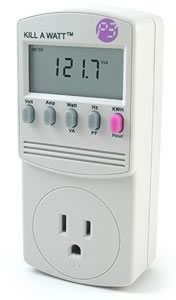
This winter, we’re trying something new. When we moved into this house, we inherited a pair of oil-filled radiator-style space heaters. We experimented with them at the end of last winter, and found they did an excellent job of heating a single room. Plus they’re cost-effective.
Using my handy Kill-a-Watt electricity usage monitor [my review], I determined that one of these heaters uses about 820 watts on its medium setting, which provides ample heat. This costs roughly 10 cents per hour. When I’m working in my office, sitting next to the heater, it’s very cozy. It’s localized warmth.
As I begin to work from home, this is going to be a Big Deal. I could run the furnace all day, or I could just use a space heater. At a cost difference of about 70 cents per hour, I think I’ll stick with the space heater. (And besides: my office gets much warmer from the space heater than from the furnace.)
Meanwhile, Kris and I will continue to employ other cheap weapons against the cold. Tonight we’ll break out the electric blanket. Based on my calculations, this only costs us a nickel a night, a cost I’m happy to pay.
I’m open to other suggestions, though — I’d love to hear about other cheap ways to keep warm during the winter.
.jpg)

November 26th, 2007 at 9:47 am
Space heaters and warm clothes are probably the easiest things to do to save money. Long term though, you should really look into sealing your house a little better. This will help lower both your winter heating bill and summer cooling bill.
There are several inexpensive and easy things anyone can do such as placing weather stripping around doors, sealing leaks around windows and other places with caulk, adding insulation to ductwork, sealing ducts with mastic or a metallic tape (not duct tape, it degrades over time!), and covering your windows with drapes or blankets at night.
November 26th, 2007 at 9:53 am
I don’t know the specifics on this (someone else please weigh in) but it is possible that keeping your heat that low at night is actually not very energy efficient. It is very likely that it uses less energy to keep it a little warmer all night and warm it up a few degrees less in the morning than the amount of energy it uses to run it back up the whole 10 degrees in the morning. I discovered this using air conditioning in Atlanta during the summer. It was far more efficient to keep it in the mid to high 70’s in the apartment while I was a work and then bring it to about 72 or 74 when I got home than it was to let it get up into the 80’s and then run like crazy when it was time for me to come home. I could be wrong but I would assume it is more or less the same principle for heating.
November 26th, 2007 at 10:12 am
I don’t know what Kill-a-Watt would say about it, but our electric heating blanket is the greatest! I love getting into a pre-heated bed at night. Add some thicker quilts on top of it, and you’re good to go for the evening.
You could always go old-school and use the heated water bags in your bed at night. I’ve also heard of people heating up bricks and wrapping them in towels as personal heaters (that may be redneck engineering though).
Great post…I’m looking forward to hearing some additional ideas.
November 26th, 2007 at 10:15 am
Another thing to try might be to build a couple of solar heaters. Check it out here:
http://lifehacker.com/software/video-demonstration/build-a-solar-heater-on-the-cheap-325275.php
You could probably modify it to make it much less ugly.
November 26th, 2007 at 10:17 am
I too have an old drafty home. I embrace it somewhat because I believe it fosters a less toxic interior.
Still…
We too have many, many windows. I put seal-n-peal on all the windows that never get opened and then I put those shrink-wrap plastic sheets over the worst offenders. Without them you can feel cold jets of air shooting into the house.
I will never replace the original windows because thay are beautiful and give my old house much of the charm that I love.
Hopefully, I will one day get to upgrade the storm windows. This will cost $7k-$10k.
I have also had quotes of around $2300 (2000 sq.ft. house) to “blow” insulation into the exterior walls.
You can always have the house “wrapped” when you get new siding — and that siding itself can be insulating.
You can always close off rooms (doors and vents).
Lastly, you can hang insulating curtains relatively inexpensively.
Of course, this all has big upfront costs.
Good luck!
Ian
P.S. We always have on our LLBean Wicked Warm Slippers as well!
November 26th, 2007 at 10:18 am
I got one of these space heaters as a gift from my mom… I haven’t turned on our furnace yet, but it hasn’t gotten to cold here in Nebraska yet either. It can get quite (uncomfortably) warm if you have it anywhere above the medium setting and have the room sealed off. These are a great investment… or a great gift!
November 26th, 2007 at 10:19 am
In addition to caulk and weatherstripping, get some of the foam backing for your electrical outlets and light switches and put them behind the outlet plates on any walls that face the outside of the house. At the hardware store where I buy them, they’re in the same aisle as the weatherstripping.
I also use window insulating kits. They’re designed to be applied to the window frame and then removed and thrown out at the end of the heating season. Some people build wooden frames sized to each window and apply the kits to the frame so they can reuse them. I need to get around to doing that. It will save me some money (about $20 per year) but more importantly, it will save me a lot of time.
The other nice thing about having a frame is that you can easily remove it. If I put the film up one week when it’s cold, then it gets warm for a couple of days, my wife complains that she can’t open the windows. If I had frames, I could put them up in October and we could just remove a couple of them when we have a warm day.
I’ve been using the kits for 3-4 years now, and they make cold rooms stay considerably warmer. Manufacturers claim they can drop your heating bill by 20-30 percent. The exact number will depend on how old your windows are.
November 26th, 2007 at 10:20 am
Wow, JD — you keep your temps lower than I do, and I’m always cold (and work from home) — we’re 68F during the day and 55F at night. I have a space heater around my workspace, lots of long underwear, fingerless gloves, and am working on my sweater/fleece collection. Just call me Bob Cratchit.
I’ve heard people reason that keeping the temps higher is more efficient, but I dropped my thermodynamics class back in the day so I can’t explain WHY it’s cheaper to drop the temp, then heat the house back up later. So, here’s an article that supports that idea: http://www.energy.iastate.edu/news/pr/pr-setbacktherm.html . Our bills are cheaper this way, so we do it.
Window shrink-wrap and insulating curtains are our friends. We have an 1800 square foot 1928 brick bungalow with 34 windows, not including the basement, so I feel your pain. At least we save a tiny bit on lighting the place, eh?
November 26th, 2007 at 10:21 am
Hi JD,
Here are some tips I compiled for saving money on winter heating bills - the best part is, many of these will save you money on your summer AC bills as well (thanks for giving permission to link to them here):
free ways to save money on your heating bill
inexpensive ways to save money on your heating bill
I hope these tips help everyone stay warm and save money this winter!
November 26th, 2007 at 10:26 am
I live in a drafty rental apartment in a cold climate. I’ve done all the cheap insulating tricks like sealing windows with foam and plastic sheeting, filling in doorjams &c but it comes down to not wanting to invest in new windows, insulation, or a more efficient heater (I pay for heat) for an otherwise cheap, large apartment in a great neighborhood.
Warm clothes make a big difference, and definitely make sure to cover your extremities. Wool outer-socks, slippers and fingerless gloves in my case make a world of difference.
I’m gradually accumulating tricks to accommodate cold (as in 50-55 degrees) temps. I also work from home, and my schedule is flexible enough that I can spread heat-producing tasks throughout the day like washing dishes, doing exercise, or taking a hot shower. Closing doors between rooms and closing heating vents in unused rooms works well — although I can’t turn off the heat in the kitchen because (paradoxically) as the room temp falls below 40-45 degrees the old fridge’s compressor turns off and the freezer starts to thaw.
Some of it is mental. I’ve felt some progress (entirely subjective) from practicing meditation. There has some research into this (eg http://www.hno.harvard.edu/gazette/2002/04.18/09-tummo.html ). I wouldn’t by any means claim to be an expert or trained in any way, but it’s not entirely fraudulent to say that your conscious mind has some obscure and perhaps indirect influence over your body temperature. In my experience I’m able to reach a state of mind that both subjectively warms my extremities and / or allows me to tolerate it better. There is some truth in the conventional wisdom than tensing up and staying still makes it harder to keep warm; relaxing and becoming comfortable in the cold makes it much more bearable.
One frugal side effect is that it becomes somewhat more uncomfortable for me to stay to retail stores where the heat is turned up high. The heat is nice at first but it quickly becomes oppressive.
November 26th, 2007 at 10:27 am
I use space heaters too…but I guess it is easier for me since I live in an apartment and don’t have roommates.
I run the heater in the bathroom before I go to take a shower. That way the room is nice and warm before I step in. This makes me bathe with the water not as hot as normal and I can take a shorter shower since i do not need to warm up under the water. This saves on the dry skin feeling from bathing with the water too hot.
November 26th, 2007 at 10:32 am
Man oh man, am I glad I am not in your predicament. I hate for our apartment thermostat to get below 70… ever. Of course, the way our apartment is laid out, that means that the other side is probably in the mid-60s. We also do not adjust the heat at night, but of course we do not have a programmable thermostat, and we both hate being cold when we first wake up.
November 26th, 2007 at 10:55 am
JD said: “Tonight we’ll break out the electric blanket.” You might want to look into an electric mattress pad. We’ve got one and both of us greatly prefer it to an electric blanket. The newer ones have silent controls (they don’t click on and off) and adjust the heating based on your body weight pressing on them (so you don’t get burned laying an a hot element, but still get warmed). The wires are not noticeable to either of us. the best feature is the preheat setting. As we are getting ready for bed, we just turn it on to preheat, and by the time we crawl in, no cold sheets! With the heat coming from beneath us, we don’t have to turn the heat up so high or layer thicker blankets on top to capture the heat as we used to do with the electric blanket.
November 26th, 2007 at 11:04 am
At our house we’ve had a war against the cold, I think I’m getting close to winning. Here’s some simple ways I stopped/slowed down the cold:
- Storm Doors at each door, got 1 for $10 and 1 free during the summer.
- Rubber flap attached to bottom of the door to prevent air coming in.
- Sealed leaking ductwork with aluminum tape (was warming my basement, but not getting to the rest of the house).
- Stuffed insulation into leaks where the ductwork met the basement ceiling.
- Blew my own insulation into the attic to build up what was already there.
- Placed insulation on my basement ceiling to prevent the cold getting upstairs.
- In the process of wrapping the ductwork with insulation.
- Space heaters in the bedrooms of our renters.
- Electric blanket on our bed.
- We do 65 night/69 day since we often have to get out of bed for our daughter or bathroom.
November 26th, 2007 at 11:05 am
I love my warm toasty house even though it’s small. I do have one window that needs the weather kit with plastic (big window in the living room) but the rest of the house is quite toasty. My problem, living in the Southern part of the US is the cooling. I need an attic fan, I think. Here we also use ceiling fans to force the warm air from the ceiling to the floor by running it backwards. I don’t do that much because my house is toasty. Weatherstripping and caulking are very important as so is attic and basement or crawlspace insulation. If you have an old gas furnace, check into the newer models. I had to replace mine a few years ago and I found out they are much more efficient now and can pay off in the long run in terms of energy costs.
Claire
November 26th, 2007 at 11:05 am
I live in the Rockies and endure single digit winters in a drafty old townhouse built in the early 1900’s.
Personally, I’d say the electric blanket is a luxury. Flannel sheets and a nice wool Pendleton blanket will keep you toasty all winter long.
The trick I’ve done this year is at night I put insulated blankets over the north facing windows. They’re typically the drafty culprits with the coldest air.
All you need is a good insulated blanket (got mine for cheap at Big Lots) and some velcro. No drafts. It takes only a few minutes to put them up. Some of them, I just leave up for the winter.
November 26th, 2007 at 11:15 am
I live in a large house, and my landlord prefers to use thermostatically-controlled heat as little as possible. I’ve actually been thinking about making an argument for using space heaters (he’s adamant in his dislike for them), because I think it would be far better to heat an area than all the rooms when people aren’t in all the rooms.
Also, something I’ve noticed (as someone who works from home), is that the longer you are in a room, the more your body heat will warm it up. To wit, my room is fairly small, and if I’m in my room for more than a few hours, it becomes warmer than the rest of the house — without the heat being on and without direct sunlight on the windows.
So, I would say that if it’s at all possible, plan to work in a smaller room with the door closed.
November 26th, 2007 at 11:18 am
I know this will come as no comfort to those of you in colder climates, but living in Houston, I love it when I can set the thermostat for 65 and actually have the heater come on! Sure beats setting it at 75 with non-stop air conditioning. Cheaper too (by far).
November 26th, 2007 at 11:41 am
Energy efficient windows and insulation is the way to go - definitely pays for itself in the long run. Here in DC it gets very cold during the winter but I seldom run the heater in winter (I keep it at 70). The insulation is my new leased condo is that good!
-Raymond
November 26th, 2007 at 11:47 am
I have a ~3000sf 5 year old house and really don’t pay that much more than you do each month in the Chicago area. We have a 94% efficient furnace though and newer building methods. Generally the heat is 70-71 during the day and 67 at night.
As others have pointed out. Seal the windows with 3M window sheeting. Helps tremendously and doesn’t cost that much. You can barely tell it’s even on the window after shrinking it.
Get blow-in insulation in the attic if you can. Again cheap and you can do it yourselves. If it’s a really old house then your outside walls might not have insulation, or maybe just newspaper. Again, you can do this yourself by renting the machine from your local borg (HD, Lowes, Menards).
We paid $500 when the house was built to upgrade the furnace and air conditioner. It has since paid for itself many times over.
November 26th, 2007 at 12:02 pm
Hi JD! Haven’t said Hi in a while.. anyway, it really gets cold up here in KFalls this time of year. Here’s how the Smart Half and I manage it. First, we’re warm climate people.. and we keep our gas furnace at about 70 this time of year. It’s in the living room and with the bathroom and bedroom doors closed, it’s not on all that much. We live in a “mill house” (originally built for mill workers) that was built in the ’20s, with a 10-year-old add-on with newer vinyl windows. About 1000 sq feet all together. We have the double hung oold windows on most of it. Someone built the storm windows for it with frames and plastic film, and we put those up in October. We have an oil heater in the bedroom- those things do rock, btw.. AND a down comforter. Real down. Fabulous. Toasty warm, we turn the oil heater down at night or we’re throwing the comforter off. Our monthly gas bill in the winter is about $40.
I’ve been helping a friend get her house warmer. She has no furnace at all, lives in what used to be the laundry room at her trailer park, has a small fan heater. It’s cinder block. We put plastic over the windows and it instantly made it much warmer. Shimmed her front door so it hung straight and added a rubber strip to the bottom. She no longer wakes up to ice on in the INSIDE of her bathroom window. But the plastic film on the outside made a huge difference immediately. We also filled a couple of old socks with sand and tied them off, and if she notices drafts, she puts the socks down and blocks the drafts.
November 26th, 2007 at 12:03 pm
If you’re renting an apartment or buying a condo, try to get a top floor south-facing unit. Our thermostat has never dropped below 60 because we absorb the heat from our neighbors below.
November 26th, 2007 at 12:03 pm
When I lived in GA I turned off the furnace and got a blanket and thick socks, then used a small electric heater for my room for the coldest nights.
When everyone around me was complaining about their gas/electric bills being in the hundreds, my gas never went above $45/mo and my electric never above $60/mo.
Now that I’m in KS, it’s the same principle, just with more space heaters. My furnace is on enough to keep the pipes from freezing, and only goes up when company is over.
Yeah it gets cold, especially in my drafty house, but that’s the obvious trade-off for a cheaper bill. All the weather-stripping, insulation foam/siding, thermostat fiddling in the world won’t keep your bill low if you insist on high heat in your house, especially considering the newest wave of price spikes in gas and oil. Either you’re comfortable or your wallet is, simple as that.
I have friend who always complains about his high heating bills despite all his finagling, but he keeps his thermostat between 75-80 all winter. Well, no duh his bill is high.
If you really *need* to save money on your heating bills, then use your own heat and buy thick socks, a thick sweater and a thick blanket. Drink hot spiced cider, tea and cocoa, and eat hearty, hot soups and stews more often. And yes, even your kids can do it. People are still alive today that remember when those and a fireplace were the only options available. If you don’t have a fireplace, switch it with a couple of space heaters and get cracking.
November 26th, 2007 at 12:04 pm
When we got home last night, the place was freezing, after having the heat off for 4 days! But then my parents had their house way cooler than they used to. We just used lots of quilts and socks!
November 26th, 2007 at 12:22 pm
Are there big rugs on all the floors? I lived for two years in a house in England heated only by fireplace. (The word “heated” isn’t even accurate — the heat was negligible.) When someone lent me a huge rug to put down on the wood floor, the average temperature went up about 5 degrees. This is literally why rugs were invented. Put them on all floors!
November 26th, 2007 at 12:23 pm
Too bad you’ll never get hot flashes! They’ll keep you warm–day and night!! 0 Cost too!
November 26th, 2007 at 12:50 pm
@Leslie and others: This has already been pointed out at least once in the comments but it is definitely more cost-effective to drop your heat dramatically at night; heating it by 10 degrees in the morning uses much less energy than keeping your thermostat set 5 degrees warmer all night long. I remember reading about some definitive studies on this topic on the Energy Star site (www.energystar.gov), which has a lot of good advice, tools, and calculators on how to save energy and money in your home.
November 26th, 2007 at 12:52 pm
Two words for you: Sheepskin slippers. Ugg makes a nice slipper with a closed heel (scuff romeo) that is like heaven. They are instantly warm and keep your feet toasty from the time you step out of bed until the time you get back in. That’s the worst time in a cold house for me: getting out of bed in the morning and into bed at night because my feet are always blocks of ice. It’s always cheaper to adapt yourself to your environment than to modify your house to be warmer. Also, love the hot water bottle idea.
November 26th, 2007 at 1:00 pm
When I was in college in Michigan, we held the thermostat at 55, and my running desktop computer kept my bedroom comfortable while I was covered in bed. In the evenings I would occasionally flip on the space heater.
For most people, it would no doubt be cheaper to turn off the computer when it is not in use, using the furnace instead. But if you have a computer which already runs 24/7, relocating that unit to a room where people can benefit from its heat may be a good move.
It’s probably not the wisest way to heat, but for those with the habit of running their computer 24/7, it’s worth knowing about. (As an IT worker, I had been doing so for years, plus I used the unit as a stereo system and alarm clock while I slept.)
November 26th, 2007 at 1:12 pm
To feel warmer at a lower temperature, try adding some humidity. My husband and stepson are more sensitive to cold than I am; even when I’m home and performing sedentary work during the day, I rarely set the thermostat above 62. They’re happier near 68. Simmering a pot of water with a cinnamon stick in it for a couple of hours before they come home not only adds a nice aroma to the house, but also makes the place seem cozier. I can usually keep the thermostat at 64 and hear no complaints on those days.
My fellows are adjusting to having me as the Keeper of the Thermostat, which required compromises. Before I entered their lives, they kept the temperature in the low 70s and wore t-shirts around the house all winter. Now, they hear, “If you’re not wearing socks and a sweatshirt, I have no sympathy,” when they whine about being chilly. For my part, I don’t turn the temperature down to the low 50s at night, like I did when I lived alone (I’d use an electric blanket and wear gloves if I was too cold).
We just added brass weatherstripping to the 90 year old windows on our bungalow — it’s amazing that no one had done that in the prior decades. We use insulated curtains and draft blockers. There are still some cold spots, but we’re working on them.
November 26th, 2007 at 1:26 pm
This works only if you have recessed windows: one that is flush with the wall can’t use this trick. As an alternative to window shrink-wrap, I discovered no-sew fun-fleece “window blankets” a couple years ago. They work best in addition to curtains, and you can take them down at a moment’s notice. Basically, you get a couple yards of fleece (enough to cover your window, at least), cut an odd number of slits in the top, run a rod thorugh the slits, and hang the whole thing up in the window’s recessed box. I used an expandable shower rod at first, but eventually the springs wore out, so now I use a simple rod and hang it on a couple of those planter hooks screwed into the recessed window area. I’m sure you could do something similar with blankets or afghans: fun fleece was used because you can cut it and it will never unravel nor stretch.
This has really helped in the bedroom, where midnight cold was practically wafting off our single-paned, aluminum-clad, 50s-era window. One problem, though: it’s so effective that moisture can (and does) get trapped between fleece and window, so you’ll have to keep on top of that.
You may already know about these tips, but in case not, here goes:
Have you considered getting blown-in insulation between your walls? It’s not quite as effective as the ubiquitous pink stuff, but it’s one of the few ways you can insulate between walls without major renovating. Lighting some incense sticks and wandering around with them can help you detect major drafts for pinpoint weatherstripping, and I’ve seen foam insulating pads designed for use behind your outlets for about $2 for 6. (I’ve heard people instead use those foam trays meat comes in, but they seem a bit too flammable for my tastes.)
November 26th, 2007 at 1:35 pm
You need insulation. Plain and simple.
Other than that, if you have central heating, you’ll need to refrain from closing off rooms, as the central heating system depends on airflow.
Plus, if you have kids, you really ought to think about keeping the house at 68 degrees at all times. Little bodies aren’t very adept at regulating their temps. They rely, somewhat like reptiles :), on their environment.
November 26th, 2007 at 1:36 pm
@Leslie:
Heating and air-conditioning are very different beasts when it comes to energy consumption. A/C has a lot of “overhead” while running the condenser to remove heat and humidity from a warm room — a furnace has no such problem.
As a result, keeping your house a fairly consistent temperature when *cooling* can be more energy efficient than turning off the A/C every day.
But, with heat, it’s best to keep the heat on only minimal when it’s not being used.
In our house, we keep things set to 53F at night (we both like sleeping cool) and while we’re away. We keep the house at 60 while we’re in it, to keep the chill off the various furniture. And, we simply use radiant space heaters whenever we settle in an area — it’s much cheaper to heat *you* (which is what radiant heaters do) than to heat a lot of empty space (convection heaters and furnaces).
Best money-saving advice? Do active things while at home. If you keep busy, you can keep the thermostat quite a bit lower. My brother-in-law’s music instructor went through college with the heat at 50F, and kept warm by playing his marimba!
November 26th, 2007 at 1:45 pm
Space heaters can make a difference, especially if spots in your house are colder than others, like my bedroom. (Faces North)
I’ve been looking at getting one of those flat panel space heaters that Chanpory highlighted on his blog:
http://www.lifeclever.com/finally-a-stylish-heater-for-your-home/
You can also wire it (or more than one) up to programmable thermostats as well.
November 26th, 2007 at 1:51 pm
Funny - I just posted a tip at my own blog. I work at home and feel bad running the heat all day “just for me,” but I’m cold most of the time (especially in the office which gets no sun). My latest stay-warm trick, in addition to drinking lots of hot beverages, is to microwave a ziplock bag of rice for 2 minutes and enjoy the warmth in my lap for a few hours! I’m sure the energy I expend to run the microwave for 4-6 minutes a day is much less than what it would be if I ran the heater or a space heater all day.
November 26th, 2007 at 1:52 pm
Living in New England we are constantly barraged by cold weather for long periods of time. The space heater is definitely a useful, and cheap way of heating a specific room. Most families that live in this area try and heat only the rooms that are being used. Doesn’t make much sense to heat the whole house, trying to limit yourself to direct heating is always better in my mind.
November 26th, 2007 at 1:56 pm
I don’t know if those are old windows or new windows. I’m guessing old.
We live in an old house too. If I were you, I’d be tempted to stick with my job for just one more year and try to replace as many of those 30 windows as I could. You’re young, hopefully you’re going to be cold or less cold for many more winters to come, lol.
November 26th, 2007 at 1:57 pm
To second the comment regarding rugs, I have another novel idea to help boost your warmth. You’ll probably think I’m nuts though!
Discover the joys of hanging big tapestries on the walls — the medievals used them to help insulate those big drafty (or is that draughty?) stone castles. If for aesthetic reasons you don’t want to reinsulate the farmhouse, some good sized tapestries on outer facing walls could help along with those thermal curtains on the windows.
If tapestries aren’t your thing you could even try just hanging some of those thermal curtains on the walls somehow.
OK, yes I’m nuts…I happen to love tapestries though.
November 26th, 2007 at 2:21 pm
Here are a couple of notes:
One of our problems is that we like our windows, and aren’t willing to sacrifice the integrity of the house for comfort and cost. This might be a subject for a future post, but we have a historic home, and would like to maintain it in decent condition. Probably a dumb financial move.
That said, I like the idea of using insulating curtains or lining the windows with plastic. I actually brought some greenhouse plastic home for one of the neighbors, who was lining his windows. I never understood why he was doing it, but now maybe I know. I’ll have to go knock on his door to ask for tips. I’m not sure I want to cover 30 windows, but I could at least cover a few!
November 26th, 2007 at 2:36 pm
“Downstairs, there’s almost as much window space as wall space on the outside of the building.”
We have the same issue. We too kept the original windows downstairs, so I understand. But the upstairs was an extension, so we put matching windows with double glazing upstairs (bedrooms).
Do you have any blind walls? We have one, and we added outside insulation three years ago. It helped significantly.
We also have thick lined curtains in the LR and DR (open plan). In winter we close them at sundown.
November 26th, 2007 at 3:02 pm
When I’m cold at home, I wear a knitted or fleece hat and scarf-it’s amazing how much warmer you are, just by adding a scarf.
Also, wearing wool socks to bed helps a lot.
November 26th, 2007 at 3:08 pm
I’m a huge fan of the space heater I bought a few years ago. It’s a ceramic electric heater from Bonair that comes with a thermostat remote - you set the temp and then put it down as close or as far away from the heater as you like. I love being able to fall asleep with it on.
Other than that… plastic over the windows or close the curtains in the rooms you’re not in, I guess.
November 26th, 2007 at 3:41 pm
I may have missed it, but it doesn’t look like anyone here has mentioned EdenPure space heaters. They are quite costly upfront, but amazing compared to other space heaters in their ability to heat and they are safe to use anywhere, even around children, pets, draperies, etc. My FIL bought three and let us use one one winter. We were hooked and bought it from him. It is a good supplemental heat source in any home or shop, and depending on the layout of your home, it could be the ONLY source of heat.
Having hypothyroidism, I often feel cold when everyone else is comfortable. When I’m feeling cold, I like to wear a knit cap, even when I’m in the house, and when I’m doing sedentary tasks, like computer work or watching TV, I like to have a heating pad in my chair. It’s much easier and cost effective to warm just my body rather than the entire room or house.
November 26th, 2007 at 4:17 pm
JD — Lots of windows are a necessity to me — you can find different styles of thermal backed drapes that could really help out.
I am not a fan of plasticing windows since whenever there is a warm enough winter day I like to open the windows and refresh the air in the house.
However, I’ve tried the thermal curtains (and a cheap alternative, tacking up a fleece blanket over the window) with great success.
Best of luck. And don’t forget the wall tapestries!
November 26th, 2007 at 4:36 pm
Please do so some research on the costs of keeping the heat on at a more middle setting. It usually costs much more to bring a huge area up to temp than to maintain it. BE CAREFUL!!! We used the oil filled heaters and generally love them. One developed issues that we were unaware of until we got an electric bill for $400 . for JUST ONE MONTH. Look into radiant floor using a Hot water heater. Also DIY blown in insulation. You can get the equipment for free or cheap depending where you get the material. Check non chain stores. They are easier to deal with and cheaper. Antique soapstone bedwarming stones are worth their weight in gold. Bake for 1 hour at 350 MAX and wrap in a towel for your toes. It is my best friend, ask my husband and kids. Ellen
November 26th, 2007 at 4:38 pm
Frugal Bachelor grew up in a very large and very old house (built in 1890’s) in Chicago, with little insulation and an unreliable old furnace. He had the cheapest parents in the world who refused to let the heat run more than it needed to stop the pipes from freezing, and Frugal Bachelor’s youth was catheterized by his teeth chattering while he hid a space heater under a blanket with him to try stay warm. Nowadays he lives in Texas, which is a little warmer. But over Thanksgiving he went back to the old house and it was cold. But his mother prepared his bed with a wool blanket, a sheet, and comforter, and Frugal Bachelor also put a space heater on, but woke up in a sweat a few hours later because it got too hot. He couldn’t believe how well the blankets worked. Another thing he learned is that a desktop computer is a very good space heater. And, conversely, it should always be turned off in the summer (Frugal Bachelor only ran A/C three or four times over this past summer). But maybe the best advice is to move to a warmer climate. Not only is energy cheaper, but so is housing.
November 26th, 2007 at 4:44 pm
I’ve heard geothermal heat pumps can save money as well, but haven’t found many price breakdowns on the initial investment.
Maybe a second post could weigh all the “high up-front investment” ways to save energy and heat homes?
November 26th, 2007 at 4:56 pm
Heat with wood. Both my family and my parents use wood burners. My parents have an old farm house, and I have an old drafty house. I cut and split my own wood. My house stays between 70-80 degrees. I have an oil furnace for backup heat if we are not here to run the wood stove. I bought 250 gallons of heating oil and that will last me all winter and then some. Once people find out you heat with wood, they will be willing to give you wood for cutting up a tree that fell down or something. I always have people offering me wood so I don´t have to buy any. It is certainly more work, but you can save on heating costs.
November 26th, 2007 at 5:00 pm
Until you try it, you won’t believe how much warmer you feel with a hat on. I love fleece cats that are lightweight, easy to wash, and come in fun colors. A sweatshirt with a hoodie is another way to go.
Just a warning about sleeping under an electric blanket… the electrical fields aren’t doing you any favors being so close to your body. Use it for warming up the bed before getting in, then shut it off. With good blankets, you won’t miss it being on.
And there’s nothing like a cat to warm up your feet or your lap!
November 26th, 2007 at 5:13 pm
For your windows, you might consider a product called Warm Window. The system includes an insulating fabric that is sewn into fabric window shades, and magnets that also go on the shades and on the window frame to seal the windows. The benefit is that you can use any fabric you like for the shades, and the insulation is totally hidden–they look just like regular roman shades. You or your wife can sew them yourselves, or you can hire a seamstress to do it.
You may also be able to keep your original windows, but have them restored to be more energy-efficient.
November 26th, 2007 at 5:29 pm
I know you don’t like/want one but a woodstove would go great in the southeast corner of your house. It wouldn’t take much to punch a chimney out the upper wall.
There are newish woodstoves that have very little smoke and almost no ash. You still have to deal with the stacking, splitting, etc.
November 26th, 2007 at 5:45 pm
wow…I never realized what a chore it is to stay warm. I guess I take my tropical Hawaiian weather for granted. We typically have lows in the low 60s, rarely dropping into the 50s at night, and highs in the low 90s (almost never breaking 100) although i’m sure the difference I pay in cost of living more than makes up for heating expenses
November 26th, 2007 at 5:57 pm
Sounds like a Three Dog Night….I do not heat my house at all. I’m wearing shorts right now. I’m also escorted everywhere by two large dogs. It’s 63 in most of the house, but right around me it is very very warm. I think you can guess why.
November 26th, 2007 at 6:05 pm
We have a heat pump, but when the temps dip below 35, it doesn’t help much. That is where the wood stove comes in. I find radiant heat to be much more effective because it heats objects (furniture, walls, stone floor or chimney) instead of air. After building up the thermal mass of said objects, they continue to keep the house warm even after the wood stove has died down. The heat from the heat pump heats the air, and even setting it at a higher temperature does not create the same warmth as heating objects. Since there is no thermal mass built up, it is a fleeting warmth anyway. For our 2,100 square foot house (with cathedral ceilings), we pay an average monthly electric bill of $80, which includes the heat pump as well as our other electrical needs. Wood to heat the house for the winter runs $400, and would be cheaper if we had the time to cut and split it ourselves. This is what is costs us to keep the house at 65 during the night and 70-75 during the day throughout. (Of course, our passive solar set-up, southern orientation with deciduous trees next to the house, helps a lot too.) Even if you don’t want a woodstove, you might consider investing in a gas stove for a central place in the house to get that radiant heat.
November 26th, 2007 at 7:11 pm
Malena: Most heat pumps have “heat strips” (auxiliary heat) that kick on when it’s too cold out for efficient heat capture. Of course, it doesn’t run terribly efficiently with the auxiliary heat on, but around here it doesn’t get *that* cold all that often.
November 26th, 2007 at 7:58 pm
Contact your electric or gas provider. Some offer programs to reduce the cost of energy efficiency projects. Last year my electric provider paid 50% of the cost to blow insulation in my home’s walls.
Also look on the US Dept of Energy’s website for instructions on how to insulate and seal your home. You might be able to do some of the work yourself. So simple, even I could do it!
November 26th, 2007 at 8:03 pm
Consider a wood stove or fireplace — if your home is that old, I’d be surprised that you didn’t have one. My family has a wood stove in the living room that we use on cold nights, and it brings the entire house up a few degrees — and the living room is positively toasty.
November 26th, 2007 at 8:57 pm
We live near Green Bay, Wisconsin also in an old, drafty farmhouse with tons of windows. We have been heating our house with a corn furnace for several years and keep it a balmy 80 degrees in here to the tune of $800 a year! Cheap and renewable energy.
November 26th, 2007 at 10:04 pm
@get rich slowly: did you really like the brand of heater you linked to?
I was thinking of getting one - my apartment feels like a north-facing igloo. The rent is cheap, but gosh is it cold. I do the hoodie and hat trick, plus some thick wool socks.
I actually use space heaters during the winter, and can vouch for the electric blanket. But I don’t like leaving on the blowing-air style heaters on when I sleep, so a nice warm radiator heater sounds like a dream. I might get a down comforter this year, because the electric blanket helped, but didn’t quite do the trick.
One trick I do have is to go to bed with a full stomach. Something nourishing but not fatty, like hot cereal. Oh yeah, and if you have any crafty friends, they can make you fingerless gloves (cut the tips off, like victorian orphan style, or go to etsy.com and get a pair.)
November 26th, 2007 at 10:20 pm
However, I *do* like these heaters in general. They seem safer than the fan-based heaters. And I like how they give a nice, gentle oozing heat. My recommendation would be to go down to your local hardware store to try one out…
November 26th, 2007 at 11:45 pm
Maybe you should look at some of the newer replacement windows. It could very well be possible to replace your ancient windows with new efficient windows that look pretty much the same. My new windows are very similar to what was in this house when it was built (& a huge visual improvement over the ’80’s bronze aluminum windows). They aren’t cheap though. I paid about $1000/per window for the triple pane double hungs I got.
Now I just need to do some insulating.
November 27th, 2007 at 12:32 am
I have shared living quarters with someone who goes hiking in Maine winters; since he needed to acclimate himself (it was his wife I felt sorry for!), I have had to figure out what how to avoid turning a fetching blue in the mornings or becoming one of those unpleasant whiny persons you sometimes read about… I advise the following for my shivering brethren and cisterns:
1. Those above me are right about humidifiers, gloves, nightcaps, and nourishing food (unfortunately, food taken without the chance to burn off often is automatically stored as fat with certain metabolisms; weigh benefits and costs; however, if you are keeping your calories to 1200 and under per day [watch protein and other nutrients!] and do not suffer from thyroid problems, you should have no problems in this regard);
2. Under–rug heaters are arguably one of humankind’s most comforting inventions. They make sense, too— heat travels up;
3. The difference between heat-seekers and cold-diggers is in their capillary network. Unfortunately, most of this is biologically determined (and often women get the shivery end of the stick), but vigorous and regular exercise; healthy, spicy foods and adequate hydration; and, strangely enough, well-moisturized skin can all contribute to a warmer perceived temperature.
The tip about local energy providers cannot be over-emphasized; some of them will actually come out and find your drafts for you, or even take an IR picture of your house, showing where all the money is escaping from.
Oh, and get your chimneys professionally cleaned if you use a fireplace; not dying in a flue fire is well worth the money— and our chimney man figured out a new baffle arrangement that made a *huge* difference in our living room temperature.
November 27th, 2007 at 2:38 am
1) Try to strike a deal on your heating. Natural gas companies will put you on a pro-rated budget, propane and fuel oil distributors will give you a set-price contract on fuel. Won’t know if you don’t ask!
2) Don’t allow your heat to go below 55. Lower than that, and your plumbing is in danger of freezing. If you are planning to maintain that temperature, wrap all exposed pipes and appliances (water heater/water softener) in insulating material.
3) Place hay bales against the foundation for insulation. Close off the entry door from the porch and used the back door to avoid the wind from the front. Cover unused doors with heavy, insulated drapes, and stuff drafty cracks with rags.
4) Caulk the exterior of your home. Look at the outside of your house. Wherever you see cracks in the trim or around windows, goop some caulk in there.
5) Hang plastic around your windows. This will stop drafts. You can get a window kit, or do it yourself. Remember to secure the plastic around the OUTSIDE of the window framing. Drafts don’t come through the glass, they come through the framing. One step better; hang thrift store blankets or insulated drapes over the windows. This will stop the cold from radiating off the glass and lowering the temperature in your rooms.
6) Insulate electric outlets that are on outside walls. Insulation kits are sold at hardware stores.
7) Close off rooms you aren’t using, as long as no plumbing runs in their walls. Unplug everything in the room (lamps & stuff), make sure there isn’t anything in there you don’t want to freeze. Shut the door, chink the cracks with rags or insulating material, and forget about it until spring.
drapes to keep in the heat.
9) Sleep more than 1 to a bed. Shared body heat is underrated.
10)Find the warmest room in your house, then make that your living room.
11) Grab the “heat” you’re wasting. Vent your dryer into the house, with the proper piping and lint trapping. When you’re done cooking, open the oven door to allow that heat to escape into the room while it’s cooling down. When the dishwasher is done running, open the door to let the wet steam into the room.
14) Eat warm, nutritious foods. Thick, hearty stews made with root vegetables are great winter foods! Crockpot hot dish suppers were our favorite in the winter.
15) Put your clothes for the next day between the blankets on your bed so they aren’t cold when you put them on. We usually just hung them on the radiators in the morning for a heat-up.
16) If you have hardwood or tile floors, put something on them for winter. Carpets, blankets, whatever. It’s pretty easy to find carpet remnants any day of the week for free, and it really helps keep the tootsies warmer.
November 27th, 2007 at 2:58 am
I second Pril’s suggestion for the down comforter - real down feathers will do wonders in the winter.
I live in SF and it gets cold - 40s (so it’s not that bad, but I’m used to 60 degree weather!) at night and the down comforter with two quilted blankets on top are more than enough so I don’t freeze. You should definitely invest in one that’s 100% down feathers - you’ll be amazed at the difference and savings in heatings. I rely on just the down, the quilts (thin polyester kinds) and no heater just fine. It’s kept the electricity bill to $50-60 for three people just on my frugal habits alone! Otherwise we’re looking at $100+!
November 27th, 2007 at 4:46 am
I live in Fla. so heating our home is not an issue. However, I did want to post to note the following issue related to utility costs. We live in a small city (which we love) that, we have come to learn, has some issues with its small city government. Our utility dept. is not automated so they come out to “read” the electric meter and water meter each month. Well, we discovered that the city does not always read the meters and estimates/averages/makes up the meter readings about 1 or 2 a year. The city is permitted to estimate a bill if they cannot read your meter but they are legally required to mark the bill “estimated”. We figured this out when I noticed our water bill creeping up, up and away (I originally attributed the change to the fact that Florida was in a dry period and water rates were going up). Month 3 of the increase I figured out that there was no way we were using as much water as the bill inidcated and husband and I went out to look at the numbers on our water meter and discovered that the water meter and the utility bill numbers did not match or even come close. We then walked around the back of our neighbors homes and out of 5 homes we could only find 3 of the water meters the others were buried under grass, dirt, etc. (meaning they had not been read in quite a while). Now when the utiity bill comes in the mail we double check it against the meters. We have also assisted the folks who rent two of our investment homes in this same city do the same. So, check your bills closely.
November 27th, 2007 at 5:45 am
If you go with the space heater, I would suggest a humidifier. Those little things can dry out the air so much that you can get a pretty bad cough that takes a while to get rid of.
I ran one in my room one year, and I had brought in some pecans in a bag. A few weeks later, I opened a pecan and it was a small dry husk.
I hadn’t figured out why I got the cough, and then added the humidifier.
November 27th, 2007 at 5:48 am
In Canada we have a great program (ecoENERGY) that is intended to save energy through home energy retrofits and the government (both federal & provincial) provide grants and rebates for various improvements. Do you have similar programs in the US?
We had an energy audit performed on our 80+ year old house (and one of our older rental houses as well) and were given an EnerGuide rating, basically a number which describes how energy efficient your home is. We were also given a personalized checklist of recommended energy improvements based on visual checks as well as air leak / seal and other tests. The checklist detailed which modifications would provide the biggest improvements. For us, blowing in insulation in the walls provided the biggest return, by far!
The up to $5,000 in grants that can be received are a huge motivator but even without, I think it would be worth having an assessment done. Our “after” score improved significantly by insulating the walls, installing a new, high efficiency furnace, and sealing around the outside joists / beams in the unfinished basement, but we only really knew *what* to do based on the expert’s advice.
November 27th, 2007 at 7:25 am
Hooray for programed thermostats!
We moved into a new house recently in Florida - so we had the opposite problem with the a/c being on all the time. At least when it’s cold you can put on a sweater! What can we do other than run around in our underwear!?
The first month durning a heat wave when we were first moving in and not paying attention: $245!!!!
Next month after the thermostat: $140 AWESOME!!
November 27th, 2007 at 7:25 am
54F at night? I’m not sure how cold it gets outside at your place. We’ve got a four-month old baby and can’t have the temp that low. Even bundling her up won’t help as newborns are still learning to regulate body temp. We keep it to 67F at night overall.
November 27th, 2007 at 7:31 am
One thing that we have done for years is balanced billing. This means that our annual estimated yearly energy bill is divided into 12 equal payments. Sometimes we owe the energy company money and sometimes they owe us, but in general it makes budgeting so much easier that it is worth the discrepancies. We do this with both the gas and electric companies. At the moment we are seeing a big drop in both utilities, as our last child has just left home for college and is using someone else’s light and hot water.
November 27th, 2007 at 9:11 am
Rico, if you don’t already have them may I recommend you purchase a sleepsack for your baby? My kids loved them. They are like a blanket sleeper with a sack where the legs go. Put it on over the baby’s pj’s, and baby stays very warm through the night. More importantly, baby sleeps better through the night! Way better than tortilla-wrap blankets.
November 27th, 2007 at 11:31 am
http://www.google.com/search?hl=en&q=interior+storm+windows
Also, look into “Interior Storm Windows” for keeping your original ones.
Ian
November 27th, 2007 at 12:36 pm
Okay, I discovered a week ago my heater is not working properly but I live in California and so far the temp in my house hasn’t dropped past 62 (although for me that’s low!) and until this past week, has been in the upper 60s. I bought 3 heat dishes from Costco and they work fine at keeping me warm whatever room I’m in BUT I heard they are huge electricity drainers. Is that true? If so, maybe it’s worth it to get my gas heater fixed asap. Does anyone know?
November 27th, 2007 at 12:46 pm
I have to say it’s nice to live in California in the winter. My gas bill for Oct was only $12.
We pay the price for our weather in the summertime though.
November 27th, 2007 at 1:38 pm
Our home is about 1500 square feet, but it’s an open space. As a result, it’s really hard to heat in general. The upper floor gets too warm, while the bedrooms downstairs remain frigid. We’ve employed a few techniques to keep from getting too cold.
Insulation:
-Double glazed windows are pricey, but have been crucial in keeping our many windows from letting the cold seep in. They really do the job.
-Weather stripping is cheap and easy to install. We sealed the external doors, and it made a big difference in diminishing the draft.
-Heavy drapes for the french doors in our bedroom protects from noise and cold. Ours have a thick liner to keep the sun out, too. While optional, it seems to insulate that much better as a result.
We also invested in a small space heater like yours. However, we put it in our son’s room because it really helps him sleep. We’ll probably get one for our room, too, which should decrease our heat usage to next to nothing.
November 27th, 2007 at 1:56 pm
Siena,
About those Costco dish heaters: they are absolute energy HOGS. My husband used one in the garage for a month, and it cost us $50 extra! We had to ditch the damned thing. He uses a little heated fan now, and only occasionally (Vornado, I think). I don’t know how many areas you need to heat up, but if you’re using more than one dish, it’s sure to be more economical to just bite the bullet and fix the heater.
November 27th, 2007 at 2:39 pm
Best way to reduce heating costs: Move to Florida
I still have my A/C running! Though it only kicks on a few times a day.
Also, in relation to #65, when the bill is estimated, they document you as having paid up to the estimated meter reading. So, if you pay over one month due to overzealous estimation, when they read it the next month you pay from the estimation point. As long as rates don’t change, you didn’t pay any more or less.
But of course, if their estimating for multiple months in a row like that, the inaccuracies accrue. I thought they HAD to check the meter every so often though… I’ll have to do more research on the matter.
November 27th, 2007 at 4:06 pm
Good Post. I am a mechanical engineer and design commercial HVAC systems. Technically as many other commenters have said, lowering your temps at night requires more input energy (gas in your case) to get your house back to your set occupied temperature. If your house is well insulated and infiltration was at a minimum, then this might make sense to do, but in your situation, you say your house is so drafty, it probably isn’t helping you at all. In simple heat transfer terms, the heat inside your house will be transfered to the outside, if the outside temp is cooler than the inside temp, your house just does it at a much faster rate than others because of lack of insulation/tightness. However, it is easier to maintain a temperature, than to go from one extreme to the other (think maintaining a set speed in your car…. this will burn less gas, than going from 0 to 60 as fast as you can). That said, decreasing infiltration by putting plastic over windows, sealing doors, etc…. would probably be more beneficial to you.
Great site btw. I have been reading now for a couple months, and this is the first post I thought I could actually contribute too lol!
November 27th, 2007 at 4:08 pm
I live alone in a modern 2 bedroom townhouse, which is also my home office. I keep things cold because I’m cheap, green and, conversely, red — with rosacea — so I would rather be in a place that was too cool than too hot.
I open and close the shades strategically to bring in all the natural solar warmth possible.
I can take tepid showers even in the winter because, like lulu, I preheat the bathroom for a few minutes with an electric space heater. Otherwise, the thermostat is currently set for 17 Celsius (about 62 degrees F). I can wander around in jeans and a t-shirt and feel fine at 18-20 degrees C, and only start shivering a little if the house dips to the lowest setting. Later on this winter, I’ll drop the lowest setting to 15C (60F) and see how I do.
November 27th, 2007 at 4:20 pm
Check out Invisible Storm Windows, here:
http://www.invisiblestorms.com/
If we hadn’t replaced our windows entirely with double-paned, energy-efficient Pellas, we might well have done business with these people, who I found at the Philadelphia Historic Home Show.
November 27th, 2007 at 6:58 pm
Last year my furnace went out. When the repairman came I was curled up with my dog in front of a space heater. He figured out that it was just the thermostat, so while he was fixing it I asked him some questions. When I asked him what kind of furnace he had, he laughed and pointed at my space heater. He used them almost exclusively; he said that it was way more cost-efficient than a furnace. Warning: the gas company may stop by your house to see if you’re stealing gas (which they did to him about once every couple of years, he said).
November 27th, 2007 at 7:45 pm
Thanks Amy for the tip. On the box they say they the heat dish uses less juice than other heaters but in the back of my head I remember hearing they used up a lot of juice. I bought three cause I had guests over for one day over the holidays for dinner but now I’m going to watch how often I use them.
I haven’t called anyone to look at my heater (it’s in the attic and I’ve never seen it). I didn’t use it all last year so I don’t know when it went kaput.
Okay, this is an odd heat strategy but I have furry big dogs (one recently passed) and I let them sleep with me when it is really cold to keep me warm.
November 28th, 2007 at 8:13 am
Now I’m thinking: my new gas furnace hardly every turns on because I let the house stay relatively cool. I had it serviced late this summer, and will continue servicing it on schedule (as I may be selling the house and need to show a good maintenance record), but if my furnace turns on rarely, will this affect its performance and lifespan badly?
November 28th, 2007 at 12:05 pm
A colleague of mine in a historic building has interior plexiglass storm windows that attach with magnets, and she loves them. There is evidently a thin permanent magnet around the edge of each window, and they snap the metal-edged plexiglass windows to these (the magnets can apparently be removed, but they have no desire to do this). The former resident of her apartment built them from a kit something like this one:
http://www.windowsaver.com/index.html
We have electric baseboard heat, also in a 1920s building with original windows, and are planning to build storms like this and attach them next month. I’ve heard the magnets can also be used to attach a DIY interior screen.
November 29th, 2007 at 3:56 am
I am in the deep south (currently 41 degrees, today’s high 61 degrees). It just made me cold reading your post. Good luck staying warm.
Best Wishes,
D4L
November 30th, 2007 at 5:14 am
[...] Frugality in Practice: Keeping Warm in Winter @ Get Rich Slowly [...]
November 30th, 2007 at 9:58 pm
[...] been doing more research about keeping our house warm. I have several things I’m going to try. As it happens, USA Today just posted an article on [...]
December 1st, 2007 at 6:57 am
[...] There are lots of good ideas: I’m buying plastic-wrap window insulation this weekend. (Read it at Get Rich [...]
December 1st, 2007 at 7:15 pm
JD–Buy a slanket! http://www.theslanket.com/
I don’t work for this company, but my boyfriend just bought me one for the holidays and it’s AWESOME.
December 2nd, 2007 at 10:21 pm
What about solar? The Pacific Northwest isn’t the sunniest place in the world but it’s not a cave either. There are technologies coming down the pike that can give you power at 30 cents per watt. Use that to heat your water and then you can crank the house heat on a little more often.
December 3rd, 2007 at 1:10 am
[...] Get Rich Slowly comments on frugality in practice with discussion on how to keep warm in winter in a drafty house. [...]
December 3rd, 2007 at 1:20 pm
Wow, look at all these great ideas!
Some of the things we’ve tried:
The windows on the front of our row-house apartment are lovely, historic, oddly shaped and amazingly drafty. We just tried the shrink-wrap sheets on them yesterday, so it’s too early to say about energy savings, but it already feels warmer without the breezes blowing! It also lets us keep the light from the windows, which thick curtains would not.
We have a little electric space heater which we love — it automatically shuts off if tipped, so we don’t worry about our cat.
Rugs have been mentioned — put them down in winter and take them up in summer.
For sleeping — down duvets and flannel sheets make it much warmer. In England I also encountered hot water bottles and a shearling-style fuzzy pad that hooked onto the mattress under the sheet.
Then there are the usual layers, wool sweaters, slippers, hot tea, soup, etc.
December 18th, 2007 at 11:24 pm
Boy am I glad to read some of these ideas! We just recently purchased a 1908 mill house- built from brick! We have discovered quite to our dismay that we went through $300+ dollars worth of oil (100 gallons) in 2 weeks - despite having our windows sealed, doors sealed- and most of the doors to bedrooms/bathroom shut constantly- we also don’t heat the upstairs and were keeping the temperature down to 65-68ish constantly downstairs- with the ceiling fan on in the living room in winter mode- and only using hot water sparatically- and heating up water when possible on the stove…
After this still didn’t save us oil- we have came up with a new game plan. We hung Blankets in the doorways (we hope to put up some doors) - This has helped A LOT! our kitchen is 48 degrees (the coldest room downstairs) and having that blanket prevents the dinning and living room area from getting as cold. We also have a radiator electric space heater which we run when we are home (we haven’t gotten an electric bill yet) and that keeps our living area at 60 degrees and a bit warmer if you sit around it- but it has reduced our furnance from kicking on…
I just have to add that I cannot believe the cost of heating - If we were to heat our whole place at a comfortable level we would end up going through more then $700.00 a month in the cold months!