How to budget: A pain-free guide to building a budget that works
“A budget is telling your money where to go instead of wondering where it went.” — John C. Maxwell
I’ve had more one-on-one money coaching meetings during the past year than my previous twelve years writing about money combined. I used to claim that I’d never do money coaching. Apparently, I was wrong.
As I meet with folks, certain common themes stand out.
For one, most folks have no idea how much they’re actually earning and spending. Their finances are like a black box. They get paid, put the money in the bank, then spend it until it’s gone. Almost nobody actively tracks what they earn and spend. “Do I have money in my checking account? I can buy something!”
Because people don’t track what they spend, it’s tough for them to plan what they spend. Frequently, I suggest that the people I meet with make a budget. Because budgets have been demonized for so long, there’s a lot of resistance to this idea. That’s too bad. Budgets don’t have to be a bother. When used correctly, they’re an excellent way to take control of your money.
If you pick a budget that fits the way you live, it can help you meet your goals more quickly. The key? Don’t think of a budget as a constraint. Real Life is a constraint; a budget helps you break free so that you can spend on what’s important to you, on the things that bring you joy.
Why Budgets Fail
A lot of people get frustrated with budgeting because it never seems to work. They never reach their spending targets. Or emergencies break the budget. Or it seems like so much work for so little reward. I hear you. I’ve been there. But if you follow a few rules (or maybe “guidelines”, if you prefer), budgeting can be less stressful and more useful.
Based on my own experience — and based on comments of GRS readers like you — I believe there are a handful of reasons most budgets fail. You may encounter trouble with your budget if:
- It’s too complicated. People have a tendency to make budgets more complex than they need to be. A simple budget is usually more useful.
- It doesn’t reflect your values. A budget should help you achieve your goals, so make it personal. If you try to use somebody else’s budget, you’re going to have a tough time.
- It doesn’t reflect reality. When you build a budget, base it on your actual income and behavior — not on some imaginary ideal you.
- It seems like a chore. Don’t let your system bog you down. Your goal is to have a budget that works, so keep looking until you find one that works for you.
To summarize: To minimize the risk of failure, a budget should be simple and easy to use while reflecting both current realities and your future goals.
That’s all rather esoteric, though. What does a simple, easy budget look like? There are a lot of approaches that work. While some people do manage to make detailed budgets work, I’ve found that “budget frameworks” are more effective for me and the people I coach.
Today, we’re going to take a deep dive into the world of budgeting. Based on my thirteen years of reading and writing about money, here are my thoughts on how to budget effectively.
How to Build a Budget
A lot of times when a person decides to get their financial house in order, the struggle to figure out how to build a budget that works. It’s common to build an elaborate budget that confuses even the person who created it. Successful budgets are usually simple.

- Destroy all your credit cards.
- Invest 20% of all that you earn. Never touch it.
- Live on the remaining 80%, no matter what.
Although Tobias is being glib, this is actually an excellent system. If you can develop the discipline to follow just these three steps, you can become rich.
That said, this budget framework is too loose for most people. (I mean, come on, it only has two categories: saving and everything else.)
The 60% Solution
A decade ago at MSN Money, editor-in-chief Richard Jenkins proposed a budget that he dubbed the 60% Solution. (That link leads to a Web Archive summary of his framework. The original is article is no longer available because MSN thinks it’s smart to throw away awesome old content.)
After twenty years of budgeting, Jenkins decided that a detailed budget was too much work for too little information. He developed a simpler framework. With this framework, his goal was to keep Committed Expenses manageable. (Jenkins says that Committed Expenses are Wants or Needs that you can’t or won’t compromise on. You’re committed to them.)

The 60% Solution suggests allocating your monthly gross (pre-tax) income like this:
- 60% to Committed Expenses such as taxes, clothing, basic living expenses, insurance, charity (including tithing), and regular bills (including things like your cell phone).
- 10% to Retirement.
- 10% to Irregular Expenses such as vacations, major repair bills, new appliances, etc.
- 10% to Long-Term Savings/Debt — money set aside for car purchases, home renovations, or to pay down substantial debt loads.
- 10% for Fun Money to be used for dining out, hobbies, indulgences, etc.
Jenkins believes that the best way to relieve money pressure is to reduce Committed Expenses. When your Committed Expenses rise, so does your stress level. If you can keep these costs under 60% of your income, you’ll have more money to spend on other things — like retirement tomorrow or fun stuff today.
The 60% Solution looks simplistic but it’s powerful. In fact, I Will Teach You to Be Rich author Ramit Sethi (who famously hates budgets) uses this as the basis for his “Conscious Spending Plan” (which, sorry Ramit, is just a budget). If Ramit likes a budget, you know it’s good.
The Balanced Money Formula
My favorite budget framework — the one I teach in workshops and encourage friends to use — is the Balanced Money Formula from All Your Worth: The Ultimate Lifetime Money Plan by Elizabeth Warren and Amelia Tyagi. (Yes, that Elizabeth Warren. I’m endorsing her budget framework, not her Presidential bid.)
The Balanced Money Formula (which sometimes gets billed as the “50/30/20 budget” by bloggers too lazy to do research) is meant to help people save and pay off debt while simultaneously leaving room for financial electives like going out to dinner and cable television.

Warren and Tyagi argue that in order to succeed financially, you must keep three broad areas of your finances “in balance”. They divide your net (after-tax) income as follows:
- Allocate no more than 50% to Needs (which the authors call Must-Haves). Needs include housing, transportation, groceries, insurance, and clothes you really need.
- Set aside at least 20% for Savings, which includes both debt repayment and retirement contributions.
- Spend the remaining (roughly) 30% on Wants. Wants include cable television, clothing beyond the basics, restaurant meals, concert tickets, comic books, knitting supplies, etc.
Warren and Tyagi insist that to maintain financial balance and to be happy, you cannot spend more than 50% of your income on Needs. (Spending less is even better.) From Warren’s experience with bankruptcy law, she’s seen that too many Americans dig a deep hole for themselves by taking on huge mortgages and car loans. If you want to keep a balanced budget (and eventually build a wealth snowball), it’s vital that you spend less on the Big Stuff — especially housing.
Note that the Balanced Money Formula considers debt reduction to be a part of Saving. I like this. I like it so much, in fact, that it’s now part of my personal “financial platform”.
Note: One shortcoming to all three of these budget frameworks is that they target twenty percent (at most) for debt reduction and saving. Twenty percent is great. It’s more than financial advisers generally recommend, and far more than most people save. But I consider twenty percent a starting point, not an end point. Ultimately, I think most folks are best-served by aiming to save half of their income.
Automating Your Budget
Budget frameworks let you wrap your head around the Big Picture, but the framework by itself isn’t very helpful. To build a budget that works, you need a system. You need a way to work with framework.
I have clear memories of my parents trying (and failing) to budget in the 1970s. Mom and Dad would get frustrated with how broke they were, so they’d sit down at the kitchen table to make a plan. After much heated debate, they’d draw up a budget in a spiral notebook. Over the next few weeks, Mom would track their spending and compare it to their projections.
The budgets never worked. It took too much effort. (There were other relationship reasons the budgets failed, but sheer labor involved played a major role.) After a couple of weeks of frustration, Mom and Dad would give up. No wonder they were always broke.
Nowadays, things are easier.
If other bloggers are too be believed, many folks use Personal Capital to track their spending. While expense tracking isn’t the same as budgeting, it’s absolutely part of the process. If you don’t track how much you spend, there’s no way to know if you’re sticking to your budget.
From chatting with Get Rich Slowly readers, I suspect that You Need a Budget (YNAB) is a better choice than Personal Capital when it comes to automating your budget. This shouldn’t be surprising, I guess. After all, YNAB is a tool specifically designed for budgeting! (Here’s my review of the YNAB software.)
Apps like these do have downsides. Personal Capital is a great free tool, but it’s also designed as a lead generator for a wealth-management firm. They’re hoping that if you use their software, you’ll eventually become a client. YNAB has no nefarious motives — in fact, the company is awesome — but the tool comes with a small monthly fee. For most folks who need to budget, however, this fee is worth it.
Still, you have other options. It’s possible, for instance, to buy stand-alone desktop software that lets you both budget and track your expenses. It’s no secret that I manage my money with a copy of Quicken 2007. (I’ll eventually move to a new version of Quicken. For now, the old version works just fine.)
My buddy Jim at Wallet Hacks is a proponent of building personalized budget spreadsheets. In fact, he recently wrote that budgeting with spreadsheets beats automated tools every time. But Jim is a ginormous nerd who loves noodling with numbers. If you’re less of a nerd, Personal Capital and/or YNAB might be a better fit.
Ultimately, it doesn’t matter which tool you choose. There’s no single right answer. Try several and figure out which works best for you and your budget. What matters most is that it’s something you’ll use, and that it’s something that will help you reach your goals.
Envelope Budgeting
Automated budgeting tools are great for most people. Some, however, might need to take a different approach.
When I met with my friends Wally and Jodie recently, I got a sense that while they’re making progress with their debt, they’re still struggling with organization. I think part of the problem is that their budget is abstract. It’s not a real, tangible thing but something that exists only on paper or in their heads.
“Have you heard of envelope budgeting?” I asked.
“No,” Wally said. “What’s that?” I gave a brief explanation.
The envelope budgeting system is a simple method that you can use with any sort of budget to help you manage your spending. You can use it with the 60% Solution, with the Balanced Money Formula, or for more complex budget systems.
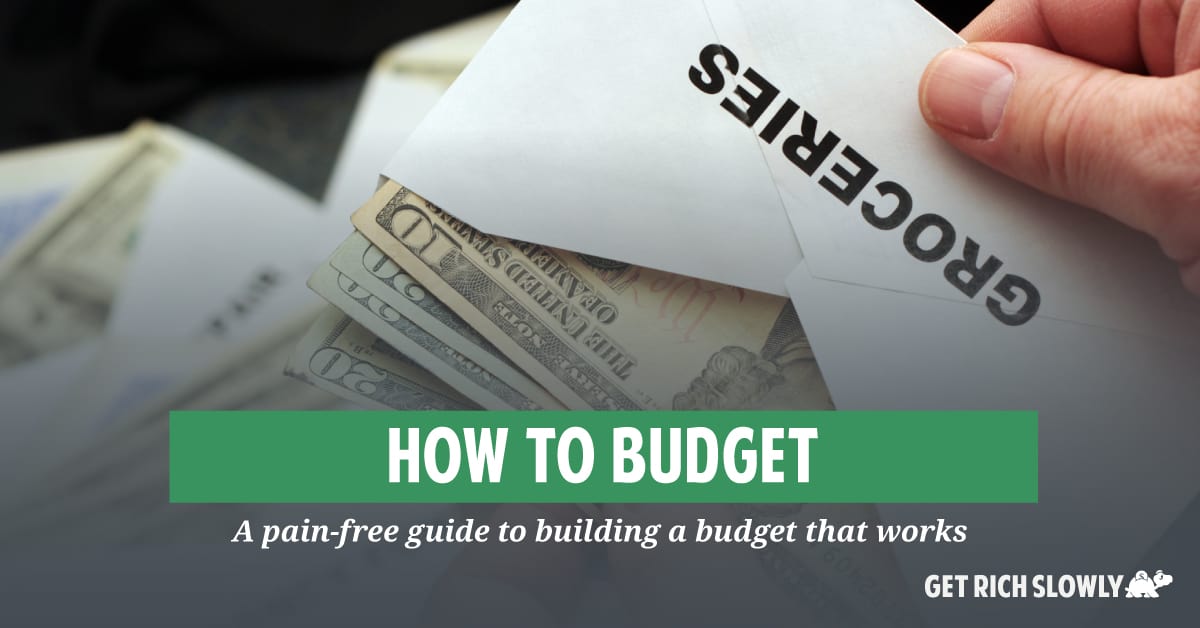
The basic idea is this: When you get paid, you divide cash into various envelopes designated for specific budget categories. Here’s how it works:
- Choose budget categories. Use one envelope for each category you plan to track. Write the category’s name on each envelope. Wally and Jodie, for instance, might have an envelope for their upcoming wedding, an envelope for travel, an envelope for groceries, and envelope for utilities, and so on.
- Set money aside. After your paycheck gets deposited, withdraw cash for each budgeted category. If Wally and Jodie have budgeted $200 for two weeks of groceries, they’d put $200 in their grocery envelope and note this amount on the back.
- Spend normally. Throughout the month, take cash from the appropriate envelopes as you make purchases. When you take money out of an envelope, note the amount on the back. Also note how much remains in the envelope. After you buy something, put the receipt and change back in the envelope.
- When an envelope is empty, you’re done. If you run out of money in an envelope, you have two options. Hardcore budgeters argue that if your “Dining Out” envelope is empty, you need to suck it up until your next paycheck. Once you’ve spent your restaurant budget, that’s it. Others say that it’s okay to take from one envelope to fund another. Which route is right for you is a personal call. But please, don’t resort to credit to compensate for an empty envelope.
- Decide what to do with surplus cash. At the end of the pay period, you’re likely to have money left in certain envelopes. You should have a system to handle this. Maybe you want to leave the surplus there, effectively giving you a larger budget in the next pay period. (If you have $87 left in your grocery envelope and add $200 more, then you have $287 for the next pay period!) A smarter move might be to take the surplus cash at the end of a pay period and put it toward a long-term goal. (Wally and Jodie could take extra grocery money, for example, and put it in their wedding envelope.)
- Do it again. Repeat this process each pay period. If you discover that you consistently have a deficit (or surplus) in certain categories, make adjustments.
Here’s a terrific step-by-step envelope budget tutorial from YouTube:
The beauty of envelope budgeting is that it’s system agnostic. It doesn’t care what kind of budget you use. You can use it for all of your budget categories or just a few. (I think most people would use it for variable expenses, not fixed expenses like mortgages and phone bills.) Plus, it’s physical. The money is real and you’re forced to actually handle it and experience the “pain of paying”.
I should note that some people want to use the envelope system but don’t want to hassle with actual envelopes. For these folks, a budget spreadsheet is a good way to simulate the system. (Or, you might try to replicate it with the You Need a Budget software.)
In 2013 here at Get Rich Slowly, Kristin Wong shared her adventures in returning to the envelope system.
How to Build a Better Budget
That’s a lot of information about budgeting, I know. It might be overwhelming. But before we wrap things up, I’d like to offer a few final tips. Let’s start with what I consider the four cardinal rules of budgeting.
- The first rule of budgeting: Don’t worry about perfection. A budget is a target. Your spending won’t be perfect the first month. Or the second. Or the third. If you can’t get your money into perfect balance, get as close as you can. Learn to make adjustments, and don’t give up.
- The second rule of budgeting: The big stuff makes more difference than the small stuff. Yes, you should clip coupons and shop at thrift stores. But you can save thousands of dollars at once by being smart when you buy a house or a car. Decrease your major expenses — like housing and transportation — and you’ll have a lot more room in your budget for the fun stuff.
- The third rule of budgeting: Make plans based on your real life, not how you wish life would be. Don’t budget for possible salary increases and ideal spending habits. If you spend money on coffee every day, make that part of your budget. If you haven’t received a raise at work, don’t count that in your income. Budget for reality, not wishful thinking.
- The fourth rule of budgeting: Keep it simple. If using your budget is a chore, you’ll never follow through. Include only as much detail as you need. Find a way to track your spending that works the way you do.
Lastly, if you struggle with keeping a budget, it may be because you’re trying to predict your spending in time chunks that are just too small. A 2008 study published in the Journal of Consumer Research found that people who made annual budgets were better able to predict their spending than those who made monthly budgets.
From the original press release:
[Researchers] found that, contrary to popular advice, people were more accurate when constructing an annual rather than a monthly budget, even when they were logging their expenses weekly.“Consumers’ default tendency is to underestimate their budgets, for both next month and next year frames,” write the authors. “However budgets for the next year are closer to recorded expenses because consumers feel less confident when estimating these budgets, and therefore, adjust them upward.”
One reason yearly budgets are more accurate is that consumers consider a greater number of expense categories when they construct them. If you construct your monthly budget in April, will you remember to include a category for Christmas gifts?
If you’ve followed my own spending adventures this year, you know I’ve encountered some of this. “Oops! I forgot I’d have a huge tax liability in April. Oh wow, I forgot that we booked a September 2019 vacation in April 2018. Now the balance is due.” And so on.
Yearly budgets aren’t very useful, however, for planning your day-to-day spending. The obvious solution is to take the best of both worlds:
- Since people generally do a better job of estimating yearly expenses rather than monthly expenses, create an annual budget.
- Once you’ve arrived at your annual budget, divide your estimated expenses in each category by twelve. This will give you a monthly number to work with.
The results of this study reiterate that over-confidence is an enormous drag on the average person’s finances. We believe we’re immune to advertising, that we can handle credit responsibly, that we can pick winning stocks. Yet study after study demonstrates that this just is not the case. In fact, those who lack confidence often make the best financial decisions.
This is also true with budgeting. In this study, subjects who were told that budgeting was difficult made more accurate estimates regarding their expenses than those who were told that budgeting was easy.
Budgeting Sets You Free
For many folks, “budget” is a four-letter word. Not for money bosses. A money boss views a budget as a useful tool with which she can help build the life she wants. At the same time, she knows that a budget isn’t fixed in stone. It’s always a work in progress.
When you use a budget, even one as simple as the Balanced Money Formula, you need to make constant adjustments. But once you get the most important expenses figured out (your Committed Expenses or Needs), you usually don’t have to worry about them much. Your housing payment doesn’t fluctuate from month to month, for instance. Your insurance premiums stay pretty constant. The same is true for your Savings. Once you get used to saving a certain amount, that becomes a habit.
Your goal, then, is to trim your Needs and boost your Savings until they’re both at respectable, sustainable levels. If you can keep these two broad categories where they should be, you can spend everything else on Wants.
Spending on fun stuff is less stressful when you know you can afford it. Budgeting isn’t a straitjacket. Budgeting sets you free.
Want more help building a budget? Try these tools:
- Here’s a free and simple Google Sheets budget planner from GRS reader Jeff M. (And here’s the article where he explains how to use it.) Jeff also shared a Microsoft Excel version of his budget planner.
- The new Get Rich Slowly file vault contains two free PDF downloads that might be useful: my handout on building a better budget and a Balanced Money Formula worksheet.
- Wallet Hacks has collated a collection of budgeting spreadsheets, some of which are specialized.
- The folks at You Need a Budget have a variety of awesome tools. There’s the software itself (my review), there’s the book (my review), and there’s the YouTube channel. If you want to learn how to budget, YNAB is a great resource.
Remember: If one budget doesn’t work, try another. Don’t just blindly use a budget from somebody else — even Dave Ramsey or Suze Orman. Use their ideas as a starting point, but tailor them so that your budget fits your life.
That’s what I did, and it worked.
Note: This is a substantial re-write of an article originally published 02 May 2011. In fact, I’d go so far as to call it a new article. I’ve moved forward many of the comments on the old article and, as usual, have placed a marker so you can tell where old comments end and new comments begin.

Become A Money Boss And Join 15,000 Others
Subscribe to the GRS Insider (FREE) and we’ll give you a copy of the Money Boss Manifesto (also FREE)
