Financial Balance Lets You Enjoy Tomorrow AND Today
Published on - December 7th, 2009 (Modified on - December 29th, 2009) (by J.D. Roth) This article is the 11th of a 14-part series that explores the core tenets of Get Rich Slowly. It originally appeared at Soul Shelter in a slightly different form.
For more than a decade, I was buried in debt. My relationship with money was poor. I earned a decent salary, but I couldn’t seem to get ahead. I lived paycheck-to-paycheck on $40,000 a year.
I’d frequently find myself standing in a store, holding a stack of CDs, say, or maybe several magazines. Inside, I’d be arguing with myself, almost as if there were an angel on one shoulder and a devil on the other. Most of the time, the devil won. I’d buy the stack of CDs or the magazines. And I’d use credit to do it. I was a compulsive spender.
Eventually, two friends helped me to realize the path I was on. I began to read personal finance books, I started Get Rich Slowly, and I converted to the “religion” of frugality. I learned to pinch pennies.
This new-found thrift was exactly what I needed. It helped me to get out of debt and to begin building wealth. I even opened my first savings account, and have now built a sizable emergency fund. Best of all, I’m maxing out my retirement savings every year.
Going to extremes
But something happened along the way. As I converted from spendthrift to, well, thrift, my relationship with money changed — but it didn’t improve. I went from a man who spent too much to a man who spent too little.
Again, it took outside intervention for me to realize I had a problem. Last year, I complained about the cost of movies. I complained about the cost of milk. I complained about the cost of hot chocolate. “You’re not being frugal,” GRS readers told me. “You’re being cheap.”
That was a wake-up call. I realized that I was still struggling to develop a healthy relationship with money. I hadn’t achieved balance.
And balance is what’s required. I believe that thrift is a virtue, and I don’t intend to abandon it. But thrift can also be a vice if taken to an extreme. It’s not wrong to spend money on yourself, if you can afford it. Money is a tool, and it should be used to bring us joy, when possible.
The balanced money formula
One tool that I’ve embraced for the past year is the balanced money formula introduced by Elizabeth Warren and Amelia Tyagi in their excellent book, All Your Worth: The Ultimate Lifetime Money Plan.
Here’s what it looks like:
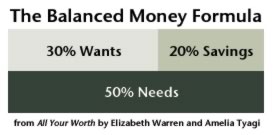
As you can see, when your financial life is in balance, you’re allocating enough for savings and needs, but you’re also setting some aside for the things you want. This idea is simple, but it was a revelation to me. No more spending too much on wants, but no more pinching pennies, either.
Since embracing the Balanced Money Formula just over a year ago, I’ve been much happier. It’s a sort of broad non-prescriptive budget the gives me the freedom to spend on my Wants — like comic books and a new bike — as long as I’m taking care of my Needs and setting something aside for Savings. I’ve learned that I can stay frugal in my day-to-day life, but it’s okay to splurge a little on the things I like — including good hot chocolate.
Finding balance
In order to find balance, you’ve got to do some soul-searching. I think of it as a three-step process:
- Find what makes you happy. Look inside yourself and ask, “What is it that brings meaning, pleasure, and joy to my life?” Be honest. How can you create a life that features more of the good stuff and less of the mundane?
- Focus on your goals. Set personal goals based on the things that make you happy. If you like music, maybe one of your goals could be to learn to play the guitar. If you want to change careers, maybe one goal would be to go back to school. Make meaningful goals a priority, and let the other stuff be secondary.
- Seek balance. Strive for moderation in all things. Pursue your goals, but don’t forget frugality. Be frugal, but don’t forget your goals. Work hard to build your financial fortress — but let yourself have a little fun, too.
The quest to achieve financial balance is about more than money. It’s also about meaning. Money is important, yes, but it’s not the only thing. Money is a means, not an end.
Each of us has parts of our lives that feel unbalanced. When we experience this lack of equilibrium, it’s important to do something about it, to make changes. From my experience, however, the most effective changes are small — they’re incremental. When we overcompensate for an imbalance, we sometimes just make ourselves miserable in a different way.
This is the 11th of a 14-part series that explores my financial philosophy. These are the core tenets of Get Rich Slowly. Other parts include:
- Tenet #1: Money is more about mind than it is about math
- Tenet #2: The road to wealth is paved with goals
- Tenet #3: To build wealth, you must spend less than you earn
- Tenet #4: Pay yourself first
- Tenet #5: Small amounts matter
- Tenet #6: Large amounts matter, too
- Tenet #7: Do what works for you
- Tenet #8: Slow and steady wins the race
- Tenet #9: The perfect is the enemy of the good
- Tenet #10: Failure is okay
- Tenet #11: Financial balance lets you enjoy tomorrow and today
- Tenet #12: Nobody cares more about your money than you do
- Tenet #13: Action beats inaction
- Tenet #14: It’s more important to be happy than to be rich
Look for a new installment in this series every Monday through the end of the year.
This article is about Basics
SEARCH FOR RECENT ARTICLES


Balance is the key.
I does seem, however, that most people think that in order to save today you must be miserable today. I think most people would sleep better today and tomorrow if they cut back.
By focusing on goals we have a sense of accomplishment today.
loading....
The only danger with the percentages in the formula above are that as income increases, you don’t want to inflate your lifestyle to justify 50% “needs.”
Personally, I put a lot more into savings. I think 20% is fairly low if you have the ability to do more. I wouldn’t say I’m out of balance (but my husband may disagree) — because the savings are something I “want” providing freedom and security.
I don’t want to nit pick the figures though — the critical point is balance — these are good guidelines but determining specific numbers that make you “balanced” should be something each individual or family comes up with.
loading....
I agree with you. Money is a tool to be used and not an end in itself. This is a great time of year to remember those who are truly struggling with real money problems.
If you’ve made some positive change in your financial life this year, why not take some time away from penny pinching and planning and enjoy time with family and friends? The dividends from that kind of time investment are priceless!
loading....
I love your story. I think it’s awesome that you were able to get out of debt as fast as you did and now you live the life you’re loving!
loading....
Those balanced money formulas always confuse me. I understand the point that you make that you should save and you should spend on wants, but really, my salary is not used 50% for “needs” and probably never will. When I was a broke entry level college grad, “needs” like rent took out a bigger chunk. Getting promotions, prepaying my mortgage and taking a mortgage for less than I could afford means that “needs” right now are a little less than 50% and will be much less when we pay off the house. So, if right now I use 35% of my salary on needs, what should I do with that extra 15%? And what if my “wants” are things I have to save for (like retiring early or taking a trip to Europe?).
loading....
Money is a means not and end. Wow. I need to reflect on that one some. You are so right. We need to have fun (within reason) as we travel this journey of life. We have to enjoy time with our family and friends. We can spend on fun and memories.
loading....
One of the “mantra’s” my husband and I use (picked up from an old roommate) is “X is a renewable resource.” This is typically used on <$15 items.
Such as “Chocolate is a renewable resource.” We can get some more next time we go to the store.
“Socks are a renewable resource.” I have a minor addiction to sockdreams.com.
It’s a reminder that we don’t have to be stingy about the small things we like. We shouldn’t buy them everyday, but finishing up the chocolate in the house isn’t the end of the world (or our budget), nor is snagging up a pair of socks.
loading....
I agree that things should be balanced, but I disagree that 20% is enough for savings. I think savings should at least equal wants. However I don’t think the formula or proportions are nearly as important as how you feel when interacting with your money. You should feel in control and confident about your money instead of vice versa.
loading....
The next question is how to allocate that 30%. we only have one income, so it is spread out – our first priority is our kids. Next is probably my husband. And even though I am actually the one working, my wants come way down the list.
loading....
I seem to remember a conversation about “Rules of Thumb” sometime ago. I think it applies here. The balanced money formula is a rule of thumb. It won’t apply to everyone exactly as it is but the general idea always holds its merit: Recognize your needs and differentiate them from your wants and always set some aside for later.
It doesn’t matter what you call each allocation or what percentage you allocate to each, the point is to have a as simple a system as you need to accomplish your goals. As PF’ers or at least PF blog readers you recognize the need to save more perhaps. So maybe you save 30% instead of 20%. That’s great! You’ve taken the model and adapted it to your own needs. Some may only be able to save 10%. So they may take the model and decide to find ways to either cut back or increase their income to meet a goal of saving 20%. Along the way they may learn new ways to save more or need less or they may learn more and decide that 20% isn’t a good goal for them.
The point is that the balanced money formula isn’t JD or anyone else saying that this is the only way. Like money, this formula is a tool. If it’s not the right tool for you, you are not bound to it. You can find another tool or invent your own. This tool is a good model to start with. It allows you to spend money on things you need, things you want, and save. Now take this and think for yourself how to adapt it to your needs.
loading....
I now feel better about my Starbucks addiction. I’m learning to be frugal in many areas of my spending habits and have gotten my daily Starbucks cost down to $2.62 a day (with a couple of days costing less when I drink their VIA). But I’ve been feeling awfully guilty about spending those 2 bucks a day. I guess I should let that guilt go and be okay with indulging in this one vice!
loading....
I think the Balanced Money Formula works for quite a lot of people- it’s working well for myself and my husband right now, actually. However, we don’t have kids yet (but are planning on having them soon) and it really disappointed me to see that the formula seems to be completely useless for a family making the median income (ie, no high earners) with young children who need to pay for childcare. Not sure whether I need to accept things will just be unbalanced for several years when we have a child, or whether there is a model out there that takes the cost of childcare into account.
loading....
If anyone is interested in learning more about the book, Terry Gross interviewed Elizabeth Warren several times on Fresh Air. The interviews are fabulous, and podcasts can be downloaded from the Fresh Air website or http://www.npr.org .
The formula is a starting point. If you are thinking about buying a house, you need to make sure your mortgage doesn’t tip you over the 50% needs budget. In future years as your income goes up but the mortgage stays constant, you might choose to either move up to a larger home, or put some extra to savings or satisfy those wants. But using the formula, you started from a point which was affordabel for you.
loading....
Are the suggested percentages before or after tax? that makes a big difference for me.
loading....
The suggested percentages are after taxes. They’re based on what you bring home in your paycheck…
loading....
You really want to stop being cheap? Start giving. Seriously. Stop thinking about it and get charitable. Put your money behind the change you want to see in the world, and do it in large enough amounts that you actually feel it. That money chart is terribly incomplete without giving.
loading....
I think allocation also depends on your personality. My husband and I are the tortoise and hare. I’d rather spend nothing for 6 months and then reward myself when I’ve achieved a milestone. He’s the save $100/week type.
So I guess the allocation thing is sound..but how and when you divy it up will vary from person to person.
loading....
I love it! Balance is so vital to long-term success. I know from personal experience that if I allow a new venture to get out of whack (AKA I obsess about it) I will burn out and fail in the long run. This has proven true in fitness, finances and even career pursuits.
Balance is a core tenet of success in all areas of life, and I focus a lot on this when I write about marriage. You need a balanced overall lifestyle in order to achieve excellence in your relationships and family life as well.
loading....
I found this rule of thumb to be meaningful to me in much the same way as you did. It helps me feel ok with buying things I want as long as my overall budget is in line. Although, I save at a rate higher than 20% and strive to squeeze more discretionary spending out of the 50% bucket.
loading....
It’s a nice guide, but for some of us it doesn’t work at all.
Single mom making $45,000, raising 3 small children who are growing like weeds. We have no debt. I’m saving 10% but the rest is needs. No cable, no entertainment budget, no monthly cell phone bill. Groceries are bare minimum ($300/mo). When all three are in public school, the cost of daycare ($600/mo) will decrease, but I will still have to pay for after school care.
What’s the answer? I don’t think there is one. I chose to have three kids when there were two incomes. Just because the other parent bails out, doesn’t mean I can just trade in the kids. But at least we can pay the bills and save.
loading....
Somewhat unrelated to the main topic: how do you figure 401k contributions if you’re counting after-tax? If I ignore them entirely and only count what we put into savings after-tax (and based on what my take-home after the contributions), we’re only saving about 26%. But if I figure everything on a pre-tax basis, we’re saving about 33%. Not being particularly adept at math, is there a quick and easy way to compare one to the other?
More related to the topic: I always find these formulas interesting. I suppose they work for some people, so that’s great, but the idea of spending 30% of my take-home on “wants” is just insane to me. I honestly can’t imagine that could come up with that amount of stuff or experiences or whatever that I genuinely want (and I don’t make that much money, so it’s not like I have an exorbitant amount to work with over here – we’re talking somewhere in the neighborhood of $600). Again, if it works for some people, that’s great.
loading....
How would you see the balance changing when you’re still paying off debt? It makes great sense for someone with no debt, but I’m not sure how it would change when you take that into account. Right now, I feel like it’s probably 50% needs, 10% savings, 30% debt, 10% wants.
I’ve struggled with how much to allocate to debt repayment as the amount I owe is HUGE (student loans mainly) and will take years to pay off. I feel guilty about spending money on meals out or clothing, but also have found that if I don’t let myself spend on some fun things I’m more likely to binge at some point and overspend.
I am still practicing – trying to find that balance – but I would love to hear how other people find it while still paying off debt.
loading....
I made the same mistake. And yes, balance is hard to achieve.
People need to realise that how much you earn changes things. I know, it seems obvious, but…
It’s okay to avoid spending money on hot chocolate when your income barely covers your needs.
When you earn enough, though, it’s good to make yourself happy from time to time.
On the other end of the spectrum… 50% in needs? What if your income doubles ? Say your boyfriend/girlfriend moves in with you, you have two incomes now but only one rent. The place you live in is perfect for you and you don’t want more.
You shouldn’t move in a bigger place just to make sure you do spend 50% on needs. Because needs are a category that doesn’t change much. Everyone has the same basic needs, and needs linked to personal cases (disabilities, sickness, etc) are not likely to fluctuate with your income.
So yes, sometimes your needs will end up being 90% of your income, sometimes they will be 10%. Because your needs don’t change much when your income does.
However, the second part, 30% wants, 20% savings, can be adapted better.
Forget about the needs. No percentage for that, I say. Pay the needs, and look at what’s left, if any (hopefully there IS something left, or you’re in deep trouble. But I digress).
Following these figures, out of what is left, 60% should go to wants – luxuries, vacation, stuff you buy for yourself or for other, you name it. And 40% to savings.
I would say, you can work around that. Think maybe about half-half, adapted to your case. So 60-40 for some, but maybe it will be 40-60 for others.
And don’t forget you’re ultimately saving for wants as well as needs (retirement). So if you’re planning on getting a car or going to a nice vacation soon, it’s okay to save more because it’s gowing towards a relatively close Wants.
Just make sure you never let the Wants category drop to 0.
What if you don’t want anything? Well, maybe you can use some of your money for things you do want but didn’t think about. Donating to a cause, inviting a friend along, things like that. You don’t have to spend the Wants to gather Stuff, especially if you end up forcing yourself.
loading....
I wish I could explain this to my wife. When she gets a paycheck, she believes it should be spent. She doesn’t believe in setting aside money. I am lucky in the fact that she does understand retirement savings, and she sets aside 10% of her salary for that. Outside of retirement savings, she doesn’t believe in saving. Any advice? She says, why save money, when you could die tomorrow and never enjoy it.
loading....
i agree to a point. it is nice to have balance, but before you can achieve balance, you have to get out of debt. it doesnt seem worthwhile to still spend on things you dont need when you have a mountain of debt you are working on.
not saying you shouldnt have some wants, but they should probably be closer to 0 than not until the credit cards are paid.
loading....
The balanced money formula has always bothered me, because it implies that my “needs” are dependent on my income, and not on me. I mean, sure, as my income grows, my needs change a little – I need more suits; maybe sometime in the future I’ll need a car or a maid or something. But income doesn’t affect my needs nearly as much as other forces in my life – family, for instance.
But really, my “needs” are just a reflection of my priorities and desires. I don’t need a big house or a fancy car or a private waitstaff – and millions of people live without these things. And ideally, my priorities don’t change with my income – the things I care about aren’t a product of how much money I make.
loading....
Different definitions of want/need are the crux of the confusion, I think. A friend of mine is helping out her son, who has a new post-college job, but can’t afford all of his “needs” on his paycheck. She is paying for his cell phone, and laughed when she said he needs a lot more options than she does. I’m not a parent, so I don’t completely understand this!
loading....
This is a good post. Sometimes we get too far while trying to save money. Balance can be achieved once we know what is truly important to us.
loading....
I have been flat broke a couple times in my life, so I know from that how it feels when you finally get over it. It makes you cheap, and a saver, so you can’t be poor again. Learning to balance is logical, but it’s a slow process.
loading....
I love the idea of the balanced formula. But my question revolves around that 20% (or whatever percent) saving. I always wonder what people include in their savings total. Does that just count emergency fund and general savings. Or do you count the money you put aside for certain things like a car, or a house furnishings fund or for down payment. Or do people count those in the want category? I’m always curious when people say they save XXX amount a month what it actually includes.
loading....
I have to agree with the folks that find this difficult to use. How do I count retirement savings if they come out pretax? Why would my needs increase with my income? If I’m saving for a vacation, is that considered savings or wants? What if what I “want” is financial security and freedom? Why is it so wrong to give up hot chocolate and CDs in exchange for early retirement and my kids college?
What I would rather see is hard numbers. “Your needs should be about $1200-$2000 a month.” Or, something like that. Yeah, they can vary a lot but there is some sort of minimum, right? Most people probably can’t eat for less than $40 a month, but $300 a person would be a lot, even eating organically. It would be more helpful to me to see, specifically, what others are spending on needs, wants, and savings.
loading....
Hey J.D.,
Achieving balance lets you take care of the essentials while still enjoying life.
There’s being frugal, and then there’s being cheap. Cheap is going to an extreme and spending as little as possible, period. Frugality, however, lets you achieve that perfect balance.
You cut out the non-essentials and spend only on what’s important to you. You save and invest money while having the newly-freed spending cash (that you would’ve spent on the unnecessary) to put into what you really enjoy.
Like you said, financial balance via frugality lets you enjoy tomorrow through saving and investing PLUS today by spending on what makes you happy.
Here’s to enjoyment-maximizing balance in finance and life,
Oleg
loading....
1) Warren considers debt repayment to be savings – as you pay it off, you’re increasing your net worth. Once the “life stealing” debt is repaid, you re-allocate those funds to liquid savings.
2) She considers the Must Have category (J.D.’s Needs) to include contractual items, such as student loans or car loans. I disagree – I allocate a car loan into Wants.
3) For those wondering about how to figure out retirement contributions, it’s straightforward. Gross income MINUS taxes = Net Income. Your retirement savings as a proportion of that figure is calculated as part of the savings item. If you make $5K gross per month, pay $1K in taxes, and put $500 in your 401(k), your savings rate is 12.5% (500/4000).
4) I also agree that 20% of net income towards savings is insufficient. And my personal balanced money formula is calculated from gross, since it’s easier to calculate for me. For me:
* 50% Needs (taxes, mortgage, utilities, food)
* 25% Retirement & Savings (19% gross to retirement, 6% gross to savings)
* 25% Wants (Car loan, spending money, eating out, gifts)
Works for me, and simplifies things quite nicely.
Sandi
loading....
Also, it’s a sad sign of American consumer-oriented culture that being “cheap” is often defined as not buying lots of “stuff.” You can avoid buying unnecessary crap, too much stuff, and excessive wants without being “cheap.” My grandmother never bought “stuff” and insisted on Payless $2 shoes until the day she died. She wasn’t cheap. She just understood what her actual needs (versus wants) were and what would make her happy. She came from a time and place where she was able to avoid internalizing that she needed to buy stuff to be happy. Instead, she used her money to have a paid off house, to help her grandchildren pay for school, to give to children in her neighborhood who needed help, to give to animals, and to pay for her healthcare and care expenses as she neared the end of her life. She recognized what really made her happy, she spent money on that, and at least for her, happiness didn’t come from the mall.
This chart also perpetuates American’s twisted views of finance by insinuating that one’s “needs” increase the more we make. Once you are earning above a certain amount of money, it would be impossible to spend half on “needs.” We need to start distinguishing between needs and wants. My basic needs regarding housing, food, etc, don’t change because my income doubled. And if I’m able to be content with what I have, why go spend more just because I have it rather than saving more, being more charitable, helping my family, or something else?
loading....
Wow. A lot of questions about the balanced money formula today. I didn’t expect that sine we’ve covered it a couple of times in the past. Plus there’s a link to an older article in the post. Still, it might be helpful to go over the basics.
First, it’s important to realize that this is a guideline. It’s a goal. Some people won’t be able to achieve balance for quite a while. And if this doesn’t fit your lifestyle, find a different budgeting framework. For me, it works well.
That said, here are some bullet points:
* The balanced money formula uses after-tax income.
* The percentages aren’t hard and fast guidelines. More properly stated, they’re “no more than 50% on Needs” (this is actually the whole key to Elizabeth Warren’s philosopy — keep your spending on Needs below half your take-homoe pay); “up to 30% on Wants” (you don’t have to spend this much, but if keep your Wants spending too low, you’ll be unhappy); at least 20% to Savings, which includes debt reduction, emergency savings, and retirement savings.
* Saving for a car or a vacation, etc. goes in the Wants category. This isn’t true Savings. It’s just deferred spending. (Does that make sense?)
* Because this is more properly viewed as “no more than 50% on Needs”, your Needs don’t have to increase with your spending. In fact, it’s best if they don’t.
* It doesn’t matter if your retirement savings comes out pretax. The basis for the formula is your after-tax income. That’s how you set the numbers. If you have pre-tax retirement savings, ignore the “pre-tax” bit when you score it.
Again, the key here is balance, letting yourself enjoy life today while also saving for the future. The Balanced Money Formula does a great job of providing a framework you can use to achieve that balance. It may not be perfect for your situation. If that’s the case, adapt it to fit your lifestyle. But do try to achieve balance.
loading....
I’m going to state this more emphatically in a separate comment, and then I’m going to edit the post to reflect this again:
The Balanced Money Formula does not say that your spending should increase with your income.
It says that you should spend no more than 50% of your income on Needs. It’s my fault for not making this clear in the post. Sometimes I forget that not everyone is immersed in this stuff like I am.
loading....
I’ve gotta’ agree with KF (#16), if you are in a position to apply this balanced money formula, you need to think of others and give. Think local and global when you do. I’d encourage you to find causes that resonate with you and impact people who are in need. Research the cause and make sure there isn’t too much going to overhead (I’d say 20% to overhead is the limit, and I’d look for an even smaller percentage).
What percentage of your money should you give? It’s up to you, but think about at least 5%, or even 10% (!).
And here’s a few quick stats to get you thinking globally this holiday season:
One of the leading causes of death in developing countries is diarrhea due to contaminated drinking water.
The estimated cost to provide clean drinking water to everyone who needs it in those countries ranges from $10 billion to $100 billion.
The National Retail Federation expects holiday spending this year to be about $440 Billion: http://www.nrf.com/modules.php?name=News&op=viewlive&sp_id=806
If everyone spent a little less this year, and sent that money to a charity who funnels the money in an appropriate way, we’d do a great deal of good in this world…
Here are a few websites to help jumpstart your research:
* http://www.water.cc/about-lwi/financials/ (5% admin costs)
* http://www.charitywater.org/ (100% of public donations directly fund water projects)
* http://www.bloodwatermission.com/about-us/more-info.php (no more than 20% to administration)
These are three sites that I found in a quick search that met my “no more then 20% admin costs” criteria. I am not affiliated with any of them, nor have I given to any of them, rather they are just a jumping off point for anyone who wants to do more research.
I do give both locally and globally, and also volunteer/serve in my community and around the world (will be going back to Africa in January). I only say this to let you know I have put my money where my mouth is, and that it is extremely gratifying – more so than material things, which is why I think you should seriously consider adding giving to the equation…
loading....
I read this book a few years ago, and really enjoyed it. It’s a simple, but powerful concept, presented in an easy to read book. Recall that Warren’s background is in bankruptcy, so she derived this formula to help keep people from going under during bad times.
The 50% on needs is intended as an upper bound. She’s not saying that if you start earning more you should buy a bigger house, she’s saying that if your basic needs (housing, food, loan payments, etc) are more than 50% you do not have enough wiggle room to get you through a job loss or disability. If your basic needs are more than 50%, you should think seriously about some major changes – moving to a cheaper house, trading in your expensive car for a cheaper used car, etc.
In the book she mentions that it’s great to save more than 20%, especially if your needs are less than 50%. As I recall, the wants category (ie music lesson for kids, birthday presents, steak, eating out) is set at 30% because that’s a reasonable amount to ensure that life is enjoyable,and because, if you needed to, the ability to cut 30% of your spending can help you get through a crunch.
She also talks about how to factor in 401k and other tax deductible savings vehicles. This is how I remember it: Say I earn 100k, but pay 30% in taxes and put 10% (10k) in my 401k. So my take home pay is 70k. My savings include the 10k I put in my 401k, so I’m at a 14% savings rate based on my take home income. She would encourage me to save another 4k to save a total of 14k (20% of 70k).
Charitable donations is another tricky thing to factor in. I don’t remember if she talks about it in the book, but I take my charitable donations off the top, and apply this formula to my take home pay after taxes and charity.
On a personal note, this book eased my anxiety and tendency to be overly frugal (aka J.D.). It helped me realize that I was was taking good care of my future self, and that I could go ahead and enjoy buying something I wanted, etc. I’m at about 40% needs, 30% wants, 30% savings.
loading....
One last point: With the Balanced Money Formula, remember that I’ve used a paragraph or two to describe something Warren and Tyagi spend a book on. If you have questions, please head to your local library. All Your Worth is a good read.
loading....
Wow who subscribes to the “30% WANTS” percentage?
That’s HUGE and pretty wasteful in my opinion. If you make $100,000/yr, it is silly to spend $30,000/yr on wants. That is a sure fire way to financial disaster.
The WANTS category should be no more than 10%, and the savings category should therefore be bumped up to 30-40%.
Stand strong people and don’t be silly with your money!
Best,
Sam-urai
loading....
Warren’s balanced money formula is based upon her research in personal bankruptcies, and is not an arbitrary formula.
Her first book “The two income trap” is very much worth reading, and as a response on how to make this “actionable” she wrote the book “All your worth” with it’s Balanced Money Formula.
Below is a couple of articles by EW:
http://harvardmagazine.com/2006/01/the-middle-class-on-the.html
http://privatizationofrisk.ssrc.org/Warren/
loading....
I think this chart is well and good if you’re healthy and plan on working until you’re 65+. For me, even though I’m only 31, I don’t think I would make it that long in the work force. Being on disability for almost nine months right now is proving that. If you’re life is “typical” and you see yourself working for a long time and you’re not up to your neck in medical bills, this may be a good way to start.
My point is, you may have to adapt to your life.
loading....
It’s Monday so maybe I’m just easily confused but I’m still not quite getting where my 401K falls into this.
So maybe someone could walk me through a real world example:
My gross pay check was 1500 dollars. I contribute 15% to my 401K which comes out to about $225. That plus my Flex Plan contributions are taken out prior to taxes. Which leaves me with about 1235 of taxable wages. After taking out taxes my net pay is ~$1000.
So now, out of that $1000 I should be spending no more than 50% on needs, up to 30% on wants and 20% savings?
Or does my 401K count towards that?
loading....
Hey J.D., it is kind of surprising what questions have popped up. This is not “new” information even here! Well, maybe it has drawn more people into the PF discussion.
@Kate, you asked about what if you’re still paying off debt. There was an answer hidden in a subsequent comment: debt repayment = savings. Reducing liabilities = increasing assets. You are better off having only $1000 in the bank for real emergencies, and zero debt, than having $11,000 in the bank and $10,000 in debt.
I’m still paying off debt. What DH and I agreed was that most “needs” (rent – our biggest expense by far, utilities, and business cell service) would be paid for out of his earnings. He covers special events and his cc minimums out of the rest, plus his self-employment taxes. My wages cover insurance and groceries (also “needs”), then I’m in charge of debt repayment with the rest of my earnings. I am also in charge of the emergency fund, long-term savings, and pretax items like 401(k), HSA, and health premiums. We agreed to think of it as, he’s covering our financial present; I’m covering our financial future.
Note, I think debt repayment itself needs to be in two categories when you make your budget or spending plan. Minimum payments are a Need. Extra payments would be Savings.
That said, if you have super-low interest debt that is not based on consumption spending (i.e. student-loan debt), I would keep that in the single category of Needs and put more emphasis on saving rather than obsess about paying off the loan early. Much better to have a whacking big savings account (or CD ladder) when the unexpected happens or when you want to buy a house. Though personally, I have no intention of buying a house until we are otherwise debt-free.
Also … as others have written, it’s important for people to be real about what constitutes Needs. Shelter, food, and clothing are Needs. Meeting your minimum financial obligations: needs. Pretty much everything else is discretionary.
loading....
I guess I need to read the book because I am still confused about wants and needs. Are new kitchen mats wants or needs? What about new clothes (yes need something to wear, but could get it at a thrift shop for less ex: underwear =needs, second jacket= want?). Food? What part of my grocery bill is needs, and what part is wants (I would have to divide my grocery bill by essential and non-essentials). Ever since I’m not at poverty level this is a problem. Also health insurance and other items taken out of paycheck – should I include those in needs (need to pay them!) or disregard because using post-tax(deduction) income?
loading....
Definitely think it’s good to have a rough idea of how to do it, but to each his own. One person’s balance probably would not carry over very well to another’s life.
That said, I still don’t understand why I get nailed for my car spending. Can I afford it? Yes. Does it make me happy? Yes. Okay, so what’s the problem again? I think there’s a bit of age discrimination going on there. (About how I can spend money on wants like cars at 21 and still make it through.)
I mean, my financial life isn’t all roses and kittens, but I’m managing fairly well, I think. The bills now get paid, the future bills will be managed somehow and we don’t live like paupers but we aren’t extravagant either.
Everyone sees what we spend our money on, so they like to assume we have a lot left over… When the money was actually the priority. Nobody sees the sacrifices that go into the cars. They don’t bother to find out that we quit eating out almost entirely for a month or two to be able to do it or what not.
loading....
Read the book. Didn’t really care for it. Find the part that deals with the balanced money formula and skip the rest. We coupled this idea with automating our finances and a method I call “batching bills.” Managing our finances has never been easier.
loading....
Some categories of expenses straddles Wants and Must-Have, like groceries, so one must make one’s own judgment.
Note that a recurring expense that you cannot quickly get rid of, like many subscriptions, is a Must-Have, since you have to pay them even when faced with economic hard-ship (like unemployment). Reducing recurring expenses is important as it increases your flexibility.
Here is a review that gives some more details about the balanced money formula:
http://www.mdmproofing.com/iym/BMF.shtml
loading....
I really appreciated your sharing about how you went from one extreme to the other J.D. I think a lot of us do that – we begin to think that we aren’t “worth” things. I know I’ve lived in situations where my cheapness (in excess of frugality) has been excessive. My experience tends to be one day I realize “I would think my friends were abusing themselves if they allowed themselves to live like this. Why am I punishing myself?” In any case,I like this 50/30/20 idea. This is the first time I’ve heard of it.
loading....
Being younger and with less income it is difficult to find that balance. Also living in a more expensive city it hurts. I know sure I could move to a city that is less expensive, but that’s not me and not what I want. So difficult to balance having fun now and having experiences and saving for tomorrow.
loading....